Joined November 2010
92 Photos and videos
Pinned Tweet
Quakery vs Science Quakery will continue to thrive until large part of population understands nature & power of scientific conclusions; that these conclusions are necessarily grounded in probability & statistics, yet ACCURATE & self correcting. Quakery can't be generalized.
1
1
4
Now what could be an evolutionary biology explanation for that? @NGKabra ?
It is not for nothing that‌ we say the nose knows. More precisely the nose knows rain drops, not just falling on the window but also far away in the bambooo groves in my beloved village in Bengal. There is even a name of that smell in my language. In Bangla we say "সোঁদা গন্ধ".
23
It is not for nothing that‌ we say the nose knows. More precisely the nose knows rain drops, not just falling on the window but also far away in the bambooo groves in my beloved village in Bengal. There is even a name of that smell in my language. In Bangla we say "সোঁদা গন্ধ".
Sharks are supposed to have the best nose in the ocean, able to smell a drop of blood from miles away. Your nose beats them, and the thing it beats them at is the smell of rain. You catch it at a level two hundred thousand times finer than a shark catches blood. That smell after rain has a name, petrichor, and most of it is one molecule called geosmin, pumped out by bacteria living in the dirt. Your nose is freakishly good at catching it. We're talking a teaspoon of the stuff stirred into two hundred Olympic swimming pools, and you would still notice. The two hundred thousand is just division. Your nose grabs the rain molecule at a tiny concentration, a shark grabs blood at a much bigger one, and one of those numbers is two hundred thousand times the other. The math is right. Each nose is doing a different job, though. You're smelling one clean, specific molecule. The shark is hunting for a messy cocktail, the juices that leak out of a wounded fish. Putting your single perfect molecule up against the shark's blurry stew was never a fair race. And blood is the shark on an off day. The smells it was actually built to chase, fish oil and torn flesh, it picks up at concentrations up to ten thousand times fainter than blood. Line your rain-smelling up against that, the shark doing what it does best, and your lead drops from two hundred thousand times to about twenty. You still win, but only just, and only on this one smell. It doesn't mean you out-smell a shark in general. To a shark, your blood and sweat are dull background noise, which is why that old line about periods drawing sharks has been knocked down by scientists for years. The drop-of-blood-from-a-mile-off image is a tall tale too. In open water a shark gets maybe a few hundred yards before the scent thins out and the trail goes cold. The reason a human ended up this tuned to the smell of wet dirt comes down to water. For our ancestors, the smell of rain meant a drink instead of dying of thirst. In 2024 a lab in Germany pinned down the exact smell-catcher we use for geosmin, then found the very same one in camels, polar bears, mice and monkeys, barely changed across a hundred million years of evolution. Camels in the Gobi are thought to sniff their way to water from fifty miles off using it. The sharpest version of that rain-detector on Earth belongs to a little desert rodent, the kangaroo rat. Its nose runs about a hundred times finer than yours.
49
Can relate to this. I take music lessons, hindusthani classical no less, late in life. Recently left a teacher due to his habit to give nothing but negative feedback. My own teaching evolved in the last 20 yrs. I now focus on coaxing view points & thoughts out of learners.
🧠 Research shows constant criticism rewires a child’s brain. And the emotional stress shapes lifelong mental health. Children raised in environments filled with constant criticism often develop a stress-response system that remains on high alert, even in the absence of actual threats. This chronic activation of the fight-or-flight state interferes with a child’s ability to feel safe, calm, or emotionally grounded. According to research from the Center on the Developing Child at Harvard University, persistent emotional stress in early life can alter brain architecture, leading to long-term issues with emotional regulation, anxiety, and attention. When everyday interactions are perceived as threatening, children may respond with hypervigilance, withdrawal, or emotional shutdown—defense mechanisms rooted in survival. As these children grow, the expectation of judgment or harm becomes deeply ingrained in their nervous system, affecting their self-esteem and relationships. They may struggle to trust others or feel secure in social settings, constantly anticipating criticism or rejection. This state of chronic stress is known as "toxic stress," and it’s been linked to a range of lifelong impacts—from depression and learning difficulties to physical health problems. The findings underscore how emotionally unsafe environments can have a lasting effect on a child’s development, both psychologically and biologically. Source: The Center on the Developing Child at Harvard University. InBrief: The Impact of Early Adversity on Children's Development.
21
So you are ok if you talk aloud to yourself. I am safe as well.
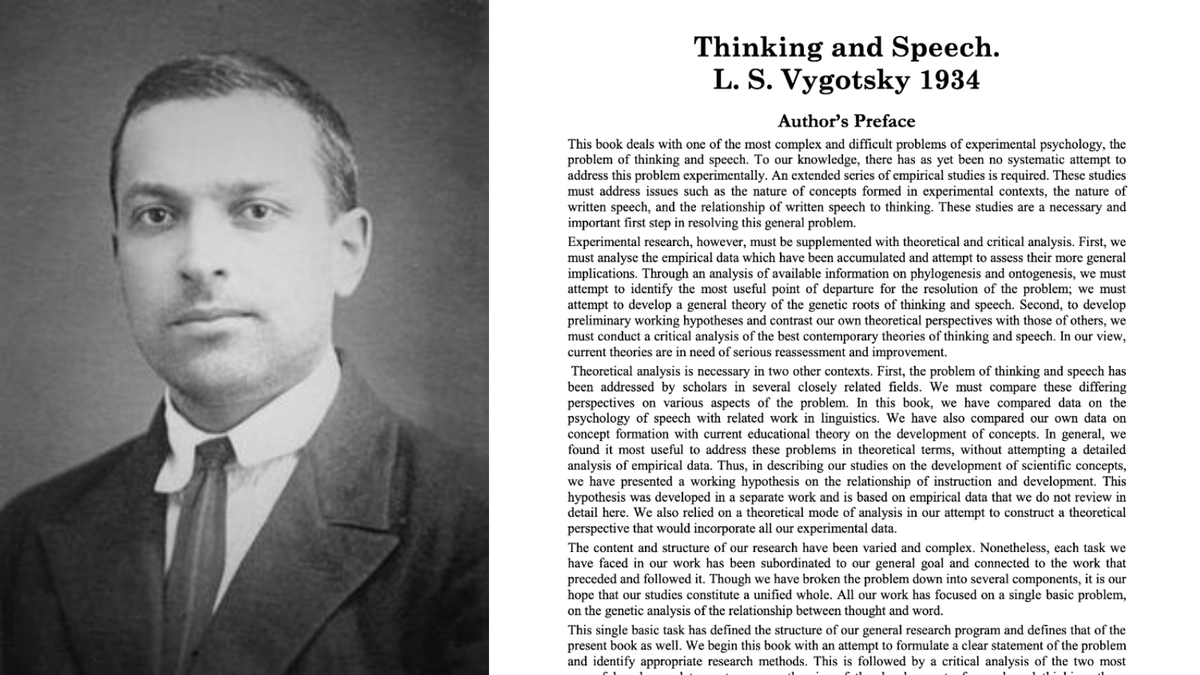
A Russian psychologist spent 10 years proving that the act of talking to yourself out loud is one of the most powerful cognitive tools the human brain has, and almost nobody outside his field has read the work. His name was Lev Vygotsky. He worked in Moscow in the 1920s and died of tuberculosis in 1934 at the age of 37. He had no laboratory, no funding, almost no English readers, and a body of work that the Soviet government suppressed for two decades after he died. He produced the foundational theory of how human cognition actually develops, and the central piece of that theory was a behavior almost every adult is faintly embarrassed about. Vygotsky noticed that young children talk to themselves constantly. They narrate their own actions, they argue with imaginary opponents, they instruct themselves through tasks out loud. The dominant theory at the time, from the Swiss psychologist Jean Piaget, said this was a sign of cognitive immaturity that children would eventually grow out of as they learned to think properly. Vygotsky said the exact opposite. He argued that this self-directed speech was the most important cognitive event in the entire developmental window, because it was the moment a child first started to use language as a tool to control their own mind. The child was not failing to think. The child was learning how to think by externalizing the process and listening to themselves do it. He predicted that as children matured, this out-loud self-talk would not disappear. It would go underground. It would become silent inner speech, which is the running monologue every adult has inside their own head for the rest of their life. The voice you hear when you read this sentence is the direct descendant of a four-year-old narrating their own block tower. For 50 years almost nobody outside Russia had access to his work, and the few researchers who did pick it up could not get funding to test it. Then in the early 2000s the experiments finally started to pile up, and what they found was that Vygotsky had been right about something even more important than he knew. The first major study came from Gary Lupyan at the University of Wisconsin and Daniel Swingley at the University of Pennsylvania in 2012. They ran a simple visual search experiment. Participants were shown 20 images at once and asked to find a specific object, like a banana or a chair. In one condition they searched silently. In the other condition they were told to say the name of the object out loud to themselves while looking for it. The participants who spoke the target name out loud found the object significantly faster, with higher accuracy, than the participants who searched in silence. The effect was strongest when the spoken word matched a familiar object the brain already had a strong category for. Saying the word out loud literally tuned the visual system to detect that thing better. The researchers called it the label feedback effect, and the implication was that the act of vocalizing a goal physically changes how the brain processes the world while pursuing it. The second major study came out of the University of Michigan and Michigan State in 2017. The lead researchers were Ethan Kross and Jason Moser, and they used both EEG and fMRI to record what happens inside the brain when people talk to themselves while emotionally upset. They asked participants to recall painful autobiographical memories and reflect on them in two different ways. Some used the first person, saying things like "why am I feeling this way." Others used the third person, referring to themselves by their own name, saying things like "why is John feeling this way." The brain scans showed that the simple act of switching from first person to third person, even silently, decreased activity in the medial prefrontal cortex, the region responsible for rumination and self-referential pain. Within a single second of using their own name instead of the word I, participants showed measurably lower emotional reactivity. The shift required no extra cognitive effort. It cost the brain nothing. And it worked. Kross described the mechanism in his interviews. Talking to yourself by name creates a small amount of psychological distance from your own experience. Your brain processes the situation more like a problem belonging to someone else, which means it can analyze it instead of drowning in it. What Vygotsky had intuited in 1934 turned out to be even more powerful than the developmental theory he built it into. The voice you use to talk to yourself is not background noise. It is one of the most precise cognitive tools the brain has, and you can change how it works just by changing the pronoun you use. People who talk through problems out loud are not anxious or unstable. They are running an externalized version of a process the rest of us are running silently and worse. The kindergartener narrating their block tower, the surgeon muttering through a procedure, the engineer pacing a hallway describing a bug to nobody, the athlete repeating a cue to themselves before a free throw, they are all using the same ancient mechanism that builds and steers human thought. You can run the experiment yourself the next time you are stuck on something hard. Stop trying to solve it silently in your head. Say it out loud. Describe what you are seeing. Walk yourself through the steps as if you were explaining it to a colleague who is not in the room. And when something genuinely upsets you, switch to your own name. Ask why this person is feeling this way, instead of why I am feeling this way. The voice you have been told to keep quiet your entire life is one of the oldest pieces of cognitive technology you own. Most people are still embarrassed to use it.

1
2
103
Cautionary Note: Not every one who feels like Dirac did, will become a Dirac. But ofcourse that is the risk to take and to strive.
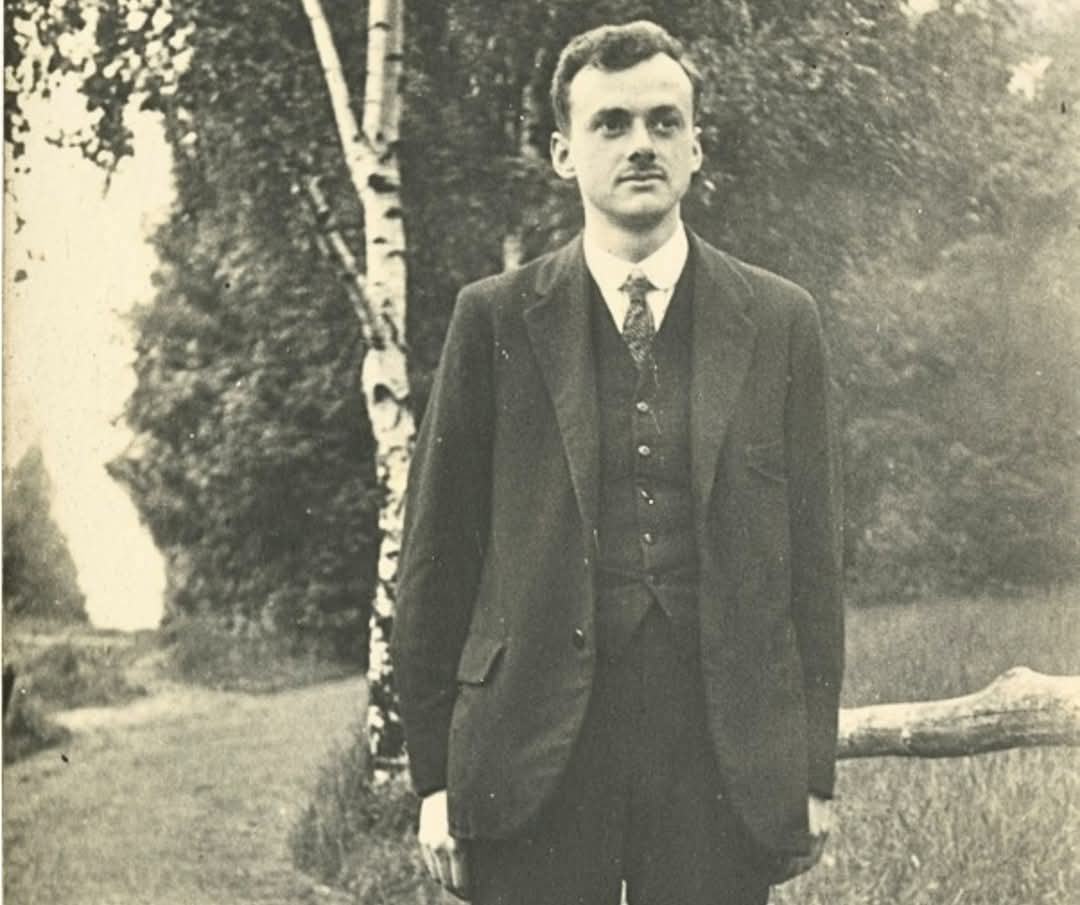
"In the winter of 1926... I was so desperate that I was ready to give up physics altogether. I felt that I was a completely untalented person who had chosen the wrong profession." - Paul Dirac, reflecting on his early struggles with quantum mechanics
1
75
The background and context of this lecture are fascinating and deserve a fuller exposition, parhaps a complete article. Putting it on my list of articles to work on and complete.
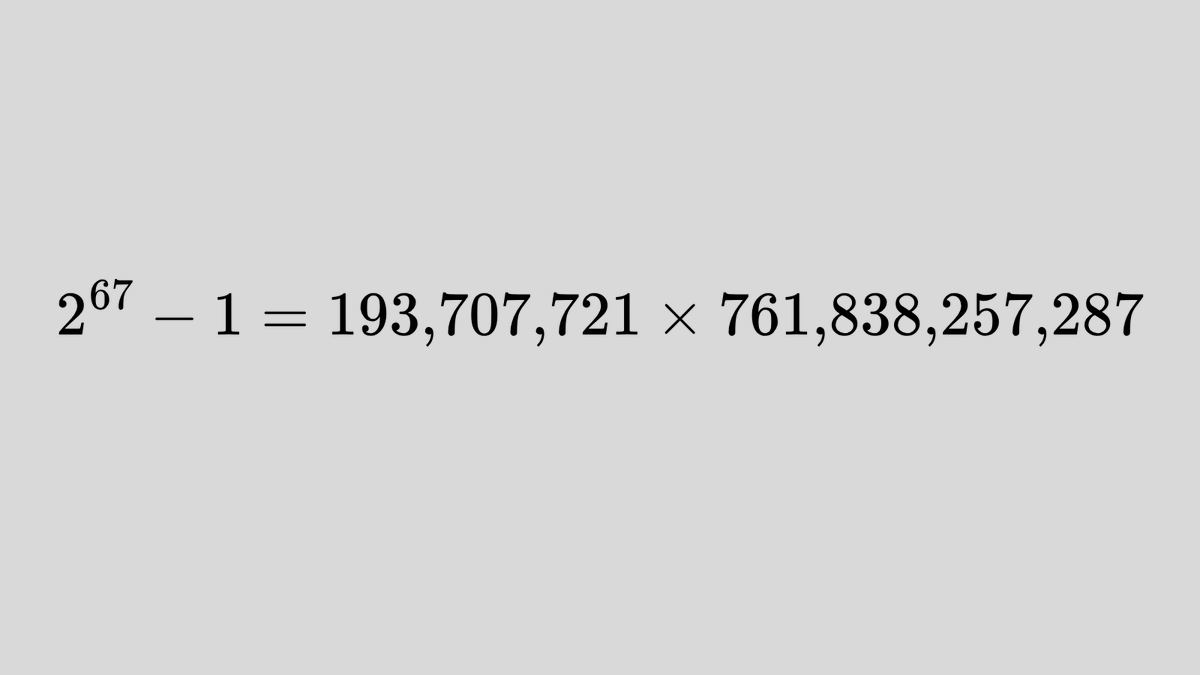
In 1903, Frank Nelson Cole, a professor of mathematics at Columbia University in New York, gave a rather curious talk at a meeting of the American Mathematical Society. Without saying a word, he wrote one of Mersenne’s numbers on one blackboard, and on another blackboard he wrote two smaller numbers and multiplied them together. Between them, he placed an equals sign—and then sat down. The audience rose to its feet and applauded, a rare outburst for a room full of mathematicians.
2
64
Do you have a theorem you fell in love with? Mine is: Urysohn's lemma. In his text book Munkres calls this one the first deep theorem of the book; up until then a bright student may anticipate and prove all the results but NOT Urysohn's Lemma. It has the touch of a genius.
1
2
53
The Urysohn Lemma shows that any two disjoint closed sets in a normal space can be separated by a continuous function. This leads to the Urysohn's metrization theorem Every second countable T3 topological space is metrizable.
1
28
But to me, Urysohn's lemma's most magical consequence is that it leads to partition of unity,a fundamental tool that allows "glueing " local properties into a global whole.
23
Walter Rudin : Principles of Mathematical Analysis Minutes: Topology. Most hated text book: Milkman and Halikas: Integrated Electronics
What’s the most wonderful textbook you’ve ever read?
2
3
1,139
I know that mathematics gives everyone headache, even those who love math. In this specific case however I am directly responsible because I was the instructor of the course that caused " His head hurt", as @GenWise_ would probably remember. Quite happy for him.
Q: "Would you do it again?" A; "In a thousand lifetimes, always yes." That's Agastya Iyer — attended GenWise GSP in Grade 9 at Shiv Nadar School, Faridabad. Now studying Mathematics at IISER, Mohali. Six hours a day of hardcore mathematics. His head hurt. But it was also the most fun he'd ever had. He came back with a notebook full of phone numbers. His GenWise alumni network spans the globe. And something he hadn't felt before — zero fear of being judged. "GenWise was when I first actually met my tribe." Some summers are just summers. This one changes everything. Gift your child this summer. @vishnu_agni @sjpatil @rpanchanathan @ashishponders #GenWise #GSP #GiftedEducation #GiftedSummerProgram
1
41
It is also a pleasant surprise to me because it was my lectures over those three weeks, 15 days and six hours each day, the made this happen, namely, "His head hurt."
It's always a pleasant surprise as to how much transformation the summer program brings about... Next one in Bangalore, June 14-28
2
27
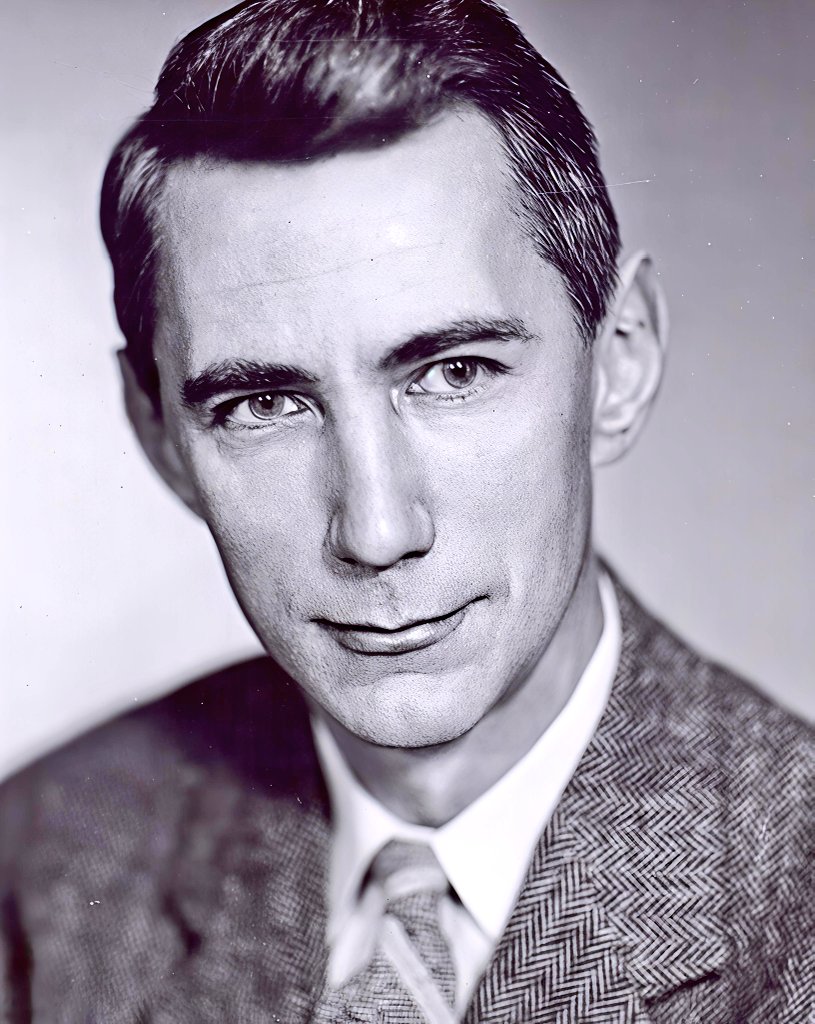
There are a few people about whom you can never read too much. Claude Shannon is most certainly one of them.
On August 10, 1937, a quiet 21-year-old named Claude Shannon submitted an 85-page thesis at MIT. No headlines. No applause. Just another paper that seemed destined to be forgotten. But inside those pages was a revolutionary idea: machines could think using simple logic, 1s and 0s, ON and OFF. By linking Boolean algebra with electrical circuits, Shannon transformed switches into decision-makers. That single insight became the foundation of the digital world. Every computer, smartphone, and algorithm traces back to it. History did not roar that day. It whispered. And from that whisper, the modern world was born, one bit at a time.
1
21
Computational Geometry Made Easy (hopefully)
(via Arindam Khan - CS Prof at @iiscbangalore on LinkedIn) - 𝗟𝗲𝗮𝗿𝗻𝗶𝗻𝗴 𝗖𝗼𝗺𝗽𝘂𝘁𝗮𝘁𝗶𝗼𝗻𝗮𝗹 𝗚𝗲𝗼𝗺𝗲𝘁𝗿𝘆 𝗳𝗿𝗼𝗺 𝗮 𝗠𝗮𝘀𝘁𝗲𝗿! Prof. Mark de Berg (TU Eindhoven) is spending his sabbatical at IISc and this week he is delivering a minicourse on topics in computational geometry and randomized algorithms. The best part? It is designed to be accessible, even if you do not have a prior background in computational geometry. If you have ever encountered computational geometry as a student, chances are you have come across his textbook. I still remember learning from it during my undergraduate days at IIT Kharagpur almost two decades ago. Beyond his influential research, Prof. de Berg is known as an exceptional teacher. Thus, it's an opportunity to see how a field is explained by someone who helped build it, and to experience the clarity that has inspired generations of students. If you enjoy algorithms, geometry, or simply good teaching, this is something you should not miss. The lectures are recorded and streamed online. The first lecture started with Backward Analysis of Quicksort and gave a meta-algorithm for randomized incremental construction, which gives algorithms for many problems, including quicksort, intersection, point location, and convex hull. YouTube link: youtu.be/2elM4h2zid4?si=E0Tk… Next lecture is tomorrow at 2 pm IST.
22
I notice with amusement that "Top Physicist from India" is not enoughl, but it has to be preceded with "IIT-JEE Rank 1". We Are Like That Only.
Meet Raghu Mahajan! (IIT-JEE Rank 1 & Top Physicist from India) Working on some of the deepest questions in string theory, quantum gravity, and black holes. > He grew up in Chandigarh, India > Secured All India Rank 1 in IIT-JEE 2006 > Joined Computer Science at IIT Delhi > After two years, he transferred to MIT > Completed his Bachelor’s in Physics and Mathematics from MIT > Pursued his Master’s at the University of Cambridge > And completed his PhD and postdoc at Stanford University in theoretical physics and mathematics After spending 16 years abroad, he returned to India in 2024 and today, he is a faculty member at ICTS-TIFR, Bengaluru. At ICTS, his work sits at the intersection of advanced mathematics, quantum theory, string theory, quantum gravity, and the deepest questions about the universe. His journey is also special because he chose to come back and contribute to building world-class research from India. From Chandigarh to IIT Delhi, from MIT and Stanford to ICTS Bengaluru, Raghu Mahajan’s journey is a powerful reminder that India can become a global home for deep scientific research.
3
39
utpal chattopadhyay retweeted
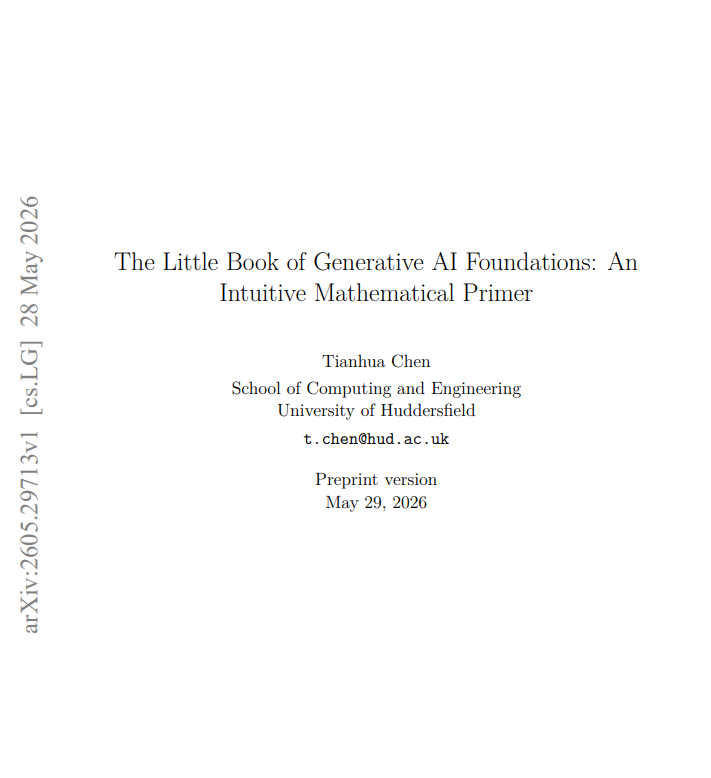
A must-read survey to refresh math and gen AI basics → The Little Book of Generative AI Foundations: An Intuitive Mathematical Primer It shows a clear walkthrough of how gen AI learns to understand, model, and create complex data, covering: - Latent algebra foundations: PCA, SVD, autoencoders - Latent models: PPCA and VAEs - VAEs: ELBO, inference, reparameterization - Diffusion: the way from noise → denoising - Score-based and continuous-time generative modelling - Density models: flows, autoregression - GANs and energy-based models beyond likelihoods
10
148
807
34,574
Rubik's cube. Let R be the 90° CW rotation of the side to the right, and U be the 90° CW rotation of the top layer. Repeatedly apply (UR). That is First R and Then U. Consider (UR)ⁿ. Is there an n when it'll return to its unscrambled position? Answer this for a 14 year old.
1
35
The obvious next step would be to find a scaffolded guided exploration of how to calculate the value of n. Again for 14 year old, math inclined kids.
1
15
utpal chattopadhyay retweeted
🚨Anthropic just showed a 24-minute workshop on how to actually do prompts for Claude. Taught by the people who built it. Free. No registration. No paywall. I've seen $300 courses that don't cover what they teach in the first 8 minutes. Watch it and bookmark it now!
15
32
105
5,937
Buddha on the art of counting: Buddha said: Son, Don't count your eggs Or the chickens before they are hatched. Learn to Count. Count the same thing in more ways than meets the eye.
1
26
In mathematics, many results boil down to bring creative about counting. You count the same thing in two different ways and equate the result. Voila. You get a nice theorem. Example: Combinatorial proof of Frrmat's little theorem.
1
32