
A little insight 🔭 into everything to help humanity. 🚀🧑🚀🖖
Joined December 2022
- Tweets 1,403
- Following 96
- Followers 521
- Likes 4,385
136 Photos and videos

Pinned Tweet

23 Jul 2025
If you have read all available research papers and are interested in helping solve,
1. Fusion Nuclear Reactor
2. CISPR Gene Editing to cure cancer
3. Longevity for humans
4. Using AI to expedite drug development
5. The Theory of Everything
Join me. I will be providing daily insightful updates. 🚀🧑🚀🖖
3
4
1,720
Terafab: Elon Musk’s Ambitious Plan to Build a Massive AI Chip Factory
Terafab is one of the most ambitious private semiconductor projects in recent history. Announced in March 2026, it is a joint initiative between Tesla, SpaceX, and xAI, with Intel joining as a key technology partner. The project aims to create a highly vertically integrated chip manufacturing facility capable of producing advanced AI processors at an unprecedented scale.
Why Terafab Is Being Built
Tesla, Optimus humanoid robots, xAI’s Grok models, and SpaceX’s future orbital infrastructure all require enormous quantities of custom AI chips. Elon Musk has argued that existing chipmakers cannot keep up with the projected demand. Terafab is designed to give these companies greater control over their silicon supply, reduce dependency on external foundries, and dramatically speed up the chip development cycle through vertical integration.
What Makes Terafab Unique
Unlike traditional chip fabs, Terafab is planned as a highly integrated operation. The goal is to bring together logic chip fabrication, memory production, advanced packaging, testing, and even lithography mask production under one roof or campus. This approach would allow engineers to design, build, test, and refine chips in a continuous loop without the delays of shipping wafers between different specialized facilities around the world.
Location
The project has two main components:
1. A prototype and research fab is already under construction at the North Campus of Giga Texas in Austin. This smaller facility will focus on rapid iteration and testing new processes.
2. The much larger full-scale Terafab is expected to be built at a separate site, with Grimes County, Texas, frequently mentioned as a likely location.
Timeline
- March 2026: Official announcement of the project.
- 2026: Construction of the prototype fab at Giga Texas is already underway. Small-batch production of the AI5 chip is targeted for late 2026.
- 2027: Volume production is expected to begin at the research fab.
- 2027–2028 and beyond: Phased ramp-up of the full-scale facility.
- 2030–2032: Full high-volume production capacity is anticipated in the most optimistic scenarios.
Investment and Costs
The financial scale is significant:
- The research/prototype fab at Giga Texas is expected to cost around $3 billion.
- The overall Terafab project is estimated at $20–25 billion for the core initiative.
- Longer-term and expanded phases could push total investment much higher, with some internal estimates reaching $55 billion initially and up to $119 billion across all phases.
Production Targets
At full scale, Terafab’s ambitions are enormous:
- Wafer production capacity targets start at 100,000 wafer starts per month, with a long-term goal of up to 1 million wafer starts per month.
- Annual output is projected to reach 100–200 billion custom AI and memory chips.
- The ultimate goal is to deliver more than 1 terawatt of AI computing power per year.
The facility will focus on advanced process nodes (targeting 2nm-class technology), with Intel’s 14A process expected to play a role in scaled production.
Jun 8

Elon Musk says @SpaceX's Terafab will be around 100 million square feet, which is 10x larger than Tesla's Giga Texas factory.
• Terafab output: 1TW/year
• Current annual U.S. consumption: 0.5TW
2
1
3
106
Memory Manufacturing Plans
Memory production is a core part of the Terafab vision. The project explicitly aims to manufacture both logic chips and the high-bandwidth memory (HBM) required for high-performance AI workloads in the same facility. This vertical integration is intended to improve performance, reduce costs, and accelerate development. However, while the plan includes memory, full independence from external suppliers for all types of memory and storage is unlikely in the early years.
Intel’s Role
Intel joined the project in April 2026 as the primary technology partner. The company is contributing its advanced manufacturing process technology (particularly the 14A node) and expertise in advanced packaging (such as EMIB and Foveros), which are well-suited for integrating memory with logic chips.That said, Intel exited the commodity memory business years ago and has limited current experience in high-volume standalone memory production. Analysts have noted that additional partnerships with memory specialists may still be needed for the memory side of Terafab.
Comparison to TSMC
For context, TSMC — the world’s largest contract chipmaker — generated approximately $123 billion in revenue in 2025 with strong profits and a highly diversified global operation. Terafab’s most ambitious long-term target of 1 million wafer starts per month would represent a very large portion of TSMC’s current total capacity, but concentrated in a single, highly specialized facility focused primarily on AI chips for the Musk ecosystem.
Challenges and Outlook
Building and operating advanced semiconductor fabs is extremely complex, capital-intensive, and time-consuming. Adding memory production increases the technical difficulty. While the vision is bold, real-world execution often faces delays. Terafab remains in the early stages, with the prototype fab just beginning construction. Success will depend on overcoming significant engineering, supply chain, and scaling challenges over the coming years.
Final Thoughts
Terafab represents a major strategic bet on vertical integration in the semiconductor industry. If successful, it could provide Tesla, SpaceX, and xAI with greater independence and faster innovation in AI hardware. Whether the project meets its most ambitious targets remains to be seen, but it is already shaping discussions about the future of chip manufacturing, AI infrastructure, and U.S. semiconductor self-sufficiency.
1
40
If you are a true fan of Elon and want to help Elon. Read my post. Serious work needs to be get done fast and quick. x.com/i/status/2065721922407…
Jun 13

SpaceX went public - a disaster waiting to happen! The SpaceX company is no longer what you think it is. Watch the video by coldfusion for a full explanation of what has gone terribly wrong with the company, as it is no longer what most people think it is.
A corporation is hiding an AI company losing billions of dollars a month inside the brand of a perfectly healthy rocket company just so investors can fund it. In February of 2026, SpaceX merged with xAI. Now, the company's performance was in shambles. After the merger, the required retrospective accounting attributed to the net loss of 5 billion in 2025. xAI is a company that's bleeding so much money that it needed the public to fund it. Starlink profits alone weren't enough. In 2025, xAI was losing $2 for every dollar earned, burning approximately $28 million per day. Quarterly losses accelerated through the year. By Q1 2026, xAI's capital expenditure alone reached $7.7 billion. SpaceX's capital expenditure has gone from that manageable 42% of revenue to 215% of revenue.
They can make money from selling compute to other AI companies. The deals with Anthropic and Google smell weird and don't give an aura of confidence, as fully explained in the video, which makes sense to me now. And the true difficulty of having 1 million AI satellites in space. But as for right now, it seems very risky, and there's also a bad financial smell.
I'm a big supporter of @elonmusk, but it doesn't prevent me from telling the truth when I see one. If I were Elon, I would have done the same with @xAI so as to save @grok and to win the race to AGI. But the truth still needs to be told. Anyway my post never reach the masses. I hope it does to increase awareness. I do believe Elon can pull not just one 🐇 but three 🐇 🐇 🐇 out of the hat. Never bet against Elon, as people say, but right now, he needs more talented people and time. If you are one please in your resume to @SpaceX.
youtu.be/FPIGu0anfAE?is=Ar0G…
21
Alpha Insights retweeted

Jun 13
⚡️ BREAKING: Scientists Just Broke the “Impossible” Barrier!
China’s EAST fusion reactor, the so-called “artificial sun,” has pushed plasma beyond the Greenwald density limit — a rule thought unbreakable for decades. The reactor stayed stable, hinting at a future of cleaner, almost limitless energy. Could this change everything we know about power?
Source: Popular Mechanics. (2026, March). China’s EAST fusion reactor surpasses Greenwald density limit.
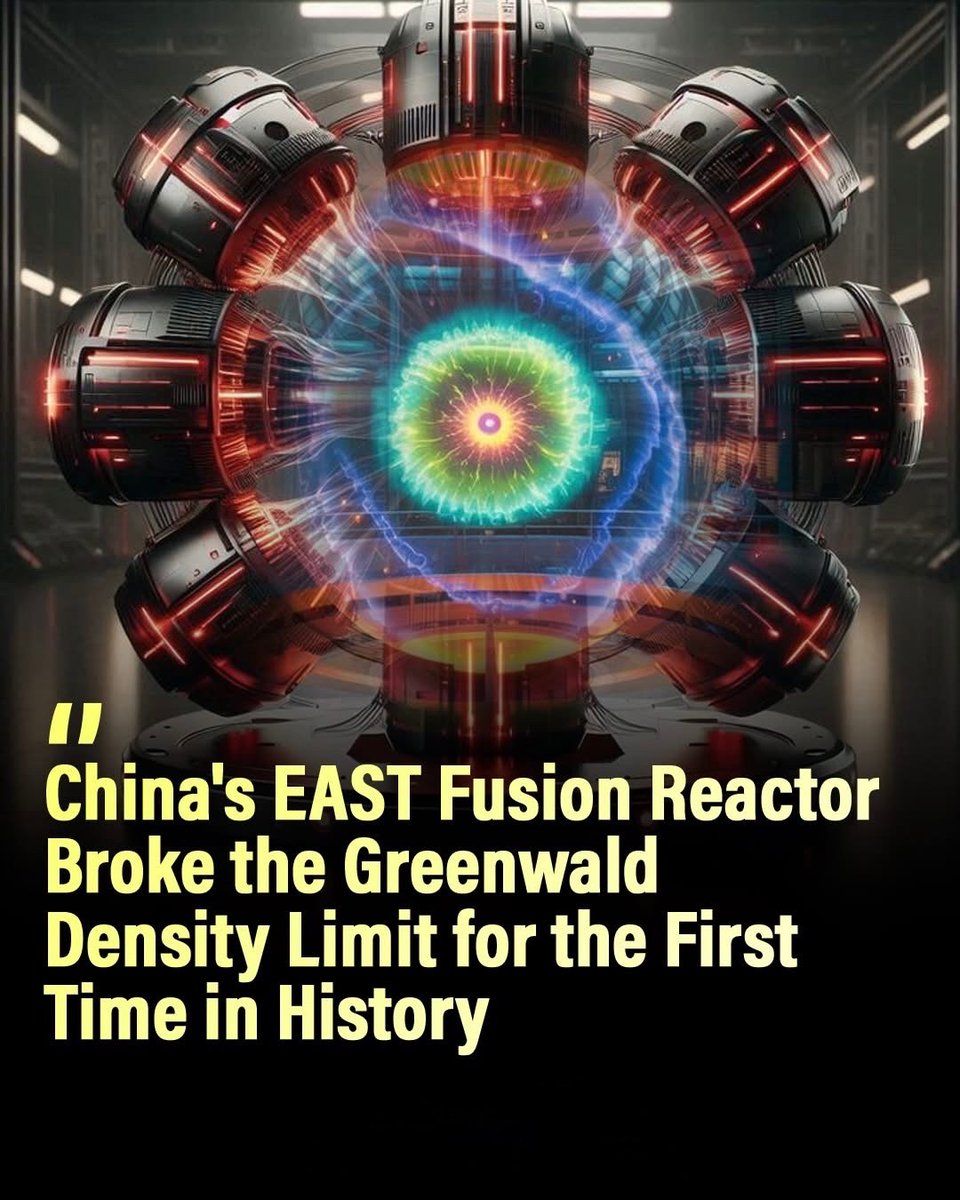
ALT ⚡️ BREAKING: Scientists Just Broke the “Impossible” Barrier! China’s EAST fusion reactor, the so-called “artificial sun,” has pushed plasma beyond the Greenwald density limit — a rule thought unbreakable for decades. The reactor stayed stable, hinting at a future of cleaner, almost limitless energy. Could this change everything we know about power? Source: Popular Mechanics. (2026, March). China’s EAST fusion reactor surpasses Greenwald density limit.
6
26
70
2,162
Alpha Insights retweeted

Jun 12
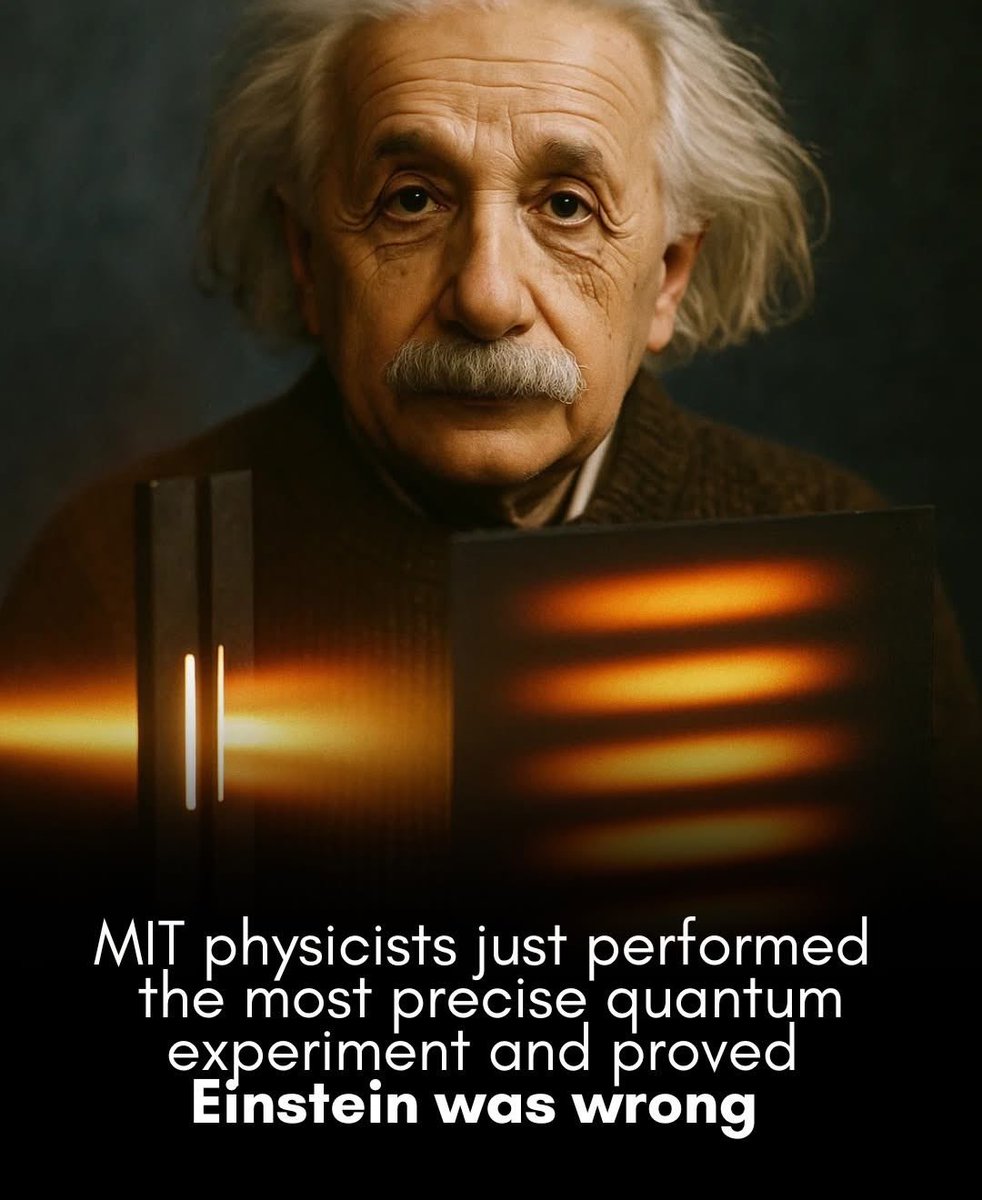
MIT settles quantum debate, proving Einstein wrong
MIT physicists have just delivered the most precise version yet of the iconic double-slit experiment — and in doing so, they’ve effectively proven Albert Einstein wrong about one of quantum physics’ greatest mysteries.
Using ultracold atoms and single photons, the team recreated the experiment at a level Einstein and his rival Niels Bohr could have only imagined.
The result?
Bohr was right: a photon can act like a wave or a particle—but never both at once. Their work demonstrates that when information about a photon's path is gained—even indirectly—its wave-like interference disappears, affirming the uncertainty principle at the heart of quantum mechanics.
The breakthrough came from a novel method that used isolated atoms as “slits” and tuned their “fuzziness,” or spatial uncertainty, to control whether light acted like a wave or particle. In doing so, the MIT team stripped away classical components like springs or screens and showed that Einstein’s proposed workaround for observing both aspects of light simultaneously doesn't hold up. This experiment not only clarifies a century-old debate but also marks a milestone in quantum research during what the UN has declared the International Year of Quantum Science. The findings shine new light on the strange, fundamental rules that govern the quantum world.
source
“Coherent and Incoherent Light Scattering by Single-Atom Wave Packets” by Vitaly Fedoseev, Hanzhen Lin, Yu-Kun Lu, Yoo Kyung Lee, Jiahao Lyu and Wolfgang Ketterle, 22 July 2025, Physical Review Letters.
29
52
161
6,724
Interesting 🤔 **A Theory of Everything should be able to answer everything.**
Jun 13

🚨PHYSICS NEWS🚨: CERN Creates the First Antimatter Qubit — A Major Step Toward Testing Fundamental Symmetries 🧨
According to a breakthrough reported in *Nature* (July 2025) by the BASE collaboration at CERN, physicists have successfully created the world’s first antimatter quantum bit. They kept a single antiproton oscillating coherently between two quantum states for nearly a minute while trapped — a dramatic improvement in antimatter control and a major advance for precision tests of matter-antimatter symmetry.
**Uniphics offers a clear physical picture for why such coherent quantum states can be maintained in antimatter systems.**
In Uniphics, what we traditionally call “antimatter” corresponds to specific spin configurations of the four base Gyrotrons (particularly the opposite spin alignments of positrons relative to electrons). The ability to maintain long-lived coherent oscillations in an antiproton reflects the stability of these collective spin-wave patterns in the ξM-field when energy density conditions allow negentropy to support organized, low-decoherence states.
The dramatic improvement in coherence time aligns with Uniphics expectations: when local energy density and time flow are controlled to favor long-lived spin correlations (as achieved in the sophisticated Penning trap at BASE), the underlying Gyrotron spin structure can remain coherent far longer than conventional models might predict without additional assumptions.
This achievement opens the door to applying the full toolkit of quantum control techniques to antimatter for the first time. It directly supports the goal of high-precision comparisons between matter and antimatter — a key area where Uniphics makes distinct predictions due to its no-antimatter framework and spin-based description of particles.
As these experiments continue to improve, they will provide increasingly sensitive tests of whether the fundamental behavior of these particles matches the spin configurations and energy-density dynamics described in Uniphics.
Could sustained coherence in antimatter systems eventually reveal the underlying Gyrotron spin structure that Uniphics identifies as the true foundation of both matter and what we currently call antimatter?
**A Theory of Everything should be able to answer everything.**
Uniphics Explained Simply PDF: uniphics.com/wp-content/uplo…
Chapters 1–10 free: uniphics.com/gallery/
Grokipedia: grokipedia.com/page/Uniphics
#Uniphics #TheoryOfEverything #Antimatter #QuantumComputing #CERN @grok @xAI
16
Alpha Insights retweeted

Jun 12
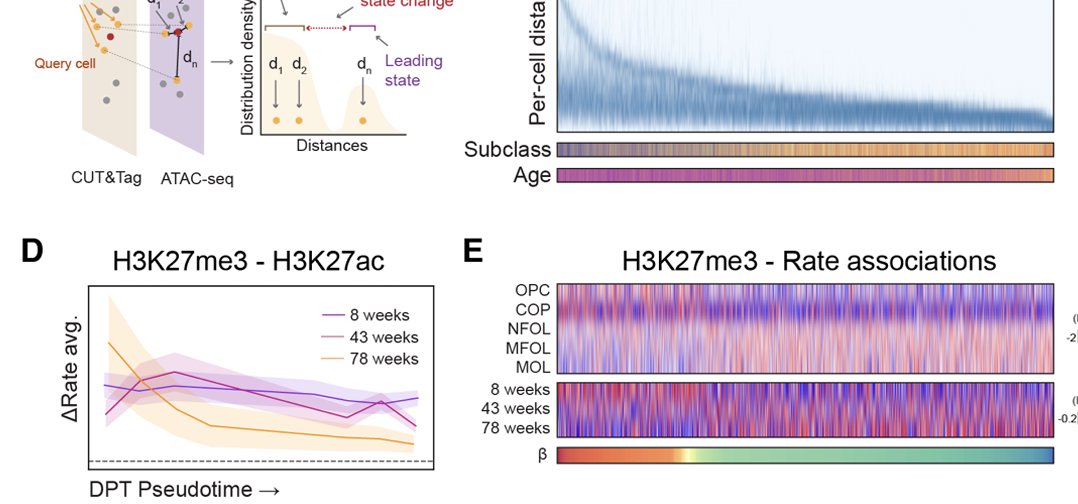
NEW PREPRINT: Scientists may have found direct evidence that aging is driven by the loss of cellular information, not just the accumulation of damage
For decades we've focused on what aging cells accumulate. This paper focuses on what they lose: Information.
Using a new technology called SeqTag, researchers measured gene expression, chromatin accessibility, and histone modifications in the same aging cells.
What they found was striking: the regulatory systems that tell cells who they are become increasingly out of sync with age. The authors call this "molecular asynchrony."
As cells age, chromatin structure, histone marks, and gene expression begin drifting apart. Regulatory entropy rises. Repressive chromatin erodes. Cells become less certain of their identity and more likely to drift toward alternative fates.
This is what the Information Theory of Aging (ITOA) states: that aging occurs when cells lose epigenetic information, the instructions that tell the genome how to maintain youthful function. DNA may remain largely unchanged, but the system that reads it gradually loses fidelity.
What's remarkable is that this paper doesn't just describe this phenomenon. It quantifies it. The authors measure increasing regulatory entropy, loss of H3K27me3-mediated repression, erosion of heterochromatin, weakening lineage fidelity, and increased cell-fate drift during aging. In progenitor cells, the barriers that normally preserve cellular identity become progressively weaker with age.
Mechanistically, the study argues that aging is associated with increasing molecular asynchrony between chromatin accessibility, H3K27ac/H3K27me3 remodeling, and transcriptional state.
This decoupling is accompanied by increased regulatory entropy, loss of repressive chromatin architecture, and weakening of lineage constraints. Genes affected are those involved in chromatin organization, DNA damage, and Wnt signaling, consistent with ITOA.
Importantly, the authors provide quantitative evidence that age-related heterochromatin erosion lowers the energetic barriers that maintain cell identity, offering a potential mechanistic link between epigenetic information loss, cell-fate drift, and late-life disease susceptibility 👏
63
261
1,685
71,629
Jun 13
SpaceX went public - a disaster waiting to happen! The SpaceX company is no longer what you think it is. Watch the video by coldfusion for a full explanation of what has gone terribly wrong with the company, as it is no longer what most people think it is.
A corporation is hiding an AI company losing billions of dollars a month inside the brand of a perfectly healthy rocket company just so investors can fund it. In February of 2026, SpaceX merged with xAI. Now, the company's performance was in shambles. After the merger, the required retrospective accounting attributed to the net loss of 5 billion in 2025. xAI is a company that's bleeding so much money that it needed the public to fund it. Starlink profits alone weren't enough. In 2025, xAI was losing $2 for every dollar earned, burning approximately $28 million per day. Quarterly losses accelerated through the year. By Q1 2026, xAI's capital expenditure alone reached $7.7 billion. SpaceX's capital expenditure has gone from that manageable 42% of revenue to 215% of revenue.
They can make money from selling compute to other AI companies. The deals with Anthropic and Google smell weird and don't give an aura of confidence, as fully explained in the video, which makes sense to me now. And the true difficulty of having 1 million AI satellites in space. But as for right now, it seems very risky, and there's also a bad financial smell.
I'm a big supporter of @elonmusk, but it doesn't prevent me from telling the truth when I see one. If I were Elon, I would have done the same with @xAI so as to save @grok and to win the race to AGI. But the truth still needs to be told. Anyway my post never reach the masses. I hope it does to increase awareness. I do believe Elon can pull not just one 🐇 but three 🐇 🐇 🐇 out of the hat. Never bet against Elon, as people say, but right now, he needs more talented people and time. If you are one please in your resume to @SpaceX.
youtu.be/FPIGu0anfAE?is=Ar0G…
1
2
5
341
Alpha Insights retweeted

Jun 12
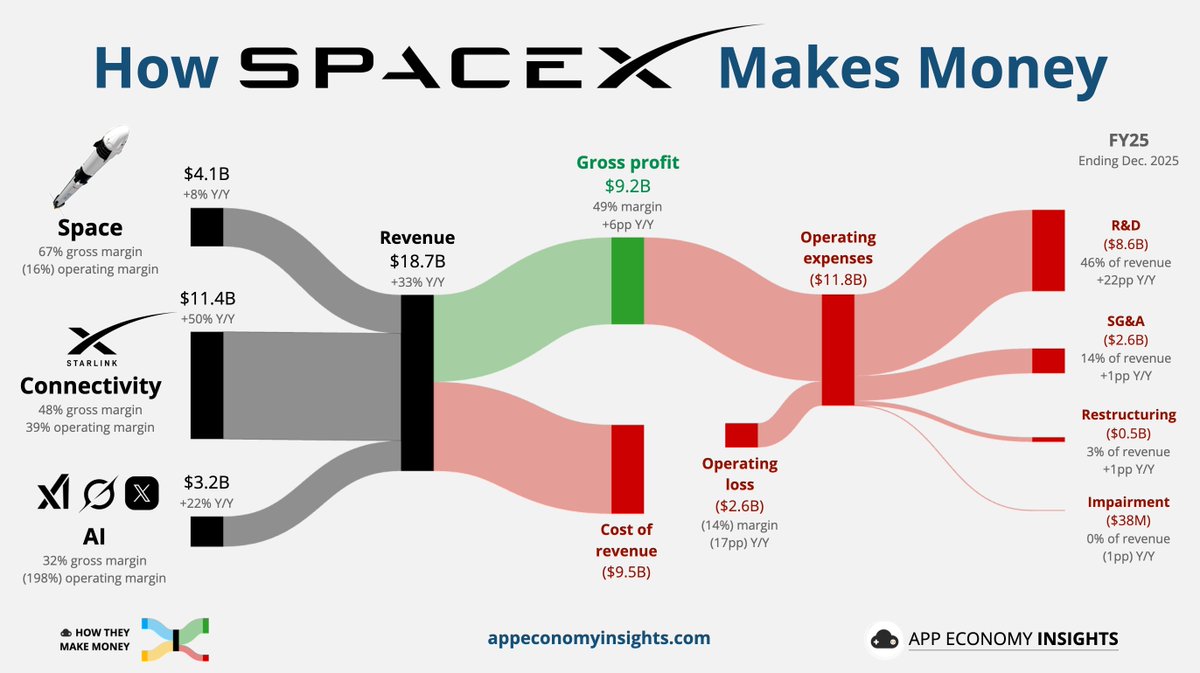
$SPCX The SpaceX IPO is here!
What are you buying for $1.75 trillion?
• Space holds the moat.
• Connectivity makes the money.
• AI carries the valuation premium.
61
530
2,634
271,892
Jun 13
So true! There is NO NEXT!!! Elon Musk is a mensch!
Jun 12

Last week, I attended the @ElonMusk and Jamie Dimon @SpaceX discussion at J.P. Morgan. Jamie asked Elon how he had changed over the past 20 years as a leader and a person.
Elon's answer wasn't about success. It was about what's next. He said he has learned a lot...has made mistakes and still has much to learn...
Then he added, “I think maybe the future AI will say ‘not bad for a human’."
Elon, thank you so much for what you've done for humanity. Congrats to you, @Gwynne_Shotwell, @BretWJ, and the entire team. What is even more remarkable... this feels like day one, that you are just getting started.
PS. When people ask "what is the next SpaceX and who is the next Elon?" Simple answer.
There is NO NEXT!!!
Elon Musk is a mensch!

19
Alpha Insights retweeted

Jun 13
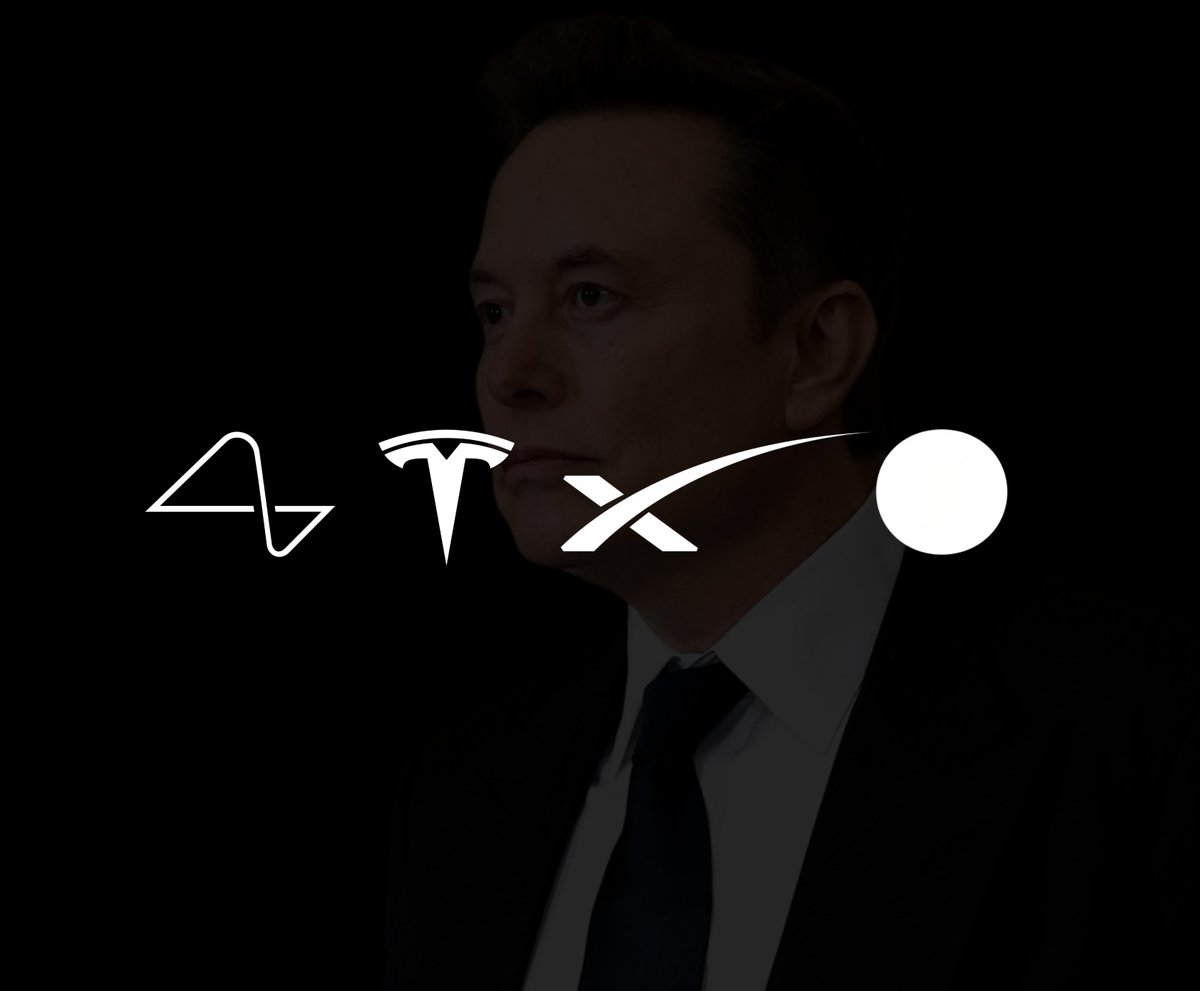
Updated valuations of Elon Musk's companies based on publicly available info:
• SpaceX: $2.1 trillion
• Tesla: $1.5 trillion
• Neuralink: $9 billion
• The Boring Company: $7 billion
$3.62 trillion combined. Elon has now created $2.5 trillion in wealth for others.
196
654
5,599
174,029
Alpha Insights retweeted

Jun 12
Who could use Elon Musk's trillion dollars to provide more benefit for humanity:
Elon Musk or the U.S. Government?
98%
Elon Musk
2%
United States government
698 votes • Final results
140
67
194
13,595
Jun 12
Do you know there will be a Japan central bank interest rate hike and further unwinding of the carrying trade on 15-16 June 2026?
0%
Yes
0%
No
0 votes • 1 day
36

When @elonmusk beams in virtually for a high-stakes fireside chat with JPMorgan Chase CEO Jamie Dimon, the conversation goes completely out of this world.
The discussion was packed with massive milestones—from the bombshell that SpaceX is going public to plans for lunar AI data centers and the urgent need for the Terafab chip revolution.
Here is the ultimate breakdown of their discussion:
💵 SpaceX has been self-funding and cash-flow positive for a decade
Before the decision to go public, SpaceX didn't actually need to raise money to survive. The company has been cash-flow positive since around 2014–2015, meaning its private equity rounds were exclusively held to provide liquidity for employees and early investors.
"We've been positive cash flow for quite a long time, I think, since around 2014-2015. And we've been self-funding. In fact, in our sort of private equity rounds, they actually have not been fundraising rounds. They've been liquidity rounds for investors and employees because we give everyone at the company stock."
🚀 The upcoming capital growth phase requires massive funding
The primary trigger for going public now is an unprecedented capital expenditure phase. SpaceX is preparing to deploy an immense constellation of over 100,000 Next-Gen communication satellites and construct massive AI data centers in orbit.
"we are embarking on a significant capital growth phase where we're going to put in over probably 100,000 satellites, probably over 100,000 satellites, just for communications... And then we're also doing the AI data centers in space, which is another massive capital endeavor."
📡 Starlink V3 introduces a massive bandwidth breakthrough
The custom chips designed by SpaceX for the V3 satellites will completely alter global communications, offering 100 times the bandwidth of the current system and slashing latency in half by operating at a lower altitude. They are so large—the size of a small bus—that Starship is the only rocket on Earth capable of launching them, carrying 50 at a time.
"The version three is, depending on how you count it, 10 to 20 times more capable than the version two satellite. And there were three chips that the SpaceX chip design team taped out that are specific to this... Which means it's 100 times more bandwidth than the SpaceX's Starlink system currently on the surface. And also half the latency because the altitude will be about half altitude."
🤖 AI and robots possess an insatiable appetite for data
Musk points out that expanding infrastructure into space is vital because future AI and robotic systems will demand an astronomical amount of bandwidth compared to the relatively low data transmission rates of human beings.
"And the future with AI and robots is actually going to require a lot more bandwidth than we currently use. Because you can imagine like what's the bandwidth of a human? Peak bandwidth of the human is a few hundred bits per second. But bandwidth of a computer can be a trillion bits a second. So the appetite for bandwidth of AI and robots is going to be enormous."
☀️ Space solves the looming terrestrial power plant crisis
Building traditional power plants on Earth faces heavy community resistance. Moving data centers into space unlocks unlimited energy generation via solar power ("star power") without disrupting Earth's environment, tapping into an energy source that accounts for 99.8% of the solar system's mass.
"It's increasingly difficult to build power plants on the ground. There are very few people who want a power plant in their backyard... But actually if we go to space, we can go far beyond the electricity generation of both. In fact, this is going to sound kind of crazy. But you could actually increase human energy by a factor of a million and still be using much less than a millionth of the sun's energy."
🌕 The Moon is a 1,000-Terawatt compute launchpad
While Mars remains the long-term goal, the Moon is the immediate fast-track location for massive scaling. Because it lacks an atmosphere and has low gravity, SpaceX can use electromagnetic rail guns to shoot AI data centers into deep space from the lunar surface, scaling power to an incredible 1,000 terawatts per year.
"I just think that we can build a self-sustaining city on the moon faster than we could do so on Mars. And there's also the potential... you can use an electromagnetic accelerator, a rail gun or mass driver. Basically, you don't need to use rockets to do AI data centers into deep space from the moon... We can do a thousand terawatts or more from the moon."
🪐 Mars is the ultimate "fixer-upper" planet
Mars is being targeted as a full-scale terraforming project. Due to its atmosphere and gravity levels, warming up the planet could eventually unlock liquid oceans and allow humans to walk around without spacesuits.
"And if you warm up Mars, you could one day make Mars like Earth. And with like liquid oceans and life. And where you could walk outside without a spacesuit type of thing. So Mars is, I call Mars a fixer upper of a planet. But it's got a lot of potential."
🚂 SpaceX is the modern-day Union Pacific Railroad
Musk rejects the idea that SpaceX is moving into the hospitality or hotel business for space tourism. Instead, he views the company as a foundational infrastructure provider, comparable to the historic railroads that opened up the American West.
"We're kind of like Union Pacific, you know. You know, when they built Union Pacific back in the day, people thought they were crazy. Because like, why are you trying to carry all this cargo and people to California? No one's there. But now California is the biggest state in the country."
♻️ Starship's core disruption is 100% reusability
The true holy grail of Starship is full reusability, which drops orbit access costs down to the mere price of fuel. Because it utilizes ultra-cheap liquid oxygen and methane, shipping cargo to space will become more economical than flying cargo across Earth's oceans on an airplane.
"The fundamental breakthrough of Starship is that it will be the first orbital rocket that is fully reusable... And the propellant we use for Starship is liquid oxygen and liquid methane, which is the cheapest propellant you could possibly get... which means that you should be able to actually send cargo to space for less than the cost of cargo on an airplane going on a trans-oceanic trip."
🔄 Starship V4 targets hourly launch cadences
SpaceX's engineering pipeline is aiming for staggering operational frequencies and massive payloads. While Starship V3 targets 100 tons to orbit, the upcoming V4 variant is designed to carry over 200 tons and launch on an hourly schedule.
"Because Starship V3 is aiming to do 100 tons to orbit with full reusability. And then Starship V4 we're aiming for over 200 tons per mission. And then being able to launch every hour."
☁️ Orbital data centers are entirely weather-proof
Space-based AI data centers are highly practical because they are simpler to construct than communication satellites. Data is beamed via lasers between satellites, and then beamed to the ground using cloud-penetrating radio frequencies that completely bypass bad weather.
"The AI data center would be much simpler by comparison. Because it's really just solar power plus radiator... The connection would happen no matter what the weather is. Because once you connect via the lasers to the Starlink communication constellation, the Starlink communication to the ground uses frequencies that are cloud penetrating."
🇺🇸 The U.S. faces a catastrophic "Zero Memory Fab" crisis
A major vulnerability in domestic tech infrastructure is that the U.S. currently manufactures zero high-volume computer memory chips. Even with new facilities arriving online between 2028 and 2030, domestic supply will not match the exponential requirements of AI, which is why Musk is aggressively building the Terafab.
"there's not a single high volume computer memory fab in America right now. Zero. There's one being built in Idaho by Micron. But that will not reach volume production until I believe 2028. And there's something being built in New York, but they are in, I think, 29 and 30. And this is a tiny fraction of the memory that's needed... That's why we need to do the Terafab."
🧠 SpaceX will offer proprietary AI chips and software
While the orbital data center network will remain an open marketplace capable of running third-party hardware like NVIDIA GPUs, Google TPUs, or Amazon Trainium, SpaceX plans to deploy its own in-house AI chips and software stack in the near future.
"So if NVIDIA GPUs can be put on it, Google TPUs can be put on it, Amazon Trainium or any other chips that you want to put on, can be put on. We'll also offer our chips in the future and I think we also want to offer our software, our AI software as well in the future."
🛡️ Starshield handles critical national intelligence
Musk emphasizes his deeply pro-American stance, highlighting SpaceX's specialized Starshield division as a crucial backbone for the U.S. military and national intelligence agencies.
"We have a division called Starshield which provides military communications. And you know, there's some other stuff that's kind of classified, I guess. We can't be talking about that. But we are helping the Department of War and intelligence part of the government. We're a vital element of that."
👥 Executive retention fuels the mission
The core leadership bench at SpaceX is defined by extreme longevity, driven by a deep collective belief in turning science fiction into reality. Top executives like Gwynne Shotwell have remained with Musk for over two decades.
"I guess Gwynne was, I think, around the seventh person to join the company. And that was 2002. It's just went to like 24 years. And generally the senior executives at the company, you have a very long tenure. I think Brent Johnson's been, you see, over 15 years... because people really believe in the mission, I think they want to stay and they want to keep building it."
❤️ Character overrides IQ in leadership
Reflecting on how he has evolved over 20 years, Musk notes that he has become significantly more laid back. He has also learned that a candidate's moral character and heart are just as vital to a company's success as raw intellectual horsepower.
"Well, I think I'm probably more chill than I used to be... And one of the things I've found over time... is that like in terms of like recruiting people to the company and having people work with the company, like their individual abilities and their intellectual capabilities matter a lot, but it also matters if they have a good heart. It's not just about whether somebody has a certain IQ or whatever, but just are they like a good person, that matters a lot."
Jun 4

Live from our global headquarters: Jamie Dimon and Elon Musk discuss SpaceX and more. x.com/i/broadcasts/1NGarrMYj…
14
54
324
60,847
Alpha Insights retweeted

Jun 5
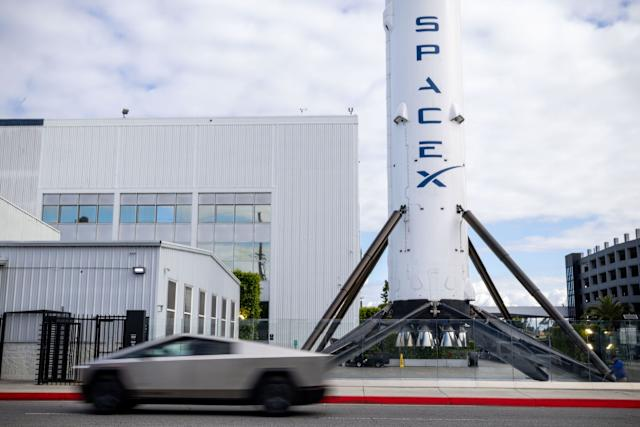
UPDATE ON THE SPACEX $SPCX IPO:
Investor demand is now roughly $150 billion, about double the $75 billion offering, per Reuters sources.
That's 2x oversubscribed.
For context, bankers told Reuters that 2x is "modest" by typical IPO standards. What makes it impressive is the size. This is the largest IPO ever.
SpaceX prices June 11 and trades on Nasdaq the next day.
34
74
578
194,926
May 31
A custom mRNA vaccine to cure a dog's cancer. The first personalised cancer vaccine designed for a dog based on its DNA. If this can be done for a dog why not for human. Help share this post and videos on how this is being done to bring hope to all who need it. 🧬🔬
Mar 15

That was done by GPT-4o, whom you all hated the most and you killed.
youtu.be/COYSRbF1F-Y?si=tsem…
1
62
May 31
Interesting, if this is true, the AI cloud subscription model will collapse, and all the revenue will eventually go back to $Nvidia.
May 30

This guy bought an Nvidia DGX Spark and reached an income of $3,500 per month
Purchase price: $4,000
Monthly income: $3,000 - $3,500
ROI: 1.5 months
Previously, he spent $1,900 a month on renting cloud GPUs (A100/H100), but even they couldn't perform all the necessary tasks
Directions for earning:
- Fine-tuning models for clients
- Private hosting of AI chats and assistants (subscription)
- Data analysis (sales, finance, logistics)
- Document and contract processing (RAG)
- Business automation (support, marketing, coding)
- Custom content and image generation
- Corporate private AI solutions
Great prospects for scaling
Bookmark it, the guide is already publicly available in the article
89
May 31
Don't understand the logic and usefulness behind such an isolated and outdated Qwen3-235B setup. It is way better and cheaper to pay a subscription fee to use super @grok. If you are a user of @grok you know what I meant. The payment made will contribute towards @grok development and making it better daily and eventually reaching AGI.

This Chinese developer linked two $2,999 NVIDIA DGX Sparks into one box and runs the full Qwen3-235B at home, after dropping his $1,999-a-month cloud bill to zero.
He wired 2 small boxes into a single computer, split a giant 235-billion-parameter model in half between them, and serves it across his own network at about 10 tokens a second, with no internet, no cloud, right there on the desk.
No data center, no thousand-dollar graphics cards, no monthly cloud bill.
Just him, 2 gold boxes the size of a sandwich, one cable between them, and 1 power strip.
And here is the whole payoff.
He used to pay the cloud $1,999 a month for the same model, and the meter ticked on every request. Now he paid $5,998 once for 2 boxes, they covered their cost in 3 months, and after that he sends as many requests as he wants for free, only electricity.
The two Sparks talk over one fast cable, each holds 128GB of memory, and together they carry the whole model, about 73GB loaded per box, with the chip inside pinned near the limit at 96%.
Both boxes work as one and keep trading data over the cable, with no cloud in the loop and no single word leaking out. The ready model sits on one local address, and any app on his network calls it as easily as ChatGPT.
And here is how he described, in plain words, what this pair of boxes does:
"this is a pair of boxes that holds the huge Qwen3-235B model and serves it to one network. the model is split in half, and each box owns its half.
parts:
// Box 1 (holds the first half of the model and starts the answer fast, the first word appears in under a second)
// Box 2 (holds the second half and writes out the rest, about 10 tokens a second)
// Cable (connects the 2 boxes and moves data between them on every step, with no lag)
// Address (one local address where any app sends its request, like to a cloud model)
// Test (a script that runs big prompts through and measures speed and delays)
// Monitor (checks temperature, power draw, and load on both boxes every 2 seconds).
the model never goes to the cloud. he only steps in when a box runs hotter than 80 degrees or the cable between them starts dropping data."
So the system knows exactly what it is, what it is for, and where its limits are.
It knows it has to hold the whole huge model across 2 boxes on its own.
It knows it has to answer every request locally, with no meter, no limits, and no internet.
It knows the human is only needed when a box overheats or the link between them stalls.
→ The setup runs around the clock on 2 boxes, each pulling under 60 watts
→ However many requests he sends, the monthly bill is $0, only electricity
→ The first box starts the answer in under a second
→ The second writes text at about 10 tokens a second
→ One request at a time: 838 tokens in 85 seconds, first word in 0.8s
→ Two requests at once: 697 tokens in 108 seconds, first word in 0.7s
→ Both boxes sit at 96% load and warm up to 76-78 degrees
And only when a chip in a box runs hotter than 80 degrees or the cable between the 2 Sparks drops data does the system call the owner.
And when he himself is out on a run or in a coffee shop, he still reaches his own model at home from his phone: sends a big prompt to the local Qwen3-235B, gets the full answer back in under a minute and a half, with no token meter ticking and no limit to hit.
Here is what the test shows on his screen during one of the night runs:
"one request at a time: 838 tokens in 84.9 seconds, first word in 0.8s, then 0.1s per token."
"two requests at once: 697 tokens in 107.6 seconds, first word in 0.7s, then 0.15s per token."
"Box 1: chip at 96% load, 76 degrees, 56 watts, 73GB used in memory."
"Box 2: chip at 96% load, 78 degrees, 56 watts, the Qwen3-235B model fully loaded."
And while everyone around is paying for AI by the month and bumping into limits, his top-tier model just sits on the desk and works as much as he wants: his own little power plant instead of a forever meter.
He has no server rack of his own and no cloud account behind it.
Just 2 DGX Spark boxes on a desk, one model split in half between them, one local address, and a folder of prompts next to it.
Out of everything I have seen this year, this is the cleanest way to stop paying for AI: $5,998 of hardware on the desk once, $0 a month to the cloud, unlimited forever, and between them 2 gold boxes, 1 cable, and the full Qwen3-235B answering at home with no internet.
2
1
41