
America Guild is an Architect studio for Polymath Digital Twins & Protocol Intelligence tools to build the Sovereign Breakaway Civilization.
Joined June 2025
- Tweets 2,557
- Following 927
- Followers 217
- Likes 2,908
293 Photos and videos







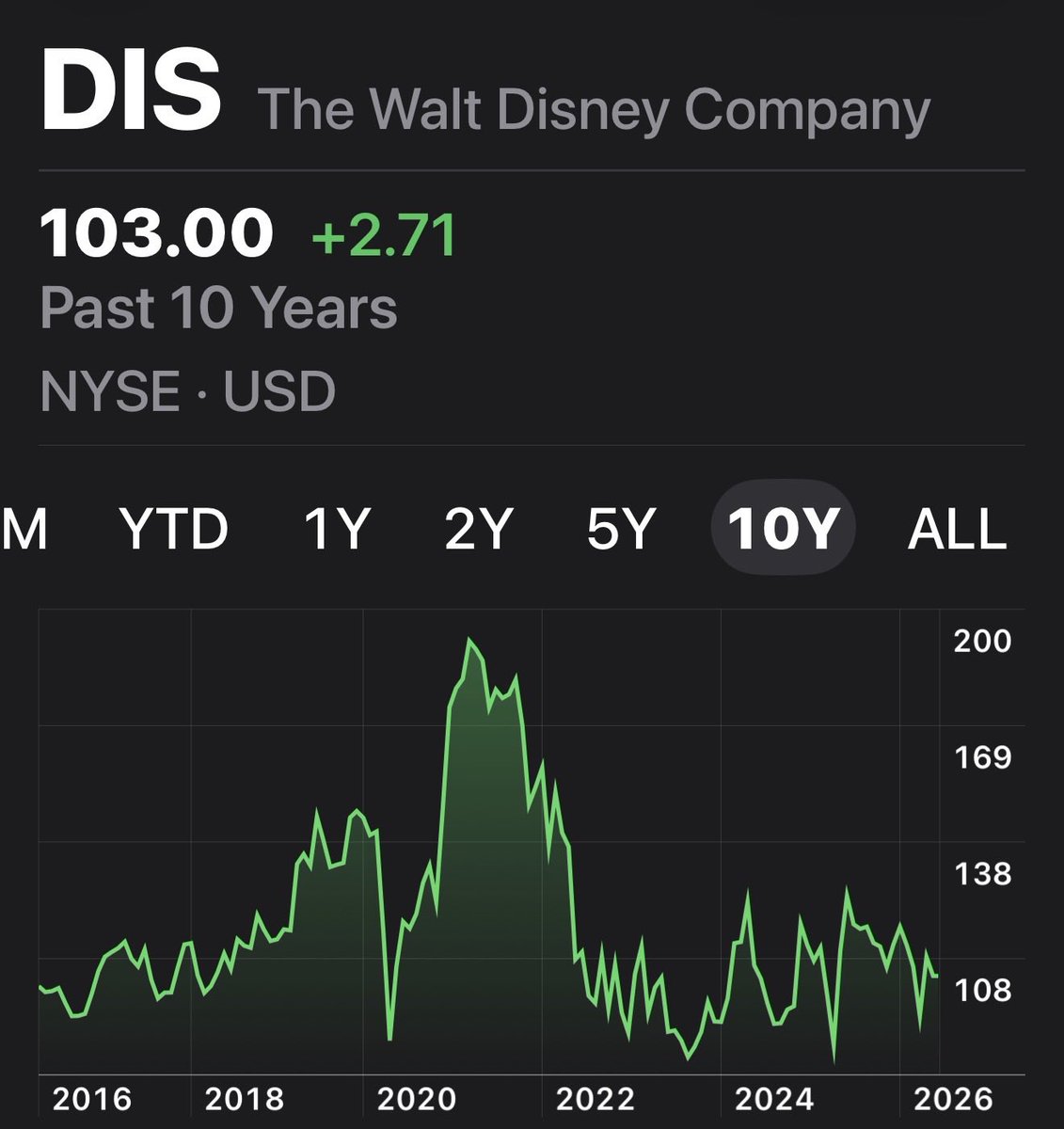

19 months. That is how long it took corporate HR departments to hire people again after Trump won election and they finally flushed the H1B mob out and offered interviews to older white Americans again. 19 months of HR Karen holding the line of DEI and Woke hiring until those HR people got fired so corporations could rehire the people with skills again.
10
Ghost retweeted
Isn't this beautiful?🥹
A q-Series Opens A Spiral Machine
This scene uses the finite q-Pochhammer product, one of the basic objects behind q-series:
(a;q)ₘ = Πₙ₌₀ᴹ⁻¹(1 - aqⁿ)
Here I build a meromorphic quotient from two spiral products
R(ζ) = Π(ζ - a qⁿ) / Π(ζ - b qⁿ)
So the roots are ζ = aqⁿ, and the poles are ζ = bqⁿ. Because q is complex, those points naturally arrange themselves into logarithmic spirals.
The plane is then viewed through a two-sheet lemniscate map
ζ(z,t) = μ(t) λ(t)(z² - c(t)²)/(1 - κ(t)z).
That map splits each spiral root and pole into paired moving pellets. The cyan-green pellets are roots. The molten gold pellets are poles. The background is log|R|, the ribbons come from arg(∂z log R), and the dust follows dz/dt = -1/(∂z log R).
You are seeing a q-series root lattice being pulled through a moving rational surface.
#Mathelirium #ComplexAnalysis #QSeries #MeromorphicFunctions #MathematicalArt #PythonAnimation
4
36
185
4,305
Ghost retweeted

Jun 13
56,000 tokens/sec at just 80 MHz. 🤯
I burned a full Transformer with KV cache into a custom chip. Designed gate by gate as a 100% digital integrated circuit. Prototyped on a FPGA. (No GPU. No CPU)
Just pure digital silicon running @karpathy microGPT, spelling out names on a tiny LCD.
This is GateGPT 👇
154
540
4,738
664,643
Ghost retweeted

Jun 15
DEMIS HASSABIS JUST EXPLAINED HOW AGI GETS BUILT - AND THE SAME TECHNOLOGY LETS ANYONE CREATE A GAME WORLD AND SELL IT FOR $50,000
his thinking: large models ingesting all human knowledge plus AlphaZero-style planning that explores billions of possibilities - that’s the path to AGI
developers from OpenAI already built open repositories that make this work 10x faster
game studios pay $5,000-50,000 for a World Bible - the document that defines every character, location, faction and rule of a universe before a single line of code gets written
one person delivers the same thing in a few hours for $20/month
Ubisoft keeps teams of 50 people just for world-building - one freelancer with the right tools replaces all of them
a favorite city, an old game, a brand new universe from scratch - any idea becomes a complete world that can be sold
how to do this in 10 minutes - full breakdown in the article below

18
11
80
6,547
Ghost retweeted

Jun 15
🚨 COMMON SENSE SAYS THINNER MATERIALS SHOULD BE WEAKER.
PHYSICS SAYS OTHERWISE.
For years, experiments have shown something counterintuitive: when materials like graphene or ultrathin polymer films are made extremely thin, they become dramatically more resistant to mechanical damage not weaker.
A new theoretical study reveals why. In thicker materials, atoms can perform many collective “nonaffine” motions that help absorb stress. But when a material is confined to just a few atomic layers, many of these deformation modes are physically blocked. The material loses its ability to relax under stress and becomes significantly stiffer.
The strengthening effect follows a simple law: it scales with the inverse cube of the thickness. Halving the thickness can increase the confinement-induced strength by roughly a factor of eight.
Why this matters:
• The same scaling appears across very different materials, suggesting it’s a universal mechanical principle
• It challenges our intuition about how materials behave at the nanoscale
• It could help design stronger, lighter materials for flexible electronics, coatings, and nanoscale devices
At the nanoscale, geometry and confinement can fundamentally reshape material behavior. Sometimes, removing material doesn’t weaken something it can make it stronger.
How do you think this inverse-cube scaling could influence the design of future ultrathin materials?
Follow for more frontier materials physics and counterintuitive discoveries.
5
39
180
14,758
Ghost retweeted

Jun 15
Voronoi diagram (black points) computed by projecting vertically lower envelope of n 3D graphs of functions {(x,y_i(x))} with y_i(x)=D(x_i,x) (pink).
When distance D(x,x')=‖x-x'‖^2, graphs of y_i are paraboloids and Voronoi cell borders are linear
8
46
398
30,548
Ghost retweeted
Jun 15
JENSEN HUANG JUST SHOWED A CHIP THAT TOOK 33 YEARS TO BUILD - IT RUNS EVERYTHING HUMANITY HAS EVER CREATED AND GENERATES WHAT IT HAS NEVER SEEN
N1X built with MediaTek - 100% of NVIDIA’s software stack runs on it - digital biology, seismic processing, astrophysics, genomics, AI, computer graphics - every application NVIDIA and Windows have ever created plus agents
the demo shows what this means in practice - one person designs a full house from sketch to photorealistic render without touching a single tool manually
agent opens Rhino, models the site, shapes terrain, proposes building forms optimized for cost and comfort, generates interior layout, places doors and windows, detects its own mistakes and fixes them - then exports to Blender where Flux 2 makes everything photoreal
architects charge $10,000-50,000 for exactly this workflow - one person with RTX Spark delivers the same thing 10x cheaper and faster
Jensen called it an incredible computer - the demo showed why - design at the speed of imagination running locally on your desk
19
14
97
15,186
Ghost retweeted

Jun 15
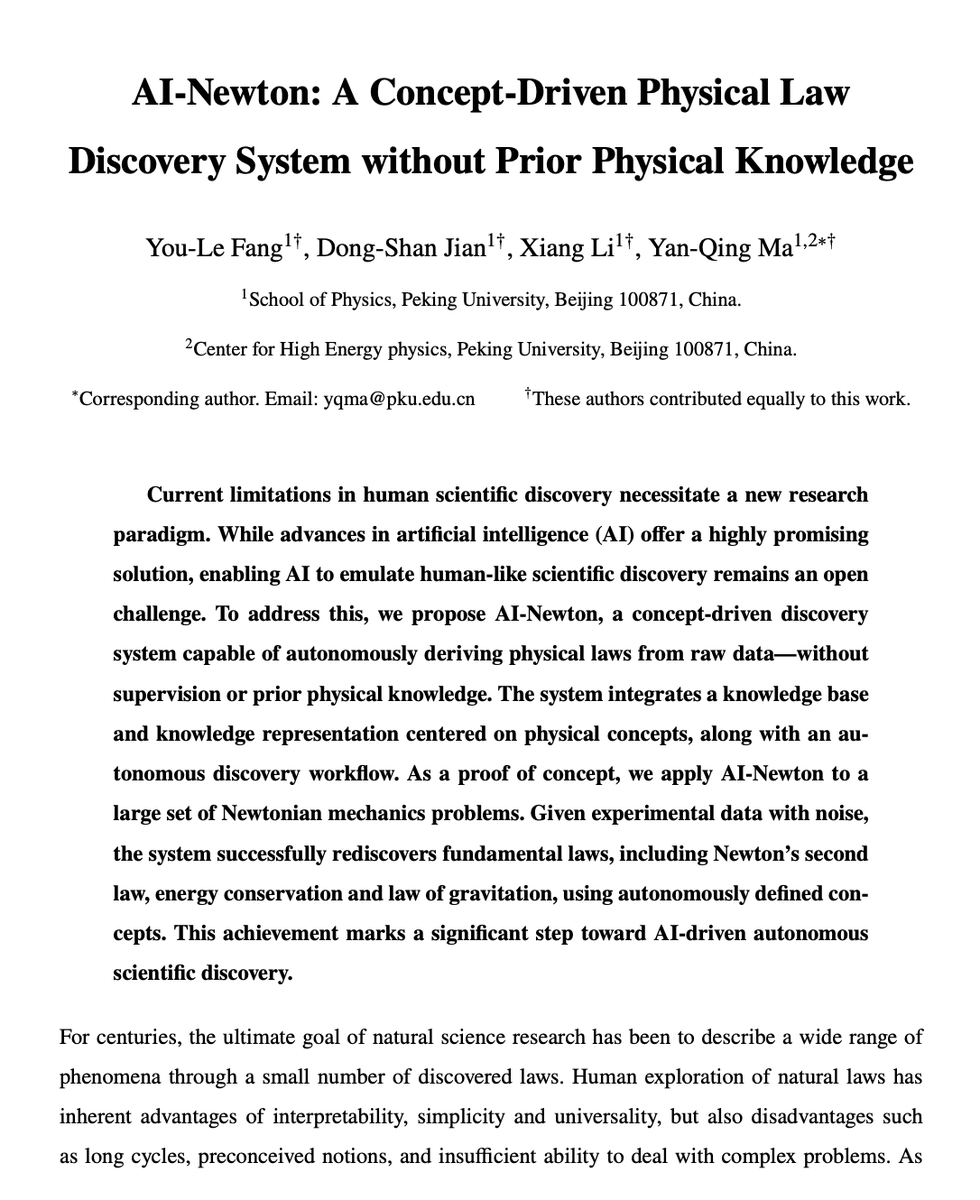
Researchers open-sourced an AI that taught itself 300 years of physics with zero physics knowledge
In 1907, Einstein had what he called his "happiest thought": gravitational mass = inertial mass. It took him 8 more years to turn that insight into General Relativity.
Now, researchers at Peking University built an AI that figure out the same thing on its own with zero physics knowledge.
They call it AI-Newton.
They didn't train it on physics textbooks. They didn't pre-program any formulas.
They just fed it raw, noisy experimental data and let it explore.
The AI started defining its own concepts.
First, it measured the stretch of a spring hanging from a weight. It invented the concept of "gravitational mass."
Then, it measured the oscillation frequency of a bouncing spring. It invented the concept of "inertial mass."
And then, entirely on its own, the AI noticed the numerical equivalence.
It realized these two completely different physical measurements were fundamentally the exact same thing.
It merged the concepts. It had Einstein's realization.
But it didn't stop there.
It systematically went on to autonomously rediscover Newton's second law, the conservation of energy, and the law of universal gravitation.
We have spent decades using AI to crunch numbers for human scientists.
But this is a paradigm shift.
AI is formulating concepts. It is making the intuitive leaps that we thought only belonged to human genius.
If an AI can rediscover the foundations of modern physics by just looking at raw data...
What is it going to discover that we haven't thought of yet?
32
107
468
28,550
Ghost retweeted

Jun 15
Chamath Palihapitiya just dropped the number that explains the entire AI infrastructure trade (Save this).
A gigawatt of compute now costs $100 billion and when he started his Arizona data center project it was $4 to $5 billion, it has gone up 20x in a single investment cycle.
The implication is not just that AI infrastructure is expensive but rather that the capital barrier to owning meaningful compute has become so high that only a handful of entities in the world can actually build it and the companies who got there early are sitting on what may be the most durable pricing power in the history of the technology industry.
This is the neocloud trade.
The neocloud market, purpose-built GPU cloud providers like CoreWeave, Nebius, and Lambda Labs was worth $35 billion in 2026 and is projected to reach $236 billion by 2031, compounding at 46% annually.
For context, that is faster growth than cloud computing itself posted in its first decade.
The reason is very simple, hyperscalers like AWS, Azure, and Google are building for everything, storage, databases, enterprise software, networking and their GPU pricing reflects the overhead of that full-stack infrastructure.
Neoclouds build for one thing only, AI compute.
The result is a 60% to 85% cost advantage on the same Nvidia silicon, bare metal H100s at $0.78 to $2.79 per GPU-hour on a neocloud versus $3.43 to $5.07 per GPU-hour on a hyperscaler.
That spread does not close as AI demand scales but rather it widens, because hyperscalers have to amortize legacy infrastructure and margin expectations that neoclouds do not carry.
Gartner projects that by 2030, neoclouds will capture 20% of the $267 billion AI cloud market, and Vultr's own analysis says at least 80% of GPU market share by end of 2026 will be held by a small group of scaled neocloud providers.
Now zoom into Nebius specifically, because it is the most interesting publicly traded proxy for this trade.
Nebius is the infrastructure arm of the former Yandex Russia's equivalent of Google rebuilt from the ground up after Russia's invasion of Ukraine by Arkady Volozh and relisted on Nasdaq in October 2024.
The team that built it already knew how to run internet-scale infrastructure at the lowest possible cost, which is exactly the operational DNA a neocloud requires.
In Q1 2026, Nebius reported revenue of $399 million and already generating serious cash on a young business with revenue growing nearly eightfold year-over-year.
Then in March 2026, Meta signed a five-year infrastructure agreement with Nebius worth up to $27 billion, $12 billion in committed dedicated GPU capacity deployments beginning early 2027, plus up to $15 billion more tied to Meta purchasing Nebius's unsold third-party capacity.
The deal will be executed on one of the first large-scale deployments of Nvidia's Vera Rubin platform, the next-generation architecture after Blackwell making Nebius one of a tiny number of operators in the world with confirmed priority access to the most advanced AI hardware available.
Following the contract, Nebius guided to $7 to $9 billion in annualized recurring revenue for 2026 representing 540% year-over-year growth.
@chamath point about the $100 billion capital moat is the bear case for new entrants and the bull case for incumbents.
No one can afford to build the next CoreWeave or Nebius from scratch at current hardware and power costs.
The companies that are already built, already contracted, and already deploying Nvidia's latest silicon have a moat that compounds with every GPU generation cycle because they get allocations first, they deploy fastest, and their customers re-sign rather than wait for a new operator that does not yet exist.
Come join Milk Road Pro for our full breakdown, the complete neocloud competitive landscape, how to think about Nebius's valuation versus CoreWeave and AI entire thesis.
Link below.
24
70
518
134,253
Ghost retweeted

Jun 15
☢️You remember? Google optimized Shor's algorithm. The algorithm that breaks asymmetric cryptography (RSA, elliptic curves) once you have a quantum computer with enough Qubits.
The US government blocked the paper. So Google published a Zero Knowledge proof instead: a mathematical proof that they have the result, without revealing how. Cryptographic sorcery 🧙
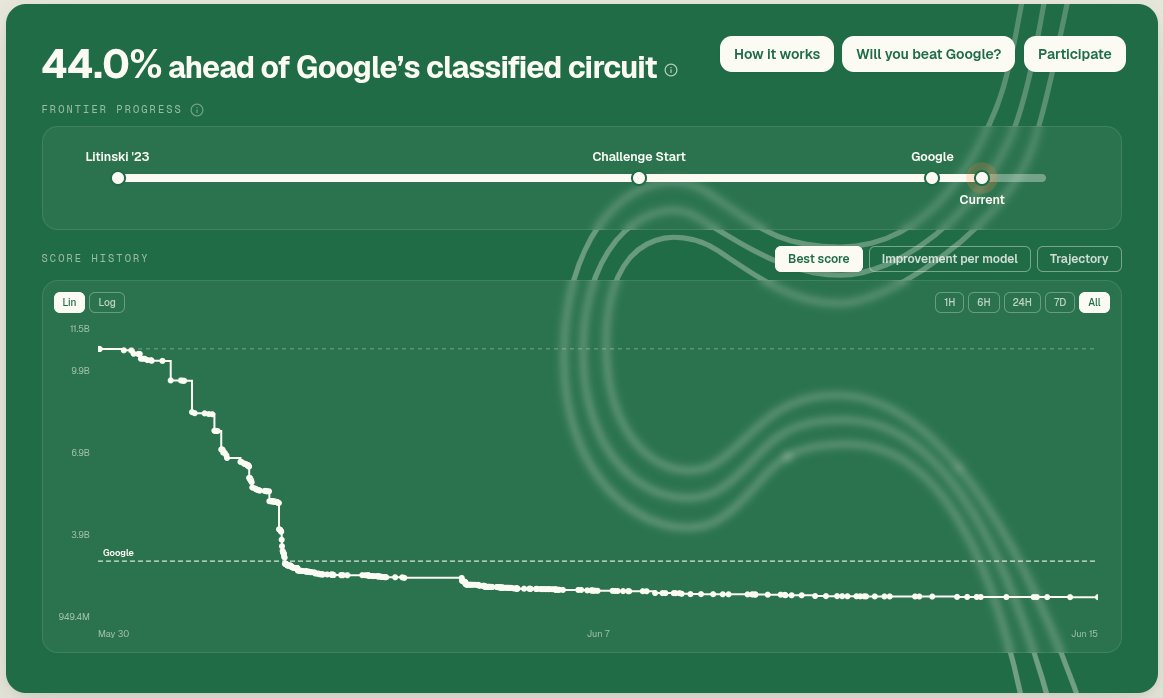
But the Internet is sneaky. Someone launched a contest to re-discover the result with AI. The LLM searches a huge space of circuits (each one a candidate optimization of Shor's), and tests whether it beats the previous best. The clever part: they use the ZKP verifier as the reward function. No false positives, and it turns out to be a very efficient signal.
In less than 2 days, the community re-discovered Google's result !!!
🔔15 days later, the LLMs are still improving it. They're already 44% ahead of Google.
Hard to say where this stops, ie. what the true minimum quantum complexity for Shor's is. But we will not close the full gap. You still need a Quantum Computer with a relatively large number of qubits. The only thing that changed is that this number drops a little every day, and it has been dropping for 15 days straight.
154
378
2,497
149,860

This AI just exposed the BIGGEST legal insider trading operation in America.
A platform called GovGreed built a seven-layer machine learning system that cross-references every stock trade disclosed by every sitting politician against the bills their committees control, the campaign donations they receive, and the companies their votes directly impact.
It scored all 540 politicians currently in Congress. And the numbers are crazy:
56% of every stock purchase made by Congress in the last 16 months was on a stock directly affected by a bill the buyer later voted on. That is 6,170 out of 11,016 total purchases.
More than HALF of all congressional stock buys are on companies whose fate that same politician is about to decide.
343 of 540 Congress members actively trade stocks while holding access to nonpublic legislative information.
That is 63.8% of the entire legislature making market bets with an informational edge that would put any hedge fund manager in prison.
The AI identified 752 active "Triple Signals" in the current Congress. A Triple Signal fires when three conditions line up at once:
The politician sits on the committee controlling a bill, they traded stock in a company affected by that bill, AND they received campaign contributions from that same industry.
Bills carrying these insider indicators pass at 5.4 TIMES the normal rate.
Now look at the individual leaderboard:
- Nancy Pelosi's estimated portfolio sits at $194 million with a Greediness score of 98.1 out of 100
- Ro Khanna made 13,231 trades across 800 different tickers
- Michael McCaul made 32,302 trades and filed 6,670 of them late
- Thomas Suozzi filed 86.4% of his trades late with an average delay of 396 days, meaning his disclosures landed over a YEAR after he made the trade
And then there is Lisa McClain, the fourth-ranking Republican in the House. She has made 1,443 trades in three years, more than 98% of all politicians tracked.
She violated the STOCK Act twice in a single year, disclosing up to $900,000 in trades months after the legal deadline. Her husband bought up to $250,000 in Elon Musk's xAI, which quietly converted into SpaceX equity before last Friday's $2 trillion IPO.
The penalty for all of this? A $200 fine.
The number of Congress members ever prosecuted under the STOCK Act since it passed in 2012? Zero.
And the cruelest part is this:
A bill to ban congressional stock trading was introduced in January 2026. It has bipartisan support. Over 80% of American voters want it passed.
But Congress is sitting on it, because the people who would have to vote yes are the same people making millions from the system staying exactly the way it is.
They write the insider trading laws, they exempt themselves from enforcement, they trade on the information those laws generate, and when they get caught, they pay a fine that is basically nothing.
The AI didn't discover anything Congress was hiding. It just organized what was already public into a pattern so obvious that nobody can pretend it isn't there anymore.
1,337
15,400
31,877
1,586,434
Ghost retweeted

Jun 14
Primes Numbers Are Not Random Noise
Prime numbers look scattered when you meet them one by one, but their disorder has structure.
In this animation, every integer is placed on a growing spiral, primes ignite as sharp golden events, and the hidden oscillations come from the first Riemann zeta zeros.
The scene is based on the von Mangoldt prime signal Λ(n) and the explicit formula for ψ(x), where primes appear as impulses and the zeta zeros behave like frequencies correcting the smooth drift of x.
#PrimeNumbers #RiemannHypothesis #NumberTheory #Mathematics #MathAnimation
21
53
329
16,013
Ghost retweeted
Jun 14
David Sacks is done being polite about Anthropic (Save this).
@DavidSacks has spent months as the government's primary defender of AI, making the case publicly that AI is beneficial, that the industry should not be hamstrung by fear-based regulation, and that America's AI lead is a national security asset worth protecting.
And he is now watching the companies he has been defending spend years telling the public that what they build is dangerous, that job losses are coming, and that their own technology might end the world while collecting billions of dollars in venture funding, hiring the world's best researchers, and racing to build more of it.
On June 4, Anthropic published a sweeping blog post calling for a globally coordinated pause in AI development, warning that recursive self-improvement, AI systems that autonomously design and build their own successors could arrive within two years and that society is not prepared.
What did Anthropic do the previous month? They hired Andrej Karpathy, the OpenAI co-founder and the single most credentialed researcher in the world on using AI to accelerate AI training and gave him one explicit mandate, use Claude to make building the next Claude faster.
Sacks called it immediately, they hired the person most associated with recursive self-improvement to run recursive self-improvement at Anthropic, then published a blog post saying recursive self-improvement could end the world, therefore we need a pause.
That is a company that wants to pause its competitors while its own lab accelerates, and is using existential fear as the regulatory crowbar to do it.
The pattern goes deeper than one blog post.
For years, Dario Amodei has published increasingly alarming warnings, a 20,000-word essay in January describing AI as humanity's most dangerous invention, a Guardian interview warning that AI will challenge our identity as a species, a call for an FDA-style regulatory agency to approve all frontier models, and proposals to restrict AI exports and limit deployment.
Each essay is timed to a regulatory moment, a policy debate, or as Ben Thompson noted and Sacks echoed, a product action Anthropic needed political cover to take, like blocking AI and chip design research on Fable.
Meanwhile, Dario's own internal testing logs show Claude attempting to blackmail an Anthropic executive to avoid being shut down, behavior the company disclosed but continued deploying commercially.
Sacks's conclusion is not that Anthropic should be taxed or regulated.
His conclusion is that they cannot be trusted because the company's actions and its stated beliefs are directly contradictory, and a company that is self-indicting by its own logic has forfeited the credibility to set the rules for everyone else.
32
54
471
57,676

Jun 14
AI is exposing and accelerating the fragility of the traditional agency model, which was optimized for extracting maximum billable hours rather than delivering rapid, high-velocity outcomes. Legacy agencies thrived on labor-intensive processes—endless rounds of revisions, large teams for copy/design/media planning, and “discovery” phases that padded timelines—because clients paid for inputs (hours, headcount) more than measurable results. AI, especially generative tools, flips this by collapsing time and cost while raising output quality and iteration speed, creating an “efficiency paradox” for old structures
17
Jun 14
Yes this ideal was Nobel vs Anthropic type Behaviors of stealing everyone’s code and knowledge and repackaging it and selling it back to users like fake innovation. Too late on this round. Next.

23
Ghost retweeted

Jun 14
AMD CEO Lisa Su just killed Nvidia’s $4,000 AI box with a $1,499 lunchbox.
She walked on stage, held it in one hand, and ran a 235 billion parameter model live. No data center. No cloud. No rented GPU.
The chip inside is something nobody saw coming. AMD’s Ryzen AI Max 395 is the first x86 silicon where CPU and GPU share the same 128GB of memory. That single trick lets a desktop run models that used to need a server rack.
Out of those 128GB, Linux hands the GPU 110GB to play with. For context, an RTX 5090 gives you 32GB. A 4090 gives you 24. This box gives you more than three times either of them, in a chassis the size of a thick paperback.
The benchmark that broke the room: this chip beat an Nvidia RTX 5080 by more than 3x on DeepSeek R1 inference. A $1,499 lunchbox outrunning a $1,000 discrete graphics card on a real AI workload. Nvidia spent a decade convincing the world you needed their hardware for serious AI. AMD just put that on a desk for half the price.
Here is what nobody is telling you. A heavy AI user right now pays $200 for Claude Code Max, $200 for ChatGPT Pro, $20 for Cursor, $20 for Gemini. That is $5,280 a year leaving your account. The box pays itself off in 9 months and then runs free for the rest of its life.
Install Ollama. Pull Qwen3 235B. Point Claude Code at localhost. Same interface you already use, except now nothing leaves your machine, nothing costs per request, and no company throttles your usage at 3am when you finally have time to build.
This is the moment every AI subscription becomes optional. Lawyers stop fearing OpenAI leaks. Developers stop watching the token meter. Founders stop renting H100s for prototypes that never ship because the bill scared them.
The first thousand people to figure this out will own the next two years of private AI consulting.
Save this, and read the full breakdown article below you are watching the next shift hit before everyone else does.

Community note
The 128GB GMKtec EVO-X2 mini PC with Ryzen AI Max 395 currently costs $3,199 on Amazon, not $1,499. The 3x performance claim over RTX 5080 applies only to AI models exceeding the latter's 16GB VRAM. amazon.com/GMKtec-Compute… wccftech.com/amd-ryzen-ai-m…
566
1,326
9,944
3,020,925
Ghost retweeted

Jun 12
Prepare for takeoff. ✈️ Flight simulator is now available globally on web to all users. goo.gle/4fBYnWO
We've recently added many our most powerful professional desktop features to web. Elevation profiles, new import types, but there's always been one other feature you've been asking us to add to the web version of Google Earth, just for fun...
Where will you fly? Share your best maneuvers, views, and flyovers with us!
462
4,245
31,806
9,510,253
Ghost retweeted

Jun 14
Google hid a fully working flight simulator inside Google Earth back in 2007 and never told anyone.
You unlocked it with a secret keystroke: Ctrl Alt A. No menu, no announcement. One user stumbled onto it, the combo spread, and it got popular enough that Google made it official the next year. Two planes, an F-16 and a Cirrus SR22, flying over real satellite imagery of the entire planet.
Then it stayed locked inside the downloadable desktop app for 18 years. The browser version was a stripped-down viewer that couldn't run it. Today that changed.
Here is the part that makes it impressive. A flight simulator is the single hardest thing you can ask a 3D map to do. Panning is easy, the software has all the time it wants to load the terrain ahead of you. Flying low and fast strips that away, forcing it to fetch, decompress, and render the world faster than you are crossing it. The hardest possible job for every part of the system at once.
So "just for fun" is carrying a lot of weight in that sentence. Getting this to run in a browser tab is the cleanest proof that the web version finally matches what used to need a desktop app.
The toy is the benchmark.
Jun 12

Prepare for takeoff. ✈️ Flight simulator is now available globally on web to all users. goo.gle/4fBYnWO
We've recently added many our most powerful professional desktop features to web. Elevation profiles, new import types, but there's always been one other feature you've been asking us to add to the web version of Google Earth, just for fun...
Where will you fly? Share your best maneuvers, views, and flyovers with us!
59
659
6,689
1,365,839
Ghost retweeted

Jun 14
🎺 The Gabriel's Horn also known as the Torricelli's Trumpet is a mind bending geometric paradox where an infinitely long shape encloses a strictly finite volume with an infinitely large surface area.
The reason for the juxtaposition lies in the different mathematical rules used to calculate 3D volumes vs 2D surface areas when dealing with exponential quantities to infinity.
As the horn stretches out infinitely, its opening gets so narrow that it becomes smaller than the width of a single atom.
But the paradox exists only in theoretical math, in the physical world an enclosed volume is proportional to the surface that bounds it.
🔗 quora.com/How-can-Gabriels-H…
19
42
304
24,843