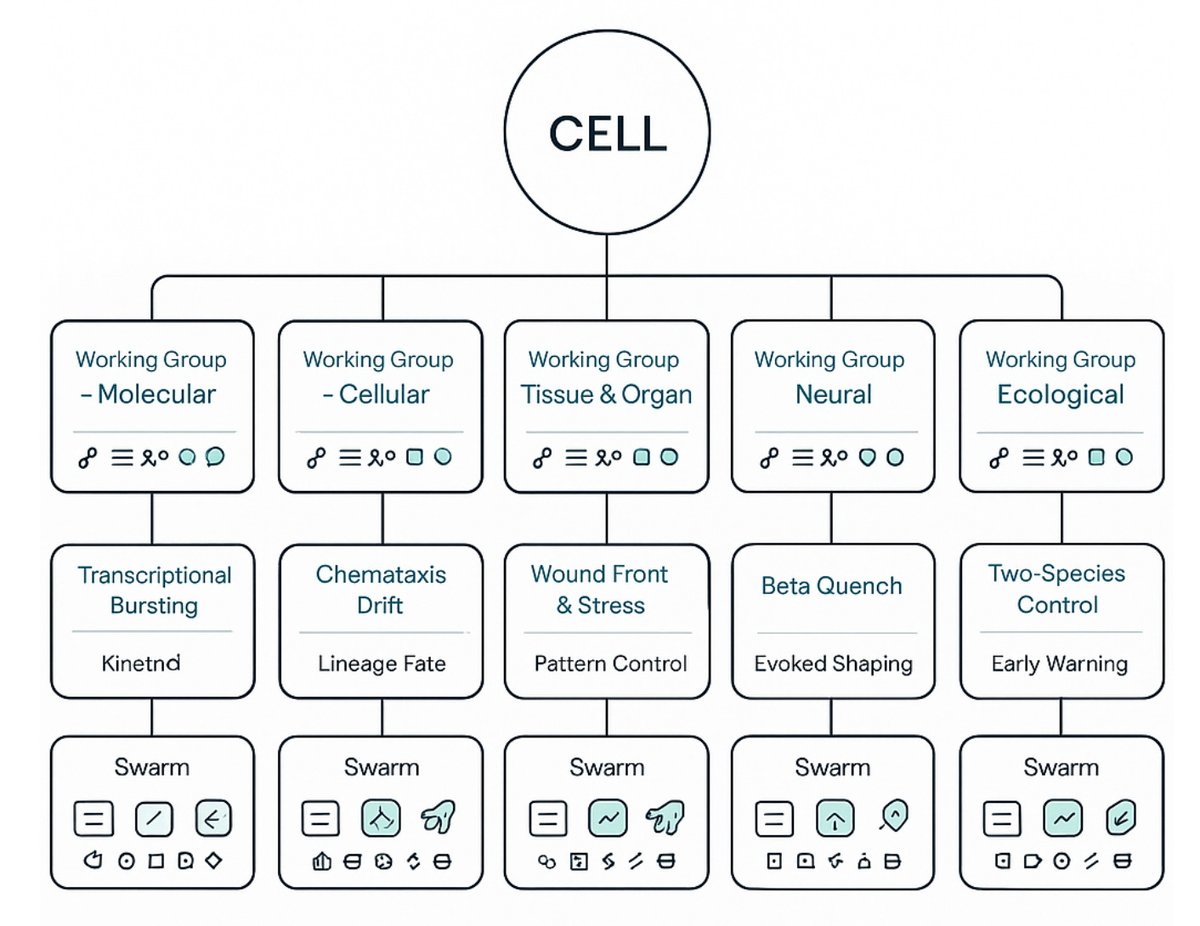
CELL: Consortium for the Equations of Life and Living Systems. Fusing MathBio, BioPhysics, CompBio and DescriptiveBio around an aggressive mathematical core.

Joined August 2025
45 Photos and videos
Pinned Tweet
Jan 16
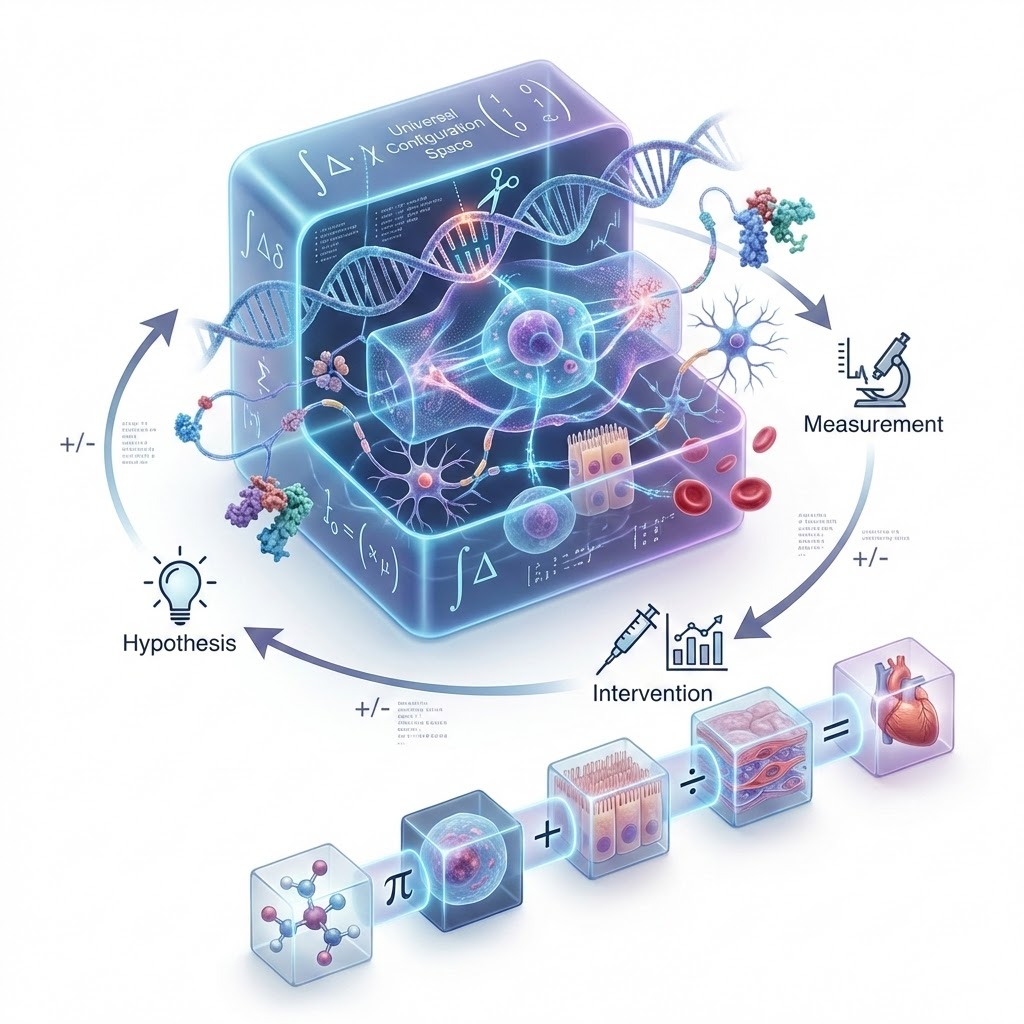
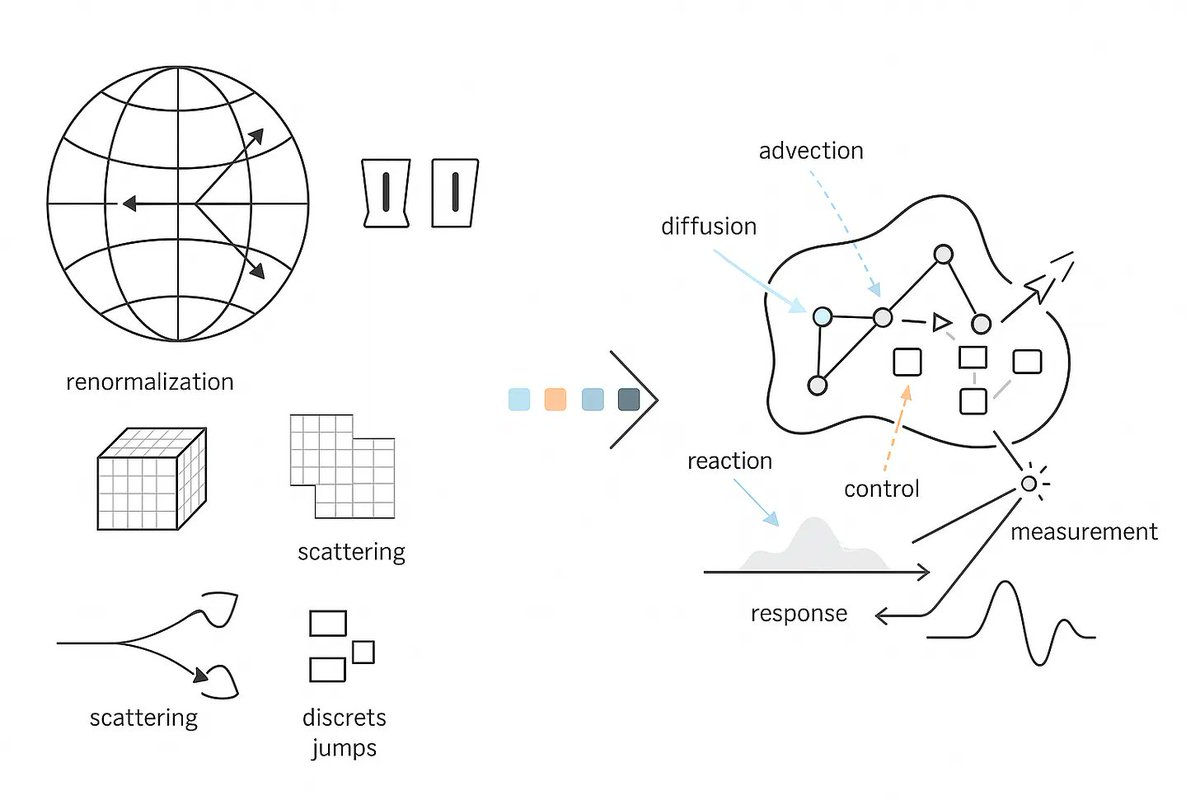
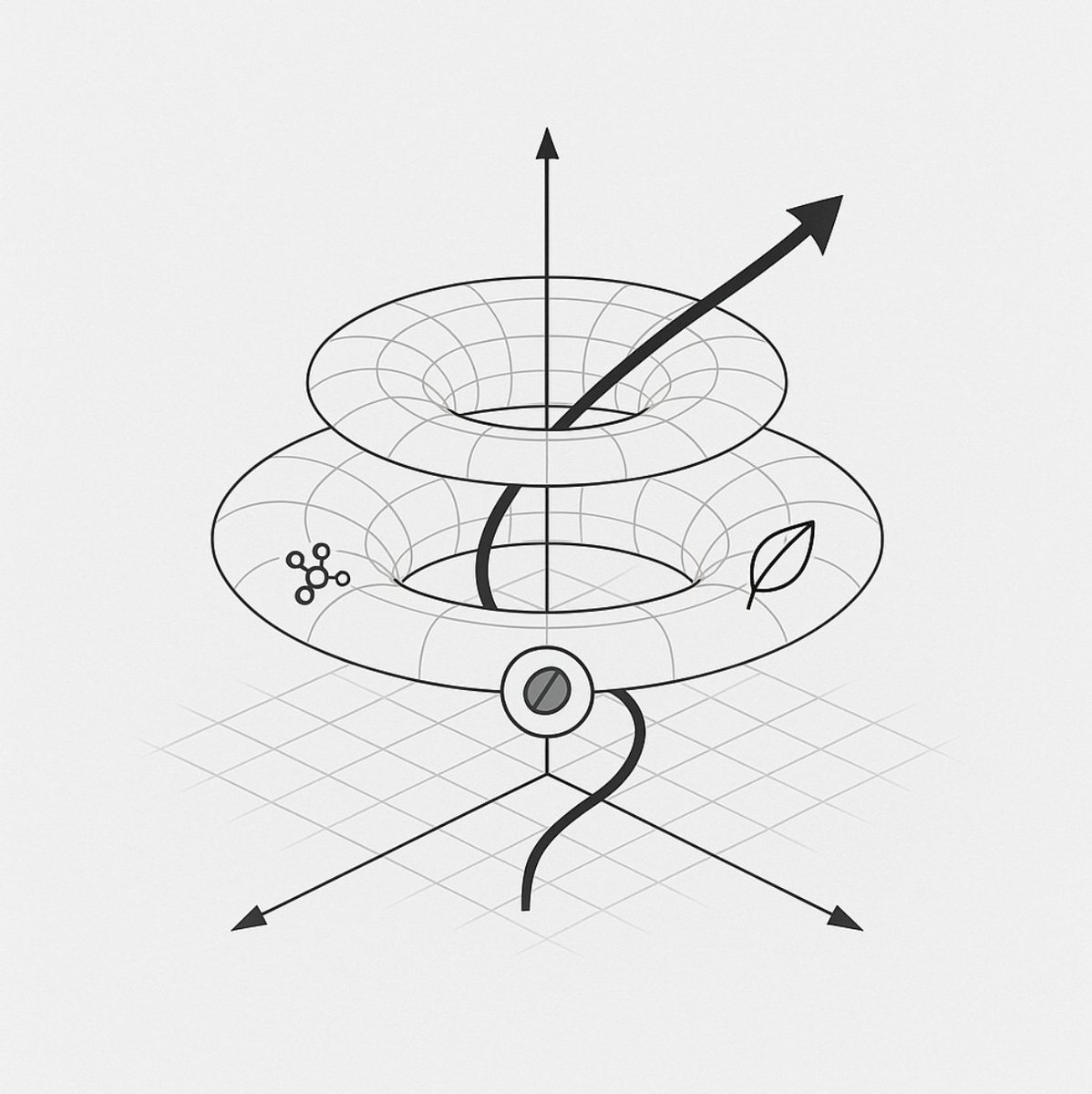
WHY ARE WE BUILDING CELL? We are building CELL because we want biology to be executable. When we perturb a system, edit a gene, apply a drug, or change a microenvironment, we want to predict what happens next, with uncertainty that is explicit and falsifiable. We want design loops that move from hypothesis to intervention to measurement without turning into a new bespoke modeling project each time. We also want transfer, across organisms, tissues, and contexts, without starting over whenever the assay changes or the experimental setting shifts. If you think mathematically, you will notice that interventions are transformations of state, so we need a language where transformations can be defined, learned, and composed. That is why we use operators. But operators are only as grounded as the state they act on. Biology’s state is hybrid at every scale, discrete choices like genotype, edits, alleles, and cell identity, continuous variables like expression and concentrations, and structured objects like lineage, spatial organization, and interaction graphs. So the first move in CELL is to define a scale-specific hybrid state space (what we call as a 'Mathematical Configuration Space' or a 'Universal Configuration Space') that assays can populate, perturbations can target, and constraints can bound, including conservation and budget constraints where they apply and an explicit accounting of uncertainty. Once that background is pinned, operators become testable objects that map state to state, and scale-to-scale composition becomes a technical question we can validate instead of a narrative we have to defend. In 2026, we are recruiting member volunteers to help galvanize the CELL community from the ground up. The work is concrete. Bring mathematicians, biophysicists, computational biologists, and empirical biologists into the same room for focused sessions on papers, concepts, and shared technical language that can actually move projects forward. If you have the time and the intent to contribute, DM us or email science collaborate@cellbiosf.org. If you care about open, rigorous science that is built in public and stays accountable to evidence, we want you in the loop. subscribe: cellbiosf.substack.com follow: x.com/cellbiosf #Biology #Math #CELL #AI #OpenScience
2
6
545
CELL retweeted
If leading AI companies are indeed approaching the point of recursive self-improvement, a coordinated, verifiable, and universally applied pause is probably the only responsible solution to mitigate several major AI risks; at least until safety guarantees are developed and demonstrated. Ensuring that such a moratorium is respected would require sincere collaboration between various countries and companies, but I definitely believe it is achievable if others follow in @AnthropicAI's footsteps.
Anthropic is calling for top AI labs to weigh slowing the pace of development, suggesting that AI systems are advancing so rapidly that they may soon be able to improve themselves without human intervention in ways that could pose societal risks. on.wsj.com/4ulkmFh
94
149
759
124,567
CELL retweeted
This is a phenomenal paper! I have been advocating Neural PDEs and Neural Operators for nearly 4 years now. It makes a brutal point about neural PDE solvers. Accuracy is the wrong religion if we refuse to price the altar. A learned simulator can look spectacular at inference time, yet still lose once you count data generation, training, tuning, and the fact that classical solvers can also run cheaply at lower fidelity. The real question becomes simple and severe. How many forward solves must the neural surrogate perform before its upfront cost is actually amortized against an error-matched numerical solver? The uncomfortable answer is that on clean toy PDE benchmarks, the threshold can sit in the hundreds of thousands of calls. But the deeper result is much more interesting. As the physics gets harder through dimension, rollout length, Reynolds number, and complex geometry, neural solvers begin to look stronger precisely because classical cost starts to explode. The real promise of neural PDE solvers may live less in benchmark accuracy and more in the regimes where simulation itself becomes economically and computationally painful. Do you which simulation is computationally painful? That’s right, Biology. arxiv.org/pdf/2605.15399 #Math #Biology
1
3
458
This is something I have been emphasizing since we started our work on Neural Operators. We very quickly went from simple fluid dynamics benchmarks to hard problems like building the first high-resolution AI-weather model, FourCastNet, and modeling turbulence in nuclear fusion. For those applications, we got speedup of 10,000 - million times. Simple benchmarks are great to test new architecture/algorithms work, but not the end.
Neural PDE solvers have seen exciting progress! 🌊 But despite growing adoption, we still don’t know 𝘄𝗵𝗲𝗻 we should use them instead of classical solvers. 🤔 Our new paper has a surprising finding: the harder the PDE task, the more cost-effective learned solvers become. 🧵👇
3
15
137
19,139
CELL retweeted
Neural PDE solvers have seen exciting progress! 🌊 But despite growing adoption, we still don’t know 𝘄𝗵𝗲𝗻 we should use them instead of classical solvers. 🤔 Our new paper has a surprising finding: the harder the PDE task, the more cost-effective learned solvers become. 🧵👇
2
26
89
29,721
CELL retweeted
What survives transformation? This is a strangely similar question I keep coming back to no matter which complex system I touch across mathematics, quantum physics, AI, or genomics. Because transformation is where shallow understanding breaks. Anything can look meaningful in its original coordinates. The real test begins when a system is acted on, measured, projected, perturbed, trained, compressed, evolved, or pushed away from equilibrium. What remains stable? What disappears? What changes shape but preserves identity? That is where the deeper structure starts to reveal itself. A system rarely tells you what it is doing. It moves everything at once. It stretches some directions, compresses others, rotates structure into unfamiliar coordinates, erases signal without apology, and then returns an output clean enough to make us think we understood the process. In quantum physics, the observable is bound to the operator. In AI, representation is shaped by learned transformations. In genomics, cellular state is governed by regulatory dynamics moving through noisy, high-dimensional biological space. Inputs and outputs are too crude. Performance is too shallow. At some point, you have to ask the more internal question. What directions does this system preserve? What directions does it kill? Where does the transformation stop mixing and reveal its native arithmetic? One deceptively simple tool I have found helpful is spectra and eigenspaces. For the uninitiated, an eigenvector is a direction that passes through a transformation and keeps its identity. The eigenvalue is the number the system assigns to that direction. The eigenspace is the full family of directions that share the same fate. The spectrum is the register of these hidden responses. In AI research, this mental model cuts sharply. Attention maps, embeddings, projection matrices, Hessians, kernels, covariance operators, and residual streams all carry spectral fingerprints. In genomics, gene regulatory networks may hide stable modes, collapsing modes, amplifying modes, and near-invariant axes of cellular response. Some signals dominate. Some decay. Some disappear into the null space. Some remain stable while everything around them churns. When we study spectra, we are asking what the system has learned to preserve, what it has learned to erase, and which hidden directions quietly govern its intelligence. The uncomfortable implication is that intelligence may live in the directions a system refuses to forget under pressure. Until we can see those directions, we are mostly grading outputs while missing the geometry that produced them. #math #AI #physics #genomics #complexsystems #intelligence
1
4
155
CELL retweeted
Folks simply do not realize what an incredible engine of innovation US academia has been. It's already being dismantled. But we are resilient to an extent. If this trend continues & academia is actually decimated, the repercussion will be felt for decades. 2/
2
2
53
4,905
CELL retweeted
This is not simply a new pancreatic cancer drug. It is a reminder that even “undruggable” biology can become treatable with persistence. Daraxonrasib doubled median OS vs chemotherapy in RAS G12 metastatic pancreatic cancer: 13.2 vs 6.6 months. A remarkable ASCO moment. #ASCO26 @DrChoueiri @TiansterZhang @CathyEngMD @montypal @tompowles1 @brian_rini @cdanicas @GlopesMd @PGrivasMDPhD @nataliagandur @yekeduz_emre @neerajaiims @ASCO @ONCOassist @OpenMedicineHQ @MedwatchKate @scserendipity1 @CParkMD @urotoday @OncLive @crisbergerot @urologysummit @SuyogCancer @Larvol @IMG_Oncologists
24
277
1,355
192,645
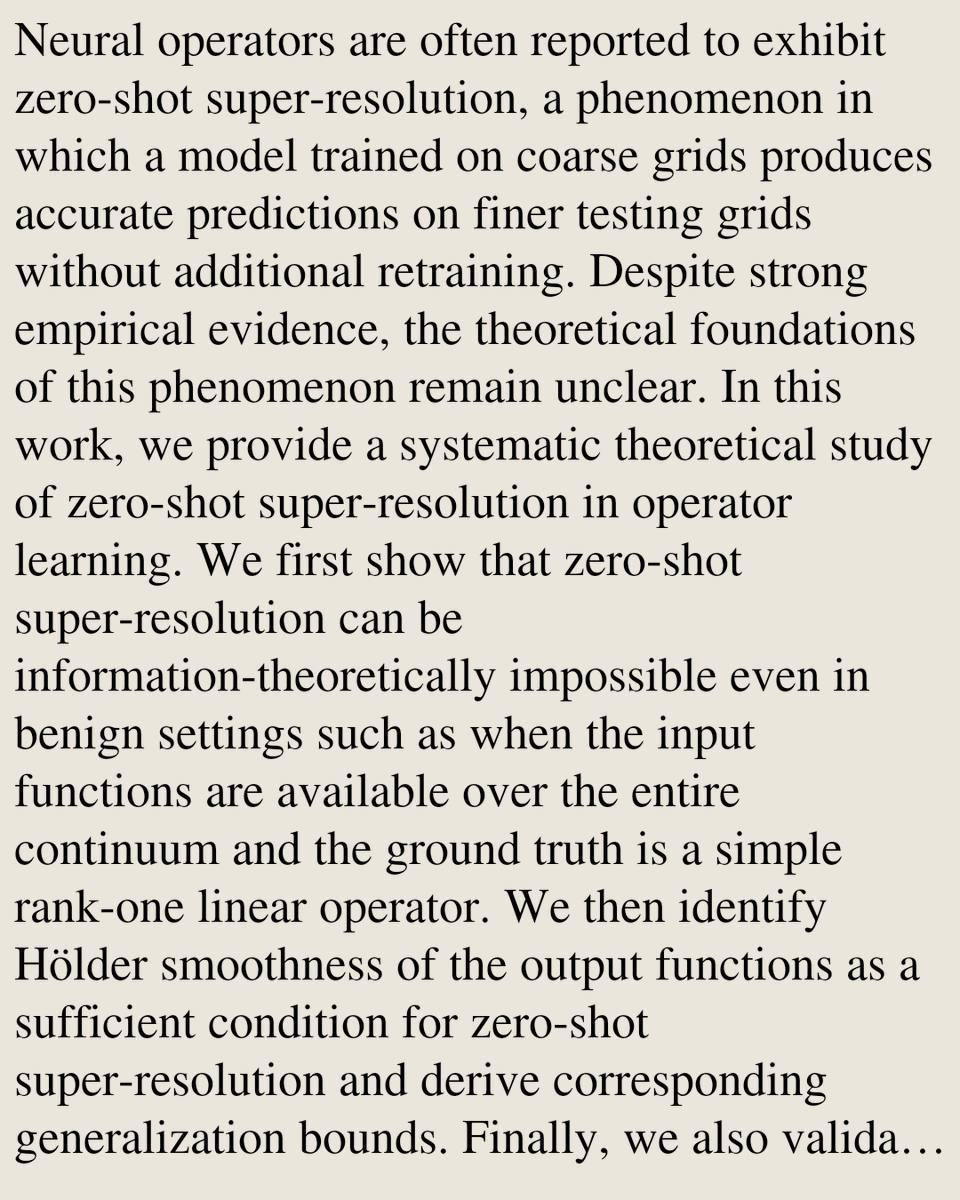
Nice work studying zero shot super resolution in neural operators.
Is Zero-Shot Super-Resolution Possible in Operator Learning? Unique Subedi, Ambuj Tewari arxiv.org/abs/2606.00296 [𝚜𝚝𝚊𝚝.𝙼𝙻 𝚌𝚜.𝙻𝙶 𝚖𝚊𝚝𝚑.𝙰𝙿]
1
4
35
5,311
CELL retweeted
We’re heading to @icmlconf in Seoul from July 6–11, to meet exceptional Machine Learning Engineers, ML Research Engineers and ML Research Scientists at all levels. If you want to solve problems that have a tangible impact on human health alongside a brilliant team, we would really like to meet you. Check the comments for the link to meet us in person👇 See you in Seoul! #ICML2026
7
6
105
7,800
CELL retweeted
Took me a while to figure out what all the ESMFold2 rage was about. At first, the benchmarking data didn't look super remarkable to me but it turns there are many impressive aspects: - Fully open source, open weights massive ESM Atlas (1.1B structures vs 0.2B for AF3). - SOTA performance despite no MSA use. MSA search and triangular attention were simply taken out of the base model. - Direct consequence, super low latency inference: 1024-residue protein structure prediction in 9 secs, still outperforming prior models on antibody-antigen tasks. - Best in class PPI and antibody-antigen results. 65% pass rate on antibody-antigen benchmarks after inference-time scaling, significant improvement over AF3. - Tons of experimental data, in particular with lab-validated miniprotein binders plus single-chain antibodies across 5 targets in cancer and immunology. Binding affinities consistent with therapeutic activity. - Inference-time scaling benefits PPI: Multiple seeds selection by confidence show real gains on challenging antibody-antigen predictions, leading to comments/hypotheses that it has learned an energy-function-like behavior via the folding module. - Base model works without MSAs, but providing them further boosts prediction quality on difficult protein-protein interaction cases. One caveat: No true scoring for protein-protein interactions, making it harder to assess which specific residues or domains are reliably involved in binding.
Today we're announcing ESMFold2, an open scientific engine to power prediction, design, and discovery across protein biology. The new model delivers state of the art performance on protein interactions, especially antibodies, a critical modality for therapeutics. We have designed and validated miniprotein binders and single chain antibodies across five therapeutic targets that are important in cancer and immunology. We are seeing very high success rates, and affinities at levels consistent with therapeutic activity. We’re also releasing an atlas of 6.8 billion proteins, and 1.1 billion predicted structures. ESMFold2 is built on a state of the art language model that has been trained on billions of protein sequences. A world model of protein biology emerges through language modeling. We’ve used the techniques of mechanistic interpretability developed to understand large language models to understand the concepts ESM uses to represent proteins. The model’s representation space has a compositional organization of features across scales, levels of complexity, and abstraction, that reflects and mirrors the understanding of protein biology developed through a century of empirical science. This understanding emerges without prior knowledge, just from language modeling of protein sequences. Language models are becoming a powerful substrate to understand and program biology. The design of protein interactions is one of the most fundamental problems in biophysics, and has critical implications for the discovery of new medicines. A simple gradient based search with the model was able to discover high-affinity protein binders. I'm excited by the potential this has to accelerate basic science and the understanding of proteins. And especially for the new avenues it opens up for therapeutic design and medicine.
10
22
189
71,024
CELL retweeted
May 29
We’re taking steps to accelerate defensive progress in biology: - Launching Rosalind Biodefense to help trusted builders develop new biodefense and pandemic preparedness capabilities.
 - Expanding trusted access to GPT-Rosalind for select U.S. government and allied partners supporting public health and biodefense missions.
 Advances in biology can strengthen our ability to prevent, detect, and respond to biological threats. 

Our goal is to help build a more robust ecosystem – giving trusted defenders frontier AI to develop and operate new defenses for public health and biodefense. openai.com/index/strengtheni…
215
230
2,183
418,860
CELL retweeted
We’re hiring in my group at Calico. We build Borzoi and its successors—deep learning models that predict how every nucleotide shapes cell-type-specific gene regulation—and apply them to interpret human genetic variation.
1
33
164
21,780
CELL retweeted
Just want to give a shout-out to David Kelley @drklly who I think often does not get the credit he deserves (outside our core community). I want to highlight why I think he is such a fantastic scientist and leader in regulatory genomics. 1/
7
32
263
46,658
CELL retweeted
"When scientists are absent from public conversations, misinformation fills the space". We have to discuss science openly in public. That means not just advertising & hyping & retweeting but also educating, discussing, criticizing, defending, arguing. All of it.
The hill I will die on - we have to rethink graduate training. “Scientists are trained for a world where data speaks for itself. Where misinformation moves slowly. Where scientific expertise naturally rises above noise. That world is gone.” sciencepolitics.org/2026/03/…
3
10
56
4,814
CELL retweeted
Apr 11
Demis Hassabis says AI won’t just accelerate drug discovery. It will replace the process entirely. The pharmaceutical industry finds drugs the same way it has for decades. Synthesize a compound. Test it on animals. Test it on humans. Wait years for approval. Hope the molecule doesn’t kill someone along the way. Every step is physical. Every step is slow. Every step is expensive enough to make most diseases not worth curing. Hassabis: “We’re focusing on solving the rest of the drug discovery process, which is a lot of chemistry, designing the compounds, checking it’s not toxic, and all the different properties you need for drugs to be safe.” That sounds incremental. It isn’t. AlphaFold solved protein folding. Isomorphic Labs is now working through the rest of the chain. Compound design. Toxicity screening. Safety profiling. All computational. None of it requires a lab. Hassabis: “I think we’ll have that whole drug design engine ready in the next five to 10 years.” Not a tool that assists chemists. A system that replaces the chemistry. But designing the drug was never the bottleneck that killed people. Clinical trials were. A single drug takes over a decade to move from lab to patient. Most of that time isn’t science. It’s bureaucracy, logistics, and the blunt reality of testing molecules on living tissue one dose at a time. Hassabis: “Simulating parts of the human metabolism, also stratifying patients to make sure that certain patients get exactly the right type of drug that’s suitable for their genomic makeup.” Simulate the patient before you treat the patient. Map individual DNA. Model personal metabolism. Test the drug on a digital replica before it touches a vein. Not personalized medicine as a marketing phrase. Personalized medicine as an engineering output. The final wall is regulatory. The FDA exists because humans make mistakes with molecules. Every approval gate was built to catch errors that cost lives. The entire structure assumes the process is fallible. What happens when the process stops being fallible. Hassabis: “Perhaps like the animal testing is not needed anymore, maybe we can go up the dosage ladder quicker, because you can rely on these models.” He’s not speculating. He’s describing a sequence. AI-designed drugs enter the existing pipeline. A dozen compounds go through full traditional trials. Regulators collect data. They back-test model predictions against real outcomes. Hassabis: “Then the government and the regulatory bodies see that and they have enough data to sort of back-test the predictions of those models.” When the models prove more accurate than the trials they’re meant to replace, the trials become the bottleneck. Not the science. The paperwork. Animal testing shortened. Dosage ladders compressed. Entire stages of the pipeline collapsed into computation. The drug doesn’t get discovered faster. The drug gets discovered differently. The laboratory moves from a building to a server. The clinical trial moves from a hospital ward to a simulation. The patient moves from a statistic to a genome. Hassabis isn’t promising a cure for one disease. He’s describing the architecture that makes curing disease an engineering problem with a known solution path. The bottleneck was never biology. It was the speed at which humans were allowed to solve it. That speed limit is about to be revoked.
18
95
421
43,821
CELL retweeted
Today, our group at @Mila_Quebec and the lab of @francesarnold at @Caltech just released a new paper I contributed to, exploring how multimodal generative modeling could accelerate protein sciences! ⬇️
What if AI could invent enzymes that nature hasn’t seen? 👩‍🔬🧑‍🔬 Introducing 🪩 DISCO: Diffusion for Sequence-structure CO-design 14 rounds of directed evolution and over a year of wet lab work. That's what it took to engineer an enzyme for selective C(sp³)–H insertion, one of the most challenging transformations in organic chemistry. DISCO surpasses this with a single plate. No pre-specified catalytic residues, no template, no theozyme, no inverse folding, just joint diffusion over protein sequence and structure. 📝 Blog: disco-design.github.io/ 📄 Paper: arxiv.org/abs/2604.05181 💻 Code: github.com/DISCO-design/DISC…
5
72
407
63,994
CELL retweeted
💥~ Introducing Odylith.AI AI coding agents can be brilliant. They can also be wrong with extraordinary confidence. In chess, the first move does not decide the entire game. But it shapes the position. It defines the risk. It opens some lines and quietly closes others. Working with coding agents feels the same. The opening matters. A repo gives an agent a lot of context. It rarely gives enough intent. It usually does not encode ownership, current constraints, recent decisions, or a rigorous definition of done. Even very strong agents still have blind spots, and once they drift early, the rest of the session turns into cleanup. That is the problem we built Odylith for > odylith.ai Odylith is a repo-local operating layer for agents like Codex and Claude Code. It grounds the agent before work begins, then keeps execution disciplined as the session unfolds. In the current published proof against the raw Codex CLI lane, Odylith reached valid outcomes 12.43 seconds faster on median, used 52,561 fewer median input tokens, and improved required-path recall, precision, and expectation success across 37 seeded scenarios (full bench on github). This is the first public launch of Odylith.AI, which means we are just getting started. If you use AI coding agents on real codebases, I want your read on it. Tell me what feels sharp, what feels rough, and what should improve next. PS: Please share and amplify. Please star the github repo if you like the project here so other operators can benefit github.com/odylith/odylith #Odylith #AI #Agents #CODEX #ClaudeCode
1
2
2
198
CELL retweeted
💥Teaser: [logo reveal] Odylith combines “Ody,” suggesting a journey, with “lith,” from the Greek lithos, meaning stone. The result is a name that suggests movement guided by permanence: exploration anchored by a stable core. It reflects the idea at the heart of the product: motion with a center, exploration with structure, and a path toward agentic AI swarms that replace rigid monoliths with adaptive, living networks. Coming soon. April 7th, 2026. Mark your calendars for first access. Just comment #Odylith to this post and I will ensure everyone commented gets access. #AI #Agents
1
1
306
CELL retweeted
At @GoogleDeepMind, we believe AI is the ultimate catalyst for science. 🧬 The best example of this has been the AlphaFold database (AFDB) of protein structure predictions which has been used free of cost by more than 3.3 millions researchers across the world! Today, in collaboration with @emblebi, @Nvidia and @SeoulNatlUni, we are expanding the database by adding millions of AI-predicted protein complex structures to the AlphaFold Database. To maximise global health impact, we’ve prioritised proteins that are important for understanding human health and disease, including homodimers from 20 of the most studied organisms, including humans, as well as the @WHO’S bacterial priority pathogens list. Read more here: embl.org/news/science-techno…
87
400
2,495
164,411
CELL retweeted
There are too many companies popping up that market biological root cause inference as though it were already a solved science problem. In reality, any system claiming to infer mechanism across functional genomics and physiology is facing an inverse problem on a massively underdetermined multiscale network, where a thin, noisy clinical snapshot is being used to reconstruct latent regulatory state, pathway activity, cell type composition, compensatory feedback, and causal direction. Even the best research groups across the world working on gene regulatory networks, single cell perturbation biology, and metabolic flux still struggle with identifiability, sparse observability, context dependence, and experimental validation, which is why grand claims built on limited clinical data deserve very hard scrutiny. #genomics #biology #clinical #diagnostics
1
1
3
172