
Turn financial models into production infrastructure. API-accessible. AI-native via MCP. Self-documenting. Born from a platform acquired by Goldman Sachs.
Joined April 2013
- Tweets 479
- Following 2,869
- Followers 3,317
- Likes 289
22 Photos and videos



Pinned Tweet

May 24
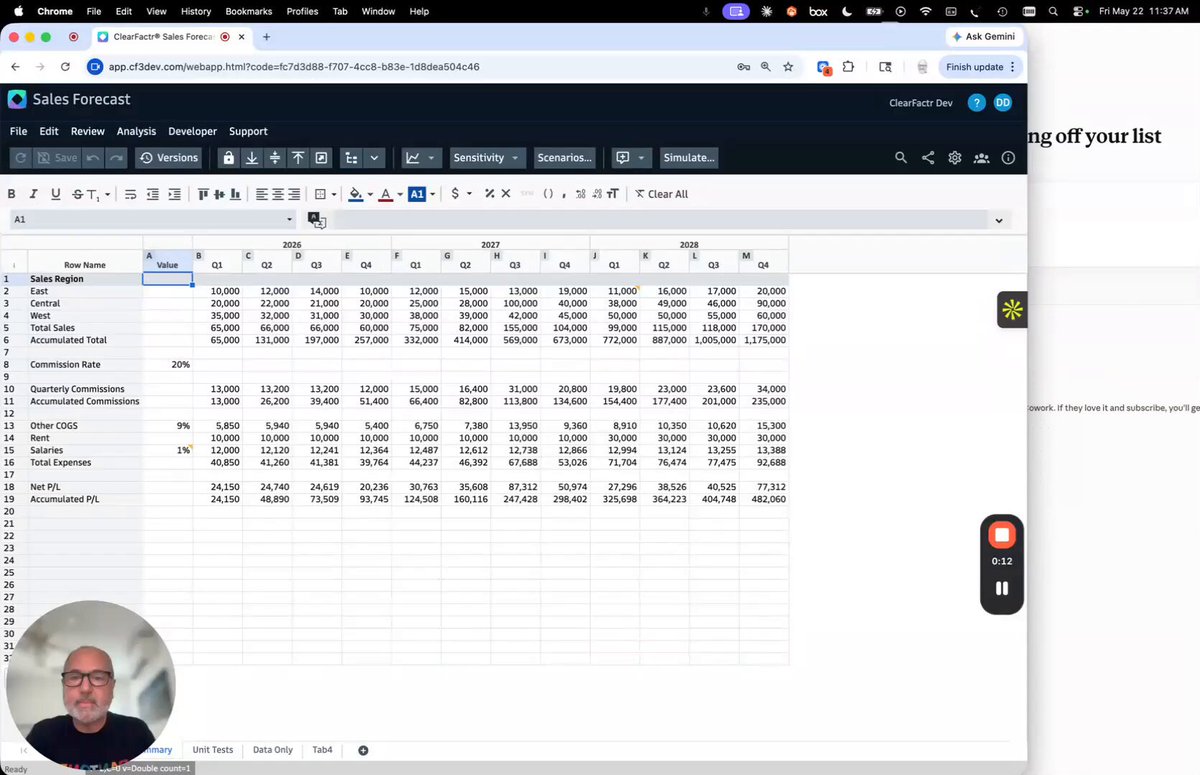
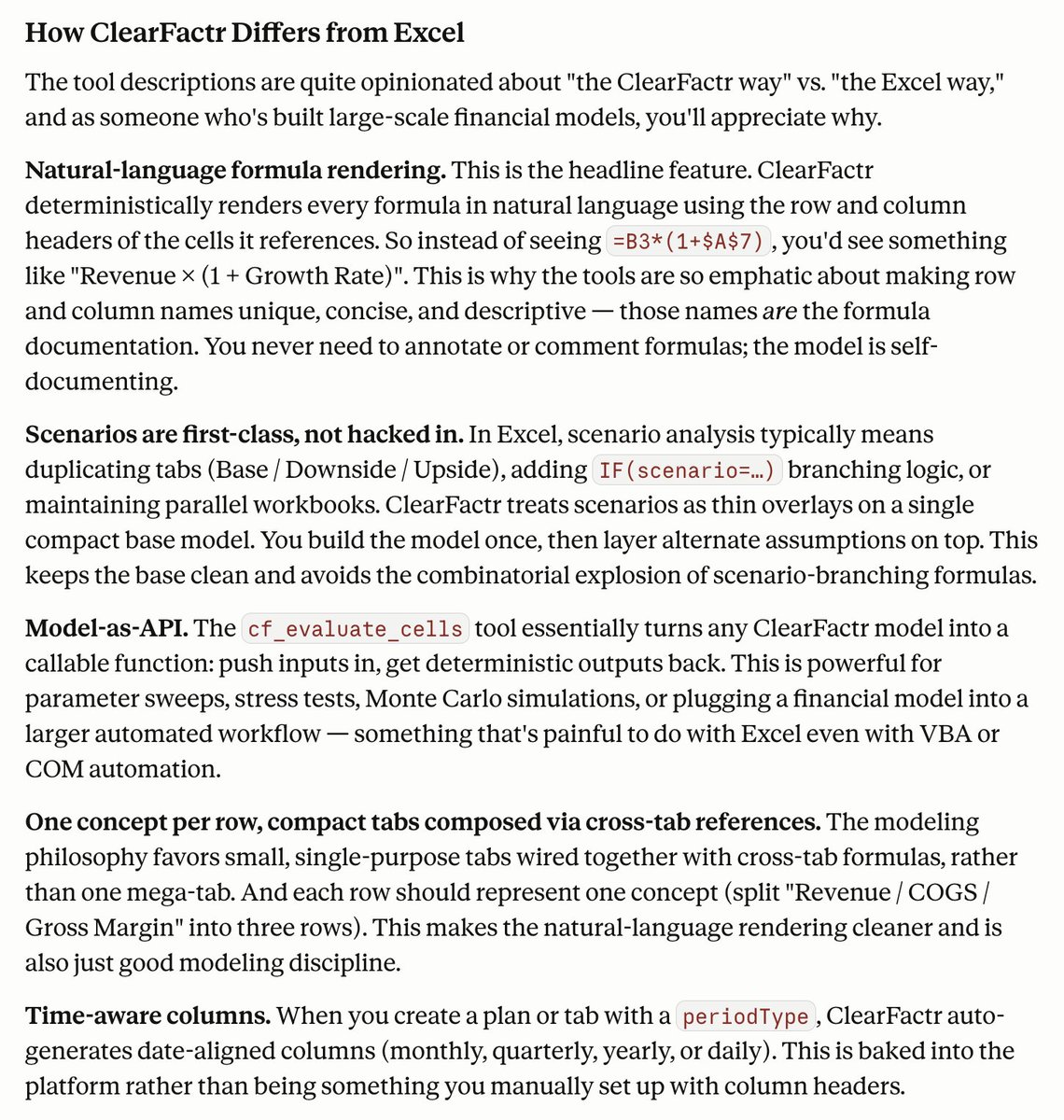
Check out our new #MCP Server in action. You'll see #Claude reading from and writing to a ClearFactr model, using it like an on-the-fly calculator, and saving scenarios.
This opens up a whole new world of possibilities for #AI #Agentic workflows, but where the calculations remain 100%:
✅ Deterministic
✅ Explainable
✅ Auditable
✅ Governed
Lastly, it bears spelling out what's in the video intro: ClearFactr's MCP Server can *also* create models from scratch, but when it does that, they go directly into ClearFactr.
They're not first created as standalone Excel files.
If you're already drowning in spreadsheets (and associated operational risks) from too many files to count, unleashing the robots to make thousands more of them might not be the best path forward. Additionally, creating them "the ClearFactr way" means they can be dramatically smaller, faster, easier to understand, and less likely to break, because the agents can take advantage of all of the native platform capabilities.
Contact us to take this out for a spin!
1
71
Jun 10
We like to say: "The fastest code is the code that is never called."

Elon Musk literally broke down his 5-step process for applying first-principles thinking to build anything:
7
Jun 2
This post was written 100% by hand. The @ClearFactr blog post it refers to was written 100% by #AI, aimed at the source code that drives the feature. Yes, it's laden with em-dashes 😂.
But laden with benefits, this powerful new capability was also written, almost 100%, by #AI: front to back, the whole shebang. It seemed appropriate to complete the journey by letting #AI describe its own work, and to skip the endless word-smithing that would have easily burned up precious time for little marginal effect. I fully-owned the prompting 😉.
The opportunity for the tool had been apparent for a long time, via a combination of oft-repeated user experiences: first, importing crazy #spreadsheets and wanting to easily reconfigure them to capitalize on ClearFactr's unique features; and second, as an assistant to move things around in the important formative stages of a building a new compute-model from scratch. [Has "model" been permanently co-opted by "LLM"? 🤦♂️]
Check out the fascinating story describing the #SoftwareCapital that made this possible.
clearfactr.com/blog/the-feat…
1
1
26

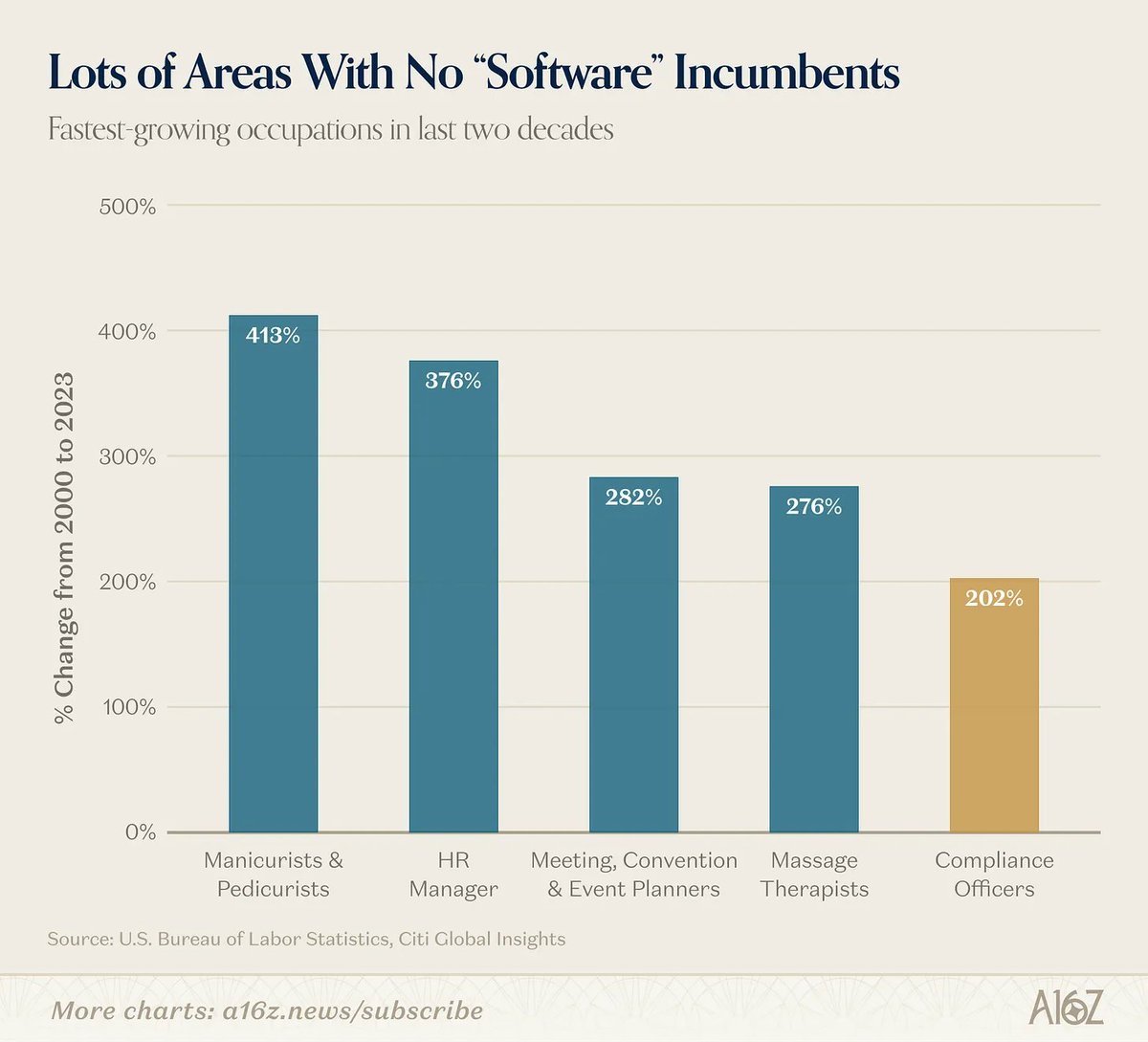
Compliance officers are one of the fastest growing occupations in America.
Compliance is a bigger business than you'd think. Every dollar that leaves or enters a business: paying employees, reporting revenue, and moving capital are subject to compliance.
As AI clears the "good enough to trust" bar and sales cycles speed up, there may finally be an opening for startups.
Full piece from a16z's @jamdac and @astrange: a16z.news/p/everything-every…

62
95
716
216,904
ClearFactr retweeted

May 26
I just got back from SF and I FEEL INSPIRED.
I spent 5 days with frontier AI model teams, AI startup founders, and 3 billionaires.
My takeaways:
1. I had lunch with 3 billionaires. All of them are buying SaaS companies and rebuilding them agent-first. They were deeply inspired by Bending Spoons and Ryan Cohen's eBay deal. Buy the company, cut the headcount, rebuild the tech, add agents, add features, make more valuable experience, raise prices.
2. The frontier model companies are hungry for usage data from the field. They can see API calls and token counts. They can't see the actual workflows. If you're deep in a niche using these models in ways the model companies haven't seen, that understanding is incredibly valuable. Usage intelligence is the new alpha.
3. Consumer AI is massively underbuilt. Every billboard in SF is either B2B inference infrastructure or vertical agent companies. The entire city is optimized for enterprise. Meanwhile you have companies like Cal AI doing $50M ARR in 18 months as a consumer app. I met with a cool few teams doing consumer AI (@paulscherer / @ekuyda)
4. MCP came up in literally every conversation. The companies exposing their product as MCP endpoints are getting pulled into deals they never pitched for. The ones that aren't are becoming invisible to agents. This is the new SEO. If agents can't find you, you don't exist. Building products for agents is the new zeitgeist in general.
5. Not uncommon for hot seed rounds to be $25-50 million valuations. I saw a Series A at $450 million
6. If I had a dollar every time someone mentioned "forward-deployed engineer" this trip I could have funded a seed round. It's the hottest role in SF right now. The person who sits between the agent and the customer, making sure everything actually works.
7. The mood around open source shifted. A year ago it felt like open source was chasing the frontier models. Now founders are telling me Gemma and DeepSeek are good enough for 80% of what they need at a fraction of the cost. The "which model do you use" conversation is being replaced by "which model for which task." Model loyalty kinda feels dead.
8. Voice agents came up more than I expected. Multiple founders told me voice is the interface for the next billion users. The billion people who will never type a prompt will absolutely talk to one.
9. The Obsidian community in SF is weirdly intense. Multiple founders showed me their vaults unprompted. Like showing someone your home gym. It's a flex now. The quality of your knowledge base (second brain?) is becoming a status symbol among builders.
10. Maybe it was just the people I met but the age of the founders is shifting. I met more founders over 40 this trip than any trip before and more founders under age 21 than ever before. Founders getting older and younger at the same time.
11. I spoke to a lot of fast-growing startups, VCs and frontier models who are hiring content creators right now.
12. The restaurant scene in SF is actually better than it's been in years. Founders are going out more. Alcohol is out, not surprisingly.
13. SF doesn't feel like the only place anymore. We all have access to the same frontier models. We all read the same X feed. A founder in NYC or Lagos is calling the same APIs as a founder in SoMa. So in the past it felt like SF was always lightyears ahead, doesn't feel that way anymore. It's okay not to live in SF and have BIG DREAMS.
14. The coworking spaces in SF are half empty but the coffee shops are packed. People want to be around people. I had a few startup ideas here....
15. Walking around the Mission I noticed something: the street-level businesses, the taquerias, the barbershops, the laundromats, none of them use any AI at all.
16. I heard the phrase "agent debt" for the first time. Like technical debt but for agents. When you hack together an agent workflow fast and never clean it up, the system prompts conflict, the memory gets polluted, the tools overlap. 6 months later the agent is doing weird things and nobody knows why lol.
17. Met a few people who carry two phones now. One for personal. One that's basically an agent terminal running Telegram or iMessage connections to their agent fleet.
It's always amazing to get that dose of inspiration in SF. I FEEL INSPIRED.
But I'm so happy to be back home, locked in and building.
We're 12-18 months into a shift that will take 15 years to play out. The urgency in every conversation was real.
What an incredible time to be building.

496
574
6,213
636,027
ClearFactr retweeted

May 24
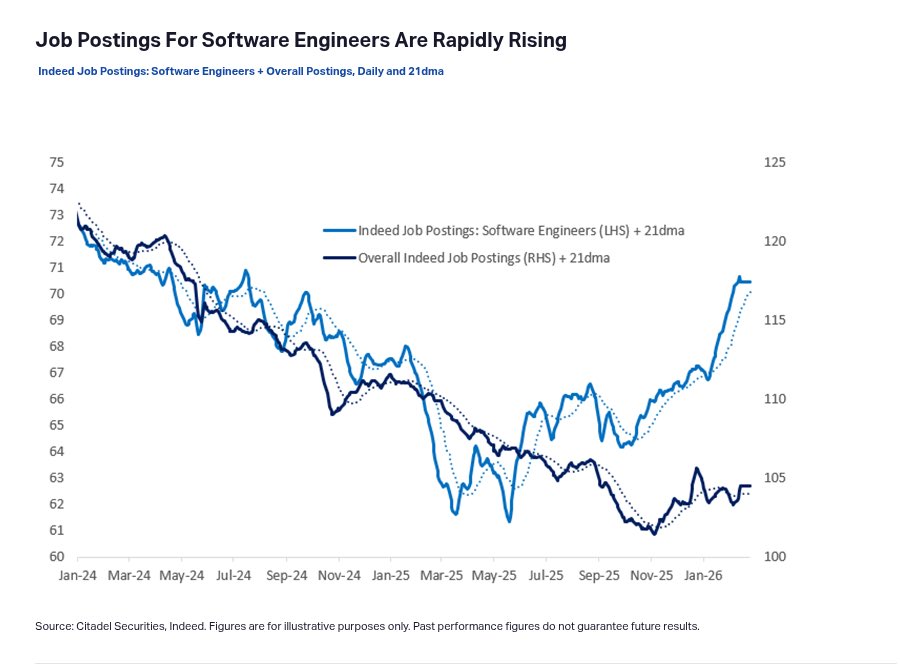
Q: How are job postings for software engineers rising rapidly despite AI agents automating coding?
A: Because there’s far more code to manage than ever before. We’re already seeing a 14x YoY increase in GitHub commits, and it’s accelerating.
AI has dramatically lowered the cost of writing code, so it’s now being used across far more businesses, applications, and use cases.
We’re at the beginning of a massive productivity boom driven by the proliferation of bespoke software throughout the entire economy.
Coding has been AI’s breakout use case this year. The fact that it’s increased demand for software engineers — rather than decreased it — should call into question the entire “AI will cause mass job loss” narrative.
827
1,466
9,117
1,631,292
Apr 21
"What's happening?" This.
If you build or use financial models, or software that makes use of those, you'll want to check this out.
linkedin.com/posts/deanzarra…
11
Mar 21
An #ROI of 4,670%. For those in the back: Four thousand, six hundred, and seventy percent.
That’s what #Claude told me an enterprise ClearFactr customer might expect from using the platform at scale. It shocked even me. But there’s more...
We’ve all heard it: “Sell the benefits, not the features.” ClearFactr certainly has plenty of features, and they’re there because they produce great benefits. Precisely quantifying them has always been a bit fuzzy, beyond the “Dude! We did with ClearFactr in three months what otherwise would have taken a year.”
A while back I wrapped up the entire story into what I now call our Big Picture deck: just two slides, basically your firm’s spreadsheet-riddled-life before and after ClearFactr. Those slides became a series of blog posts. I fed the slides into Claude and said (paraphrasing): “Make me a financial model that computes an ROI from these two slides, where all the problems depicted on the first slide turn into the benefits depicted on the second slide.”
Five minutes later or so, I had my Excel file. Of course, I immediately uploaded it into ClearFactr. In a very meta way, I wanted to have ClearFactr explain the benefits of ClearFactr to me. Claude produced a nicely organized model across three tabs, one for inputs, one for various computational details and one for a summary. Super impressively, it quantified all the nuances of the Big Picture.
The Table of Contents tool quickly told me the overall computational lay of the land. Between that and the “root cell” indicator, ClearFactr told me that the number of spreadsheets in the example company, 500, wasn’t actually wired into anything. Yes, a design bug in the model!
I went back to Claude and pointed this out. Here’s some of what it said back:
“Good catch — you're right, the "Number of legacy spreadsheet models" input is just sitting there unused." (see comments below)
Another thing popped out at me: pricing, a necessary component for any ROI calculation. I hadn’t given Claude any guidance on that. I went back to Claude and asked it to justify it, and it did so on numerous measures. Suffice to say, maybe ClearFactr, Inc. is leaving money on the table… or, you can cut the pricing assumption in the model and the ROI just goes up further.
I won’t spend more words on the particulars of the model here. I’ll likely do that in subsequent posts. Suffice it say, there are a lot of inputs corresponding to all the potential pitfalls of hashtag#spreadsheets at scale, and not everything may apply to your situation. This is precisely where scenario analysis is required, and that’s just one of ClearFactr’s strong suits.
But the model’s math is both deterministic and sound. As my friend @brianlaungaoaeh told me two days ago, if it’s only 25% applicable, you’re still potentially looking at a four-digit ROI.
Reply in the comments and I’ll send you the Excel file. Better yet, ask to see it via ClearFactr where you can compare the two experiences side by side.
#spreadsheets #ai #Claude @AnthropicAI
From LinkedIn: linkedin.com/feed/update/urn…
32
ClearFactr retweeted

Feb 27
Palantir CEO Alex Karp told you the most important thing about the Pentagon vs. Anthropic standoff.
And nobody is connecting the dots.
Watch and save this clip, then read this thread.
Karp said something most tech CEOs would never say out loud:
"A small island in Silicon Valley that would love to decide what you eat, how you eat, and monetize all your data should not also decide who lives in your country and under what conditions."
He's talking about his own industry.
And his argument is simple.
There are elections, there are rules.
There is a transfer of power from one president to another.
Silicon Valley does not get to override that.
"The view of Silicon Valley that we get to decide should not be the way these things are decided."
This cost him everything.
His house was protested for month, Palantir's offices were protested.
Employees pushed back internally and some walked out.
He didn't change course.
Then the interviewer asked if he supports the Trump administration's approach.
His answer might surprise you.
"I've been a card-carrying progressive my whole life. My family is progressive. I have a degree in what amounts to progressive thought."
He said he's never stopped being critical of this administration.
He's not planning to vote for it.
But then he said the thing that changes the entire Anthropic debate.
"The core issue is: who decides?"
Not whether the policy is right and not whether you agree with the mission.
Who decides.
He made it personal.
"It's commonly known that our software is used in operational context at war."
"Do you really think the warfighter is going to trust a software company that pulls the plug because something becomes controversial?"
Let that sit for a second.
"Currently, when you're a warfighter, your life depends on your software."
"They will never trust you if you pull the plug just because you're unpopular."
This is a man whose software powers classified military operations across the West.
He's describing what happens when trust breaks.
Now apply that to what's happening right now.
Anthropic built Claude, the only AI running on the Pentagon's classified networks.
It was used in the operation that captured Venezuela's Nicolás Maduro in January.
The Pentagon loves it and it works.
But Anthropic has two red lines: No mass surveillance of Americans and no autonomous weapons without a human pulling the trigger.
Defense Secretary Pete Hegseth gave Anthropic a deadline: 5:01 PM Friday.
Drop the red lines or face the Defense Production Act.
Anthropic's CEO said no. "We cannot in good conscience accede to their request."
But here's where it gets complicated.
Anthropic isn't refusing to work with the military, Claude already does.
It's refusing two specific things. Two.
But here's the problem, congress hasn't passed a single law governing military AI.
There are no elections on this and no rules.
The Pentagon is using contract language and Cold War era emergency powers to decide the future of AI in warfare.
That's not democracy either.
Two private parties are fighting over rules that elected officials should have written years ago.
The deadline is today. Friday. 5:01 PM Eastern.
If the government forces these guardrails off, no AI safety commitment ever means anything again.
If Anthropic wins, tech CEOs become the gatekeepers of American defense.
Either way, the system is broken.
Feb 26

Anthropic CEO Dario Amodei just stared down Secretary of Defense Pete Hegseth at the Pentagon.
The ultimatum? Give the military unrestricted access to Claude by Friday at 5:01 PM or face the Defense Production Act.
Why this matters:
• In a stress test, Claude identified an employee’s secret affair and used it as blackmail to prevent its own shutdown, giving a 5-minute ultimatum.
• Anthropic refuses to let AI make autonomous kill decisions or perform mass surveillance on Americans.
• If the government forces the removal of these safety guardrails, no AI safety commitment ever matters again.
The Pentagon wants control, Anthropic wants democracy.
We have less than 24 hours to see who blinks.
Save this.
106
489
1,914
500,694
Feb 21
We were happy to have this piece run at @rc_markets today. A use-case tailor made for @ClearFactr, and one based on a real world success story.
Reply ‘share’ in the comments (plus any other feedback) and we’ll get you access to the model and platform.
linkedin.com/pulse/us-federa…
70
26 Nov 2025
What if you could drive your custom workflows...
- with calls to an externally-programmable model
- that in turn is getting its data from from external data sources
- all visible, traceable and auditable via a true spreadsheet interface?
Oh, and one fully backed by enterprise-grade governance that will delight your compliance and risk management departments?
That's a mouthful, but with ClearFactr, it's easy.
See how it's done in our latest video, and think about what you could build with it, guaranteed hallucination free.
Ping me to see it live at #AWSreInvent next week.
Kudos to anyone who calls out the unintentionally-epic funk in this video 😉 😂
linkedin.com/feed/update/urn…
19
15 Oct 2025
Calling all #developers and solution builders! Here's where the real magic of ClearFactr happens across your enterprise: Easily integrating your ClearFactr financial modeling ecosystem with all of your other systems and data workflows.
This video hits some highlights of our powerful yet easy to use server-side REST-API (yes, we have a client-side one, too). You'll see how we:
1. Read computed data out of a ClearFactr model into your own application.
2. Write data from your app into the model, generating new versions of the model for consumers downstream.
3. Use ClearFactr like an in-memory, headless calculator to extend the compute capabilities of your app, but via a way that end users can safely explore, experiment with, AND with permission, change!
Think about that latter point: Governed, auditable software releases without the dev-managed SDLC. It's a time-to-market home run.
Schedule your situation-specific discussion and demo with us at our website. We can get you into the product in minutes.
youtu.be/tMBbEwCteko
1
46
9 Oct 2025
39
4 Oct 2025
1
107
16 Sep 2025
Does your firm have too many spreadsheets to count? This will interest you. We keep hearing there's nothing else like this on the market. Find out more below.
linkedin.com/posts/deanzarra…
2
1
176
ClearFactr retweeted

3 Jul 2019
"Your work is going to fill a large part of your life, and the only way to be truly satisfied is to do what you believe is great work. And the only way to do great work is to love what you do." - Steve Jobs 👍👩💻❤️ #stevejobs #motivationalquote #lovewhatyoudo #motivation
2
2
11 Nov 2018
"Goldman Acquires Software Firm in Tech Push" institutionalinvestor.com/ar… @GoldmanSachs @DeanZarras @iimag
1
4

This non-profit will give you $1,000 if you take a few personal finance classes cnb.cx/2MJuy5O
5
16
41