
God fearing | 🕶️🧠 ZK researcher |📚 Student | 🚀 Learning Rust | 👨🎓 mathematician
Joined January 2025
- Tweets 60
- Following 531
- Followers 56
- Likes 3,587
Photos and videos
Adedoyin retweeted

May 1
Happy new month 🎯
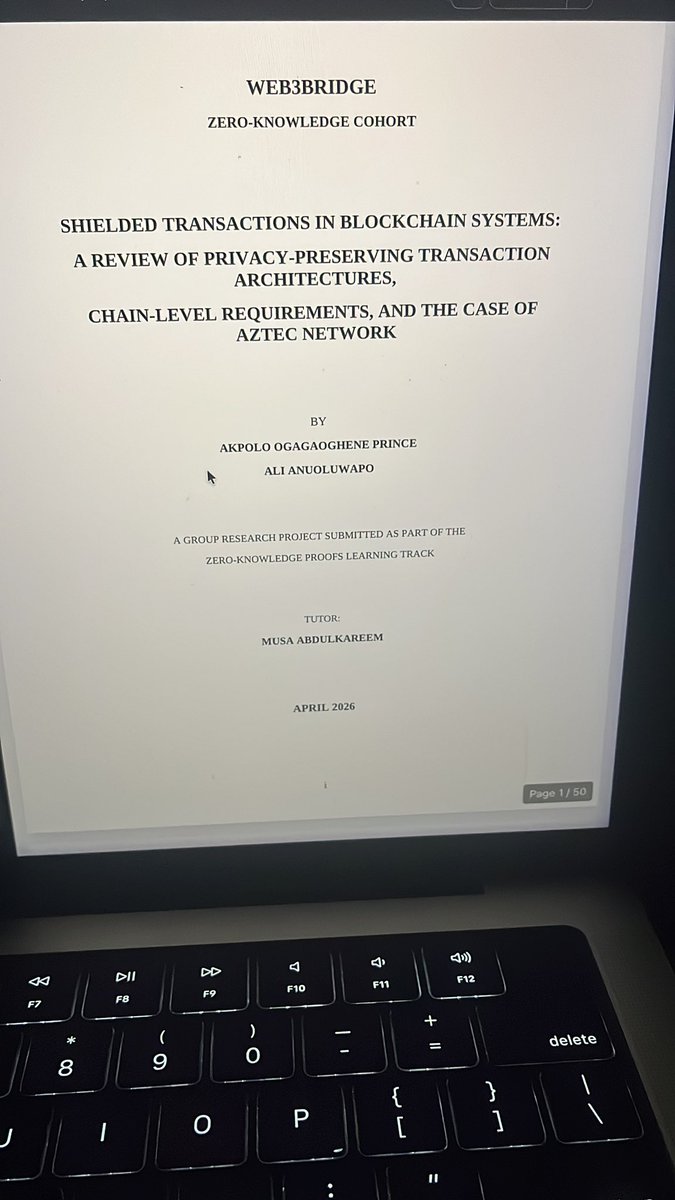
Spent April deep in my ZK project at @Web3Bridge with my teammate @ali_anuoluwapo
Tutor: @WiseMrMusa
Topic: Shielded Transactions
Covered the state of the art, chain-level requirements, mixers and privacy pools, EVM compatibility, and a deep dive on Aztec Network.
To the ZK gurus: please review and tell me what I missed. No one is perfect.
Link 👇
docs.google.com/document/d/1…
#ZK #ZeroKnowledgeProof #BuildingInPublic
@EliBenSasson @Starknet @StarknetAfrica @Stellar_WA @Celo
7
20
414
Adedoyin retweeted

Feb 17
Day 15/100 of ZK 🔐
Today we moved to lattice-based cryptography, the backbone of post-quantum security and the go to foundation for powerful Fully Homomorphic Encryption (FHE).
First, lattices in pure math: A lattice is a discrete subgroup of ℝⁿ generated by integer linear combinations of basis vectors. Think of it as an infinite grid of points in high-dimensional space, regular but sparse.
Key hard problems include:
* Shortest Vector Problem (SVP): Find the shortest non-zero vector in the lattice. Brutally hard in high dimensions.
* Closest Vector Problem (CVP): Given a target point (not necessarily on the lattice), find the closest lattice point.
These worst-case problems are believed to resist even quantum attacks, unlike factoring or discrete logs, which Shor's algorithm crushes.
Learning With Errors (LWE): Introduced by Regev, LWE turns these into average case hardness perfect for crypto. Given matrix A ∈ ℤ_q^{m×n}, secret s ∈ ℤ_q^n, and small error e (from a discrete Gaussian or similar), samples are (a_i, b_i = <a_i, s> e_i mod q). Recovering s from many samples is as hard as solving approximate SVP/CVP in the worst case.
Why lattices for FHE? FHE lets you compute on encrypted data without decrypting — add/multiply ciphertexts to get encrypted results. Classic encryption (RSA, ECC) breaks under quantum threats, and even classically, it can't support unlimited homomorphic ops without noise explosion.
Power of FHE: True privacy preserving cloud computing, secure ML on encrypted data, confidential smart contracts — compute anything (arbitrary circuits) while data stays encrypted end-to-end.
Lattice-based schemes dominate practical FHE because LWE/Ring-LWE supports noisy but homomorphic operations, with bootstrapping to refresh noise and enable unlimited depth.
TFHE (Torus FHE): A fast, practical FHE variant working over the torus ℝ/ℤ (real numbers mod 1). It uses TLWE/TRLWE samples (noisy linear equations on the torus) and GSW-style ciphertexts for fast bootstrapped binary gates. TFHE excels at Boolean circuits, with very efficient gate bootstrapping.
Lattice crypto, via LWE and variants, delivers quantum resistant primitives and enables FHE's holy grail: arbitrary computation on encrypted data. The "noise" in LWE hides secrets while allowing meaningful ops, and lattices' hardness survives quantum scrutiny.
Thanks a lot @Dev_esayayo for your taking me through the math behind ZK, and for being patient throughout the process.

2
2
33
753
Adedoyin retweeted

Feb 16
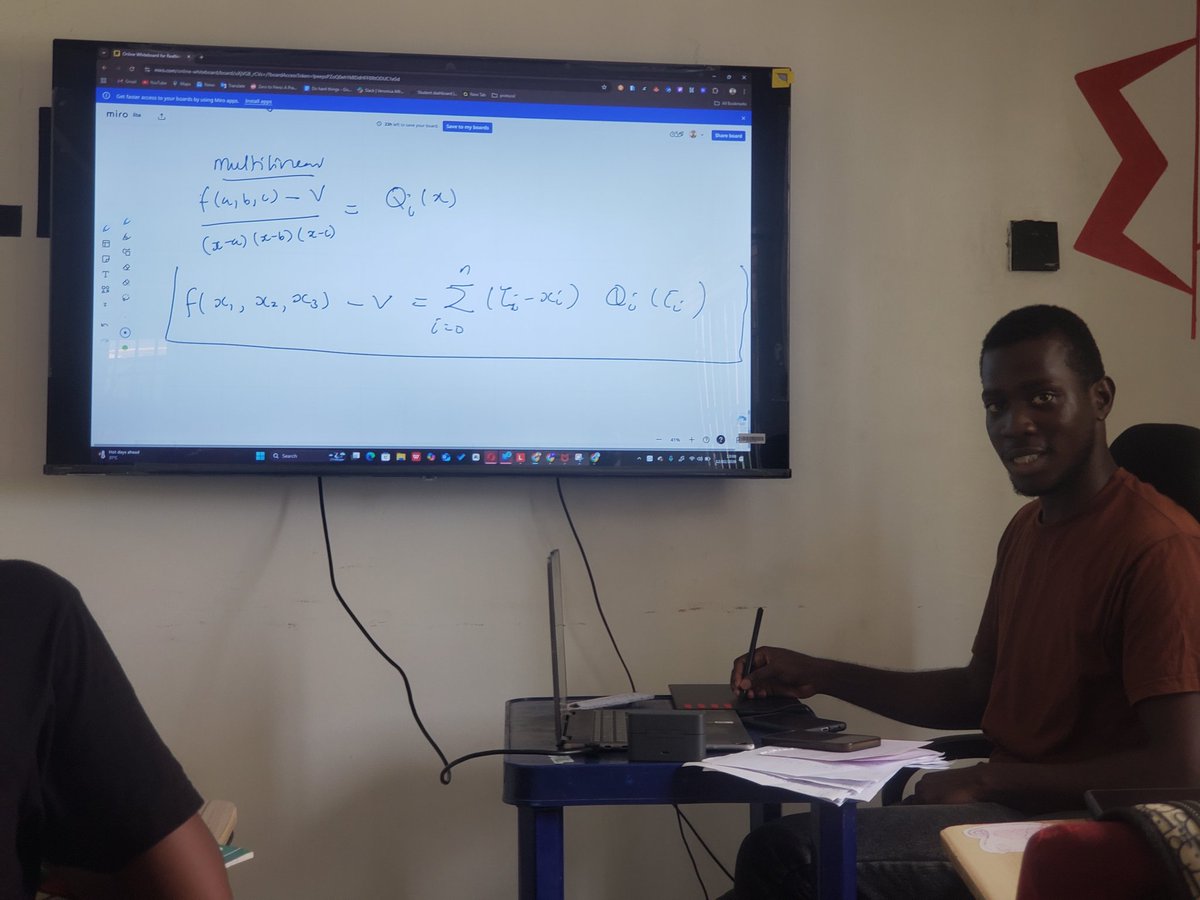
Week 3 of my zero-knowledge journey with @Web3Bridge... Absolutely Interesting.
This week pushed me to my limits and had me questioning all my life decisions at 2 AM 🤣. But honestly? That's when you know you're learning something real.


4
3
46
904
Adedoyin retweeted

Feb 16
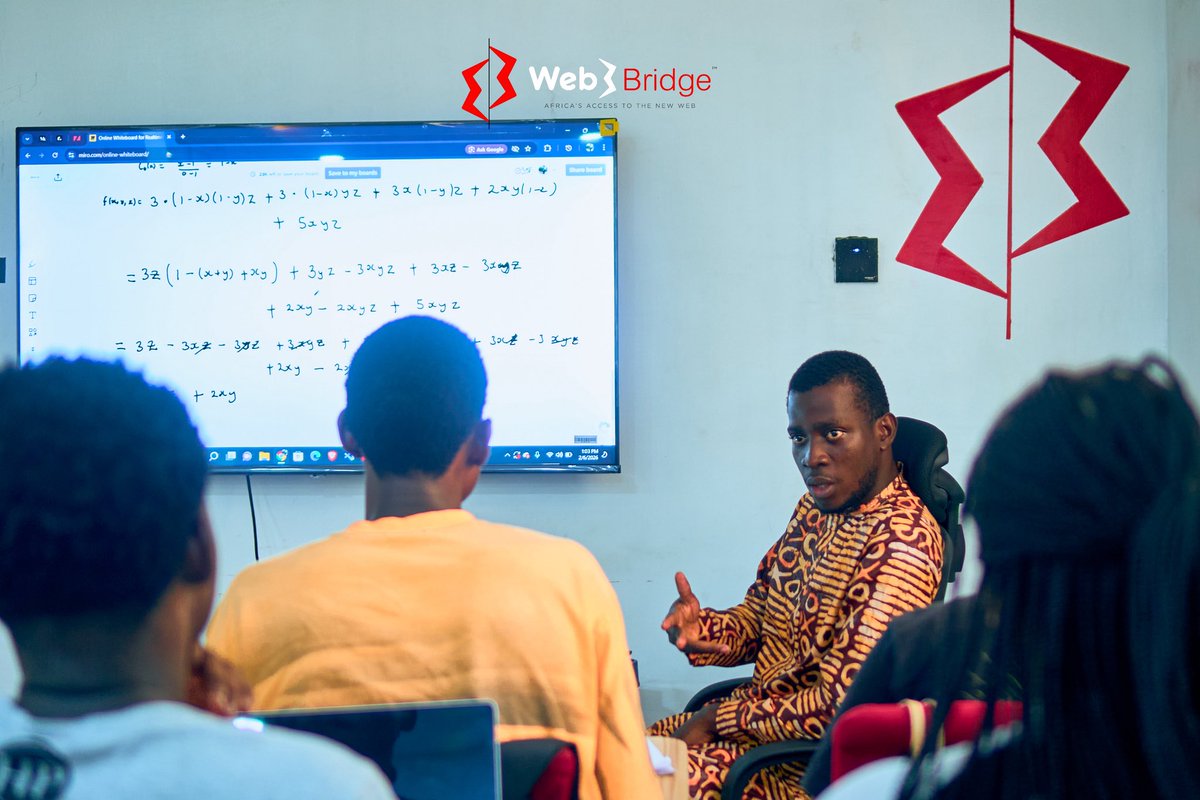
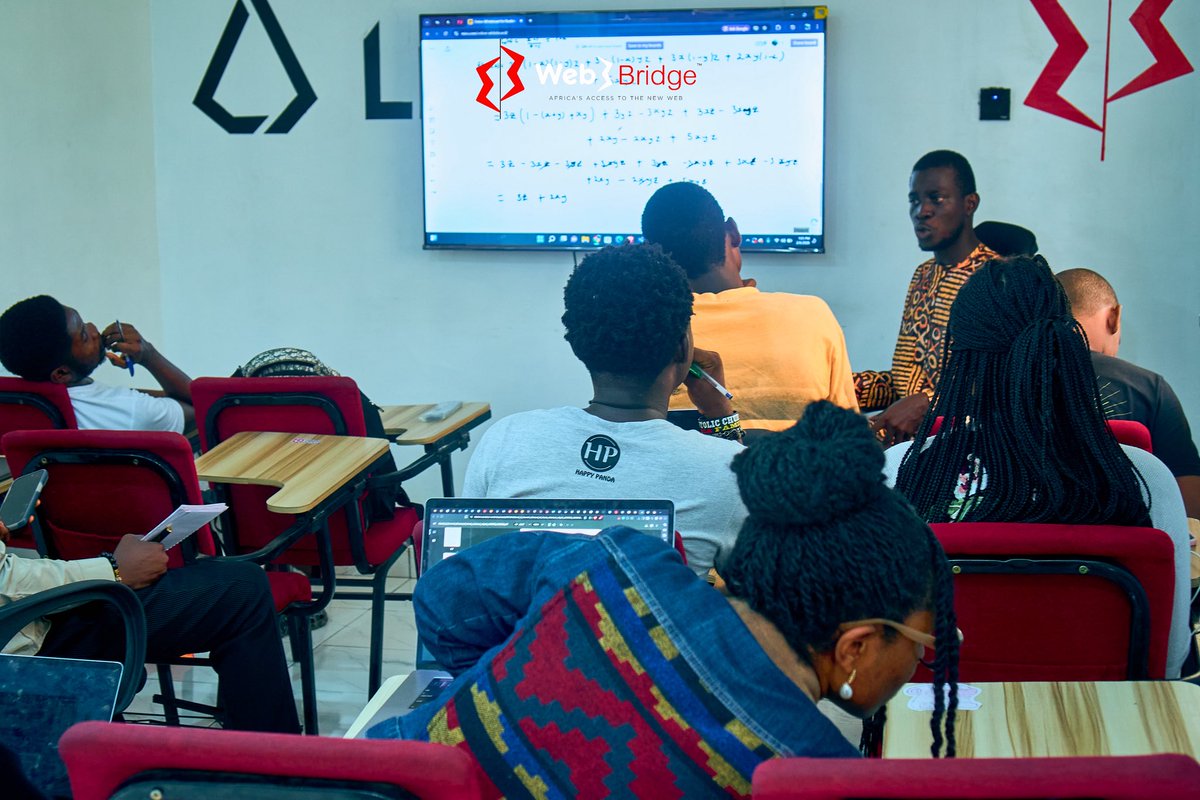
For two weeks, our ZK cohort dove deep into one of the most complex areas in Web3.
Having a mentor who is calm, patient, and understands how to simplify the difficult makes all the difference.
To Mentor @Dev_esayayo , thank you for your clarity, your teaching style, and your commitment to helping students truly understand not just memorize.
We appreciate you. 🚀🙌
#Web3bridge #ZeroKnowledgeProofs #TechEducation #Web3Learning

2
3
45
1,070
Adedoyin retweeted
Feb 12
Day 13/100 of ZK 🔐
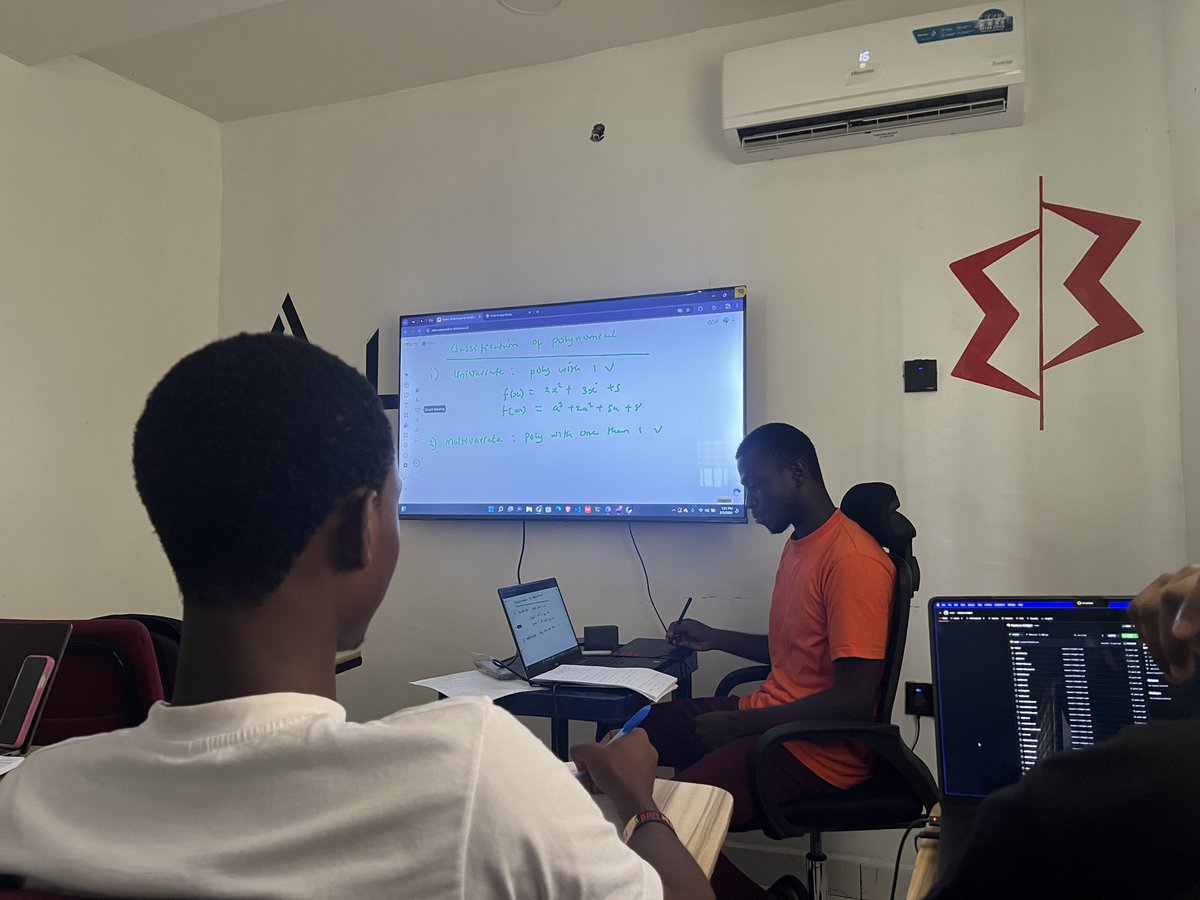
Today we finally reached one of the most important building blocks in modern zk-SNARKs: Polynomial Commitment Schemes (PCS).
A commitment scheme is a cryptographic primitive that works like a digital envelope, you commit to a value now (hide it), and later you can open/reveal it exactly as committed, without being able to change your mind.
Two core security properties:
* Hiding: The commitment reveals nothing about the committed value (looks random to anyone who doesn’t know the opening).
* Binding: Once committed, you cannot open to a different value.
A Polynomial Commitment Scheme (PCS) extends this to entire polynomials instead of single values. You commit to a polynomial f(x) of known degree, then later prove statements about it (most commonly “f(a) = b for this point a”) with a very small proof that anyone can verify quickly.
A typical PCS has four main algorithms:
* Setup: Generate public parameters (often via a trusted setup ceremony).
* Commit: Produce a compact commitment C to the polynomial f(x).
* Prove evaluation: Generate a short proof π that f(a) = b (without revealing f).
* Verify: Check that the proof π is correct for the given commitment C, point a, and claimed value b.
Many PCS require a trusted setup, a one-time ceremony that produces structured reference strings (SRS). If the toxic waste from setup is destroyed, the scheme is secure, if leaked, fake proofs can be forged.
Zero polynomial
The zero polynomial is the polynomial that is identically zero everywhere (all coefficients = 0).
In ZK, many protocols reduce the proof of correct computation to showing that a certain “error” or “constraint” polynomial is the zero polynomial.
Proving “this polynomial is identically zero” is much easier than proving arbitrary properties, you just show it evaluates to zero at enough random points (or use techniques like sum-check). If it’s zero at more points than its degree, it must be the zero polynomial everywhere (by fundamental theorem of algebra over fields).
The big picture in zk-SNARKs:
SNARK = IOP (Interactive Oracle Proof) PCS
The IOP gives an interactive protocol with oracle access to polynomials, the PCS turns those oracle queries into short, non-interactive proofs via commitments and evaluation proofs.
KZG (Kate-Zaverucha-Goldberg) commitment scheme is one of the most widely used PCS today (especially in PLONK, Marlin, and many Ethereum zk-rollups). It uses bilinear pairings on elliptic curves and a trusted setup to produce very small evaluation proofs (usually just one group element).
PCS lets us hide entire polynomials and prove evaluations succinctly, turning huge computations into small, verifiable claims.
KZG trusted setup zero-polynomial checks = the succinctness engine behind most production zk-SNARKs today.
#ZeroKnowledgeProof #Math
1
1
12
336
Adedoyin retweeted
Feb 11
Day 12/100 of ZK 🔐
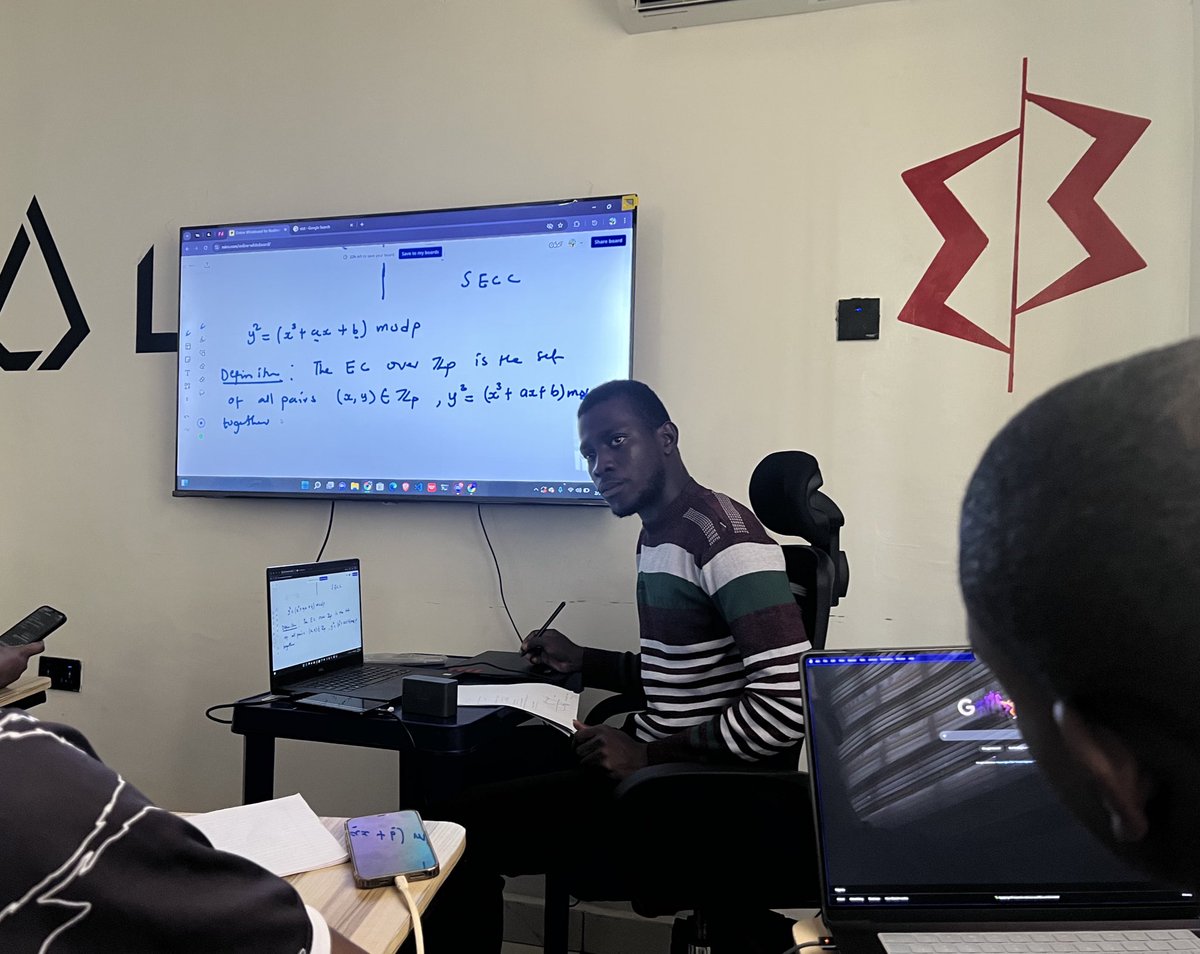
Today was a deliberate repeat of Day 11, we went back over cyclic groups, the discrete logarithm problem, Diffie-Hellman key exchange, the generalized DLP, and elliptic curves.
Reinforcement for better understanding. Sometimes the second (or third) pass is when the concepts really lock in. Seeing how the shared secret emerges from exponentiation without ever sending the exponents, why prime-order cyclic subgroups are non-negotiable for security, how the same DLP hardness applies across different algebraic structures, and why elliptic curves give us a more efficient, stronger version of the same one-way function.
Mastery in crypto and ZK comes from revisiting the foundations until they feel intuitive. Cyclic groups DLP/ECDLP remain the bedrock of secure key agreement, signatures, and most ZK protocols.
2
2
20
485
Adedoyin retweeted
Feb 10
Day 11/100 of ZK 🔐
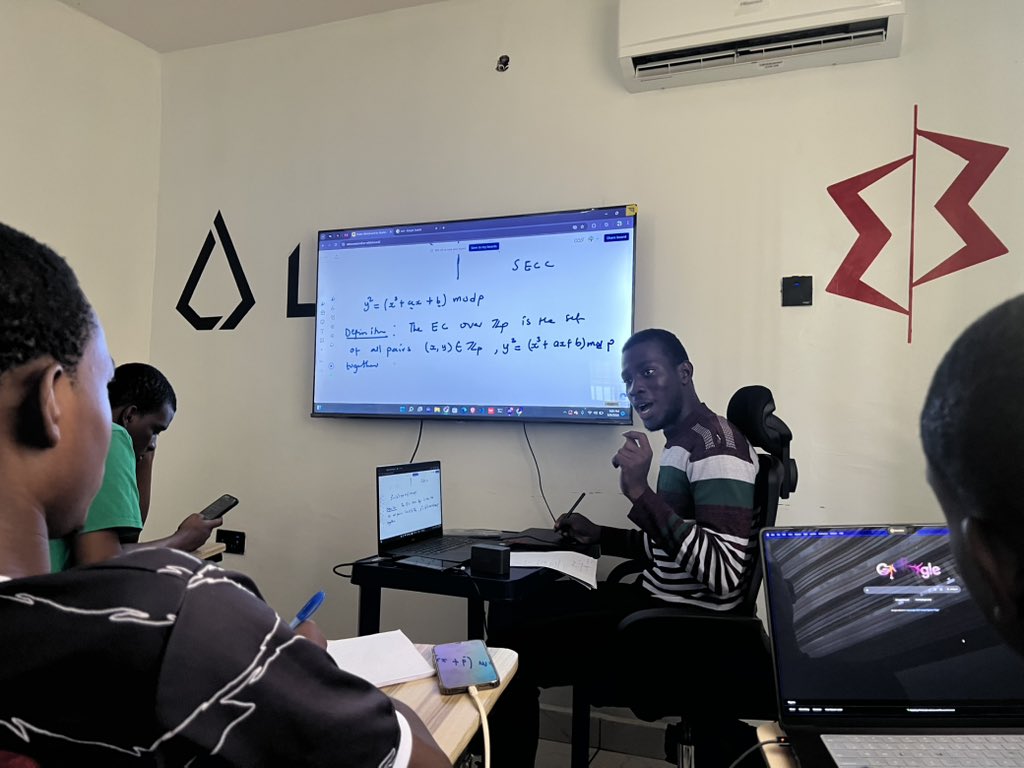
Today we continued exploring cyclic groups and connected them directly to the discrete logarithm problem (DLP), then looked at Diffie-Hellman key exchange, the generalized DLP, elliptic curves, and their analytical expression.
Cyclic groups are groups in which one element can generate all other elements in the group (the element is called primitive or generator ) under the group operation. In ZK and crypto, we always use cyclic groups of prime order because of their properties: One generator for every element except the identity, and the discrete log problem stays hard. They maximize security.
The discrete logarithm problem (DLP) is the core hardness assumption here. Given a generator α and an element A = α^a (mod p), finding the secret exponent a = log_α A (mod p) is believed to be computationally infeasible for well-chosen groups (large prime order, no special structure). This one-wayness is what secures many protocols.
Diffie-Hellman key exchange uses exactly this hardness.
Alice picks private exponent α, computes A = α^α (mod p) and sends A publicly.
Bob picks private exponent β, computes B = α^β (mod p) and sends B publicly.
Alice computes the shared secret: B^α = (α^β)^α = α^(αβ) (mod p)
Bob computes the same: A^β = (α^α)^β = α^(αβ) (mod p)
Both now share the secret key α^(αβ) (mod p).
An eavesdropper sees α, p, A, and B but must solve the DLP to find α or β (or compute the shared secret directly, which is the Computational Diffie-Hellman problem, which is still hard if DLP is hard).
Generalized DLP
The same problem exists in any cyclic group (G, ∘) with operation ∘ and order n (size |G| = n): given generator g and h = g^x, recover x.
The hardness depends on the group: classic multiplicative groups mod p, elliptic curve groups, etc. Each setting can offer different security levels or advantages (e.g., elliptic curves give smaller keys for equivalent security).
Elliptic curves are the most common setting for modern DLP today.
An elliptic curve over a finite field is defined by an equation of the form y² = x³ a x b (mod p), the analytical (equation) form.
Points on the curve form an abelian group under a geometric “chord-and-tangent” addition law. Scalar multiplication k·P = P P … P (k times) is easy, but the inverse — given Q = k·P, find k—is the ECDLP (elliptic curve discrete logarithm problem), which is currently harder than classic DLP for the same bit size, which is why elliptic curves dominate in signatures, key exchange, and zk-SNARKs..
Analytical expression
This simply refers to the explicit equation that defines the curve, like y² = x³ a x b over the field. Choosing a and b such that the curve has no singularities, has large prime order, and resists known attacks is critical for security in protocols.
Cyclic groups DLP hardness = the foundation of secure key exchange and signatures. Elliptic curves give us a stronger, more compact version of the same idea, which is why most modern ZK systems (Groth16, Plonk, etc.) run on EC groups.
#ZeroKnowledgeProof #ZK #Math
1
2
14
495

Adedoyin retweeted
Feb 9
Day 10/100 of ZK 🔐
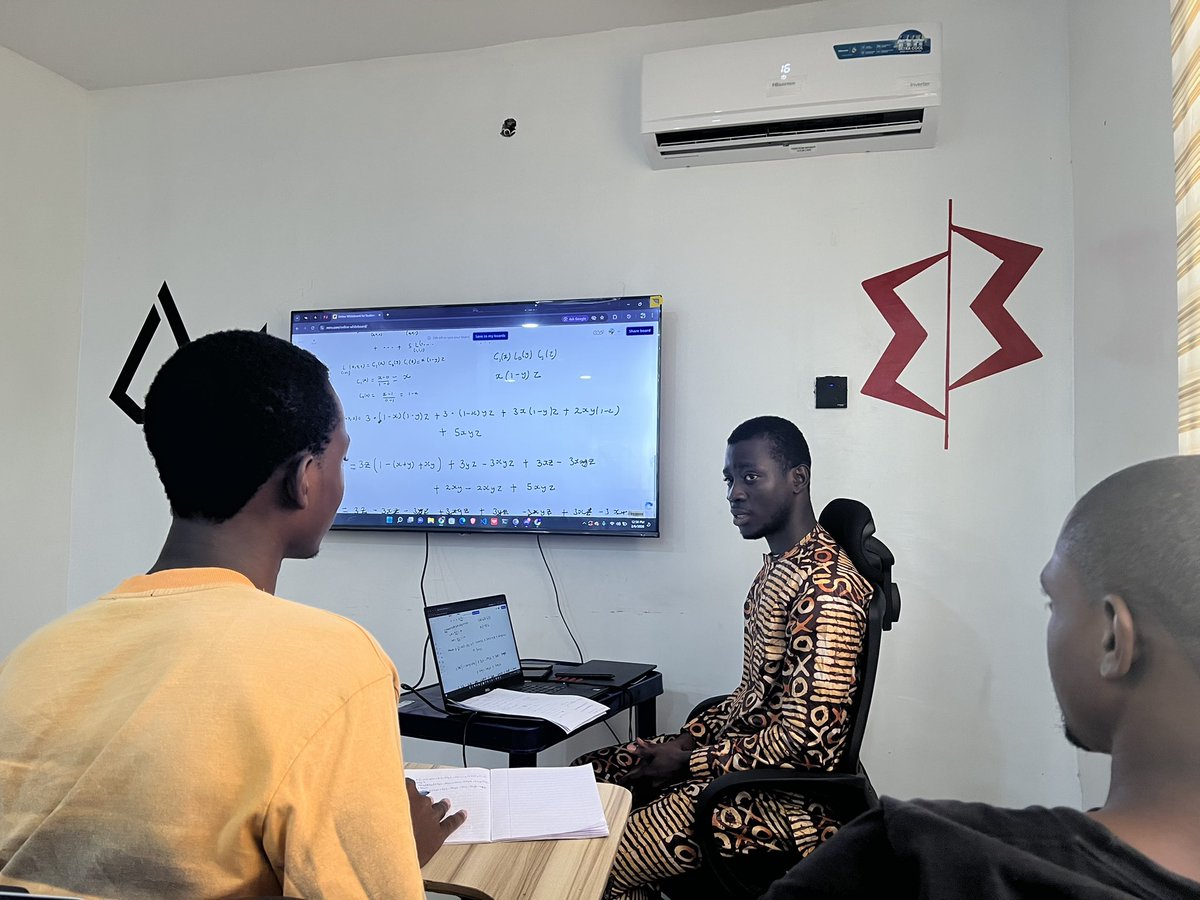
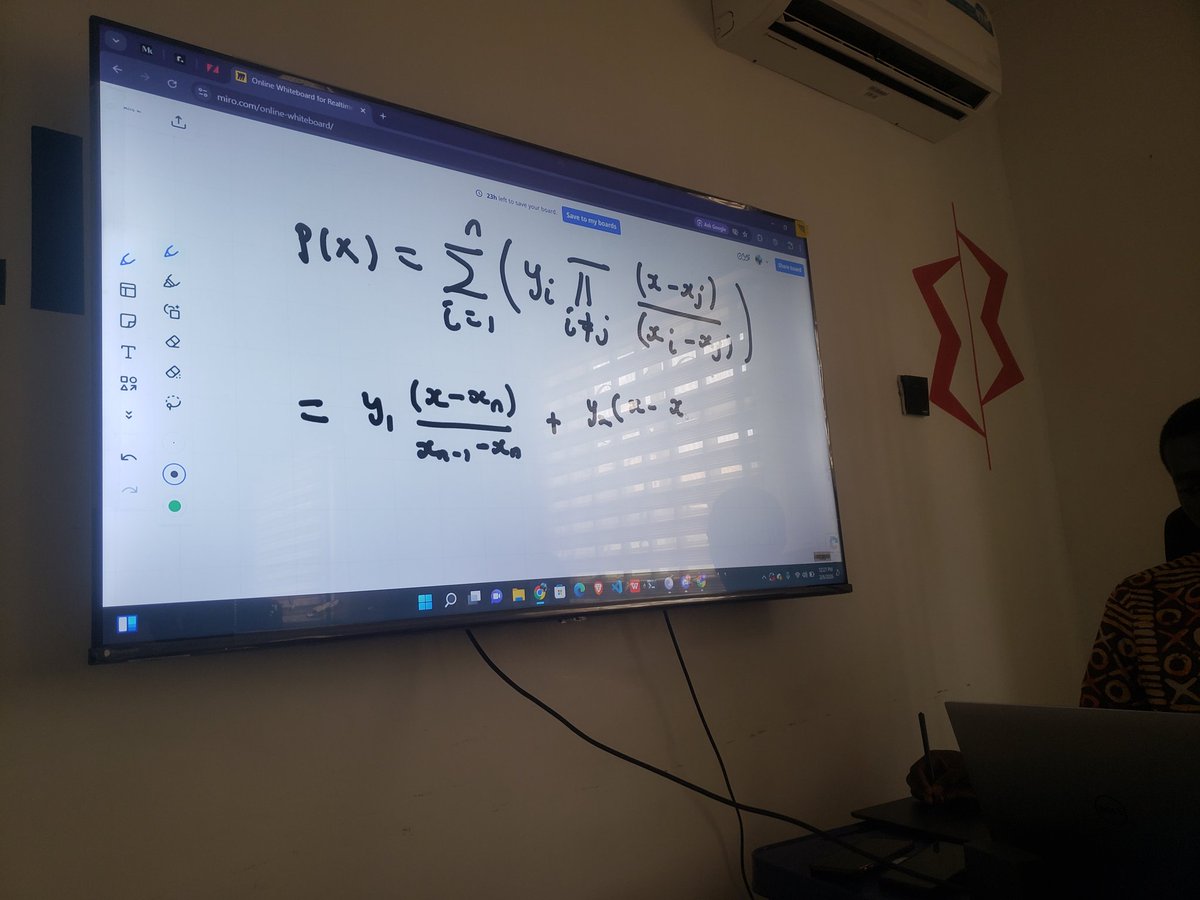
Today we stayed focused on polynomials, digging deeper into multilinear polynomials, revisiting Lagrange interpolation, exploring partial evaluation, and getting an intro to arithmetization — the bridge from computation to polynomials.
Multilinear polynomials
These are multivariate polynomials where each variable has degree at most 1.
Simple example: f(x, y) = 4 6x 9y 11xy
No squared terms, no higher powers, just products of different variables (or single ones, or constants).
In ZK they work because many computations (especially boolean circuits or hypercube sums) naturally produce multilinear extensions. This keeps degrees low, which means smaller proofs, faster verification, and more efficient protocols like sum-check.
Lagrange interpolation
The straightforward method that finds the unique lowest-degree polynomial that passes exactly through every one of those points.
Picture it as building the curve piece by piece: for each known point, you create a small “helper” function that is 1 only at that point and 0 at all the others. Then you scale each helper by the known value and add them up. The result is the full polynomial equation.
This is used in ZK to open commitments (“prove the value at this point is correct”) and in secret sharing (rebuild the secret from enough points).
Partial evaluation
When you have a polynomial with several variables, partial evaluation means plugging in values for some of them, leaving the others free.
Example: f(x, y, z) = xy 3z 5x 2
Set y = 2 and z = 1 → f(x, 2, 1) = x·2 3·1 5x 2 = 7x 5
You’ve reduced a complicated 3-variable polynomial to a simple one-variable one.
ZK protocols (especially sum-check) use this repeatedly: fix variables one by one, reduce the dimension step by step, and prove each smaller piece until only a single evaluation remains to check.
Arithmetization (first intro)
This is the process of turning any computation (code, circuit, execution trace) into one or more polynomial equations that must hold true.
Once everything is polynomials, the prover can use commitments, evaluations, and interpolation tricks to prove the computation was done correctly without revealing private inputs.
Multilinear polynomials keep things fast and low-degree; partial evaluation shrinks big problems layer by layer; Lagrange lets us reconstruct from points; arithmetization translates real-world programs into the math language ZK can prove.
#ZK #ZeroKnowledgeProof #Cryptography #Math
2
23
643
Adedoyin retweeted
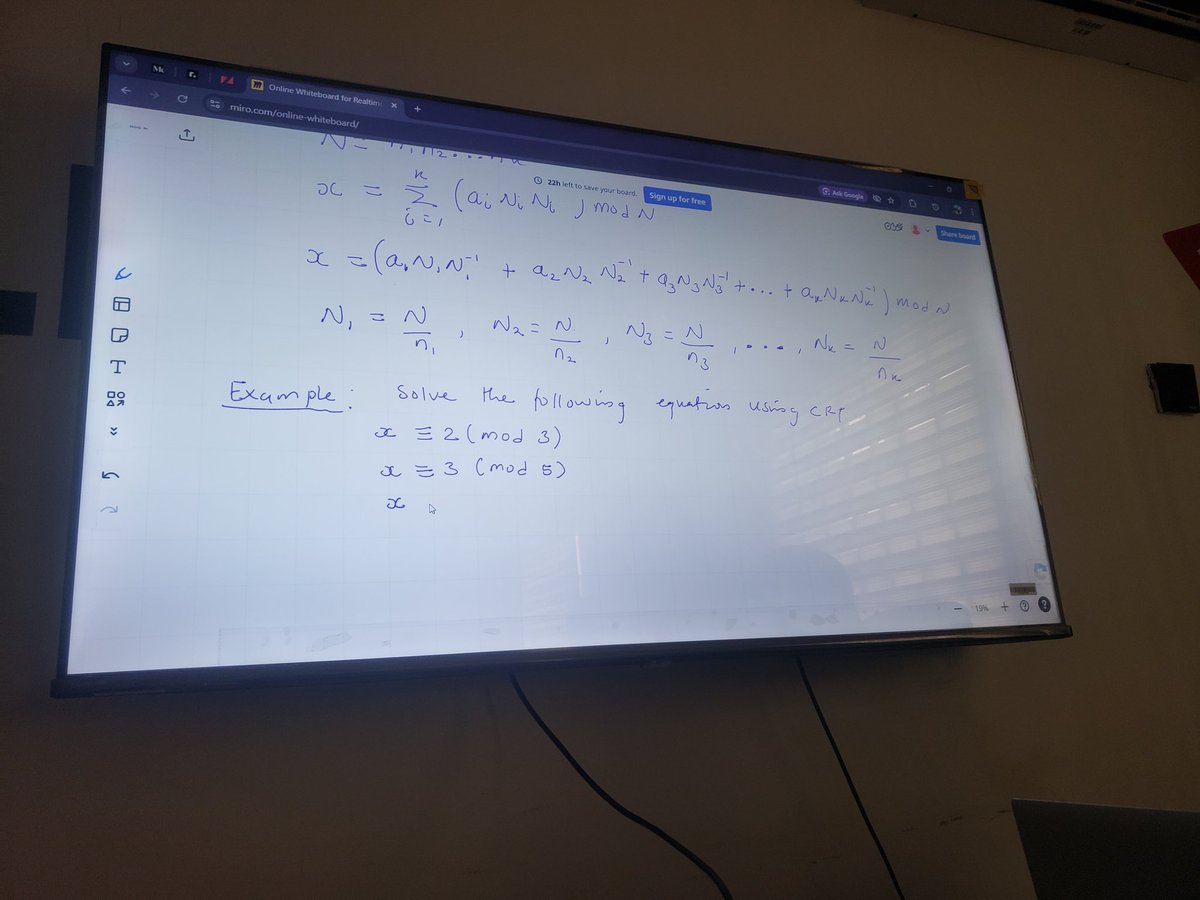
Week 2 of my zero-knowledge journey with @Web3Bridge is complete, and I'm having an absolute blast! 🔥
The mathematics behind cryptography is incredibly fascinating.
9
2
76
2,262
Adedoyin retweeted
Feb 6
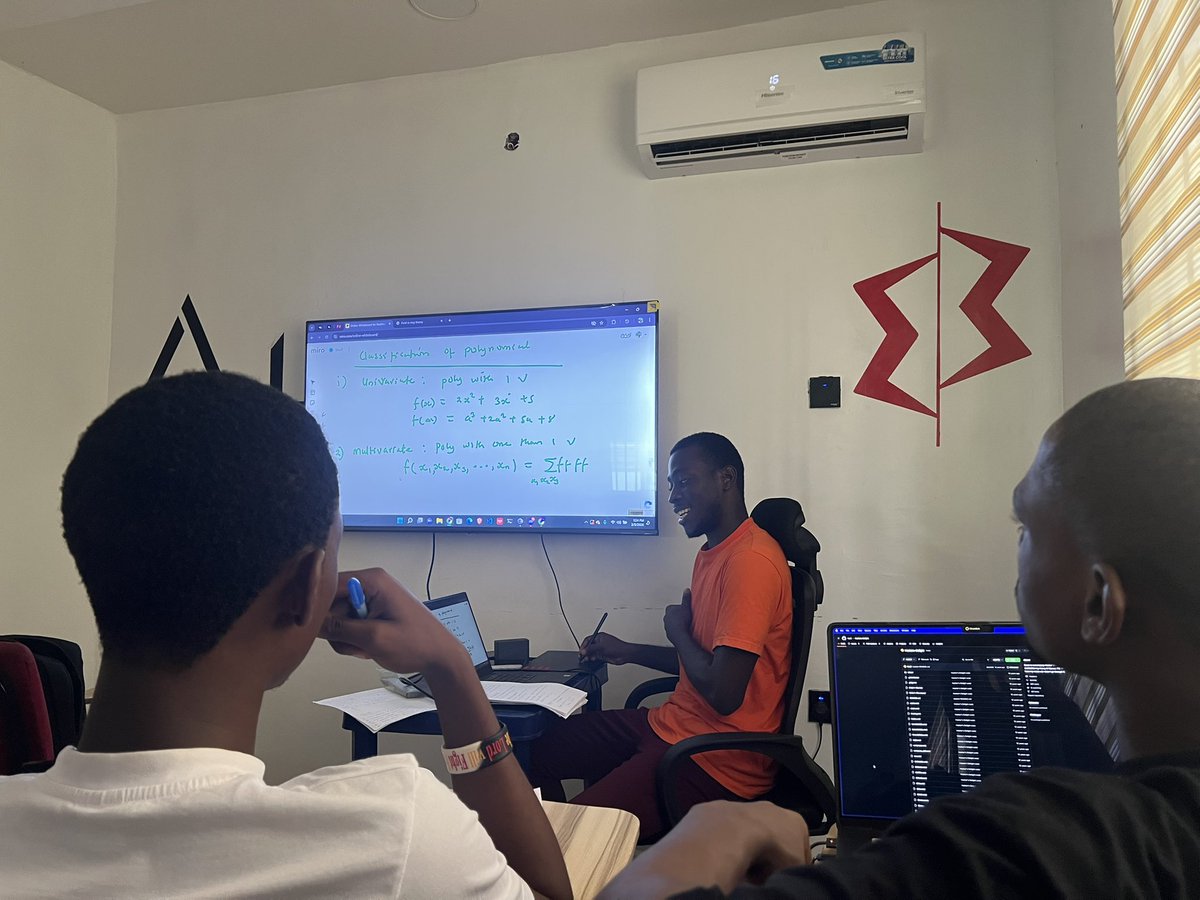
Day 9/100 of ZK 🔐
Continued with the group theory, bijections, rings, and then straight into polynomial territory.
Group theory deep dive:
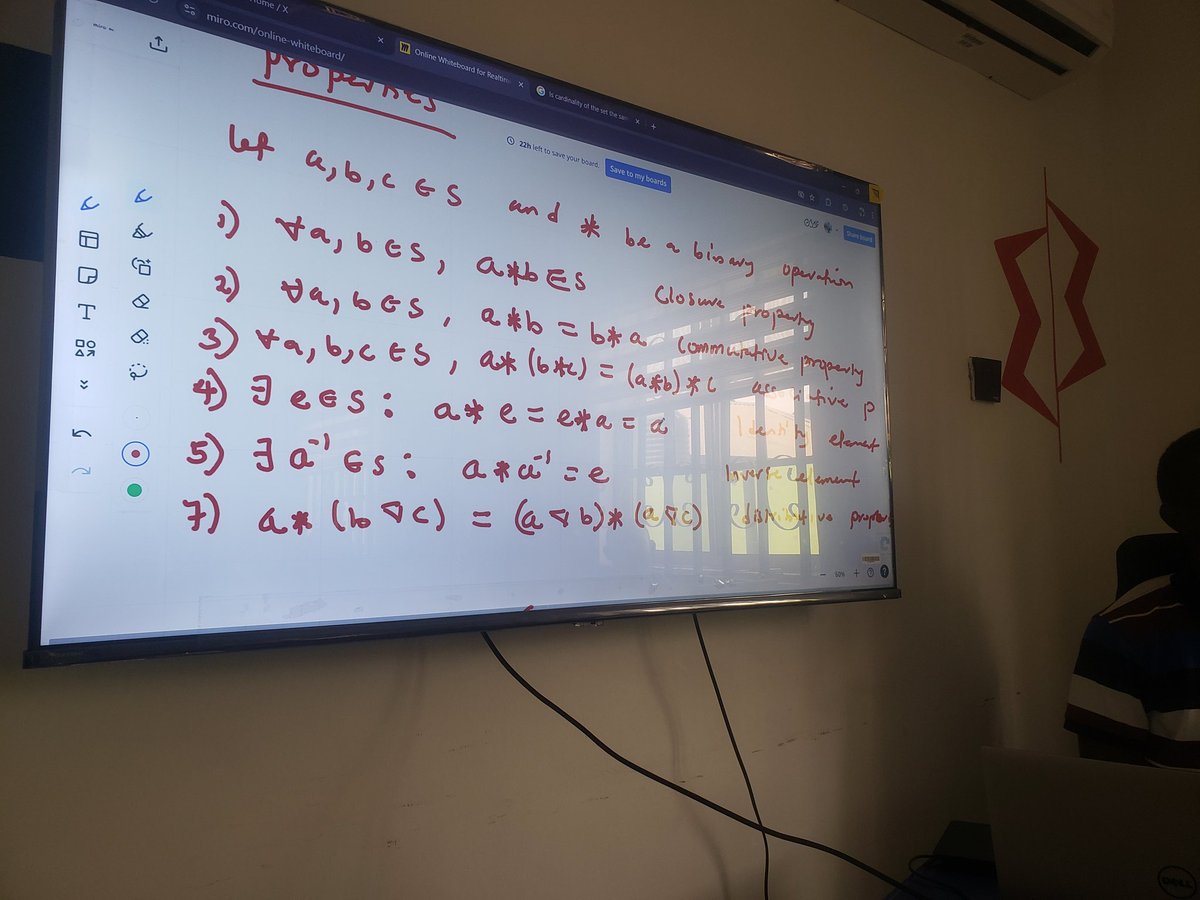
A subgroup is simply a smaller group living inside a bigger one. A subgroup H of group G is a subset that is itself a group under the same operation: closed, has identity, inverses, associative. Conditions: non-empty, closed under operation & inverses.
Cyclic groups are generated by a single element g: G = {g^k | k ∈ ℤ} (or mod order for finite). Most ZK-friendly elliptic curves use cyclic subgroups of prime order for security (ECDLP hard).
Group homomorphism φ: G → H preserves operation (φ(a * b) = φ(a) * φ(b)). Isomorphism is a bijective homomorphism, basically a structure-preserving relabeling of elements. Bijection = one-to-one and onto (every element in target maps uniquely from source).
Rings:
A ring is a set with two operations (usually and ×): (R, ) is an abelian group, × is associative distributive over .
Types we touched: commutative rings (× commutative), rings with identity (has 1), integral domains (no zero divisors), fields (every non-zero element has × inverse). Finite fields F_p (p prime) and polynomial rings are everywhere in ZK.
Then we reached polynomials, the real workhorse
A polynomial is a sum of monomials (coefficient times variable to a power).
Univariate = one variable, e.g., f(x) = 4x³ – 2x 7.
Multivariate = several variables, e.g., f(x,y) = xy 3x 2y 5.
Multilinear polynomials are special multivariate ones where no variable appears to power higher than 1 (very useful for efficient protocols like sum-check).
Evaluation and Interpolation:
Evaluation just means “put a number in place of the variable and calculate the result.”
Example: f(x) = 2x 3
f(5) = 2×5 3 = 13
That’s it. In ZK we evaluate at hidden points to check properties without showing the whole polynomial.
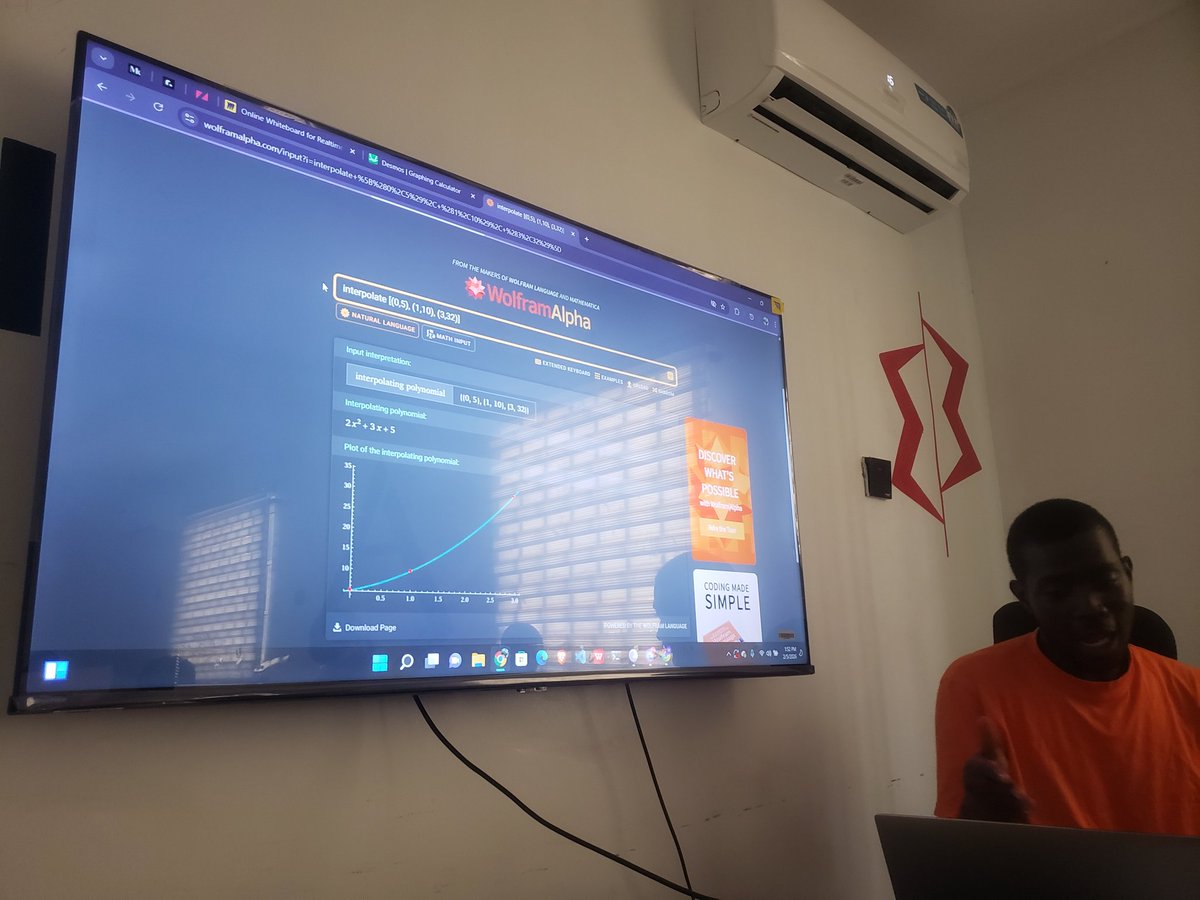
Lagrange interpolation:
Imagine you have a secret curve (the polynomial) and you only know a few exact spots it passes through, like:
* At x=1, the height is 4
* At x=3, height is 10
* At x=5, height is 28
Lagrange interpolation is the clever recipe that rebuilds the exact polynomial that goes through all those spots, and it’s guaranteed to be the unique lowest-degree one that fits perfectly.
It works by creating little helper curves (basis polynomials) that are 1 at one known point and 0 at all the others, then blending them together weighted by the known heights.
This is the backbone of Shamir secret sharing and many polynomial commitment opening proofs.
2
3
24
544
Adedoyin retweeted

Seeking God in all things brings about God's grace, goodness and guidance. #dclmwestmidlandsbirmingham #dclm
1
23
128
1,850
Adedoyin retweeted

Jan 3
My first Space on X 🙂↕️
Hey undergraduates, I and a couple of my graduate friends (top Gs in UI, UNN and UNILAG) have something important to share with y'all!
Be there 🫰
Retweet for reach!
x.com/i/spaces/1MnxnPQpBgXGO
4
6
19
1,144

11 Dec 2025
Last chance to be first. Season 5 of the Zama Creator Program is live with $53,000 in rewards and 1,006 Zama OG NFTs for top FHE creators. zama.org/programs/creator-pr… via @zama
1
52
Adedoyin retweeted

16 Aug 2025
First university to go live with the Solana Students Africa Hackathon @SolanaStudentAf?
None other than University of Lagos—yes, you guessed right! 🙌🏾
Sept 4 is when the Solana x AI Hackathon 2025 kicks off right on Unilag campus with a $10,000 prize pool, hybrid format, and five groundbreaking tracks, from AI-powered metadata engines to Solana Pay campus tools. Beginners and pros are all welcome.
Register now and build on the future of Solana:
🔗 solanastudentsafrica.com
Unilag, let’s lead the way!

2
10
52
2,652
Adedoyin retweeted

18 Jun 2025
PRAYERTHON 2025 IS HERE!!!🔥
The battle is real, but so is our God.
When we pray, we're not just speaking words, we're wielding weapons of warfare.
Join Prayerthon 2025 and let's fight for healing, restoration, and revival.*
#Prayerthon2025 #dlcfunilag "
1
3
14
303
Adedoyin retweeted
15 Jun 2025
“Bible A–Z Challenge!”
We asked our members to mention a Bible character starting with any letter—and make a sentence with the name. The results? Hilarious, creative, and Spirit-filled! 😄📖🔥
…you just have to see it for yourself!
#dlcfunilag
3
11
295
Adedoyin retweeted

14 Apr 2025
🐣 🌷 Easter Giveaway 🌷🐣
I’m giving away one CompTIA Security Exam Voucher!
How to enter:
•Like & RT this post
•Comment or tag a friend
Winners will be announced Friday
Good luck and Happy Easter!

771
903
1,695
120,536
Adedoyin retweeted

5 Feb 2025
Giving away $1000 split over 4 people 🎁
To enter:
- Follow @CryptoMafia420 🛎️
- Drop your $SOL wallets👇🏻
- Like & RT this ✔️
4x winners ($250 each) ~ 24 hrs ⏰

1,693
1,027
1,179
106,303
Adedoyin retweeted
5 Feb 2025
You want to become a Web3 developer, and you’re not joining Web3Bridge? 👀👀
This look says it all—rethink your choices, my friend. 😏
Click the link and join the waitlist to be a part of our next Cohort! 🚀
web3bridgeafrica.com/registe…
#Web3Bridge #JoinTheCommunity

1
4
30
884