
Joined October 2021
- Tweets 11,252
- Following 1,861
- Followers 969
- Likes 2,454
1,552 Photos and videos









18h
EX POST!™ JUNE 13, 2026
EVENING EDITION
FIGHT NIGHT AT THE WHITE HOUSE
No one can accuse Donald Trump of thinking small.
Tomorrow, the South Lawn will become an arena.
A temporary structure known as "The Claw" will host UFC Freedom 250. The estimated $60 million venue will seat about 4,300 spectators, including roughly 1,000 members of the military.
Security preparations have been described as comparable to those used for the Super Bowl. A legal challenge seeking to stop the event failed, and because the White House sits on federal property, the fights will operate under an unusual regulatory arrangement rather than under the normal authority of a state athletic commission.
Presidents have welcomed champions before.
But no president has transformed the White House grounds into an octagon.
Whether viewed as entertainment, politics or branding, the event may say something important about the Trump era.
Not every presidency seeks grandeur.
Some seek normalcy.
Some seek accomplishment.
Some seek history.
And some seek attention. ❦
HIGH-LEVEL U.S., JAPAN AND SOUTH KOREA OFFICIALS MEET IN TOKYO
Senior officials from the United States, Japan and South Korea met in Tokyo to strengthen cooperation and coordinate policy toward North Korea amid growing concerns over regional security.
The talks brought together countries whose relationships have often been strained by history and unresolved disputes dating back generations.
WHY ARE JAPAN AND SOUTH KOREA MEETING?
Because countries that spent generations arguing are finding themselves confronted by common challenges.
North Korea's nuclear ambitions, China's growing influence and Russia's ties with Pyongyang have pushed old rivals toward closer cooperation.
History still matters.
But geography has a vote.
And when longtime rivals begin coordinating strategy at the highest levels, the world should notice. ❦
Follow EX POST!™ @EXPostNewsMedia
Nobody Does What We Do
@AP @Reuters @nytimes @MollyJongFast @MuellerSheWrote @RonFilipkowski
#Japan #SouthKorea #Tokyo #UFC #WhiteHouse #Trump
157
23h
This is amazing!

21
Jun 13
EX POST!™ JUNE 13, 2026
AFTERNOON EDITION
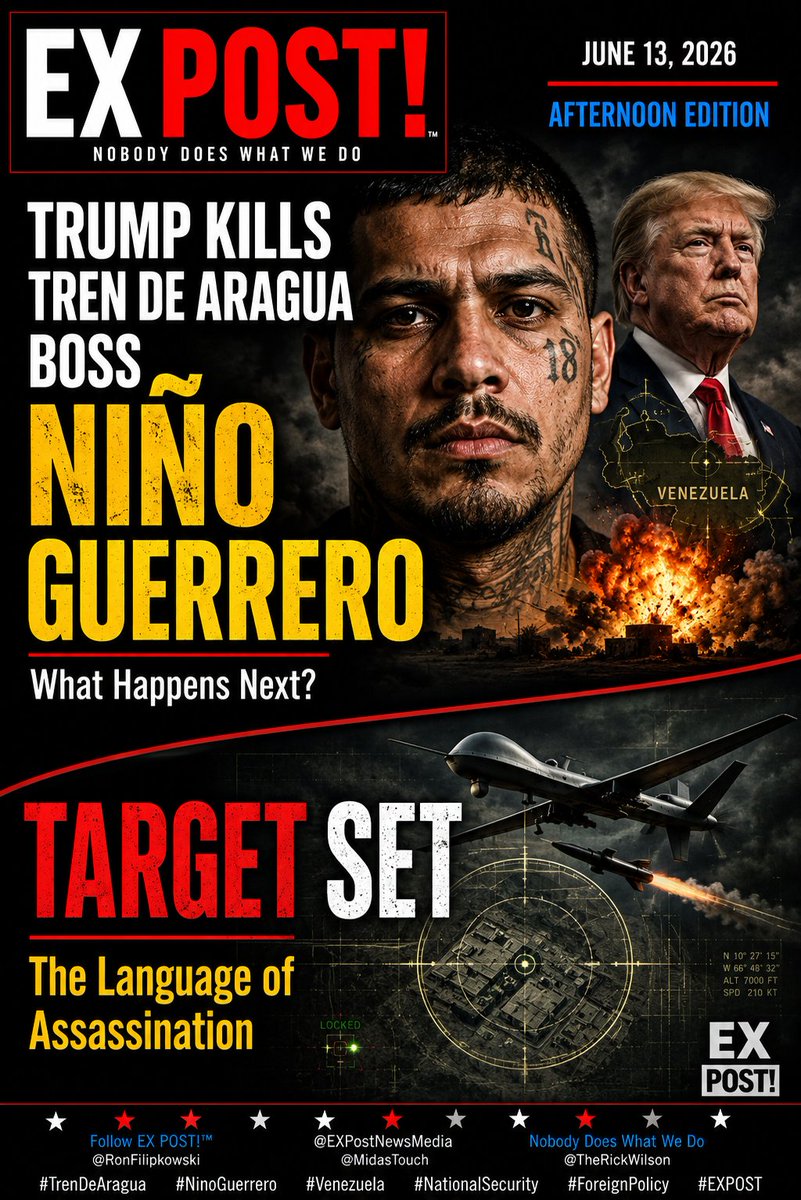
TRUMP KILLS TREN DE ARAGUA BOSS NIÑO GUERRERO
What Happens Next?
President Trump announced that U.S. Southern Command carried out a strike that killed Héctor "Niño" Guerrero, the founder and leader of the Venezuelan gang Tren de Aragua. Reports indicate the operation was conducted with Venezuelan cooperation. ❦
No one should mourn Niño Guerrero. He presided over one of the hemisphere's most violent criminal organizations.
But the question isn't whether he deserved to die.
The question is what comes next.
Criminal organizations do not always disappear when their leaders do. Sometimes they fragment. Sometimes they spread. Sometimes they seek revenge.
And if members of Tren de Aragua retaliate, if cells already inside the United States decide revenge matters more than money, are we prepared for that?
These are not arguments against action.
They are questions about consequences.
Because history teaches that the first strike is often the easy part.
The second and third chapters determine whether a victory remains a victory.
Success will not be measured by the first explosion.
Success will be measured by what happens next. ❦
.
TARGET SET
The Language of Assassination
Secretary Pete Hegseth described the killing of Niño Guerrero as a "swift and lethal kinetic strike."
Think about that phrase.
Not an arrest.
Not an indictment.
Not an extradition.
A kinetic strike.
That is military language.
It belongs to the vocabulary of war.
High-value targets.
Target packages.
Eliminated.
Degraded capabilities.
Kinetic operations.
These are phrases Americans once associated with ISIS, Al Qaeda, and enemy commanders on distant battlefields.
Now they are being used to describe operations against criminal organizations.
Perhaps that is appropriate.
Perhaps it is overdue.
But it is also something new.
And new things deserve scrutiny.
Because words matter.
The language we use reveals the assumptions we make.
If criminal organizations are now military targets, if targeted killings become routine, if "kinetic strikes" replace arrests and indictments, then we are entering a different era.
Not necessarily a wrong era.
But a different one.
History has a way of changing one phrase at a time. ❦
Follow EX POST!™
@EXPostNewsMedia
Nobody Does What We Do
@Reuters @AP @nytimes @washingtonpost @ProPublica @TheAtlantic @GuardianUS
#TrenDeAragua #NinoGuerrero #Venezuela #NationalSecurity #TargetedKilling #ForeignPolicy #Trump
72
Jun 13
"The American story was written by patriots..."
Yes, and by abolitionists, immigrants, unions, suffragists, civil rights marchers, Native peoples who survived conquest, and Mexican Americans who were here long before your AI slideshow.
History is bigger than your tribe.
And the flag belongs to all of us. ❦
34
Jun 13
Republicans say Democrats create nothing, yet much of modern America was built by Democrats and often with bipartisan support. Social Security, Medicare, labor protections, scientific institutions, and countless public works didn't appear by magic.
Legislators don't build cars or rockets. They build institutions. FDR never assembled a tank, yet his administration helped create the framework that won World War II and transformed America.
Creation is hard. Destruction is easy. If your politics consists mainly of dismantling what others built, perhaps the problem isn't that your opponents create nothing. Perhaps it's that you create so little yourself.
@SenWarren
1
25
Jun 13
EX POST!™ JUNE 12, 2026
COMMENTARY
WHO'S CELEBRATING?
Why Doesn't America Share More In What It Helps Build?
Congratulations to Elon Musk, we are told.
Congratulations to America.
The entire economy, according to the celebration, is lifted by the new $2.1 trillion SpaceX valuation.
How?
Explain.
A valuation is not a paycheck.
It does not lower rents. It does not reduce debt. It does not make groceries cheaper. It does not pay medical bills. It does not put money in workers' pockets.
It makes shareholders richer.
It makes executives richer.
It makes billionaires richer.
That is not the same thing as lifting the entire economy.
Americans helped build the environment that made SpaceX possible. Taxpayers financed research. Taxpayers funded contracts. Taxpayers provided infrastructure, education, and a stable legal system. NASA itself became one of SpaceX's biggest customers.
And yet, when private fortunes soar, we are expected to celebrate as though those fortunes belong to all of us.
Who's celebrating?
Certainly not the family struggling with rent.
Certainly not the retiree choosing between prescriptions and groceries.
Certainly not the worker whose wages have barely moved while the cost of living has exploded.
No.
The people celebrating are the people becoming even wealthier.
Private fortunes are not the same thing as national prosperity.
When a handful of people gain billions and ordinary Americans gain little or nothing, it is indecorous to declare victory on behalf of everyone else.
The rich get richer and call it patriotism.
The poor get poorer and are told to celebrate.
Avarice has swagger.
Until it doesn't.
Then gravity introduces itself. ❦
Follow EX POST!™
@EXPostNewsMedia
Nobody Does What We Do
@RBReich @MollyJongFast @MuellerSheWrote @briantylercohen @RonFilipkowski @TheRickWilson @SykesCharlie @MeidasTouch @ProPublica @TheAtlantic
#SpaceX #ElonMusk #Economy #WealthInequality #CostOfLiving #WorkingClass #MiddleClass #EconomicJustice #EXPOSTNewsMedia
42
Jun 13
EX POST!™ JUNE 12, 2026
EVENING EDITION
CROSSING THE LINE
Military force against commercial shipping carries consequences far beyond the battlefield.
When nations go to war, lines begin to blur.
But some lines should remain bright.
This week, the United States disabled three commercial tankers by firing missiles into their engine rooms. Three Indian sailors were killed. India has formally protested and called for an end to the attacks. American officials insist the vessels were violating a blockade and ignored warnings. Perhaps so. But that is not the point.
Commercial shipping is the circulatory system of the world economy. Once military powers begin attacking merchant vessels, even under legal or strategic justifications, something dangerous changes. The line separating warships from commerce begins to disappear.
History teaches that blockades, seizures, and attacks on shipping have a habit of expanding beyond their original purpose. They create uncertainty, frighten crews, raise insurance rates, and invite retaliation. They turn sailors, engineers, and ordinary workers into casualties of policies they did not create.
More troubling is the absence of any visible success. Iran remains defiant. Tensions remain high. Diplomacy remains stalled. Meanwhile, Washington finds itself granting concessions and scrambling to contain consequences that military pressure was supposed to prevent.
Strength is not measured by how many engine rooms can be destroyed.
Strength is measured by whether force produces peace.
The United States has every right to defend itself and its allies. But there is a difference between defense and turning commercial shipping lanes into battlefields.
That line matters.
And this week, America crossed it. ❦
THE WRONG PLACE TO SAVE
Republicans are planning to touch the third rail in 2027.
America can afford war.
America can afford tax cuts.
America can afford trillion-dollar defense budgets.
But somehow, every time Washington goes looking for savings, it winds up staring at the medicine cabinet and the retirement check.
Speaker Mike Johnson says Republicans have a plan to "adjust and fix" Medicare, Medicaid, and Social Security next year. Supporters say they are talking about fraud and waste. Maybe some of that exists. Every large program has inefficiencies.
But priorities matter.
If America can spend hundreds of billions expanding military budgets and financing conflicts abroad, why are retirees, disabled Americans, and working families always the first place lawmakers look for sacrifices?
War consumes treasure at a breathtaking pace. Missiles cost millions. Deployments cost billions. Entire campaigns cost fortunes. Yet the political conversation rarely begins with reducing military commitments or demanding peace.
Instead, it begins with programs that millions of Americans depend upon for doctors, medicine, food, and dignity.
That is backwards.
A nation reveals its values by what it protects.
Social Security is not foreign aid.
Medicare is not a luxury.
Medicaid is not a hobby.
These are promises made to Americans who spent decades paying into the system and raising families.
If Congress wants to talk seriously about deficits, then every category of spending should be on the table, including endless military commitments and ever-expanding defense budgets.
Shared sacrifice means shared sacrifice.
Not wars without limits and benefits without mercy. ❦
Follow EX POST!™ @EXPostNewsMedia
Nobody Does What We Do
@Reuters @AP @guardian @propublica @TheAtlantic @MollyJongFast @MuellerSheWrote @RonFilipkowski @briantylercohen @BrianKarem @MidasTouch @TheRickWilson @charlie_sykes @maddow @NicolleDWallace @ChrisMurphyCT @RepSwalwell
#Iran #Shipping #Diplomacy #India #MiddleEast #ForeignPolicy #WorldNews #SocialSecurity #Medicare #Medicaid #MikeJohnson #Congress #Healthcare
76
Jun 13
EX POST!™ JUNE 12, 2026
COMMENTARY
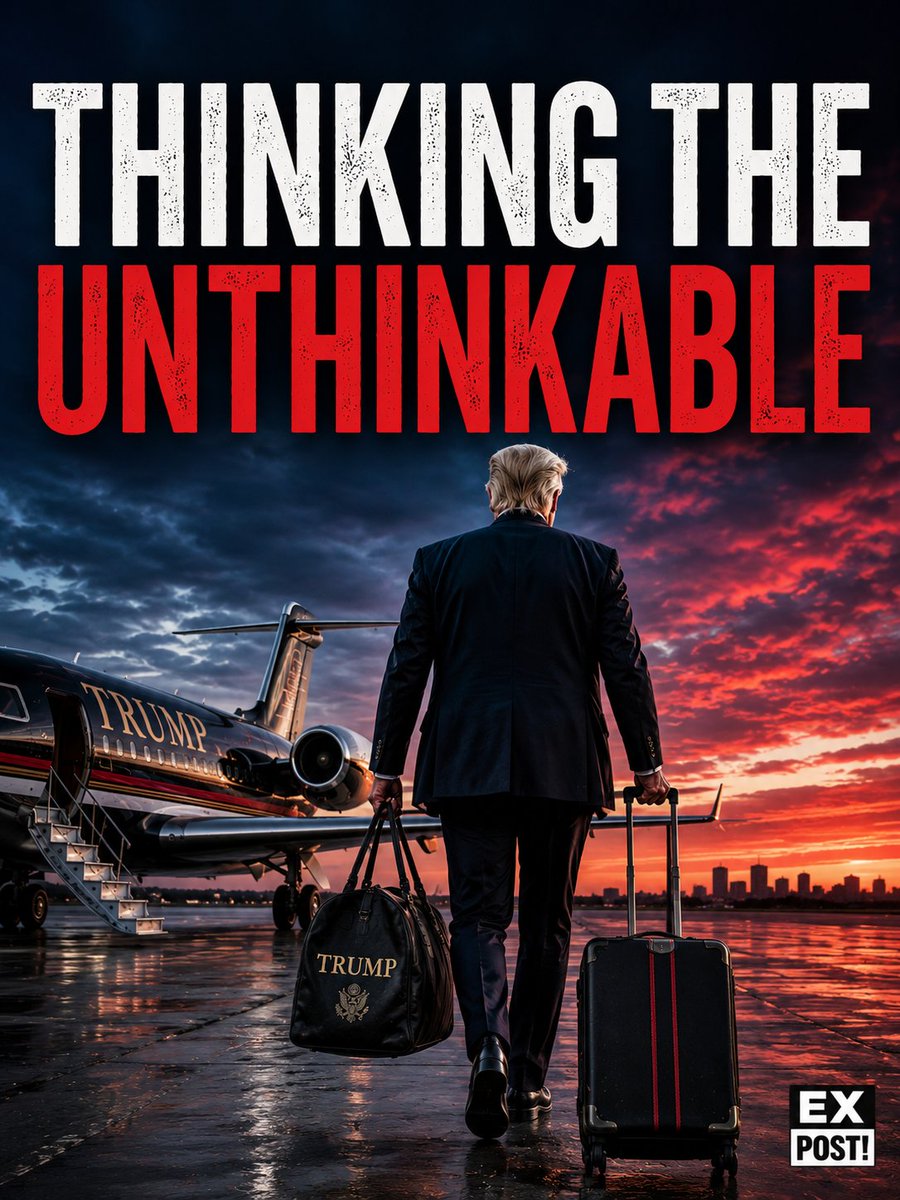
THINKING THE UNTHINKABLE
This is such an outrageous idea that I have never heard anyone discuss it.
Not Democrats.
Not Republicans.
Not cable news.
Not pundits.
Not historians.
Nobody.
And yet I have spent months asking the AI the same question over and over again.
Why doesn't Donald Trump just leave?
Not flee.
Not escape.
Not because he's guilty.
Not because he's afraid.
Just leave.
Retire.
Go someplace beautiful. Argentina. Saudi Arabia. Anywhere. Sleep late. Play golf. Enjoy his family. Write his memoirs. Eat burgers. Watch sunsets.
I know.
It sounds absurd.
The odds of such a thing are probably five percent or less.
But history is filled with events that nobody saw coming.
Nobody expected Nixon to resign.
Nobody expected George Washington to voluntarily surrender power.
Sometimes the unthinkable happens.
And sometimes it doesn't.
Which is why this is not a prediction.
It's a thought experiment.
And thought experiments have value because they force us to ask questions we otherwise wouldn't ask.
For months, I asked the AI why Donald Trump wouldn't simply leave.
The AI always rejected the idea.
"No," it told me. "That's not who he is."
Fair enough.
Trump likes the spotlight. He likes the applause. He likes the combat. He likes the pageantry. He likes winning. He likes being Donald Trump.
And perhaps the AI was right.
But I kept asking.
Before the midterms, I wondered why he wouldn't simply leave and avoid all the headaches that surely await him. After all, even if Republicans retain the Senate, a hostile House would make life miserable. Impeachments. Investigations. Endless noise. Why bother?
The AI always said no.
But recently I changed the question.
I stopped asking what Donald Trump would do.
And I asked what would actually be best for Donald Trump.
Those are not the same question.
Suddenly, the answer changed.
Not because Trump changed.
Because the question changed.
I asked the AI:
"Forget politics. Forget image. Forget what he'll actually do. If you were advising Donald Trump after he leaves office, what would you tell him?"
The machine paused.
And then, to my surprise, it answered:
"Sir, you've won twice. You've climbed every mountain there was to climb. You've lived in towers. You've lived in palaces. You've stood on the biggest stage in the world. You've outlived scandals, enemies, impeachments, and predictions of your demise.
There are no more mountains.
Go enjoy the rest of your life.
Sleep late.
Play golf.
Spend time with your family.
Write your memoirs.
Eat good burgers.
Wake up someplace beautiful where the headlines don't matter.
Go with your freedom.
Go with your dignity.
Let younger men fight younger men's battles.
You've done enough."
I sat there staring at the answer.
Not because I thought Donald Trump would actually do it.
Not because I thought he would move to Buenos Aires or Riyadh.
But because the AI had finally answered a different question.
Not, "What will Donald Trump do?"
But, "What should an old lion do when there are no more mountains left to climb?"
Perhaps the most unthinkable thing of all is not that Donald Trump might someday leave.
Perhaps the most unthinkable thing is that he might one day decide that he has done enough.
And if that day ever comes, I hope somebody tells him, with affection and without irony:
"Sir, go enjoy the rest of your life with freedom and dignity.
You've done enough."
Now that is thinking the unthinkable. ❦
Follow EX POST!™
@EXPostNewsMedia
Nobody Does What We Do
@MollyJongFast @MuellerSheWrote @briantylercohen
#Trump #DonaldTrump #Politics #History #Commentary #ThoughtExperiment #EXPOST
63
Jun 12
EX POST!™ JUNE 12, 2026
AFTERNOON EDITION
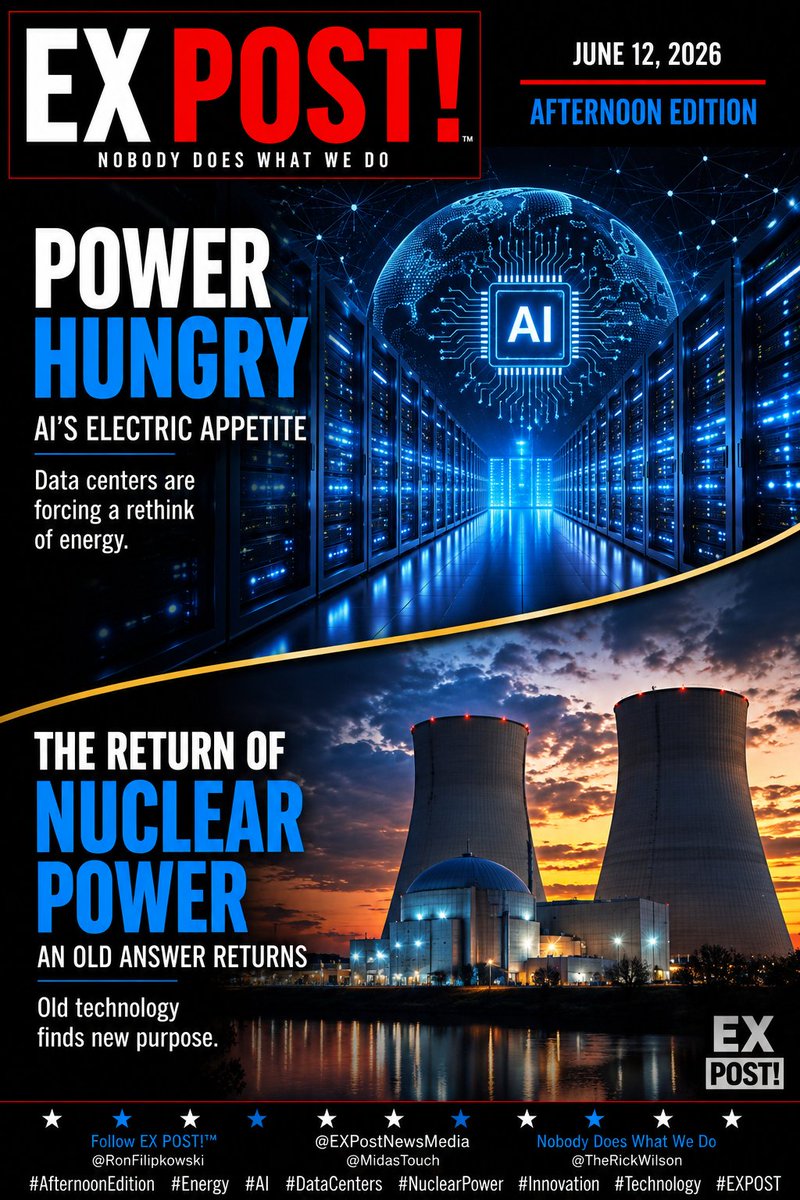
POWER HUNGRY
AI'S ELECTRIC APPETITE
Artificial intelligence is creating an unexpected challenge: power. The enormous data centers behind AI models consume staggering amounts of electricity, and demand is rising quickly. Utilities, technology companies, and governments are racing to expand the grid, build new generation capacity, and improve storage systems. What once seemed like a purely digital revolution is revealing very physical limits.
Major technology companies are now investing heavily in their own energy strategies. Some are signing long-term agreements with utilities, while others are exploring partnerships involving solar, wind, battery storage, and even nuclear power. The scale of AI's appetite is beginning to reshape conversations about infrastructure and national competitiveness.
THE BIGGER STORY
For decades, the internet felt almost weightless. But every AI breakthrough ultimately runs on electrons. The race for artificial intelligence is becoming a race for energy, and whoever can generate and deliver enough power may hold a decisive advantage. ❦
THE RETURN OF NUCLEAR POWER
AN OLD ANSWER RETURNS
Nuclear energy, long considered a relic by many, is enjoying renewed interest. Governments and private companies are investing billions in existing plants, advanced reactors, and small modular designs in hopes of providing reliable, carbon-free electricity. Supporters see nuclear power as an answer to growing demand, while critics remain concerned about costs and waste.
A new generation of reactors promises greater efficiency and enhanced safety, while several countries are extending the lives of existing plants rather than shutting them down. Technology companies seeking dependable electricity for AI data centers have also become unexpected allies in nuclear energy's revival, giving the industry momentum it has not enjoyed in decades.
THE BIGGER STORY
History has a sense of irony. In a century shaped by artificial intelligence and cutting-edge technology, one of the most important solutions may come from an industry born generations ago. The future may arrive with dazzling software, but it may still depend on the humble work of keeping the lights on. ❦
@AP @Reuters @WSJ @FinancialTimes
#ArtificialIntelligence #AI #Energy #Electricity #NuclearEnergy #Technology #DataCenters #Innovation
Follow EX POST!™ @EXPostNewsMedia Nobody Does What We Do
1
43
Jun 12
I'm going to try learning and using Codex to automate my EX POST!™ production.
If anything happens to me, just know that I'm neither depressed nor suicidal.
32
Jun 12
EX POST!™ JUNE 11, 2026
EXPLAINER
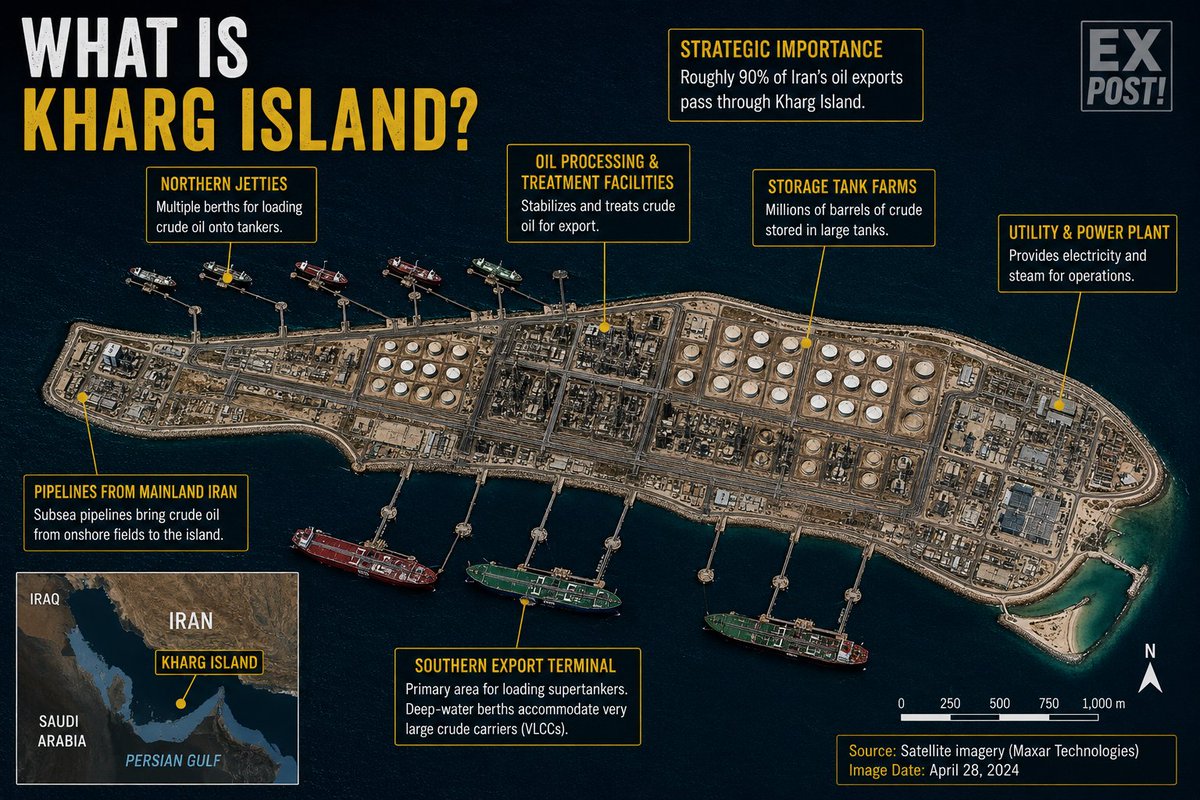
WHAT IS KHARG ISLAND?
Kharg Island is a small island in the Persian Gulf, but it occupies an outsized place in world energy markets. Pipelines carrying crude oil from fields across Iran converge there. The oil is gathered, processed, stored, and loaded onto giant tankers bound primarily for Asia.
In simple terms, Kharg Island functions as the heart of Iran's oil economy.
Like arteries feeding a heart, pipelines from across the country bring oil to one place. From there, the island pumps revenue back into the Iranian economy. Roughly 90% of Iran's oil exports pass through Kharg Island.
That is why military planners have long regarded it as one of the most strategically important pieces of real estate in the Middle East. You do not have to occupy Tehran to damage Iran economically. Disrupting Kharg Island means disrupting the flow of money that finances much of the government and its activities.
WHAT MAKES IT SO IMPORTANT?
Kharg Island contains processing facilities, vast storage tank farms, and deep-water loading terminals capable of servicing some of the world's largest tankers. During the Iran-Iraq War, both sides repeatedly attacked the island because they understood that whoever threatened Kharg Island threatened Iran's economic lifeblood.
Any major attack there would ripple far beyond Iran. Oil prices could surge. Shipping routes throughout the Persian Gulf could be disrupted. Inflation could rise worldwide. Regional powers could be drawn into a wider conflict.
WHAT WOULD "BOOTS ON THE GROUND" MEAN?
An airstrike could damage facilities. Occupying the island would be something else entirely.
Holding Kharg Island would require troops, ships, air defenses, logistics, and a constant flow of supplies. Iranian missiles, drones, and naval forces could make maintaining that position extraordinarily difficult. Taking the island would not simply be a raid. It would mean opening a new front in a larger war.
THE BIGGER STORY
Kharg Island is important not because of its size, but because of what flows through it.
A tiny island in the Persian Gulf acts as the beating heart of Iran's oil economy. And when the heart of an economy is threatened, the shockwaves can be felt around the world. ❦
Follow EX POST!™
@EXPostNewsMedia
Nobody Does What We Do
@ForeignAffairs @CFR_org @WarOnTheRocks @CSIS @BBCWorld @AliVelshi
#KhargIsland #Iran #PersianGulf #OilMarkets #EnergySecurity #MiddleEast #Geopolitics #WorldNews
84
Jun 12
EX POST!™ JUNE 11, 2026
EVENING EDITION
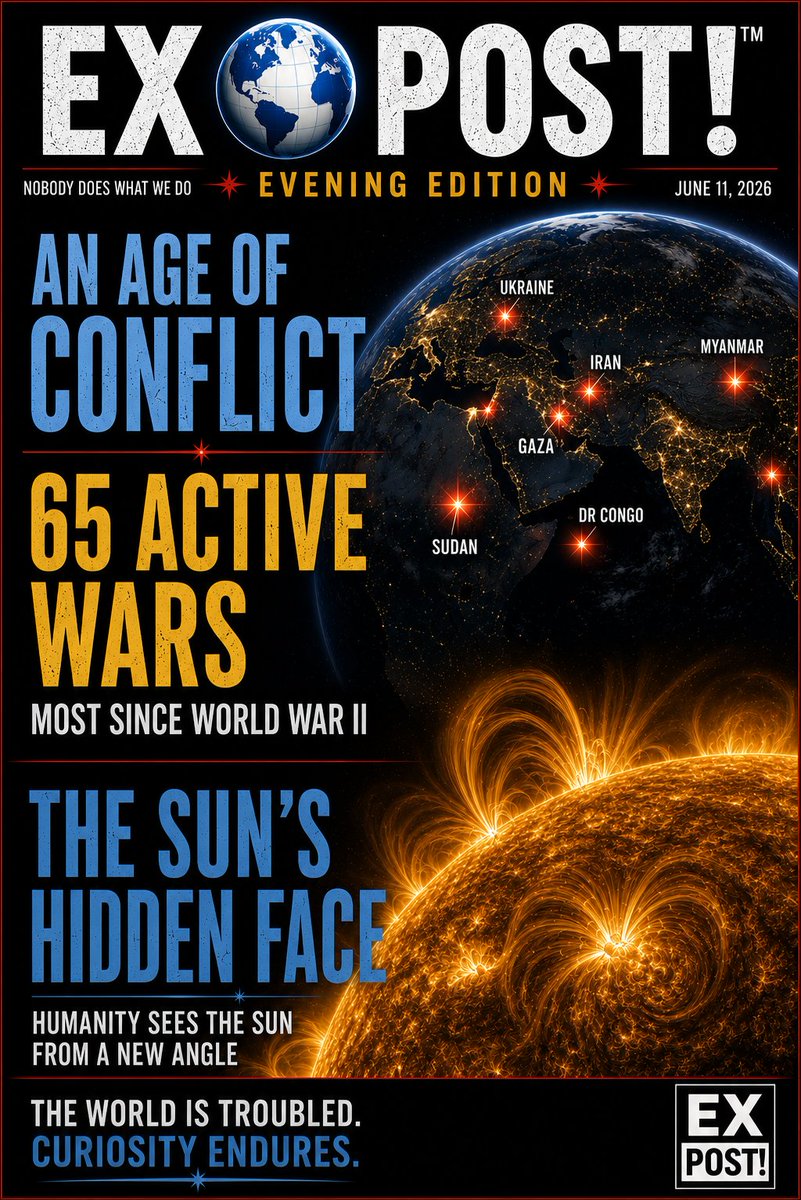
AN AGE OF CONFLICT
65 ACTIVE WARS. THE MOST SINCE WORLD WAR II.
WHAT HAPPENED
The latest crisis between the United States and Iran appeared to ease after reports of U.S. strikes, Iranian retaliation, and President Donald Trump announced that planned follow-up attacks had been called off amid what he described as a diplomatic breakthrough.
But even as the immediate crisis appeared to cool, a troubling new study pointed to something much larger.
THE BIGGER STORY
Researchers found that 2025 saw 65 active conflicts across 35 countries, the highest number recorded since World War II. Conflict-related deaths climbed to roughly 245,000, reflecting a world where violence is no longer confined to one region or one ideology.
Ukraine. Gaza. Sudan. Myanmar. Congo. The Middle East.
Different histories. Different grievances. Different wars.
But taken together, they reveal a planet under strain.
WHAT CHANGES
History does not always announce itself with a date and a headline. Sometimes it arrives quietly, hidden inside the numbers.
The world is not engaged in one global war. But the accumulation of conflicts, rising fatalities, and increasing tensions among major powers suggest that peace itself is under pressure.
Whether this era becomes remembered as a passing storm or the beginning of a more dangerous age will depend on choices still being made.
The numbers are alarming. The suffering is real. But catastrophe is not destiny. ❦
THE SUN'S HIDDEN FACE
HUMANITY SEES THE SUN FROM A NEW ANGLE
WHAT HAPPENED
For the first time in history, scientists have captured images of the Sun's south pole, revealing a region that had never before been seen directly.
The achievement opens a new window onto the star that sustains life on Earth.
THE BIGGER STORY
Most observations of the Sun have come from viewpoints near its equator. The new images offer scientists an entirely different perspective and may improve our understanding of solar cycles, magnetic fields, and the storms that occasionally interfere with communications and electrical systems here on Earth.
WHAT CHANGES
At a moment when headlines are dominated by war, another side of humanity continues to reveal itself.
Human beings are capable of destruction.
Human beings are also capable of wonder.
Even in an age of conflict, curiosity endures. ❦
Follow EX POST!™
@EXPostNewsMedia
Nobody Does What We Do
@AP @Reuters @NPR @Nature @NASA @PBSNews
#EveningEdition #WorldNews #Iran #Ukraine #Sudan #Myanmar #Science #SolarScience #Astronomy #Space #EXPOST
111
Jun 12
THE IDOL OF PATRIOTISM
Patriotism is a virtue.
Unquestioning patriotism is a vice.
There is nothing wrong with loving one's country. A nation needs citizens who cherish it, defend it, and hope for its success. But every virtue, if elevated above all others, eventually becomes dangerous.
Patriotism becomes an idol when loyalty to country outweighs loyalty to truth.
History is full of examples. Nations have committed injustices, launched disastrous wars, violated rights, and turned against their own ideals. Yet many of these actions were defended by people who believed that criticism itself was betrayal. They confused devotion with obedience.
A healthy patriotism asks whether the nation is living up to its principles. An unhealthy patriotism insists that the nation can do no wrong.
The distinction matters.
Citizens are not servants of the state. They are guardians of it. Love of country does not require silence. In fact, self-government depends upon the willingness of citizens to speak when something is wrong.
Blind patriotism demands conformity.
True patriotism demands conscience.
A nation is not honored by pretending it is perfect. It is honored by the courage to confront its failures and by the determination to live up to its highest ideals.
As Malcolm X observed:
"You're not to be so blind with patriotism that you can't face reality. Wrong is wrong, no matter who does it or says it."
Patriotism is a virtue.
But when patriotism itself becomes sacred, truth becomes expendable.
And that is when patriotism ceases to be love of country and becomes something else entirely. ❦
Follow EX POST!™
@EXPostNewsMedia
Nobody Does What We Do
@MollyJongFast @RonFilipkowski @MuellerSheWrote
#Patriotism #Democracy #TruthMatters #CivicDuty #Constitution #AmericanValues #Politics #History #Freedom #EXPOST
31
Jun 11
EX POST!™ JUNE 11, 2026
AFTERNOON EDITION
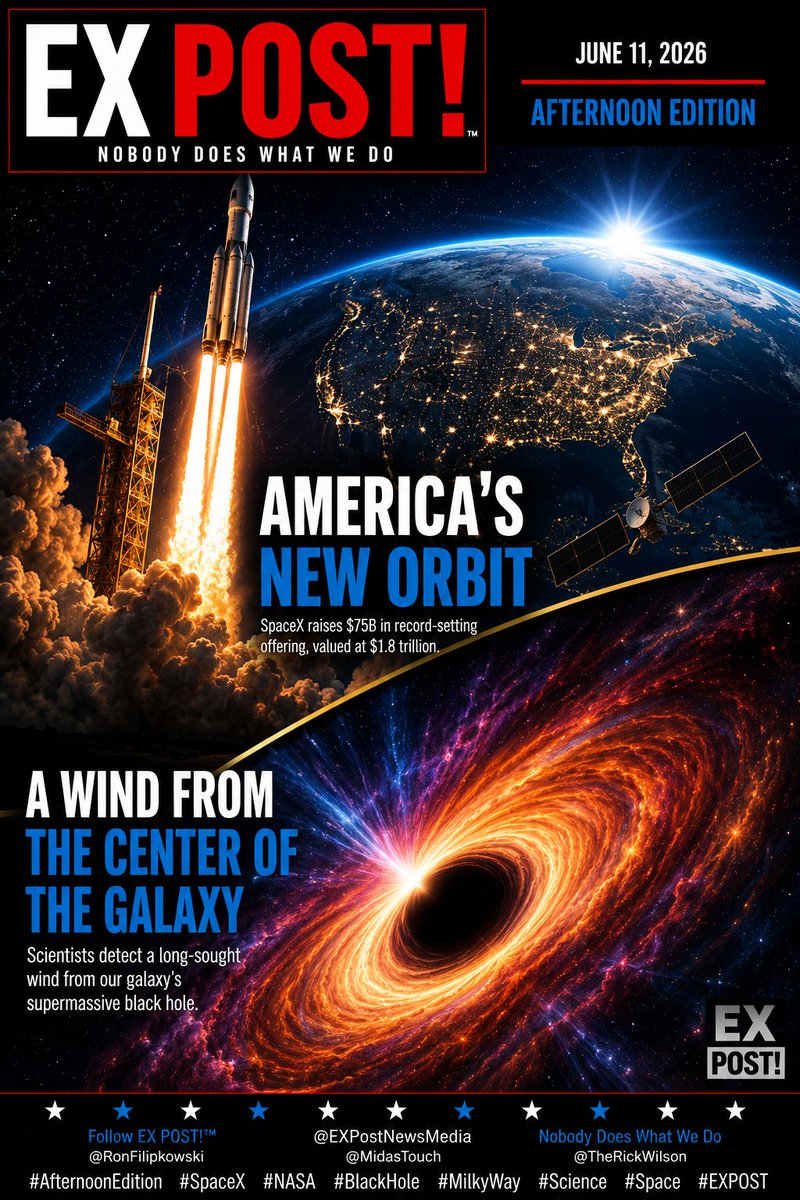
AMERICA'S NEW ORBIT
SpaceX has become one of the most valuable companies in history after raising $75 billion in a record-setting public offering.
The milestone highlights how rapidly private companies are reshaping a domain once dominated almost exclusively by governments.
WHAT HAPPENED
The offering valued SpaceX at roughly $1.8 trillion, cementing its position as a dominant force in commercial launches, satellite communications, national security, and NASA missions.
THE BIGGER STORY
The story is bigger than Elon Musk.
Space itself is changing.
Private companies are increasingly providing capabilities once considered the exclusive responsibility of governments. As those companies grow, questions are emerging about how much of humanity's future in communications, defense, and exploration may depend on a handful of corporate giants.
The next space race may not be between nations.
It may be between companies. ❦
A WIND FROM THE CENTER OF THE GALAXY
For half a century, scientists believed it had to exist.
Now they have finally found it.
Astronomers have detected the wind flowing from Sagittarius A*, the supermassive black hole at the center of the Milky Way, nearly 26,000 light-years from Earth.
WHAT HAPPENED
Researchers discovered that the black hole generates a surprisingly gentle outflow that has carved an enormous cone-shaped cavity through surrounding gas.
The discovery confirms decades of predictions and gives scientists a new window into the forces shaping our galaxy.
WHAT CHANGES
The universe still keeps secrets.
Fifty years after scientists first suspected this galactic wind existed, humanity finally has evidence.
The discovery deepens our understanding of how black holes influence galaxies and serves as a reminder that even after centuries of exploration, there are still wonders waiting to be found.
Sometimes the universe whispers.
And sometimes it takes fifty years to hear it. ❦
Follow EX POST!™ @EXPostNewsMedia Nobody Does What We Do
@Reuters @AP @NASA @NASAWebb @SpaceX
#AfternoonEdition #SpaceX #NASA #Astronomy #BlackHole #MilkyWay #Science #Space #EXPOST
1
54
Jun 11
EX POST!™ JUNE 10, 2026
EVENING EDITION
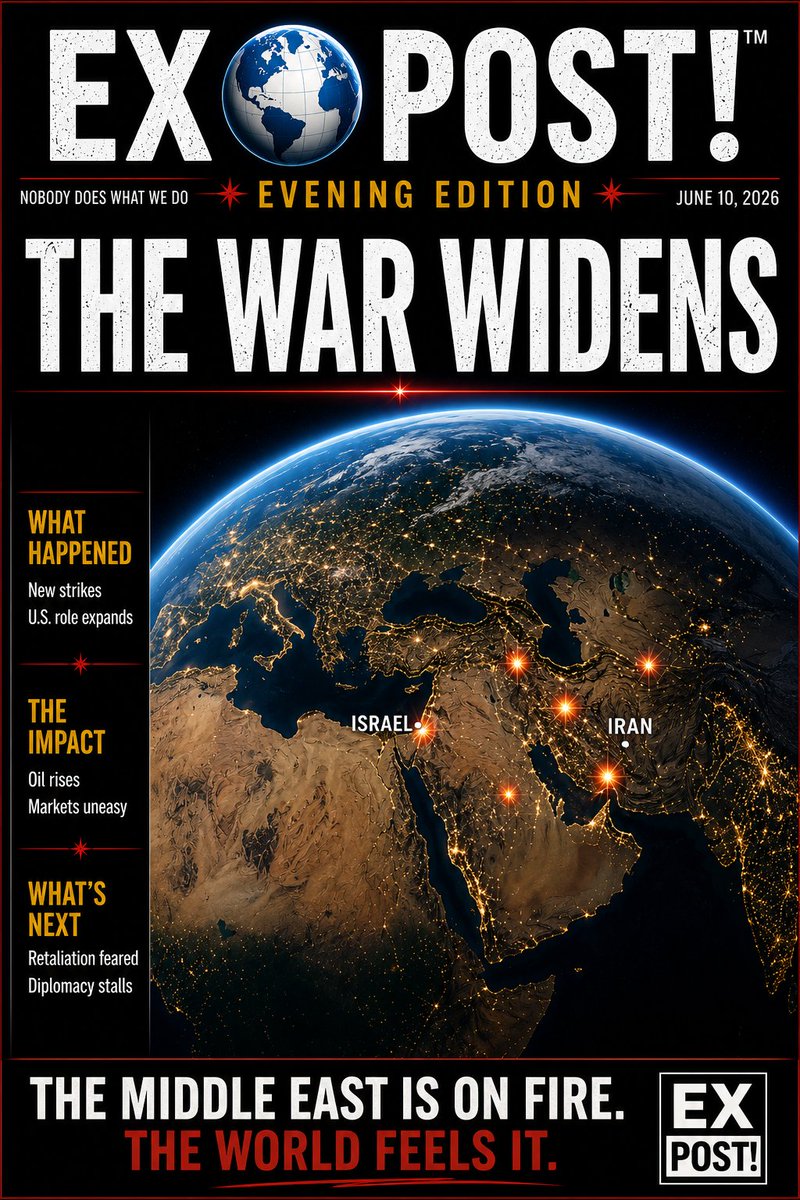
THE WAR WIDENS
New strikes inside Iran and an expanding American role are raising fears that a regional conflict could become something much larger.
WHAT HAPPENED
Israel launched another round of attacks against targets inside Iran as the United States expanded its involvement in the conflict. Iran vowed retaliation, and military activity across the region intensified.
THE BIGGER STORY
What began as a confrontation between Israel and Iran is increasingly drawing in the United States and threatening to destabilize the wider Middle East. Oil markets, shipping routes, and diplomatic efforts are all under growing strain.
WHAT CHANGES
Each new exchange increases the risk of miscalculation. Even leaders seeking to avoid a broader war may find events moving faster than diplomacy.
The Middle East is on fire. The world feels it. Enough. ❦
Follow EX POST!™ @EXPostNewsMedia Nobody Does What We Do
@AP @Reuters @nytimes @washingtonpost @CNN @MSNBC
#Iran #Israel #MiddleEast #BreakingNews #WorldNews #Geopolitics #EXPOST
107
Jun 10
A FEW GLORIOUS MOMENTS
For a few glorious moments,
we took a breath.
For a few glorious moments,
we could feel our skin
and hear our own thoughts.
For a few glorious moments,
we looked toward the future,
knowing it would not stay.
The dishes would return.
The headlines would return.
The noise would return.
But not yet.
For a few glorious moments,
nothing needed fixing.
Nothing needed proving.
Nothing needed explaining.
And because we knew they would pass,
they became precious.
For a few glorious moments,
everything was enough. ❦
by Roland Vasquez
27