138 Photos and videos


Jun 12
There you go, US and IRAN deal

The Islamabad Memorandum of Understanding has never been closer. Pending its finalization, the media should refrain from entering speculation about its content.
In line with our responsible and transparent approach, all details will be shared with the public in due course.
61
Jun 12
Mark my words, $NOK will announce AI related acquisition within this year.
Jun 11

JP Morgan out ve on Nokia $NOK , price target raised to $21 Mentions a undisclosed win at Google in the Data Center space.
The strong product line-up will position Nokia at the leading edge in the optical market. With Nokia’s own Indium Phosphide fab capacity coupled with its own packaging capability, Nokia has positioned its optical business for significant order & sales growth into 2027
New wins in Datacenter switching add another leg to Nokia's growth:
"We know from the company’s guidance that they won other hyperscaler/s as customers. Google $GOOGL has been talked of as a likely customer of Nokia’s switch products for over a year and they could be one of the new hyperscalers that the company has won business at. It is possible there are one or more other customers for the business"
1
148
Jun 9
Wow, gigantic AI satellite

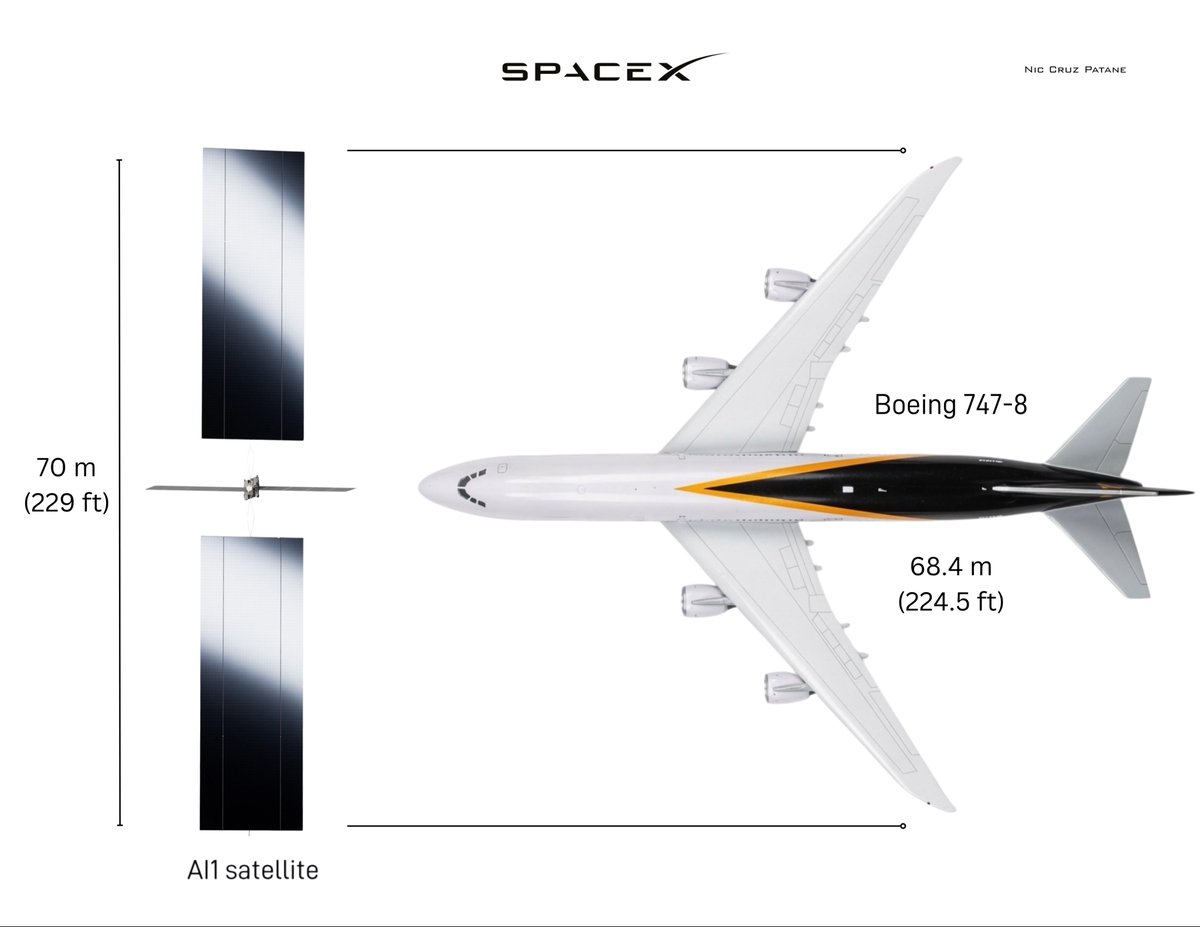
SpaceX AI Satellites are HUGE.
They have a wingspan of 70 meters (229 ft) when deployed.
To put that in perspective, a Boeing 747-8 has a wingspan of 68.4 meters (224.5 ft).
138
Jun 9
All 4 ETFs please

We have some big launches coming soon. Which AI theme are you most excited about?
1
107

$BRUN shares unlocked and hit the market today. Green/flat close. Kinda weird huh? It was literally a nothing burger.
Let's do a quick recap here:
> $475M ARR guided for 2026, recurring not lumpy
> $1.45B contracted backlog as of Jun 1, up from $940M at the May listing
> NVIDIA Exemplar Cloud status on Blackwell, NVIDIA's top validation tier
> One of only a handful worldwide, alongside Azure, CoreWeave, Oracle, Nebius
> Dell and Fluidstack named. Thinking Machines Lab signed May 21. CDW in the channel
> 153MW of contracted compute
> Analyst targets to $45, up from $25
Insiders and the sponsor hold most of those unlocked shares. They were handed the right to sell into strength.
Put yourself in their shoes. You sit on the board. You see the pipeline and what's in store before retail does. Do you dump in the $30s if you think it is worth multiples more next year?
The unlock is a calendar event misrepresented as a negative catalyst. The backlog is a demand event. One is noise, one compounds. I have read every filing this company has put out. This is just short term noise, and it does not break the thesis.
Just my 2c.
- Leki the investing monkey 🐵
14
4
90
11,525
Jupiterian retweeted

Top two ideas right now:
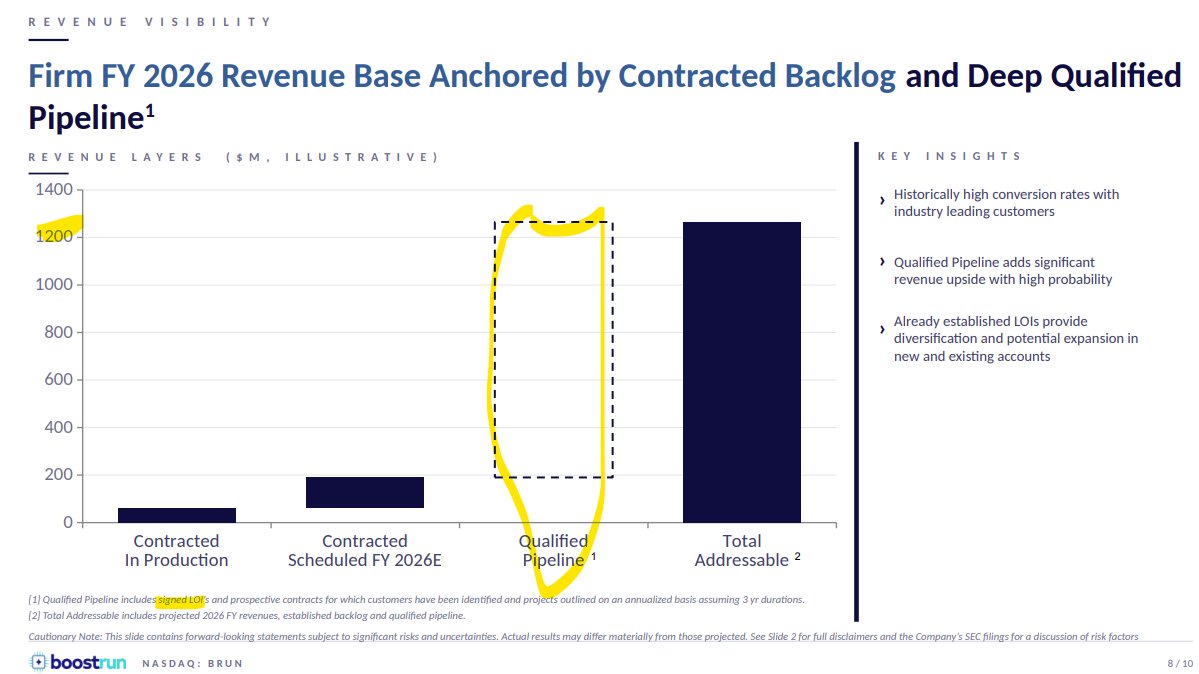
$brun: mgmt thinks they get to $1.2B ARR run rate maybe by end of year (per recent investor deck June 2). Using $NBIS $CRWV EV/S as a comp puts that stock at $100 (vs. $30 today) by year end. The lock up fears that ppl had were unwarranted. Per @OddDiligence lock up most likely a October/November event. CEO/COO own 60% so material amount of shares unlikely to hit tape even then @burningbushcap @mkfilko
$aaoi: guiding to $5.5B annualized run rate revenue next year, $lite guiding to 40% ebit margins, if AAOI gets to 20% (seems conservative), stock is 11x run rate EBIT growing at 100% .. That puts the stock over $400 (vs $200 today) quite easily @JonahLupton @aleabitoreddit
2
2
63
9,147
Jun 8

Nebius has announced an investment of £1.7 billion to build out capacity in the UK with three new deployments of NVIDIA infrastructure.
The three new sites will deploy the latest generations of NVIDIA’s full-stack, end-to-end AI factory platform technology and combined will reach 65 MW when fully ramped up in 2027.
In addition to the capacity investment, Nebius is expanding its commercial and AI R&D hub in London and establishing local partnerships with universities and research institutions through Nebius Academy.
Arkady Volozh, founder and CEO of Nebius, said:
"The UK is one of the places where AI is being built, deployed, and adopted at the same time — by startups, by enterprises, and by the public sector. The work is happening here and the demand is here. And we are also here for the long run."
Read the full press release: nebius.com/newsroom/nebius-e…
84
Jupiterian retweeted
Addressing the $brun FUD. Have a nice weekend.
1/ ASSET OWNERSHIP — Finance leases under ASC 842 transfer substantially all risks/rewards of ownership. CRWV finances its GPUs too. IREN finances its GPUs. The colo criticism is valid but applies equally to every neocloud at this stage. NBIS and CRWV started with a colocation model as well. So not sure why some would suggest this is a negative? Following a proven playbook. Colocation --> growth --> build your own.
2/ BARE METAL TERMINAL VALUE — If bare metal has no terminal value, $CRWV at $55B market cap is also uninvestable. The market disagrees. BRUN moves up the stack the same way CRWV is — you can't make this argument without being negative on CRWV/NBIS too.
3/ CRYPTO REVENUE — In 2025 BRUN had capacity before customers existed. Throwing idle GPUs at crypto to cover fixed costs while ramping. They now have $1.415B in contracted backlog. Management is implying $4B based on LOIs per recent investor deck. Looking at 2025 crypto revenue is looking in the rear view mirror. BTW, CRWV started as a crypto mining company.
4/ CUSTOMER QUALITY — Mira Murati left OpenAI as CTO to build a frontier lab and signed a $471.7M non-cancelable contract with BRUN over CRWV and NBIS. That's the opposite of adverse selection. Management says they have LOIs for $3.5B in the pipeline that they expect to convert. The $400M ARR is already locked through June 1, so everything additional is beat and raise upside. Guidance is so sand bagged its not even funny.
5/ BRIDGE LOAN — A company in default on an $11M bridge in February is now sitting on $134M SPAC proceeds with a $2B market cap and full equity market access. Applying February liquidity constraints to June 2026 is stale analysis. We already saw this play out with $IQE HSBC. The bridge loan is a joke.
6/ PRICING POWER — The binary is simple: you're either AWS (expensive, full stack) or bare metal optimized. NBIS and CRWV sell the same thing. Nobody calls them uninvestable on pricing power grounds. 3-year non-cancelable contracts already lock in current pricing anyway.
7/ EXEMPLAR — 8 providers out of hundreds of NVIDIA Cloud Partners. If it were easy there'd be 80 partners not 8. The preferred GPU allocation is structural. NVIDIA equity would be nice but the certification is independently validated.
The M&A comp you're missing: IREN just acquired a company at 5x ARR on $125M ARR. BRUN is at $470M ARR run rate right now. At 5x that's $2.35B — roughly current EV. At $1.2B LOI ARR that's $6B. The M&A floor alone justifies the current price with significant upside.
@aleabitoreddit @leopoldasch @mkfilko @burningbushcap @ParadisLabs
7
5
83
11,007
Jupiterian retweeted

Jun 5
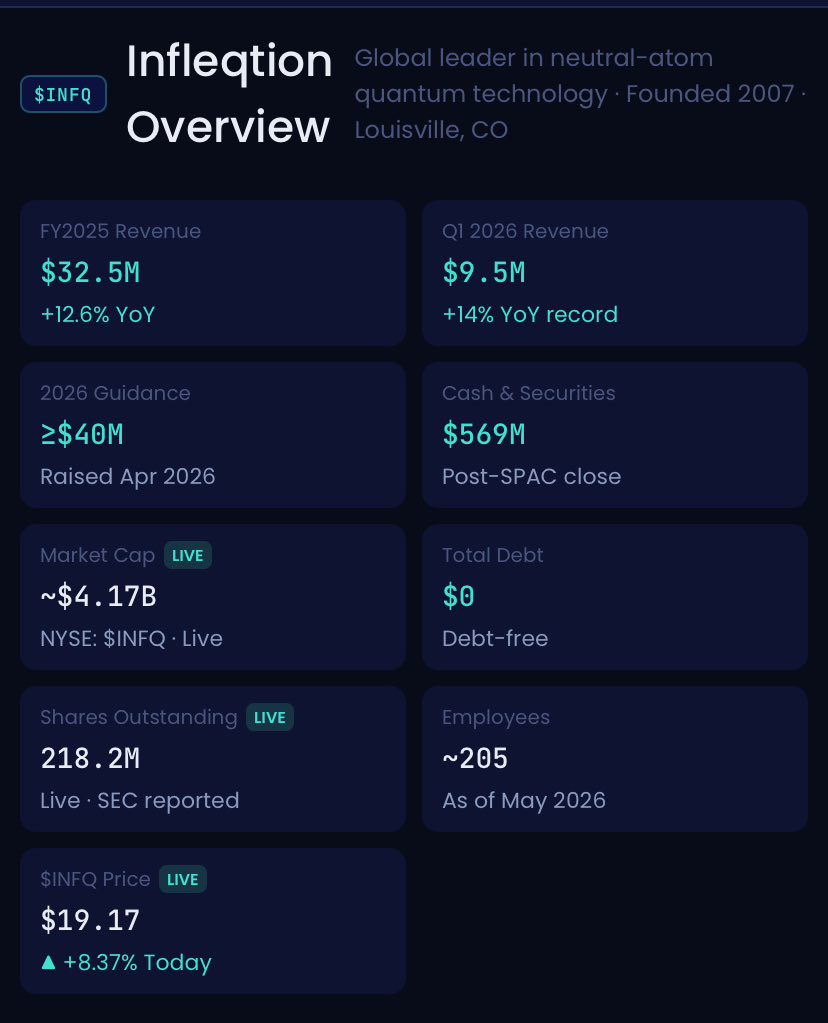
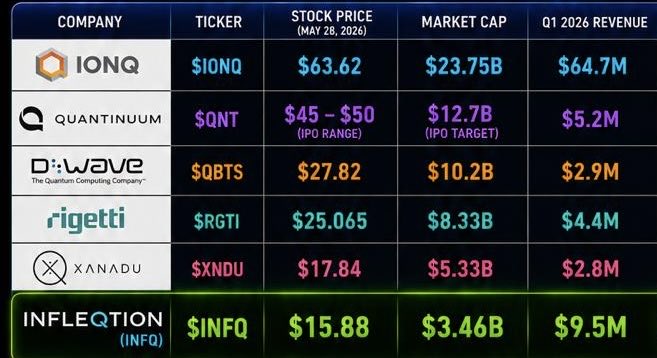
$INFQ chart night again 📊
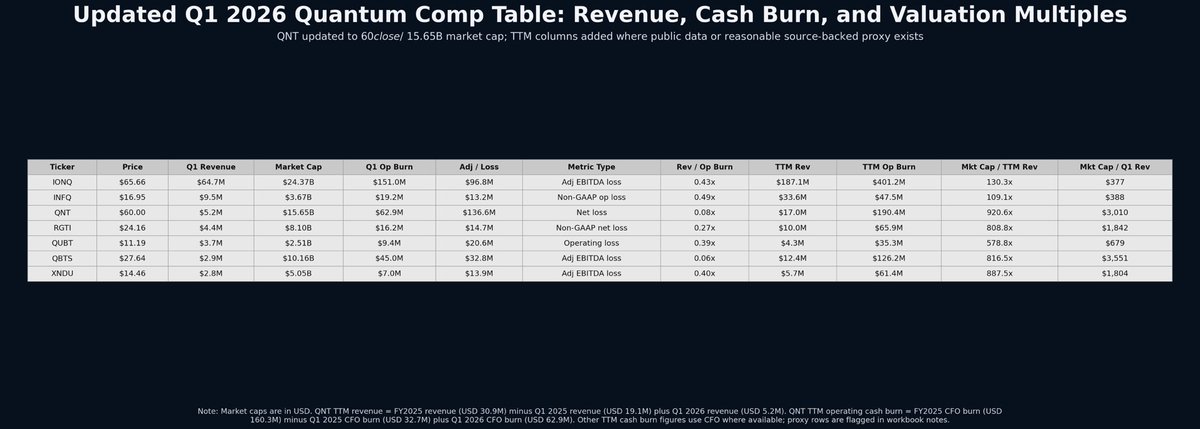
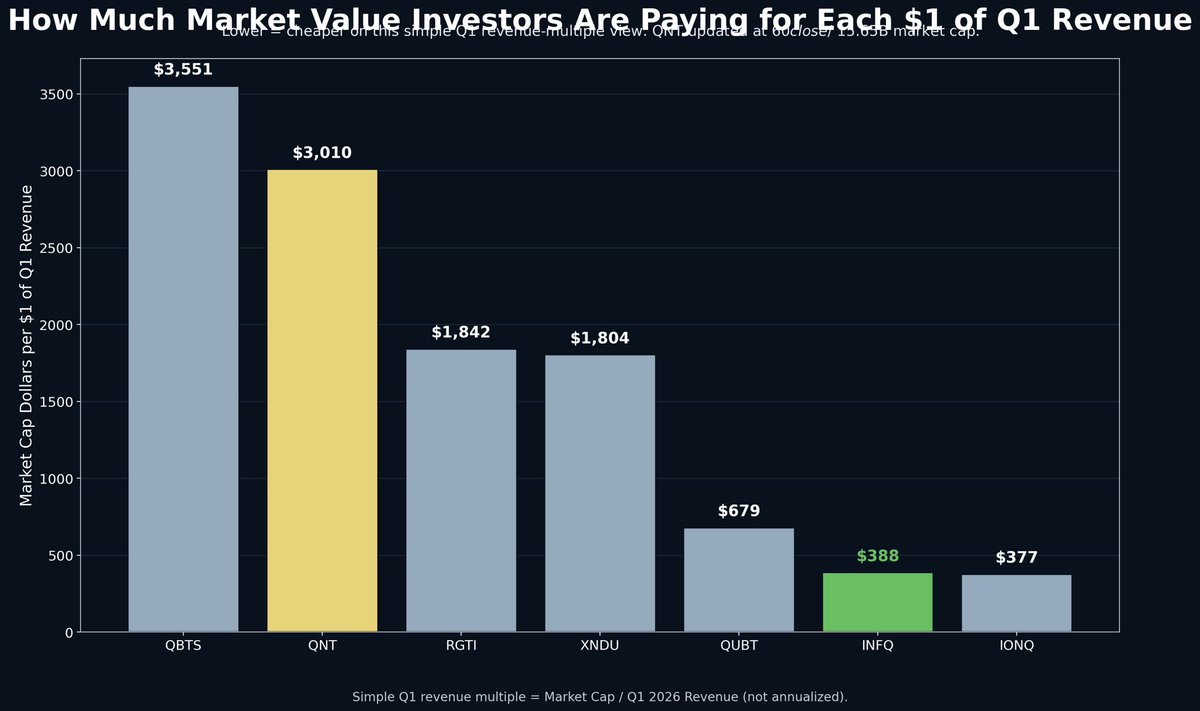
I updated the quantum comp charts I posted a couple weeks ago now that Quantinuum priced/closed at $60/share.
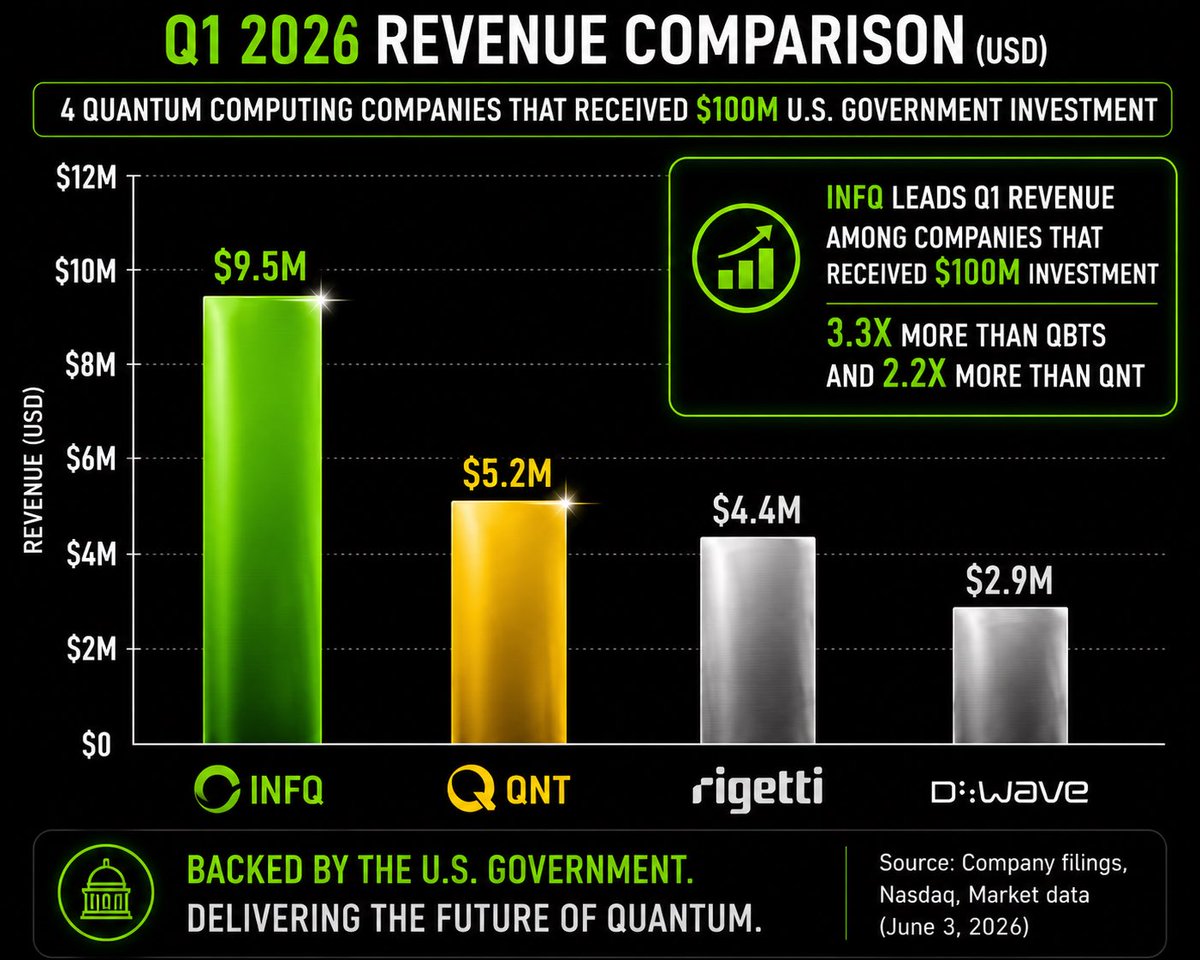
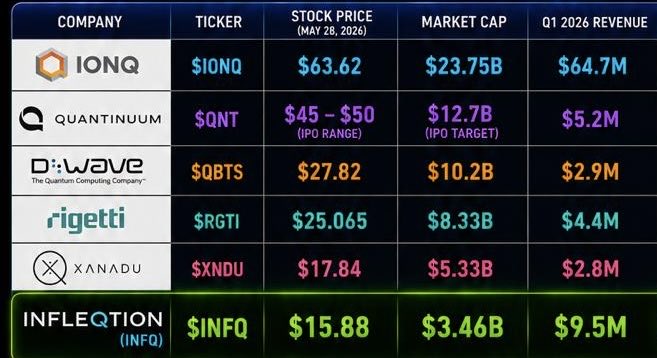
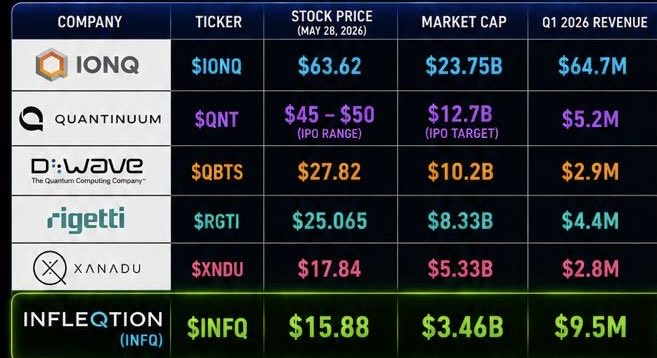
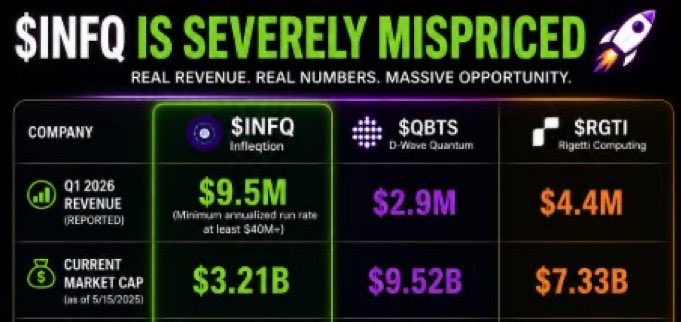
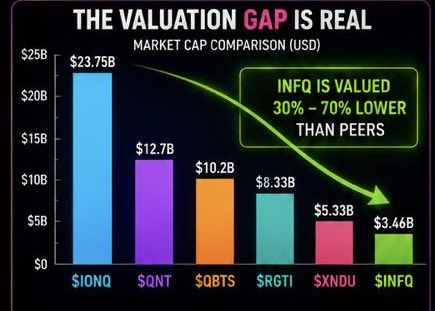
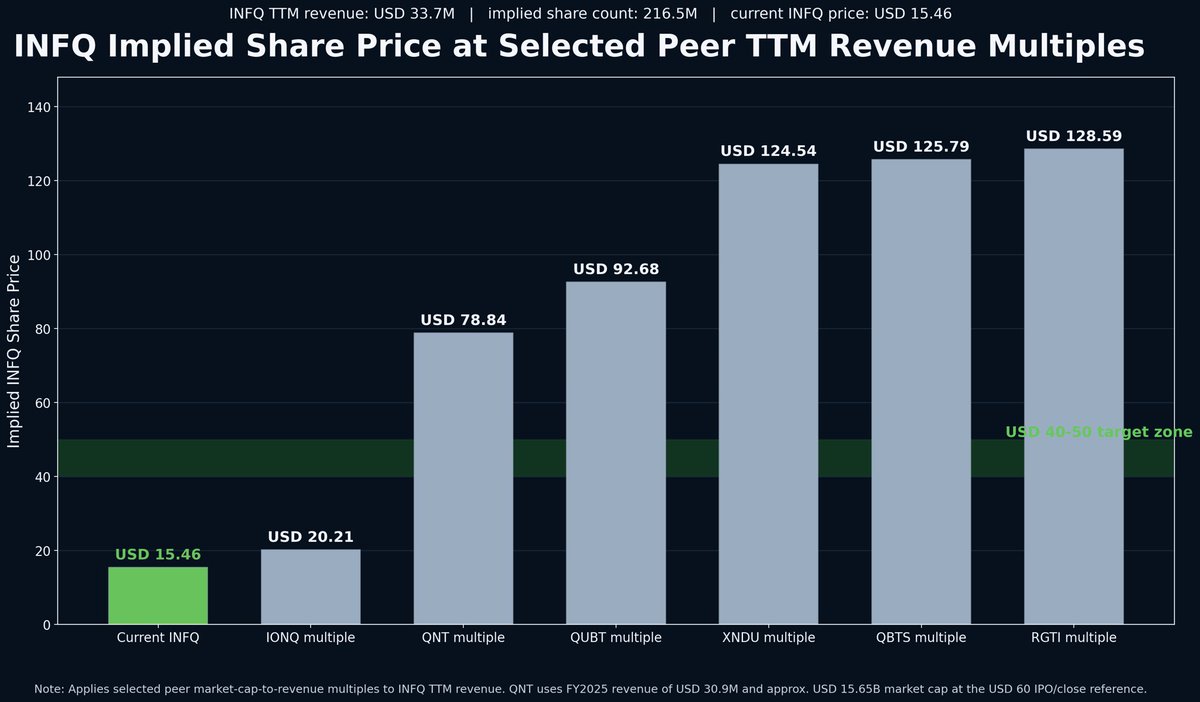
That matters because the QNT peer multiple changed materially. Using the prior ~$12.7B IPO valuation, the QNT revenue multiple implied roughly $64/share for INFQ. Using the updated ~$15.65B market cap at $60/share, that implied INFQ value moves to about $78.84/share.
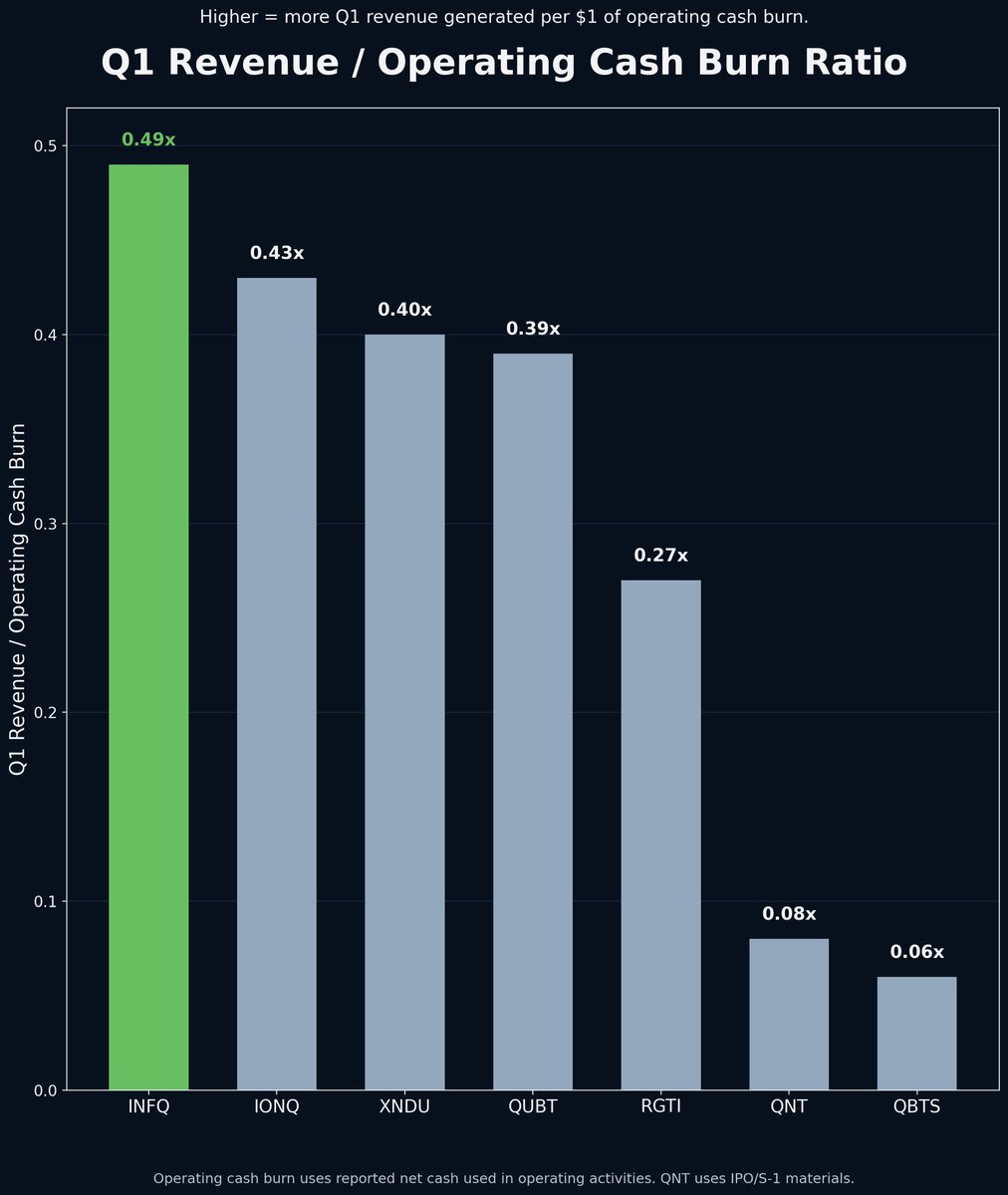
Also notable, the estimated trailing 12 month operating cash burn:
QNT: ~$190M
INFQ: ~$47.5M
So QNT is trading at a much higher revenue multiple while burning roughly 4x more operating cash over the trailing period.
INFQ still screens well on the simple efficiency metric too:
Q1 revenue / Q1 operating cash burn
INFQ: 0.49x
IONQ: 0.43x
QNT: 0.08x
None of this means every quantum company should trade at the same multiple. They are different businesses, different tech stacks, different stages, and different investor stories.
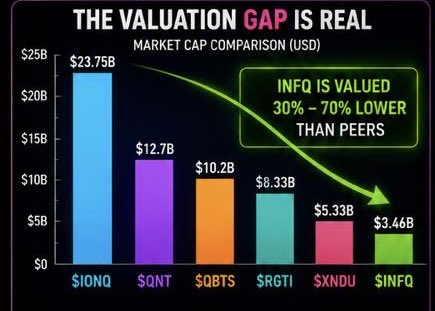
But the valuation gap is still hard to ignore.
My $INFQ base case right now is closer to the $40–$50 range. My fair value case is the $50–$60 range, especially if the market keeps rewarding quantum names at these kinds of revenue multiples. Most bullish case if huge news were to break? No comment 🤣
If QNT deserves its public-market premium, I think INFQ deserves a serious re-rating debate too.
Not investment advice. Just updated comp math.
$INFQ $QNT $IONQ $RGTI $QBTS $QUBT
1
4
32
16,070
Jupiterian retweeted

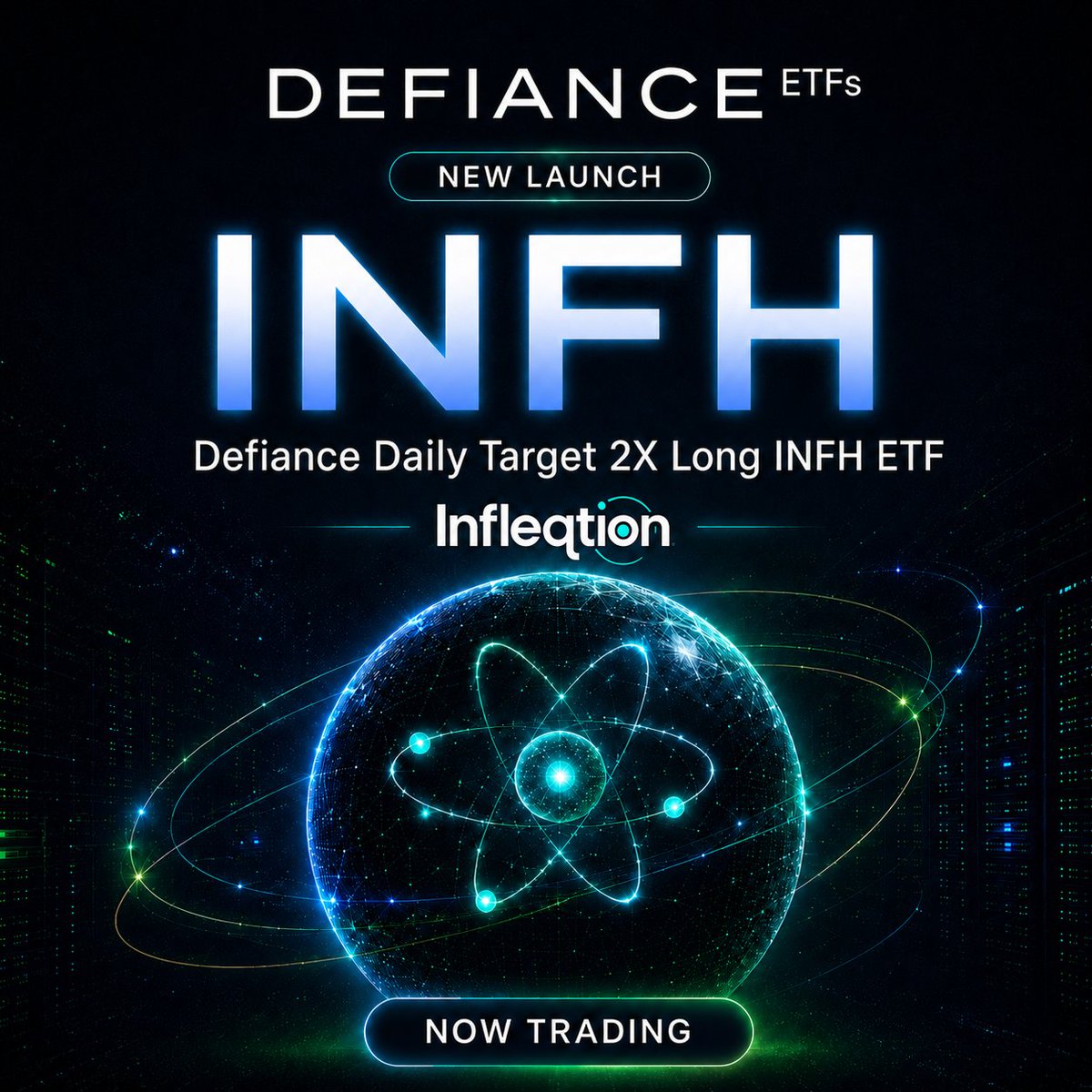
Meet $INFH — the Defiance Daily Target 2X Long INFQ ETF.
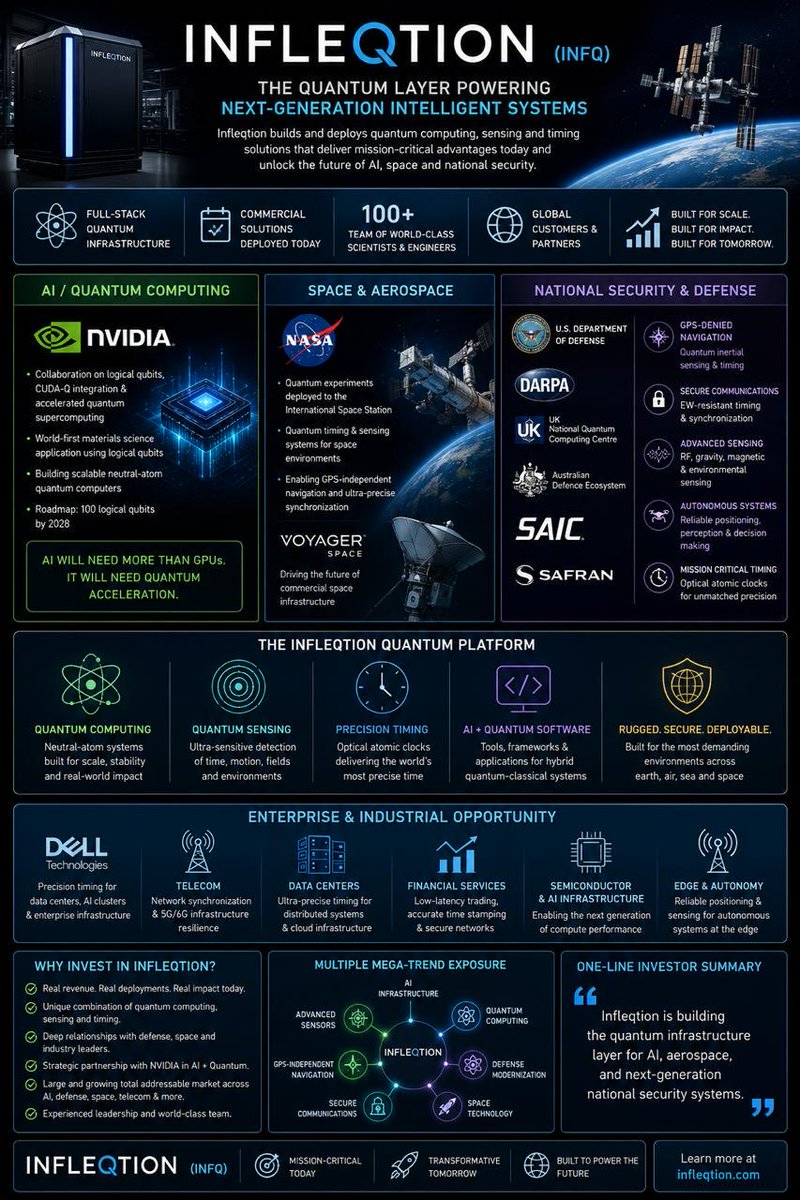
2x daily exposure to Infleqtion ($INFQ), the neutral-atom quantum company powering computing and sensing for government, defense, and aerospace.
Learn More: defianceetfs.com/infh
Investing involves risk. Principal loss is possible. Distributed by Foreside Fund Services, LLC. The fund is designed to be utilized only by knowledgeable investors who understand the potential consequences of seeking daily leveraged (2X) investment results, understand the risks associated with the use of leverage, and are willing to monitor their portfolios frequently. An investor could lose the full principal value of their investment within a single day. An Investment in INFH is not a direct investment in Infleqtion.
3
8
32
3,831
Jun 5
RT @miscomputate: Interesting article today by one of my least favorite stock outlets @themotleyfool - no shame in admitting it. But I thro…
1
11
Jun 5
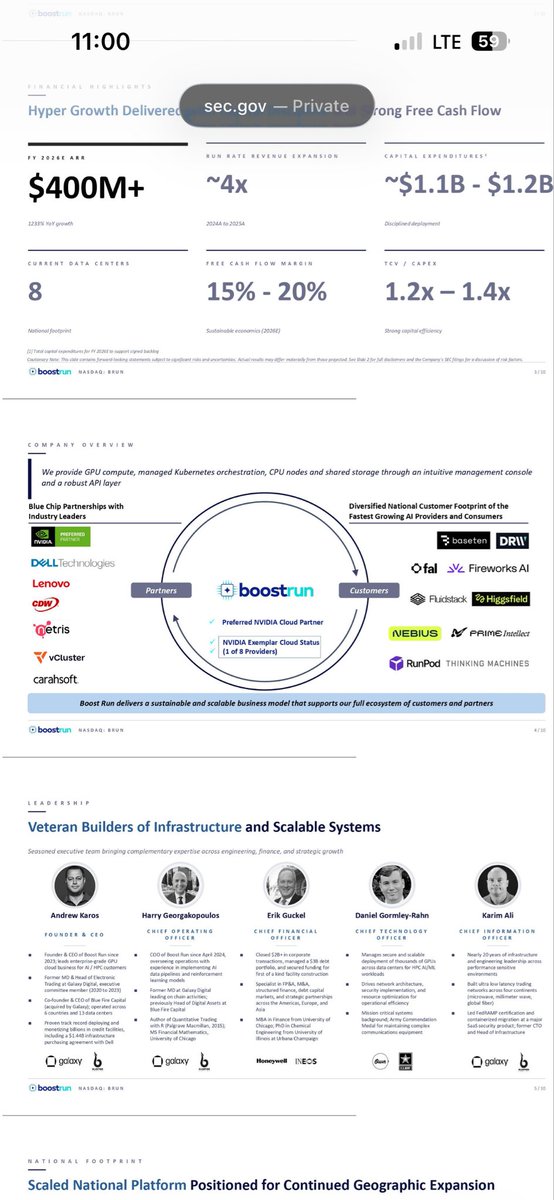
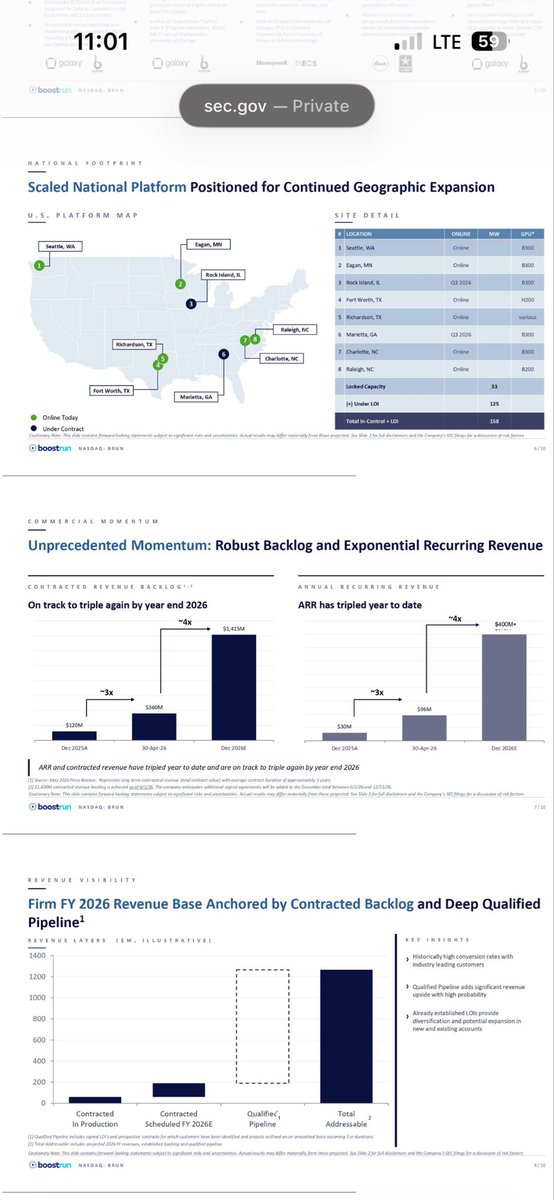
$BRUN 400 m ARR is impressive number, the customer list is growing especially $NBIS and @thinkymachines are their customers now.

$brun guiding to FCF margin of 20% with arr at least tripling. $470MM ARR contracted for 2026, likely to exit closer to $800M. If they grow 2x next year (implying much slower growth ie conservative), the stock is like 10x FCF on 2027 exit rate.
Stock going much higher. Bought more today. $100 by year end seems realistic $200 next year
@burningbushcap
1
3
188
Jun 4
$QNT 15.6B IPO, Fault Tolerance Quantum Computing and Why does Logical Qubits matter?
Most investors still think quantum computing is a race for more physical qubits.
Wall Street is increasingly betting on something else:
Logical Qubits.
That’s why Quantinuum’s IPO priced at $60/share, valuing the company at roughly $15.6B, and was reportedly 20x oversubscribed.
Why?
Because a quantum computer with 1,000 noisy physical qubits is often less useful than one with a few dozen high-quality logical qubits.
A logical qubit is an error-corrected qubit built from many physical qubits working together.
Think of it this way:
Physical qubits = raw materials
Logical qubits = finished products
Without error correction, quantum computers produce too many mistakes to solve commercially valuable problems.
With error correction, they become scalable.
That is the bridge between a science experiment and a trillion-dollar computing platform.
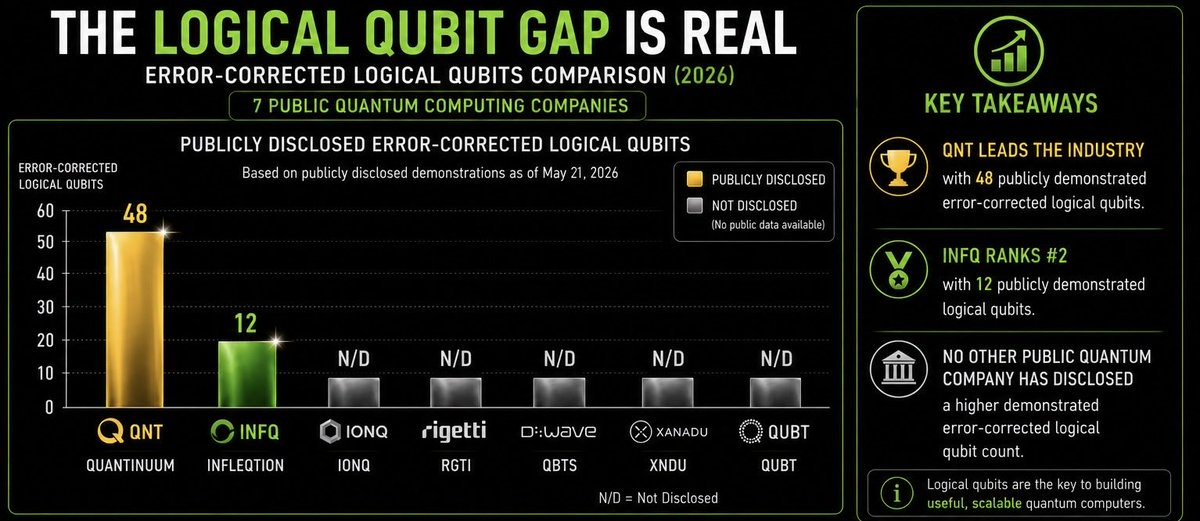
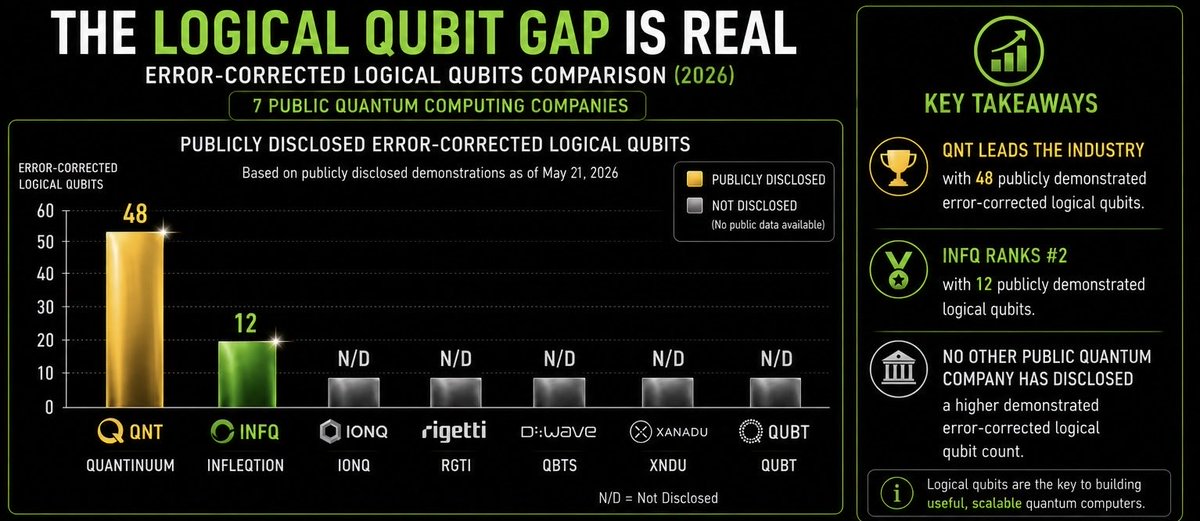
Today, Quantinuum has publicly demonstrated 48 error-corrected logical qubits, one of the strongest results in the industry.
By comparison, most public quantum companies still focus investor presentations on physical qubits, gate fidelity, or future roadmaps.
Wall Street isn’t paying $15.6B for current revenue.
Wall Street is paying for the possibility that Quantinuum may be among the first companies to achieve:
✅ Fault-tolerant quantum computing
✅ Large-scale logical qubit architectures
✅ Commercially useful quantum applications
In other words:
Investors are not valuing what Quantinuum is today.
They are valuing what Quantinuum could become if logical qubit scaling continues.
That’s why a company generating only a few million dollars in quarterly revenue can command a valuation larger than many mature technology companies.
In quantum computing, the most important metric is no longer:
“How many physical qubits do you have?”
The question becoming increasingly important is:
“How many logical qubits can you reliably run?”
That is where the next phase of the quantum race begins.
“””NVIDIA won the AI era with GPUs. The winners of the quantum era may be the companies that master logical qubits.”””
1
1
10
328
Jun 4
One fact that most quantum investors are missing:
Among publicly traded pure-play quantum computing companies, only Quantinuum ($QNT) and Infleqtion ($INFQ) have publicly demonstrated double-digit logical qubits.
Anyone can talk about physical qubits.
Very few can demonstrate error-corrected logical qubits.
Today’s public disclosures show:
🟨 Quantinuum ($QNT): 48 logical qubits
🟩 Infleqtion ($INFQ): 12 logical qubits
The rest of the public quantum sector discusses physical qubits, gate fidelity, roadmaps, or future targets.
1
1
35
Jun 4
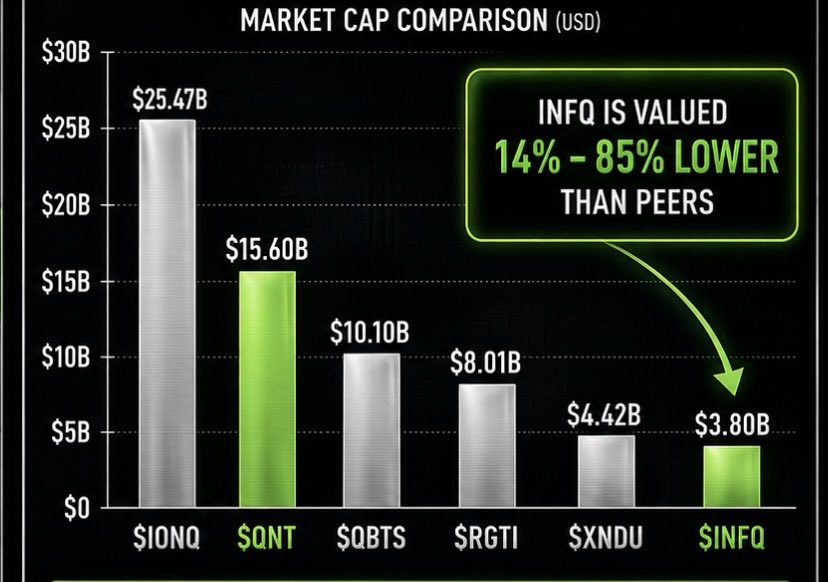
What’s interesting is that Quantinuum now trades at roughly 4x the valuation of Infleqtion, despite both companies being among the very few public pure-play quantum companies with publicly demonstrated double-digit logical qubits.
The market has already recognized the value of logical qubits.
The question now is whether it has recognized all of the companies that possess them.
#QuantumComputing #Quantinuum #Infleqtion #LogicalQubits
1
30
Jupiterian retweeted

Quantinuum just dropped this video, right before their IPO.
It has only 600 views.
The company is a monster. I like everything I see. Amazing presentation, compelling technology (all-to-all qubit connectivity).
The quantum market is growing stronger by the day.
$INFQ $IBM $QBTS $IONQ $QNT
youtu.be/OXEg0A6N1Ds?si=DgzW…
9
13
63
9,808
Jun 3
$DGXX has massive upside potential, the deal with $CBRS is interesting and planning to add NVIDIA Vera Rubin GPU.
Jun 3

$DGXX Digi Power X committed $35M to purchase NVIDIA Vera Rubin systems — the next-generation rack-scale platform succeeding Blackwell, pairing Rubin GPUs with 288GB HBM4 memory. Deployment targeted Q1 2027.
Key operational updates:
NeoCloudz GPU-as-a-Service live since May 15 — first AI revenues recognized in May 2026
Phase 1 data center campus (15 MW) on track for December 15, 2026
Grid interconnection finalized, all long-lead equipment secured
$150M cash on hand as of today, $65M already deployed into Alabama site
Project-level debt financing being arranged — non-dilutive
Strong balance sheet backing a real buildout with live revenue. One to watch in AI infrastructure.
Not financial advice.
1
2
201
Jun 3
Trying to stay ahead of the curve!
Luckily, had a chance to read a bout NTN technology in 2023 which led to $ASTS discovery in early 2024.
Then, thought that Quantum computing era will be arrived in near future so bought $IONQ $QBTS $RGTI in 2024.
Now, it is the time for Quantum Sensing so own $INFQ, a global leader with full stack sensing platform including Atomic clock, Inertial Navigation and Quantum Spectrum.
$IBM $MSFT $GOOG $GFS $NVDA
May 31

Looking back to my multibagger trades today.
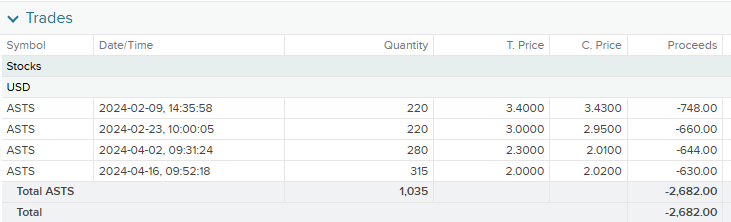
The most profitable trade is $ASTS so far, bought at 2, 2.3, 3 and 4 in 2024 .
In 2nd place, obviously it is Quantum trades and bought
$IONQ at 7.3, 7.7
$QBTS at 1.05
$RGTI at 0.85, 0.93, 1.2
Anyway, I have sold them all now😃 .



77
Jun 3
This is exactly pointing to @infleqtion $INFQ $GOOG
“My conclusion? The tech is real, very real. Even Google recently decided to start a neutral atom lab, a notable pivot from their sole focus on superconducting qubits. If you care about qday, i.e. the day a quantum computer will break the first piece of cryptography in production, neutral atoms demand your attention. I shared some of my learnings on Shor and neutral atoms in a 30min talk at the ZKProof cryptography conference. You can find it on YouTube by searching "zkproof neutral atom".
Jun 2

Today a crazy quantum story just got wilder.
On March 31, the Google Quantum AI team published a landmark result on Shor's algorithm for elliptic curve cryptography. Technically, the paper was a bombshell: a dramatic 10x improvement over the state-of-the-art. As a stunt and wakeup call to the blockchain space, those optimisations were illustrated on secp256k1, the elliptic curve underlying Bitcoin and Ethereum signatures.
But perhaps the most striking part of the paper was sociological, not technical. Instead of following standard academic process, the optimisations were kept secret, hidden behind a zero-knowledge (ZK) proof. Google's accompanying blog post mentions they "engaged with the U.S. government". The ZK proof demonstrates the existence of algorithmic improvements without leaking details. Academic censorship with ZK, a historic first!
As a co-author of the Google paper I witnessed some of the context surrounding this censorship. To be honest, multiple aspects of that context don't sit well with me. As much as I believe the general public ought to know more, I am limited in my ability to whistleblow. Though let me be clear about one thing: the Google team's professionalism has been absolutely exemplary, and they deserve nothing but praise.
Censorship has a way of backfiring. The Streisand effect, where an attempt to bury something only draws more attention to it, is exactly what's unfolding today. First, Google's key optimisation has been rediscovered by the French. And in a thrilling turn of events, a collaborative Shor-at-home challenge just launched. The initiative, available at ecdsa[.]fail, breached a new Shor world record in a matter of hours.
Let's start with the rediscovery. Just two months after Google's paper, French quantum expert André Schrottenloher cracks the main secret optimisation. His paper, titled "Optimized Point Addition Circuits for Elliptic Curve Discrete Logarithms", landed on the arXiv today. Big congrats to André, who beat several other nerdsnipped experts to it. In a blog post also published today, Craig Gidney, the world expert on Shor optimisations, revealed that he'd been sitting on this very optimisation for a whole year under censorship pressure.
Interestingly, André missed a handful of minor optimisations, both from Google's original publication and from improvements found since. It's plausible there's still plenty of juice left to squeeze out of Shor, and this is exactly what the ecdsa[.]fail challenge is about. The verifier program developed for the ZK proof does double duty, automatically filtering for valid submissions. Dozens of compounding small and micro improvements are rolling in. As of the time of writing there's an 8.4% improvement to Google's circuit, as measured by the product of logical qubit count and Toffoli gate count. Nice!
The nerdsnipping ran deeper than anyone expected. Over the last few weeks it became clear it extended well beyond André and other quantum experts. Behind the scenes, a small army of amateurs quietly got to work. Inspired by Karpathy-style autoresearch, they turned AI on Shor. Ironically, the verifier program for the ZK proof makes an ideal reward function for AIs. The barrier to entry for this modern style of research is refreshingly low, with several non-experts, even a teenager, finding nice optimisations. Get in touch if you'd like to join a Telegram group with fellow autoresearchers :)
Part 2: neutral atoms and qday
The story doesn't end with Google. On the same day Google went public, a stealthy startup called Oratomic published its own Shor paper in a coordinated release. It made a splash, ultimately becoming the most upvoted paper on scirate[.]com, a website ranking arXiv papers.
Oratomic's claim was wild. By building on Google's logical optimisations and applying custom physical optimisations for neutral atoms, they claimed just 10K physical qubits were sufficient to run Shor's algorithm on secp256k1. That number is mind-bogglingly low.
Knowing essentially nothing about neutral atoms when Oratomic's paper landed, I was intrigued and decided to learn more about the tech. I fell straight down the rabbit hole and spent a couple hundred hours on the topic. I got a little obsessed and watched every YouTube video I could find and spoke to a bunch of experts.
My conclusion? The tech is real, very real. Even Google recently decided to start a neutral atom lab, a notable pivot from their sole focus on superconducting qubits. If you care about qday, i.e. the day a quantum computer will break the first piece of cryptography in production, neutral atoms demand your attention. I shared some of my learnings on Shor and neutral atoms in a 30min talk at the ZKProof cryptography conference. You can find it on YouTube by searching "zkproof neutral atom".
Here's an interesting observation about this duo of breakthrough papers: neither Google nor Oratomic say a word about what their results mean for qday. No timelines. Zero. Nada. That is especially baffling given that the whole point of whitehat quantum cryptanalysis is to inform qday estimations and help the general public make good decisions.
So let me attempt to partially fill the silence, similarly to what Scott Aaronson did in his April 29 post. Given everything I know, including scary non-public information, I now put the odds of qday by 2032 at 50%. 10% by 2030.
Anecdotally, the US government has its own date: 2035. Originating at the NSA and later adopted by NIST, it's when branches of the US government will be disallowed from using quantum-vulnerable cryptography. In plain language: with hindsight, that date is a joke and should be discounted entirely. I don't see how NIST avoids being forced to pull it forward by years.
Part 3: post-quantum cryptography
There are good reasons to sound the alarm today, but please do not panic. Rushing carelessly towards immature post-quantum cryptography is a recipe for disaster. IMO a good target date for migration is 2029, roughly 3.5 years out. 2029 happens to be the date selected by Google, Cloudflare, and the Ethereum Foundation.
These days most of my time goes to safely migrating Ethereum towards post-quantum cryptography as part of the broader lean Ethereum effort. There's a lot to do. We need to rip out and replace BLS signatures at the consensus layer, KZG commitments at the data layer, and ECDSA signatures at the execution layer.
The plan to get there is compelling, and is based on hash-based cryptography. Within the Ethereum Foundation we've developed a Swiss army knife called leanVM (github[.]com/leanEthereum/leanVM) powered by the magic of hash-based SNARKs. Thanks to truly exceptional work by Emile, Thomas, and others, its performance is derisked. Regarding security, leanVM is a jewel, a minimal zkVM crafted for end-to-end formal verification and maximum security.
Want to help? There are two $1M initiatives. First, the Proximity Prize (proximityprize[.]org). Solve a long-standing mathematical conjecture in coding theory, improve hash-based SNARKs, and go home a millionaire. Second, the Poseidon Initiative (poseidon-initiative[.]info), offers $1M for breaking Poseidon, the SNARK-friendly hash function.
1
6
281