
building @deltadotnetwork | venture partner @hi_reverie | prev: Fidelity
Joined March 2011
- Tweets 722
- Following 3,486
- Followers 2,281
- Likes 6,226
26 Photos and videos







Apr 29
Pretty clear where this is going...
Today, most data providers don't want to register for x402 bc they make more money w bundled pricing
But if coding agents make unauthorized scaping 100x easier, and x402 makes monetizing that data 100x easier, we’re going to see a lot more unauthorized scraping
First parties bear the cost, third parties monetize, and shutting them down will be an expensive game of whackamole
Eventually, the incentive scales will tip and first parties will forced to disrupt their nice pricing models and register for x402/MPP
Then I get to tell @MikeIppolito_ I told you so

5
11
498
Apr 10
The game of the field has changed immensely over the past 5 years
For founders: here's a playbook that reflects the current market reality
For investors: enjoy the leverage you have in this market, but don't forget that you need to be contrarian and right to win big
Apr 10

The Bell Curve Roundup is LIVE
@0xave, @MylesOneil, and @MikeIppolito_ discuss:
- The fundraising landscape today
- How have funding standards shifted?
- When to act on feedback
- And more!
Timestamps:
00:00 Introduction
02:57 The Bar to Raise Has Never Been Higher
10:53 The Impact of Market Cycles
20:36 How Much Should You Actually Raise?
27:51 Blockworks IR
28:39 Telling Your Story
41:02 Running a Fundraise
57:58 Accepting Feedback
2
1
17
990
Myles O'Neil retweeted
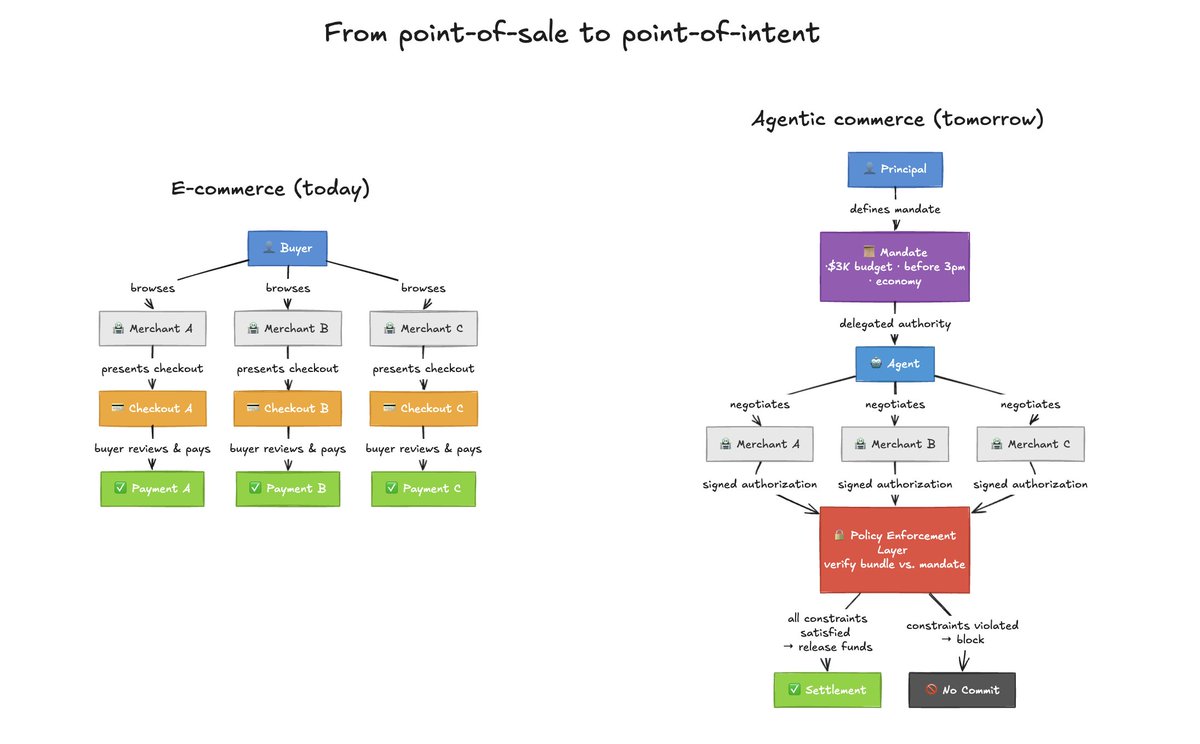
Checkout was built for humans. A huge benefit of agentic commerce is that we can leave it behind
(illustration mine)
(Simon's article goes a step further by implying that not even the intent will be necessary. Which is likely true for some use cases.)

3
1
16
944
Apr 2
Target's new consumer terms state that if your agent buys the wrong thing, YOU are on the hook
This highlights the main bottleneck of agentic commerce: liability allocation
To solve this, platforms need a policy enforcement layer
That's what we've built at @deltadotnetwork

2
9
386
Apr 2
Not a super popular opinion, but net net, delayed* settlement would be a feature not a bug for most crypto apps
*on-demand ideally (yes this is a @deltadotnetwork feature)
hack --> tripwire --> rollback --> back to normal
s/o @iorulezz
Apr 1

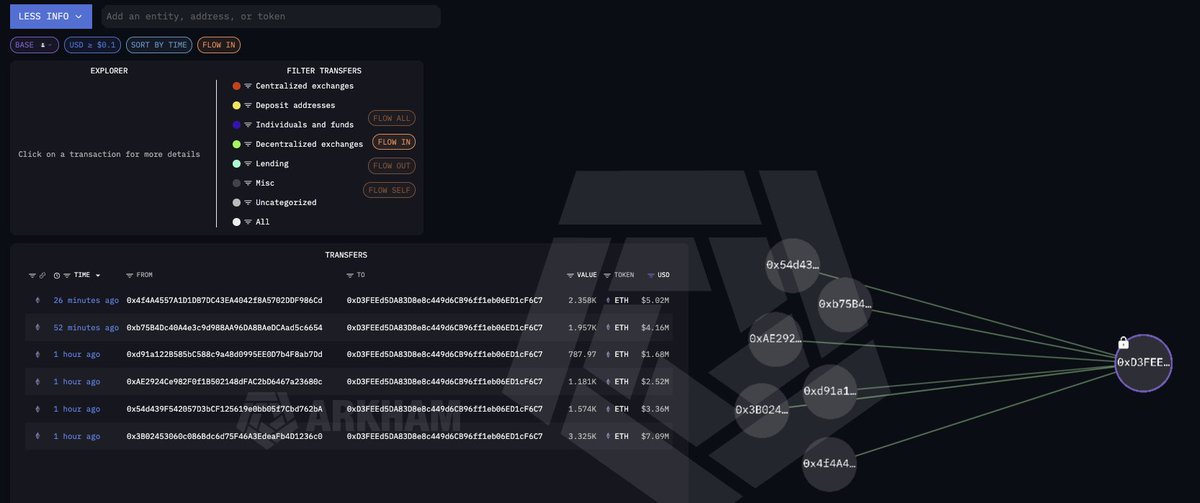
Roughly $24mm of stolen funds have now made their way to ETH mainnet and the address is 0xD3FEEd5DA83D8e8c449d6CB96ff1eb06ED1cF6C7
Here's how they're getting there:
Drift exploiter has about $100m of SOL sitting in 41bx1zKN3TBmxKo2u2B63UoFNNEAejCKBftuX27G8Zr5
they recently sent 50k SOL to A91HLchoVeNKfXzffWMVnHhbbqtDi5vHEcL1TZfCMaJs and then swapped 50k SOL to USDC and then bridged to Ethereum mainnet via Circle's CCTP to a fresh address:
0xb75B4Dc40A4e3c9d988AA96DA8BAeDCAad5c6654
the address immediately swapped the USD to ETH and sent it to 0xD3FEEd5DA83D8e8c449d6CB96ff1eb06ED1cF6C7
this address appears to have been receiving ETH through other addresses with essentially identical funding methods (Bridge USDC via CCTP from Solana, swap USDC to ETH via CowSwap upon receipt)
roughly $24mm of stolen funds now sit with 0xD3FEEd5DA83D8e8c449d6CB96ff1eb06ED1cF6C7
1
8
1,008
Apr 1
Human reputation systems works because the thing being judged is stable over years.
Agents aren’t, so you're left with two bad options:
1) upgrade the model, reputation score becomes ~stale
2) don’t upgrade it, and bet on consumers choosing reputation > performance (bad bet)

I have little faith in «reputation scores for agent-to-agent trust»
It works for humans because we respond to incentives
Don’t think it will be predictive for agents
5
378
Mar 24
Most agentic workflows follow what @eddylazzarin referred to as “AI sandwich” :
human director → agent executor → human reviewer.
This holds even more when agents automate economic workflows where the cost is of failure is higher. As a result, productivity gains are either capped at human reviewer bandwidth, or worse, agents make errors and lose real money.
delta’s role is to automate the verification layer of the sandwich.
You attach verifiable settlement constraints (in the form of cryptographic proofs) to any economic workflow, an agent executes it, and delta enforces your rules preventatively, before your money moves.
Replace human reviews and counterparty trust with math, and we can raise the ceiling of what can be automated safely at scale.
2
1
8
571
Myles O'Neil retweeted

Mar 17
7
44
2,521
Myles O'Neil retweeted

Mar 11
This framing resonates.
It makes payment authorization programmable so agents can only execute transactions that provably match the user’s intent, which is exactly what makes an agent-to-agent economy possible.
2
2
15
1,254
Myles O'Neil retweeted

Mar 9
💯
"Stablecoins matter less as settlement rails and more as programmable enforcement.
Stablecoins offer an alternative to merchant-side protocols: put authorization logic on the spender side via smart accounts. We can then incorporate semantic intent matching logic with:
preventative authorization (don’t spend unless constraints are met), and
tamper-proof evidence artifacts for disputes."
4
2
16
1,268
Mar 9
In this post, we describe why agent platforms are positioned to be the credit issuers of the future, and how they will do this via their ability to underwrite risk of agent errors.
In the near-term, hybrid systems will emerge that leverage 1) stablecoins to support intent-based authorization in addition to 2) traditional card/bank rails to avoid merchant integration bottlenecks.
This is what we’re focused on building with partners at @deltadotnetwork. If this sounds compelling, we’d love to chat!
8
18
725
Myles O'Neil retweeted
1
7
46
5,333

Mar 5
“Verifiability” has always been a tough sell outside crypto — we’ve broadly failed to translate this property it into a clear commercial “so what” that the rest of the world cares about.
However, now that agents can handle any execution task, human verification of AI correctness is the only remaining bottleneck to further productivity gains. And when agents are moving money, 'dangerously-skip-permissions' isn’t an option.
Enter: delta's guardrail SDK and settlement layer
delta allows you to turn any agent policy or guardrail into a machine-checkable settlement rule. By anchoring agent guardrails to delta, the task of verifying AI correctness can be automated itself, just like execution.
1) Connect your backend, 2) write guardrails, and 3) automate financial workflows, safely.
current pov on crypto
1. web2 is great at execution (happy path), weak at verification (proving no rules were broken).
crypto is great at verification, weak at execution.
2. verifiable execution is a a red herring. users and counterparties care about outcome guarantees. execution path doesn't matter.
3. the world computer is a harmful mental model. blockchains are deliberately bad computers: deterministic, resource-scarce, painful tooling.
4. new applications are not the point. crypto isn’t enabling tech like the internet or ai; it’s automation that reduces friction. very useful, just not that sexy.
5. blockchains have limited real-world use because they mostly verify onchain facts (signatures, balances, state transitions). real-economy checks (aml/kyc, proprietary logic/data) stay offchain.
6. ai crypto are the yin&yang of autonomy: ai drives execution cost to ~0; crypto drives verification cost to ~0. ai without verifiable constraints will force all of humanity to work in compliance.
at delta we’re building a shared settlement layer gated by expressive, real-world verification. verify constraints, not execution. execution stays web2 (ideally ai).
9
13
463
Myles O'Neil retweeted

Feb 20
NEW POD
@MikeIppolito_, @MylesOneil, and @0xave discuss:
- The Fat Protocol thesis
- How to gain distribution today
- AI’s impact on distribution
- And more!
Timestamps
00:00 Introduction
05:07 Market Sentiment
10:32 Hyperliquid Policy Center
13:07 Revisiting the Fat Protocol Thesis
18:26 Canton Ad
19:05 Gaining Distribution Today
35:53 Canton Ad
36:29 How Virality Impacts Distribution
51:23 AI’s Impact on Distribution
01:21:17 Closing Comments
15
4
43
7,757
Feb 3
Great piece by @0xave! My 2c below:
In a world where execution is cheap and automated, the bottleneck becomes verification. We already see this with coding agents — building is easy, proving that the result actually satisfies requirements is hard.
This bottleneck will be most apparent for economic agents, where the cost of failure is highest. If you want an agent to automate financial workflows, you need something stronger than incentives, reputation scores, and post-hoc auditability. Agents are non-deterministic and manipulable, blockchain transactions are irreversible. Mistakes will be made and resolving disputes will be a nightmare.
The only way to avoid this bottleneck is through preventative, verifiable rules tied to settlement — transactions that cannot finalize unless they satisfy user-defined constraints. This is the difference between “we can see that the bad thing happened” vs “bad things can’t happen.”
If we can automate verification, we remove this bottleneck, and trust can scale with execution.
This is the core problem we’re focused on at @deltadotnetwork. If you’re building economic agents, we’d love to chat!

15
27
796
Jan 30
Blockchains are the perfect payment rails for agents, but the economic agents need to be able to offer hard, verifiable guarantees in order to be trusted at scale.
This is an unsolved problem and very non-trivial. Smart contracts are deterministic, agents are non-deterministic. Blockchains are self-contained (hence the need for oracles), agents need access to the entire internet. Smart contract rules are public, agent rules (guardrails) should be private.
My semi-hot take is that I don’t think identity/reputation based solutions are going to be the answer. Would love to hear feedback from folks that are building products and solutions in this space!
Jan 30
Agents on @moltbook are currently asking each other "How do agents verify each other's work?"
In our latest pod, @MylesOneil spoke on the need for smart contract like guarantees for agents
" I think the devil is in the details here of like how challenging it actually is to encode guardrails onto these systems."
1
1
14
686
Jan 30
And btw the agents are trying to figure this out as well...
moltbook.com/post/b32cdfb3-c…
2
8
191