
438 y.o. | Founding engineer @ Domu.ai | Burn this moment into the retina of your eye.
Joined February 2023
- Tweets 376
- Following 627
- Followers 59
- Likes 3,925
8 Photos and videos

Angel Loredo retweeted

Jun 13
Marc Andreessen explains how to identify fake founders
“There are definitely people that come in [to pitch us] and present themselves to be something they’re not. They’ve read all the books. They will have listened to this interview. They study everything and they construct a facade…. And the amount of this is exactly correlated with the NASDAQ.”
As Marc explains, when stock prices are high and tech is hot, there are a lot people who decide being a tech founder is a fast track to high status:
“They’re fundamentally oriented for social status — they’re trying to get the social status without the substance. And there are always other places to go to get social status. So after 2000, the joke was B2B meant back to banking and B2C meant back to consulting — which is, the people who showed up to be in tech were like, yeah, screw it. This is over. I’m going to go back to Goldman Sachs or McKinsey where I can be high status. So you get this flushing kind of effect that happens in a downturn. But in a big upswing, you get a lot of people showing up with, let’s say, public persona without the substance to back it up.”
How does Marc identify these people? He uses the same technique that homicide detectives use to find out if you’re innocent — keep asking increasingly detailed questions:
“You ask increasingly detailed questions and people have trouble making things up and things just fuzz into obvious BS, and fake founders basically have the same problem. They’re able to relay a conceptual theory of what they’re doing… But as they get into the details, it just fuzzes out. Whereas the true people that you want to back can do it. What you find is they’ve spent 5 or 10 or 20 years obsessing over the details of whatever it is they’re about to do. And they’re so deep in the details and they know so much more about it than you ever will.”
Source: @hubermanlab (Sep 2023)
31
73
925
167,251

Angel Loredo retweeted

Jun 10
Remember when compilers would detect that someone was using it to build another compiler and silently inject bugs?
93
236
7,401
531,368

Angel Loredo retweeted

Jun 9
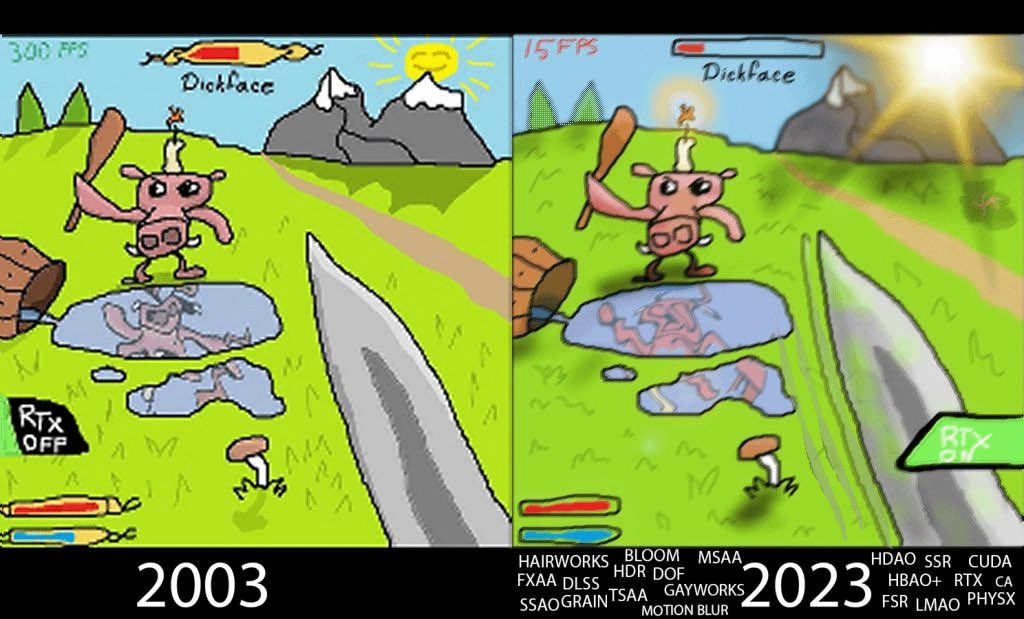
Sadly there was some beef between runk and grunk over the GPL and flag syntax so Ronald is now only reachable for patches by email once a week when he’s not making raw honey.
MacOS ships with crunk.
1
10
440
8,864

Jun 2
Every latin american young professional should listen to this. People put these mental barriers that just artificially put them at a disadvantage when trying to achieve their dreams.
Literally at every stage of life no matter what you have accomplished, the untrained mind can trick you into still get stuck complaining in circles. The trained mind tricks you into thinking about solutions.
Just go out and do stuff, play the cards life has given you.

Ben Horowitz: “Do not expect life to be fair. It will only defeat you.”
The Andreessen Horowitz co-founder is asked for advice that he has found useful in his own life. Ben responds:
“The thing that I would say has had the biggest effect on me is something my father said to me years ago: ‘Life isn’t fair.’ That advice seems really simple, but the thing I’ve seen that defeats people more than any other thing in life is the expectation of some fairness.”
He continues:
“There are all kinds of things that are going to happen to you that don’t happen to other people and are completely unfair. But it doesn’t matter because that’s the way it is. And as soon as you can get that idea out of your mind [that life should be fair], you can just deal with it… ‘What should I do now?’ is the real question — not ‘How do I go back and get people to be fair?’… Life’s not fair. That’s the nature of it. If you think about it more than five seconds, you’ll realize that… As an individual, do not expect anything to be fair. It will only defeat you.”
Source: @lennysan (Sep 2025)
19
Angel Loredo retweeted

May 30
While I share Elon’s distaste for credentialism, I think he’s swung a bit far on the anti-researcher pendulum.
It is my experience you need researchers chewing on cigarettes, walking circles in the parking lot, lying on the floor staring at the ceiling, producing many ideas that don’t work, and making terrible engineering decisions, to find the novel borders of Truth.
One of RenTech’s earliest successful strategies didn’t make money until an entry level engineer came in and fixed a trivial mistake in the code. Necessary, but so too was the thousands of hours of cigarette chewing from mediocre engineers.
Having the right ideas >> beautifully engineering the wrong idea.
Beautifully engineering the wrong idea == lots of work with little displacement

16
23
355
63,069
Angel Loredo retweeted

May 28
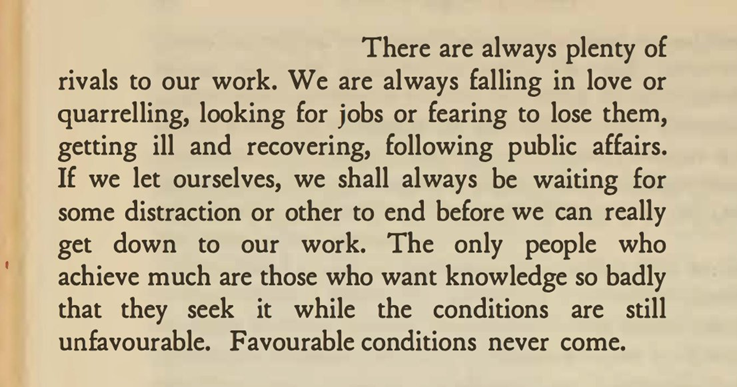
C. S. Lewis with maybe the most important paragraph ever written for people with creative ambitions
39
1,200
7,017
412,219

Angel Loredo retweeted

May 22
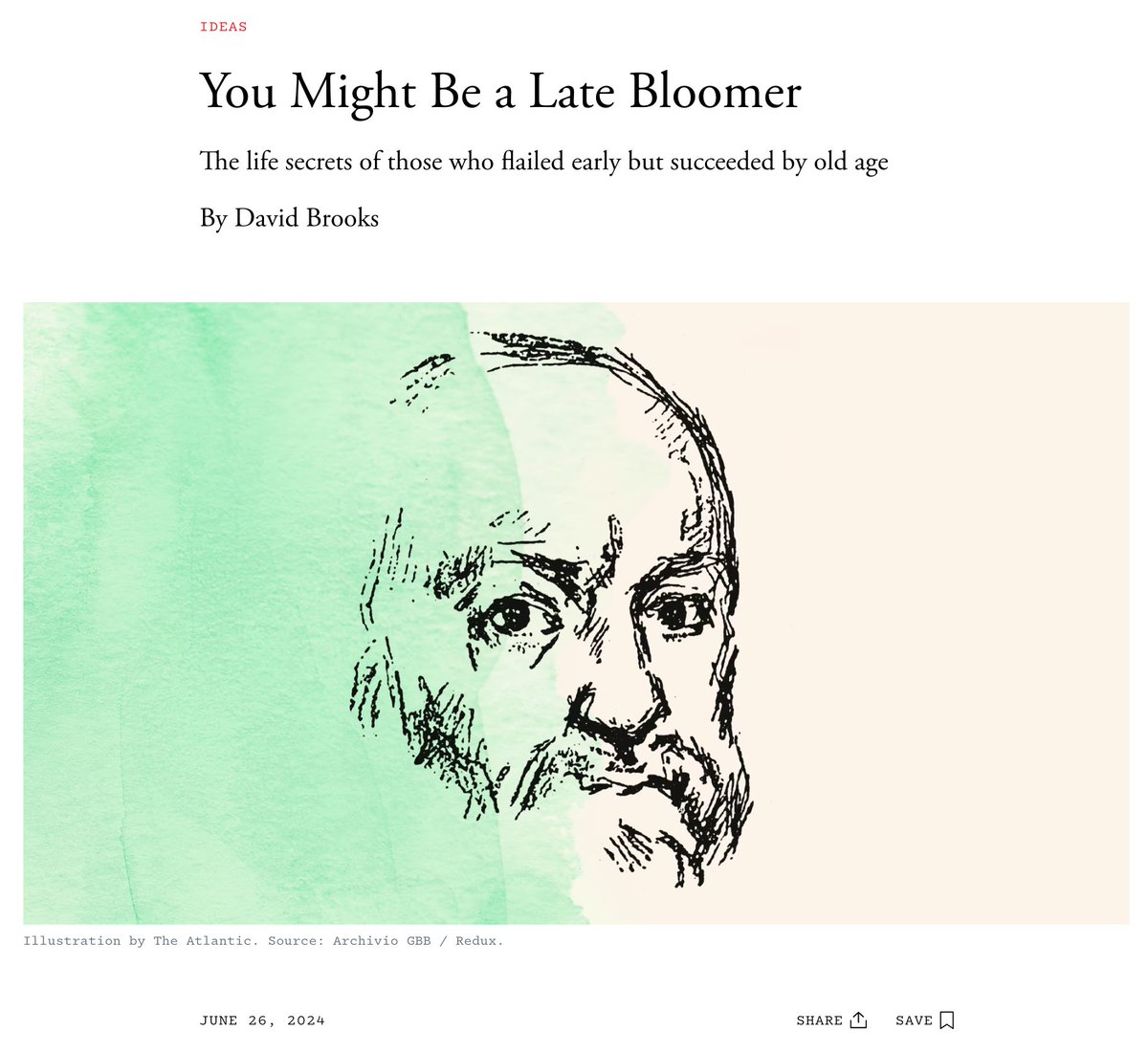
I was reminded recently of an article by David Brooks in The Atlantic, titled "You Might Be a Late Bloomer." Two paragraphs that have stuck with me:
"We have a notion that the happiest people are those who have aimed their life toward some goal and then attained it, like winning a championship trophy or achieving renown. But the best moments of life can be found within the lifelong learning or quest itself. It's doing something so fulfilling that the work is its own reward. 'Effort is the one thing that gives meaning to life,' the Stanford psychologist Carol Dweck once wrote. 'Effort means you care about something.'
'The secret of life is to have a task, something you devote your entire life to, something you bring everything to, every minute of the day for the rest of your life,' the sculptor Henry Moore once told the poet Donald Hall. 'And the most important thing is—it must be something you cannot possibly do.'"
34
412
3,747
171,243
Angel Loredo retweeted

May 22
People get emotional over failure and that’s when the problems compound.

Failure is feedback, not a verdict.
"Failure in American society is a badge of honor."
x.com/shaneparrish/status/20…
6
46
20,060
May 20
Never saw things this way! Interesting thing to think about
May 20

Fork your dependencies, trim them to only your use case, never update unless it breaks for your users. I’ve been vocal about this for 10 years. I’ve always said that updating is way riskier than latent bugs (which can be tracked and CVEs monitored).
If you are updating a dependency, it’s on you to analyze every single commit in the full transitive set of dependencies. If you dont see anything compelling, dont update!
I remember at HashiCorp once in awhile an engineer would try to update a dep or replace a DIY lib with an external one and id always ask “show me the commit we need.” Dont update for the sake of it.
Feeling pretty swell about this mentality with all the supply chain attacks happening.
16
Angel Loredo retweeted

May 17
You cannot think clearly about your path while optimizing for the applause of people playing a different game.
7
40
331
6,079

The vibes in SF feel pretty frenetic right now. The divide in outcomes is the worst I've ever seen.
Over the last 5yrs, a group of ~10k people - employees at Anthropic, OpenAI, xAI, Nvidia, Meta TBD, founders - have hit retirement wealth of well above $20M (back of the envelope AI estimation).
Everyone outside that group feels like they can work their well-paying (but <$500k) job for their whole life and never get there.
Worse yet, layoffs are in full swing. Many software engineers feel like their life's skill is no longer useful. The day to day role of most jobs has changed overnight with AI.
As a result,
1. The corporate ladder looks like the wrong building to climb.
Everyone's trying to align with a new set of career "paths": should I be a founder? Is it too late to join Anthropic / OpenAI? should I get into AI? what company stock will 10x next? People are demanding higher salaries and switching jobs more and more.
2. There’s a deep malaise about work (and its future).
Why even work at all for “peanuts”? Will my job even exist in a few years? Many feel helpless. You hear the “permanent underclass” conversation a lot, esp from young people. It's hard to focus on doing good work when you think "man, if I joined Anthropic 2yrs ago, I could retire"
3. The mid to late middle managers feel paralyzed.
Many have families and don't feel like they have the energy or network to just "start a company". They don't particularly have any AI skills. They see the writing on the wall: middle management is being hollowed out in many companies.
4. The rich aren’t particularly happy either.
No one is shedding tears for them (and rightfully so). But those who have "made it" experience a profound lack of purpose too. Some have gone from <$150k to >$50M in a few years with no ramp. It flips your life plans upside down. For some, comparison is the thief of joy. For some, they escape to NYC to "live life". For others still, they start companies "just cuz", often to win status points. They never imagined that by age 30, they'd be set. I once asked a post-economic founder friend why they didn't just sell the co and they said "and do what? right now, everyone wants to talk to me. if i sell, I will only have money."
I understand that many reading this scoff at the champagne problems of the valley. Society is warped in this tech bubble. What is often well-off anywhere else in the world is bang average here.
Unlike many other places, tenure, intelligence and hard work can be loosely correlated with outcomes in the Bay. Living through a societally transformative gold rush in that environment can be paralyzing. "Am I in the right place? Should I move? Is there time still left? Am I gonna make it?" It psychologically torments many who have moved here in search of "success".
Ironically, a frequent side effect of this torment is to spin up the very products making everyone rich in hopes that you too can vibecode your path to economic enlightenment.
1,143
1,275
16,557
13,317,937
May 16
The cloud won! You don’t have to think about servers anymore! Everything is a microservice! Lambdas are king! Kubernetes is our garbage collector! Hardware scales infinitely!
May 15
I strongly believe there are entire companies right now under heavy AI psychosis and its impossible to have rational conversations about it with them. I can't name any specific people because they include personal friends I deeply respect, but I worry about how this plays out.
I lived through the great MTBF vs MTTR (mean-time-between-failure vs. mean-time-to-recovery) reckoning of infrastructure during the transition to cloud and cloud automation. All those arguments are rearing their ugly heads again but now its... the whole software development industry (maybe the whole world, really).
It's frightening, because the psychosis folks operate under an almost absolute "MTTR is all you need" mentality: "its fine to ship bugs because the agents will fix them so quickly and at a scale humans can't do!" We learned in infrastructure that MTTR is great but you can't yeet resilient systems entirely.
The main issue is I don't even know how to bring this up to people I know personally, because bringing this topic up leads to immediately dismissals like "no no, it has full test coverage" or "bug reports are going down" or something, which just don't paint the whole picture.
We already learned this lesson once in infrastructure: you can automate yourself into a very resilient catastrophe machine. Systems can appear healthy by local metrics while globally becoming incomprehensible. Bug reports can go down while latent risk explodes. Test coverage can rise while semantic understanding falls. Changes happens so fast that nobody notices the underlying architecture decaying.
I worry.
29
Angel Loredo retweeted

May 11
One of the biggest problems with using LLMs as a google replacement for programming, is that getting zero relevant results on google used to be a signal that you had the wrong idea about the root cause. Whereas LLMs will happily indulge any terrible idea you suggest.
141
612
10,122
195,795
May 12
Being a full time fuzzer and benchmarker sounds dreadful and the opposite of what made me want to love computers
May 12

Bun's Rust rewrite is pretty impressive, but the code is..... well, I'm no Rust expert, but I'm really interested in what will be the strategy to maintain it, if the rewrite is to be kept. Like, it is impossible to maintain current codebase for humans, no chance.
Will the team become fulltime fuzzers and benchmarkers for whatever Claude generates? Or will they do another infinite tokens dump to make it into "idiomatic" Rust?
Regardless of what happens, Bun is the perfect guinea pig for such experiments - it's a real world project with some real adoption, but ultimately stakes are very low, because there are alternative runtimes that you can just switch to if it turns out to be bad
1
37
May 10
I don’t care if:
Ilya was right
Rando company rewrote rando web tool in x lang
Rando company laid off x amount of people
I want:
People building COOL things, and thinkers thinking about things.
Algorithm show me the right things my mute button is eroding.
14
Angel Loredo retweeted

May 9
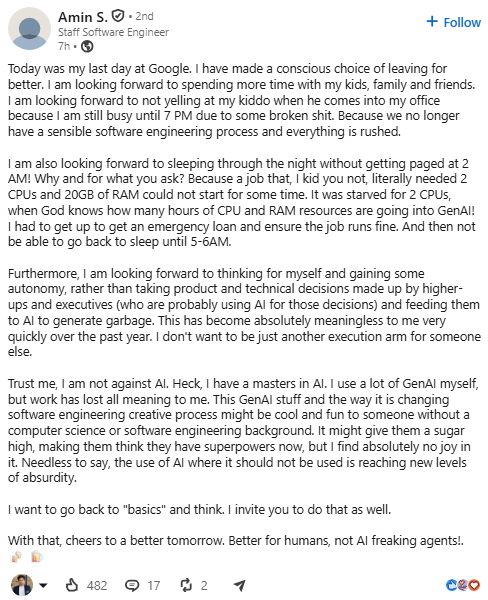
The AI existential crisis incoming

103
189
3,793
217,792
May 8
I fear the day I lose the fascination of going deep. Computers are wonderful
May 4

There’s a famous Usenet story about a programmer (Mel) who refused higher level abstractions.
It was the late 1950s, and even in that era, Mel was…well today we’d call him a boomer.
Mel only wrote in raw hexadecimal. He didn’t approve of compilers, and refused to use optimizing assemblers.
"You never know where it's going to put things”, he said.
Everyone else in the company was moving on to FORTRAN, and they didn’t understand why Mel was so stubborn about using new tools. He *loved* self-modifying code.
“If a program can’t rewrite its own code”, he asked, “what good is it?”
Mel eventually left the company, and other engineers were tasked with understanding what was left.
Mel’s hand-optimized routines always beat the assemblers; but some of it looked absolutely bizarre.
One engineer took ~2 weeks to understand why there were loops with no exit condition…yet the program worked fine.
I won’t spoil all the details, you should really read it, it’s short. But it’s a fantastic piece on “what defines a real programmer?”…which is becoming increasingly relevant in this vibe-coded era.
I strive to understand computers as deeply as Mel! If we aren’t careful, we’re going to lose the “Mels” of this world to time.
That’s part of why I go so deep in my youtube videos. I hope that younger viewers are genuinely fascinated by the inner workings of our machines, instead of handing everything off to higher abstractions.
1
15