
1 Photos and videos
Milo Spirig retweeted

Feb 5
Ever since I met @sidd in our early days at Stripe, I hoped we’d one day find an idea big enough to start a company together.
That day is finally here.
After building quietly for the past year, I’m excited to officially launch @AccrualHQ, a new foundation for professional accounting 👇
21
4
99
29,307
Milo Spirig retweeted

9 Oct 2025
So October 15th, the extended US tax deadline, is just around the corner, and I have some observations which are more about LLM progress than taxes.
Background: many people professionally involved with LLMs estimate 2026-2028 as the year where one can get an LLM to "do taxes."
14
16
345
108,829
Milo Spirig retweeted

7 Apr 2025
One shipyard in China made more commercial ships last year than the total number the U.S. has produced since World War Two. 8/
21
529
3,698
275,138
Milo Spirig retweeted

6 Apr 2025
Having now spent about half my life in each (and loving both), herewith the pros and cons of Europe and the US in everyday life:
Better in Europe
• Bike lanes and bike infrastructure. London, Paris, and Amsterdam are all excellent these days. (As are many other European cities.) Made even better by easy-to-rent e-bikes—now almost always the fastest way to get around.
• The urban walking experience generally. Partly for density reasons, and partly because of...
• Late-night cafe, brasserie culture. Is there an economic reason for this or is it just climate and contingent zoning?
• Architecture. Around 1920, we forgot how to make nice buildings. European cities tend to have more construction from before the Great Forgetting, and it makes the built environment much more pleasant.
• Pedestrianized streets. Often with cobblestones.
• In general, European cities are just more pleasant. Given how hard it is to build a good city (or indeed to retrofit one), this feels like a big deal.
• Cured and pickled food.
• Bread. Obviously varies by country, but it’s generally true.
• Voltage. What are Americans doing waiting so long to boil kettles?
• Beauty in the mundane. I find that you’re more likely to find tasteful touches in prosaic places in Europe.
• Motorway design and signage. Standardized, clear, and easy-to-use. The US is a mess by comparison.
• Bathroom doors. That is, in Europe, they’re proper doors. Why does America make us see others’ feet?
• The clangor of church bells on Sunday.
• Trains. Enough said.
• Pharmacies. I'd love to understand why they're so much nicer in Europe.
• Cheese. Again, lots of cross-country variation, but true in general.
• I'm not sure why, but European regulation on many everyday items seems better. Sunscreens in Europe are better, as are bike helmets.
• Wine.
• Languor, joie de vivre, hygge, gemütlichkeit, craic. I think Europeans are better at unwinding. Drawing contrast with what he found in the US, De Tocqueville observed that in Europe "idleness is still held in honor". This difference remains apparent.
• Road density. Europe generally has many more roads per square mile, which makes it easier to find nice places to run, walk, and cycle.
Better in the US
• Air conditioning. Consistently bad in Europe. (Partly for silly degrowth-related reasons?)
• Coffee. Opinions will differ, naturally, but third wave coffee has seen much more enthusiastic adoption in the US.
• Cookie banners. That is, the lack of them. (Well, there are some, but it’s not as bad as the fusillade one is subjected to in Europe.)
• Internet speeds. European wifi often reminds me of my dialup youth.
• Capital markets. If you need money (as a consumer, a small business, or a startup), it’s much easier to get it in the US.
• Being able to buy groceries on Sunday. Inexplicably challenging on the continent.
• Showers. Like the tepid air conditioning, daily ablutions in Europe are conducted beneath parsimonious trickles.
• Urban air quality. Maybe surprisingly, it is, on average, better in the US. The unpleasant whiffs of diesel exhaust is part of the reminder that one is back in Europe.
• Government efficiency. In general, things happen faster in the US.
• Labor laws. As covered in Stripe's annual letter this year, people are more likely to work in high productivity sectors in the US (and thus to earn more). Rigid rules impede this reallocation in Europe.
• Culture of general aviation with many thousands of small airports. There are around 700,000 pilots in the US—far more than there are in Europe.
• Hospitals. A controversial claim, perhaps, but I find that those who have received care in Europe and the US prefer the US.
• Beer. The microbrewery revolution of the US means that it’s clearly the better place for it.
662
409
6,591
1,555,176


PROMPTS ARE TINY PROGRAMS
We’re now about 18 months into the AI revolution. One thing that was uncertain in late 2022 was whether prompt engineering would be around to stay, or whether better AI would quickly obviate it.
I now think it’s around to stay and I have an explanation that makes sense to me, at least: prompt engineering is just a subset of software engineering.
That is, prompts are tiny programs written in natural language. But the API isn’t specified and varies between models. So guessing the right “function calls” with clever use of vocabulary is a huge part of the game. On the other hand, even if you don’t guess *exactly* the right words to use, the model will often do what you mean.
This is different from how we normally think of an API, which is both more legible and more fragile. The exact words to make an API do what you want are written down, but if you don’t say those exact words it won’t do what you want.
Even given this difference, the concept of prompts as tiny programs using hidden APIs helps explain the bizarre magic associated with specific phrases. I’m reminded of Quake3’s fast inverse square root[1,2], which has a famously obscure incantation in C that just so happened to deliver a 4X speedup.
More code now looks like that, and it makes sense. C is how you talk to machines and English is how you talk to humans. So, just like you write part of a large application in C for performance, you’ll also write part of it in English for dealing with unstructured data.
You can go further with this analogy. Once you think of prompts as code, you can probably generate model-aware syntax highlighters for favored keywords. You can maybe automatically generate API-like docs from a model for the most common use cases.
And you can think of every new model you add to your codebase as roughly analogous to adding a new programming language — because just as it takes time for someone to ramp up on the idioms of Rust, they’ll need to play around with the latest Mistral to get the hang of how to talk to it.
Anyway — this is all probably obvious to folks spending 100% of their time in the field, and is similar to some of the things @karpathy has posted about, but at least for me it was a useful articulation of why prompts are around to stay: prompts are tiny programs.
[1]: stackoverflow.com/questions/…
[2]: beyond3d.com/content/article…

23 Jan 2024

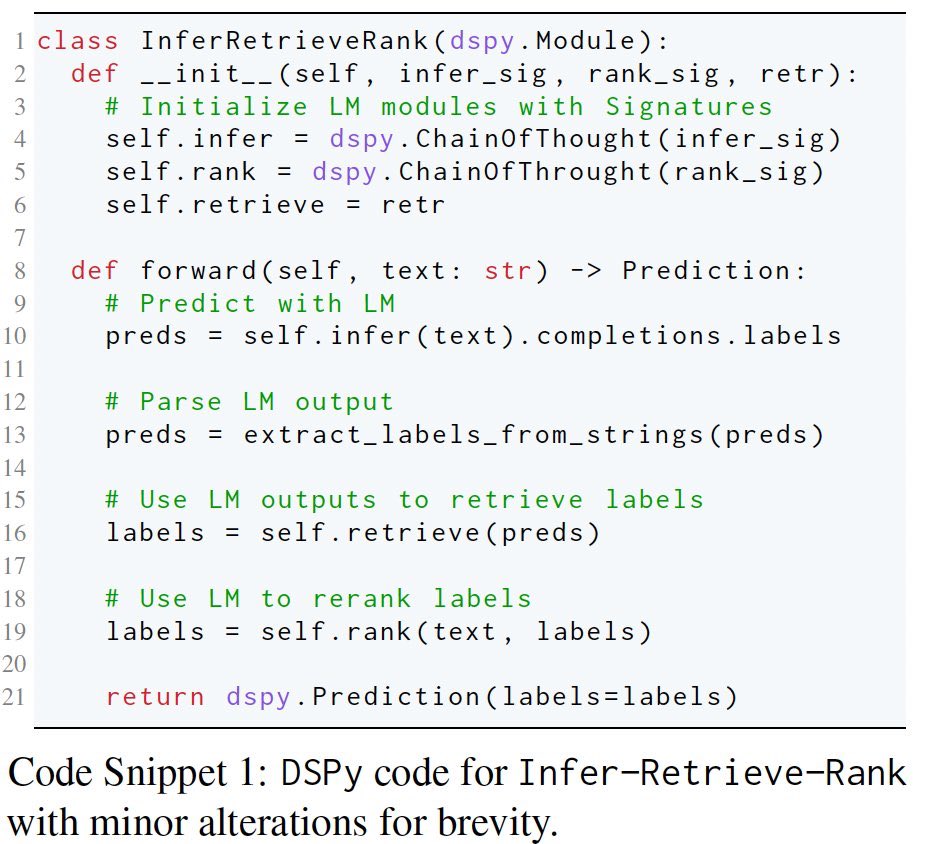
We started this project thinking LMs can’t be prompted to do classification tasks with over 10,000 classes — especially when documents are long!
But the incredible @KarelDoostrlnck found this elegant DSPy program that, once optimized on ~50 examples, sets the state of the art.
90
371
2,549
1,279,340
Milo Spirig retweeted

21 Dec 2024
Overheard in Silicon Valley: "My biggest lesson from the last year is just, it’s all going to happen. All my childhood dreams of space colonies and brain interfaces and AI and robots. Everything is just… going to happen."
928
1,549
16,846
1,339,744
Milo Spirig retweeted

10 Dec 2024
Excited to share that we’ve raised a $25M Series A, led by @JenniferHLi @a16z along with @sequoia, @thegp, @felicis, @zapier, and @mongoDB Ventures:
stainlessapi.com/blog/stainl…
8
13
128
59,764

28 Apr 2024
my personal addition: write down your own list of life advice, ideally together with a partner or close friend.
26 Apr 2024

It's my birthday time, and my present this year is to offer another 101 bits of advice, in a nice handy list. Enjoy! kk.org/thetechnium/101-addit…
1
2
252
24 Apr 2024
I left Brex a couple of months ago to join @RattrayAlex and the team at @StainlessAPI to build the future of REST. Our SDK announcement today tackles the most salient problem: type safety. I'm incredibly proud of what the team has shipped and we're just getting started!
24 Apr 2024

And just like that, @StainlessAPI is live to the world! stainlessapi.com/blog/announ…
Over the last two years in private beta, we've helped @OpenAI, @AnthropicAI, @Cloudflare, @MuxHQ, @Lithic, @ModernTreasury, @useOrb, @tryfinch, and others deliver quality SDKs to their developers.
1
11
373
24 Jan 2024
Always a highlight to read Dan’s letters.

My annual letter:
danwang.co/2023-letter/
This year I discuss a walk-and-talk; Crumb; running and tangping; Knausgaard; Elon as Palmer Eldritch; quantity has a quality all its own; Chicago as a megacity; memelords; Norton; food as physical pleasure; hunching; and a pause.
1
215
Milo Spirig retweeted

7 Nov 2023
Another big step for @OpenAI developers that happened yesterday, we shipped V1.0 (and V1.1 shortly after) of the Python SDK with the help of the amazing team at @StainlessAPI! ✨
Check it out: github.com/openai/openai-pyt…
20
78
618
216,381

We just published the State of Webhooks Report 🎉🎉🎉
svix.com/blog/state-of-webho…
For the report we looked at over 100 of the top API providers, examining how they've embraced and implemented webhooks.
Are most leading API providers on board with best practices?
How have they optimized, secured, and enriched their webhook offerings to cater to the needs of today’s developers and businesses?
We also looked at internal data to provide some statistics on real world deliveries.
Check it out!
5
11
2,938
14 Aug 2023
We are excited at @brexHQ to announce our Group Events product. Corporate travel has traditionally been a single-player experience, and legacy TMCs still treat it that way. Group Events extends Brex Travel to a multi-player experience and brings large-scale team and company event management right into the Brex dashboard and mobile apps.
techcrunch.com/2023/08/14/br…
11
523
Milo Spirig retweeted

15 Jul 2023
this is a masterpiece 🤣
177
1,819
10,040
1,805,209
5 Jul 2023
If you are looking for a new book for this summer, I've put together an updated short list of what I've enjoyed reading over the past couple months. Full list and links here: milo.run
7
301
Milo Spirig retweeted

23 May 2023
✨ Today, we’re announcing @withPlenty : where couples invest and plan for their future together. ✨
It’s our first step towards becoming the home where families collaboratively manage their financial lives.
🧵 Why we built Plenty 0/8
techcrunch.com/2023/05/23/pl…
9
19
95
33,943
22 Mar 2023
Excited to announce the business travel product our team has been working on! DM me if you’re interested in a demo.

Today is the official launch of Brex travel! ✈️
We are now the most unified global spend platform, providing travel booking and management — along with corporate cards, expense management, reimbursements, travel, business accounts, and bill pay — all on one tech stack.
Read more: brex.com/journal/press/brex-…
1
9
1,010

Griz was founded by Stripe alum @GrisetChristian and is backed by @firstround and @XtripeVC. They are on a mission to rebuild the most overlooked and toilsome aspects of producing data products, and are hiring a founding engineer. Interested? 👉 griz-tech.notion.site/Foundi…
1
3
301
9 Nov 2022
🚀🔥
9 Nov 2022

1/ ✨ Today we’re launching Roi: the *one* app to manage all of your investments.
Use it to trade, discover and track stocks, NFTs, crypto, DeFi and more.
Download now: bit.ly/roi-download
👇more
1