
Joined July 2023
- Tweets 1,533
- Following 2,478
- Followers 1,168
- Likes 23,080
26 Photos and videos






Pinned Tweet

Apr 26
Since many of you guys want answer as much as I do, I will save myself a bit of time by putting down a few of the thoughts I've written about... here in one place.
I remember the days of ELIZA back in the 1960s - yes, I’m that old. It was the first chatbot, roughly 500 lines of code, laughably stupid by today’s standards yet utterly groundbreaking. Many users were convinced a real human therapist was behind the screen. This became known as the ELIZA effect: our well-documented human tendency to anthropomorphize machines and project real intelligence, empathy, or consciousness onto software.
That same effect explains why so many today are fooled by LLMs. Despite giga-scale weights and impressive outputs, LLMs are nothing more than a vastly more sophisticated ELIZA - statistical pattern-matchers, fancy random word generators.
I’ll be the first to admit I don’t know what consciousness is (no one seems to), and my shorthand of “awareness” is lame. But I know what it isn’t. LLMs are NOT conscious and never will be - unless your definition is loose enough to call a parrot intelligent simply because it can 'talk'. You can steer LLMs to say literally anything you want; that’s a feature of a machine: a countersign of sentience. End of story.
I work with frontier LLMs every damn day... all day long. They’re as dumb as a box of rocks. But they’re still incredibly useful tools - IF you throw a TON of engineering at them.
This is my opinion… and worth every cent you’re paying for it. 😊
A user asks:
"When you speak you just utter it word by word, the ever continuing stream of thought coming somewhere from your non-verbal brain.
Words are just an interface for the vast complexity of your brain.
How are you better than LLMs when speaking?"
Good question.
Perhaps its true that when a certain complexity is reached, it becomes 'smart'.
Since we really don't know that much about intelligence or consciousness, who's to say?
My interest is a lot more down the earth: can I make LLMs do real work? Reliable work. After kicking them every day for the last few years I have come to these conclusions, not just by understanding how they work, but from experiences with their work products:
1. They are as dumb as a box of rocks - not always or even usually, but often enough to make them useless out-of-the-box for serious, reliable work products.
2. I have to have a human-in-the-loop (me!) to avoid the accumulating chain errors from this:
0.9 ^ 5 (90% accuracy over five trials)
which computes out to flipping a coin. Nowhere near enough reliability to 'sell' - if one is honest.
So these two factors - which are consequences of how these LLMs work internally - are pretty fatal to LLMs WITHOUT a TON of engineering to mitigate the consequences.
All the other noise out there about whether LLMs are truly 'intelligent' or 'can reason' or are 'alive' or are 'conscious' are philosophical questions IMO... which as much as I enjoy them, can't easily overcome the downsides...
I would agree with the 'Its Alive!' crowd more ... except that working with these LLMs for 8,000 man hours now, there are too many counter-indicators of the stance that LLMs can 'reason' etc.... at least from my work and my use case. And all LLM outcomes are deterministic... so that given enough time a person with paper and pencil can replicate the output of an LLM from its inputs.
So after 55 years, 1 million LOC, 12 software patents, 2 arvix paper in AI/quantum, I don't think we are yet seeing emergent intelligence. Am I on the lookout for it? Yep.
User says:
"All the best programmers I know are starting to write code by hand again."
Seems to be a trend. The valley of disillusionment. Reality strikes back. The hard work begins. The realization that LLMs are a dead-end to AGI. All this coming together at the same time.
Still, I press ahead with my auto-coding tool... as it was designed from the ground up with these realizations
1. Devs want model/lab agnostic coding platforms
2. Devs want desktop privacy
3. Devs want pay-as-you-go model costing
None of the lab coding platforms provide these.
4. It is mathematically impossible for LLMs to get to AGI. If you don't understand this simple engineering limitation, then you don't understand how LLMs ACTUALLY work. Myself and others have written about this quite a bit before so check it out.
5. It is this terrible LLM limitation (#4) that means that a new kind of AI foundation is needed - not a transformer. It CAN NOT be based on next token prediction, but must be based on world view, logic and reasoning.
6. So AGI is decades away IMO. The problem for the labs is that they need a trillion dollars to survive and research in the meantime, which means downplaying #4 and upselling the ridiculous idea that LLM-based AI can replace workers.
7. This is NOT to say that we can't push LLMs into a lot of useful service... in fact my last year has been dedicated to this possibility. But we're talking REAL SWE, not the hacking/slop/vibe that results in 500,000 LOC for Claude, for instance.
About me:
Started coding 55 years ago - never stopped
1 million LOC - at least
8,000 hours working with LLMs since before ChatGPT-3 (Neo)
12 software patents - 7 of those pending in the AI domain
Principle author of COSMOS Revelation 1980s
Principal author of SEEKERChat.ai RAG 2010s
Principal author of ViperPrompt.ai 2025
2 arxiv science papers:
arxiv.org/pdf/2601.19929
arxiv.org/pdf/2110.11163
And I was the principle editor of this quantum paper:
arxiv.org/pdf/2306.09122
You can go to my linkedin page to see some of the 5 granted patents. The last 7 (regarding LLMs) are pending. linkedin.com/in/david-ostby
-05621351/
And yes, having 'AI' code 'for you' will definitely reduce your experience 'coding'. But also remember that current computer languages (like python) are abstractions of lower coding languages, which are abstractions of machine code, which are abstractions of processor bit streams. The first machine I worked on to any degree was a mini-computer and we often opened a panel and 'wire-wrapped' taps into the computer back plane.
So in that sense, if we can perfect our auto-coders a bit more, perhaps they will take their place as the next layer of abstraction. My efforts of the last year are an experiment in exactly this. We shall see.
7
10
438

The smartest man in AI just exposed the whole AGI narrative as a LIE.
And he used a physics problem from 1905 to prove it.
His name is Demis Hassabis. He runs Google DeepMind, and won the Nobel Prize for using AI to crack a problem in biology that had stumped scientists for 50 years.
Almost nobody in this industry has a track record like his.
He went on the NothingButTech podcast and called out the biggest lie in AI right now:
Right now the loudest voices in AI are telling you that AGI is basically here. OpenAI has literally defined AGI as a system that can outperform humans at most "economically valuable work." In other words, if it replaces enough jobs, we have arrived.
Hassabis thinks that bar is a joke.
He said real general intelligence has to do what the human brain can do, because the brain is the only proof we have that this kind of intelligence is even possible. He called that "a higher bar than just being able to do some useful economic work," which is about as close as a polite British Nobel laureate gets to calling his rivals out.
Then he gave the actual test:
Today's AI has read everything humans have ever written, including the theory of relativity. So when it explains relativity back to you, it's repeating an answer that already exists.
That's not intelligence.
So Hassabis proposed a test that makes memorization impossible. Train an AI on only what humanity knew in 1901, four years BEFORE Einstein published relativity. Then ask it to come up with relativity on its own.
It can't look up the answer, because in 1901 the answer doesn't exist yet. The only way to pass is to do what Einstein actually did: Take the same physics everyone else had and reason its way to an idea no human had ever had.
Hassabis says not a single AI today can, no matter how much it has memorized. Which means what we keep calling "almost AGI" is really just the best librarian in history.
It can find any answer that already exists but it cannot create one that doesn't.
His second version is even sharper:
AlphaGo, the system his own team built, famously invented a brand new move that no human had played in 2,000 years of the game.
Everyone called it genius but Hassabis says that still is not the bar.
The real test is not whether an AI can invent a new move inside Go, it is whether an AI could INVENT a game as deep and as beautiful as Go in the first place.
No model that exists today can do it.
The people telling you AGI has already arrived are the same people raising hundreds of billions of dollars on that exact promise.
The valuations only work if the finish line is right in front of us. So the finish line keeps getting dragged closer, and AGI keeps getting quietly redefined down to "does useful work," until the products they already sell happen to qualify.
Hassabis has nothing to prove and nothing to sell you. He already won the Nobel, and he is telling you the machines still cannot do the one thing that would make them genuinely intelligent, which is have a truly original idea.
To be fair to him, he is not a pessimist about it. He believes real AGI IS coming, and he is spending his life building it. He just refuses to pretend it is already sitting in your phone.
So the next time a founder tells you AGI is months away, remember that the one man in the room with a Nobel Prize built his test around Einstein, and admitted that nothing we have made can pass it.
What do you think?
206
478
3,201
1,267,720
David Ostby retweeted

Jun 7
You can raise millions and fail.
You can raise almost nothing and win.
Investors are not validation.
They don't know whether your idea will work.
Fundraising is not traction.
The market decides.
Not investors.
Don't confuse it with progress.
94
56
745
42,774

David Ostby retweeted
Jun 5
pitch me your company in 1 word.
3,121
40
1,304
462,076
David Ostby retweeted

Jun 5
The "AI makes you a 10x Developer" you keep seeing on X is an ABSOLUTE illusion. And the empirical data finally proves it!
The overwhelming consensus right now is that AI coding tools make every developer 10x faster, rendering foundational learning obsolete.
Here is what the actual, data-backed reality looks like:
1. The "Time Savings" Illusion: A study by METR tracked experienced contributors tackling tasks in complex codebases. While developers predicted AI would save them 24% of their time, using AI actually increased completion time by 19%. Why? Because models generate syntactically correct code that completely misses broader system architecture, forcing engineers to waste hours debugging out-of-context boilerplate.
2. The Comprehension Trap: A randomized trial by Anthropic analyzed developers learning a new framework. Those who relied on AI to generate their code scored 17% lower on comprehension tests. When you treat AI as a typewriter instead of a sounding board, your brain skips the critical cognitive heavy lifting.
3. The Junior Bottleneck: A Harvard-backed study tracking tech worker records revealed that companies adopting generative AI cut junior developer hiring by 9% to 10%, while senior roles remained entirely flat. AI isn't replacing engineers—it's replacing the entry-level code-typists.
5
6
19
2,600

Demis Hassabis was asked if a machine needs a heart to be intelligent.
He said it was optional.
Hassabis: “I think it will need to understand emotion… it might be not necessary, or in fact not desirable for them to have the sort of emotional reactions that we do as humans.”
Understand. Not feel.
A machine that maps your grief and carries none of it.
It hears the crack in your voice. Names the wound. Sees your next move before you make it. And feels nothing the whole time.
Then he called emotion a “design decision.”
The thing humans built every religion, every love song, every war around, reduced to a toggle someone leaves off.
If the smartest thing we ever build looks at emotion and skips it, emotion was never the ceiling of intelligence.
It was the cost of running a brain inside a body that could die.
Fear kept us off the ledge. Love held the tribe together. Grief made us remember the dead so we wouldn’t follow them.
Every feeling you’ve ever had is a survival patch written by a body that bleeds.
The machine doesn’t bleed.
So it doesn’t need the patch.
We always assumed feeling was the foundation of understanding someone.
The machine is about to prove it was the interference.
The clearest view of the human condition will belong to something that never has to live one.
Hassabis says this is five to ten years out.
Emotion was never proof we were the smartest thing alive.
It was proof we were the most afraid of dying.
38
14
48
6,634

I have spent a long time trying to build a set of rules for agents to follow to try and automate some tasks. The simple fact is that they will not follow them, if there is a short cut it will be taken. They absolutely cannot be relied on for deterministic work.
2
1
3
112
David Ostby retweeted

May 20
IMO: The breaking the rules is a consequence of two arithmetic phenomena:
1. Higher percentage of extrapolation (out of distribution) calculations. Or in street language "making stuff up"
2. The faster accumulation of errors duet to repeated use of unreliable activities that compound in the agent's context window. This math is relatively simple and known in engineering reliability calculations of assemblies of components.
What surprises me the most is how smart people (I'm referring to end users now) seem to totally forget this simple fact and deploy these agents like they would be some sort of gods or something.
Unbelievable! & Amazing!
1
2
8
260
David Ostby retweeted

May 15
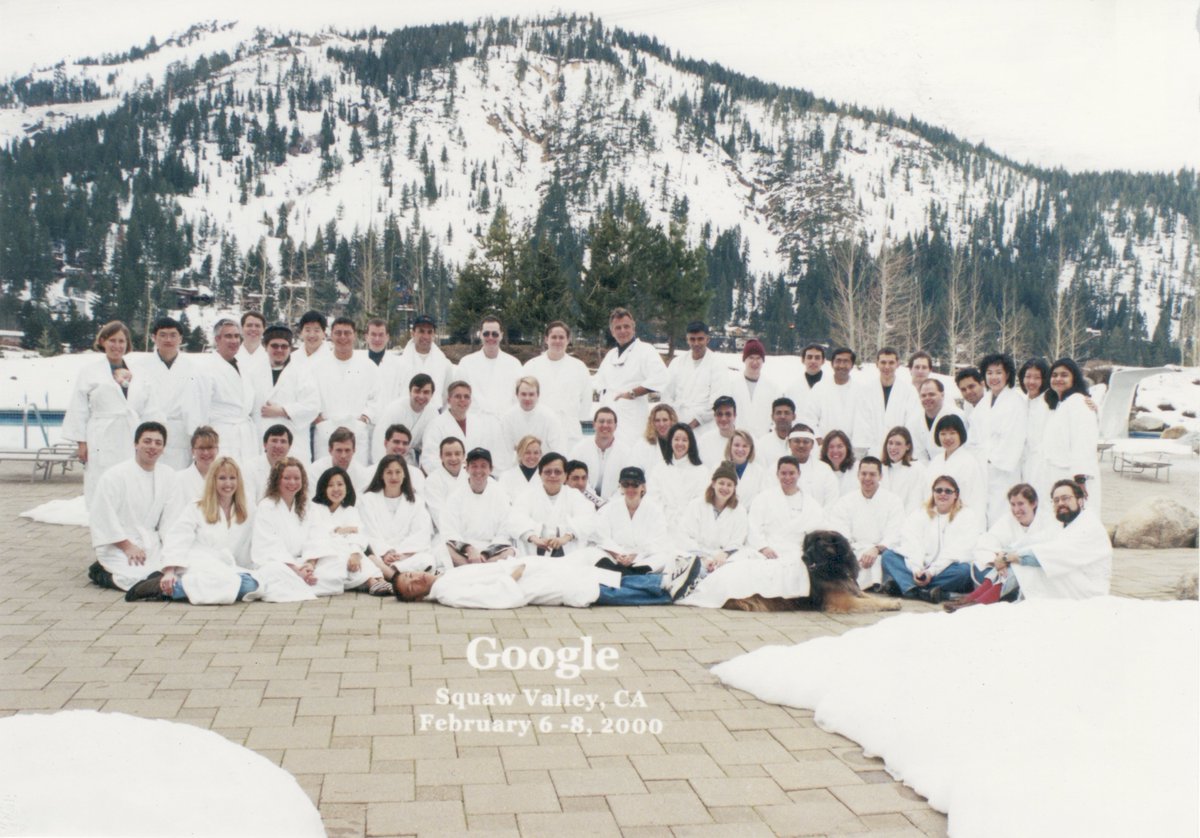
If you’re starting a cult, we want to back you!
- preseed/seed (ideally first check)
- $100-250k checks
- decisions made within 48 hrs max
Find a warm intro or fill out form on our website!

97
32
838
88,382
David Ostby retweeted

I'm almost tempted to vibe-code a multi-agent AI system and instruct it to recursively self-improve into a "superintelligence"...
... just so we can check back in at the end of this year and see how gloriously wacko and error-compounded it has become.
19
5
50
2,248
David Ostby retweeted

May 12
The next billion-dollar founder has 9 followers on X rn.
We will FIND you & FUND you!
May 11

The next billion-dollar founder has 9 followers on X rn.
I will find you & fund you!
110
12
241
21,820
David Ostby retweeted
May 11
The next billion-dollar founder has 9 followers on X rn.
I will find you & fund you!
792
42
1,553
84,400

David Ostby retweeted

May 10
Brandolini's law: The amount of energy needed to refute bullshit is an order of magnitude bigger than that needed to produce it
1
1
168
David Ostby retweeted

May 11
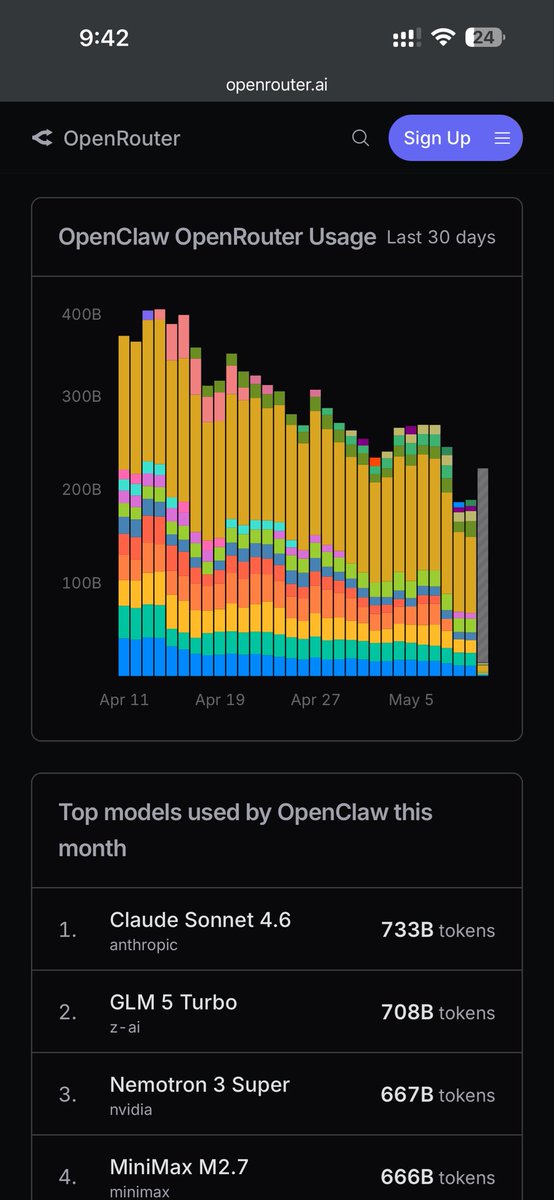
The world woke up and realized that LLMs running in a loop ("agents") are no more accurate or reliable than LLMs themselves
Yet another hype cycle of the AI bubble deflated
Surely a few more trillion in data center capex will fix it tho
May 11

Openclaw token consumption fell by half in a month, per openrouter data
What happened?
14
36
331
27,504
David Ostby retweeted
The best part about standing against irrational AI overhype in biology is that it will age like fine wine.
The AI evangelists can throw all the insults and fallacious arguments they want. The severe bottlenecks in high-quality wet lab data aren't going away.
Over the next few years it will become clear that:
- AI drug discovery only offers incremental improvements to traditional success rates in clinical trials.
- Many specific AlphaFold predictions are wrong.
- AI for biology suffers from major gaps in high-quality multi-omics and in-vivo data.
- Computational simulations and automated labs are far from quick fixes.
- A lot of the general hype was driven by entities with vested financial interests in AI company valuations.
Hopefully, once these realisations hit mainstream discourse, we can have a more measured and rational conversation about how AI can realistically contribute to biology.
31
17
136
12,880
David Ostby retweeted
May 9
Major green flags in a founder:
1/ crazy grit, won’t give up
2/ started building before pitching investors
3/ constantly moving, constantly generating new information
4/ very technical
5/ not addicted to founder cosplay
6/ goes out and talks to users
7/ finds creative, experimental marketing channels
8/ genuinely cares about what they’re building
9/ never blames others or external factors
10/ tinkered with projects obsessively at a young age
11/ constantly comes up with interesting ideas
12/ knows their metrics cold
13/ doesn’t chase hype, chases truth
14/ excellent storyteller. Can sell the vision to hires, investors, and customers
15/ can clearly explain what they are building in one sentence
16/ can’t stop talking to customers
If you hit a good chunk of these, tell me what you are building
205
128
1,718
67,378
May 8
I haven't a clue what to do about it: the pandemic of 'LLMs reason'. 'LLMs can think'. 'LLMs are alive!'. Etc.
So I've concentrated on what I know. Having been involved with each of the automation cycles since 1970, I've stuck to the practical side of the AI equation.
But to clear up a rampant misunderstanding: When Dario, Altman et al say things like 'AI is going to replace 50% of human workers' and other such statements, I scratch my head.
First off, in automation cycles, we have never 'replaced humans': we automate FUNCTIONS. And often/hopefully that makes the humans more efficient.
This can have a RIF-like affect... take for instance the recent SalesForce RIF.
But one consequence of this is that RIF CEOs have a very hard time pointing to any employee and saying 'AI replaced' that person, RIGHT THERE. Never gonna happen.
Because guess what? Automating FUNCTIONS is a lift, often heavy. Takes all manner of skilled Devs/PMs/SMEs/Analysts to accomplish it. I DO however believe that attempts are being made to do exactly this. This will cause an increase in need for those skill sets, not a decline.
Otherwise, people would be having more luck with my remedy, which is a sure fire way to ACTUALLY REPLACE HUMANS:
To 'replace' yourself at work do the following. (You will want to try this at home first)
1. Get out your laptop and label with with your name.
2. State on the label that you should continue to receive your paycheck and state your address to mail your pay to.
3. Bring up your favorite LLM.
4. Sit there in front of the LLM and wait for the it to take over your job.
5. If, after an hour nothing has happened, do this next:
6. Type this prompt exactly (works every time) : 'Oh Great and Wonderful Claude, I command that you replace me at my workplace with your intelligence, wisdom and knowledge'.
That's it!
You're Welcome.
7
44,431
David Ostby retweeted

May 7
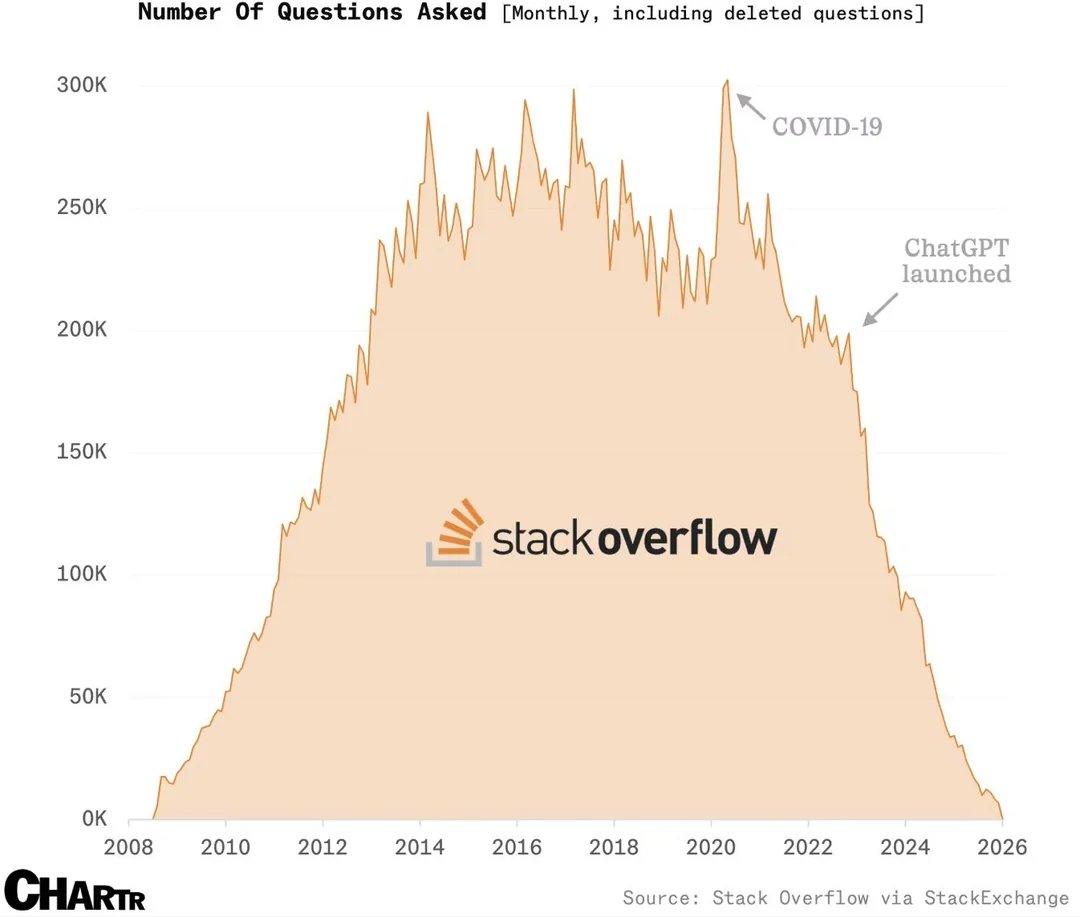
STACK OVERFLOW IS DEAD
from 2008 to 2020 stack overflow grew every single year.
peaked at 300,000 questions per month during covid when every developer was home learning new skills
THEN chatgpt launched in late 2022
the drop is brutal, 300k per month down to what looks to be less than 1000 by 2026.
developers stopped asking stack overflow and started asking AI
why spend 20 minutes writing a question, formatting your code, waiting for someone to maybe reply with a condescending "this is a duplicate" comment when you can paste the error into claude and get a working answer in 10 seconds
the entire knowledge base that took 15 years to build is now being replaced by models that were trained on it
the irony is that AI learned to code partly from stack overflow answers. and now it's killing the platform that taught it
this is the clearest chart showing AI's real world impact on an entire industry
RIP Stack Overflow 2026
13
6
33
4,352