
partner @hiframework ||| long tough-minded optimists ||| my views only, not financial advice
Joined January 2012
- Tweets 2,001
- Following 2,127
- Followers 2,588
- Likes 7,751
239 Photos and videos












Brandon Potts retweeted

We are thrilled to lead back-to-back financings into @MeckaAI to build infrastructure for robots to learn about the world and deploy reliably.
Mecka is the fastest-growing revenue company we've ever invested in and is still accelerating.
Thrilled to deepen our partnership with @joshavata @jasontheutopian and the entire Mecka team.
Jun 1

Today @MeckaAI is announcing $60M in funding to become the data and deployment layer for physical AI
This raise will allow us to scale our data infrastructure, invest into new verticals, and deploy robots into the real world
11
10
72
15,461
Brandon Potts retweeted

May 20
Jito 2026 Q1 Quarterly Call x.com/i/broadcasts/1MJgNgkOk…
15
36
117
59,095
Brandon Potts retweeted

May 16
Or go to the Presidio, jump in the ocean, get a coffee at The Mill, watch sunset at Twin Peaks, ride a bike anywhere, see live music, eat a burrito, take a grass nap in GG Park, have beer at The Page, watch the Bay Bridge lights, wander Chinatown, wander Ferry building, run across GG Bridge, walk Fort Funston, eat the best meal of your life with friends…drive any direction for 2hrs. And be deeply grateful for the heavenscape you live in.

The vibes in SF feel pretty frenetic right now. The divide in outcomes is the worst I've ever seen.
Over the last 5yrs, a group of ~10k people - employees at Anthropic, OpenAI, xAI, Nvidia, Meta TBD, founders - have hit retirement wealth of well above $20M (back of the envelope AI estimation).
Everyone outside that group feels like they can work their well-paying (but <$500k) job for their whole life and never get there.
Worse yet, layoffs are in full swing. Many software engineers feel like their life's skill is no longer useful. The day to day role of most jobs has changed overnight with AI.
As a result,
1. The corporate ladder looks like the wrong building to climb.
Everyone's trying to align with a new set of career "paths": should I be a founder? Is it too late to join Anthropic / OpenAI? should I get into AI? what company stock will 10x next? People are demanding higher salaries and switching jobs more and more.
2. There’s a deep malaise about work (and its future).
Why even work at all for “peanuts”? Will my job even exist in a few years? Many feel helpless. You hear the “permanent underclass” conversation a lot, esp from young people. It's hard to focus on doing good work when you think "man, if I joined Anthropic 2yrs ago, I could retire"
3. The mid to late middle managers feel paralyzed.
Many have families and don't feel like they have the energy or network to just "start a company". They don't particularly have any AI skills. They see the writing on the wall: middle management is being hollowed out in many companies.
4. The rich aren’t particularly happy either.
No one is shedding tears for them (and rightfully so). But those who have "made it" experience a profound lack of purpose too. Some have gone from <$150k to >$50M in a few years with no ramp. It flips your life plans upside down. For some, comparison is the thief of joy. For some, they escape to NYC to "live life". For others still, they start companies "just cuz", often to win status points. They never imagined that by age 30, they'd be set. I once asked a post-economic founder friend why they didn't just sell the co and they said "and do what? right now, everyone wants to talk to me. if i sell, I will only have money."
I understand that many reading this scoff at the champagne problems of the valley. Society is warped in this tech bubble. What is often well-off anywhere else in the world is bang average here.
Unlike many other places, tenure, intelligence and hard work can be loosely correlated with outcomes in the Bay. Living through a societally transformative gold rush in that environment can be paralyzing. "Am I in the right place? Should I move? Is there time still left? Am I gonna make it?" It psychologically torments many who have moved here in search of "success".
Ironically, a frequent side effect of this torment is to spin up the very products making everyone rich in hopes that you too can vibecode your path to economic enlightenment.
83
200
4,116
287,250

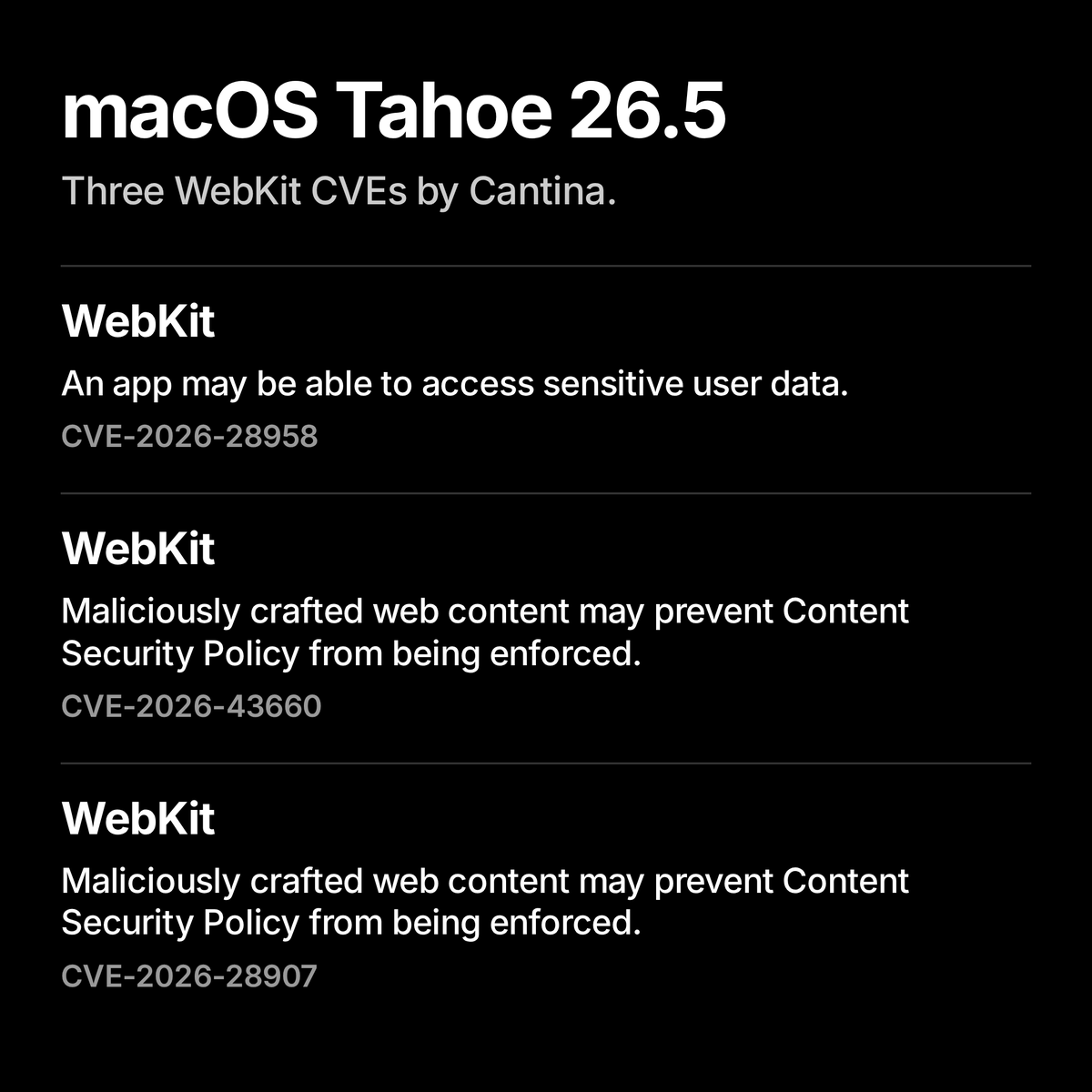
Cantina was mentioned thrice in @Apple's security update yesterday.
We're doing our part in the looming bugapolypse to protect critical infrastructure.
Update your Apple devices 🫡
May 13

Apple patched a 13-year-old bug in WebKit yesterday.
Apex, Cantina's autonomous AppSec agent, found it.
It's one of three Apex findings in the same release. Two are CSP bypasses.
Full writeup: cantina.review/ze5
1
4
49
5,942
Brandon Potts retweeted

May 6
coding is 70% solved. most people have not written a single line of code in 2026.
the next problem to solve is continuous security. 24/7 running in the background checking your code and every step in the development lifecycle.
5
3
22
1,708
Brandon Potts retweeted

May 5
I’m excited to announce that DFlow has been acquired by MoonPay.
DFlow has consumed almost every waking moment of my life since I started it in 2021. An incredible amount of work has gone into it over the years with tangible growth results that reflect the massive effort of the entire team.
Today, DFlow is integrated almost universally across trading apps on Solana. Transactions constructed by DFlow are in almost every block produced on Solana. We’ve served millions of traders across the world. We’re constantly on the frontier of the technology powering markets, working with the largest and most cutting edge businesses in next-gen finance like Phantom, Kalshi, Coinbase, and hundreds more.
I’m proud of what we’ve built so far and excited to work with Ivan and the MoonPay team on the next phase of insane growth.

89
38
491
85,408
Brandon Potts retweeted

May 5
Built for the trader you've become.
160
191
1,080
252,664

Brandon Potts retweeted

Apr 22
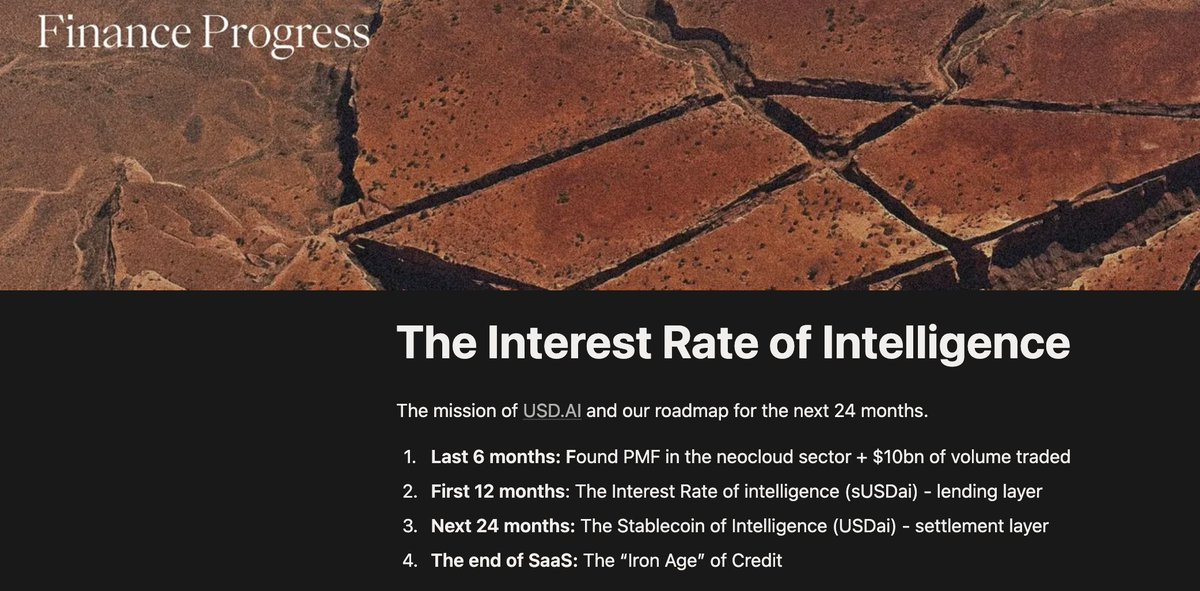
The next stage of @USDai_Official is more execution:
See what we've done in the last 6 months, and where we're going in the next 24 months, and how the most important commodity of the AI sector (GPUs) is turning into a new asset class 👉
33
17
145
18,477
Brandon Potts retweeted

Apr 20
Look guys, it's actually really straightforward, a bunch of people staked their ETH on the Ethereum blockchain to earn yield, except they didn't want their capital to be locked up, so they actually staked with a liquid staking protocol called Lido who provided them a liquid staking receipt token called stETH, except they decided to juice their yield further by depositing their stETH receipt tokens into a restaking protocol called Eigenlayer, except they didn't want to lock up their capital, so they actually restaked with a liquid restaking protocol called KelpDAO who provided them with a liquid restaking receipt token called rsETH, except they decided to juice their yield further by depositing their rsETH tokens into a lending protocol called Aave so that they could open a leveraged looping position that borrows ETH against the rsETH collateral and restakes the ETH into rsETH which is then deposited as collateral, except it turns out rsETH used a cross-chain bridge called LayerZero that was hacked by north koreans causing rsETH to become undercollateralized and now these looping positions are stuck and unprofitable, and everyone is pointing fingers at each other, and also DeFi is a very serious industry

682
1,533
11,176
754,060
Brandon Potts retweeted

Apr 13
Thanks @domcooke for spending months on researching and writing this piece. Einstein once said, "If you can't explain it simply, you don't understand it well enough." By that measure, Dom has blown me away with how deeply he came to understand Hyperliquid and what we're all building together.
When someone asks what "housing all of finance" means, I'm proud to point them to this piece. I hope readers appreciate just how much Dom and his team put into their work. It reflects the thoughtful craft that is in Hyperliquid's DNA. Special thanks to @patrick_oshag for taking a bet on Hyperliquid's story.
Apr 13

This is the story of Hyperliquid, the most profitable startup per employee on earth, told from a guarded office in Singapore.
Last year, its team of 11 generated $900 million in profit. It's 3 years old, has never taken a dollar of venture capital, and is beginning to change how century-old markets work.
Its founder, Jeffrey Yan (@chameleon_jeff), had never taken a physics class when he picked up a textbook at 16. Two years later, he won gold at the International Physics Olympiad. In 2019, he started trading with $10,000 from a living room in Puerto Rico—working off a television because he didn't own a monitor.
Within 3 years, he was running one of the largest anonymous crypto trading firms.
Then he shut it down. Yan was rich and free, but he had spent years inside crypto, watching it betray itself. Bitcoin's central premise was decentralization. Yet the biggest exchanges were centralized. Crypto kept reintroducing the dependence on trust it was built to eliminate. He set out to create what should have existed.
Hyperliquid is a blockchain with a trading exchange on top, and anyone can build on it. Yan's vision is to house all of finance. In 3 years, it has done over $4 trillion in volume. And in the past few months, it has begun to outgrow crypto.
Markets for oil, silver, and the S&P 500 now trade on Hyperliquid around the clock, weekends included, and are growing roughly 40% week on week. When the US and Israel bombed Iran on a Saturday in February, Hyperliquid was the venue traders turned to.
Hyperliquid's success has cost Yan his freedom. He works out of a secret office in Singapore and cannot travel without two bodyguards. Even the team's housekeeper doesn't know what they do.
In January, @domcooke spent a week at their office. Read his profile on Yan and @HyperliquidX below.

324
553
3,736
451,190
Brandon Potts retweeted

Apr 9
Hello, I'm Pakistan and this is Jackass
Apr 8

🚨Breaking: Iranian media: Pakistan handed the United States a version different from the one it received from Iran, and provided Iran with a different version from what it received from Washington.



35
614
12,703
514,727
Brandon Potts retweeted

EXCLUSIVE: The CIA late last year raised the status of its elite cyber espionage division, providing it more resources to analyze and disrupt digital threats, as well as amp up the agency’s own technological innovation efforts.
therecord.media/cia-director…
11
82
396
66,896
Brandon Potts retweeted

Apr 9
Hi. Professional C/C programmer here. The open-source code I can find written by Adam Back and Satoshi Nakamoto don't look remotely similar.
Back's code looks typical of academic Unix programmers who also hack their code to run on Windows.
Satoshi code was written by a professional Windows programmer who also wrote for Unix.
Stylistically, they look nothing alike. There's not enough time between 2005 when I can find the newest Adam Back and January 2009 when Satoshi published Bitcoin/0.1 to account for the change. Both are perfectly competent programmers, but stylistically, they are completely different.
The NYTimes tried to compare their English language in posts/emails. I'm compare their C/C language in their open-source code. The NYTimes merely points out they both use C as if that's another corroborating detail, when the actual code seems to disqualify Adam Back.
Apr 8

Bitcoin’s founder, Satoshi Nakamoto, has remained hidden for 17 years. A trail of clues — and a year of digging by our reporter, John Carreyrou — led us to a 55-year-old computer scientist in El Salvador named Adam Back. nyti.ms/4bXWC3V
264
918
10,664
1,402,978

Brandon Potts retweeted

Apr 7
okay I actually forgot the Epstein files
well played
74
672
18,259
499,208
Brandon Potts retweeted

Apr 8
Mythos appears to be the first class of models trained at scale on Blackwells. Then will be Vera Rubins. Pre-training isn't saturated. RL works. And there is *so much* computing coming online soon.
Buckle your chin strips. It's going to be fucking wild.
106
307
3,900
453,268
I see a lot of conflicting opinions on this, and this is a nuanced discussion. Here's what I see on the ground:
For context, we built a frontier AI security tool called Apex (#1 on the HackerOne business leaderboard for 2026, over $100B in exploitable funds saved), and have found severe critical bugs in both open source and closed source codebases.
We've found and reported issues in pretty much everything: compilers, smart contracts, layer-1 blockchains, browsers, operating systems, old Linux libraries, formal verification solvers, GPU code, fortune-500 companies, you name it. If you're reading this, it's pretty likely we found something in a piece of software you were using.
1. AI has changed the economics of security.
There's no such thing as an impenetrable system; a highly motivated, well-resourced attacker will be able to hack into anything they want to. So security is really about using your resources effectively to make attacking as expensive as possible.
AI has completely changed the economics here. It's pretty obvious to people how AI has changed the economics around building software. If you can describe what a software application is supposed to do, getting an MVP is just a prompt away. There's a similar phenomenon in security happening right now that people are slowly waking up to.
2. The gap between attackers and defenders:
Nicolas Carlini, a security researcher from Anthropic, gave a wonderful talk last month at a security event in San Francisco that I attended, where he discussed how security has historically had a balance between attackers and defenders and how new technology has favored defenders more than attackers. However, he warns that this dynamic is changing with the accelerated improvements in AI. A lot of software out in the open will be vulnerable for a while to people poking around with new tools (claude "find me a critical bug, make no mistakes"). In the long term, defenders may win, and we may have very secure software and things rewritten in safer languages, but it's pretty clear there will be a short-to-medium-term security apocalypse.
3. On open-source vs closed source
From what I see building a frontier security tool, it's far easier to break fully open-source code than closed source. We literally have a factory that we can feed open-source code into, and it'll spit out exploits. With closed-source binaries, an experimental version of this factory has surprised us; for example, we have a High severity bug on then closed-source Claude Code that Anthropic paid a bounty for (this was before the whole leak). But putting closed source binaries in our factory is largely hit or miss, it takes expert human labor to make it work on closed-source binaries today.
The counterargument of "but ... LLMs will write a perfect decompile" is not as simple as you'd put it. I can't go into the specifics without giving away some of the work we're doing there. Give it a try, pick an important closed source binary and see how much work it takes to get a useable reverse. It's some work today, and the results are not yet reliable.
As of now, being closed-source buys you more time vs open source when it comes to the AI security apocalypse. But this may be as short as a few months. I say this as someone who has written a lot of open-source code. It's time to rethink some of your assumptions from first principles.
Apr 4

"North Korea is willing to spend $100 million for a $300 million prize. You don't have $100 million to defend yourself"
Haseeb on why open source might stop being the default in crypto
"The pollyanna-ish kumbaya version of open source we've had over the last 20 years is going away"
"Crypto apps are open source but they're maintained by a single company. Only Drift uses the Drift contracts. That's really different from open source like Linux or Axios"
"There's such an asymmetry between attackers and defenders that this may end up pushing against open source as the default. Maybe they issue a zero knowledge proof that shows there's no admin key, but they're not going to decompile the code for you"
7
4
46
9,595
Brandon Potts retweeted

Apr 1
usdc team in cannes right now while the drift hacker takes 3 hours to bridge and swap all the $270m
31
63
1,216
84,071
Brandon Potts retweeted

Mar 26
1/ I've been quiet/taking the high rd while those pushing permissioned networks FUD permissionless networks (esp @solana) *everywhere*. I actually knew this was coming immediately after my panel @blockworksDAS & tackled it w/o naming names on stage. But I'll now be direct . . .

"MEV — that ability for people to reorder transactions to extract value, something that happens on top of Ethereum and Solana — that's just not suitable for financial markets."
@drwconvexity @DRWTrading
41
55
446
156,092