
Founder @globetrottersai | Ex-CTO & co-founder @agorapulse ($0 to $20M ARR) | Agentic Web x TravelTech
Joined November 2007
- Tweets 2,604
- Following 1,312
- Followers 1,175
- Likes 1,920
141 Photos and videos


Benoit Hediard retweeted

Jun 3
Leading companies are moving from two-week sprint cycles to a daily rhythm that combines human judgment with overnight agent execution.
The opportunity now is how organizations use the capacity those agent-enabled workflows create. mck.co/3Q0yqpt
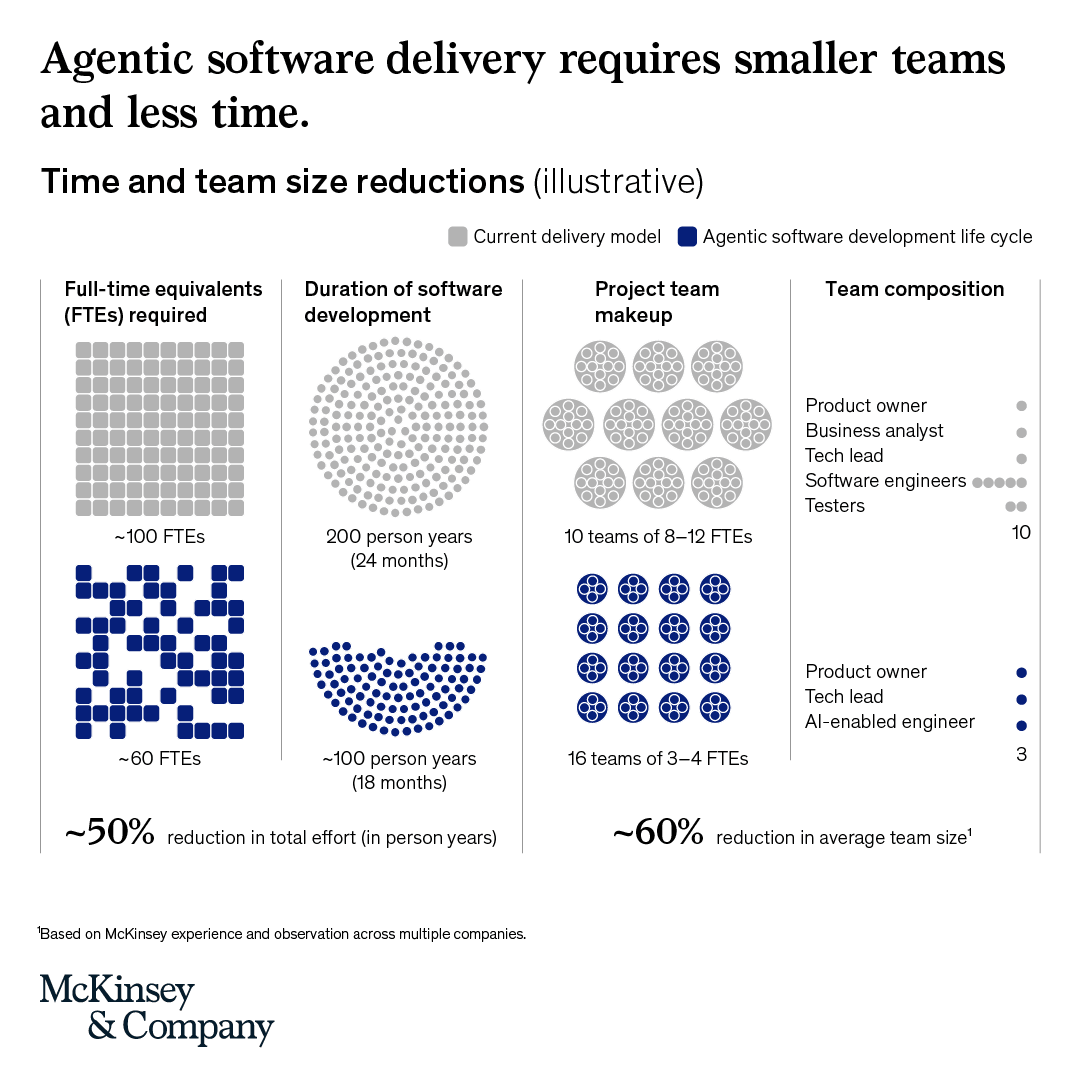
ALT Comparison of traditional and agentic software delivery showing smaller teams and shorter development times with about 50% less effort and 60% smaller teams.
22
103
572
183,092

May 12
Amazing article about current state of Agentic Engineering (and Vibe Coding). 100% aligned with @wesmckinn
Feb 17

New post: "The Mythical Agent-Month"
With coding agents, we are writing code faster than ever. But hands on keyboards was never the bottleneck, a lesson from Fred Brooks's 1975 classic that we keep painfully relearning. Will it be different now, or will we run into the same "brownfield barriers" as new agent-native software projects scale up?
wesmckinney.com/blog/mythica…
1
39
Benoit Hediard retweeted

Apr 22
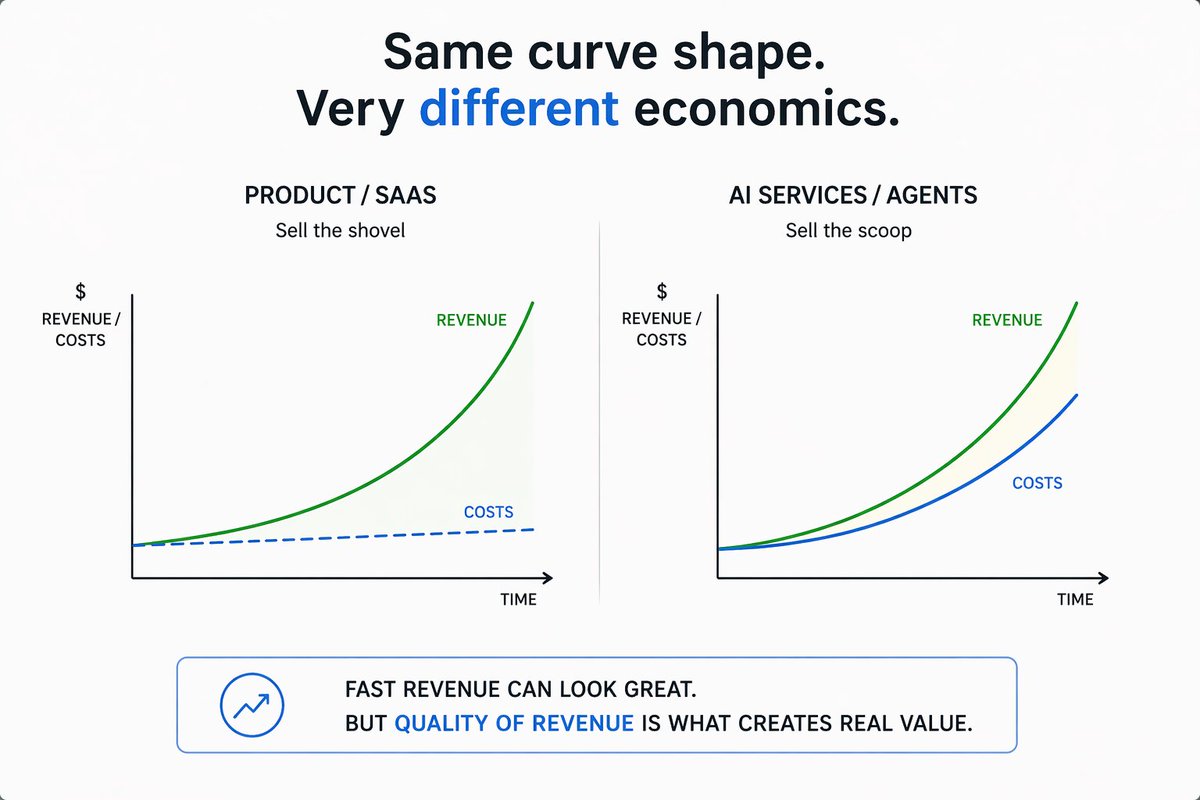
The success of an AI company is now judged by the shape of its curve.
People talk about “curves”.
Not “Where will you end the year?”
But “What did you make in the last 3 months?”
Revenue is the new religion.
But something fundamental changed:
👉 the nature of revenue.
SaaS sold products. Tools.
Shovels and picks.
AI sells services.
Resources.
Every single scoop. With a product:you build once.
Then margins expand.
With a service:you pay every time. Compute. Infra. Models.
Selling scoops is easier.
Faster.
More rewarding upfront.
But less profitable.
Revenue grows fast.
But it’s not the same quality.
The real opportunity?
Product × AI
The magic of service.
With the margins of SaaS.
Same curve.
Very different economics.
1
1
4
488
Benoit Hediard retweeted

Apr 12
Another week on the road meeting with a couple dozen IT and AI leaders from large enterprises across banking, media, retail, healthcare, consulting, tech, and sports, to discuss agents in the enterprise.
Some quick takeaways:
* Clear that we’re moving from chat era of AI to agents that use tools, process data, and start to execute real work in the enterprise. Complementing this, enterprises are often evolving from “let a thousand flowers bloom” approach to adoption to targeted automation efforts applied to specific areas of work and workflow.
* Change management still will remain one of the biggest topics for enterprises. Most workflows aren’t setup to just drop agents directly in, and enterprises will need a ton of help to drive these efforts (both internally and from partners). One company has a head of AI in every business unit that roles up to a central team, just to keep all the functions coordinated.
* Tokenmaxxing! Most companies operate with very strict OpEx budgets get locked in for the year ahead, so they’re going through very real trade-off discussions right now on how to budget for tokens. One company recently had an idea for a “shark tank” style way of pitching for compute budget. Others are trying to figure out how to ration compute to the best use-cases internally through some hierarchy of needs (my words not theirs).
* Fixing fragmented and legacy systems remain a huge priority right now. Most enterprises are dealing with decades of either on-prem systems or systems they moved to the cloud but that still haven’t been modernized in any meaningful way. This means agents can’t easily tap into these data sources in a unified way yet, so companies are focused on how they modernize these.
* Most companies are *not* talking about replacing jobs due to agents. The major use-cases for agents are things that the company wasn’t able to do before or couldn’t prioritize. Software upgrades, automating back office processes that were constraining other workflows, processing large amounts of documents to get new business or client insights, and so on. More emphasis on ways to make money vs. cut costs.
* Headless software dominated my conversations. Enterprises need to be able to ensure all of their software works across any set of agents they choose. They will kick out vendors that don’t make this technically or economically easy.
* Clear sense that it can be hard to standardize on anything right now given how fast things are moving. Blessing and a curse of the innovation curve right now - no one wants to get stuck in a paradigm that locks them into the wrong architecture. One other result of this is that companies realize they’re in a multi-agent world, which means that interoperability becomes paramount across systems.
* Unanimous sense that everyone is working more than ever before. AI is not causing anyone to do less work right now, and similar to Silicon Valley people feel their teams are the busiest they’ve ever been.
One final meta observation not called out explicitly. It seems that despite Silicon Valley’s sense that AI has made hard things easy, the most powerful ways to use agents is more “technical” than prior eras of software. Skills, MCP, CLIs, etc. may be simple concepts for tech, but in the real world these are all esoteric concepts that will require technical people to help bring to life in the enterprise.
This both means diffusion will take real work and time, but also everyone’s estimation of engineering jobs is totally off. Engineers may not be “writing” software, but they will certainly be the ones to setup and operate the systems that actually automate most work in the enterprise.
254
643
5,312
1,770,557

Apr 4
Are you suffering from token anxiety and Claude addiction 💉🤖?
levelup.gitconnected.com/cla…
58
Benoit Hediard retweeted

Mar 31
We just rebuilt every startup in @ycombinator's latest demo day batch.
Here's what our agentic "founders" pulled off and what it means for the future of startups.
Fully useable products at the bottom of the thread below 🤖🧨
177
128
1,047
544,726

Benoit Hediard retweeted

Feb 25
When building costs drop 90% but distribution costs stay flat, you get a gold rush where everyone digs and nobody sells.
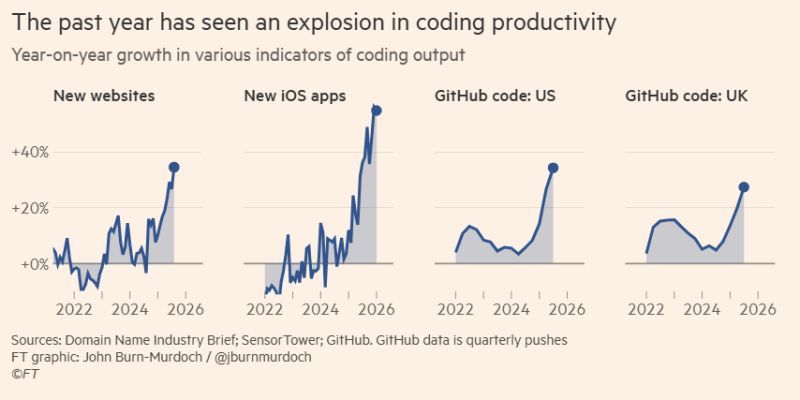
That’s what this chart actually shows. New websites up 40%. iOS apps up 50%. GitHub pushes up 35%. Everyone read “barrier to building disappeared” and heard opportunity. The correct read is that 557,000 new apps hit the App Store last year, a 24% spike, flooding a discovery channel that was already dead on arrival. 90% of senior mobile professionals surveyed said organic App Store discovery was effectively over before this wave even hit. Half of all App Store searches are just people typing in brands they already know.
The supply side hockey-sticked. The demand side didn’t move.
This is why tech layoffs doubled to 264,000 in 2025 while code output simultaneously exploded. Companies don’t need more builders. They need people who can get the thing in front of someone who’ll pay for it. Distribution, positioning, audience, brand. The functions that never got the AI productivity boost.
Nicholas nails the conclusion that taste and knowing what to build are what matter now. But taste is only half of it. You also need the channel. The unsexy reality is that a mediocre app with 100,000 newsletter subscribers will outperform a beautiful app with zero distribution every single time. The apps winning in 2026 aren’t the best-built ones. They’re the ones attached to someone who already has an audience.
Building software used to be the moat. Now building software is the commodity. Distribution is the new moat, and unlike code, it doesn’t get cheaper with AI.
Feb 24

I think we are witnessing the biggest explosion in software creation in history.
New website creation is up 40% year on year. New iOS apps are up nearly 50%. GitHub code pushes in the US jumped 35% and in the UK around 30%.
All of these metrics were flat for years before late 2024. The entire graph looks like a hockey stick.
You no longer need a six month runway and a dev team to ship something real.
We see this in our metrics as well!
People who never wrote a line of code are building and launching apps.
The barrier to building software just disappeared.
What matters now is knowing what to build and the taste to build it right.
96
209
2,045
345,737
Benoit Hediard retweeted

9
47
569
53,388

Benoit Hediard retweeted
Feb 21
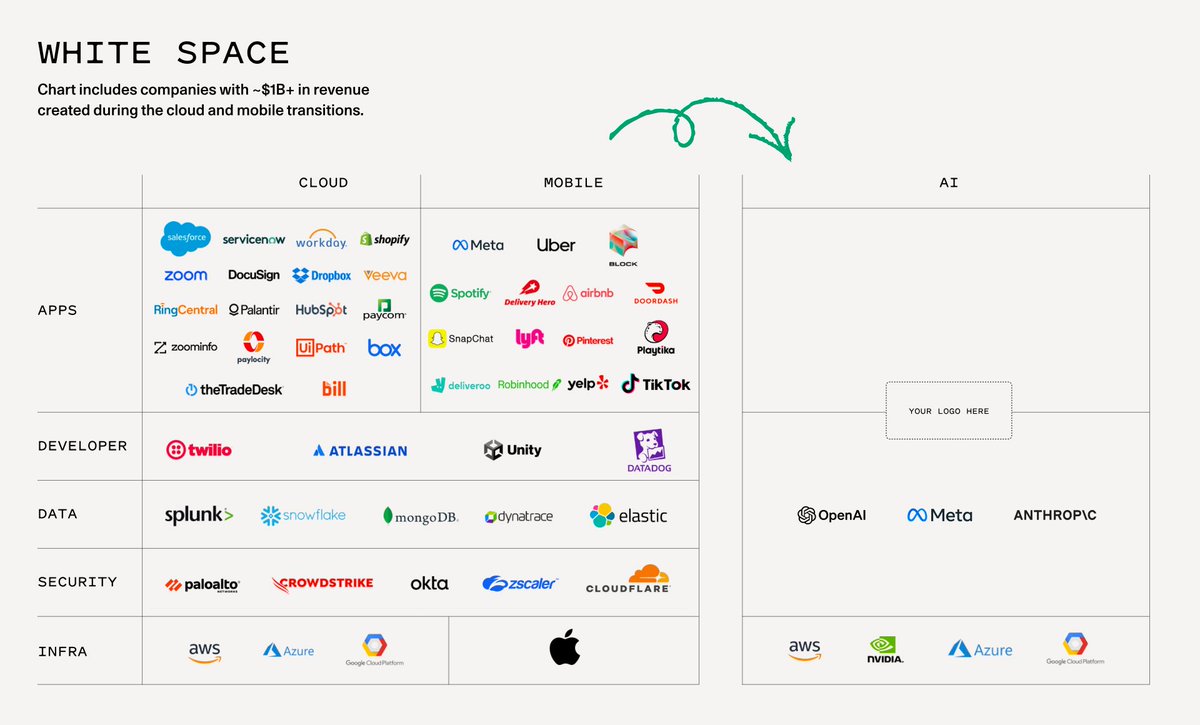
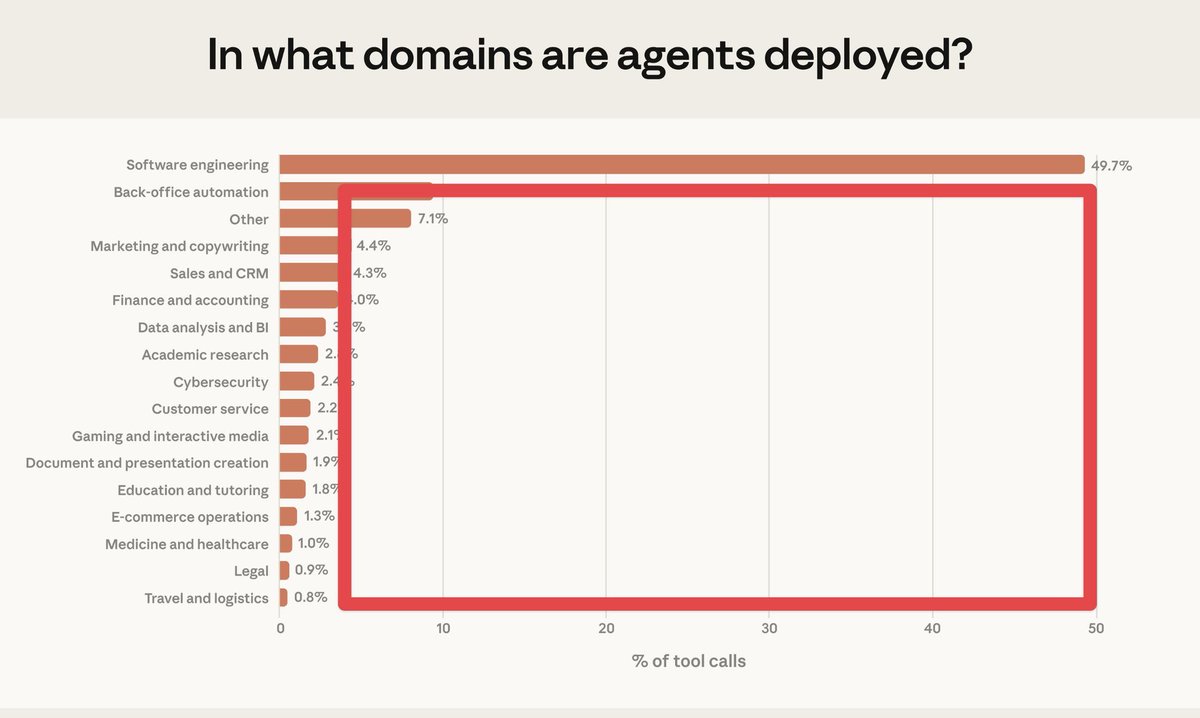
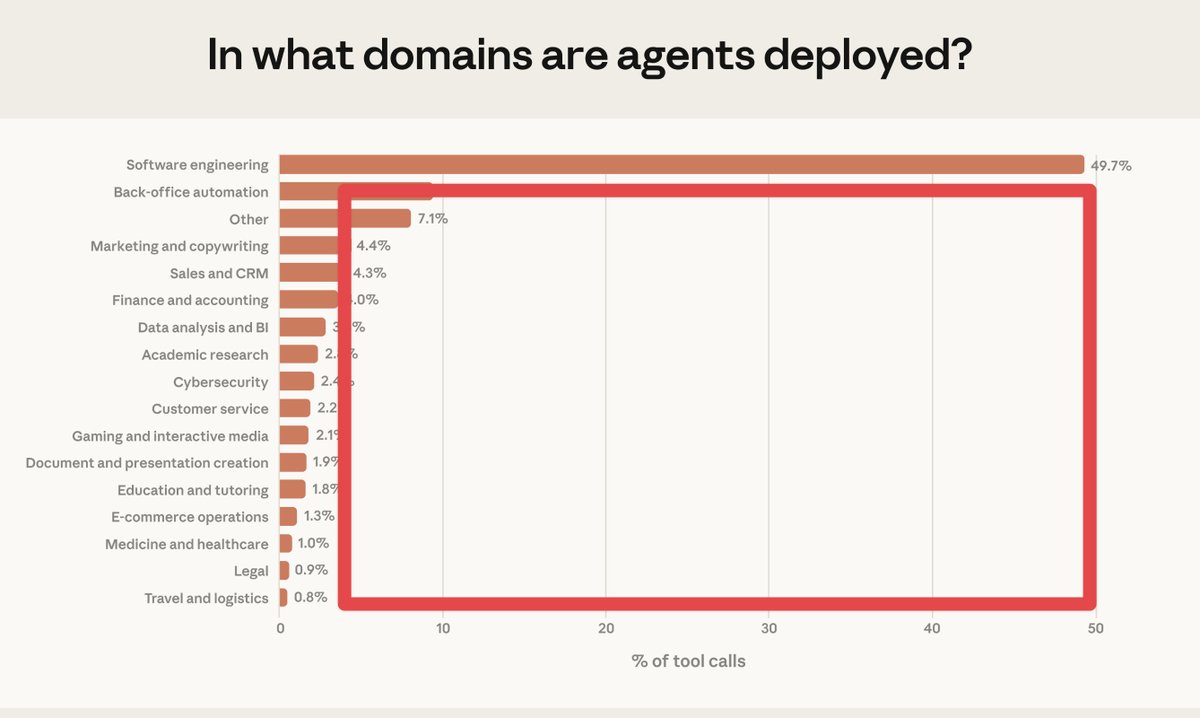
This chart is a good reminder of how much opportunity there is in AI agents right now.
There will be plenty of horizontal opportunities for agents, but equally many workflows that need deep domain expertise to actually make the user successful at automating the unique processes in their vertical.
The template is to build agentic software that taps into proprietary data, handles the workflow in a way that bridges the user and the agent collaboration effectively, and has a deep domain-specific context engineering, and the ability to drive change management for customers.
There still are huge openings in many categories.

81
79
647
247,710

Benoit Hediard retweeted

Jan 19
84
223
2,638
1,251,183
Benoit Hediard retweeted

Feb 12
140
364
2,127
1,316,648
Benoit Hediard retweeted

Feb 7
170
419
8,057
5,114,936
Benoit Hediard retweeted

Feb 1
Brian Chesky's vision for an AI-first world is miles ahead of the Silicon Valley narrative. Haven't seen it this clearly since Steve Jobs.
155
406
5,009
540,492
Benoit Hediard retweeted

Jan 26
A few random notes from claude coding quite a bit last few weeks.
Coding workflow. Given the latest lift in LLM coding capability, like many others I rapidly went from about 80% manual autocomplete coding and 20% agents in November to 80% agent coding and 20% edits touchups in December. i.e. I really am mostly programming in English now, a bit sheepishly telling the LLM what code to write... in words. It hurts the ego a bit but the power to operate over software in large "code actions" is just too net useful, especially once you adapt to it, configure it, learn to use it, and wrap your head around what it can and cannot do. This is easily the biggest change to my basic coding workflow in ~2 decades of programming and it happened over the course of a few weeks. I'd expect something similar to be happening to well into double digit percent of engineers out there, while the awareness of it in the general population feels well into low single digit percent.
IDEs/agent swarms/fallability. Both the "no need for IDE anymore" hype and the "agent swarm" hype is imo too much for right now. The models definitely still make mistakes and if you have any code you actually care about I would watch them like a hawk, in a nice large IDE on the side. The mistakes have changed a lot - they are not simple syntax errors anymore, they are subtle conceptual errors that a slightly sloppy, hasty junior dev might do. The most common category is that the models make wrong assumptions on your behalf and just run along with them without checking. They also don't manage their confusion, they don't seek clarifications, they don't surface inconsistencies, they don't present tradeoffs, they don't push back when they should, and they are still a little too sycophantic. Things get better in plan mode, but there is some need for a lightweight inline plan mode. They also really like to overcomplicate code and APIs, they bloat abstractions, they don't clean up dead code after themselves, etc. They will implement an inefficient, bloated, brittle construction over 1000 lines of code and it's up to you to be like "umm couldn't you just do this instead?" and they will be like "of course!" and immediately cut it down to 100 lines. They still sometimes change/remove comments and code they don't like or don't sufficiently understand as side effects, even if it is orthogonal to the task at hand. All of this happens despite a few simple attempts to fix it via instructions in CLAUDE . md. Despite all these issues, it is still a net huge improvement and it's very difficult to imagine going back to manual coding. TLDR everyone has their developing flow, my current is a small few CC sessions on the left in ghostty windows/tabs and an IDE on the right for viewing the code manual edits.
Tenacity. It's so interesting to watch an agent relentlessly work at something. They never get tired, they never get demoralized, they just keep going and trying things where a person would have given up long ago to fight another day. It's a "feel the AGI" moment to watch it struggle with something for a long time just to come out victorious 30 minutes later. You realize that stamina is a core bottleneck to work and that with LLMs in hand it has been dramatically increased.
Speedups. It's not clear how to measure the "speedup" of LLM assistance. Certainly I feel net way faster at what I was going to do, but the main effect is that I do a lot more than I was going to do because 1) I can code up all kinds of things that just wouldn't have been worth coding before and 2) I can approach code that I couldn't work on before because of knowledge/skill issue. So certainly it's speedup, but it's possibly a lot more an expansion.
Leverage. LLMs are exceptionally good at looping until they meet specific goals and this is where most of the "feel the AGI" magic is to be found. Don't tell it what to do, give it success criteria and watch it go. Get it to write tests first and then pass them. Put it in the loop with a browser MCP. Write the naive algorithm that is very likely correct first, then ask it to optimize it while preserving correctness. Change your approach from imperative to declarative to get the agents looping longer and gain leverage.
Fun. I didn't anticipate that with agents programming feels *more* fun because a lot of the fill in the blanks drudgery is removed and what remains is the creative part. I also feel less blocked/stuck (which is not fun) and I experience a lot more courage because there's almost always a way to work hand in hand with it to make some positive progress. I have seen the opposite sentiment from other people too; LLM coding will split up engineers based on those who primarily liked coding and those who primarily liked building.
Atrophy. I've already noticed that I am slowly starting to atrophy my ability to write code manually. Generation (writing code) and discrimination (reading code) are different capabilities in the brain. Largely due to all the little mostly syntactic details involved in programming, you can review code just fine even if you struggle to write it.
Slopacolypse. I am bracing for 2026 as the year of the slopacolypse across all of github, substack, arxiv, X/instagram, and generally all digital media. We're also going to see a lot more AI hype productivity theater (is that even possible?), on the side of actual, real improvements.
Questions. A few of the questions on my mind:
- What happens to the "10X engineer" - the ratio of productivity between the mean and the max engineer? It's quite possible that this grows *a lot*.
- Armed with LLMs, do generalists increasingly outperform specialists? LLMs are a lot better at fill in the blanks (the micro) than grand strategy (the macro).
- What does LLM coding feel like in the future? Is it like playing StarCraft? Playing Factorio? Playing music?
- How much of society is bottlenecked by digital knowledge work?
TLDR Where does this leave us? LLM agent capabilities (Claude & Codex especially) have crossed some kind of threshold of coherence around December 2025 and caused a phase shift in software engineering and closely related. The intelligence part suddenly feels quite a bit ahead of all the rest of it - integrations (tools, knowledge), the necessity for new organizational workflows, processes, diffusion more generally. 2026 is going to be a high energy year as the industry metabolizes the new capability.
1,639
5,581
40,695
7,793,147
Benoit Hediard retweeted

Jan 22
@PostgreSQL has long powered core @OpenAI products like ChatGPT and the API. Over the past year, our production load grew 10× and keeps rising. Today we run a single primary with nearly 50 read replicas in production, delivering low double-digit millisecond p99 client-side latency and five-nines availability. In our latest OpenAI Engineering blog, we unpack the optimizations we made to to scale @Azure PostgreSQL to millions of queries per second for more than 800M ChatGPT users. Check out the full post here: openai.com/index/scaling-pos…
41
189
1,306
468,297