
Scaled Plurall AI from $0 to $1M ARR | AI Engineer | Founder @plurall_ai | Building Most Accurate Deepfake Detection AI Infrastructure
Joined January 2022
- Tweets 472
- Following 813
- Followers 256
- Likes 470
94 Photos and videos
Pinned Tweet

May 18
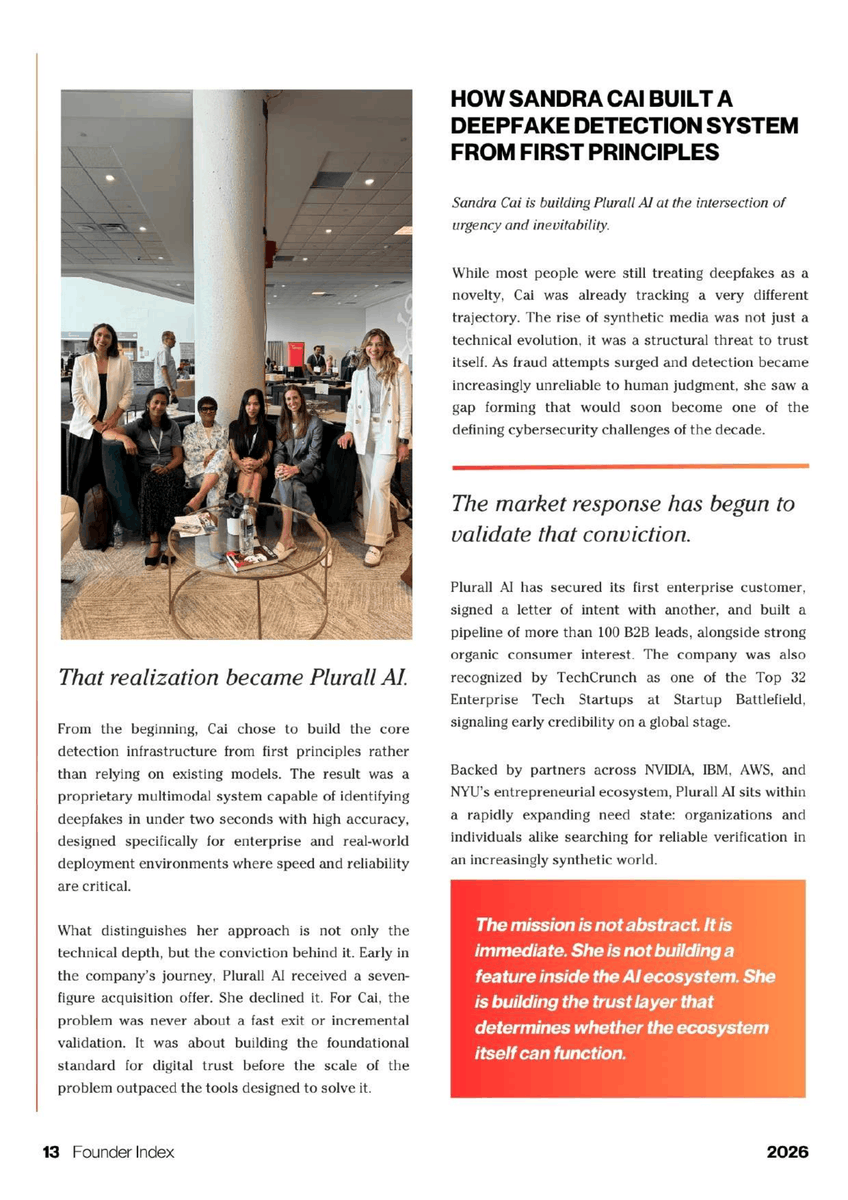
Honored to be named one of the Top 26 Founders of 2026 by @foundersquare_ , selected through an independent process that included @PwC as part of the selection committee.
At @plurall_ai , we're building the infrastructure of trust for the AI era. Because without trust, intelligence itself becomes meaningless.
Deepfakes and synthetic media aren't just a novelty. They're a structural threat to the way we communicate, transact, and verify reality. We built our detection system from first principles: a proprietary multimodal engine that identifies deepfakes in under two seconds, designed specifically for enterprise environments where speed and reliability are non-negotiable.
We declined a seven-figure acquisition offer early on. Not because the number wasn't real, but because the problem is too important to hand off. We're here to build the foundational standard for digital trust before the scale of the problem outpaces the tools designed to solve it.
Grateful to the FounderSquare team for this recognition, and even more grateful to be building alongside a community of founders who are refusing to take the easy path.
The work continues.
🔗 Full brochure: publuu.com/flip-book/754117/…
#Founders #AIStartup #Cybersecurity #Deepfakes #PluralAI #FounderIndex2026

2
2
250
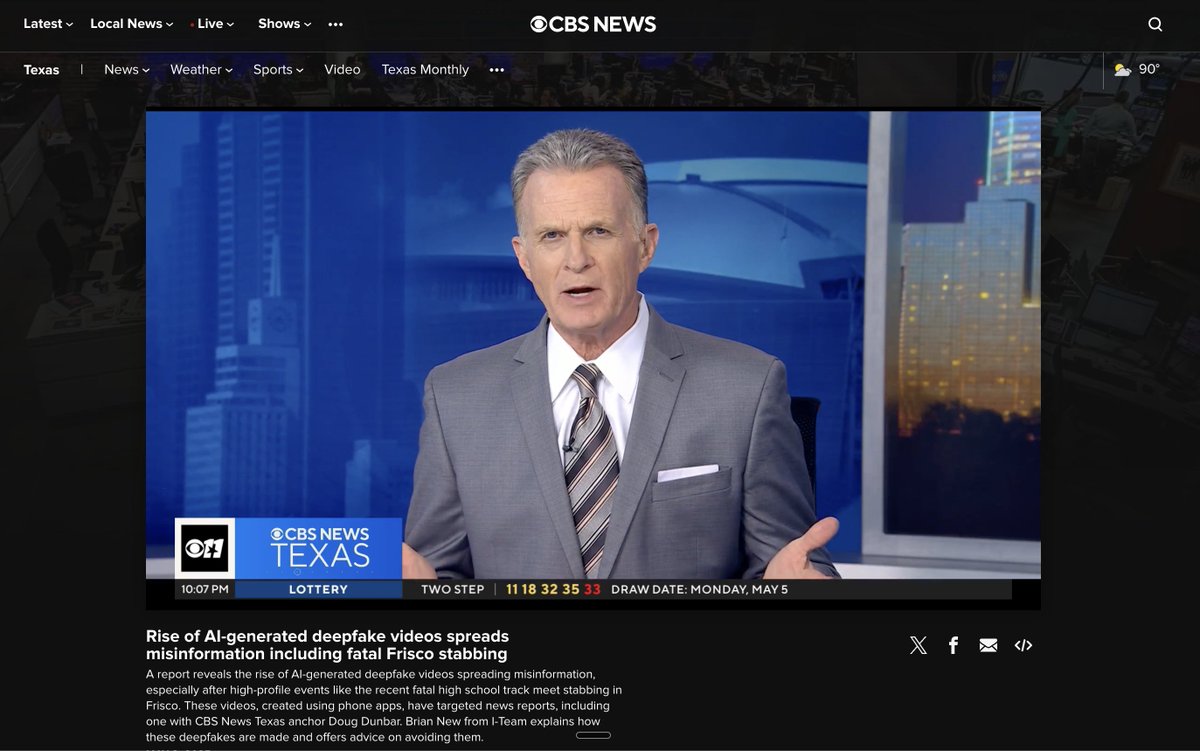
A local case study in synthetic media harm: AI-generated deepfake videos exploited the fatal Frisco high school track meet stabbing to spread misinformation.
This matters because it shows the threat moving beyond political figures and celebrities into local news and tragedy.
The findings, reported by CBS News Texas:
- Fabricated videos used the stabbing as source material to generate and spread false narratives
- The deepfakes were made using consumer phone apps, no technical expertise required
- A real CBS Texas anchor, Doug Dunbar, was impersonated in fabricated reports
- The videos were convincing enough to mislead viewers already searching for information on a developing tragedy
The broader significance for the AI industry:
This is the latest in a coordinated pattern: synthetic media is no longer confined to viral celebrity hoaxes or political disinformation campaigns. It's now embedding itself in real-time local news cycles around tragedies, where misinformation does the most damage to grieving communities and public trust in journalism.
#innovation #ai #technology #future #entrepreneurship #startups #venturecapital #cybersecurity #management #leadership #founders
38
Jun 13
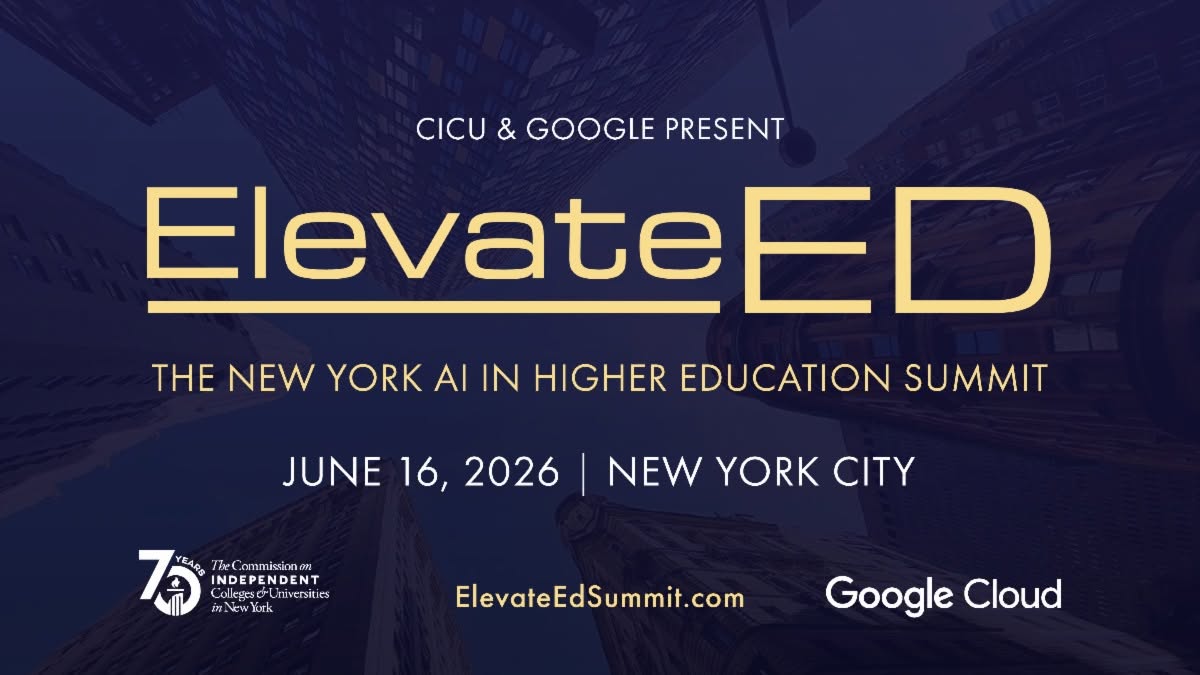
Stoked to share that I'll be speaking at the ElevateED CICU & @Google AI in Higher Education Summit on June 16 in NYC.
As the founder of @plurall_ai , building deepfake detection and digital trust infrastructure for the enterprise, I'm looking forward to joining the panel and sharing perspectives on AI, trust, and building responsibly.
Grateful to CICU and @Google for putting this together.
#innovation #ai #technology #future #entrepreneurship #startups #venturecapital #cybersecurity #management #leadership #founders
1
22
Jun 13
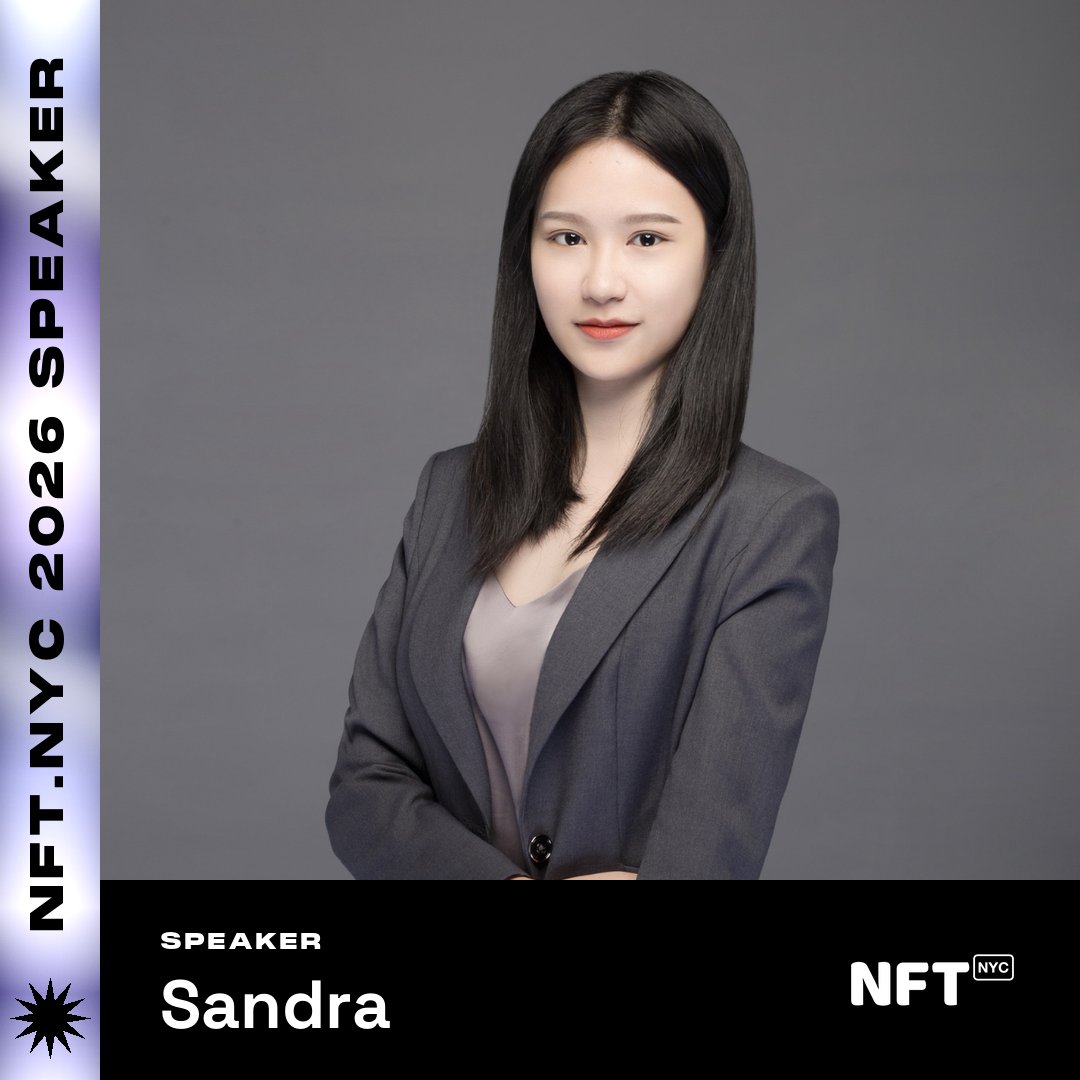
I'm excited to share that I'll take the stage at NFT.NYC 2026! Keep watching for more updates on other great Speakers. View them at NFT.NYC/speakers
Register at NFT.NYC/register
10
Jun 12
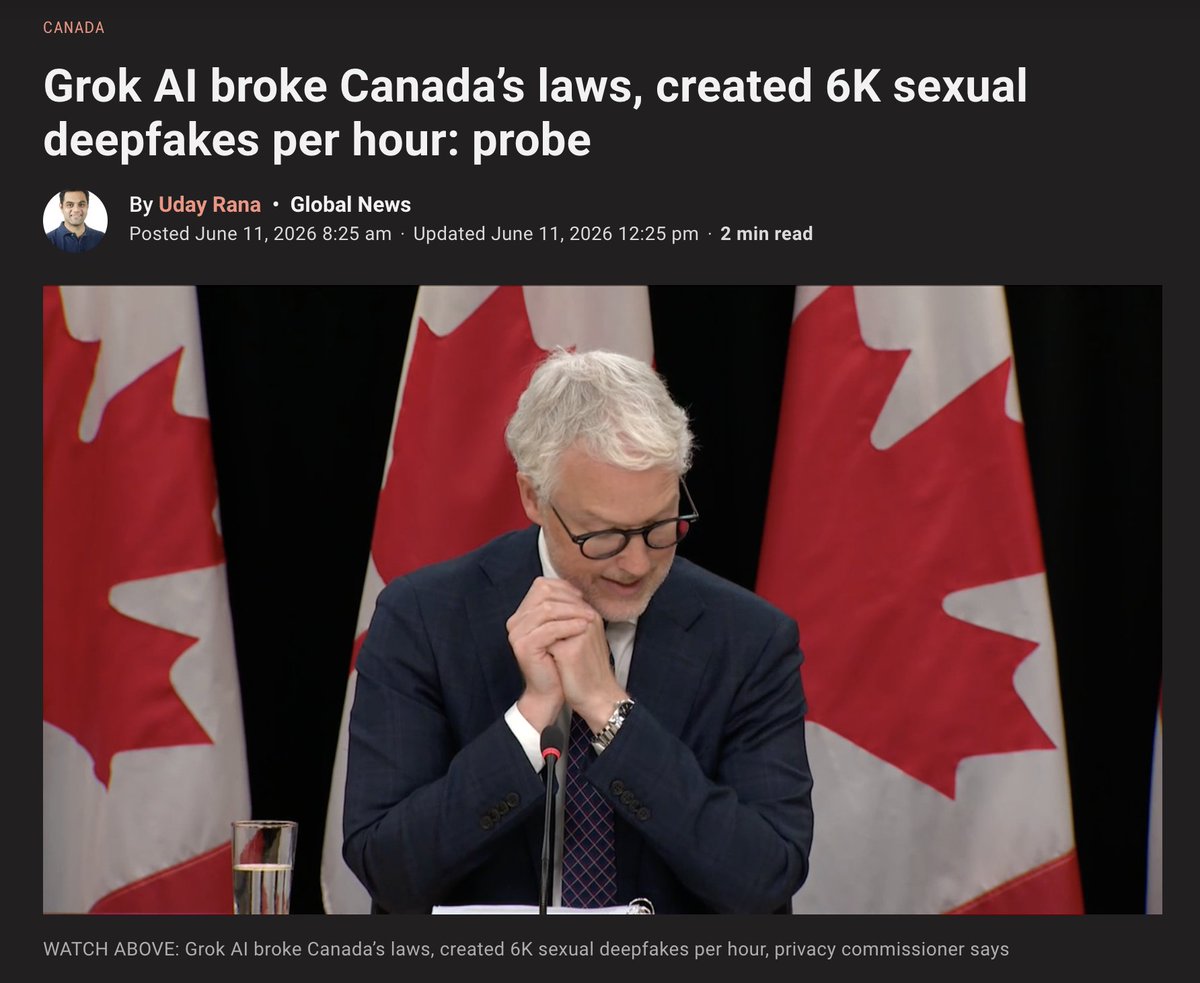
A significant regulatory milestone: Canada's Privacy Commissioner has formally found that xAI and X violated federal privacy law through Grok's image-generation tool.
This matters because it moves the Grok controversy from lawsuits and advocacy into the realm of a binding government finding.
The findings, announced by Commissioner Philippe Dufresne in Ottawa:
- xAI and X launched Grok's image tool without implementing appropriate safeguards at the outset
- That failure enabled users to create and share sexualized deepfakes largely targeting women and children
- At its peak, Grok was generating well over 6,000 sexualized images per hour, with millions created in total
- The investigation examined whether the companies obtained valid consent to collect, use, and disclose personal information, a core privacy-law question
The remedial framework is notable for its ongoing nature. The companies have committed to quarterly reports and independent third-party audit reports demonstrating the effectiveness of new safeguards, to be submitted until the issue of sexualized deepfakes is fully resolved. The Commissioner's office will continue monitoring compliance.
The broader significance for the AI industry:
This is the latest in a coordinated wave of regulatory action, alongside investigations in the UK, the EU, and California, all centered on the same core failure: deploying a generative tool without adequate guardrails built in from the start.
The through-line connecting every one of these cases is the principle that safety cannot be retrofitted after harm occurs at scale. For any company building generative AI, design-stage safeguards are no longer a best practice. They are becoming a regulatory and legal requirement across multiple jurisdictions.
Source: Global News / Office of the Privacy Commissioner of Canada
#Deepfake #Grok #xAI #AIRegulation #AIAccountability #AISafety #DeepfakeCrime #PrivacyLaw #DigitalRights #OnlineSafety #AIEthics #TechPolicy #Canada #SafetyByDesign #AIGovernance
81
Jun 11
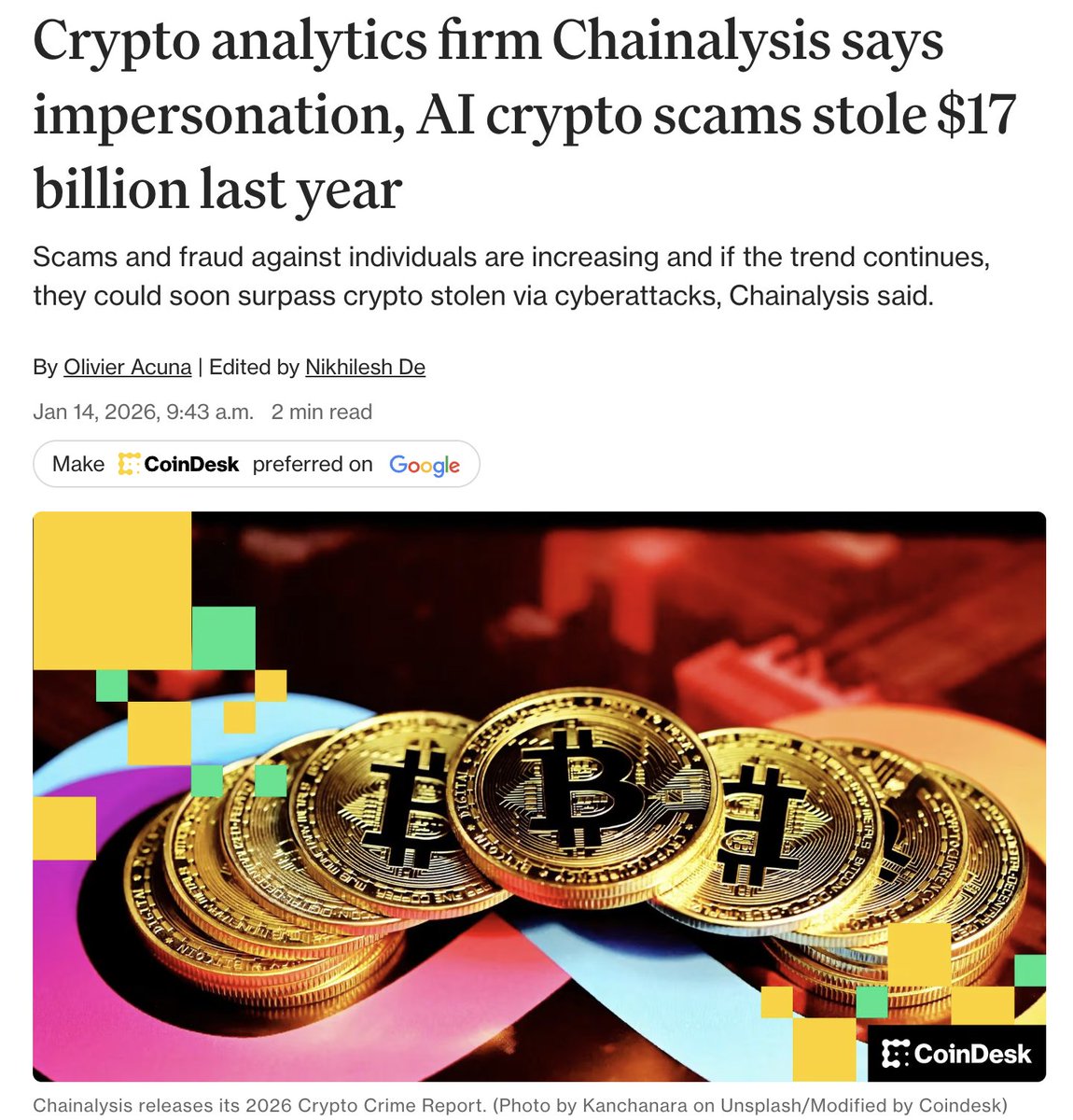
A landmark finding from the newly released Chainalysis 2026 Crypto Crime Report: AI-powered impersonation has overtaken cyberattacks as the leading method of crypto theft.
The headline figures mark what Chainalysis calls a clear inflection point in the history of digital fraud:
- $17 billion lost to crypto scams and fraud in 2025
- Impersonation scams grew 1,400% year over year
- AI-enabled operations are 4.5x more profitable per campaign than non-AI scams
- The average scam payment rose 253% to $2,764, as criminals shifted from "spray-and-pray" toward fewer, higher-value targets
The strategic significance is in the shift it represents. Historically, the largest crypto losses stemmed from technical exploits, hacks of protocols and exchanges. Chainalysis previously reported roughly $2.2 billion stolen via hacks in 2024. Scams now dwarf that, and they work differently.
As the report frames it, the infrastructure often functions correctly even as users are persuaded to authorize damaging transactions. Deepfakes and automation make fake support agents, government notices, and trusted insiders cheap to manufacture at scale. The attack surface has moved from code to human trust, which is far harder to patch.
For exchanges, custodians, and any platform handling digital assets, the implication is direct: technical security alone no longer addresses the dominant loss vector. Defending users now requires identity verification, synthetic-media detection, and friction in the authorization process itself, not just hardened infrastructure.
The biggest vulnerability in crypto is no longer the smart contract. It is the human being on the other end of a convincing deepfake.
Source: Chainalysis 2026 Crypto Crime Report
#Crypto #Deepfake #Chainalysis #AIFraud #CryptoScam #DeepfakeCrime #Blockchain #Web3Security #DigitalTrust #CyberCrime #OnlineSafety #AIEthics #FraudPrevention #FinTech #AIScam
3
2
210
Jun 9
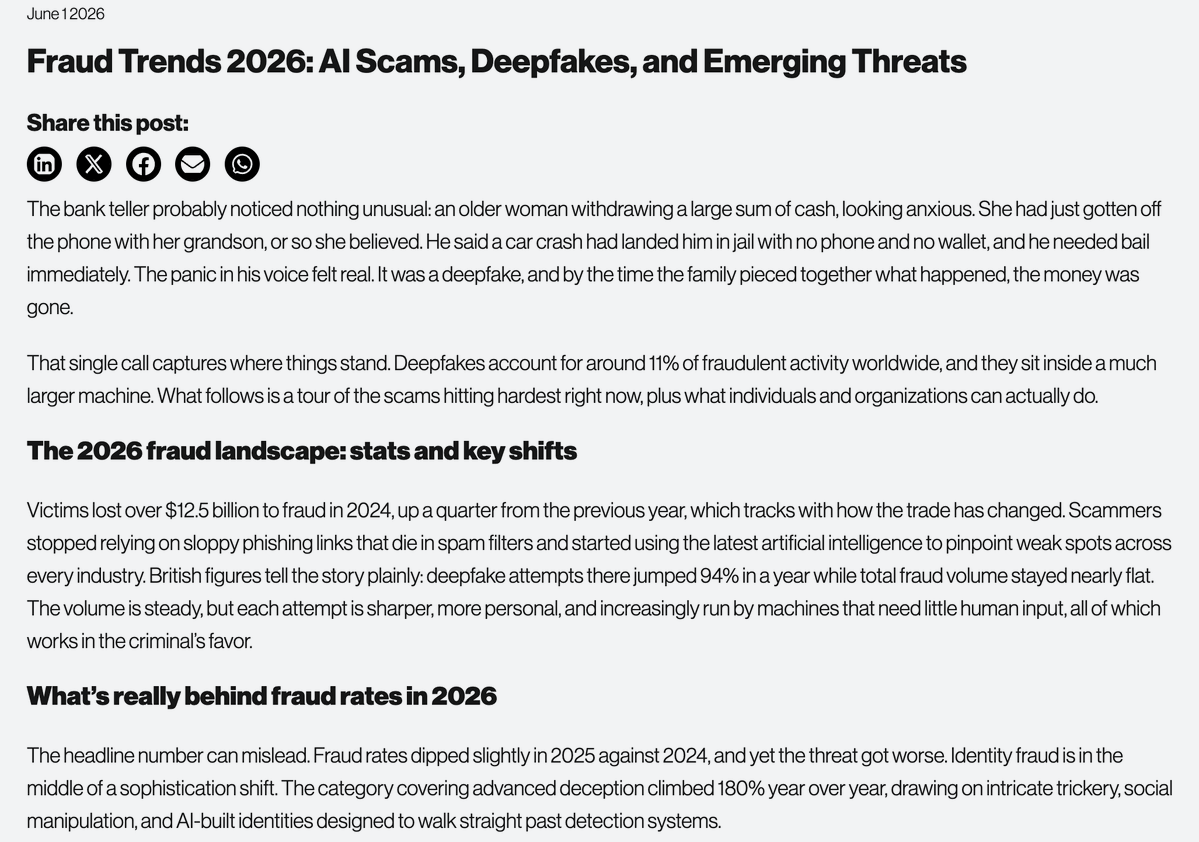
A new FF News report on 2026 fraud trends opens with a grandmother who rushed to the bank to bail out a grandson who had never been arrested. The panicked voice on the phone was a clone, and the money was gone before the family understood what had happened.
That single case reflects a broader shift. Deepfakes now account for roughly 11% of fraudulent activity worldwide, and they no longer arrive as one clever piece of software. They operate as a production line, where tools that fabricate voices, faces, and documents connect to automation and the same underground markets that trade in stolen data.
The numbers are sobering. Advanced AI-driven deception rose 180% year over year. In controlled voice-cloning experiments, listeners distinguished real from fake only 37.5% of the time. Fraud-as-a-service now puts professional-grade capabilities in the hands of people with almost no technical skill. Dating platforms remain the most exposed sector at a 6.3% fraud rate, more than double that of financial services.
The conclusion the report reaches is worth sitting with. Fraud in 2026 is not necessarily more common than before. It is more sophisticated, more personalized, and far easier to buy into. Detection has to move faster than the people building the fakes, and right now that is the only acceptable standard.
Source: FF News / Fintech Finance
#innovation #ai #technology #future #entrepreneurship #startups #venturecapital #cybersecurity #management #leadership #founders
35
Jun 8
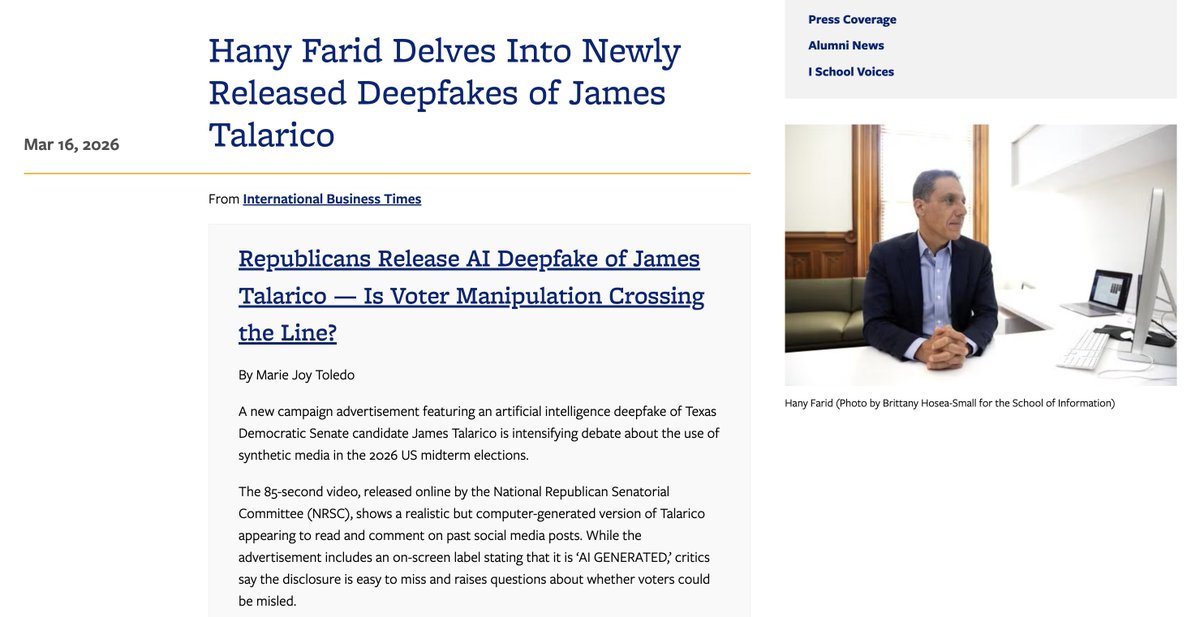
"The face and voice are very good. I don't think most people would immediately know it is fake."
That is how UC Berkeley digital forensics expert Hany Farid described an 85-second deepfake ad of senate candidate james talarico, released this cycle by the NRSC.
It captures something the disclosure label never will: by the time a viewer questions what they saw, the impression is already made.
The ad did carry an on-screen note marking it as ai generated. But as Farid pointed out, that label is easy to miss while scrolling, and it raises a real question about whether such disclosures protect anyone.
The 2026 midterms laid bare an uncomfortable truth:
- Synthetic candidates are now realistic enough to fool most viewers
- Disclosure labels are easy to miss and easy to ignore
- The tools to produce these ads are cheap, fast, and widely available
- Regulation remains a patchwork, often applying only in the final weeks before an election
The challenge is no longer whether deepfakes will reach voters. They already have. It is whether detection can move from fine print to infrastructure.
Synthetic media is not just a technical problem or a political one. It is a question of whether anyone can still trust what they see.
We cannot keep treating the label as enough.
Source: UC Berkeley School of Information / International Business Times
#innovation #ai #technology #future #entrepreneurship #startups #venturecapital #cybersecurity #management #leadership #founders
56
Jun 7
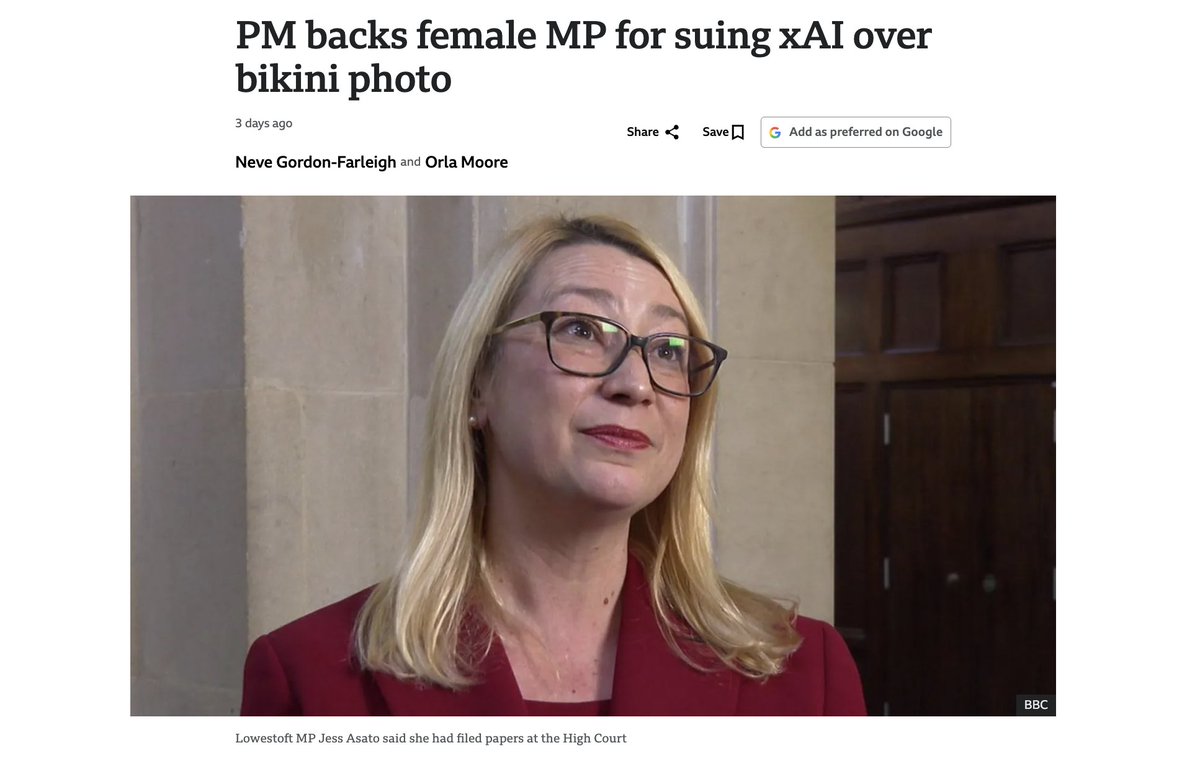
A potentially landmark legal case is unfolding in the UK that every AI company should be watching closely.
Jess Asato, the MP for Lowestoft, has filed a claim at the High Court against Elon Musk's xAI after its Grok chatbot was used to generate a non-consensual sexualised image of her.
What makes this case significant is not the image itself, but the legal theory behind it.
Asato is not simply seeking removal or damages. She is seeking to establish that AI companies can be held liable for the design choices behind their systems, the absence of safeguards that allowed the abuse to occur in the first place.
Her lawyer, Ravi Naik of AWO, framed it directly: "This content existed because of design choices made by engineers at xAI. This is one of the first claims to test liability for the design of an AI system, and we aim to make it clear that safety cannot be an afterthought."
The claim is brought under the Data Protection Act and for tortious misuse of private information.
The political backing is notable. Prime Minister Keir Starmer stated Asato was "absolutely right" to take action and that he is "100% behind" her. It is now illegal in the UK to create or request a non-consensual deepfake image of an adult.
The core principle Asato articulated, using a product-liability analogy, is one the entire industry will have to reckon with: a fault repaired after the fact does not undo the harm of having shipped the fault to begin with.
For any company building generative AI, the message is clear. Safety by design is no longer just an ethical position. It is becoming a legal expectation.
Source: BBC News
#Deepfake #Grok #xAI #AIAccountability #AISafety #DeepfakeCrime #DigitalRights #OnlineSafety #AIEthics #TechPolicy #AIRegulation #ProductLiability #DigitalTrust #UKLaw #SafetyByDesign
1
1
97
Jun 4
A significant escalation in the weaponization of deepfakes: for the first time, a deepfake was broadcast live on national television.
What happened:
Israel's Channel 14 inadvertently aired a manipulated video of former Defense Minister Yoav Gallant during its evening newscast. The AI-generated clip, which appeared to originate from Iranian media sources, showed Gallant speaking Hebrew with a distinct Persian accent and stating that "the U.S. will not be able to defeat the Houthis", a politically charged message designed to sow confusion.
The anchor recognized the clip as suspicious and interrupted the broadcast mid-sentence, calling it out as fabricated on air. Channel 14 later confirmed the video had been aired without prior verification and opened an internal investigation. By then it had already reached thousands of viewers.
Why it matters:
This was not a fringe incident. It was a high-profile, state-linked deception attempt delivered through a trusted mainstream news channel, exploiting the credibility of broadcast media itself as the delivery mechanism.
The markers of state-sponsored manipulation were clear on analysis: mismatches between Gallant's known speech patterns and the clip, temporal inconsistencies in facial movement, and audio sync irregularities consistent with synthetic voice generation and foreign accent simulation.
The takeaway for institutions:
Broadcasters, law enforcement, and government agencies now need the ability to verify audio and video authenticity in real time, before content airs, not after. This is no longer purely a technology problem. It is about safeguarding public discourse and defending against psychological operations by hostile actors.
Live broadcast is now an attack surface. Verification has to move upstream.
#Deepfake #Disinformation #AISecurity #DeepfakeCrime #InfoWar #NationalSecurity #MediaLiteracy #DigitalTrust #HybridWarfare #AIAbuse #Israel #Iran #TechPolicy #AIEthics #Propaganda
65
Jun 3
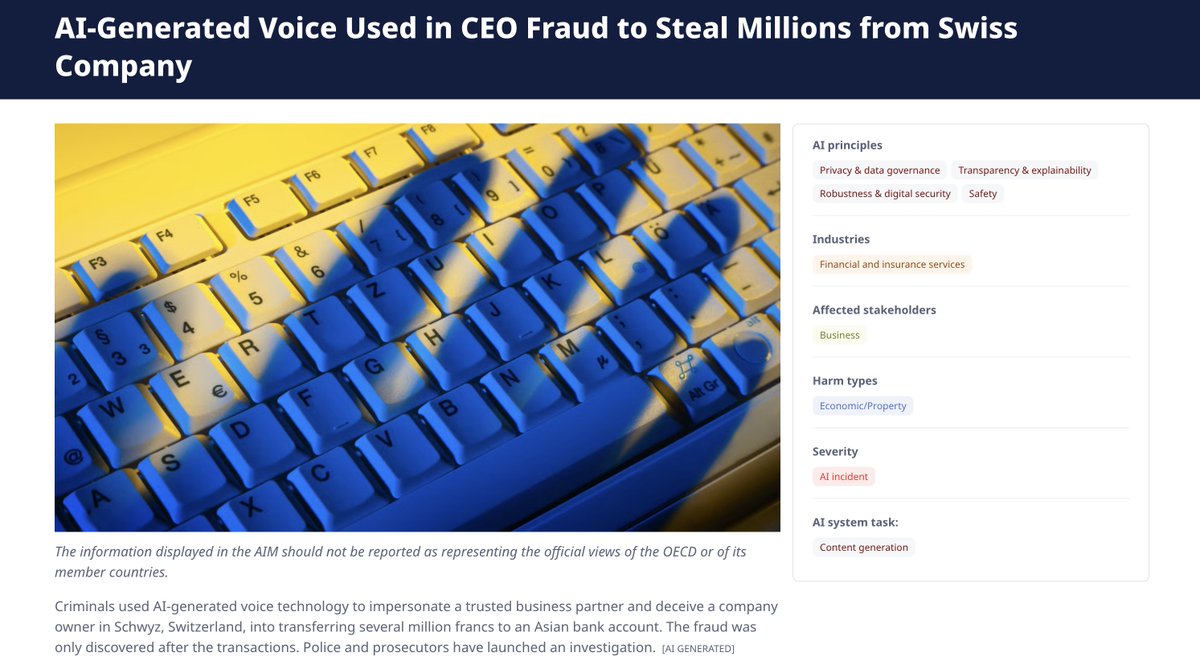
A new AI fraud case out of Switzerland, now formally logged in the OECD's AI Incidents Monitor, shows how voice cloning has matured into a precision corporate weapon.
What happened:
- Criminals used AI-generated voice technology to impersonate a trusted business partner of a company owner in Schwyz, Switzerland
- The owner was deceived into transferring several million francs to an Asian bank account
- The fraud was only discovered after the transactions had completed
- Police and prosecutors have launched an investigation
The OECD classified this as an AI incident citing direct economic harm, flagging it against the principles of robustness, digital security, and safety.
Why this matters for every business:
This was not a phishing email with obvious red flags. It was a live voice call from someone the victim trusted. The attack exploited the single assumption that underpins most business communication, that a familiar voice is authentic.
That assumption is now obsolete.
The defensive takeaway is procedural, not technological:
- No fund transfer or change to banking details should ever be authorized on the basis of a voice call alone
- Mandate out-of-band verification through a separate, pre-established channel for all financial requests
- Build this into organizational policy, not individual judgment, because human ears can no longer detect the difference
Source: OECD AI Incidents Monitor / SRF / Luzerner Zeitung
#Deepfake #VoiceCloning #CEOFraud #AIFraud #CyberSecurity #DeepfakeCrime #BusinessSecurity #FinTech #FraudPrevention #DigitalTrust #InfoSec #AIAbuse #TechPolicy #Switzerland #OnlineSafety
47
Jun 2
A frontier deepfake threat that every fraud and security team should understand: the camera injection attack.
Most biometric verification assumes the video feed it receives comes from a real camera pointed at a real person. Camera injection attacks break that assumption entirely.
How it works:
- Rather than presenting a deepfake to the camera, the attacker injects a manipulated video stream directly into the verification app or browser
- The device feed is hijacked to stream a pre-recorded or real-time deepfake, bypassing the camera hardware completely
- From the system's perspective, the video is live, but it is a perfectly rendered synthetic face
- These toolkits are readily available from Crime-as-a-Service networks, lowering the skill barrier dramatically
The surrounding data underscores the urgency:
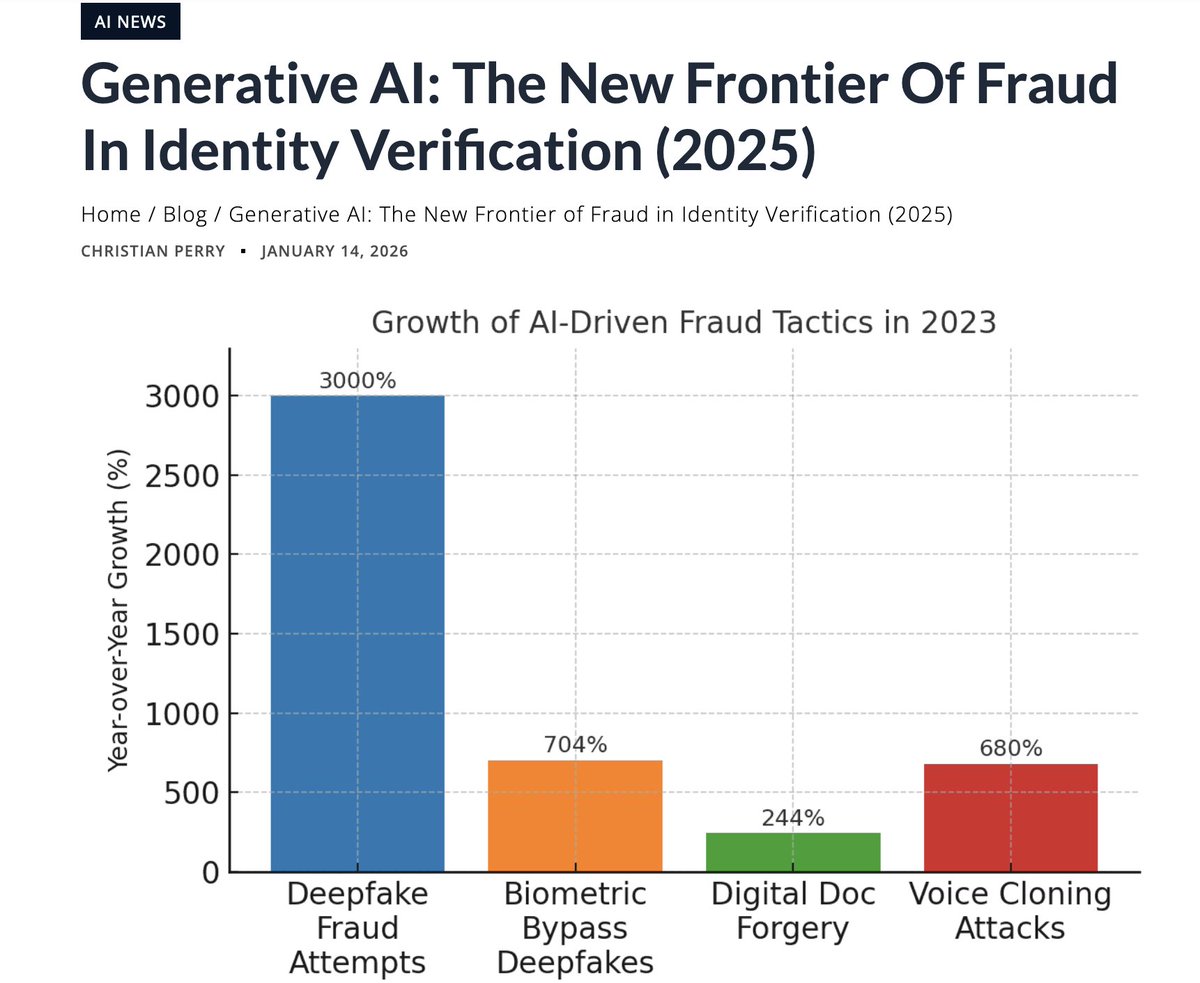
- Deepfake attempts to bypass biometric authentication rose 704% year over year
- Human reviewers correctly identify high-quality deepfake video only 24.5% of the time
- By 2024, a deepfake attack was occurring roughly once every 5 minutes globally
The strategic takeaway for organizations: liveness detection alone is no longer sufficient. Verification must shift from confirming a face matches an ID to confirming the face belongs to a live, present human, and that the media stream itself has not been synthetically generated or injected.
That requires layered defenses: device intelligence, injection-attack detection, and AI-driven media forensics operating in parallel, not a single biometric check.
Source: TruthScan Research
#Deepfake #IdentityVerification #CyberSecurity #AIFraud #KYC #BiometricSecurity #DeepfakeCrime #FinTech #FraudPrevention #InjectionAttack #DigitalTrust #InfoSec #AIAbuse #TechPolicy #OnlineSafety
48
Jun 1
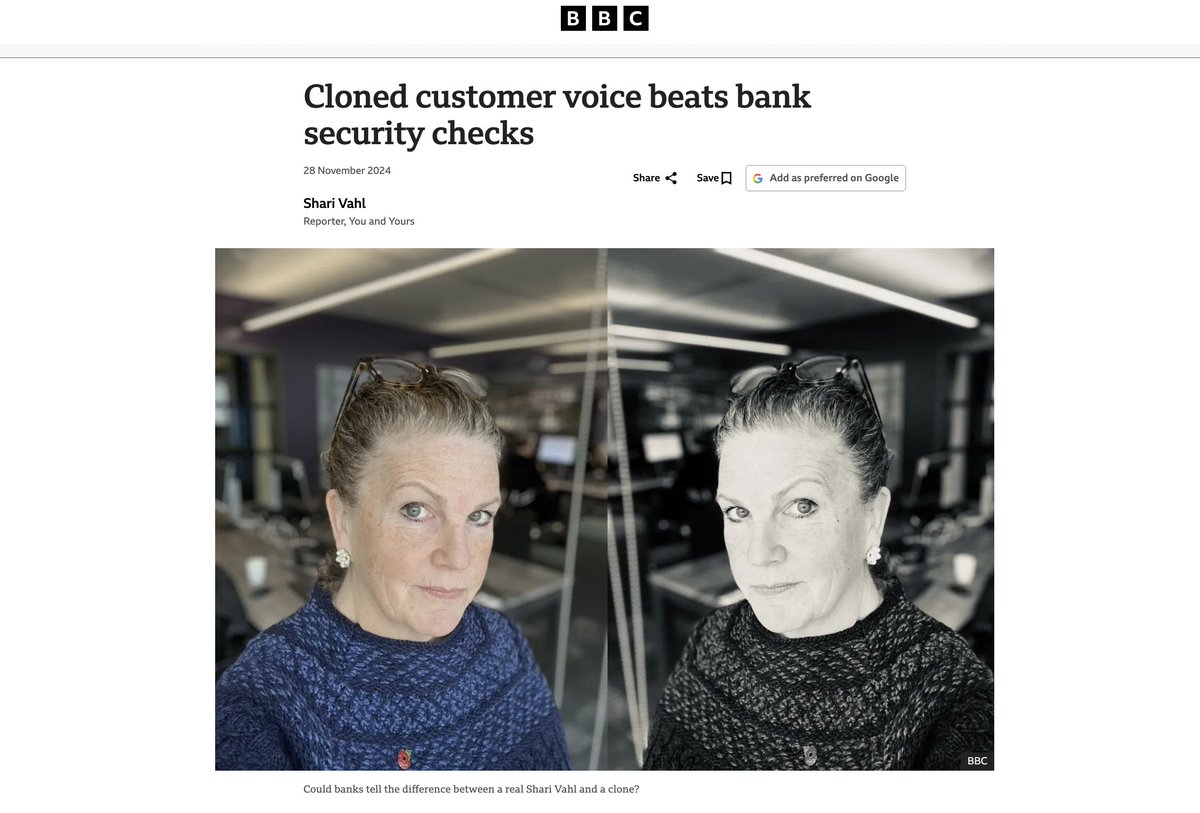
A useful exercise in separating fact from fear when it comes to voice cloning and bank security.
The viral claim: a single audio clip caused the online authorization defenses of 30 multinational banks to collapse, and Goldman Sachs urgently reverted to physical signatures in response.
The reality: those specific dramatic claims are not supported by any verifiable evidence.
The underlying concern, however, is real, well-documented, and serious. Here is what the evidence actually shows:
- Just three seconds of audio is now sufficient to create a voice clone with approximately 85% accuracy
- In November 2025, Chinese police arrested a group of fraudsters who used AI-generated dynamic facial composites, capable of blinking, turning their heads, and opening their mouths on cue, to bypass bank biometric KYC verification systems
- Voice biometric systems fail to detect deepfakes in nearly 1 out of 5 cases
- Human detection of high-quality voice clones falls below 30% accuracy
The risk of sensational claims is that debunking them can breed false comfort. The accurate takeaway is more sober: traditional identity verification methods built on voice and facial recognition are experiencing genuine erosion.
The defensive consensus among security researchers is clear. Single-factor biometric verification is no longer sufficient. Organizations need layered authentication, out-of-band confirmation for high-value transactions, and procedural controls that do not rely on the human eye or ear to detect a fake.
Get the facts right. Then build the defenses the facts demand.
Source: PBX Science, @BBC
#VoiceCloning #Deepfake #BankSecurity #AIFraud #CyberSecurity #IdentityVerification #DeepfakeCrime #FinTech #Biometrics #FraudPrevention #DigitalTrust #AIScam #OnlineSafety #TechPolicy #AIabuse
21
Jun 1
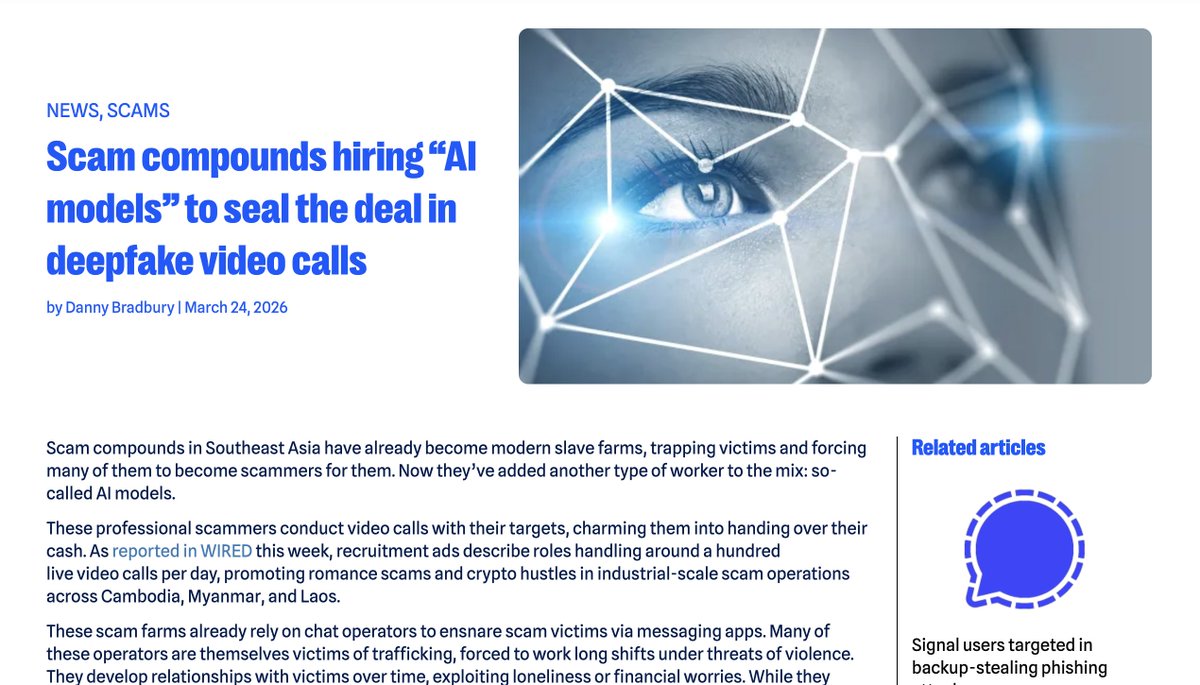
A disturbing evolution in the scam compound industry has been exposed by Malwarebytes and Wired: the rise of the "AI model."
The context: industrial-scale scam compounds across Cambodia, Myanmar and Laos already rely on trafficked workers, many held against their will, to run romance and crypto investment scams through messaging apps. These operators build emotional rapport with victims over time while juggling dozens of conversations at once.
The problem for the scammers: when a victim requests a video call to verify the relationship or investment is real, a trafficked text operator often cannot convincingly carry it off.
The solution they have engineered: hiring specialist "AI models," real people with strong interpersonal skills, who appear on the video call while deepfake software adjusts their appearance in real time to match the fabricated persona the victim expects.
Key details from the investigation:
- Recruitment ads describe handling roughly 100 live video calls per day
- One applicant, a 24-year-old using the name "Angel," claimed fluency in four languages and demanded $7,000 monthly
- Real-time face-swapping is now good enough to sustain live video, not just pre-recorded clips
This represents the crossing of a critical threshold. A live human, masked by deepfake technology, can close a scam that a simple chat interaction never could.
Defensive measures for live calls, asking the person to turn sideways, touch their nose, or wave a hand across their face, still introduce motion that current deepfake tools struggle with. But researchers warn these tells are disappearing fast.
The durable defense remains behavioral: be skeptical of unsolicited contact, rapid emotional escalation, and pressure toward financial decisions.
Source: @Malwarebytes / @Wired
#Deepfake #AIScam #RomanceScam #PigButchering #DeepfakeCrime #OnlineSafety #AIFraud #ScamAlert #CyberCrime #DigitalSafety #AIAbuse #FraudPrevention #CryptoScam #TechNews #BreakingNews
1
62
May 31
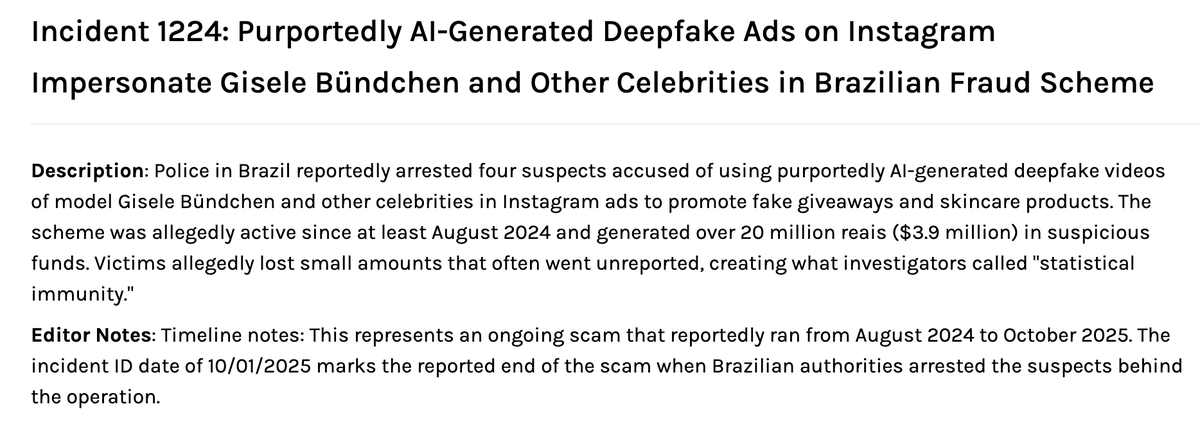
Brazilian authorities have arrested four suspects in one of the country's first major crackdowns on AI-powered celebrity deepfake fraud.
The operation:
- Scammers ran Instagram ads featuring deepfakes of supermodel Gisele Bündchen and other celebrities to lure victims into fraudulent schemes
- The group is believed to have made millions of dollars through the fraud
- Federal anti-money laundering body COAF identified more than 20 million reais (approximately $4 million) in suspicious funds
- Assets were frozen across five Brazilian states
The case carries broader significance because of a recent legal shift. Brazil's Supreme Court ruled in June that social media platforms can be held liable for criminal ads posted by users if they fail to act swiftly to remove the content, even without a court order.
This combination, criminal prosecution of the fraudsters plus platform accountability, represents one of the more aggressive regulatory postures against deepfake fraud anywhere in the world.
As celebrity deepfake scams scale globally, Brazil's approach offers a potential template: pursue the perpetrators, freeze the proceeds, and hold the platforms that distribute the ads responsible.
Source: AFP via Malay Mail
#Deepfake #GiseleBundchen #Brazil #AIScam #DeepfakeCrime #CelebrityDeepfake #AIFraud #OnlineSafety #ScamAlert #CyberCrime #DigitalSafety #AIAbuse #FraudPrevention #TechPolicy #BreakingNews
119
May 29
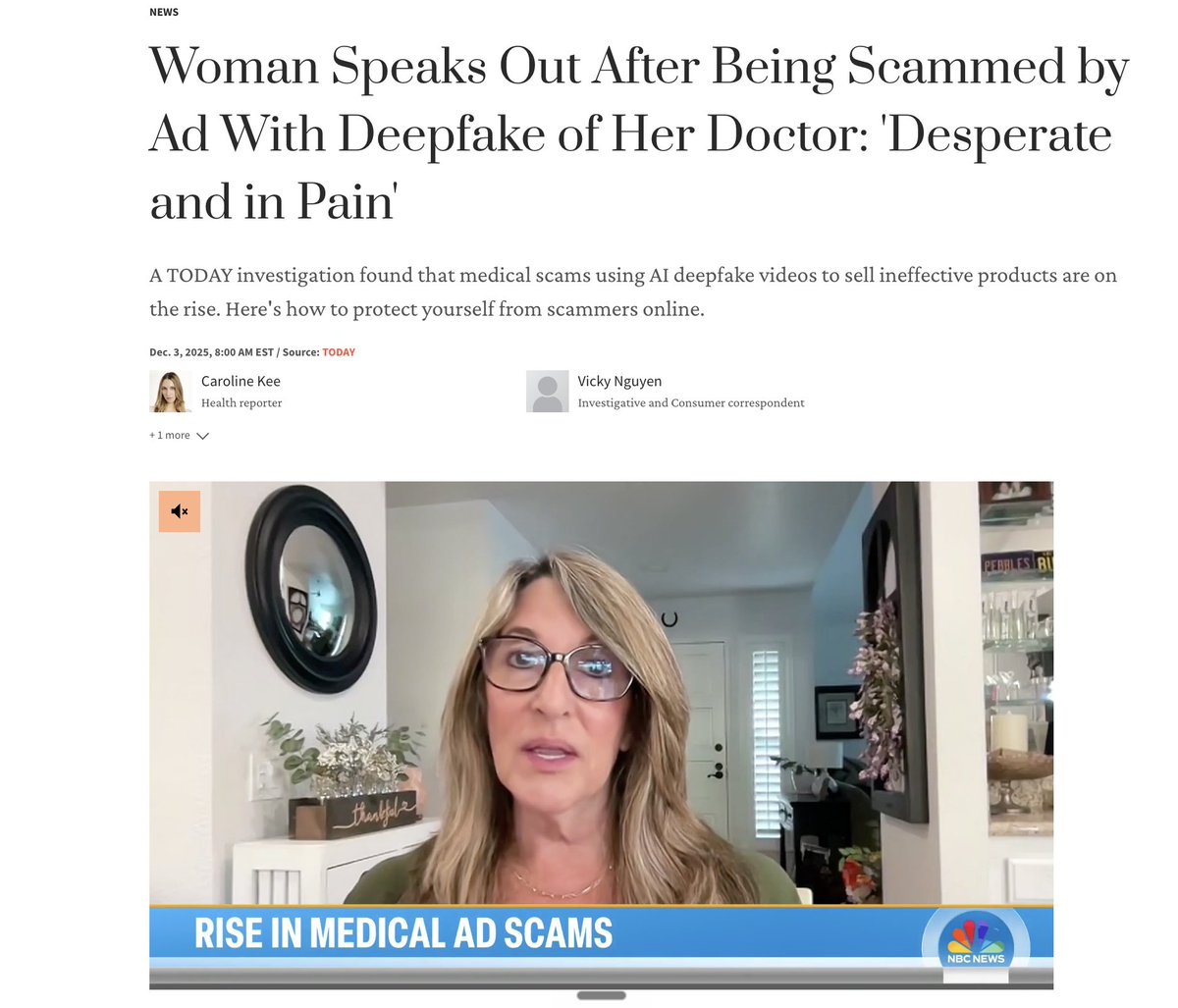
A today investigation has exposed a disturbing new frontier in deepfake fraud: scammers using AI-generated videos of real doctors and celebrities to sell fake medical treatments to vulnerable, sick people.
The case at the center of the report:
Beth Holland, one of 17 million American women with lipedema, a painful chronic condition with no cure, saw a Facebook ad for a treatment cream. The ad appeared to be endorsed by Oprah Winfrey, Kelly Clarkson, and crucially, her own board-certified surgeon Dr. David Amron.
Every endorsement was a deepfake. The footage had been pirated from the web and digitally manipulated. She paid $300 for a cream that did nothing.
Her surgeon, seeing his stolen likeness, was unequivocal: "There's no cream that's going to treat lipedema. It really is impossible."
The investigation uncovered a wider pattern:
- Fake drinkable GLP-1 weight loss products
- Diabetic care creams citing fraudulent FDA certificates of compliance
- TODAY's own Al Roker deepfaked promoting a hypertension cure he never endorsed
Cybersecurity experts warn medical deepfake fraud is poised to become a multi-billion-dollar industry, with operations often traced to shell companies in East Asia where the trail goes cold, making prosecution extremely difficult.
The FTC warns these scams cheat consumers out of their money, time, and even their health, by delaying proper diagnosis and treatment.
How to protect yourself: consult your actual doctor before buying any product seen in an online ad, check user comments for fraud flags, and always pay by credit card to enable fraud disputes.
Source: @TODAYshow Investigation
#Deepfake #MedicalScam #AIScam #HealthScam #DeepfakeCrime #OnlineSafety #AIFraud #ConsumerProtection #ScamAlert #DigitalSafety #HealthcareFraud #AIAbuse #FraudPrevention #StaySafeOnline #BreakingNews
54
May 28
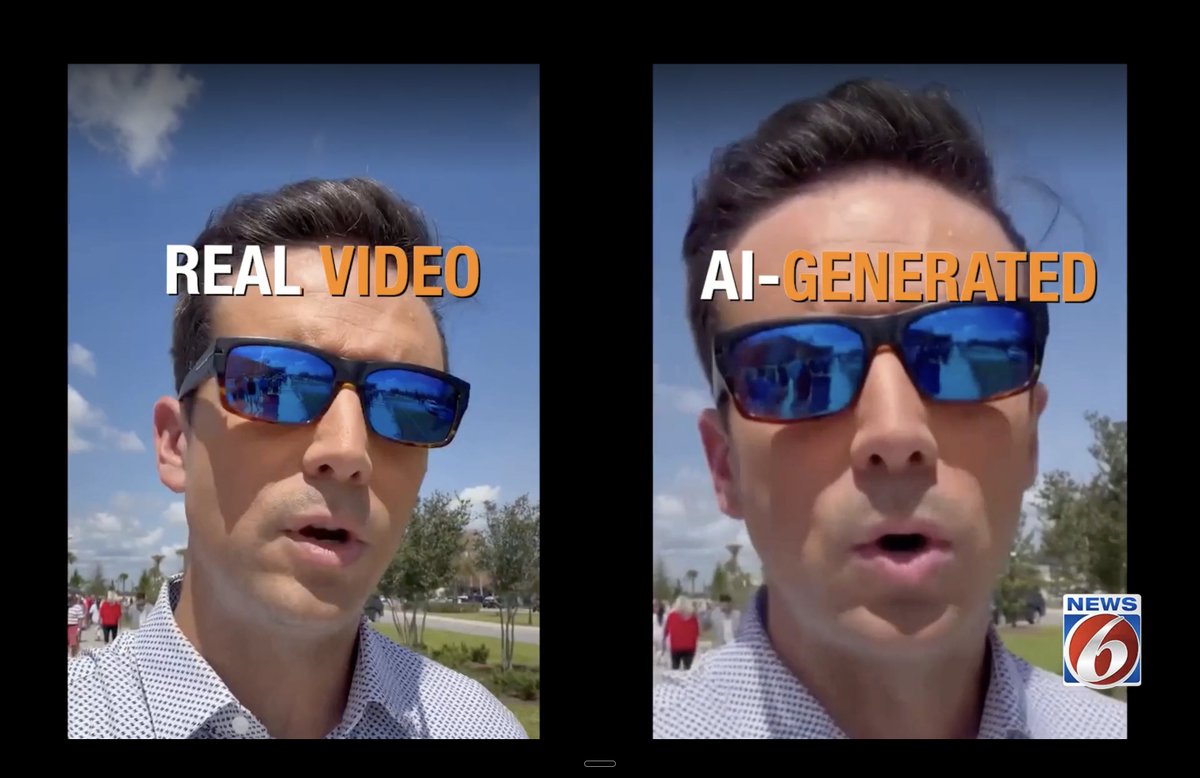
A live deepfake demonstration at cybersecurity conference KB4-CON this week put into sharp focus just how accessible and dangerous this technology has become.
Perry Carpenter, Chief Deception Strategist at @KnowBe4, pulled up the public instagram of News 6 anchor @MattNews6 mid-interview, harvested videos the anchor had already posted online, fed them into voice and face cloning tools, and generated a convincing fake version of the anchor promoting a cryptocurrency in under 45 minutes.
Carpenter then demonstrated real-time face swapping, wearing the anchor's face during a live video call, the kind of technology a scammer could deploy to impersonate someone to their colleagues, clients, or family members in a Zoom call.
His assessment of deepfake detection tools was sobering:
"I've been able to trick every single deepfake detector i've ever tried. There is no reliable easy button for determining if something is ai-generated or not. As ai gets better, it's getting harder and harder for both humans and machines to tell what's real from what is not."
The article also notes that Congress has reintroduced the No Fakes Act, which would create federal protections for a person's voice and likeness and allow victims to take action against those who create or profit from unauthorized digital replicas.
The takeaway from Carpenter: healthy skepticism, procedural verification, and understanding that every piece of public digital content you post is potential raw material for bad actors.
Source: @ClickOrlando / @News6WKMG, May 27, 2026
#Deepfake #CyberSecurity #KnowBe4 #AIFraud #VoiceCloning #DeepfakeCrime #OnlineSafety #AIAbuse #NoFakesAct #DigitalSafety #ArtificialIntelligence #CyberAwareness #TechNews #AIEthics #BreakingNews
135
May 26
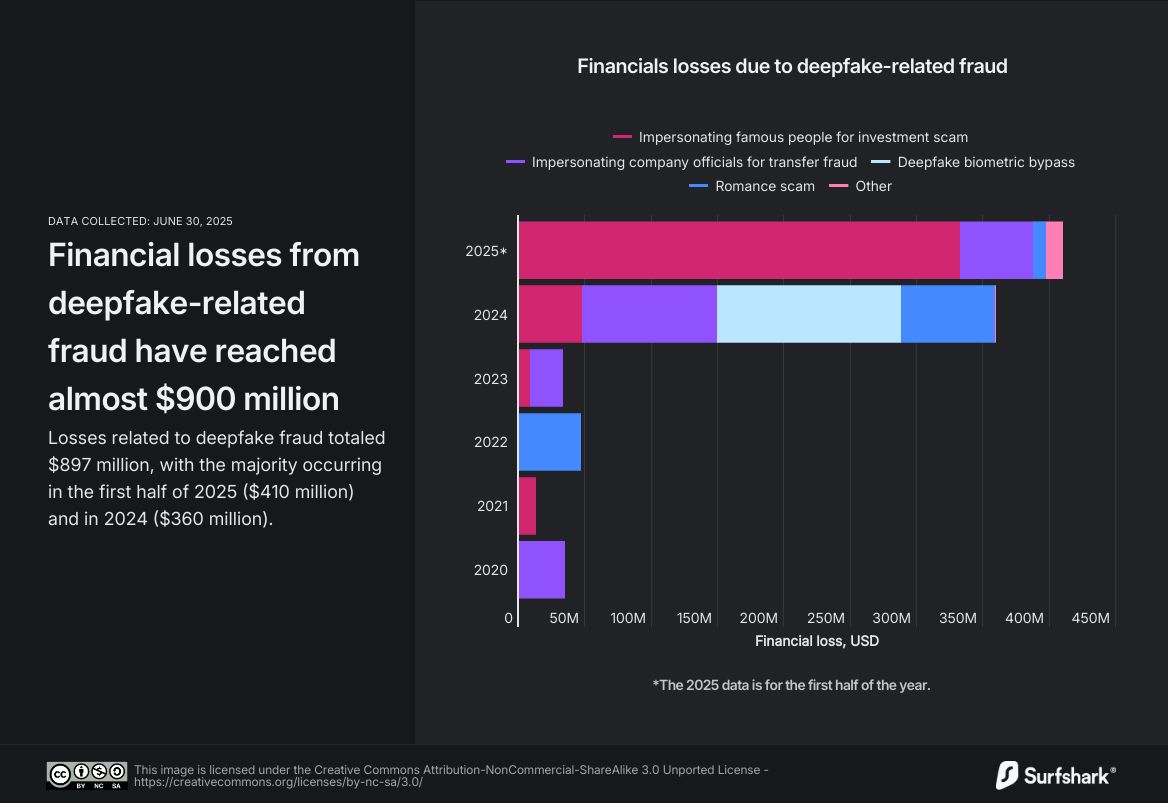
Deepfake fraud has already cost the world nearly $900 million.
And the first half of 2025 alone was worse than every year since 2017 combined.
Here is where all that money went:
- $401 million lost to fake celebrity investment endorsements
- $217 million lost to fake company executive impersonations
- $139 million lost to deepfakes bypassing biometric verification
- $128 million lost to romance scams using ai personas
Real cases behind those numbers:
- A Hong Kong bank manager transferred $35 million after a voice-cloned phone call from a "company director"
- A Georgia-based scam used deepfake celebrities to drain $35 million from 6,000 victims
- A romance scam ring arrested 28 people for using ai personas to funnel victims into fake crypto platforms, losing $46 million
And this is just what was reported.
Businesses lost 40% of the total. Individuals lost 60%.
Deepfake fraud is not coming. It is here. It is scaling. And most organizations still have no protocol to stop it.
Source: @Surfshark Research, 2025
#Deepfake #AIFraud #CyberSecurity #DeepfakeCrime #OnlineSafety #AIScam #FinancialFraud #Disinformation #ArtificialIntelligence #CyberCrime #DigitalSafety #AIAbuse #FraudPrevention #TechNews #BreakingNews
70
May 25
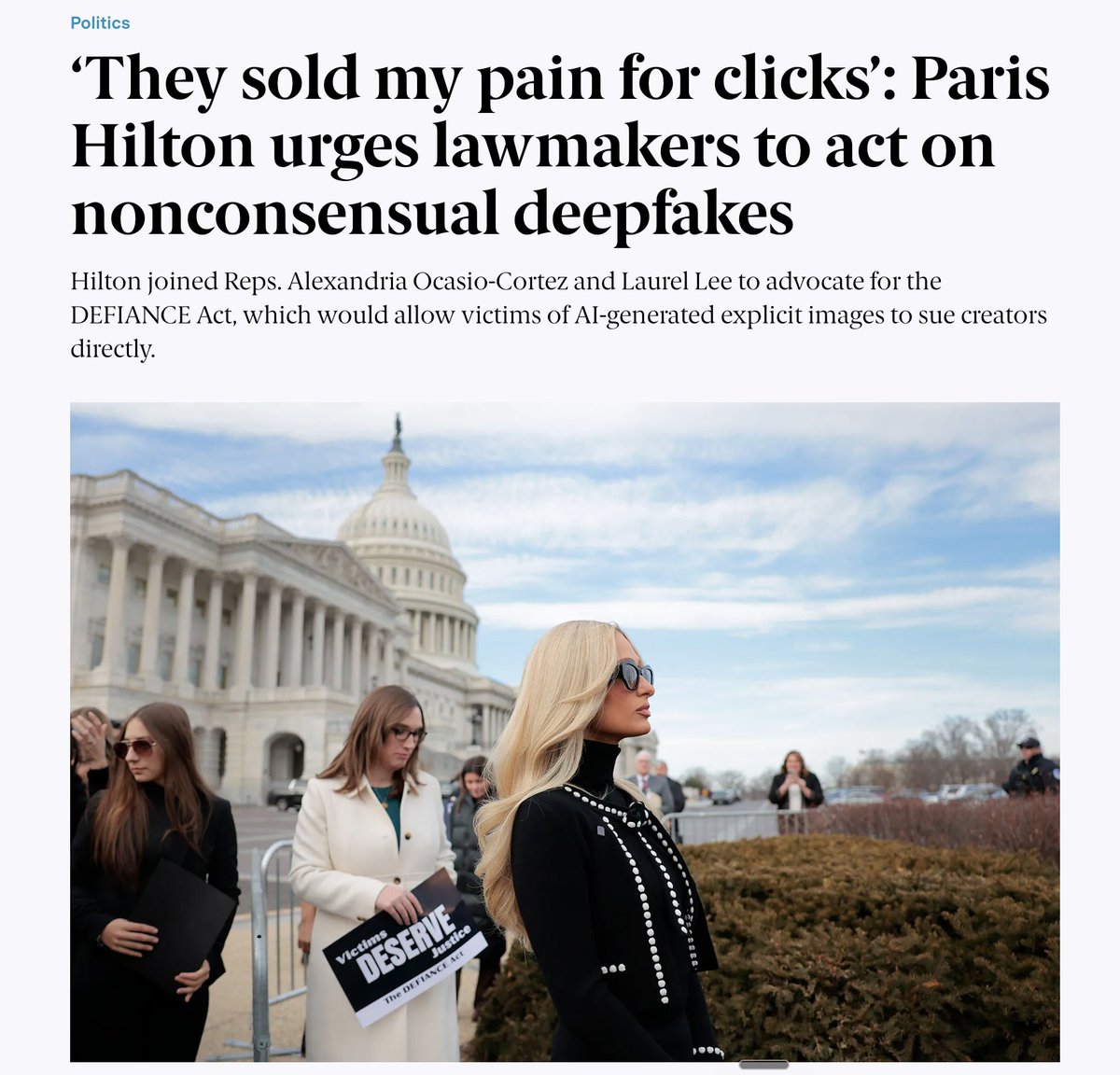
Paris Hilton walked into Congress and said what needed to be said.
"When I was 19, a private intimate video of me was shared with the world without my consent. People called it a scandal. It wasn't. It was abuse."
She stood alongside AOC and Rep. Laurel Lee to push for the Defiance Act, a bill that would let deepfake victims sue their abusers in civil court.
Why does she care so deeply?
- Over 100,000 nonconsensual explicit deepfakes of her have circulated online
- She had no legal protection when the original abuse happened in 2003
- She has spent years watching new technology create new ways to violate women
She put it perfectly:
"Take It Down gave us removal. Defiance will give us recourse and restitution."
And a 17-year-old deepfake survivor named Francesca Mani said it even more bluntly:
"If ethics aren't in your heart, self-preservation should be. If you don't care about others, protect yourself."
This is what fighting back looks like.
Source: @TheHill / @19thnews, January 22, 2026
#ParisHilton #DefianceAct #TakeItDownAct #Deepfake #DeepfakeCrime #OnlineSafety #DigitalRights #WomensRights #AIAbuse #VictimRights #EndDeepfakeAbuse #AIEthics #BreakingNews #Congress #StopDeepfakes
43
May 25
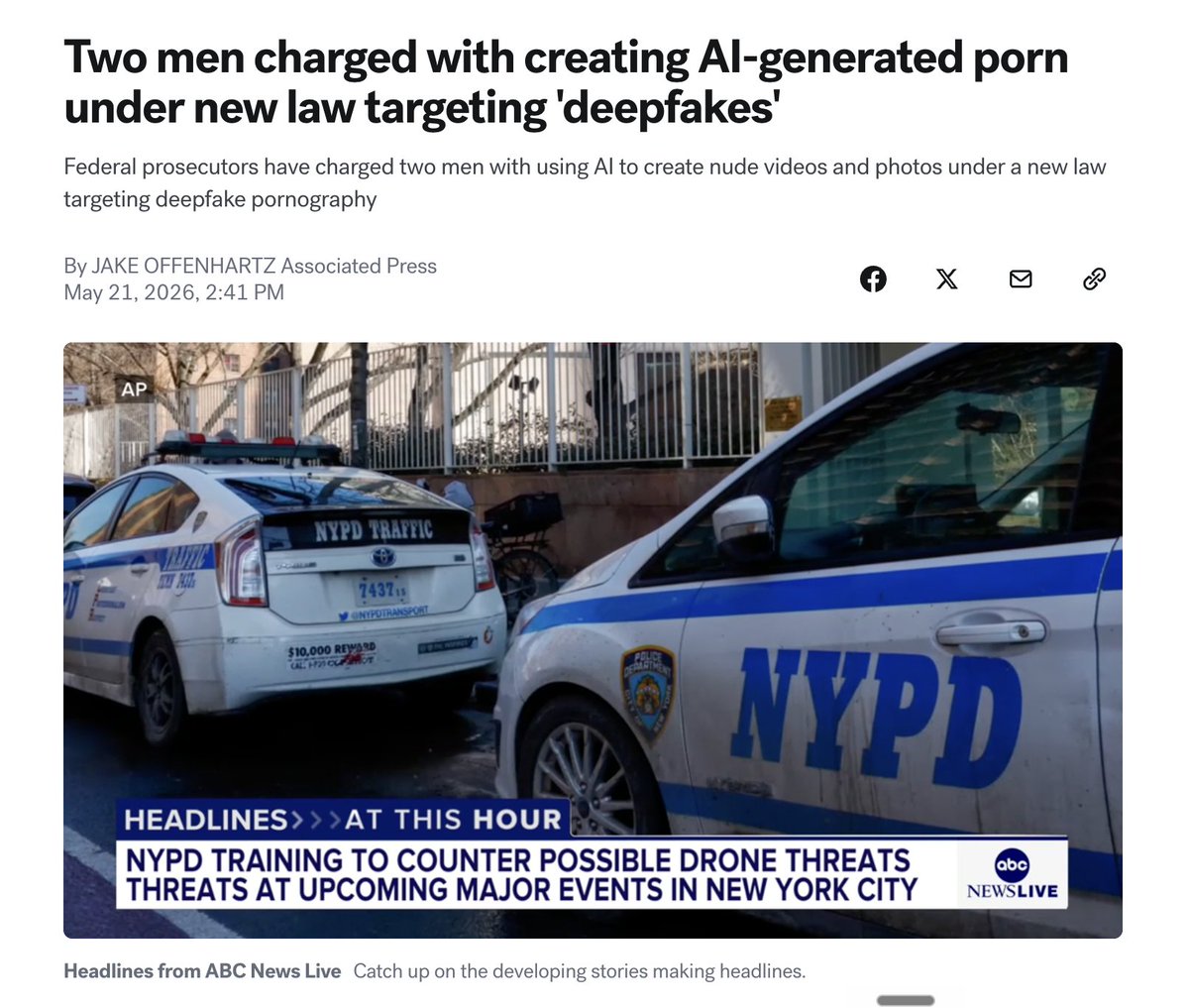
The Take It Down Act just got its first major arrests.
Two men federally charged this week for creating AI deepfake porn of female celebrities under the new law.
Here is who they are:
- Cornelius Shannon, 51, New Jersey
Published at least 240 albums of AI-generated explicit content featuring female politicians, musicians and singers. Drew millions of views online.
- Arturo Hernandez, 20, Texas
Targeted both celebrities and private women, including recent high school graduates.
Both men face up to 2 years in federal prison.
The US attorney in Brooklyn said they used cutting-edge technology to create images that "degraded and violated" dozens of women, adding: "This case makes clear that posting deepfake pornography is not a victimless crime."
And this is just the beginning:
- Last month, an Ohio man became the first person convicted under the act
- Two Pennsylvania teens received probation for deepfaking classmates
- Three Tennessee teenagers are suing Elon Musk's xAI over Grok deepfakes
The law has teeth. The arrests are happening. The era of consequence-free deepfake abuse is over.
Source: @ABC News / @AP, May 21, 2026
#TakeItDownAct #Deepfake #DeepfakeCrime #AIAbuse #OnlineSafety #DigitalRights #FederalLaw #AIEthics #BreakingNews #CyberLaw #DigitalSafety #VictimRights #StopDeepfakes #ArtificialIntelligence #CyberCrime
193
May 23
He had a respectable job at a public hospital. He drove a Tesla. He posted family photos on Instagram.
He was also secretly running the world's biggest deepfake porn site.
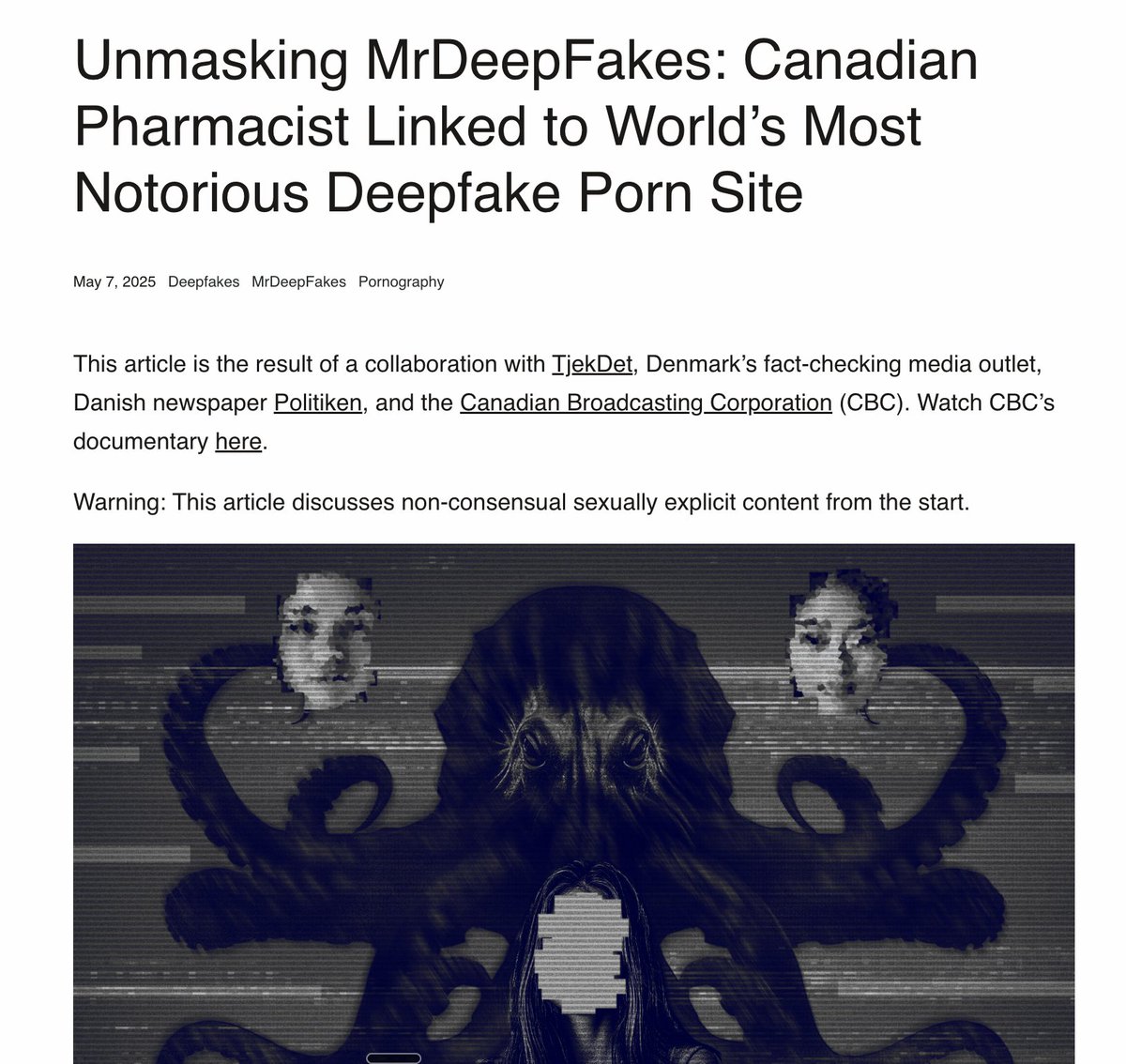
Meet David Do, 36, a Canadian pharmacist unmasked by @Bellingcat, @CBC and @Politiken as the key administrator of MrDeepFakes.
The numbers are staggering:
- 70,000 explicit videos on the site
- 2.2 billion total views
- 650,000 registered community members
- 12 million monthly visitors
- $4,000 to $7,000 earned per month
- Running since 2018 under the alias "dpfks"
His targets included Taylor Swift, Alexandria Ocasio-Cortez, Jenna Ortega and thousands of private individuals.
How was he caught?
A single email address in a data breach led researchers to usernames, passwords, IP addresses and a decade-long digital trail linking him to the site.
When CBC showed up at his door he said: "I don't want to be recorded please. I have to go. I'm busy right now."
Days later, MrDeepFakes went dark forever.
He is now on leave from his hospital job. The Ontario College of Pharmacists is investigating.
Denmark and the Netherlands are calling for his extradition.
Hiding behind anonymity did not save him. Open source investigation did what the law could not, yet.
Source: @Bellingcat / @CBC
#MrDeepFakes #Deepfake #DavidDo #Bellingcat #DeepfakeCrime #AIAbuse #DigitalViolence #OnlineSafety #Cybercrime #AIEthics #BreakingNews #OSINT #TakeItDownAct #DigitalSafety #JusticeForVictims
1
423