
Founder & editor, worksinprogress.co @stripe. Fellow, @createstreets. Board, @sci_works. Advisory board, @FixBritain_.
Joined June 2012
- Tweets 27,886
- Following 837
- Followers 21,942
- Likes 97,366
2,887 Photos and videos














Ben Southwood retweeted

23h
This is, perversely, good news for Britain, Australia, Japan, Europe, and other countries being cut off that would once have seen themselves as close allies of the United States.
It shows us what the future may hold if AI is the strategically and economically decisive technology of the 21st century and is controlled by the US and China. It is good news because *it may be happening early enough to give us time to act.*
I think this will be rescinded pretty soon, but it’s a sign of things to come. In a future where frontier models cannot be used outside the US, our industries and economies will fall behind and American businesses may not be able to operate overseas. We won’t be able to defend ourselves militarily with defence systems built on obsolete software. Europe 2031 is a good scenario of what a future like this could mean: europe2031.ai
Some of the things we need to do are ‘no regrets’ measures we should do anyway. But some are genuinely costly and risky.
We need cheap electricity – powered by gas, coal (this is costly, coal is very bad), deregulated nuclear fission – whatever can provide *cheap, reliable, 24/7* power. This almost certainly excludes wind power, which is enormously expensive and unreliable. We need projects to be able to connect to the grid in days rather than years by paying for fast-track connections.
We need to make it incredibly easy to build data centres, with the property taxes retained locally and hypothecated for local tax cuts so there is some direct benefit for locals. This doesn’t need to be nationwide.
We need to create new regulatory regimes for innovative businesses that give them the right to hire and fire staff with ease. The difficulty and cost of firing staff is one of the main reasons Europe has fallen behind so badly. We need to create a parallel employment regime that companies and workers can opt in to: worksinprogress.co/issue/why…
Even though I think it will probably fail, I think we should probably try to create a good, non-American frontier AI lab. I am quite pessimistic about this – even extremely well-resourced, innovative software companies are struggling to do this. But the stakes are so high that not trying seems foolish.
One thing that might work in our favour is the number of brilliant AI engineers who are not US citizens, who under the current export controls do not have access to Mythos/Fable even if they live and work in the US. What happens to Demis Hassabis, Ilya Sutskever, Andrej Karpathy, and the many other Europeans, Canadians, etc who are working on AI models in Britain and America who are affected by this?
I do not think we should force our own companies to use model, because this would exacerbate their economic weakness – this lab should have to compete on an even playing field. I am deeply sceptical that this can work, but we cannot rule it out. If we do it, it has to be able to pay US salaries, operate without political constraints. worksinprogress.co/issue/how…
It is cope to tell yourself that Trump is an aberration or that these export controls are a one-off. To repeat, I think these specific controls will be lifted quickly and it will be easy to move on and forget it happened. But this is a look into a potential future. Every one of us that is not a US citizen is at risk. The standard political divides do not apply here; the question is whether you grasp the enormity of AI as a technology. We have to act!
Jun 13

The US government, citing national security authorities, has issued an export control directive to suspend all access to Fable 5 and Mythos 5 by any foreign national, whether inside or outside the United States, including foreign national Anthropic employees.
The net effect of this order is that we must abruptly disable Fable 5 and Mythos 5 for all our customers to ensure compliance.
Access to all other Claude models is not affected.
We apologize for this disruption to our customers. We believe this is a misunderstanding and are working to restore access as soon as possible.
Read our full statement: anthropic.com/news/fable-myt…
139
341
1,760
268,116
Ben Southwood retweeted

Britain urgently needs to maximise sovereign AI capabilities - tho this also means keeping strong trusted US relationships. Losing access to frontier models is a major blow for British businesses and their employees, and our security.
We need to rapidly permit data centres, build cheap energy sources, and create a business environment that attracts more top AI researchers and startups. Not Miliband's Net Zero madness.
US govt is of course right that AI safety is important. But it’s best ensured by transparency and public-private partnerships (e.g. AISI's work with Anthropic) not by suddenly banning access for key allies like Britain.
Jun 13
The US government, citing national security authorities, has issued an export control directive to suspend all access to Fable 5 and Mythos 5 by any foreign national, whether inside or outside the United States, including foreign national Anthropic employees.
The net effect of this order is that we must abruptly disable Fable 5 and Mythos 5 for all our customers to ensure compliance.
Access to all other Claude models is not affected.
We apologize for this disruption to our customers. We believe this is a misunderstanding and are working to restore access as soon as possible.
Read our full statement: anthropic.com/news/fable-myt…
88
184
1,007
52,079

22h
If you're not following Works in Progress art director Atalanta Xanthe you should be!
Jun 12

A perverse pleasure in hand-drawing a medieval border around this article from the 1880s about how labor saving devices will take all our jobs. One of my fav articles yet to design, from the most recent issue of @WorksInProgMag (process on the left, final spread on the right)


2
60
6,804
Ben Southwood retweeted

Jun 12
A perverse pleasure in hand-drawing a medieval border around this article from the 1880s about how labor saving devices will take all our jobs. One of my fav articles yet to design, from the most recent issue of @WorksInProgMag (process on the left, final spread on the right)
7
3
79
10,768
Ben Southwood retweeted

Jun 12
Finished the latest @WorksInProgMag on my return flight.
No one talking about the full page ad for “dime?” Stainless steel headphones in a stainless steel puck.
@WIRED you had the last mainstream coverage of these.

2
7
780
Ben Southwood retweeted

Jun 12
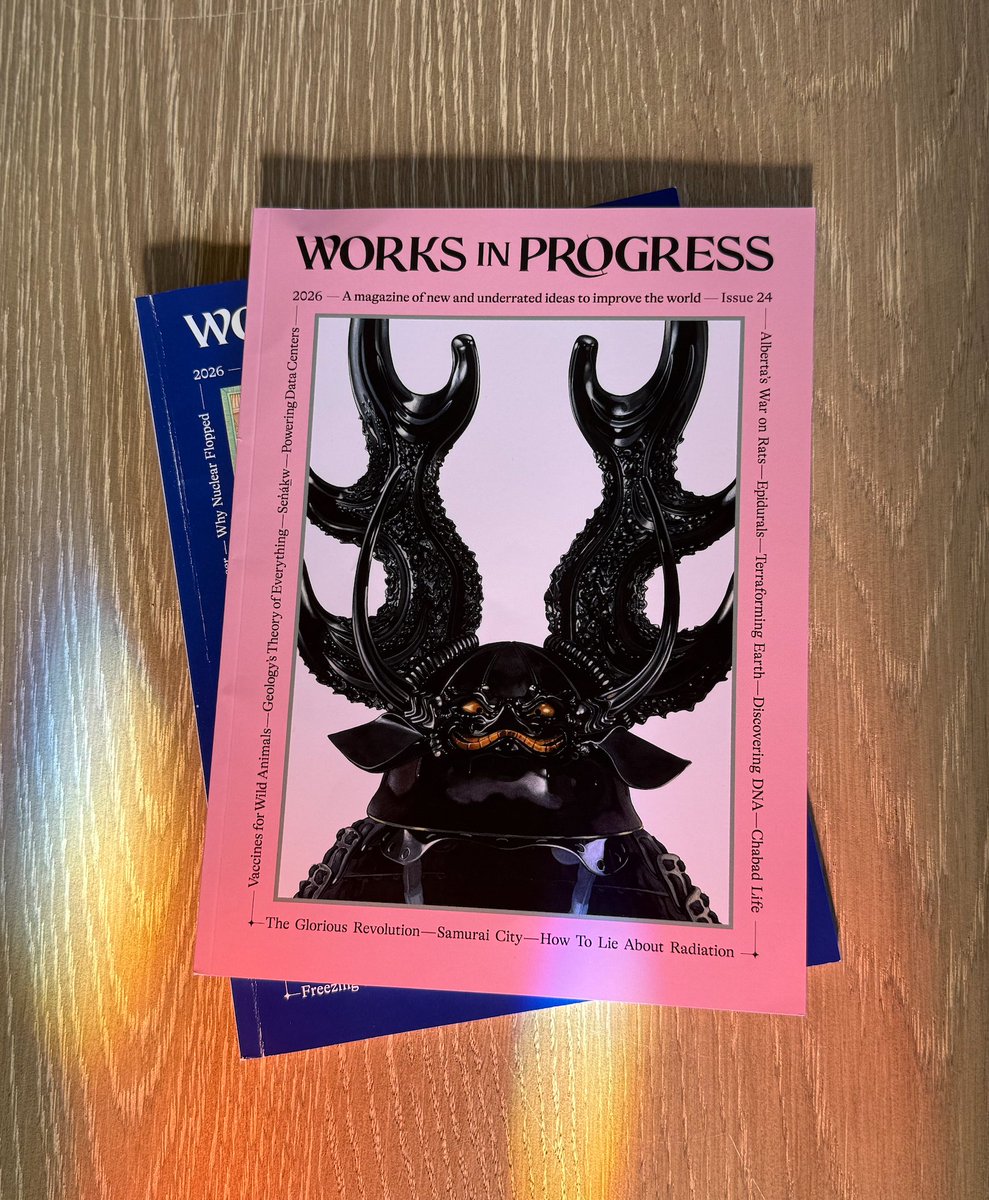
I am always delighted by @WorksInProgMag - so dense with ideas and beautiful graphics and ornamentation. My 3yo gets pumped when his lego packages arrive in the mail; I get pumped when my WIP packages arrive.


2
2
19
3,010




Ben Southwood retweeted

Jun 11
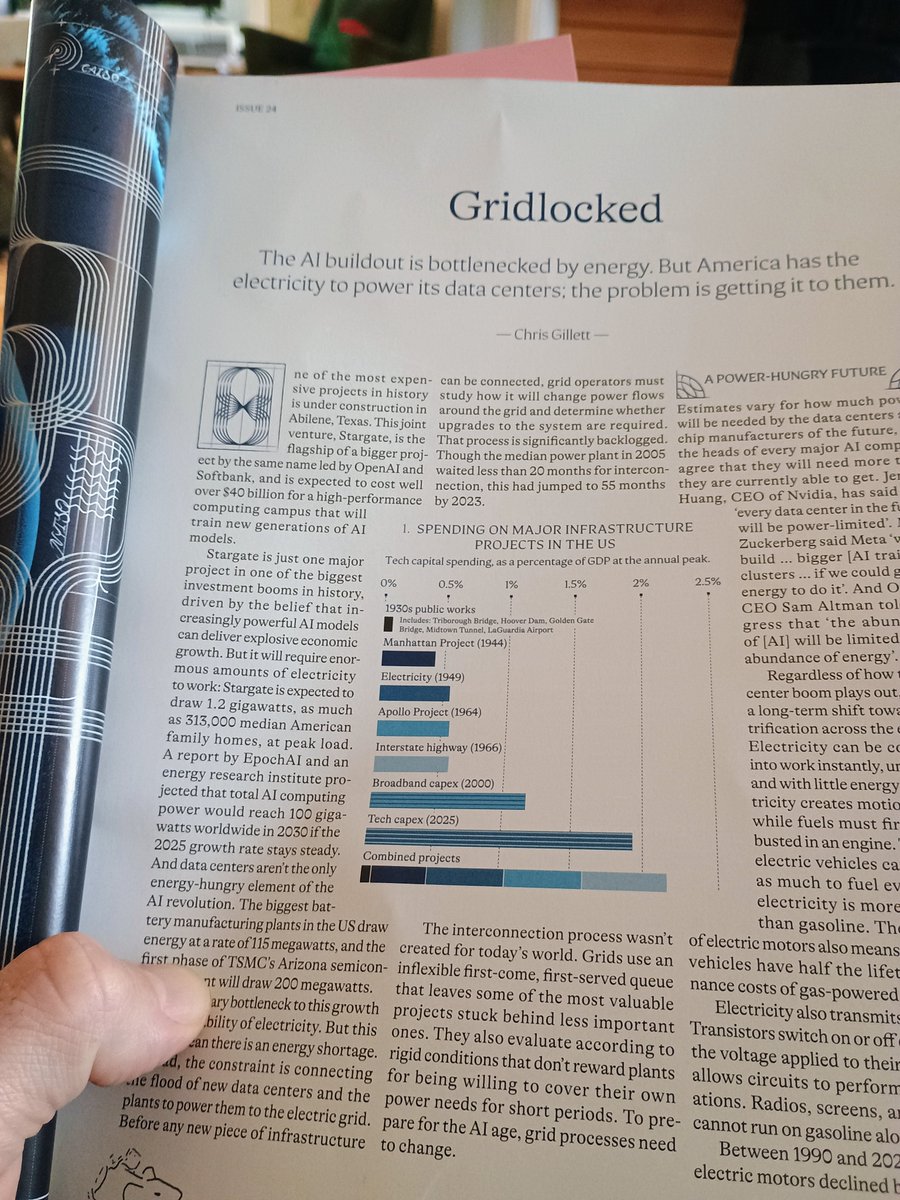
What's better than getting a new @WorksInProgMag in the mail? Seeing it includes an article on electric infrastructure by @ChrisGillett !
1
5
22
3,173
Jun 13
I think this piece is onto something.
Men & women are getting a totally distorted sense of gender relations, what the other sex is actually like, and more, driving them apart, because of the way that social media works
cartoonshateher.com/p/maybe-…
1
15
1,902
Ben Southwood retweeted

Jun 12
What's new in biology? @salonium and I are back with the monthly roundup. Highlights include:
1. A permanent gene-editing therapy to lower cholesterol.
2. Promising data on a mRNA cancer vaccine for high-risk melanoma.
3. A functional cure for some patients with hepatitis B.

7
21
129
9,420


Jun 12
I love Saloni's and Niko's biology updates!

New post!
@NikoMcCarty and I have been writing regular round ups for a little while now, but so much has happened recently that this month’s What's New in Biology post feels like it contains a year’s worth of breakthroughs.
worksinprogress.news/p/whats…
The most effective weight-loss drug so far, cancer breakthroughs, gene editing for cholesterol, ancestral CRISPR systems, a cure for some with hepatitis B, the first PROTAC drug, and more.
Read it here!
10
1,788
Jun 12
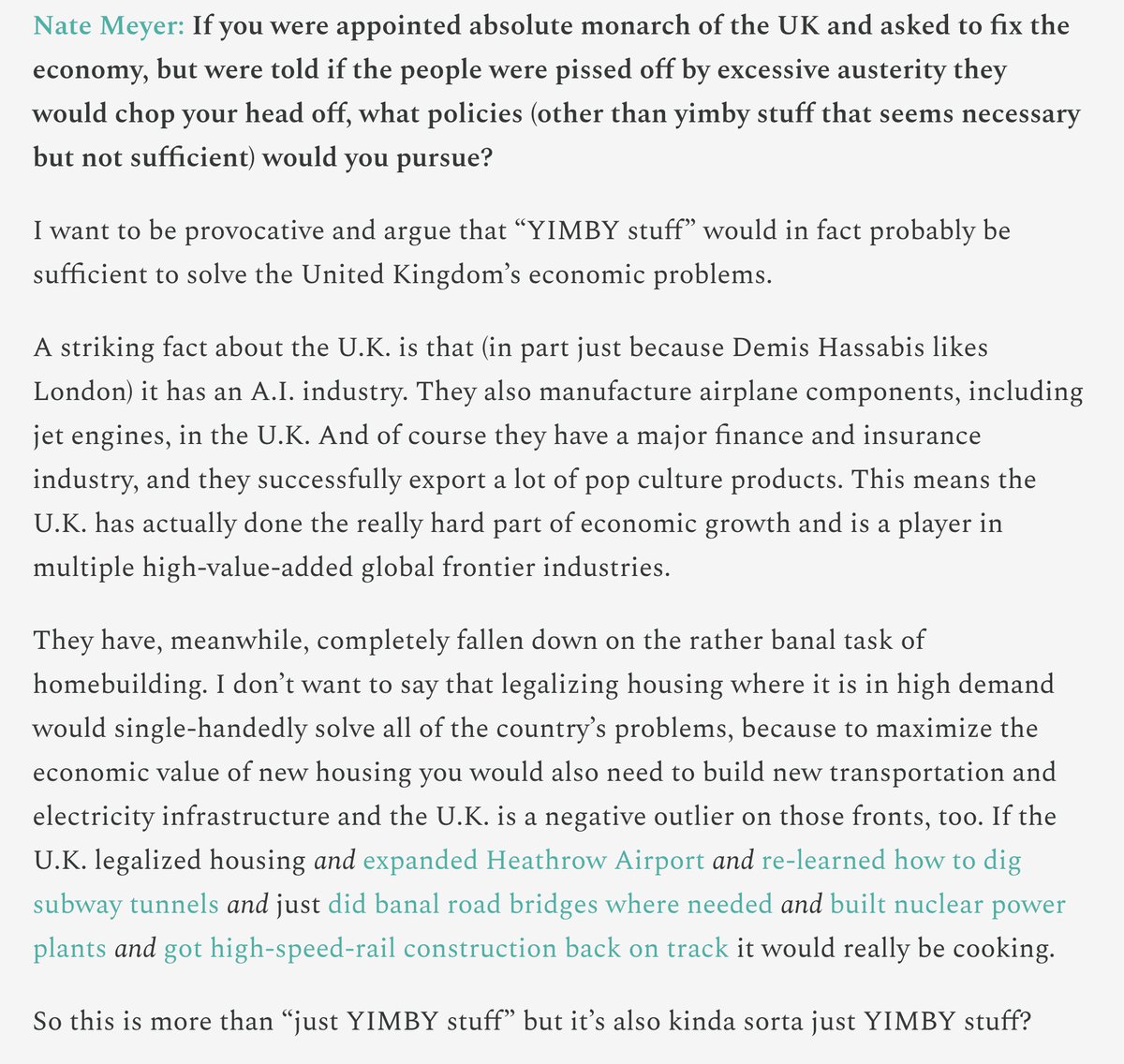
If you want to read the 12,000-word version of this @mattyglesias thesis: ukfoundations.co/

1
34
2,568

Jun 12
It's such a funny combo. We actually DO have too much electricity for the current price.
Building subsidised wind farms on CfDs won't bring its price down – even if the wholesale price reaches zero, bills to households and industry will go up due to the fixed and grid costs.
But in many sense we don't have enough electricity, which is part of why its price is so high. A paradox it's only possible to understand if you think about how we set prices and run our grid and market. telegraph.co.uk/business/202…
7
15
56
4,158
Jun 12
We effectively tax the marginal unit of electricity at around 2/3, spreading most of the fixed costs of the grid (caused by renewables expansion) over all the units of electricity consumed, rather than putting it on the cost of a connection. x.com/bswud/status/204394271…
Apr 14

Right now, British electricity pricing is bonkers. Prices are disconnected the from the underlying reality in several very important ways.
1. The costs of keeping the grid going, like transmission and balancing, are spread over every unit of electricity sold. This means the price of an extra unit of electricity is vastly higher than the social cost of providing that unit. The cost of having a grid connection at all is, conversely, much lower than it actually costs society to provide you one.
Economically, this amounts to a crippling price cap on grid connections, which is part of why we can't expand infrastructure to plug people in: they don't pay for it. It also amounts to an enormous tax, over 2/3 of the price of electricity, on using an extra unit of it.
Which is presumably why electricity use has cratered since 2003, when we started driving up the cost of our grid like this.
Note how perverse the incentive is here. We are heading into a situation where electricity is extremely expensive because the ratio of grid costs to the amount of electricity put through that grid. Our high prices incentivise everyone to have a connection, but then to use it as little as possible, the EXACT opposite of what we need. We charge the most tax on people use their connection most intensively (i.e., efficiently) and the least on those who use it the least intensively!
2. We impose carbon taxes on electricity produced through gas that we don't impose on gas used directly. This is part of why electricity is so expensive, and means people electrify less than we would like, which leads to less decarbonisation overall. A child, with a basic understanding of supply and demand, would see how perverse this is.
3. We charge the same price for electricity nationwide, and pay the same amount, in a single market, even though electricity is worth more and less at different places. This is part of why people are building solar farms in Scotland, where it is not only less sunny, but which is on the other side of massive grid congestion that we are paying BILLIONS of pounds to relieve. Yet we keep paying people to make the problem worse.
4. We keep buying Contracts for Difference off electricity generators. CfDs say 'we will pay you X for every unit of electricity you produce, whenever you produce it'. (Recent iterations have cut off these payments when prices go negative, but they will still pay them £90 per megawatt hour when the megawatts they are producing are worth 1p each!)
Renewables Obligations Certificates were a lot more honest. They just paid producers a top up on what they got on the open market: a straightforward subsidy. CfDs are a totally hidden subsidy. The amount of subsidy is set by the market trajectory after today. So, for example, every time we sign a new wind CfD we increase the subsidy for past tranches.
The really messed up thing is that CfD recipients do not cover for when they don't provide any power. If the CfD was set on quantity as well, so generators had to pay back money when they didn't produce, to cover the cost of running the grid to accommodate them, and for the gas needed to keep the lights on, then we would get a good sense of how much we were actually paying. Buying a CfD would be buying new electricity at its going rate. Instead, practically all the important pricing functions are hidden.
The result of all these broken pricing systems is poor coordination. Everyone is working exactly as the price system tells them to: plug in but only use your grid connection when the grid is having trouble, use less electricity, don't electrify, add generation far away from where it is consumed, and produce the most electricity possible whenever and wherever you like, not when or where it's rare and expensive. The ultimate result is expensive electricity, industrial decline, and economic stagnation.
7
1,252
Ben Southwood retweeted

Jun 11
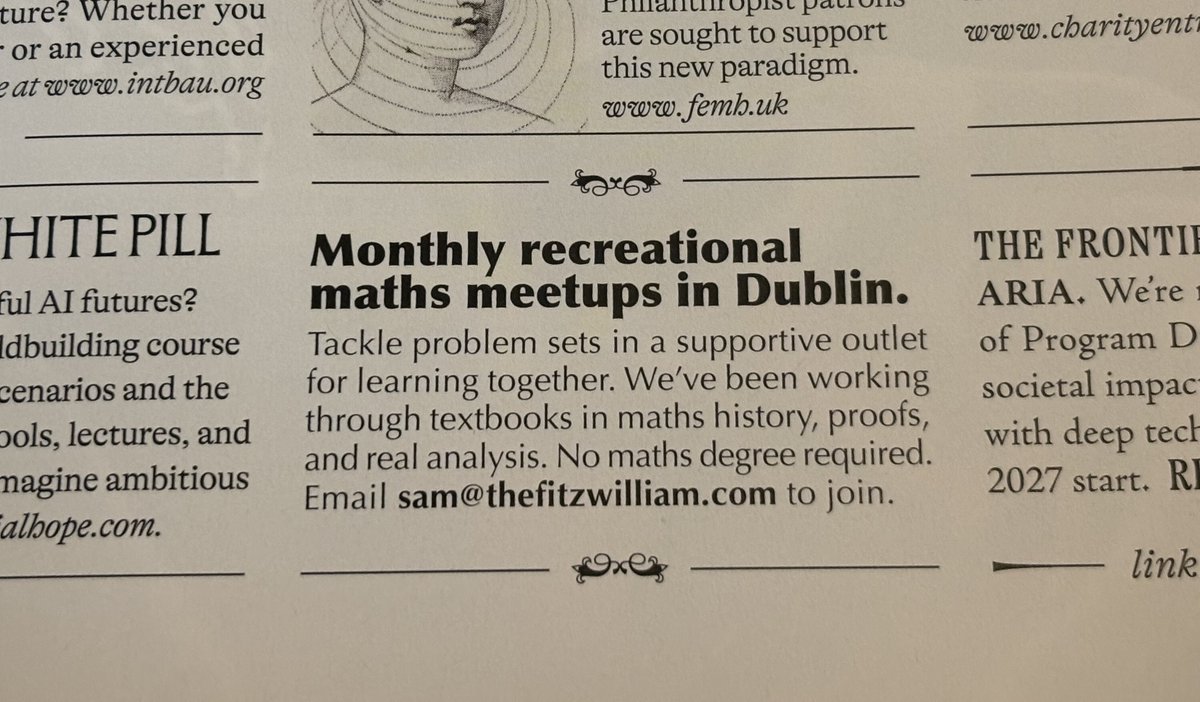
The Fitzwilliam maths meetups were featured in the latest paper edition of @WorksInProgMag
3
3
21
1,595
Ben Southwood retweeted

Jun 12
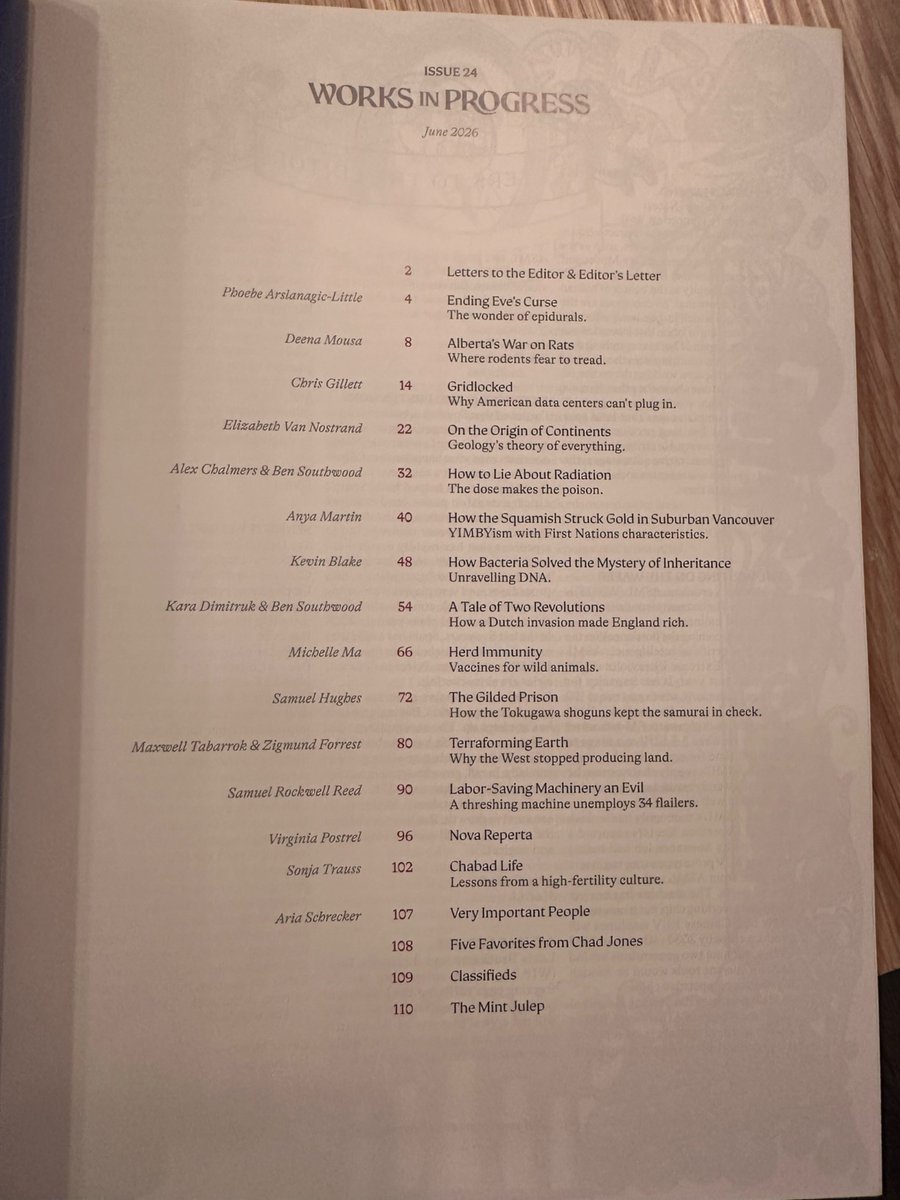
This issue of Works in Progress looks ridiculously stacked
3
49
3,385
Jun 11
Science funding in the UK is scarce, and we should be focusing on the activities with the biggest spillovers, that the private sector will not fund.
That means stuff like data infrastructure: UK Biobanks, RECOVERY trials, test reactors, tools, not subsidising startups.
Jun 11

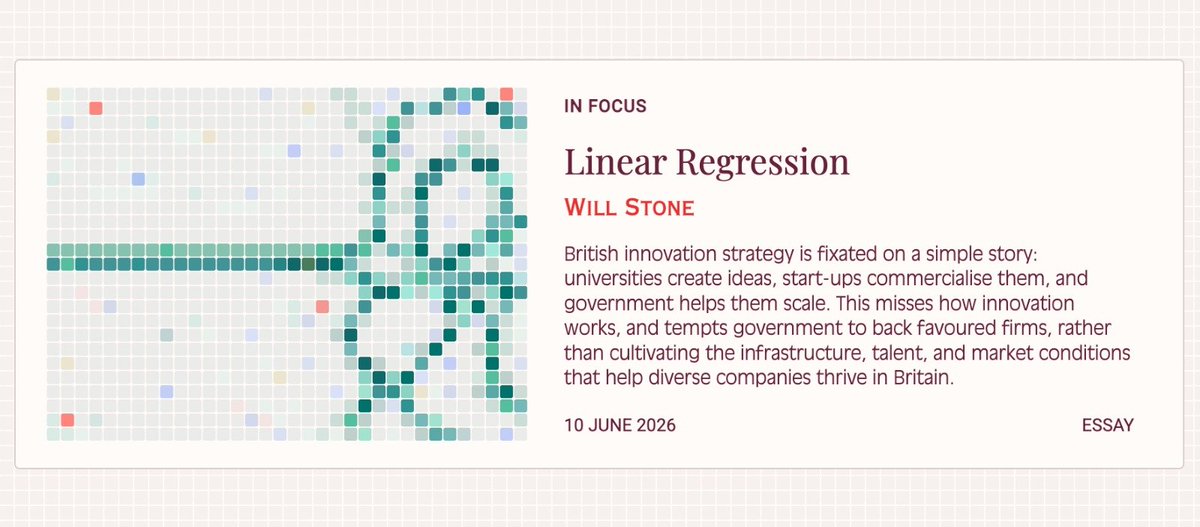
New @sci_works essay 🧵
British innovation strategy is fixated on a simple story: unis generate ideas, start-ups commercialise them, government helps them scale.
This is legible, politically attractive, & wrong.
Policy built on it will deliver neither breakthroughs nor growth.
1
15
1,680
Ben Southwood retweeted

Jun 10
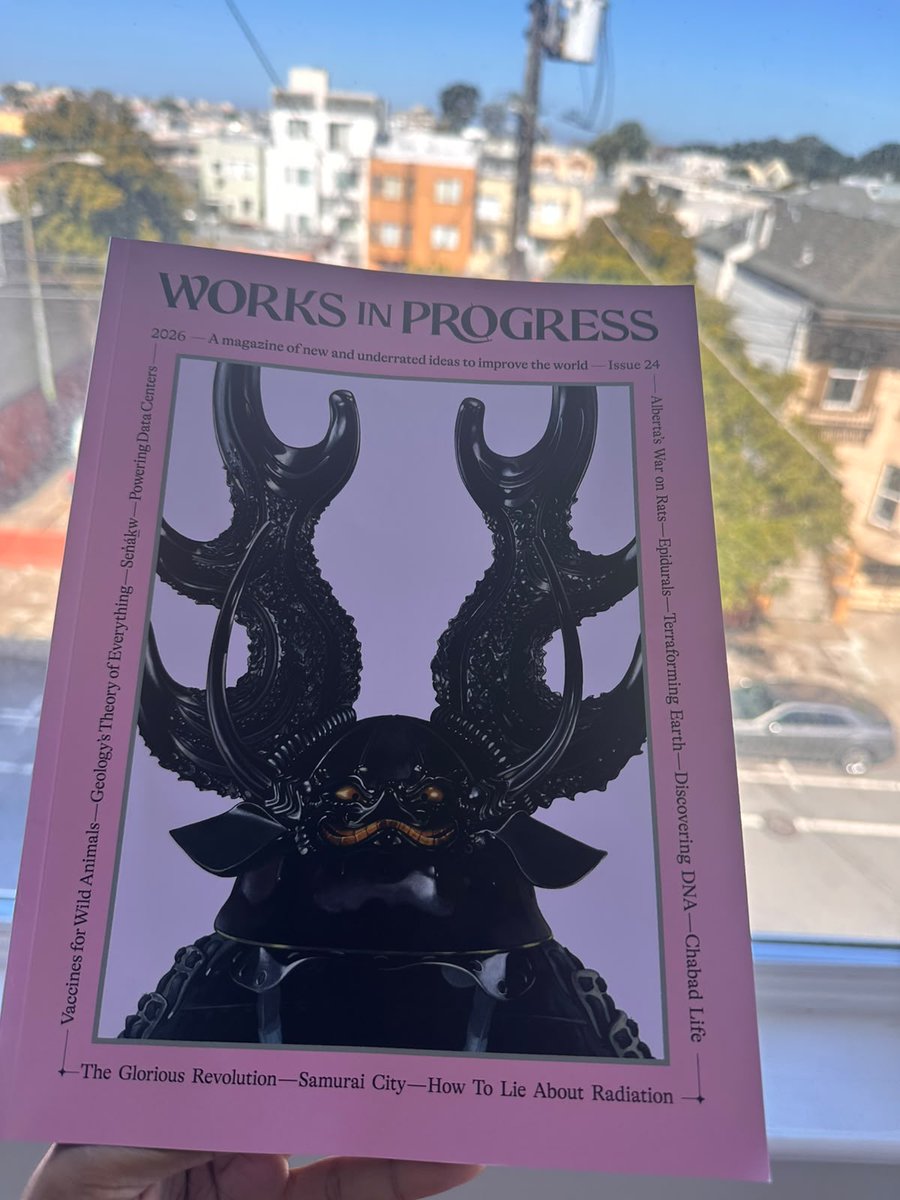
long live print! excited to dig into the latest issue of @WorksInProgMag

1
3
16
2,382