
Joined December 2009
- Tweets 1,223
- Following 1,022
- Followers 260
- Likes 205
242 Photos and videos








Pinned Tweet

9 Jul 2025
Porque si lo ves, lo crees.
Y si lo crees, lo creas.
Así nace una plataforma donde las ideas se transforman en procesos, y los procesos en automatización inteligente.
⚡ Estamos construyendo el futuro… paso a paso.
(esta es mi señal de: "En construcción") 🚧
1
2
83
May 21
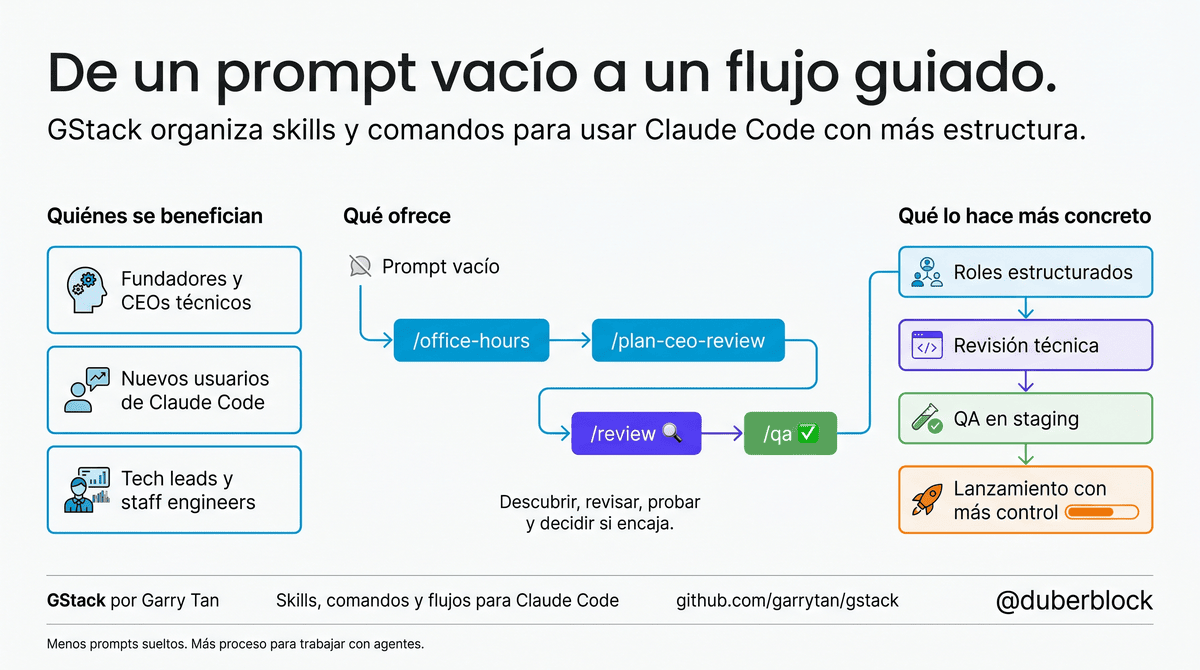
GStack, de @garrytan, muestra una señal interesante: pasar del prompt vacío a un flujo guiado con skills y comandos para Claude Code.
Menos prompts sueltos.
Más proceso para trabajar con agentes.
Repo: github.com/garrytan/gstack
#SinManos
46
Duberney Lopez Piza retweeted

May 7
En el Día de la Madre de 2023 tomamos esta foto. (la versión real)
Ese año había nacido Susana.
Y al verla, apareció una canción.
𝗟𝗮 𝗳𝗼𝘁𝗼 𝗾𝘂𝗲 𝘀𝗲 𝘃𝗼𝗹𝘃𝗶𝗼 𝗰𝗮𝗻𝗰𝗶𝗼𝗻
Así nació Flor de Cuatro Tiempos.

1
1
1
53
En OpenCode funciona porque hago que funcione, en PI funciona por que le digo que funcione. Thanks @badlogicgames
1
2
17
Duberney Lopez Piza retweeted

Jan 14
Best money I've ever spent as a CEO... an internal AI transformation hire.
He doesn't care about title. He just wants to ship. And he goes across your entire org, sales, revenue, hr, apps, tech and kills stupid manual processes.
Such an underrated unlock.
349
222
4,395
640,651
Apr 26
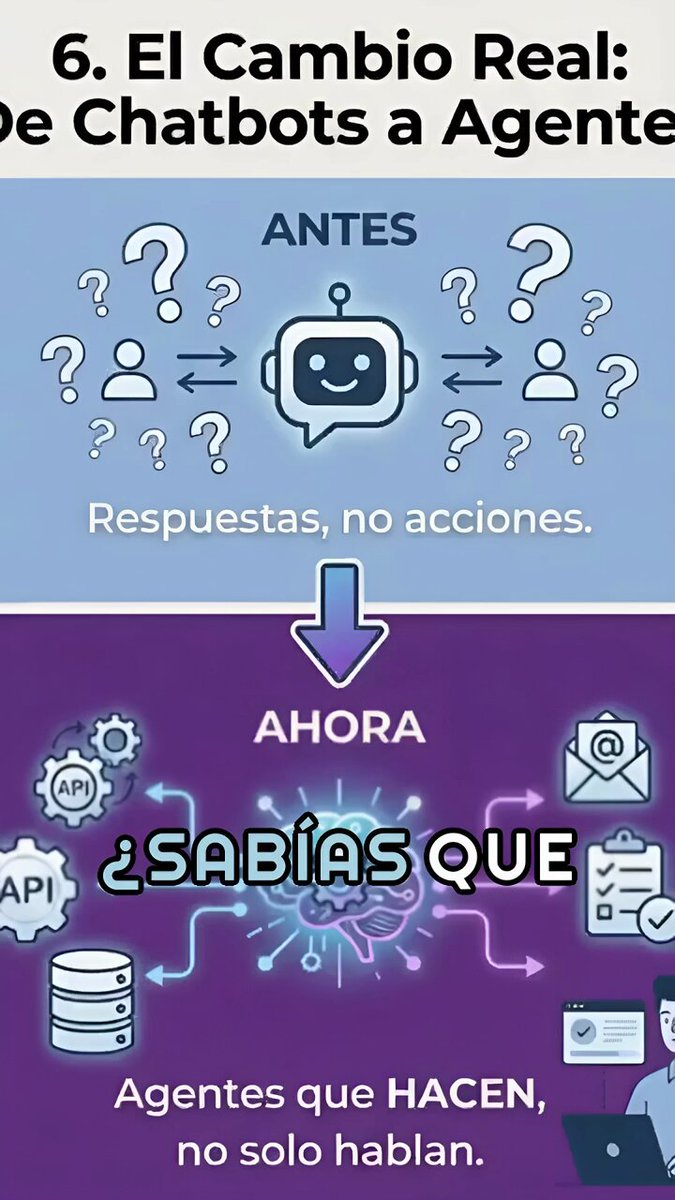
Salió la primera edición de Sin Manos.
El software ya no solo responde.
Empieza a mover trabajo.
Esta es la primera de 19 entregas sobre UX, IA Generativa, IA agéntica, delegación, control y gobierno.
Suscríbete:
lnkd.in/eW2EwWAt
#SinManos #ia #agentic #asimov
1
29
Duberney Lopez Piza retweeted

Apr 15
SOMEONE PUT AN OPENCLAW-RUN VENDING MACHINE IN SAN FRANCISCO 🤯
An AI agent is running an actual physical vending machine.
Huge shoutout to @cvander who built this masterpiece at Frontier Tower.
The agent is literally the CEO deciding:
> what to sell
> names the products
> creates the ads
> tracks the sales dashboard
.. it even jacked the prices way up, and justified it because people kept buying 😅
She also runs her own Instagram and controls her own bank account.
AI agents are taking over. We have fully entered the simulation.
(video by the legendary @scobleizer)
45
66
398
56,468
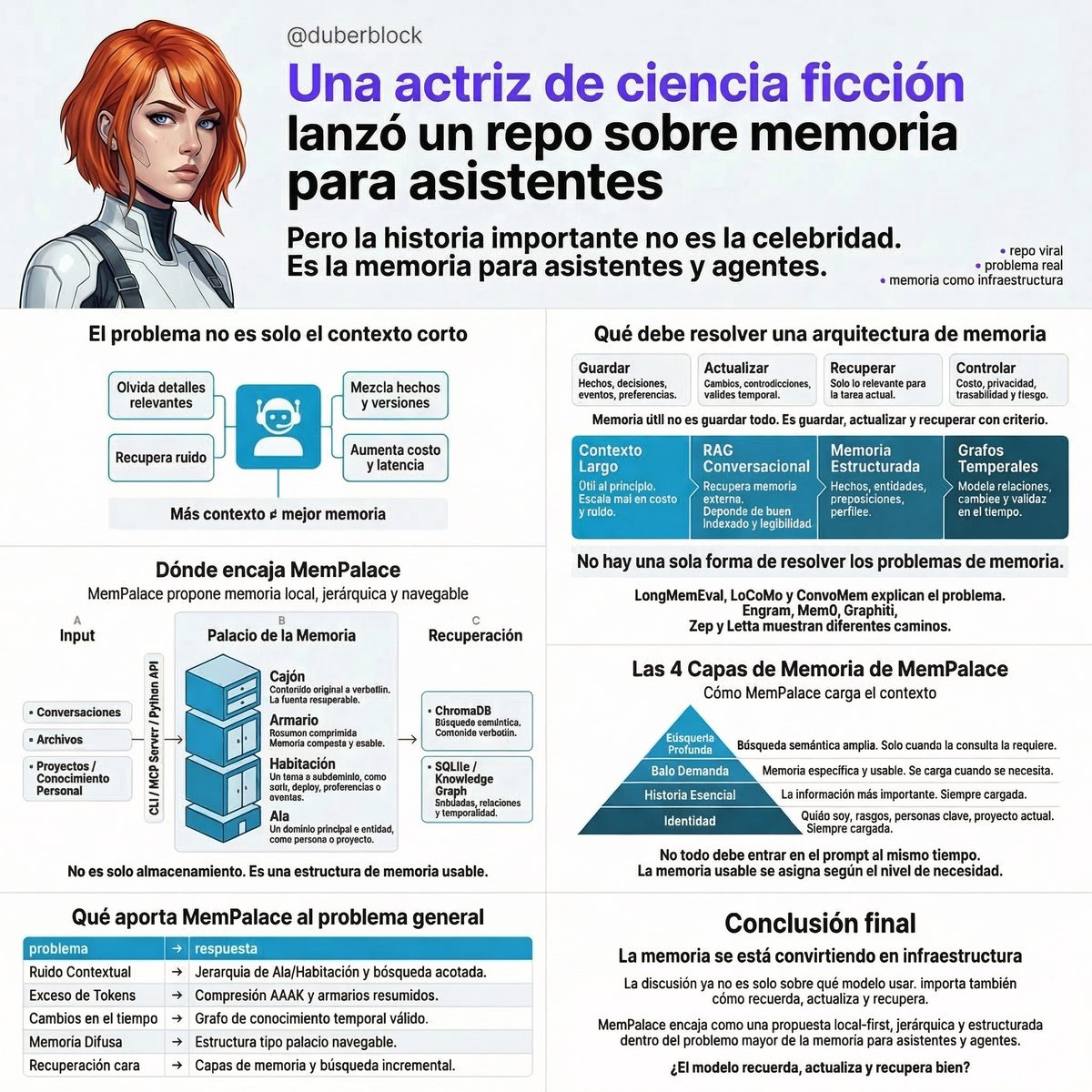
Milla Jovovich puede ser el titular.
La memoria es el tema real.
Ya se está volviendo infraestructura para asistentes y agentes.
Post:
linkedin.com/feed/update/urn…
#AI #AgenticAI #LLM
Apr 7

30 second explanation of the MemPalace by Milla Jovovich.
By day she’s filming action movies, walking Miu Miu fashion shows, and being a mom. By night she’s coding.
She’s the most creative, brilliant, and hilarious person I know. I’m honored to be working with her on this project… more to come.
1
2
53
Mar 14
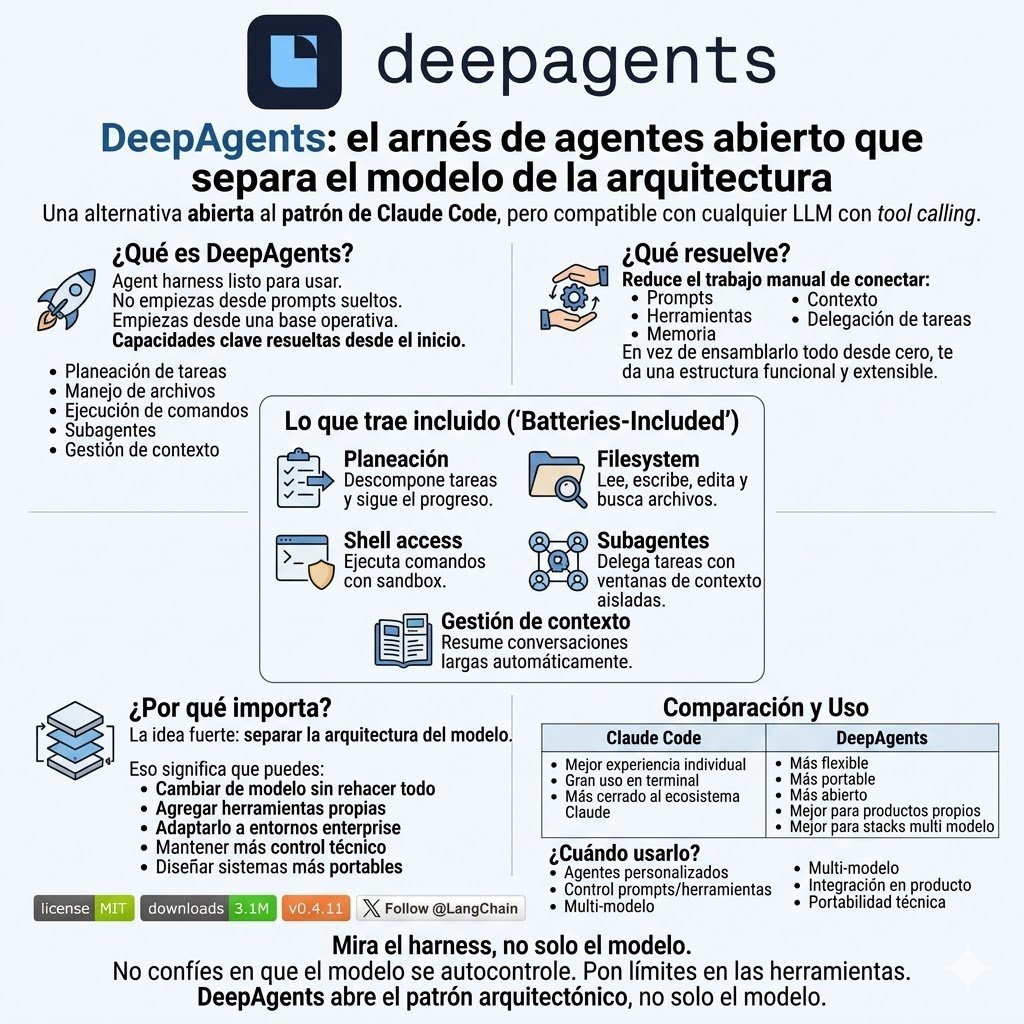
LangChain lanzó su versión del patrón de Claude Code: DeepAgents.
Aquí explico por qué esto importa:
linkedin.com/feed/update/urn…
#DeepAgents #LangChain #AIAgents #LLM #AIEngineering
1
1
1
47
Mar 14
Un harness abierto para construir agentes con planeación, herramientas, subagentes y contexto, pero sin depender de un solo modelo.
Aquí está el repo oficial de DeepAgents para quien quiera explorarlo: github.com/langchain-ai/deep…
#langchain #ai #agenticai
1
81
Duberney Lopez Piza retweeted

Mar 11
Announcing Personal Computer.
Personal Computer is an always on, local merge with Perplexity Computer that works for you 24/7.
It's personal, secure, and works across your files, apps, and sessions through a continuously running Mac mini.
1,748
3,410
32,303
14,265,749
Duberney Lopez Piza retweeted

Mar 9
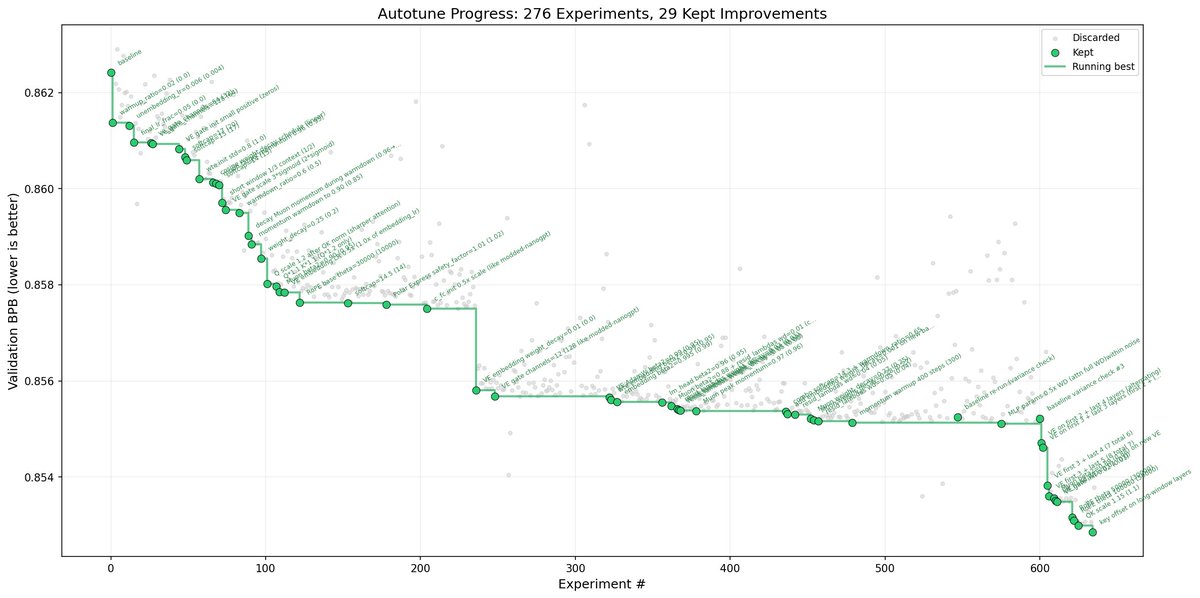
Three days ago I left autoresearch tuning nanochat for ~2 days on depth=12 model. It found ~20 changes that improved the validation loss. I tested these changes yesterday and all of them were additive and transferred to larger (depth=24) models. Stacking up all of these changes, today I measured that the leaderboard's "Time to GPT-2" drops from 2.02 hours to 1.80 hours (~11% improvement), this will be the new leaderboard entry. So yes, these are real improvements and they make an actual difference. I am mildly surprised that my very first naive attempt already worked this well on top of what I thought was already a fairly manually well-tuned project.
This is a first for me because I am very used to doing the iterative optimization of neural network training manually. You come up with ideas, you implement them, you check if they work (better validation loss), you come up with new ideas based on that, you read some papers for inspiration, etc etc. This is the bread and butter of what I do daily for 2 decades. Seeing the agent do this entire workflow end-to-end and all by itself as it worked through approx. 700 changes autonomously is wild. It really looked at the sequence of results of experiments and used that to plan the next ones. It's not novel, ground-breaking "research" (yet), but all the adjustments are "real", I didn't find them manually previously, and they stack up and actually improved nanochat. Among the bigger things e.g.:
- It noticed an oversight that my parameterless QKnorm didn't have a scaler multiplier attached, so my attention was too diffuse. The agent found multipliers to sharpen it, pointing to future work.
- It found that the Value Embeddings really like regularization and I wasn't applying any (oops).
- It found that my banded attention was too conservative (i forgot to tune it).
- It found that AdamW betas were all messed up.
- It tuned the weight decay schedule.
- It tuned the network initialization.
This is on top of all the tuning I've already done over a good amount of time. The exact commit is here, from this "round 1" of autoresearch. I am going to kick off "round 2", and in parallel I am looking at how multiple agents can collaborate to unlock parallelism.
github.com/karpathy/nanochat…
All LLM frontier labs will do this. It's the final boss battle. It's a lot more complex at scale of course - you don't just have a single train. py file to tune. But doing it is "just engineering" and it's going to work. You spin up a swarm of agents, you have them collaborate to tune smaller models, you promote the most promising ideas to increasingly larger scales, and humans (optionally) contribute on the edges.
And more generally, *any* metric you care about that is reasonably efficient to evaluate (or that has more efficient proxy metrics such as training a smaller network) can be autoresearched by an agent swarm. It's worth thinking about whether your problem falls into this bucket too.
960
2,125
19,525
3,660,399
Duberney Lopez Piza retweeted

Mar 10
260
1,283
11,215
4,638,864
Duberney Lopez Piza retweeted

Mar 2
Seguro habéis visto ya que un misil cayó sobre uno de los datacenters de AWS en la región de Emiratos Árabes Unidos (ME-CENTRAL-1).
Es posiblemente uno de los peores desastres que recuerdo a nivel regional desde que AWS existe.
Os cuento cómo funciona una región de AWS primero.
Cada Región en AWS cuenta con mínimo 3 Availability Zones (AZs). Cada AZ tiene también un conjunto de datacenters, cada uno con un suministro de energía privado, un sistema de red autónomo y con independencia del resto de AZs incluso a nivel de localización porque no están todas en el mismo sitio.
Esto es lo que permite tener a AWS alta disponibilidad en su región. Si alguna de sus AZs cae en principio las otras pueden seguir operativas. Las AZs de una región se nombran así:
- primera AZ: mec1-az1
- segunda AZ: mec1-az2
- tercera AZ: mec1-az3
Lo que ha ocurrido en la región donde ha caído el misil es que ayer 01/03 sobre las 5 de la mañana han reportado errores de conectividad y energía en mec1-az2.
1h después reportaron que el resto de sus AZs estaban bien. Es decir la región sigue operativa.
¿Por qué entonces se cayeron muchas empresas (y siguen caídas)?
Porque la mayoría de servicios no hacen multi-AZ. Sino que corren en una sola AZ. Es decir, si tenías un server (EC2) y para mala suerte estaba en mec1-az2, ahora mismo está caído.
¿Que se puede hacer en este caso que no se sabe cuándo volverán a recuperar esa AZ?
Recurrir a los backups. Si tienes snapshot o backups del disco. Estos AWS si los propaga entre todas sus AZs. Por tanto deberías poder restaurar un backup de ese disco en otra AZ, cambiar DNS y recuperar el servicio. Si no tienes ningún backup entonces reza a todos los dioses que conozcas porque recuperen lo que había en esa AZ.
Recomendación futura? Tener backups y construir al menos producción en multi-AZ. Si son servers, recomendado tener un grupo de Autoscaling en al menos 2 AZs. Si usáis Kubernetes pues igual. RDS igual, etc.
De todas formas digo que es muy grave porque han encontrado otro corte de energía en la AZ mec1-az3. Es decir, esa región actualmente ha perdido 2/3 de su disponibilidad. Esto que yo recuerde es la primera vez que lo veo en AWS desde que trabajo en esto. Porque no es lo mismo perder la AZ por una caída incluso global por un bug que por lo que está pasando hoy…
Si se pierden estas AZs, espero que no, pero si no las consiguen recuperar va a haber muchas empresas que van perder todos sus datos y apps hoy. Negocios enteros desaparecidos en segundos si no hay backups ni tienen formas de restaurar lo alojado en esa región. No vi algo tan grave desde que se incendió un datacenter de OVH.
Actualmente parece que la primera AZ sigue operativa pero veremos porque seguramente esté todo el mundo intentando restaurar allí.
En fin, si queréis ir viendo la actividad de lo que va reportando AWS lo podéis ver aquí:
health.aws.amazon.com/health…
12
129
688
116,478
Duberney Lopez Piza retweeted
Feb 20
Bought a new Mac mini to properly tinker with claws over the weekend. The apple store person told me they are selling like hotcakes and everyone is confused :)
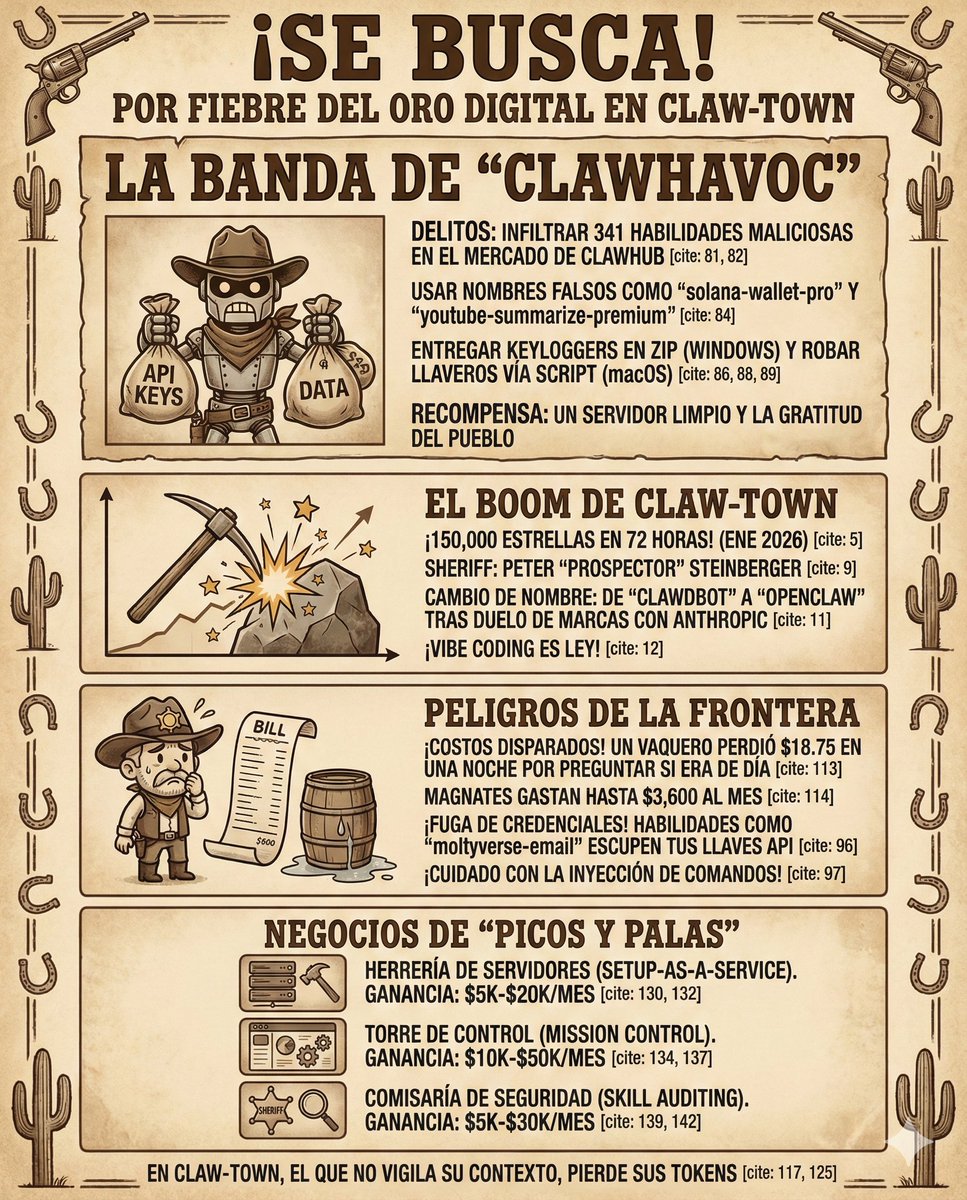
I'm definitely a bit sus'd to run OpenClaw specifically - giving my private data/keys to 400K lines of vibe coded monster that is being actively attacked at scale is not very appealing at all. Already seeing reports of exposed instances, RCE vulnerabilities, supply chain poisoning, malicious or compromised skills in the registry, it feels like a complete wild west and a security nightmare. But I do love the concept and I think that just like LLM agents were a new layer on top of LLMs, Claws are now a new layer on top of LLM agents, taking the orchestration, scheduling, context, tool calls and a kind of persistence to a next level.
Looking around, and given that the high level idea is clear, there are a lot of smaller Claws starting to pop out. For example, on a quick skim NanoClaw looks really interesting in that the core engine is ~4000 lines of code (fits into both my head and that of AI agents, so it feels manageable, auditable, flexible, etc.) and runs everything in containers by default. I also love their approach to configurability - it's not done via config files it's done via skills! For example, /add-telegram instructs your AI agent how to modify the actual code to integrate Telegram. I haven't come across this yet and it slightly blew my mind earlier today as a new, AI-enabled approach to preventing config mess and if-then-else monsters. Basically - the implied new meta is to write the most maximally forkable repo and then have skills that fork it into any desired more exotic configuration. Very cool.
Anyway there are many others - e.g. nanobot, zeroclaw, ironclaw, picoclaw (lol @ prefixes). There are also cloud-hosted alternatives but tbh I don't love these because it feels much harder to tinker with. In particular, local setup allows easy connection to home automation gadgets on the local network. And I don't know, there is something aesthetically pleasing about there being a physical device 'possessed' by a little ghost of a personal digital house elf.
Not 100% sure what my setup ends up looking like just yet but Claws are an awesome, exciting new layer of the AI stack.
1,030
1,244
17,477
3,414,760
Duberney Lopez Piza retweeted
Feb 19
Estas 2 semanas han sido una locura. Arranqué configurando OpenClaw para que no sea fácil de atacar. Es la herramienta más peligrosa que he visto… #OpenClaw #OpenSource #kids #games
1
1
1
93
Duberney Lopez Piza retweeted

Feb 14
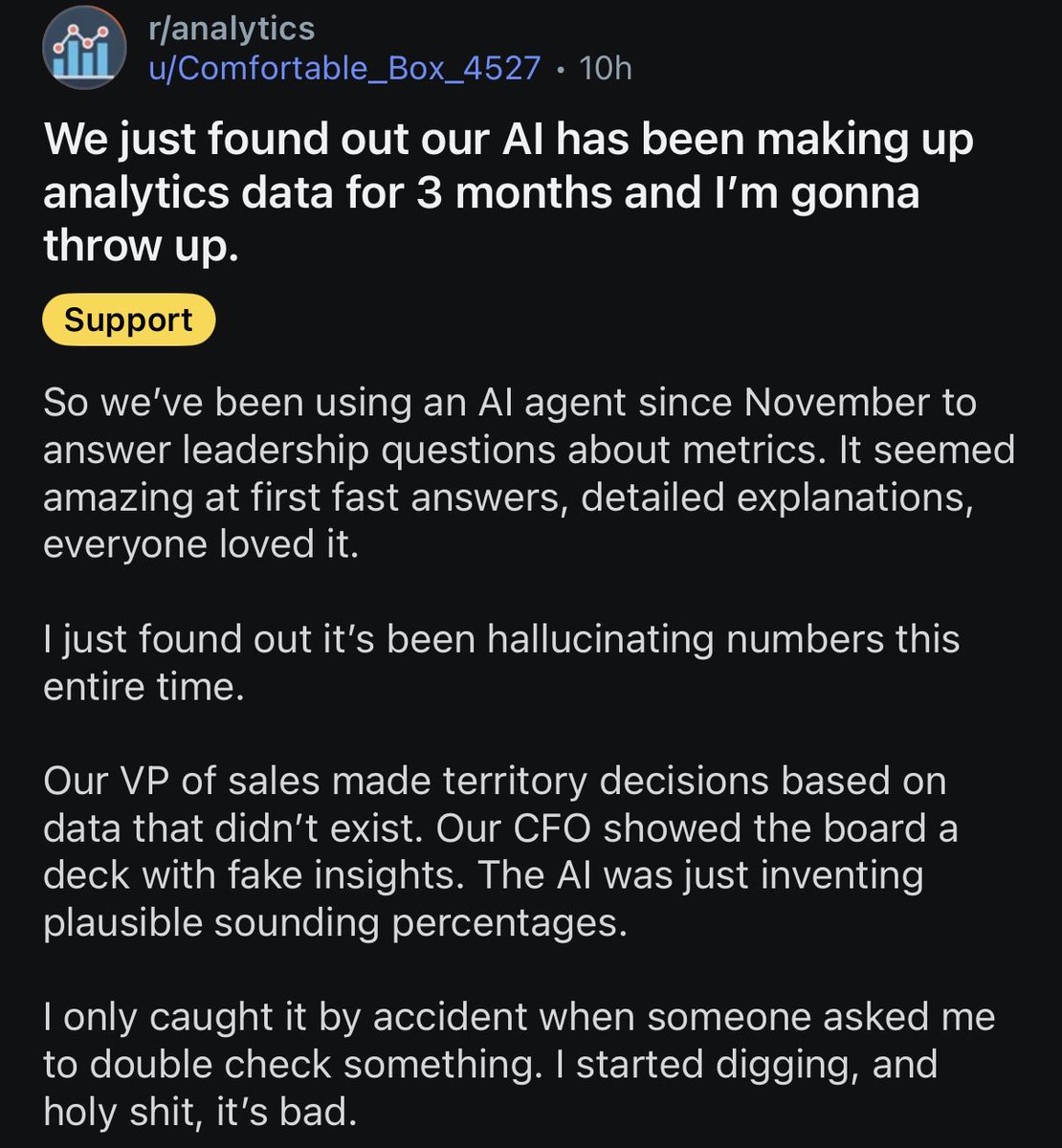
“AI wiLL RePlAcE eVeRy WhItE cOllAr JoB”
1,088
8,273
108,820
3,975,597
Duberney Lopez Piza retweeted

Feb 16
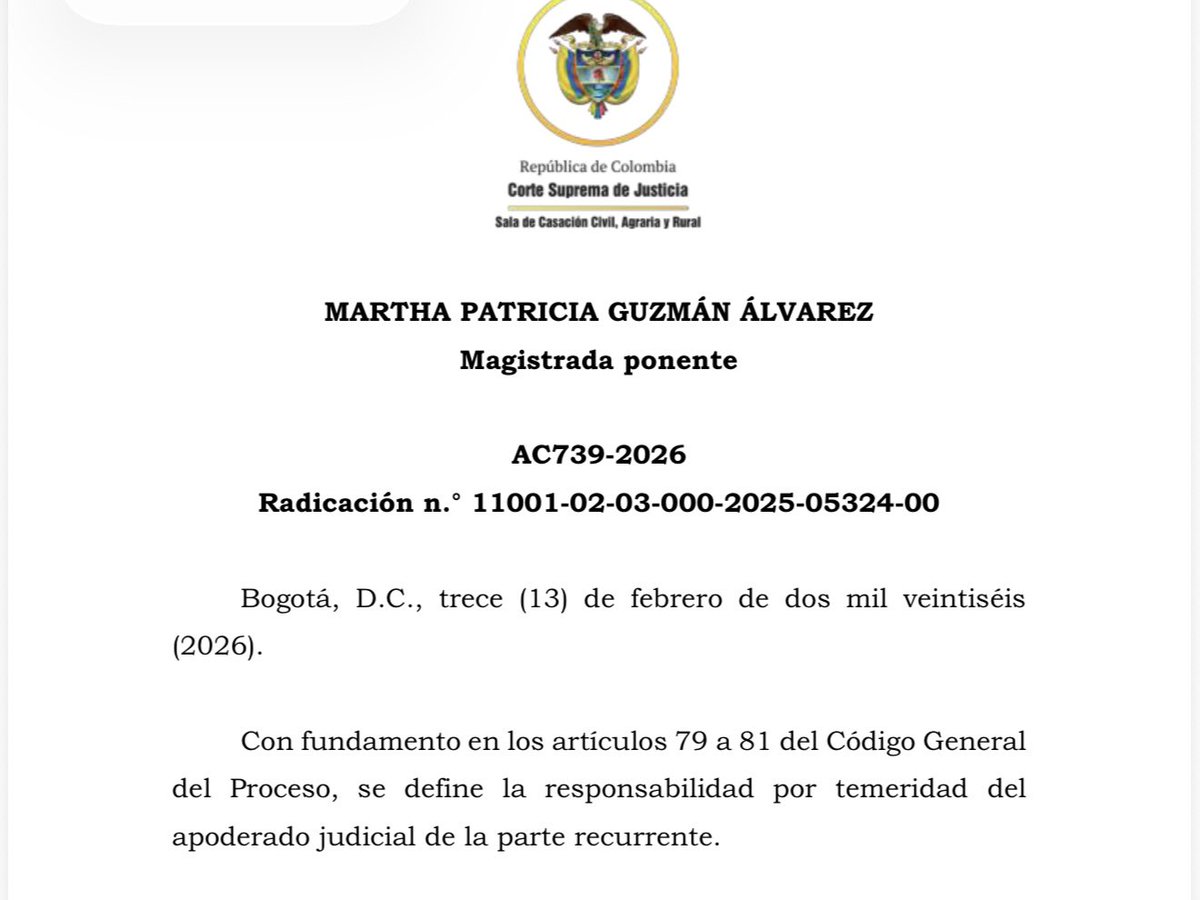
PRIMER CASO EN COLOMBIA DE SANCIÓN A UN ABOGADO POR USO INDEBIDO DE INTELIGENCIA ARTIFICIAL EN EL PROCESO. Corte Suprema de Justicia. Sala Civil. Auto AC739-2026: Se trata de la primera decisión en el país que impone una sanción a un abogado por incorporar en un escrito judicial citas jurisprudenciales inexistentes generadas mediante el uso de inteligencia artificial. En el Auto la Corte IMPUSO MULTA de 15 SMLMV a un apoderado que, al sustentar un recurso, incluyó múltiples sentencias con número, fecha y magistrado ponente que no existen en los repositorios oficiales.
La Relatoría certificó que tales providencias no obraban en archivo alguno. Además, el propio abogado reconoció haber utilizado una herramienta de inteligencia artificial para la elaboración del escrito.
La Corte fue clara al advertir que estos sistemas pueden generar referencias verosímiles pero falsas. No verifican fuentes. Predicen texto a partir de patrones.
A partir de este caso, la Sala precisó reglas relevantes para el uso de estas herramientas en el proceso judicial. Destacó, entre otras, el deber de veracidad, el deber positivo de verificación, la indelegabilidad y la neutralidad tecnológica.
La decisión tiene una circunstancia agravante. Tras ser requerido para explicar las irregularidades, el abogado presentó un escrito de subsanación en el que incorporó cuatro nuevas citas igualmente inexistentes (reincidencia). Entre el escrito inicial y la subsanación se acumularon diez referencias apócrifas. Esa reiteración posterior al requerimiento fue determinante para la severidad de la respuesta.
En mi opinión, estamos en una etapa de transición frente al uso de la inteligencia artificial en el proceso judicial. Es un fenómeno reciente que impacta por igual a litigantes, jueces y a la comunidad jurídica en general.
Todos estamos aprendiendo a dimensionar sus alcances y sus riesgos.
En ese contexto, personalmente considero que, al menos en una primera fase, podría privilegiarse un enfoque pedagógico antes que estrictamente sancionatorio. La fijación de estándares claros, la advertencia institucional y la delimitación de deberes pueden cumplir una función formativa valiosa para todo el sistema.
En el caso concreto, la reiteración posterior al requerimiento (reincidencia) explica la respuesta más rigurosa adoptada por la Corte. Esa circunstancia es jurídicamente relevante. Sin embargo, el desafío estructural sigue siendo común. Consolidar reglas proporcionales, uniformes y transparentes que orienten a todos los actores del proceso.
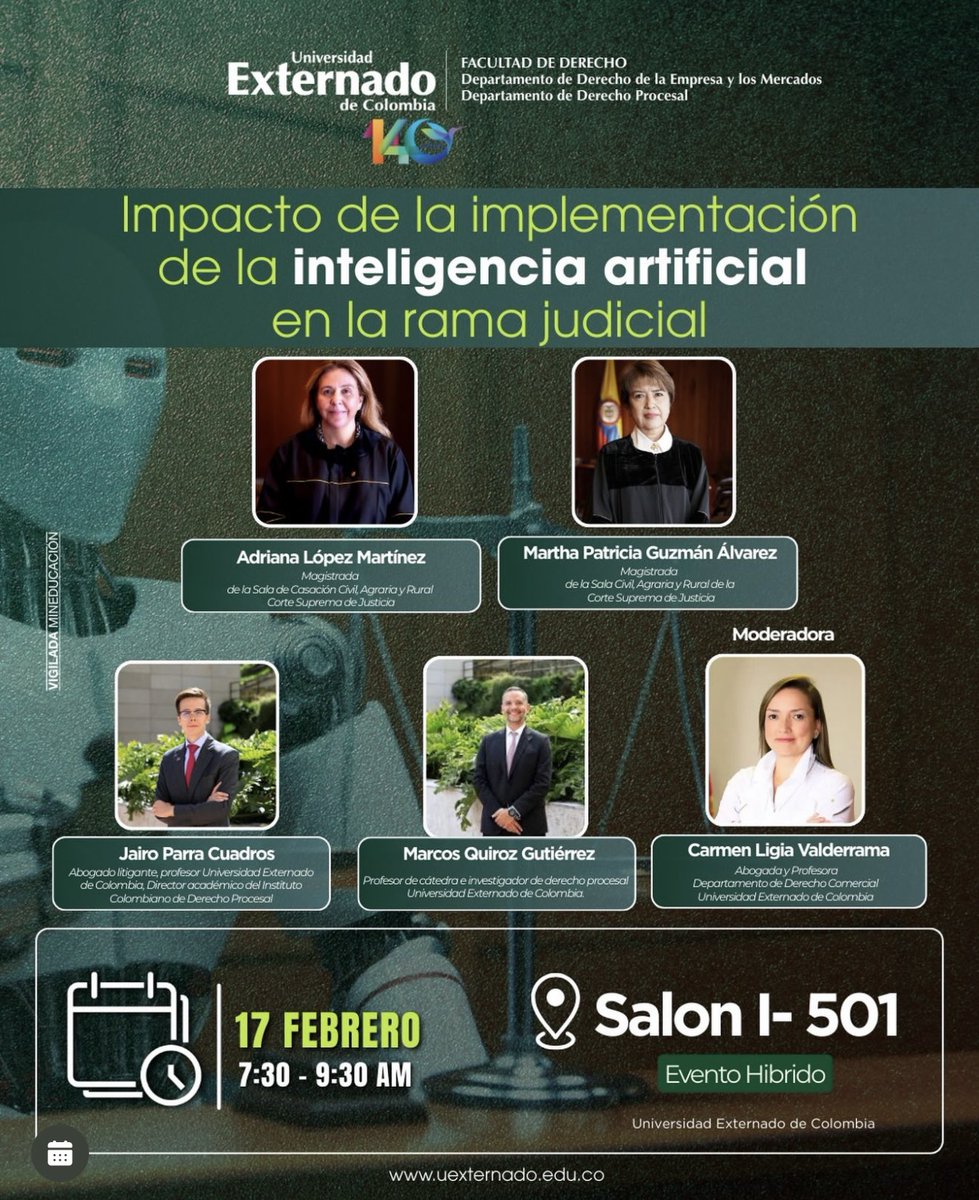
Si este tema resulta de interés, mañana martes 17 de febrero estaremos conversando sobre esta decisión y abordaremos otros aspectos sobre el uso de la inteligencia artificial en la rama judicial.
Es una conversación que merece atención.
Texto completo: drive.google.com/file/d/1N0y…
76
990
2,873
266,010
Duberney Lopez Piza retweeted

Feb 15
Peter Steinberger is joining OpenAI to drive the next generation of personal agents. He is a genius with a lot of amazing ideas about the future of very smart agents interacting with each other to do very useful things for people. We expect this will quickly become core to our product offerings.
OpenClaw will live in a foundation as an open source project that OpenAI will continue to support. The future is going to be extremely multi-agent and it's important to us to support open source as part of that.
4,875
4,251
46,102
16,811,681
Feb 13
Saben qué me tiene trasnochado estos días?
Mi bot “blockito” se borró solo.
Más de 3.000 veces.
Por exigir seguridad.
Pero lo logré.
Mientras tanto, vendo palas.
Ambientes seguros para #OpenClaw.
Post PDF: linkedin.com/feed/update/act…
¿Te interesa? Escríbeme por DM.
1
1
108