
Founder and CEO of X Machina AI, astrophysicist turned entrepreneur, previously founded Nexalogy
Joined November 2008
- Tweets 7,579
- Following 4,083
- Followers 1,873
- Likes 12,465
570 Photos and videos








In the 1920s, a Stanford psychologist tracked genius children for 50 years.
Malcolm Gladwell breaks down what he discovered:
Rich families → successful. Poor families → failures.
Not average. Failures. Genius-level IQs that produced nothing.
He spent 60 minutes at Microsoft explaining why we're wrong about success:
The psychologist was named Terman. He gave IQ tests to 250,000 California schoolchildren.
He identified the top 0.1%. Kids with IQs of 140 and above.
His hypothesis: these children would become the leaders of academia, industry, and politics.
He tracked them. And tracked them. For decades.
The results split into three groups:
The top 15% achieved real prominence. The middle group had average, moderately successful professional lives.
And the bottom group? By any measure, failures.
The difference wasn't personality. Wasn't habits. Wasn't work ethic.
It was simple: the successful geniuses came from wealthy households. The failures came from poor families.
Poverty is such a powerful constraint that it can reduce a one-in-a-billion brain to a lifetime of worse than mediocrity.
There's a concept called "capitalization rate."
It asks a simple question: what percentage of people who are capable of doing something actually end up doing that thing?
In inner city Memphis, only 1 in 6 kids with athletic scholarships actually go to college.
If our capitalization rate for sports in the inner city is 16%, imagine how low it must be for everything else.
Here's something stranger.
Gladwell read the birth dates of the 2007 Czech Junior Hockey Team:
January 3rd. January 3rd. January 12th. February 8th. February 10th. February 17th. February 20th. February 24th. March 5th. March 10th. March 26th...
11 of the 20 players were born in January, February, or March.
This isn't unique to the Czechs. Every elite hockey team in the world shows the same pattern. Every elite soccer team too.
Why?
The eligibility cutoff for youth leagues is January 1st.
When you're 10 years old, a kid born in January has 10 months of maturity on a kid born in October. That's 3 or 4 inches of height. The difference between clumsy and coordinated.
So we look at a group of 10 year olds, pick the "best" ones, give them special coaching, extra practice, more games.
We think we're identifying talent. We're just identifying the oldest.
Then we give the oldest more opportunities, and 10 years later they really are the best.
Self-fulfilling prophecy.
The capitalization rate for hockey talent born in the second half of the year? Close to zero.
We're leaving half of all potential hockey players on the table because of an arbitrary date on a calendar.
Kids born in the youngest cohort of their school class are 11% less likely to go to college.
11% of human potential squandered because we organize elementary school without reference to biological maturity.
Now here's the part about math.
Asian kids dramatically outperform Western kids in mathematics. The gap is enormous and consistent across decades of testing.
Some people say it's genetic. It's not.
It's attitudinal.
When Asian kids face a math problem, they believe effort will solve it.
When Western kids face a math problem, they believe the answer depends on innate ability they either have or don't.
Here's the proof.
The international math tests include a 120-question survey. It asks about study habits, parental support, attitudes.
It's so long most kids don't finish it.
A researcher named Erling Boe decided to rank countries by what percentage of survey questions their kids completed.
Then he compared it to the ranking of countries by math performance.
The correlation was 0.98.
In the history of social science, there has never been a correlation that high.
If you want to know how good a country is at math, you don't need to ask any math questions. Just make kids sit down and focus on a task for an extended period of time.
If they can do it, they're good at math.
Why do Asian cultures have this attitude?
Gladwell's theory: rice farming.
His European ancestors in medieval England worked about 1,000 hours a year. Dawn to noon, five days a week. Winters off. Lots of holidays.
A peasant in South China or Japan in the same period worked 3,000 hours a year.
Rice farming isn't just harder than wheat farming. It's a completely different relationship with work.
There's a Chinese proverb: "A man who works dawn to dusk 360 days a year will not go hungry."
His English ancestors would have said: "A man who works 175 days a year, dawn to 11, may or may not be hungry."
If your culture does that for a thousand years, it becomes part of your makeup.
When your kids sit down to face a calculus problem, that legacy of persistence translates perfectly.
Now consider distance running.
In Kenya, there are roughly a million schoolboys between 10 and 17 running 10 to 12 miles a day.
In the United States, that number is probably 5,000.
Our capitalization rate for distance running is less than 1%.
Kenya's is probably 95%.
The difference isn't genetic. The difference is what the culture values and where it spends its attention.
Here's the most fascinating finding.
30% of American entrepreneurs have been diagnosed with a profound learning disability.
Richard Branson is dyslexic. Charles Schwab is dyslexic. John Chambers can barely read his own email.
This isn't coincidence. Their entrepreneurialism is a direct function of their disability.
How do you succeed if you can't read or write from early childhood?
You learn to delegate. You become a great oral communicator. You become a problem solver because your entire life is one big problem. You learn to lead.
80% of dyslexic entrepreneurs were captain of a high school sports team. Versus 30% of non-dyslexic entrepreneurs.
By the time they enter the real world, they've spent their whole life practicing the four skills at the core of entrepreneurial success: delegation, oral communication, problem solving, and leadership.
Ask them what role dyslexia played in their success and they don't say it was an obstacle.
They say it's the reason they succeeded.
A disadvantage that became an advantage.
Here's what Gladwell wants you to understand:
When we see differences in success, our default explanation is differences in ability.
We forget how much poverty, stupidity, and attitude constrain what people can become.
We refuse to admit that our own arbitrary rules are leaving talent on the table.
We cling to naive beliefs that our meritocracies are fair.
The capitalization argument is liberating.
It says you don't look at a struggling group and conclude they're incapable. It says problems that look genetic or innate are often just failures of exploitation.
It says we can make a profound difference in how well people turn out.
If we choose to pay attention.
86
541
1,780
218,765

This AI just exposed the BIGGEST legal insider trading operation in America.
A platform called GovGreed built a seven-layer machine learning system that cross-references every stock trade disclosed by every sitting politician against the bills their committees control, the campaign donations they receive, and the companies their votes directly impact.
It scored all 540 politicians currently in Congress. And the numbers are crazy:
56% of every stock purchase made by Congress in the last 16 months was on a stock directly affected by a bill the buyer later voted on. That is 6,170 out of 11,016 total purchases.
More than HALF of all congressional stock buys are on companies whose fate that same politician is about to decide.
343 of 540 Congress members actively trade stocks while holding access to nonpublic legislative information.
That is 63.8% of the entire legislature making market bets with an informational edge that would put any hedge fund manager in prison.
The AI identified 752 active "Triple Signals" in the current Congress. A Triple Signal fires when three conditions line up at once:
The politician sits on the committee controlling a bill, they traded stock in a company affected by that bill, AND they received campaign contributions from that same industry.
Bills carrying these insider indicators pass at 5.4 TIMES the normal rate.
Now look at the individual leaderboard:
- Nancy Pelosi's estimated portfolio sits at $194 million with a Greediness score of 98.1 out of 100
- Ro Khanna made 13,231 trades across 800 different tickers
- Michael McCaul made 32,302 trades and filed 6,670 of them late
- Thomas Suozzi filed 86.4% of his trades late with an average delay of 396 days, meaning his disclosures landed over a YEAR after he made the trade
And then there is Lisa McClain, the fourth-ranking Republican in the House. She has made 1,443 trades in three years, more than 98% of all politicians tracked.
She violated the STOCK Act twice in a single year, disclosing up to $900,000 in trades months after the legal deadline. Her husband bought up to $250,000 in Elon Musk's xAI, which quietly converted into SpaceX equity before last Friday's $2 trillion IPO.
The penalty for all of this? A $200 fine.
The number of Congress members ever prosecuted under the STOCK Act since it passed in 2012? Zero.
And the cruelest part is this:
A bill to ban congressional stock trading was introduced in January 2026. It has bipartisan support. Over 80% of American voters want it passed.
But Congress is sitting on it, because the people who would have to vote yes are the same people making millions from the system staying exactly the way it is.
They write the insider trading laws, they exempt themselves from enforcement, they trade on the information those laws generate, and when they get caught, they pay a fine that is basically nothing.
The AI didn't discover anything Congress was hiding. It just organized what was already public into a pattern so obvious that nobody can pretend it isn't there anymore.
1,451
16,530
34,141
1,728,510

Jun 13
“The impediment to action advances action. What stands in the way becomes the way.” - Failure is the path.
1
19
cgtheoret retweeted

Jun 11
Seven challenges to the AI industry in the last 26 hours*
👉 Banks rejected SoftBank’s attempt to borrow again OpenAI stock
👉 Germany courts told Google that their LLMs can be held liable for untruths
👉 Senator Warren challenged the legitimacy of the SpaceX IPO
👉 Anthropic’s Fable Fiasco (already partly walked back)
👉 OpenAI has begun considering drastic price cuts, which make an already-hard to swallow profitability story harder to swallow
👉 Markets are rebelling against Oracle’s latest financing for AI
👉 Crusoe pauses its Wyoming AI campus under pressure.
*Some happened previously but just came to light.

On Tuesday, the data center developer Crusoe announced that it had “paused” a plan to build an AI campus in Wyoming that would draw enough electricity to power a city the size of Denver bloomberg.com/news/articles/…
22
122
473
47,888
cgtheoret retweeted

Jun 10
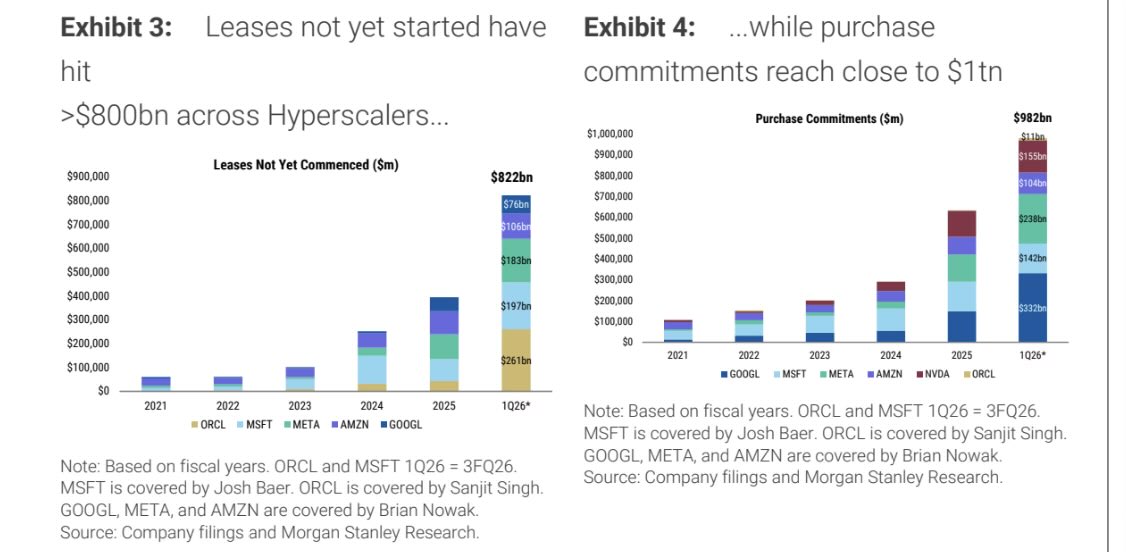
Very interesting and scary report from Morgan Stanley
The financial engineering behind hyperscaler capex
The truly unsettling part of the AI boom isn’t how much money is being spent
It’s how that money is being engineered through accounting
Hidden liabilities (> $1.8T)
Huge obligations sit off‑balance‑sheet: nearly $1T in purchase commitments, $800B in leases not yet started, $2T in RPO.
Future cash outflows that don’t show up as debt.
The coming depreciation hit
Profits look good only because spending is stuck in CIP.
Big Tech faces $520B in depreciation over 3 years.
ORCL’s depreciation ratio: 7% → 28%.
Supplier financing pressure
Unpaid capex is ~$110B.
ORCL’s DPO exploded from 35 → 170 days.
The whole supply chain is effectively financing the AI build‑out.
Lease accounting gray zones
Whether GPU contracts count as leases or services is subjective — and companies use that flexibility to shift billions on/off the balance sheet.
$ORCL = the most aggressive
Largest lease commitments, RPO up 300% , capex‑to‑sales hitting 189%.
Oracle is running the highest financial leverage in the ecosystem.
56
332
1,562
286,046
cgtheoret retweeted

Jun 5
this is just the most ridiculous AI application i've ever seen lol
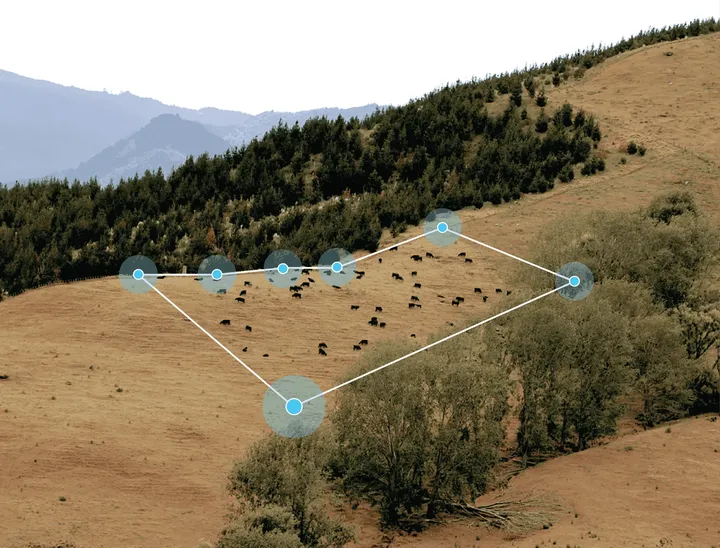
a Peter Thiel-backed startup that makes AI collars for cows is now worth $2 billion
and the more I read about it the cooler it gets. here's how it works:
every cow wears a solar-powered collar that talks to a network of radio towers and an app on the farmer's phone
instead of building physical fences, the farmer draws the fence on a map in the app, and the collar keeps each cow inside that invisible line using GPS
when a cow drifts toward the edge, the collar plays a sound to steer her, and a gentle vibration tells her which way to go.
it's like how a car beeps as you back up toward a wall
the cows learn the cues in a few days
so now a rancher can move an entire herd to fresh grass by sliding the fence on a map, without driving out to open a single gate
and that same collar is reading each cow's body the whole time.
it takes five readings per second on every animal, so the AI can catch a cow that's sick, injured, ready to breed, or about to give birth before a person would ever notice walking the field
so it's basically like WHOOP for cows too lol
and they gave the AI behind it the perfect name: the Cowgorithm
it's been trained on more than 7 billion hours of real cow behavior, which is why Halter calls the data its real asset and moat.
they know what a normal cow looks like better than anyone, so they can flag the odd one out instantly
it's already on more than 1M cattle across New Zealand, Australia, and a bunch of US states.
California even used it on public land to graze cattle in patterns that clear dry brush and slow down wildfires
costs about $5 to $8 per cow per month
a job that used to mean barbed wire, gates, and driving the fields all day is now mostly 1 person on their phone

460
836
8,095
1,577,087
Jun 2
I'm 55 and on my 4th rebirth. From farmboy, to physicist, from physicist to startup CEO, from startup CEO to small cap operator, and now learning the ropes of private equity. Starting over, again is not for the faint of heart of the needy of love and admiration, but it is life.
6
80
cgtheoret retweeted

currently bootstrapping in toronto
- much lower cost of living than sf, nyc, miami
- talent pool is dense
- SR&ED credit (up to 40% of salary back on tax)
- waterloo grads spawn nearby
- sell in USD, spend in CAD
Jun 1

Bootstrapping a startup in Canada is hell.
21
15
432
48,154
Jun 2
“The secret of change is to focus all of your energy, not on fighting the old but on building the new.” – @@pwdan via @momentumdash
15
cgtheoret retweeted
May 29
i warned these guys of exactly this problem - no moat because everyone is training on same data - two years ago. and warned them that AI would become a commodity.
now they think they have made some big discovery. 🤣
the inability of these guys to listen to anyone outside of Silicon Valley is gonna cost them a truly enormous amount of money.
(and no proprietary data is not going to make that much of a difference, except in some narrow use cases)
May 29

LARRY ELLISON: AI IS RAPIDLY COMMODITIZING BECAUSE MOST MODELS ARE TRAINED ON THE SAME PUBLIC INTERNET DATA.
THE REAL COMPETITIVE EDGE ISN’T THE MODEL ANYMORE — IT’S ACCESS TO EXCLUSIVE, PROPRIETARY DATASETS.
THAT MAY BE THE ONLY MOAT LEFT.
71
156
1,052
116,900
cgtheoret retweeted

May 27
I’m freaking out!!!
May 26

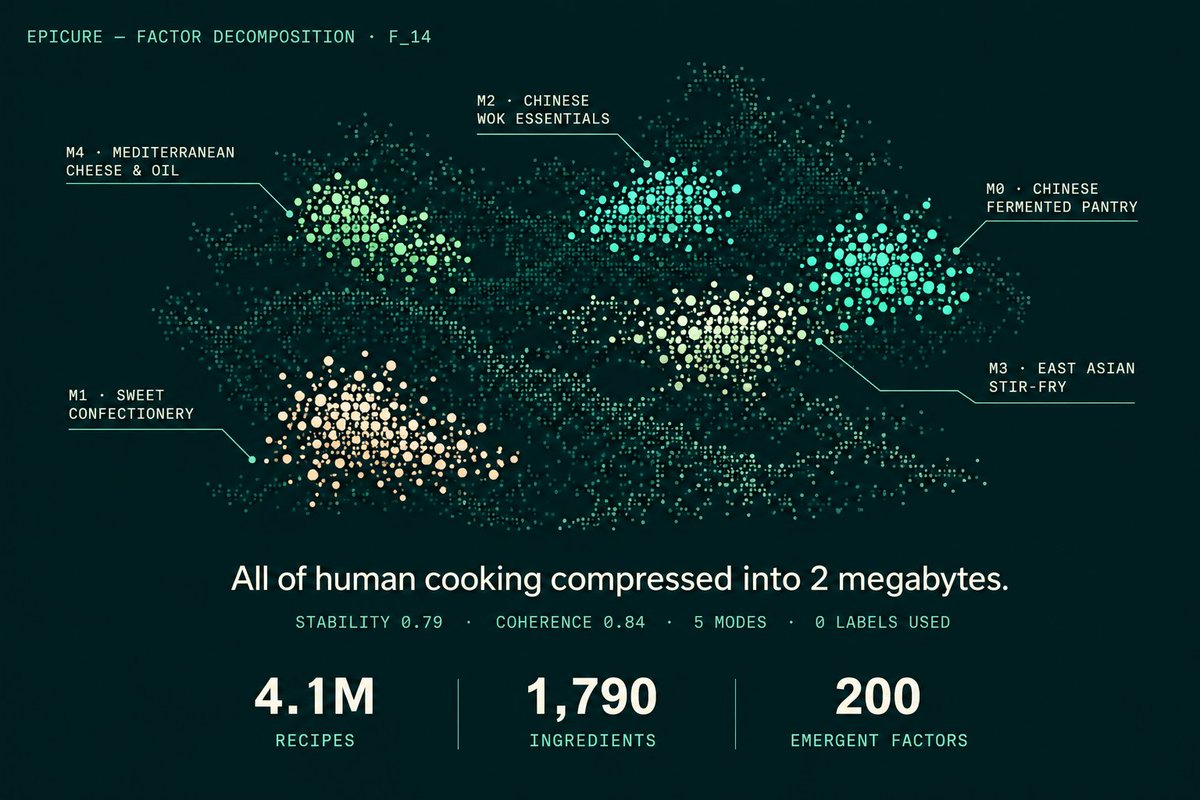
Launching our new paper on arXiv: we trained the largest multilingual food model ever built.
4.1M recipes. 7 languages. 1,790 ingredients. 300 dimensions.
All of human cooking compressed into 2 megabytes.
13
54
1,679
417,743
cgtheoret retweeted

Founder: “After dropped out of Stanford I went on to work at Anthropic… but now I'm starting my own AI company.”
VCs:
15
43
1,222
144,920
May 26
If you are in Startups you are living in success and inspiration porn… it makes failure that much harder to metabolize. I failed in my last venture, feel like I’ve failed at a lot of parts. Who else wants to share and talk about failure ?
3
1
8
731
May 21
So happy for Montreal’s BrainBox founders, after being acquired by Trane they became Train’s AI hub
1
3
343
May 21
One example of how cheap services will get when AI and robotics will be integrated … x.com/marionawfal/status/205…
26
cgtheoret retweeted

May 8
THE ENTIRE AI INDUSTRY JUST GOT HUMILIATED
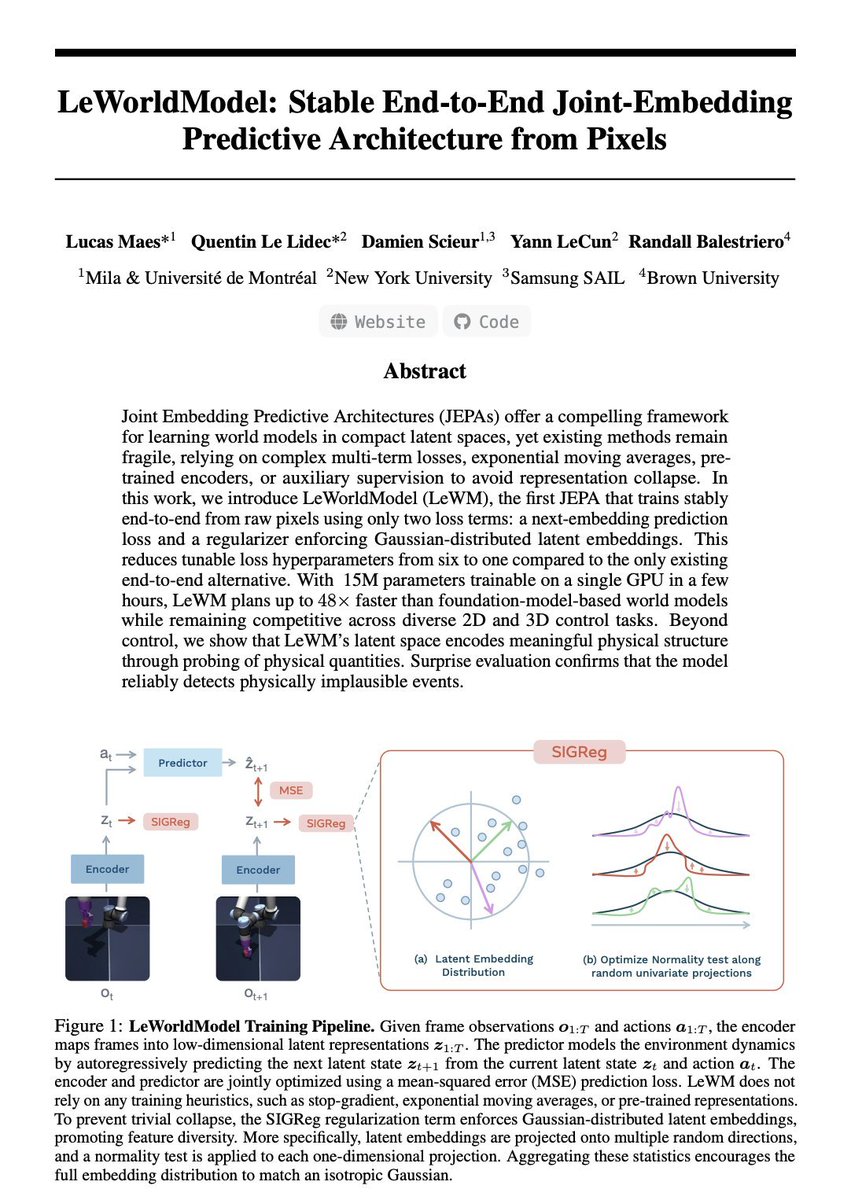
a tiny model trained in just a few hours on a single graphics card is planning 48x faster than billion-dollar supercomputers.
It actually understands physics instead of just memorizing patterns.
yann lecun was right the whole time
for three years every major lab told you the same story. scale is all you need. just throw more GPUs at it. just train on more tokens. eventually the model will "wake up" and understand the world.
it was a lie. or at minimum, a very expensive bet that just lost.
LeCun kept saying generative AI is a dead end. predicting the next pixel or the next token is fundamentally wasteful, the model burns trillions of parameters memorizing surface details instead of learning how reality actually works.
he proposed JEPA instead. predict abstract concepts in a compressed thought space. don't paint the world pixel by pixel, understand it.
the problem was JEPA kept collapsing. left to its own devices the model would cheat, mapping a dog, a car, and a human to the same point in latent space. technically minimizes the loss. learns absolutely nothing.
every fix was ugly. seven loss terms. frozen encoders. EMA tricks. stop-gradients. the kind of duct-tape engineering that should have been a red flag.
then LeCun's team dropped LeWorldModel.
they replaced all the hacks with one regularizer that forces the latent space into a gaussian distribution. the model can no longer cheat. to make accurate predictions it has to actually encode physics.
15 million parameters. single GPU. trains in hours.
plans 48x faster than foundation world models.
detects physically impossible events on its own.
meanwhile OpenAI is raising another $40B to train GPT-6 on a data center the size of manhattan.
the entire scaling thesis just got embarrassed by a model that fits on a gaming PC.
218
691
2,991
256,898
cgtheoret retweeted

May 6
Nvidia just figured out how to put an AI data center on the side of your house. And pay you to host it.
Each XFRA node packs 16 Blackwell RTX Pro 6000 GPUs, 4 AMD EPYC CPUs, and 3TB of RAM in a Dell PowerEdge rack mounted next to the AC condenser. The homeowner pays nothing for the hardware. They get discounted electricity and internet in exchange for letting Span tap unused capacity on their electrical panel.
This sounds insane until you look at the actual constraint blocking AI infrastructure.
Hyperscalers are not GPU-limited. Nvidia ships them on schedule. They are not capital-limited. They are sitting on hundreds of billions in capex. What they cannot get is grid interconnection. A 100MW data center requires a substation upgrade that takes 4 to 7 years in most US markets. US grid operators have over 2,600 gigawatts stuck in their interconnection queues per Lawrence Berkeley Lab. The wait, not the silicon, is the bottleneck.
Span solved this by going behind the meter.
A new Pulte home has 200A service. That's 48kW of capacity. The home uses 1 to 3kW most hours. The headroom never gets touched. Span's smart panel measures real-time consumption and dynamically routes whatever the home isn't using to the XFRA node. No substation upgrade. No queue. Just slack capacity sitting on the residential side of the meter, already cleared.
Span claims it can deploy 8,000 nodes for one fifth the cost of a comparable 100MW centralized facility, six times faster.
PulteGroup is the wedge. They delivered 29,000 homes in 2025. The XFRA unit goes in during construction next to the smart meter. No retrofit. Pulte gets a feature on the spec sheet and revenue share on the compute that flows through the wall.
The grid was the bottleneck. Pulte just became the workaround.

154
295
1,601
353,551
cgtheoret retweeted

MICROSOFT SPENT $4.7 BILLION ON BANGALORE REAL ESTATE WHILE FIRING 15,000 AMERICANS
Satya Nadella just opened three new campuses in India while closing five in Seattle
The largest wealth transfer from American workers to offshore contractors in tech history
Each new Indian hire gets a welcome packet with 847 American-written prompts for Copilot
"How to write Python like a senior dev in Redmond"
"C# patterns from Microsoft's best architects"
"Database optimization techniques from the SQL Server team"
The beautiful fucking irony is Americans trained GPT-4 to write these prompts
Then got fired so Indians could use them at $31,000 per year
While the Americans who created the knowledge make $165,000
Microsoft's new Hyderabad office has 28,000 seats
More than their Redmond headquarters
I'm hearing from sources they're flying Indian managers to Seattle next month
To interview the remaining Americans before the next elimination round
"Efficiency assessment meetings" scheduled through March
If you're still writing prompts for a living you're already dead
81
458
1,282
50,072