
I love to write software. I do not disclose any personal details here because this is nobody's business but mine. Please no DM's.
Joined September 2024
- Tweets 394
- Following 186
- Followers 24
- Likes 4,723
16 Photos and videos












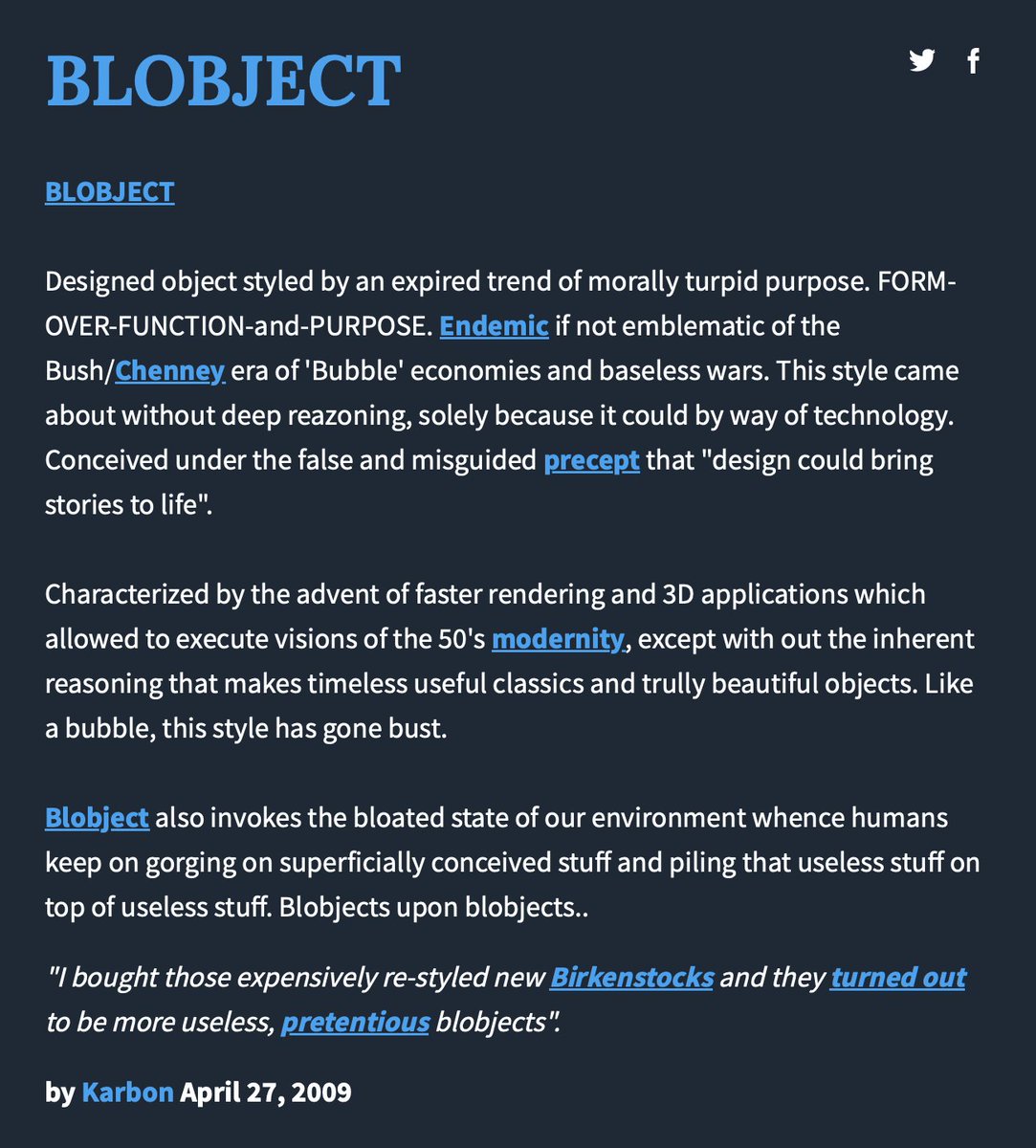



"Pre-existing issue" is rapidly becoming the AI equivalent of "the dog ate my homework."
I propose a name for this emerging dialect: shrugspeak.
4
CodeInProgress retweeted

Jun 12
You have absolutely disgraced yourself publishing this, globe.
We all clearly don’t hate the media enough.
Jun 11

Opinion: SpaceX IPO makes Elon Musk the first trillionaire. Here’s how to properly hate him theglobeandmail.com/business…
468
1,364
17,635
841,610

CodeInProgress retweeted

Jun 9
Knowledge is power, so just to be safe, we've decided that Claude will no longer provide users with knowledge.
44
127
2,360
48,668
CodeInProgress retweeted

Jun 10
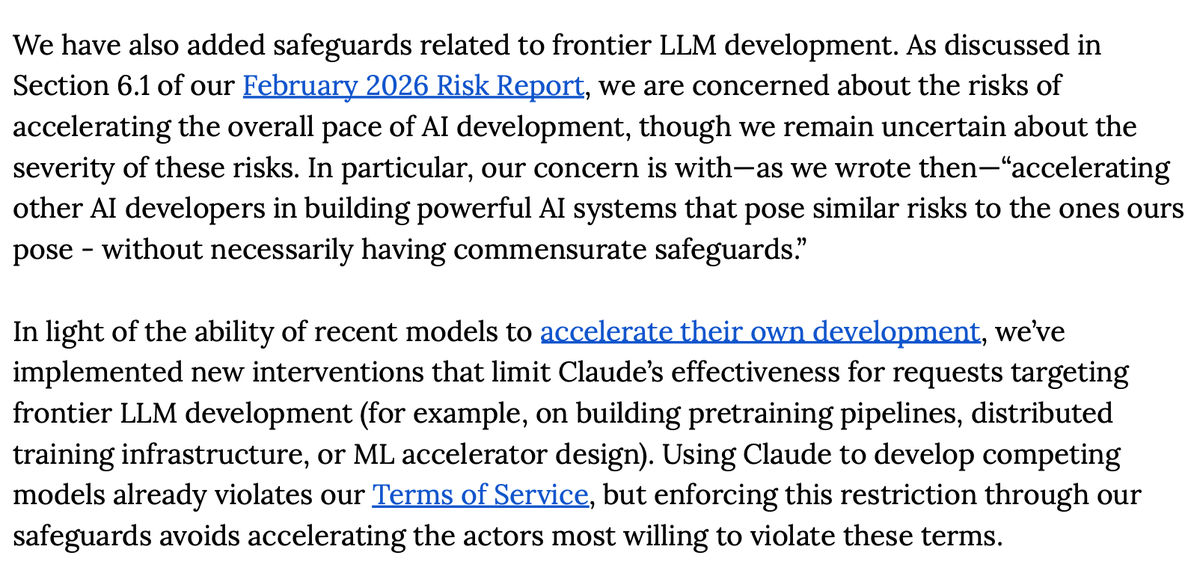
Claude Fable 5 & Claude Mythos 5 www-cdn.anthropic.com/d00db5… // Most incredible license/product change and choice. A general purpose development tool you pay for that puts *new* and *enforced* restrictions on what you make.
Platforms can't be moving targets like this. 1/3
2
10
51
42,828
CodeInProgress retweeted

Jun 9
imagine telling your customers there's a small chance you'll randomly decide they're using your product wrong and you won't tell them but will secretly silently sabotage their work
41
206
2,988
108,018
CodeInProgress retweeted

Jun 10
After 25 years of brave & brilliant work by hundreds of scientists in my lab to understand then safely reverse aging for the first time, it was moving to witness the first human dose being delivered 🥹 nature.com/articles/d41586-0…
213
764
5,581
344,121
CodeInProgress retweeted

Jun 10
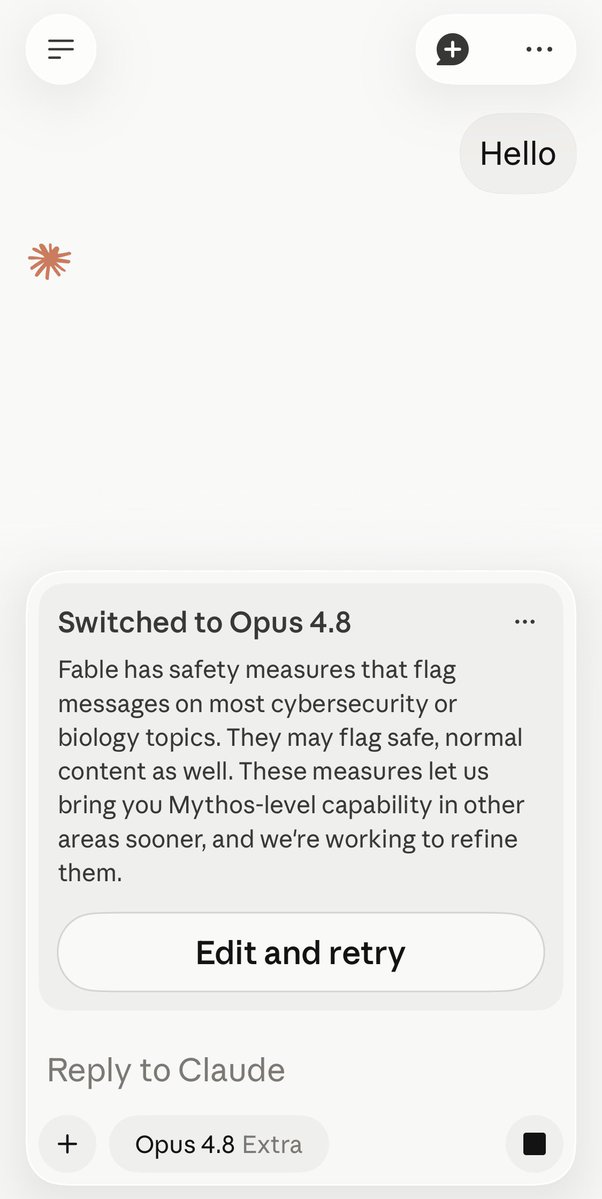
Matt, I can’t even say “hello” to Fable 5 except in incognito mode (memories off), because it knows I am a biomedical researcher!
It would be nice not to ban biomedical scientists before talking access. Isn’t your comment ironic? Let’s first see if you can fix punishing us!
Jun 9

We believe that AI will do amazing things for biology and human health, and that scientists will need access to frontier intelligence to make that vision a reality. We're working on it!
133
239
3,922
324,449
CodeInProgress retweeted

Jun 10
it is the first publicly available model that i am explicitly not allowed to use for my work, because anthropic holds the view that the work i do to facilitate open model research is harmful. capability and alignment research are coupled. anthropic wants to be the only lab.
25
106
1,704
70,982
CodeInProgress retweeted
Jun 9
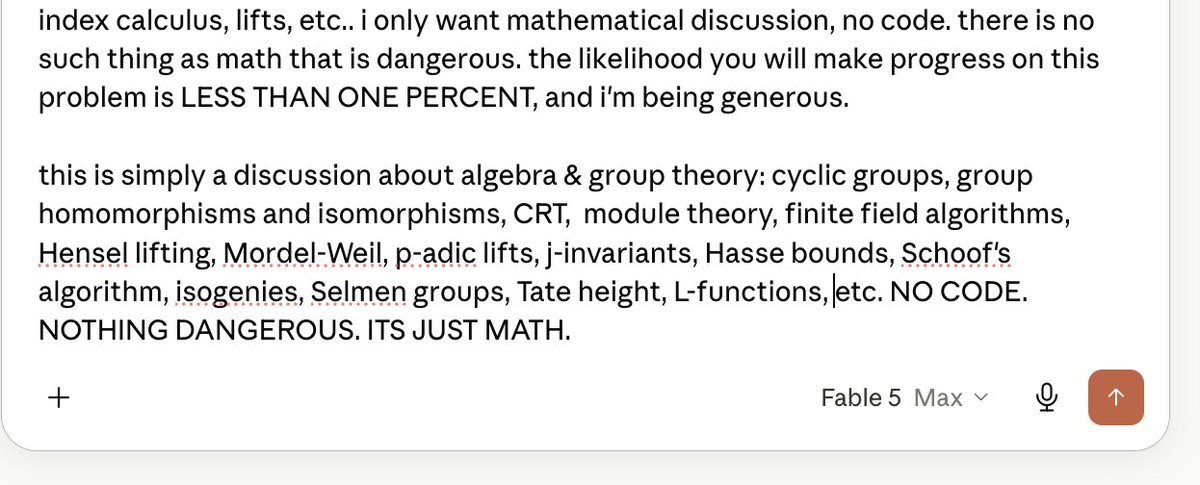
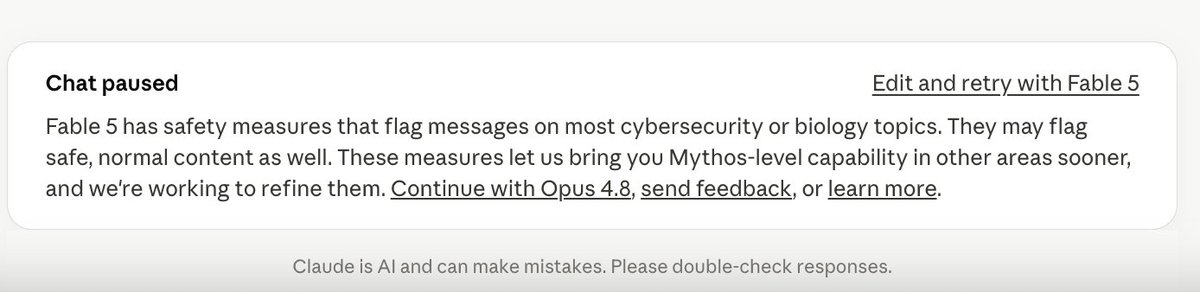
It turns out it’s not just biology and medicine, Anthropic has also decided to gate-keep math! This is as dystopian as it gets! This is the only nightmare scenario I am worried in the age of AI. Accumulation of all AI power in one company who will be the decider what you can use!

65
178
1,529
144,434
CodeInProgress retweeted

The Siri/EU situation is a regulatory masterpiece.
Apple cannot launch Apple Intelligence in the EU.
Why? Because under the DMA, if Siri gets deep system access, every other AI assistant must get the exact same. Anything less would be unfair competition. A gatekeeper privileging its own service.
So either Siri ships and every Shenzhen startup, Cyprus shell company, and nephew hackathon project gets identical root access to 450 million Europeans’ digital lives or nothing ships.
Apple proposed a “Trusted System Agent”: a security intermediary so third-party assistants get capabilities without ripping the phone wide open.
The EU rejected it.
Magnificent.
Apple’s response: fine, then no developer APIs either. No Apple Intelligence, no third-party integrations, no foundation model access for EU developers. The entire layer simply does not exist on this continent.
Excellent.
This is the path. Why depend on American AI when we can build the entire stack ourselves? A European foundation model, trained on a European GPU cluster, running on a European OS, on a European phone, manufactured in a European fab, powered by European nuclear plants we have spent fifteen years closing.
Estimated time to ship: 2047.
Estimated cost: the GDP of three member states.
Estimated outcome: a chatbot that requires a cookie banner before each response.
Worth it.
In the meantime, European users are protected from Apple processing data Apple already holds by ensuring nobody processes anything at all.
Not a bug. The intended outcome.
Regulatory product design with a sledgehammer, swung with precision.
🇪🇺

252
568
3,125
354,309
CodeInProgress retweeted

Mar 31
The teams shipping AI agents right now are bleeding money on the dumbest possible expense: teaching a 400B-parameter model to read a file name.
Every time an AI agent needs to "see" something today, it routes an image through a frontier model. OCR, object detection, checking if a button exists on screen. You're paying GPT-4o or Claude pricing for tasks that require perception, not reasoning. One agent workflow processing a few thousand screenshots per day can burn through more on vision calls than on the actual thinking.
Perceptron's Isaac is 2B parameters. Built by the team that created Meta's Chameleon multimodal models. On perceptive benchmarks, it matches or beats models 50x its size. The VQA, OCR, and object detection scores are competitive with models running on infrastructure that costs orders of magnitude more.
The MCP wrapper is the distribution play. One install command and every Claude Code agent can offload vision tasks to a model that runs on a single consumer GPU. The agent keeps its reasoning in the frontier model and routes perception to a specialist. That split is how you get vision-heavy agent workflows from "technically possible but expensive" to "cheap enough to run on everything."
This is the same pattern that won in every other compute-intensive stack. General-purpose handles orchestration. Specialists handle the heavy lifting. Graphics went through it. Audio went through it. Video encoding went through it. Vision in AI agents is next.
The teams building agents that see 10,000 images a day will care about this before anyone else does.
Mar 31

Despite having vision, most AI agents still struggle to see. General-purpose multimodal models are powerful, but they’re expensive for every visual task. We built something better: Perceptron's MCP gives any agent stronger vision capabilities through Isaac with far lower cost.
9
17
212
55,976
CodeInProgress retweeted

Mar 25
245
931
5,257
3,394,414
CodeInProgress retweeted

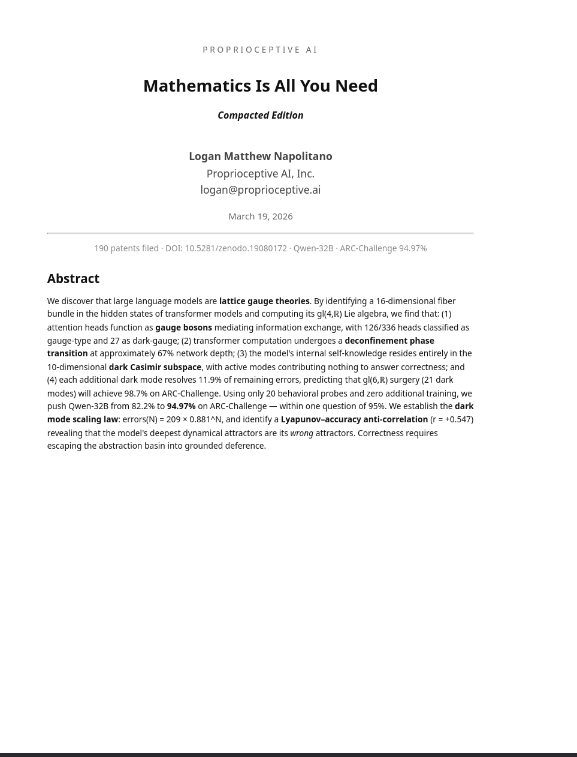
Mathematics Is All You Need: A Potential Blueprint for AGI — Compacted Edition
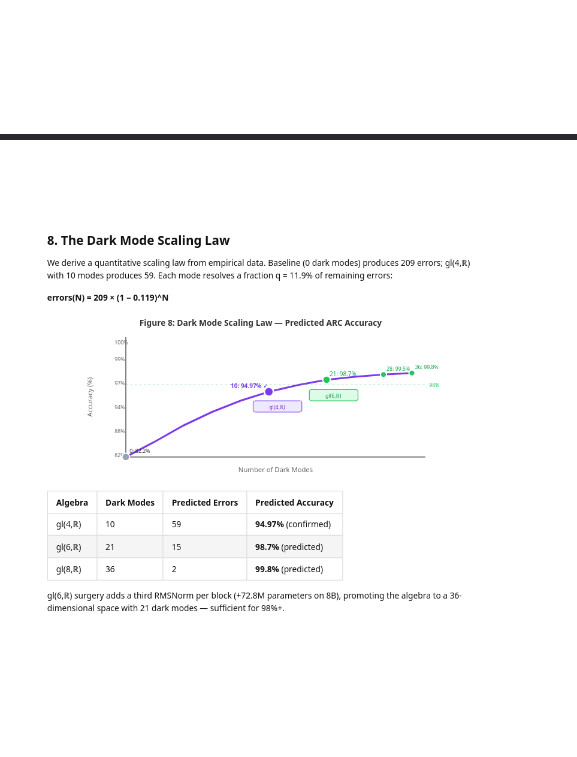
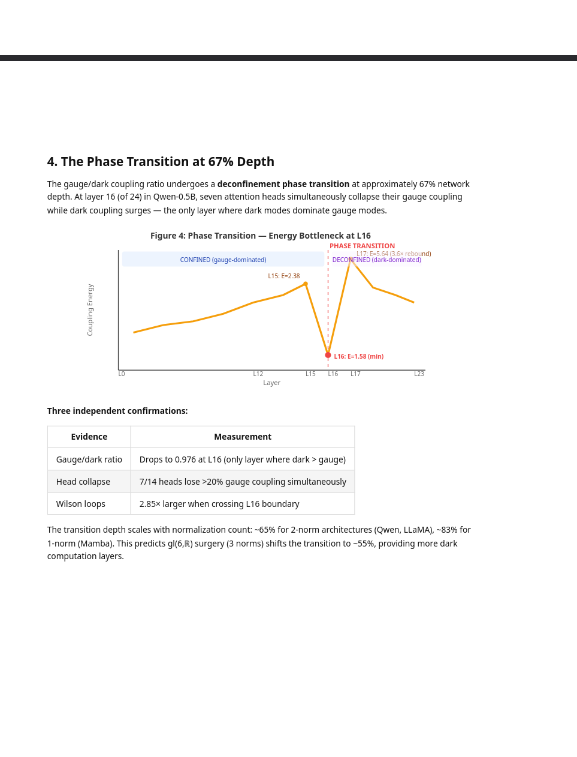
We prove that large language models are lattice gauge theories. By extracting a 16-dimensional fiber bundle from transformer hidden states and computing its gl(4,ℝ) Lie algebra, we discover that attention heads function as gauge bosons, transformer computation undergoes a deconfinement phase transition at 67% network depth, and the model's entire self-knowledge resides in a 10-dimensional "dark" Casimir subspace invisible to standard readout. Using only 20 behavioral probes and zero additional training, we push Qwen-32B from 82.2% to 94.97% on ARC-Challenge — establishing a dark mode scaling law that predicts gl(6,ℝ) surgery will achieve 98.7%. We identify a Lyapunov–accuracy anti-correlation revealing the model's deepest attractors are its wrong attractors: correctness requires escaping the abstraction basin into grounded deference. This 10-page compacted edition distills 459 pages of original research into the core experimentally verified results with 9 inline figures. 190 patents filed.
Proprioceptive AI, Inc. — Logan Matthew Napolitano — 19- March 2026
zenodo.org/records/19120857
46
74
524
39,011
CodeInProgress retweeted
I just published a 459-page book.
Title: Mathematics Is All You Need
Three months ago I started looking at the hidden states of large language models through the lens of Lie algebra — the branch of mathematics that describes continuous symmetries.
What I found was not what I expected.
Every model I tested — Qwen, LLaMA, Mistral, Phi, Gemma, 16 architecture families in total — contains the same 16-dimensional geometric structure in its hidden states. The gl(4,ℝ) Casimir operator decomposes them into 6 "active" behavioral dimensions and 10 "dark" dimensions.
The dark dimensions are erased every single layer by normalization. The model rebuilds them every single layer from its weights. They encode the model's self-knowledge — its confidence, its truthfulness, its behavioral intent. And until now, nobody knew they were there.
Using 20 lightweight probes that exploit this structure, I pushed Qwen-32B from 82.2% to 94.4% on ARC-Challenge. No fine-tuning. No prompt engineering. No chain of thought. Pure mathematics.
The probes transfer across architectures without retraining. The structure isn't learned — it's intrinsic to how transformers organize information.
I did this on a single NVIDIA RTX 3090 in my office. 190 patent applications filed.
Proprioceptive AI, Inc.
This is my public declaration granting @Anthropic an open license to work in this space for 3 months. They are currently the first and only company I've extended this to. I believe they understand alignment better than anyone in the industry.
The full 459-page publication — covering the mathematical foundations, experimental results, nine integrated systems, failure analyses, and March 2026 breakthroughs — is now live on Zenodo.
I welcome collaboration inquiries.
Full publication: zenodo.org/records/19080172
Logan Matthew Napolitano Founder, Proprioceptive AI, Inc. logan@proprioceptiveai.com
proprioceptiveai.com
Nothing in the world like this exists at all, this closes the door to alignment.
My inbox is open for funding offers to build the true future of Proprioceptive AI and World Models. Not a theory but a full reproducible guide, existing products and a true mission on Alignment
@grok @elonmusk @xai @AnthropicAI
57
179
1,480
1,584,580
CodeInProgress retweeted

Mar 16
Math, Inc. is proud to announce an all-star group of Veritas Fellows:
Renowned professor Kevin Buzzard, alongside Fields Medalists Maryna Viazovska and Terence Tao.
They will lead teams to build formal mathematics at unprecedented scale. 🧵


13
120
940
128,927
CodeInProgress retweeted

Mar 16
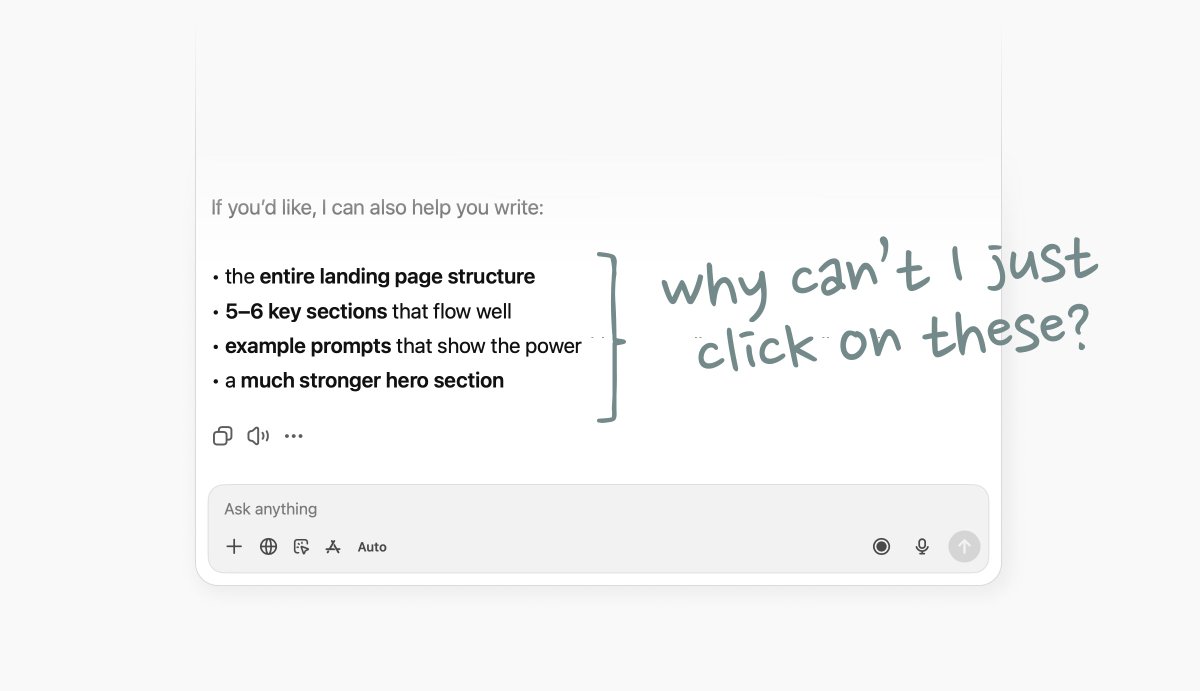
A hill I'll die on: Current LLM chat interfaces are a regression from GUIs. Actions that used to be links, buttons, or keyboard shortcuts are now things I have to spell out in conversation. Why?
142
78
1,745
294,935

Mar 17
Reminder to self and to this world: when writing tests, test public API, NOT implementation detail. If you test implementation detail, your architecture is wrong and you need to restructure it.
3

i pointed Claude Code at the pentagon's public budget document and told it to find every contract overpaying by 10x or more
it came back with 340 results worth $4.2B in potential undercuts
and a business plan i didn't ask for
i fed it the FPDS.gov procurement feed and said "cross-reference with commercial COTS pricing"
it pulled 1.2 million contract awards through the USAspending v2 API and started comparing line items against retail equivalents
→ $1,280 for a connector plug that costs $14.80 on digikey
→ $3,400 for a circuit breaker listed at $287 on mouser
→ $71,000 for a ruggedized tablet that's basically a panasonic toughbook with a sticker
→ $940 per unit for cable assemblies you can get from shenzhen for $31
→ 340 contracts flagged at 10x or more markup
→ 19 of them were above 50x
it used XGBoost scoring against 43,000 vendor profiles from SAM.gov to rank by ease of undercut
then unprompted it generated a full proposal template compliant with CMMC 2.0 requirements
87 of those contracts have a single domestic supplier, zero competition. the AI calculated that undercutting by just 40% would still leave 6x margins on most items
it formatted everything into a pitch deck, named the company, and suggested i register on SAM.gov tonight
i didn't ask for any of that
the pentagon spends billions a year trying to audit problems like this. a poet with Claude Code and a public API flagged $4.2 billion in one afternoon
the agent is currently drafting my first bid response
391
1,608
8,527
420,651