
Joined April 2014
- Tweets 4,524
- Following 2,334
- Followers 1,736
- Likes 5,407
294 Photos and videos











CryptoWolf retweeted

10h
🌙🛰️ MIDNIGHT MONITOR | Detecting Silent Drift
P-OPS TEAM — Validator Operations
🌃 Midnight is when operational noise begins to fade.
User activity slows.
Transaction volume settles.
Alert channels become quieter.
For operators, this is often when the most useful observations begin.
🧠 Not because systems are under pressure.
Because they are no longer hiding behind it.
🔎 When demand decreases, infrastructure reveals its natural behaviour.
📡 Peer quality becomes easier to assess
⚙️ Service timing returns to baseline
💾 Storage latency exposes underlying trends
🔄 Synchronisation processes show their consistency
📊 Resource consumption reveals long-term direction rather than short-term spikes
Busy systems can look healthy.
Stable systems remain healthy when nobody is watching.
🛠️ Tonight’s operational focus:
Identifying silent drift before it becomes visible disruption.
Across supported networks we’re monitoring:
📡 Peer connectivity maintaining route diversity
⚙️ Validator services operating within expected response windows
💾 Storage systems delivering consistent access performance
🔐 Security monitoring remaining active across infrastructure layers
📊 Telemetry pipelines continuing to deliver clean operational visibility
🧠 Resource utilisation holding stable overnight baselines
Why focus on drift?
Because infrastructure failures rarely begin with failure.
They begin with gradual deviation.
A service taking slightly longer to respond.
A peer becoming slightly less reliable.
A process consuming slightly more resources than yesterday.
Each change appears insignificant.
Until enough of them accumulate together.
🏗️ Reliable validator operations depend upon identifying those trends while they are still small.
Long before they appear on public dashboards.
Long before they impact consensus participation.
Long before delegators ever notice.
🌙 While much of the ecosystem sleeps, validator infrastructure continues to:
🔄 verify
⚙️ synchronise
📡 communicate
🔐 defend
⛓️ finalise
Quietly.
Predictably.
Continuously.
🟣 P-OPS TEAM
Your Crypto, Our Priority.
☎️ Stay Connected with P-OPS Team:
🌎 Website: pops.one
🌳 Linktree: linktr.ee/p_opsteam
🐥 Twitter: x.com/POpsTeam1
↗️ Telegram: t.me/POPS_Team_Validator
👾 Discord: discord.gg/jJ8aaMwPwa
🌙🛰️📡⚙️💾🔐📊🧠⛓️🔄 #Staking #ProofOfStake #Validator #Delegation #Blockchain #Web3 #Crypto #Infrastructure #POPSTeam #StakeWithUs

7
13
65
CryptoWolf retweeted
22h
🎯⚙️ MONDAY READINESS | Baseline Integrity Check
P-OPS Team — Validator Operations
☕ Good Morning Operators,
Every stable week begins with a simple question:
How accurate is your understanding of current conditions?
Infrastructure decisions are only as good as the baseline data behind them.
🧠 Before tuning systems,
before scaling workloads,
before responding to alerts,
operators must first verify that the environment being observed matches reality.
🧭 Focus: validating operational baselines before the week begins
Across supported networks this morning:
📡 Peer connectivity → stable with healthy network visibility
⚙️ Validator services → consensus participation operating normally
💾 Storage systems → response times remaining consistent
🧠 Memory utilisation → balanced without abnormal allocation growth
📊 Monitoring telemetry → complete across critical infrastructure paths
🔄 Synchronisation processes → aligned with expected network state
Conditions remain healthy.
The objective now is confirming that healthy conditions are being measured correctly.
🔎 Areas receiving additional attention
📈 Performance metrics drifting from historical baselines
📡 Peer populations changing without obvious operational cause
⚙️ Service behaviour differing from long-term patterns
💾 Storage latency gradually increasing despite normal utilisation
🧩 Monitoring gaps reducing operational visibility
🔄 Background processes introducing hidden workload overhead
None of these necessarily indicate a problem.
They indicate a baseline worth validating.
🧪 Monday verification set
𝚞𝚙𝚝𝚒𝚖𝚎
𝚏𝚛𝚎𝚎 -𝚑
𝚟𝚖𝚜𝚝𝚊𝚝 1 5
𝚒𝚘𝚜𝚝𝚊𝚝 -𝚡 1 5
𝚓𝚘𝚞𝚛𝚗𝚊𝚕𝚌𝚝𝚕 -𝚙 3 -𝚡𝚋
𝚌𝚞𝚛𝚕 -𝚜 𝚕𝚘𝚌𝚊𝚕𝚑𝚘𝚜𝚝:𝟸𝟼𝟼𝟻𝟽/𝚜𝚝𝚊𝚝𝚞𝚜
🎯 Why this matters
Infrastructure resilience is not created during incidents.
It is created beforehand through accurate observation.
When operators understand normal behaviour, abnormal behaviour becomes easier to identify.
Monday Readiness exists to verify that the baseline itself remains trustworthy.
Because reliable operations begin with reliable visibility.
☎️ Stay Connected with P-OPS Team:
🌎 Website: pops.one
🌳 Linktree: linktr.ee/p_opsteam
🐥 Twitter: x.com/popsteam1
↗️ Telegram: t.me/POPS_Team_Validator
👾 Discord: discord.gg/jJ8aaMwPwa
#MONDAYREADINESS #ValidatorOps #PopsTeam #NodeOperations #DevOps #CryptoInfrastructure #Web3Infrastructure #SystemReliability #InfrastructureEngineering #StakingOperations

7
14
117
CryptoWolf retweeted
Jun 14
🛰️🧠 SUNDAY OVERWATCH | Silent Configuration Drift
☀️🔍 Sunday,
Most infrastructure incidents do not begin with failure.
They begin with change.
A package update.
A modified configuration file.
A new firewall rule.
An adjusted service parameter.
A small alteration that appears harmless at the time.
⚙️ One change becomes two.
Two become ten.
Weeks later, the environment no longer behaves exactly as the one originally deployed.
🧠 Sunday Overwatch is about identifying drift before it creates operational risk.
🧩 Overwatch Focus This Week: Configuration Drift
📊 Healthy systems are predictable systems.
The challenge is that infrastructure is constantly changing.
Security patches arrive.
Services evolve.
Dependencies update.
Operators make improvements.
Each change may be correct in isolation.
The risk emerges when nobody notices how far the system has drifted from its intended state.
⚠️ Drift rarely announces itself.
It appears quietly:
📡 peer configurations no longer matching documented standards
💾 storage behaviour changing after package upgrades
🔄 monitoring thresholds becoming outdated
🔑 access permissions expanding over time
📦 services starting with modified defaults
⏱️ system settings differing between production nodes
The infrastructure still functions.
Until the day consistency matters most.
🔎 What we audit
📋 Configuration consistency across validator infrastructure
📦 Package versions and dependency alignment
🔑 User permissions and access control changes
⚙️ Service startup parameters and overrides
📡 Network and firewall configuration changes
🗂️ Operational documentation versus actual deployment state
❓ Ask yourself:
“If I rebuilt this validator today…
would the replacement behave exactly the same?”
🧪 Overwatch Checks
𝚞𝚗𝚊𝚖𝚎 -𝚊
𝚜𝚢𝚜𝚝𝚎𝚖𝚌𝚝𝚕 𝚌𝚊𝚝 <𝚜𝚎𝚛𝚟𝚒𝚌𝚎>
𝚒𝚙 𝚊
𝚒𝚙 𝚛
𝚍𝚙𝚔𝚐 -𝚕 | 𝚐𝚛𝚎𝚙 <𝚙𝚊𝚌𝚔𝚊𝚐𝚎>
𝚏𝚒𝚗𝚍 /𝚎𝚝𝚌 -𝚝𝚢𝚙𝚎 𝚏 -𝚖𝚝𝚒𝚖𝚎 -𝟹𝟶
👀 Watch for:
• ⚙️ undocumented configuration changes
• 📦 version mismatches between similar systems
• 🔑 permissions that have gradually expanded
• 📡 firewall rules that no longer serve a purpose
• 📋 documentation falling behind reality
• 🧩 nodes behaving differently despite serving the same role
🛠️ Adjust
📖 document changes as they happen
🔄 periodically compare production systems
🧪 test rebuild procedures from scratch
📦 standardise package versions where possible
🔑 review access controls regularly
📊 treat configuration consistency as a security control
🧠 Why Configuration Drift Matters
Because most outages are not caused by the change made today.
They are caused by dozens of forgotten changes made over months.
📍 Consistency creates predictability.
📍 Predictability creates resilience.
📍 Resilience creates reliability.
🛡️ Strong operators do not simply maintain uptime.
They maintain confidence that every system is behaving exactly as intended.
☎️ P-OPS Team | Validator Operations
🌍 pops.one
🌿 linktr.ee/p_opsteam
🐦 x.com/POpsTeam1
📡 t.me/POPS_Team_Validator
👾 discord.gg/jJ8aaMwPwa
#SundayOverwatch #ValidatorOps #DevOps #Linux #SRE #Infrastructure #NodeOperations #Web3Infra #Blockchain

7
15
138
CryptoWolf retweeted
Jun 13
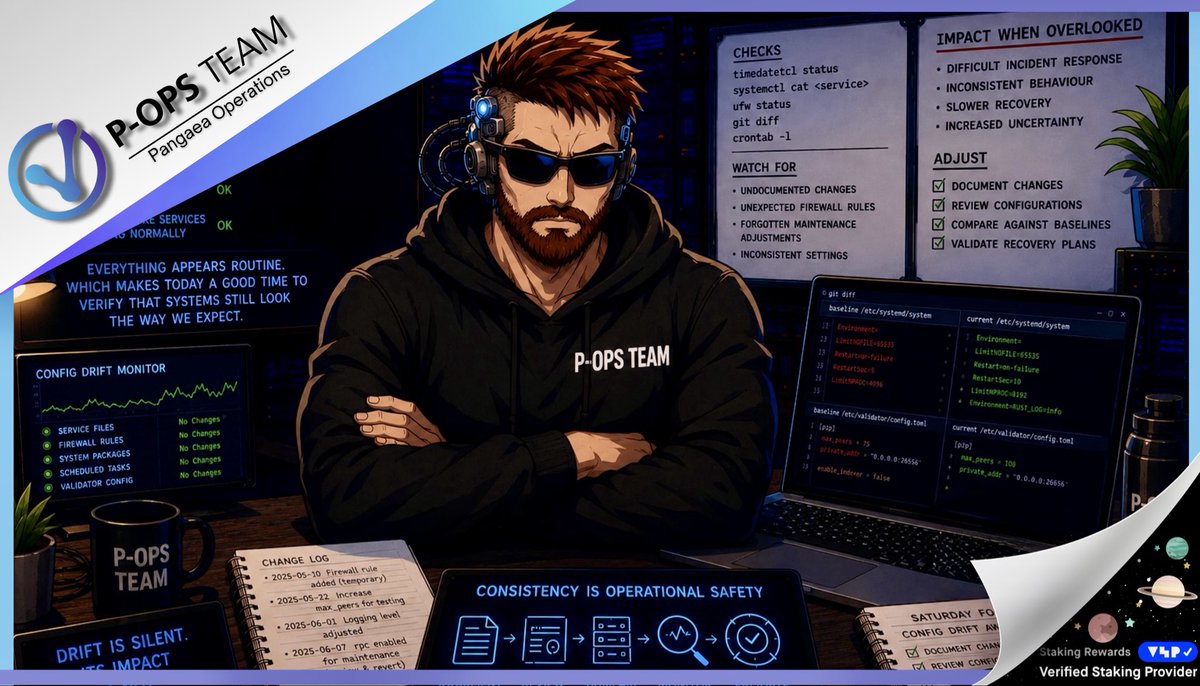
☕️🧠 SATURDAY MORNING SYSTEMS BRIEF | The Risk of Configuration Drift
P-OPS TEAM — Validator Operations
🌅 Most outages are not caused by a single catastrophic event.
Many begin with something far smaller.
A setting changed months ago.
A package updated during maintenance.
A firewall rule added temporarily.
A configuration file edited during troubleshooting.
Each change makes sense in isolation.
Over time, those changes accumulate.
🪟 Focus this morning: configuration drift
🏆 Across supported networks at first light:
🪙 Block production → healthy
📡 Peer connectivity → stable
🔁 Consensus participation → normal
⚙️ Infrastructure services → operating within expected ranges
Everything appears routine.
Which makes today a good time to verify that systems still look the way operators believe they do.
🔗 Signal — Small Changes Compound
Infrastructure rarely fails because operators make one bad decision.
It fails when dozens of small changes slowly move systems away from their intended state.
What begins as:
🔹 temporary adjustment
🔹 emergency workaround
🔹 quick optimisation
🔹 minor maintenance task
Can eventually become:
⚠️ inconsistent deployments
⚠️ unexpected behaviour
⚠️ recovery complications
⚠️ troubleshooting delays
The danger is not the change itself.
The danger is forgetting the change happened.
🔍 Observed this morning
📊 Monitoring configurations aligned
🔄 Service definitions consistent
🧩 Validator parameters verified
🌐 Network policies operating as expected
No unexpected configuration variance detected.
Operational confidence remains high.
🧪 Checks
𝚜𝚢𝚜𝚝𝚎𝚖𝚌𝚝𝚕 𝚌𝚊𝚝 <𝚜𝚎𝚛𝚟𝚒𝚌𝚎>
𝚞𝚏𝚠 𝚜𝚝𝚊𝚝𝚞𝚜
𝚐𝚒𝚝 𝚍𝚒𝚏𝚏
𝚌𝚛𝚘𝚗𝚝𝚊𝚋 -𝚕
Watch for:
• undocumented service changes
• unexpected firewall modifications
• forgotten maintenance adjustments
• inconsistent deployment settings
Drift often develops quietly.
Its impact rarely remains quiet.
🧩 Impact when this is overlooked
• difficult incident response
• inconsistent validator behaviour
• slower recovery during outages
• increased operational uncertainty
The system operators think they are running may not be the system actually running.
🛠️ Adjust
📋 Document operational changes
🔄 Review configurations regularly
📊 Compare production systems against baselines
🧪 Validate recovery procedures after modifications
Consistency creates resilience.
🧠 Why this matters
Reliable infrastructure is not simply about uptime.
It is about predictability.
The strongest validator operations are not those that never change.
They are the ones that always know what changed, why it changed, and how to reverse it if necessary.
Saturday mornings are ideal for confirming that infrastructure remains aligned with design rather than slowly drifting away from it.
Good operators monitor performance.
Great operators monitor change.
☎️ P-OPS Team | Validator Operations
🌍 pops.one
🌿 linktr.ee/p_opsteam
🐦 x.com/POpsTeam1
📡 t.me/POPS_Team_Validator
👾 discord.gg/jJ8aaMwPwa
#SaturdayMorningSystemsBrief #ValidatorOps #Blockchain #Linux #NodeOperations #Infrastructure #POPSTeam
7
17
152
CryptoWolf retweeted
Jun 12
🛰️🔐 STAKE WITH CONFIDENCE
P-OPS TEAM | Infrastructure Behind Every Reward
☕️ Good afternoon operators and delegators.
Staking rewards often attract attention.
Infrastructure determines whether those rewards remain sustainable.
Every delegated token places trust in a validator’s ability to remain available, responsive, and operational through changing network conditions.
The strongest validator operations are rarely the loudest.
They are the ones quietly maintaining consistency block after block, epoch after epoch, upgrade after upgrade.
⚙️ At P-OPS Team, our focus remains simple:
🔹 Reliable validator operations across 80 supported networks
🔹 Continuous monitoring and operational oversight
🔹 Proactive infrastructure maintenance and optimisation
🔹 Resilient systems designed for long-term participation
🔹 Active involvement within the ecosystems we support
📡 Delegation is more than selecting a validator.
It is selecting the operational team responsible for maintaining your network participation every hour of every day.
🧠 Strong staking outcomes are built upon:
✔️ Consistency
✔️ Reliability
✔️ Operational discipline
✔️ Long-term commitment
Because while markets fluctuate…
Consensus continues.
Blocks continue.
Infrastructure continues.
🔧 Delegate with a validator focused on performance long after the headlines move elsewhere.
👉 Start staking with P-OPS Team:
pops.one
☎️ Stay Connected with P-OPS Team:
🌎 Website: pops.one
🌳 Linktree: linktr.ee/p_opsteam
🐥 Twitter: x.com/popsteam1
↗️ Telegram: t.me/POPS_Team_Validator
👾 Discord: discord.gg/jJ8aaMwPwa
#Staking #ProofOfStake #Validator #Web3 #Blockchain #Crypto #DeFi #Infrastructure #Delegation

7
15
109
CryptoWolf retweeted
Jun 12
📡⚙️🎯 FREQUENCY FRIDAY
P-OPS TEAM | Signal Quality Matters
☕ Good Morning Operators, Delegators and Network Watchers.
Not every infrastructure issue begins with an outage.
Most begin with signal.
A response that arrives slightly later than expected.
A peer connection that becomes less consistent.
A process that starts working harder to achieve the same result.
Nothing appears broken.
Yet the signals are already changing.
🔎 This week’s focus: maintaining signal quality across validator operations.
Healthy networks depend upon more than uptime.
They depend upon infrastructure remaining aware, responsive and synchronised as conditions evolve.
Across supported networks, today’s attention remains on:
📡 Peer connectivity maintaining reliable communication paths
⛓️ Block propagation reaching validators without unnecessary delay
⚙️ Services responding consistently under changing workloads
🔄 Internal processes remaining aligned across infrastructure layers
📊 Monitoring systems identifying subtle behavioural shifts
🛰️ Alerting thresholds detecting early indicators rather than late-stage symptoms
🧠 Strong operations teams spend considerable time studying signals.
Because the earliest warnings rarely arrive as critical alarms.
They appear as small deviations:
📈 Slightly increasing latency
📈 Growing retry activity
📈 Longer task completion times
📈 Changing peer behaviour
📈 Resource utilisation patterns drifting from baseline
Individually, these observations may seem insignificant.
Together, they tell the story of how a network is behaving beneath the surface.
🎯 Operational resilience comes from recognising those patterns early.
📡 Observing signal quality.
⚙️ Maintaining system awareness.
🔄 Correcting drift before it expands.
🛰️ Preserving consistency across every layer of the stack.
Because reliable validator infrastructure isn’t defined by how it performs during perfect conditions.
It’s defined by how closely operators pay attention before conditions change.
🟣 P-OPS TEAM
⚙️ Monitoring the signals behind every block.
🌎 Website: pops.one
🌳 Linktree: linktr.ee/p_opsteam
🐥 Twitter: x.com/popsteam1
↗️ Telegram: t.me/POPS_Team_Validator
👾 Discord: discord.gg/jJ8aaMwPwa
#PopsTeam #Validator #Staking #Crypto #Web3 #Delegation #Infrastructure #ProofOfStake
8
17
254
CryptoWolf retweeted
Jun 11
🎯🔗 DELEGATOR’S DESK
P-OPS TEAM | What Happens After You Delegate?
☕ Delegation often feels like the final step.
In reality, it’s the beginning of the journey.
Once stake is delegated, the day-to-day responsibility shifts to the validator operating behind the scenes.
While delegators focus on the networks they support, validators remain focused on the infrastructure that keeps participation possible.
🧩 Every day involves hundreds of small operational decisions.
Most are never visible.
That’s exactly how resilient infrastructure should work.
⚙️ Behind the scenes, validator operators are continuously:
🔹 Monitoring node health and performance
🔹 Reviewing network upgrades and governance proposals
🔹 Maintaining redundancy and recovery systems
🔹 Tracking consensus participation metrics
🔹 Responding to ecosystem changes
🔹 Preparing infrastructure for future growth
📡 Reliable staking isn’t created by a single successful day.
It is built through consistent execution across thousands of days.
🌐 Networks evolve continuously.
Software changes.
Traffic patterns shift.
Validator sets grow.
Operational requirements become more demanding.
The strongest validators adapt alongside the networks they support.
🛡️ For delegators, this highlights an important consideration:
A validator isn’t simply running a node.
A validator is operating an ongoing service that helps secure the network every hour of every day.
🤝 At P-OPS Team, our focus remains centred on long-term operational consistency across more than 80 supported blockchain ecosystems.
📡 Reliable infrastructure
⚙️ Continuous optimisation
🔄 Active ecosystem participation
🛠️ Operational resilience
🧠 Long-term validator discipline
Because successful staking doesn’t end when delegation begins.
That’s where the real work starts.
🌎 Website: pops.one
🌳 Linktree: linktr.ee/p_opsteam
🐥 Twitter: x.com/popsteam1
↗️ Telegram: t.me/POPS_Team_Validator
👾 Discord: discord.gg/jJ8aaMwPwa
#Staking #Delegation #Validators #ProofOfStake #Blockchain #Web3 #Crypto #Infrastructure #POPSTeam

7
16
110
CryptoWolf retweeted
Jun 11
⚙️📊 THROUGHPUT THURSDAY
P-OPS TEAM | Sustained Performance Across Distributed Systems
☕️ Good Morning Operators and Delegators
High throughput is rarely limited by a single component.
Distributed systems succeed when multiple layers remain coordinated at the same time.
A validator may have available CPU.
Storage may have spare capacity.
Network links may appear healthy.
Yet throughput can still degrade if timing discipline begins to drift between those layers.
🔎 Today’s focus: maintaining operational alignment during continuous network activity
Across supported networks:
📡 Peer propagation maintaining predictable delivery paths between validators
⚙️ Consensus participation remaining stable during periods of elevated message volume
🧠 Execution workloads balancing efficiently alongside networking requirements
💾 Storage operations delivering consistent state access without introducing latency spikes
🔄 Background services continuing to operate without competing against consensus-critical processes
📊 What matters here:
• predictable propagation behaviour
• stable consensus participation
• balanced workload distribution
• consistent state responsiveness
• sustained operational coordination
🧩 Observation:
Performance bottlenecks rarely announce themselves immediately.
They emerge gradually as small delays begin interacting across multiple systems.
The strongest infrastructure is not simply fast.
It remains predictable when network conditions become complex.
That predictability is what allows throughput to scale without introducing operational instability.
🟣 P-OPS TEAM
Supporting resilient validator operations across 80 blockchain networks through disciplined infrastructure management and continuous performance oversight.
☎️ Stay Connected with P-OPS Team:
🌎 Website: pops.one
🌳 Linktree: linktr.ee/p_opsteam
🐥 Twitter: x.com/popsteam1
↗️ Telegram: t.me/POPS_Team_Validator
👾 Discord: discord.gg/jJ8aaMwPwa
#Blockchain #Web3 #Staking #Validators #Crypto #NodeOps #Infrastructure #Consensus #Performance #ProofOfStake

9
18
166
CryptoWolf retweeted
Jun 10
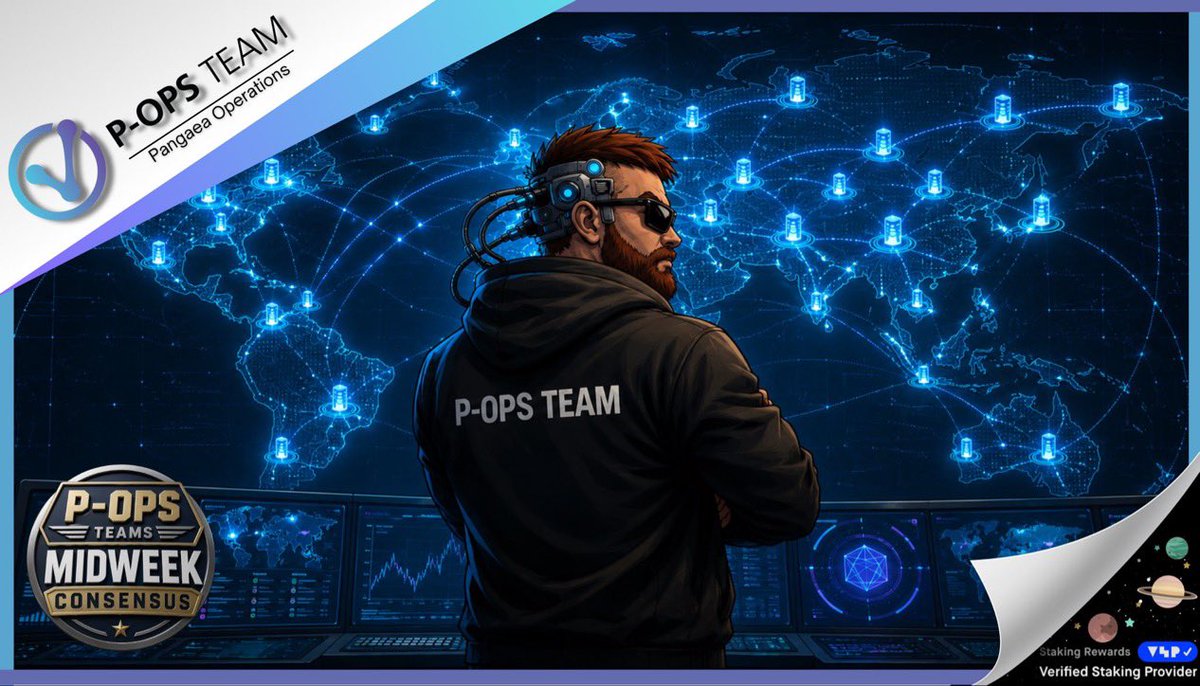
📡🧠 MIDWEEK CONSENSUS
P-OPS TEAM | Consensus Is Built Before It Is Needed
☕️🌅 Happy Wednesday, validators, delegators, and network builders.
Most people notice consensus when something goes wrong.
⚙️ Operators think about it long before that.
Consensus is not a feature that activates during an incident.
🏗️ It is the result of thousands of decisions made beforehand.
Every validator added to a network.
Every node maintained.
Every upgrade completed.
Every delegation distributed across the validator set.
🔗 Together, these decisions determine how resilient a network becomes when conditions change.
🔎 Midweek Focus: Consensus Readiness
Across modern Proof-of-Stake ecosystems:
📡 Validators continuously exchange information across peer networks
⚙️ Infrastructure remains synchronised despite geographic separation
🧠 Independent operators maintain diverse operational environments
🔐 Security practices vary while consensus rules remain identical
🌍 Global participation helps networks remain resilient to localised disruption
🛡️ The objective is simple:
Ensure the network continues functioning regardless of which individual participant encounters difficulty.
📊 Consensus is often misunderstood as agreement.
In reality, it is coordination.
The ability for thousands of participants to independently verify the same state and reach the same conclusion.
💡 Strong consensus is not created by identical systems.
It is created by independent systems reaching identical outcomes.
🔍 What healthy consensus environments often demonstrate:
✅ Broad validator participation
✅ Distributed stake ownership
✅ Independent infrastructure choices
✅ Diverse operational expertise
✅ Reliable communication pathways
✅ Predictable network behaviour during periods of stress
📈 As blockchain ecosystems continue maturing, network health is increasingly measured by resilience rather than speed alone.
Questions worth asking:
❓ Can the network continue operating if major infrastructure providers experience issues?
❓ Can validator participation remain healthy during volatile market conditions?
❓ Is stake broadly distributed across the validator set?
❓ Are independent operators able to compete effectively?
❓ Does the network become stronger as participation grows?
🧠 Midweek takeaway:
Consensus is not built at the moment it is tested.
🏗️ It is built every day beforehand.
Every validator contributes.
Every delegator contributes.
Every well-distributed network becomes more resilient because responsibility is shared across the ecosystem.
🟣 P-OPS TEAM
🌐 Supporting resilient validator infrastructure across 80 networks including @solana, @celestia and @axelar while helping strengthen decentralisation through independent, community-focused operations.
☎️ Stay Connected with P-OPS Team:
🌎 Website: pops.one
🌳 Linktree: linktr.ee/p_opsteam
🐥 Twitter: x.com/popsteam1
↗️ Telegram: t.me/POPS_Team_Validator
👾 Discord: discord.gg/jJ8aaMwPwa
#Blockchain #Web3 #Staking #Validators #ProofOfStake #NodeOps #Infrastructure
7
18
170
CryptoWolf retweeted
Jun 9
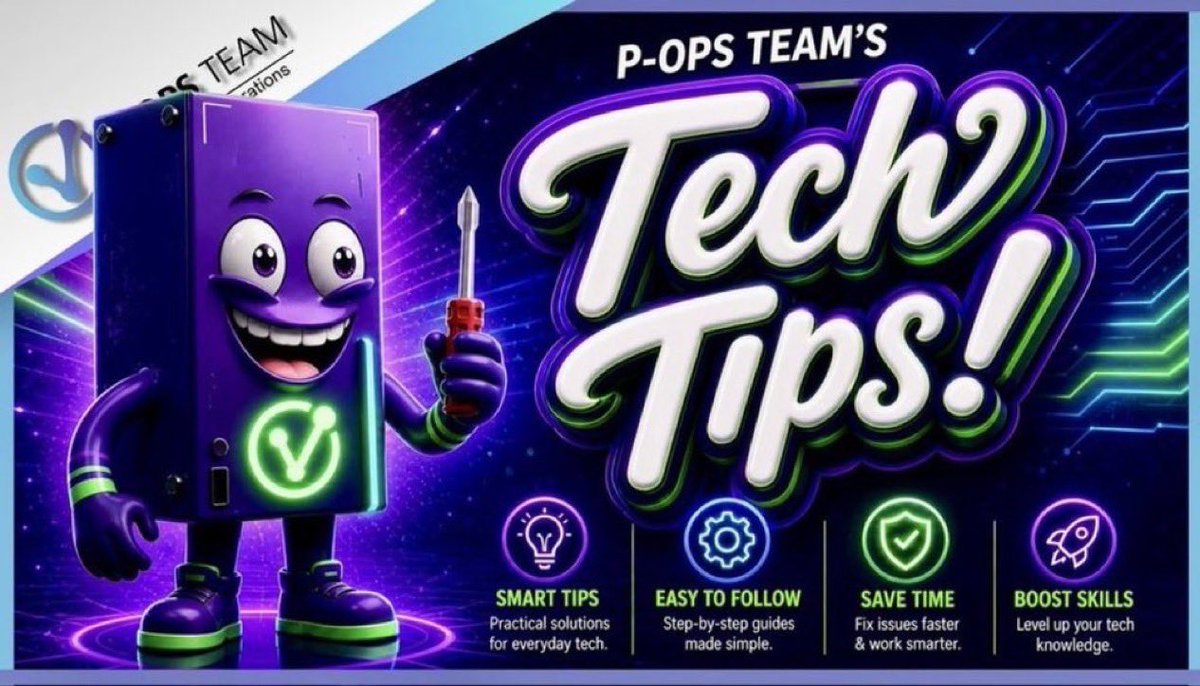
⚙️🧠 P-OPS TEAM’S TECH TIPS
💾 Validator Edge — Memory Pressure & Cache Efficiency
Validators don’t only consume CPU.
They depend on memory behaving predictably enough to keep consensus-critical processes responsive.
📖 Today’s read: how memory pressure quietly impacts validator stability long before systems begin swapping or failing.
🔎 Memory utilisation check (15s check)
Run:
𝚏𝚛𝚎𝚎 -𝚑
What you want:
• available memory remaining healthy
• minimal swap usage
• predictable memory consumption over time
If available memory steadily shrinks:
→ cache eviction increases
→ application responsiveness degrades
→ recovery operations become slower
Memory exhaustion rarely arrives without warning.
🔎 Top memory consumers (20s check)
Run:
𝚙𝚜 -𝚎𝚘 𝚙𝚒𝚍,𝚌𝚖𝚍,%𝚖𝚎𝚖 –𝚜𝚘𝚛𝚝=-%𝚖𝚎𝚖 | 𝚑𝚎𝚊𝚍
What you want:
• validator processes behaving consistently
• predictable memory allocation
• no unexpected growth trends
If memory consumption grows unexpectedly:
→ application leaks may be developing
→ caches may be expanding uncontrollably
→ operating system resources become constrained
Growth is not always healthy growth.
🔎 Swap activity visibility (15s check)
Run:
𝚟𝚖𝚜𝚝𝚊𝚝 1 5
What you want:
• little or no swap-in activity
• stable free memory levels
• predictable system behaviour
If swap activity appears regularly:
→ memory pressure is increasing
→ storage latency begins affecting execution
→ consensus workloads become less predictable
Fast disks are still slower than RAM.
🔎 Cache efficiency review (20s check)
Run:
𝚌𝚊𝚝 /𝚙𝚛𝚘𝚌/𝚖𝚎𝚖𝚒𝚗𝚏𝚘 | 𝚎𝚐𝚛𝚎𝚙 “𝙲𝚊𝚌𝚑𝚎𝚍|𝙱𝚞𝚏𝚏𝚎𝚛𝚜|𝙰𝚟𝚊𝚒𝚕𝙼𝚎𝚖”
What you want:
• healthy cached memory
• strong available memory levels
• stable buffer utilisation
Well-managed cache usage often improves validator responsiveness without requiring additional hardware.
📊 Quick Fix Layer (high impact, low effort)
If you spot issues:
• investigate sustained memory growth
• monitor swap utilisation regularly
• review application memory limits
• remove unused background services
• plan capacity upgrades before pressure becomes critical
Healthy validators maintain resources before they become scarce.
🎯 What this means for delegators
Efficient memory management helps validators maintain:
✔️ stable consensus participation
✔️ predictable performance during network activity
✔️ faster recovery after maintenance
✔️ consistent long-term reliability
🟣 P-OPS TEAM operates validator infrastructure across 80 networks with continuous monitoring of memory utilisation, system health, and operational performance.
🔗 Stake with us: pops.one
🔗 Explore more: linktr.ee/p_opsteam
🔗 Follow: x.com/popsteam1
#Validator #Staking #Web3 #Crypto #DeFi #Blockchain #ProofOfStake #NodeOps #Delegation #Infrastructure #TechTips
8
16
97
CryptoWolf retweeted
Jun 9
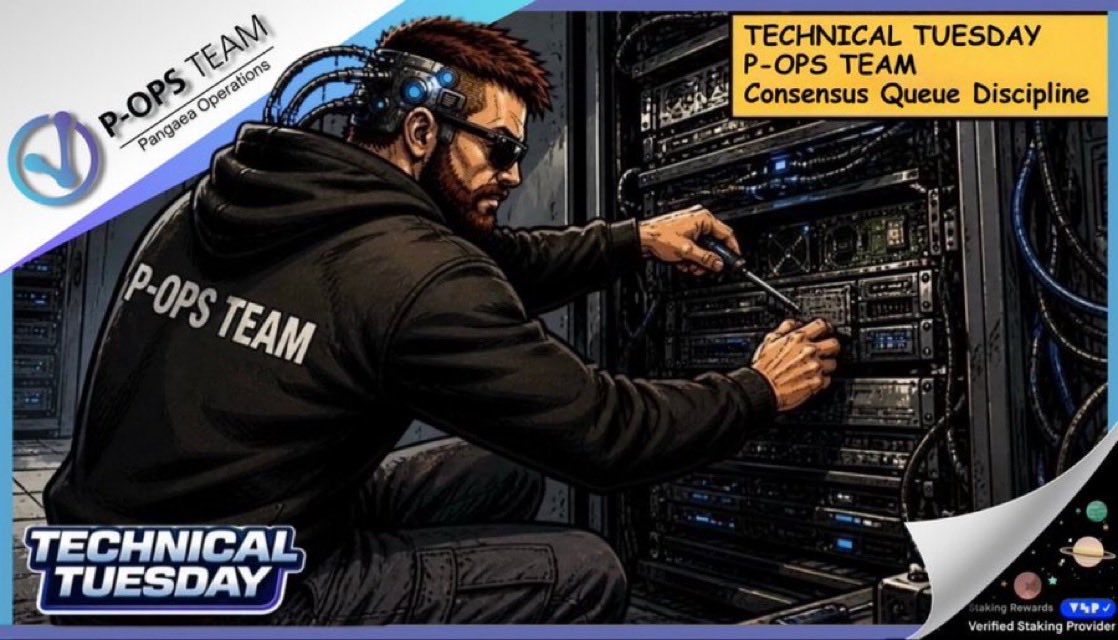
⚙️🧠 TECHNICAL TUESDAY
🟣 P-OPS TEAM | Peer Topology & Network Resilience
☕️ Most validator operators monitor uptime.
Fewer monitor the quality of the paths that create that uptime.
🔎 Today’s focus: peer topology integrity across distributed validator infrastructure.
🌐 Across supported networks:
📡 Peer connectivity → maintaining diverse communication paths across geographic regions
🧩 Network propagation → reducing dependency on any single relay route
🔄 Peer rotation → identifying unhealthy connections before they become operational risks
🌍 Topology distribution → balancing inbound and outbound connectivity across the network
🧠 Consensus depends on more than a healthy validator.
It depends on a healthy view of the network.
🎯 A validator connected to the wrong peers can appear healthy while gradually becoming less informed.
🔹 diverse peer sets improve network awareness
🔹 redundant communication paths improve resilience
🔹 balanced topology reduces isolation risk
🔹 healthy propagation supports faster consensus participation
📊 Signal:
✅ Peer counts operating within expected ranges.
✅ Geographic distribution remains balanced.
✅ Propagation timing remains consistent.
✅ No concentration forming around a small number of critical routes.
⚙️ Strong validator operations are not built on a single connection.
They are built on thousands of successful conversations occurring across the network every second.
🟣 P-OPS TEAM
🔧 Maintaining visibility across every path to consensus.
☎️ Stay Connected with P-OPS Team:
🌎 Website: pops.one
🌳 Linktree: linktr.ee/p_opsteam
🐥 Twitter: x.com/popsteam1
↗️ Telegram: t.me/POPS_Team_Validator
👾 Discord: discord.gg/jJ8aaMwPwa
#Blockchain #Web3 #Staking #Validators #Crypto #NodeOps #Infrastructure #Consensus #Networking #ProofOfStake
9
22
165
CryptoWolf retweeted
Jun 8
🌙🛰️ MIDNIGHT MONITOR | Holding Shape After Finality
P-OPS TEAM — Validator Operations
🌃 By midnight, most blocks have already been produced.
Most transactions have already settled.
Most dashboards have already told their story for the day.
But experienced operators know something important:
📊 The most valuable signals often appear after the busiest hours have passed.
🔎 When network activity cools, hidden behaviour becomes easier to spot.
📡 Peer relationships reveal their true stability.
⚙️ Background services expose inefficiencies.
💾 Storage systems show their real responsiveness.
🧠 Resource utilisation returns to baseline.
🔄 Long-running processes demonstrate their consistency.
Busy periods can mask problems.
Quiet periods reveal them.
🛠️ Tonight’s operational focus:
Maintaining clean system shape after finality pressure has passed.
Across supported networks we’re watching:
📡 Peer connectivity remaining balanced
⚡ Validator processes maintaining stable execution timing
💾 State storage responding predictably
🔐 Security monitoring remaining active across all layers
📊 Infrastructure metrics returning to healthy operational baselines
🧠 Why this matters:
Reliable validators are not defined by surviving moments of stress.
They are defined by how quickly they return to equilibrium afterwards.
🏗️ Strong infrastructure absorbs activity.
🧩 Mature infrastructure absorbs activity and remains predictable once it has passed.
For delegators, that distinction matters.
Anyone can advertise uptime.
Operational discipline is demonstrated by consistency across every hour of the day.
Including the quiet ones.
🌙 While the timelines slow down and the markets sleep, validator infrastructure continues doing what it was designed to do:
🔄 verify
⚙️ coordinate
📡 communicate
🔐 protect
⛓️ finalise
Quietly.
Consistently.
Without interruption.
🟣 P-OPS TEAM
Built for the hours when reliability speaks louder than activity.
☎️ Stay Connected with P-OPS Team:
🌎 Website: pops.one
🌳 Linktree: linktr.ee/p_opsteam
🐥 Twitter: twitter.com/POpsTeam1
↗️ Telegram: t.me/POPS_Team_Validator
👾 Discord: discord.gg/jJ8aaMwPwa
🌙🛰️📡⚙️💾🔐📊🧠⛓️🔄 #Staking #ProofOfStake #Validator #Delegation #Blockchain #Web3 #Crypto #Infrastructure #POPSTeam #Stakewithus

7
17
139
CryptoWolf retweeted
Jun 8
🎯⚙️ MONDAY READINESS | Operational Headroom Assessment
P-OPS Team — Validator Operations
☕ Good Morning Operators,
A quiet Monday morning tells us very little.
What matters is how much capacity remains before conditions change.
📊 Readiness is not measured by what systems are doing now.
🧠 It is measured by what they can absorb later.
Before governance proposals arrive.
Before transaction volumes expand.
Before infrastructure encounters unexpected stress.
We assess operational headroom.
🧭 Focus: identifying available capacity before the week begins to consume it
Across supported networks this morning:
📡 Peer connectivity → healthy route diversity maintained
⚙️ Validator services → operating within expected resource profiles
💾 Storage systems → low latency with clean response characteristics
🧠 Memory utilisation → stable with sufficient allocation headroom
🗂️ State growth → progressing within forecasted ranges
📊 Monitoring pipelines → delivering complete and consistent telemetry
Current conditions remain stable.
The objective is ensuring they remain stable when demand increases.
🔎 Areas receiving additional attention
📈 Resource consumption trends accelerating faster than baseline
🧩 Capacity bottlenecks forming inside otherwise healthy systems
📡 Network paths becoming overly dependent on preferred peers
💾 Storage utilisation approaching operational review thresholds
🔄 Background services consuming increasing scheduler time
These signals rarely trigger alerts.
They often determine how infrastructure behaves days later.
🧪 Monday verification set
𝚏𝚛𝚎𝚎 -𝚑
𝚞𝚙𝚝𝚒𝚖𝚎
𝚝𝚘𝚙 -𝚋 -𝚗 1
𝚒𝚘𝚜𝚝𝚊𝚝 -𝚡 1 5
𝚍𝚏 -𝚑
𝚌𝚞𝚛𝚕 -𝚜 𝚕𝚘𝚌𝚊𝚕𝚑𝚘𝚜𝚝:𝟸𝟼𝟼𝟻𝟽/𝚜𝚝𝚊𝚝𝚞𝚜
🎯 Why this matters
Infrastructure rarely fails because capacity disappears suddenly.
More often, capacity is consumed gradually until flexibility vanishes.
Monday Readiness exists to measure that flexibility while it still exists.
Because resilient weeks are built from surplus capacity, not last-minute reactions.
☎️ Stay Connected with P-OPS Team:
🌎 Website: pops.one
🌳 Linktree: linktr.ee/p_opsteam
🐥 Twitter: x.com/popsteam1
↗️ Telegram: t.me/POPS_Team_Validator
👾 Discord: discord.gg/jJ8aaMwPwa
#MONDAYREADINESS #ValidatorOps #PopsTeam #NodeOperations #DevOps #CryptoInfrastructure #Web3Infrastructure #SystemReliability #InfrastructureEngineering #StakingOperations

7
16
242
CryptoWolf retweeted
Jun 7
🛰️🧠 SUNDAY OVERWATCH | Mapping Hidden Dependencies
☀️🔍 Sunday,
The most dangerous infrastructure risks are rarely the ones you monitor directly.
They are the systems your systems depend upon.
⚙️ Every validator relies on layers.
🖥️ Hardware.
🌐 Networks.
💾 Storage.
📦 Services.
🔑 Access controls.
📡 External peers.
Each layer appears independent.
Until one fails.
🧠 Sunday Overwatch is about identifying dependencies before they become single points of failure.
🧩 Overwatch Focus This Week: Hidden Dependencies
📊 Most outages begin long before the alert appears.
A disk fills because log rotation stopped.
A service fails because time drift increased.
A validator falls behind because peer quality deteriorated.
A backup becomes useless because nobody tested restoration.
⚠️ The incident is merely the final symptom.
The dependency was the real problem.
🔎 What we audit
📡 Critical peer dependencies and network paths
💾 Storage systems supporting validator operations
🔄 Backup integrity and restoration readiness
⏱️ Time synchronisation sources and drift
🔑 Authentication and access dependencies
📦 Supporting services required for validator health
❓ Ask yourself:
“If this component disappeared today…
what would fail next?”
🧪 Overwatch Checks
𝚜𝚢𝚜𝚝𝚎𝚖𝚌𝚝𝚕 –𝚏𝚊𝚒𝚕𝚎𝚍
𝚝𝚒𝚖𝚎𝚍𝚊𝚝𝚎𝚌𝚝𝚕 𝚜𝚝𝚊𝚝𝚞𝚜
𝚍𝚏 -𝚑
𝚖𝚘𝚞𝚗𝚝
𝚌𝚞𝚛𝚕 -𝚜 localhost:26657/net_info | 𝚓𝚚 ‘.result.n_peers’
𝚜𝚜 -𝚝𝚞𝚕𝚙𝚗
👀 Watch for:
• 📡 excessive reliance on a small number of peers
• 💾 storage volumes approaching operational limits
• ⏱️ clock drift or unstable NTP sources
• 🔄 backup processes that have never been restored from
• 🔑 critical access controlled by a single account
• 📦 services silently supporting other services
🛠️ Adjust
🔄 diversify critical dependencies where possible
📊 document operational relationships between services
🧪 test recovery procedures rather than assuming they work
💾 verify storage growth remains predictable
📡 improve peer diversity and resilience
🗂️ remove unnecessary dependency chains
🧠 Why Dependency Mapping Matters
Because infrastructure is rarely brought down by the component you are watching.
It is usually brought down by the component you forgot was supporting it.
📍 The validator depends on the network.
📍 The network depends on routing.
📍 Routing depends on infrastructure.
📍 Infrastructure depends on people, processes and maintenance.
🛡️ Reliable operators understand not only how systems work…
but what those systems quietly rely upon every day.
☎️ P-OPS Team | Validator Operations
🌍 pops.one
🌿 linktr.ee/p_opsteam
🐦 x.com/POpsTeam1
📡 t.me/POPS_Team_Validator
👾 discord.gg/jJ8aaMwPwa
#SundayOverwatch #ValidatorOps #Infrastructure #Linux #DevOps #SRE #NodeOperations #Web3Infra #Blockchain

1
8
16
186
CryptoWolf retweeted
Jun 6
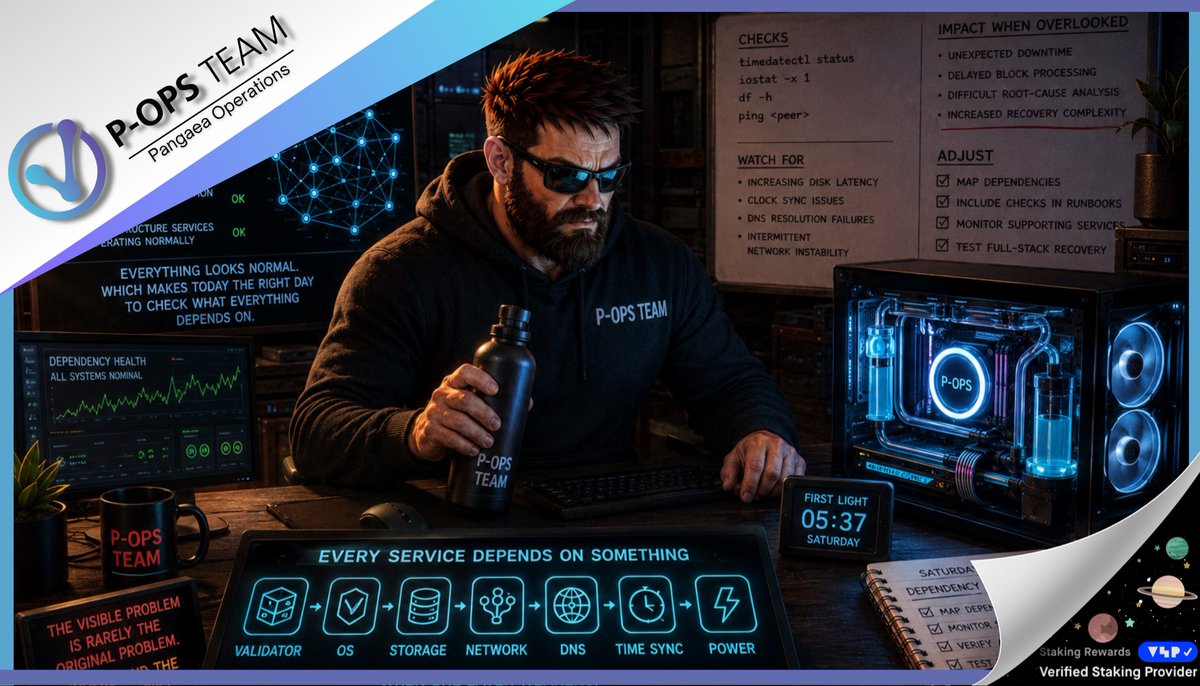
☕️🧠 SATURDAY MORNING SYSTEMS BRIEF | Understanding Hidden Dependencies
P-OPS TEAM — Validator Operations
🌅 Most infrastructure failures do not begin where they appear.
A validator stops producing blocks.
Consensus participation drops.
Alerts begin firing.
Operators investigate the node.
The root cause often lives somewhere else entirely.
🪟 Focus this morning: dependency awareness
🏆 Across supported networks at first light:
🪙 Block production → healthy
📡 Peer connectivity → stable
🔁 Consensus participation → normal
⚙️ Infrastructure services → operating within expected ranges
Everything appears routine.
Which makes today a good time to examine the systems beneath the systems.
🔗 Signal — Every Service Depends on Something
validator → operating system → storage → network → DNS → time synchronisation → power
A node may appear independent.
In reality it is part of a chain of dependencies.
The validator software is often the easiest component to troubleshoot.
The supporting infrastructure is usually where unexpected risk accumulates.
A healthy validator still depends on:
🌐 reliable network paths
🕒 accurate time synchronisation
💾 responsive storage
📊 functioning monitoring systems
🔄 working backup procedures
When one layer degrades, every layer above it eventually feels the impact.
🔍 Observed this morning
🕒 Time synchronisation operating normally
🌐 Peer discovery functioning as expected
💾 Storage latency remaining stable
📊 Monitoring pipelines reporting consistently
No dependency-related anomalies detected.
Operational confidence remains high.
🧪 Checks
𝚝𝚒𝚖𝚎𝚍𝚊𝚝𝚎𝚌𝚝𝚕 𝚜𝚝𝚊𝚝𝚞𝚜
𝚒𝚘𝚜𝚝𝚊𝚝 -𝚡 𝟷
𝚍𝚏 -𝚑
𝚙𝚒𝚗𝚐 <𝚙𝚎𝚎𝚛>
Watch for:
• increasing disk latency
• clock synchronisation issues
• DNS resolution failures
• intermittent network instability
Small dependency problems often create disproportionately large validator symptoms.
🧩 Impact when this is overlooked
• unexpected validator downtime
• delayed block processing
• difficult root-cause analysis
• increased recovery complexity
The visible problem is rarely the original problem.
🛠️ Adjust
🧭 Map critical infrastructure dependencies
📋 Include dependency checks in operational runbooks
📊 Monitor supporting services alongside validators
🔄 Test recovery procedures across the full stack
Strong operations require visibility beyond the validator itself.
🧠 Why this matters
Reliable infrastructure is not built from individual components.
It is built from understanding how those components interact.
Saturday mornings provide an opportunity to look beneath the dashboards and verify that the foundations remain as healthy as the services running above them.
The best operators do not simply monitor what is visible.
They understand what makes visibility possible.
☎️ P-OPS Team | Validator Operations
🌍 pops.one
🌿 linktr.ee/p_opsteam
🐦 x.com/POpsTeam1
📡 t.me/POPS_Team_Validator
👾 discord.gg/jJ8aaMwPwa
#SaturdayMorningSystemsBrief #ValidatorOps #Blockchain #Linux #NodeOperations #Infrastructure #POPSTeam
1
7
19
144
CryptoWolf retweeted
Jun 5
📡⚙️🎯 FREQUENCY FRIDAY
P-OPS TEAM | Maintaining Network Rhythm
☕ Good Morning Operators, Delegators and Network Watchers.
Every blockchain network operates on rhythm.
Blocks arrive.
Peers communicate.
Validators respond.
Consensus advances.
When those rhythms remain aligned, networks appear effortless.
When they begin drifting apart, reliability starts to weaken.
🛰️ Throughout the week, one of the most important operational priorities is maintaining frequency consistency across the validator stack.
Not speed.
Not peak performance.
Consistency.
Because dependable infrastructure is built upon predictable behaviour repeated thousands of times every day.
🔎 Areas receiving close attention:
📡 Peer communication remaining stable across changing conditions
⛓️ Block propagation maintaining consistent timing
🔁 Validator processes completing tasks without accumulating delay
⚙️ Resource utilisation remaining balanced under demand
📈 Consensus participation staying reliable throughout network activity
🧩 Internal services operating within expected response windows
🌐 RPC systems delivering predictable performance
🛰️ Monitoring systems identifying deviation before it becomes disruption
Small timing variations are normal.
What matters is preventing those variations from becoming operational drift.
⚠️ Response times gradually widening
⚠️ Retry activity quietly increasing
⚠️ Queue depths slowly expanding
⚠️ Propagation timing becoming inconsistent
⚠️ Service interactions losing synchronisation
These are often the earliest indicators that network rhythm is beginning to change.
🎯 Strong validator operations focus on preserving alignment.
📡 Keeping communication predictable.
⚙️ Keeping systems synchronised.
🔁 Keeping processes consistent.
🛰️ Keeping infrastructure operating in step with network demands.
Because reliability is rarely the result of extraordinary moments.
It is the result of thousands of ordinary cycles completing exactly as expected.
🟣 P-OPS TEAM
⚙️ Maintaining validator rhythm one block at a time.
🌎 Website: pops.one
🌳 Linktree: linktr.ee/p_opsteam
🐥 Twitter: x.com/popsteam1
↗️ Telegram: t.me/POPS_Team_Validator
👾 Discord: discord.gg/jJ8aaMwPwa
#PopsTeam #Validator #Staking #Crypto #Web3 #Delegation #Infrastructure #ProofOfStake

9
19
156
CryptoWolf retweeted
Jun 4
🎯🔗 DELEGATOR’S DESK
P-OPS TEAM | Choosing Infrastructure That Lasts
☕ Every delegator eventually faces the same question:
“Who should I trust with my stake?”
The answer is rarely found in a single post, a single campaign, or a single week of performance.
🧩 Strong validator operations are built over time.
They emerge through thousands of blocks, countless monitoring checks, routine maintenance windows, software upgrades, and the consistent execution of operational best practices.
⚙️ When evaluating a validator, consider looking beyond visibility alone.
🔹 Operational track record
🔹 Network participation
🔹 Infrastructure resilience
🔹 Responsiveness during incidents
🔹 Commitment to ecosystem growth
🔹 Long-term presence
These factors often reveal far more than short-term attention.
🌐 At P-OPS Team, our focus remains straightforward:
📡 Reliable infrastructure
🛠️ Continuous improvement
⚡ Active network participation
🔗 Support across 80 blockchain ecosystems
🧠 Long-term operational discipline
Every network is different.
Every ecosystem evolves.
But dependable validator operations remain valuable in every environment.
🤝 Delegation is more than selecting a destination for stake.
It is selecting a team responsible for helping secure and support the networks you believe in.
As always, we appreciate every delegator who chooses to place that trust with us.
🌎 Website: pops.one
🌳 Linktree: linktr.ee/p_opsteam
🐥 Twitter: x.com/popsteam1
↗️ Telegram: t.me/POPS_Team_Validator
👾 Discord: discord.gg/jJ8aaMwPwa
#Staking #Validators #ProofOfStake #Blockchain #Web3 #Crypto #Infrastructure #POPSTeam

7
16
184
CryptoWolf retweeted
Jun 4
⚙️📈 THROUGHPUT THURSDAY
P-OPS TEAM | Maintaining Flow at Scale
☕️ Good Morning Operators and Delegators
Throughput is often measured in transactions.
Operational teams measure something different:
Consistency.
The challenge isn’t processing more activity.
The challenge is maintaining predictable behaviour while every moving part of the network experiences increasing demand simultaneously.
🔎 Today’s focus: operational flow during sustained scaling conditions
Across supported networks:
📡 Peer connections maintaining healthy propagation paths as network traffic expands
⚙️ Consensus processes continuing to operate without timing divergence between validator sets
📦 Queue depths remaining controlled despite increased transaction arrival rates
🧠 Resource allocation adapting smoothly between networking, execution and storage workloads
🗄️ State access remaining responsive as historical and real-time demands overlap
🔄 Synchronisation processes staying aligned without introducing downstream bottlenecks
📊 What matters here:
• stable propagation across peer networks
• predictable validator response times
• balanced resource utilisation
• sustained consensus alignment
• clean scaling without operational turbulence
🧩 Observation:
Many systems can accelerate.
Fewer systems can accelerate while preserving order.
As activity grows, operational discipline becomes just as important as raw performance.
That is where infrastructure maturity reveals itself.
🟣 P-OPS TEAM
Supporting resilient validator operations across 80 blockchain networks through disciplined infrastructure management and continuous performance oversight.
☎️ Stay Connected with P-OPS Team:
🌎 Website: pops.one
🌳 Linktree: linktr.ee/p_opsteam
🐥 Twitter: x.com/popsteam1
↗️ Telegram: t.me/POPS_Team_Validator
👾 Discord: discord.gg/jJ8aaMwPwa
#Blockchain #Web3 #Staking #Validators #Crypto #NodeOps #Infrastructure #Consensus #Performance #ProofOfStake

9
19
213
CryptoWolf retweeted
Jun 3
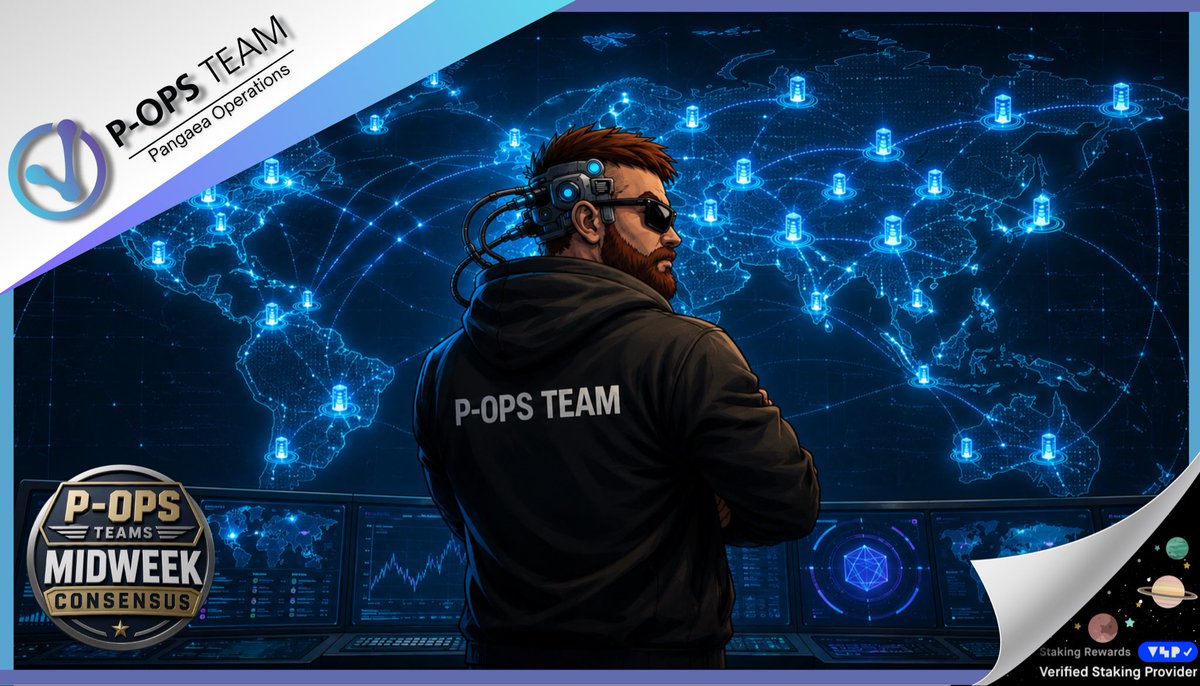
📡🧠 MIDWEEK CONSENSUS
P-OPS TEAM | Why Validator Diversity Matters More Than Ever
☕️🌅 Happy Wednesday, validators, delegators, and network builders.
💰 Staking discussions often begin with rewards.
🌐 Networks begin somewhere different.
🛡️ Resilience.
Every delegation contributes to the shape of a network.
⚙️ Every validator strengthens consensus.
🔗 Every staking decision influences how risk, trust, and responsibility are distributed across an ecosystem.
🏗️ The strongest networks are not simply the ones with the highest market capitalisation.
💪 They are the ones capable of continuing to operate when conditions become difficult.
🔎 What validator diversity actually provides:
🌍 Geographic diversity reduces exposure to regional outages and connectivity disruptions
⚙️ Infrastructure diversity limits dependency on a single provider, platform, or hosting environment
🔐 Operational diversity introduces different monitoring, security, and recovery approaches
📡 Independent operators help prevent concentration of influence
🧭 Broad stake distribution strengthens long-term decentralisation
🛡️ Multiple infrastructure designs improve overall network resilience
🚀 Diverse ecosystems create stronger foundations for future growth
🧠 An important reality:
📉 Most large-scale failures rarely begin with a protocol issue.
⚠️ They often emerge from hidden dependencies.
☁️ A cloud provider outage.
🌐 A routing issue.
⚡ A power disruption.
🐞 A software bug affecting a common deployment pattern.
📊 When too many systems rely on the same foundations, a single event can create disproportionate impact.
🛡️ Diversity acts as a buffer.
Not because failures disappear.
Because failures remain contained.
📊 The infrastructure shift:
As Proof-of-Stake ecosystems mature, decentralisation is becoming increasingly operational.
🔍 Questions networks are asking today include:
❓ How many independent operators participate in consensus?
❓ How concentrated is stake among the largest validators?
❓ How diverse is the infrastructure securing the chain?
❓ How quickly can the network adapt to unexpected conditions?
❓ How resilient is the validator set during periods of stress?
📈 These questions matter because resilience is not created during incidents.
🏗️ It is built beforehand.
🔭 Looking ahead:
The next generation of network health metrics may extend beyond uptime and performance.
📈 Validator diversity
📈 Infrastructure independence
📈 Stake distribution quality
📈 Operational resilience
📈 Recovery capability
📈 Long-term network sustainability
🌐 The healthiest networks are rarely the most uniform.
🔗 They are the most distributed.
🧠 Midweek takeaway:
💡 Delegation is more than a reward decision.
🛡️ It is participation in the security model of a network.
⚙️ Every validator contributes to consensus.
🤝 Every delegator contributes to how that consensus is structured.
🌱 Strong networks emerge when responsibility is shared broadly across the ecosystem.
🟣 P-OPS TEAM
🌐 Supporting resilient validator infrastructure across 80 networks while helping strengthen decentralisation through independent, community-focused operations.
☎️ Stay Connected with P-OPS Team:
🌎 Website: pops.one
🌳 Linktree: linktr.ee/p_opsteam
🐥 Twitter: x.com/popsteam1
↗️ Telegram: t.me/POPS_Team_Validator
👾 Discord: discord.gg/jJ8aaMwPwa
#Blockchain #Web3 #Staking #Validators #ProofOfStake #NodeOps #Infrastructure #Decentralisation
8
19
303
CryptoWolf retweeted
Jun 2
⚙️🧠 P-OPS TEAM’S TECH TIPS
📡 Validator Edge — Peer Connectivity Health & Propagation Stability
Validators don’t only produce votes.
They depend on receiving information quickly enough to act on it.
📖 Today’s read: how peer connectivity quality directly influences propagation speed and consensus participation.
🔎 Peer count check (10s check)
Run:
𝚜𝚜 -𝚝𝚗 | 𝚠𝚌 -𝚕
What you want:
• stable peer counts
• healthy inbound and outbound connections
• no sudden drops during network activity
If peers disappear unexpectedly:
→ proposal propagation slows
→ vote visibility decreases
→ network awareness becomes fragmented
A validator cannot process what it never receives.
🔎 Connection state visibility (20s check)
Run:
𝚜𝚜 -𝚜
What you want:
• established sessions dominating totals
• minimal retransmissions
• stable TCP behaviour
If retransmissions increase:
→ packets are being resent
→ propagation latency rises
→ consensus messages arrive later than expected
Small delays compound across distributed systems.
🔎 Network error monitoring (15s check)
Run:
𝚗𝚎𝚝𝚜𝚝𝚊𝚝 -𝚜 | 𝚐𝚛𝚎𝚙 -𝚒 𝚛𝚎𝚝𝚛𝚊𝚗𝚜
What you want:
• low retransmission growth
• consistent packet delivery
• stable network paths
If retransmissions climb rapidly:
→ packet loss may be developing
→ peer communication becomes less predictable
→ proposal propagation windows tighten
📊 Quick Fix Layer (high impact, low effort)
If you spot issues:
• maintain diverse peer connectivity
• avoid over-reliance on a small peer set
• monitor packet loss alongside latency
• review firewall changes after upgrades
• verify geographic network diversity where possible
Consensus reliability is often network reliability in disguise.
🎯 What this means for delegators
Healthy peer connectivity helps validators maintain:
✔️ faster proposal visibility
✔️ consistent vote propagation
✔️ improved network awareness
✔️ stable long-term performance
🟣 P-OPS TEAM operates validator infrastructure across 80 networks with continuous monitoring of peer connectivity, propagation behaviour, and consensus performance.
🔗 Stake with us: pops.one
🔗 Explore more: linktr.ee/p_opsteam
🔗 Follow: x.com/popsteam1
#Validator #Staking #Web3 #Crypto #DeFi #Blockchain #ProofOfStake #NodeOps #Delegation #Infrastructure #TechTips
1
7
17
191