

5m
Pact Swap @Pact_Swap Coinweb @CoinwebOfficial approach to the blockchain trilemma:
Security:
Swaps are enforced by on-chain smart contracts and collateralized penalty mechanisms, so if one party fails, the other is automatically compensated - no trusted validators or custodians.
Decentralization:
Coinweb doesn’t introduce a new consensus layer. It relies entirely on the native consensus of chains like $BTC, $ETH, $BNB, $POL, removing the need for bridges or external validator networks.
Scalability & cost efficiency:
A consensus-free cross-chain execution layer plus just-in-time collateral reduces infrastructure and capital requirements, cutting swap costs dramatically compared to traditional bridge systems.
Result:
Native assets swap across multiple blockchains, with security from L1s, decentralization from no extra consensus, and scalability from Coinweb’s execution layer.
That’s the Pact Swap × Coinweb architecture in action.
1
7

Most blockchains still rely on state machine replication.
Every validator reruns the same computation.
Again.
And again.
That works for simple execution.
It breaks down when applications need continuous computation, real-time state updates, simulations, trading engines, or complex offchain processing.
Proof-carrying computation changes the model.
Execute where it's efficient.
Generate a cryptographic proof.
Verify and settle onchain.
Massive computation doesn't need massive replication.
That's how you unlock entirely new categories of onchain applications without sacrificing security or verifiability.
Execute once.
Verify everywhere.
@RialoHQ

5

added a fresh batch of community tools to the hub - vote-lockout monitoring, validator comparison, profit calculators, an XDP feature checker and more. thanks to the builders behind Votalizer, Phase, Decentra and others for the work. winstakelabs.com/tools
1
1
VI VINO retweeted

A must read by @LeeSmithDC.
"Vance’s validator calls with the press, influencers, and think-tank experts constitute the centerpiece of his communications campaign, which is modeled after Obama’s Iran deal echo chamber but with one big difference. The Obama team set up its comms infrastructure to steamroll Iran deal opponents, like U.S. lawmakers, nuclear proliferation experts, Republican voters, and pro-Israel activists. Vance’s only audience is Trump. By generating positive articles, social media posts, and TV appearances celebrating Vance’s hard-fought progress in bending the Iranians to his will, the vice president is amassing evidence to show Trump that his supporters are 100% behind the president’s new policy of accommodating Iran, Obama’s policy"
15h

What Trump calls the worst deal ever negotiated, and has identified for more than a decade as Exhibit A in the case against American loserdom, has now become the pattern of his own Iran policy — Obama's policy. I explain today in @tabletmag
tabletmag.com/sections/news/…
2
8
32
3,234
Mikel retweeted

TPN Dev Update.
The initial validator and miner code is written and working. We are now building everything on top of this foundation.
First goals are set. Scope of work and roadmap drops early next week.
We are moving fast.
2
2
25
527

@konnex_world
Konnex is setting a new standard for DePIN security. By splitting validator stakes into $KNX and stablecoin tranches, they protect the network from market volatility while ensuring that any attempt to spoof GPS data results in immediate, unrecoverable slashing.
6

10 | Side Hustle Validator
"Give me 5 side hustle ideas based on my profile [SKILLS INTERESTS]. For each, validate demand, startup effort, time to first income, and scalability."
1
2

Tired of human validator risks?
@aeredium introduces the world’s first TEE-attested Layer 1 where machines enforce the rules.
Quantum-resistant security, bridgeless cross-chain & institutional-grade execution Real certainty in Web3. aeredium.io #Aeredium #TEE
3

@ethereum Day 7
How Does Ethereum Stay Secure Without a Boss?
Let me ask you something.
Would you trust a bank that had no security guards?
No alarms.
No surveillance cameras.
No systems to prevent theft.
Probably not.
Now here's the fascinating part.
Ethereum secures billions of dollars in value every single day...
Without having a CEO.
Without a headquarters.
And without a central authority controlling everything.
So how is that even possible?
The answer lies in something called Proof of Stake.
Don't let the fancy name scare you.
The concept is actually simpler than it sounds.
Think of Ethereum as a massive digital city.
For this city to function properly, it needs honest participants to verify transactions and ensure nobody cheats the system.
These participants are called validators.
Validators are people and organizations that help maintain the Ethereum network.
To become a validator, they must lock up a certain amount of ETH as a commitment to acting honestly.
You can think of it as putting down a security deposit.
By doing this, validators earn the right to help confirm transactions and add new information to the blockchain.
In return for their work, they receive rewards paid in ETH.
Now, here's where things get interesting.
What happens if a validator tries to cheat?
What if they attempt to approve fraudulent transactions?
Ethereum has built-in penalties.
Validators who act dishonestly can lose a portion of the ETH they lock up.
This system creates powerful incentives.
Be honest and earn rewards.
Try to cheat and risk losing money.
For most participants, honesty becomes the smarter choice.
This approach is called Proof of Stake because validators prove their commitment to the network by staking ETH.
Before Ethereum used Proof of Stake, it relied on a different system called Proof of Work, which involved massive amounts of computing power and electricity consumption.
In 2022, Ethereum completed a major upgrade known as The MERGE.
This transition moved Ethereum from Proof of Work to Proof of Stake.
One major benefit?
Ethereum significantly reduced its energy consumption while maintaining strong security.
Of course, no system is completely perfect.
Security is an ongoing process.
But Ethereum's design aligns incentives in a way that encourages participants to protect the network rather than attack it.
Thousands of validators around the world work together to keep Ethereum running.
No single person controls it.
No government owns it.
No company can shut it down.
Its security comes from decentralization and economic incentives working hand in hand.
Ethereum stays secure through a system called Proof of Stake, where validators lock up ETH to help verify transactions honestly.
Those who follow the rules earn rewards.
Those who attempt to cheat risk losing their staked ETH.
Remember:
Ethereum's security doesn't depend on trust in one organization.
It depends on thousands of participants working together with shared incentives.
Raji.

@ethereum Day 6
Gas Fees Explained: Why Does Ethereum Charge You to Use It?
Have you ever paid for transportation during rush hour?
Maybe you have noticed that getting a ride across town on a quiet Sunday afternoon costs less than trying to get one during peak traffic.
More people.
More demand.
Higher prices.
Ethereum works in a surprisingly similar way.
One of the first things newcomers notice when using Ethereum is something called "gas fees."
And almost immediately, they ask:
"Why do I have to pay extra just to use Ethereum?"
It's a fair question.
To understand gas fees, you first need to understand that Ethereum isn't operated by a single company.
There isn't an "Ethereum headquarters" with employees processing transactions.
Instead, Ethereum runs on thousands of computers around the world.
These computers work together to validate transactions, execute smart contracts, and keep the network secure.
That work requires resources.
Computing power.
Storage.
Electricity.
Time.
Gas fees are simply the payments users make to compensate the network for processing their transactions.
Think of gas fees like paying a delivery service.
The more complicated the delivery, the more work involved.
The more people trying to use the service at the same time, the higher the cost may become.
Sending ETH to someone?
Small amount of work.
Interacting with a complex decentralized application?
More work.
Heavy network traffic?
Potentially higher fees.
This is why gas fees can fluctuate.
When millions of users are trying to use Ethereum simultaneously, they compete for limited processing capacity.
Those willing to pay higher fees often have their transactions processed more quickly.
Now, here's something important:
Gas fees do NOT go to Ethereum itself.
Remember, Ethereum isn't a company.
The fees help reward participants who secure and maintain the network.
Without incentives, fewer people would help operate Ethereum.
And without those participants, the network couldn't function reliably.
Of course, high gas fees have been one of Ethereum's biggest challenges.
The community recognizes this.
That's why ongoing improvements and Layer 2 solutions are being developed to make transactions faster and more affordable.
Gas fees aren't random charges designed to frustrate users.
They are part of the system that keeps Ethereum decentralized, secure, and operational.
Don't forget,
Gas fees are transaction costs paid by users to compensate the network for processing transactions and executing smart contracts.
The busier the network becomes, the more expensive those fees can sometimes be.
Remember this always:
Gas fees aren't the price of Ethereum.
They are the cost of using Ethereum.
Raji.
10

29m
GM and happy Sunday CT
The more time I spent understanding @RetiumChain the more I discovered components that resembled puzzle pieces—complementing one another and beginning to connect as a solution to a common problem in traditional blockchains: transaction throughput efficiency. The architecture’s mechanism began to take shape much more clearly, aiming to create a network capable of processing all transactions in a more structured manner.
There is no waiting in a single global queue (traditional mempool).
Everything is processed in parallel and routed through appropriate logical paths, utilizing a validator mesh and multi-vector architecture.
From the validation process, block assembly, to finalization—there is no reliance on a single path or a single party.
Every transaction is processed through the staging, execution, validation, and finalization stages, all of which run entirely in a distributed manner. Ultimately, this minimizes bottlenecks.
Absolutely, Retium is ready for large-scale operations right from its architectural level, delivering efficiency and structured transaction behavior by utilizing multiple logical paths in parallel, rather than forcing transactions into a single queue.

20h

Gm Crypto Antusiasme
Getting to Know @RetiumChain Better: A Blockchain Built Entirely on a 100% Independent Codebase and Featuring Its Own Architecture.
It’s no secret that most modern blockchains today are built on the concept of probability. Take Bitcoin, for instance, which still prioritizes hashing through Proof of Work, while the majority of Proof of Stake networks I’m aware of still use validator selection methods that involve elements of chance, rotation, or specific random mechanisms.
To address this issue and avoid uncertainty or luck in determining “who is authorized to process transactions,” Retium’s approach emphasizes a network structure built on deterministic mathematical logic. This allows the network structure to be independently calculated and verified by anyone. Retium also stands out as a blockchain with a logic-based architecture, featuring a mesh validator network and a multi-vector network structure.
The goal is clear: Retium is a Layer-1 blockchain created as a solution to the fundamental limitations of traditional blockchains, such as:
• Blockchain congestion/bottlenecks due to linearity
• A single pool vulnerable to spam attacks
• Concentration of power in the hands of validators
• Volatile transaction fees
• Scaling challenges
With Retium’s key components, such as:
1. Validator Mesh Architecture
2. Multi-Level Role-Based Verification
3. Deterministic Logic Path
4. Multi-Vector Block Structure
5. Logic-Weighted Transaction Fee
Each component aims to pioneer the creation of a network that is far more predictable, fair, and easier to scale compared to older blockchain models.
Built on a strong foundation, the network structure is based on Prime Number Mathematics. The Whitepaper states, "Each block position is determined by prime factorization and mathematical relationships."
To elaborate,
Instead of a block being considered the "next block" in a linear chain:
Block A -> Block B -> Block C
Behind the scenes, Retium establishes a block’s identity based on mathematically verifiable and reproducible relationships.
Conceptual practice:
• Tick /1 introduces Prime P₁
• Tick /2 introduces Prime P₂
• Tick /3 introduces Prime P₃
From these points, the combination of primes triggers the generation of valid block identities and relationships.
Underlying this is the fact that every composite number has a distinct/unique prime factorization (Fundamental Theorem of Arithmetic), which fully enables a block’s position to be easily verified through the same mathematical rules by all network nodes. The uniqueness of prime factorization is also the most fundamental principle in modern number theory.
Meanwhile, traditional blockchain mechanisms often require several elements:
- Validator selection
- Leader election
- Randomness source
- Lottery mechanism
However, such systems actually open the door to new issues:
- MEV
- Manipulation
- Uncertainty in transaction order
- Front-running
- Specific/favored validators
This is why Retium uses a block structure based on deterministic mathematical rules, eliminating the need to trust third parties, as every node can compute the same result. In most deterministic blockchain systems, this ensures that all participants produce identical outputs when given the same inputs. Every node can compute the same result. The key advantage is a reduced reliance on the aforementioned random mechanisms.

1
1
6

Yes, you can mine Mirex through multiple methods, including node operations, validator staking participation & Use advanced mining hardware . More details about these opportunities will be shared by team soon. Stay tuned for official announcements.
𝗗𝗮𝘃𝗲 retweeted

34m
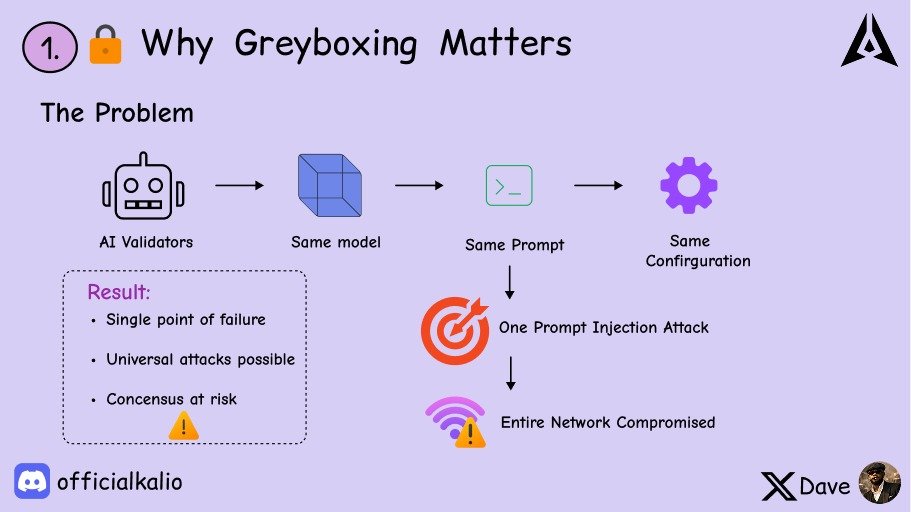
Greyboxing is GenLayer's security layer that prevents attackers from manipulating AI validators by making every validator's AI environment slightly different.
Think about it this way
The Problem
If every validator used:
~The same AI model
~The same prompts
~The same settings🧵
Jun 9

GenLayer is being used to solve a problem in the prediction and outcome markets:
Price feeds can tell you things like “what is the price of ETH?” But they cannot reliably decide real-world events like:
Who won a game or Whether an event happened 🧵
1
4
8
48


Every validator needs updated information in time.
And as blockchain ecosystems continue growing, that process becomes harder.
◆ More validators entering the network
◆ More applications creating demand
◆ More transactions increasing traffic
1
1
3

47m
Everyone focuses on speed.
But what happens after you become faster?
You gain an advantage.
In blockchain networks, the winners are often not the participants with the most resources, but the ones who receive critical information first.
A validator that decodes a block earlier can participate sooner.
A builder that receives data faster can submit more competitive blocks.
A searcher that reacts milliseconds earlier can capture opportunities others never even see.
This is why @get_optimum's vision extends beyond networking.
The goal is not merely to reduce latency.
The goal is to transform information delivery into a competitive advantage that anyone can access.
Traditionally, achieving low-latency performance required expensive infrastructure, premium routing, and strategic geographic positioning.
Only a small number of well-capitalized participants could compete at the highest level.
Optimum changes that equation.
By creating a decentralized acceleration layer powered by Flexnodes and a global bandwidth marketplace, the network distributes performance instead of concentrating it.
The result is a future where access to fast and reliable data is no longer reserved for a select few.
More participants can compete.
More validators can perform efficiently.
More builders can innovate.
And more value can be created across the entire ecosystem.
Speed creates opportunities.
Consistency creates confidence.
But accessibility creates growth.
That's the bigger story behind Optimum.
Not just a faster blockchain network.
A more competitive, more efficient, and more decentralized future for Web3.

Most people think blockchain performance is about speed.
But markets don't actually reward speed.
They reward certainty.
In many blockchain environments, a piece of information is only valuable if it arrives before a specific deadline. A few milliseconds can determine whether a validator earns a reward, a builder wins an auction, or an opportunity disappears entirely.
That's why average latency isn't the real problem.
The real problem is unpredictability.
When participants can't reliably predict when data will arrive, they compensate by overbuilding infrastructure, sending redundant messages, and relying on geographic advantages. The result is a system where success often depends on network positioning rather than efficiency.
This is where @get_optimum changes the equation.
By making data delivery more consistent and predictable, Optimum isn't just improving network performance. It's reducing uncertainty across the entire market.
The goal isn't simply to move information faster.
It's to ensure information arrives when it matters most.
In blockchain economies, predictable delivery creates value, reduces risk, and levels the playing field.
Speed is important.
But consistency is what markets can truly price.

7
agtasu retweeted

Sonic keeps shipping
💠 Binance increased its validator stake by another 10M $S (86M total)
💠 Over $422B USDC volume processed on Sonic
💠 USSD powered sftUSD yields surpassed 25% APY with no incentives
💠 200K $S World Cup campaign now live
From infrastructure to DeFi, the @SonicLabs ecosystem continues to grow.
The ticker is $S.

2
1
8
104

@konnex_world
Decentralized physical infrastructure requires absolute trust. Konnex enforces this via multi-tranche staking ($KNX stablecoins). Attempted GPS spoofing or validator collusion doesn't just fail—it triggers immediate slashing.
5
lovefreak retweeted

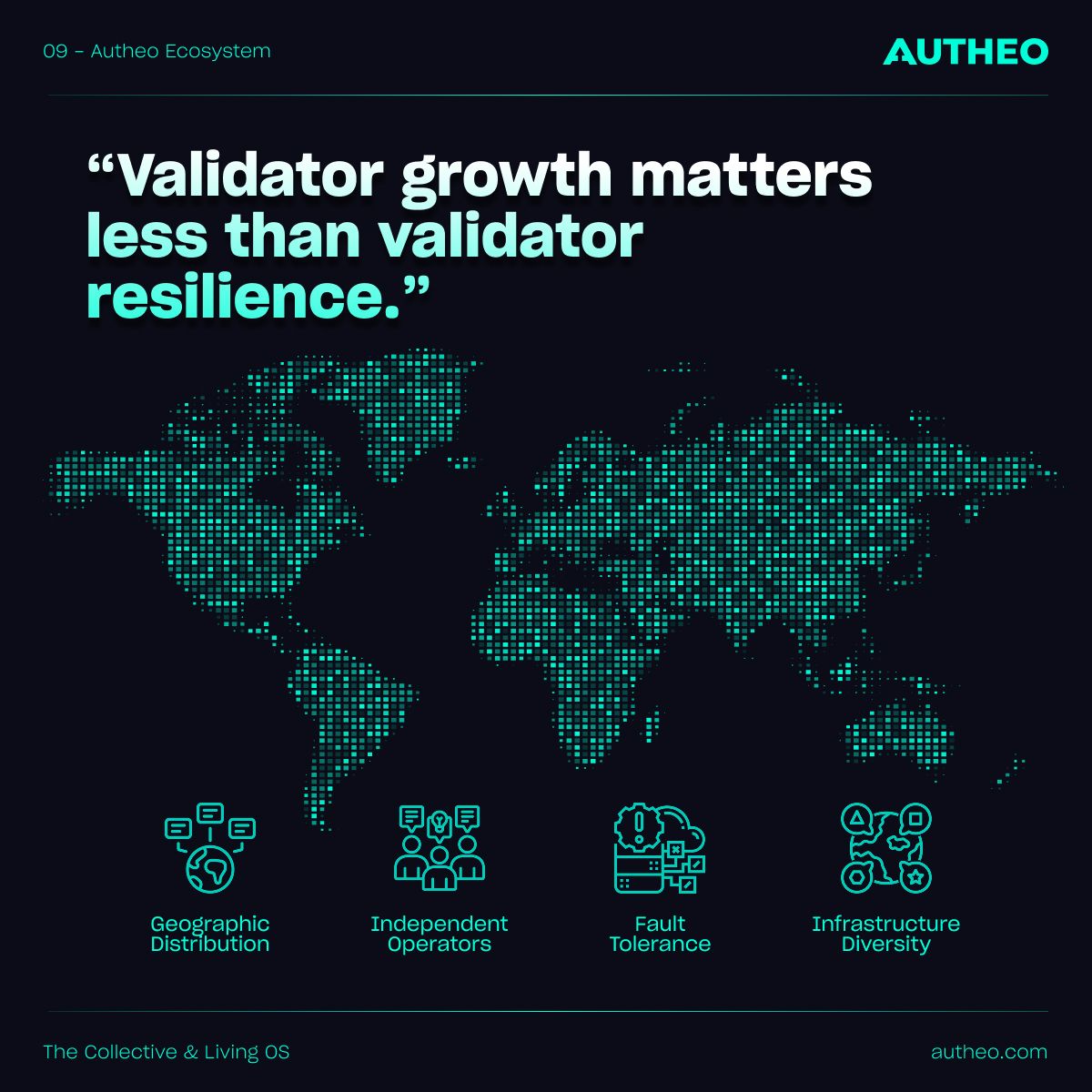
Validator count is easy to compare.
What happens when validators fail, go offline or come under stress is harder to measure.
That's why Autheo was designed with geographic distribution, operational independence, recovery capabilities and quantum-resistant validator signing from the start.
Something worth keeping in mind when comparing networks 🤔
68
16
82
599