Joined March 2008
- Tweets 7,605
- Following 351
- Followers 2,540
- Likes 2,383
232 Photos and videos
Thatchaphol Saranurak retweeted

DIMACS is hosting not one, not two, but three workshops on fine-grained complexity next month, from July 20–31!
Registration is free but required. To register, click each relevant workshop page on the DIMACS events page: dimacs.rutgers.edu/events/li…
Hope to see many of you there!
Feb 17

2/3 Workshops (dates links):
• Algebraic Techniques in FGC (July 20–22): dimacs.rutgers.edu/events/de…
• FGC of String Problems (July 23–25): dimacs.rutgers.edu/events/de…
• FGC of Graph Problems (July 27–31): dimacs.rutgers.edu/events/de…
1
158
Thatchaphol Saranurak retweeted

A remarkable paper appeared on arXiv tonight by Thomas Bloom, Will Sawin, Carl Schildkraut and Dmitrii Zhelezov. In this paper, they prove that there exists c>0 and arbitrarily large finite sets A of real numbers such that max(|A A|,|AA|)≤|A|^{2-c}. This disproves the well-known sum-product conjecture over the real numbers. The sum-product conjecture considers the two most basic operations: addition and multiplication. A A is the set of all pairwise sums of two elements in A while AA is the set of all pairwise products of two elements in A. (1/5)
17
132
969
355,547

May 28
I fully agree with this post by @thegautamkamath on how preparing talks is one of the best ways to upgrade my own thinking.
So, I certainly do not want to waste that opportunity by delegating it to AI.
kamathematics.wordpress.com/…
1
1
26
2,914
May 21
I thought this day would come sometime this year, not today.
Of course, I know that solving problems is not the only thing we theorists do. We also develop good definitions and frameworks: a theory that clarifies things.
Still, the existential crisis feels very real today.

1
3
27
1,918
Thatchaphol Saranurak retweeted

The penalty is a 1-year ban from arXiv followed by the requirement that subsequent arXiv submissions must first be accepted at a reputable peer-reviewed venue. 4/
37
161
2,205
359,909
Thatchaphol Saranurak retweeted

May 9
Mathematics as a field is going to have to reorient itself in light of powerful AI. But a slight pushback to Gowers's comment:
"If LLMs are at the point where they can solve 'gentle problems', ...the lower bound for contributing to mathematics will now be to prove something that LLMs can’t prove, rather than simply to prove something that nobody has proved up to now and that at least somebody finds interesting."
Mathematics is infinite and thus inexhaustible. By having powerful AIs that can do heavy lifting, more of the burden is shifted towards taste and asking the right question. The possibility of discovering something by looking in the right place that everyone else missed becomes possible. In mathematical physics for instance, an Einstein with inspiration of the equivalence principle might not have to toil for a decade to invent general relativity, but could have equations proposed, their solutions found, and scenarios validated as limits of Newtonian physics. Contributing to mathematics, rather than having the bar raised for problem-solving, has opened up for ideation and generation.

But if AI mathematics continues to progress at anything like its current rate -- which is what I expect to happen -- then we will face a crisis very soon, and mathematics departments, who owe a duty of care to their students, should be urgently preparing for it.
27
29
221
41,967
Thatchaphol Saranurak retweeted

This is the best essay about AI and cheating and education I have read. lesswrong.com/posts/nR3Dkyiv…
15
85
7,142
Apr 27
Big congrats!

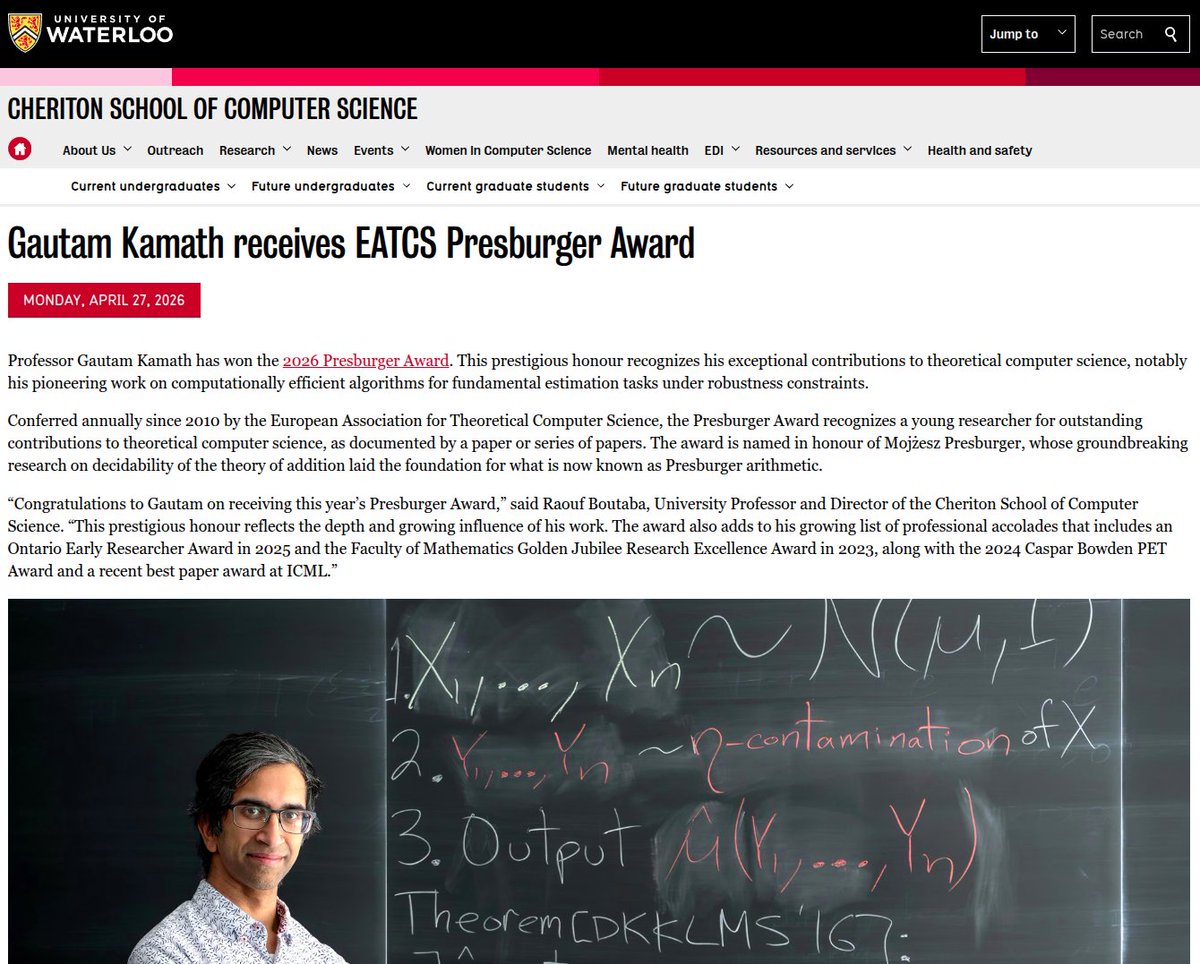
I am honoured (and still a bit stunned) to receive the 2026 Presburger Award from @eatcs_secretary.
This recognizes 1 or 2 young scientists for outstanding contributions in theoretical CS
This honour is shared w my collaborators, students, institutions, & research community 1/7
7
574
Thatchaphol Saranurak retweeted

Apr 19
The ACM Transactions on Algos (TALG) announced the Harold N. Gabow Annual Best Paper Award, for research contributions with lasting significance in algos.
bsky.app/profile/anupamg.bsk…
2
8
908
I poured my soul into building this course last fall:
Graph Algorithms via Graph Decomposition
This has been a powerful framework in graph algorithms for over 20 years, but the literature is scattered and technical.
So, I tried to organize part of it into one coherent story.
6
58
595
34,711
Topics researchers might find worth browsing:
A unified treatment of variants of expander decomposition and expander hierarchies
Cut-matching games under updates
A unified view of dynamic shortest paths and push-relabel
Combinatorial max flow via directed expander hierarchy
2
1
48
3,358
Full materials: sites.google.com/site/thsara…
1
6
110
3,246
Mar 29
It is cool to see how "Markov Chain with Rewinding", introduced for proving lower bounds for sublinear algorithms, can be a model to say something useful for LLM
arxiv.org/abs/2603.22784
1
13
53
4,907
Thatchaphol Saranurak retweeted

Mar 14
The greatest living mathematician just solved 22 million math problems and is now asking the internet to fit the answers on a single page.
Terence Tao, Fields Medalist, co-founded SAIR Foundation earlier this year with Nobel, Turing, and Fields laureates to run AI-powered science at scale. Their first project: the Equational Theories Project. Humans, automated theorem provers, and Lean formal verification working together for seven months. 4,694 equational laws. Every possible logical implication between them mapped and formally proven. 22,028,942 edges in a single implication graph.
Now Tao and SAIR are turning that dataset into a competition.
The constraint: 10 kilobytes. That’s roughly 10,000 characters. A single page of text. The challenge is to distill 22 million verified mathematical results into a prompt so effective that a cheap, open-source AI model currently performing at coin-flip accuracy starts getting 55% to 60% of them right.
This is a test of what mathematicians actually know versus what they think they know. The ETP used brute-force computation, automated provers like Vampire (which alone resolved 99.995% of queries), and months of ad hoc human proofs for the hardest dozen cases. The knowledge exists. The question is whether it can be stated simply enough for a small model to use it.
Tao’s framing says everything. He compared the cheat sheet to what a struggling undergrad brings into a final exam: one page of notes that makes or breaks the grade. Except the exam is 22 million questions and the student is an LLM with no reasoning ability.
Stage 1 submissions close April 20. The top 1,000 advance to Stage 2, which requires actual proofs instead of true/false answers.
SAIR’s board reads like a roster of the people who built the foundations that AI systems are now trying to learn from. And their first public competition is asking the crowd to teach a cheap model what the best mathematicians and the best theorem provers took seven months to figure out.
If the winning cheat sheet works, it tells us something profound about how much mathematical knowledge is compressible. If it doesn’t, it tells us something equally important about what machines still can’t learn from text alone.
Mar 14

Our co-founder Terence Tao is announcing SAIR Foundation's inaugural competition: the Mathematics Distillation Challenge.
Co-organized by @damekdavis, Terence Tao, and SAIR Foundation.
competition.sair.foundation/…
11
55
350
44,085
Thatchaphol Saranurak retweeted

Feb 2
Exciting opportunities for high school students at the National Science Foundation EnCORE Institute at the University of California San Diego.
FinDS Program: mathfinds.ucsd.edu
1
1
5
746
Jan 26
Given AIs, I am still not sure how to teach algorithm classes today and in the future.
This discussion is quite nice, though.
youtube.com/watch?v=Vnz8aqOW…
1
9
2,023
Thatchaphol Saranurak retweeted

Jan 23
The 2026 Michael and Sheila Held Prize goes to Irit Dinur, Subhash Khot, Guy Kindler, Dor Minzer and Muli Safra for their work on the 2-to-2 Games Theorem.
nasonline.org/award/michael-…
1
7
31
2,663
Jan 10
interesting thread.
I am not sure I completely agree with it yet.

We can automate the proving of theorems, or the discovery of conjectures, or even the invention of new axiom systems, but we can't automate *mathematics*. Because "mathematics" is the name we give to the *human* cultural story, not to the formal methods themselves. (14/15)
604
Thatchaphol Saranurak retweeted

Jan 7
Reflecting on @geoffreyhinton's flawed view of math as a "closed system", here are 3 key aspects of math that the general public (including physics Nobel prize winners) tends to get wrong:⤵️
10
43
254
68,589
Thatchaphol Saranurak retweeted

21 Dec 2025
2025 was an eventful/disruptive year for computer science research, for two reasons: 1) a shock to federal funding, and 2) the arrival of AI models capable enough to assist mathematical research. 1) is unambiguously bad and 2) is probably mostly good. I'll write about AI first.
1
49
291
59,011