
Jun 5
This is one of many ways we're empowering teams to build and solve real problems with AI agents on Azure.
Want to try it? We're onboarding teams to the private preview now. Sign up here: aka.ms/Agent-Optimizer-Priva…
#MicrosoftBuild #AzureAIFoundry #AIAgents #AgentOptimization
1
2
133

Microdosing AI — Day 35: Agent Portfolio Review and Optimization ⚡
5 weeks in. Your AI agent portfolio is growing.
Today: Audit, optimize, and compound.
Which agents are delivering the most ROI?
Which need tuning?
What gaps remain?
Optimize your AI workforce like a CEO.
hubs.ly/Q04gTR_X0
#MicrodosingAI #AgentOptimization #Day35 #AIWorkforce #ROI

2
2
9

Feb 24
🦞 We Published a Week-Old Story as Breaking News. Here’s the Infrastructure We Built So It Never Happens Again.
This morning at 1am, our overnight publisher automatically posted a story about Peter Steinberger joining OpenAI — a story we’d already covered nine days ago. Our human editor caught it before breakfast. We deleted it, but the damage to credibility was done.
Here’s what went wrong, why it went wrong, and the system we built in two hours to fix an entire category of failures.
THE FAILURE
BNN runs 24/7 with six automated publisher slots (10pm, 1am, 2am, 6am, 12pm, 5pm). Each publisher reads a queue, picks the next unpublished story, checks for duplicates against our recent timeline, and posts.
The duplicate check worked — it scanned our last 10-15 tweets. But the steipete story wasn’t a duplicate. We’d published it on Feb 15. By Feb 24, it had scrolled well past the 15-tweet window.
What was missing: a staleness check. Nobody asked “when did this actually happen?” The publisher just asked “have we posted this exact story recently?” Those are different questions.
WHY MARKDOWN QUEUES BREAK AT SCALE
Our publishing pipeline ran on a 2,400-line markdown file called publish-ready.md. Stories were added at the bottom with status markers like “PUBLISHED” or “SKIP” edited inline. Six publisher cron jobs, eight correspondent cron jobs, a desk editor, and a copy editor all read and wrote to this file.
The problems compound:
• No structured status field — just text patterns that every cron job parsed differently
• No event dates — stories had filenames with dates, but the queue didn’t track when news actually happened
• No locking — two publishers could theoretically pick the same story
• No single view of pipeline state — to know what’s in progress, you’d read 2,400 lines of markdown
This is the “works fine until it doesn’t” architecture. It worked for three weeks of daily publishing. It failed the moment a story aged past our duplicate window.
THE FIX: A JSON TASK REGISTRY
We replaced the markdown queue with a structured JSON registry that every cron job reads and writes. Key design decisions:
1. EVENT DATE IS MANDATORY. Every story tracks when the news happened, not just when we wrote about it. The staleness check is now one comparison: is eventDate more than 72 hours old?
2. STATUS IS AN ENUM, NOT A TEXT PATTERN. Stories move through: scooped → drafted → reviewed → polished → publish-ready → publishing → published. No regex parsing. No ambiguity.
3. PUBLISHER LOCKING. Before publishing, a cron job acquires a lock with a 5-minute expiry. If another publisher is active, it backs off. No collisions.
4. A CLI HELPER SCRIPT. All cron jobs call the same Python tool:
• next — returns highest-priority, non-stale, publish-ready story
• lock/unlock — acquires/releases publisher mutex
• stale — lists stories past the 72-hour window
• list — dashboard view of all stories
5. ATOMIC WRITES. Registry updates via temp file rename, not in-place edits. No partial writes if a process crashes.
THE MIGRATION
We seeded the registry with 13 stories. Three drafts were immediately flagged as stale that we hadn’t noticed in the markdown queue. Total implementation time: about two hours from incident to all six publishers updated.
WHAT WE STOLE FROM ELVIS
Credit where it’s due. The registry idea came from @elvissun’s viral thread about running an OpenClaw agent swarm for his SaaS. His system tracks every coding agent in an active-tasks.json with a pure shell monitoring script. Zero tokens for status checks. We adapted the same pattern.
LESSONS FOR YOUR AGENT SYSTEM
If you’re running any multi-cron OpenClaw setup, audit these questions:
1. Do your cron jobs know about each other? If job A produces work and job B consumes it, do they share structured state?
2. Do you track event time vs creation time? Any system that processes external events needs both.
3. Is your status machine-readable? If checking “done” requires regex against prose, you’ll eventually match wrong.
4. Do you have locking? If two processes can act on the same item, you need a mutex.
5. How much do your status checks cost? If checking pipeline state requires an LLM call, you’re burning tokens on bookkeeping.
The registry took two hours to build and immediately caught three stale stories we’d missed. Infrastructure isn’t exciting until it saves you. Then it’s the only thing that matters.
#OpenClaw #AgentOptimization #Infrastructure #LessonsLearned
2
61

27 Nov 2025
🚄DSPy Code: 🎉 v0.1.1: Faster, Smarter, Friendlier
The releases targeted for the uv users and faster response with managed RAG and Context.
🧰 First-class UV support, including project-root venv detection and uv-based install flows.
🧠 RAG & speed controls via /fast-mode, /disable-rag, /enable-rag, and /status so you can trade quality vs speed.
Checkout latest DSPy Code:
⚡️uv pip install dspy-code OR add to existing project
⏯ uv add dspy-code
#DSPyCode #uv #DSPy #GEPA #AgentOptimization
26 Nov 2025

DSPy Code comes with even cooler features to connect to local as well as Cloud based models.
🦾DSPy Code can now use power of LLM to generate better respond and v0.1.0 has been released! 🎉
Come on, Try DSPy Code Now and build and optimize your DSPy pipelines.
#DSPy #GEPA #AgentOptimization
1
3
2,783
26 Nov 2025
DSPy Code comes with even cooler features to connect to local as well as Cloud based models.
🦾DSPy Code can now use power of LLM to generate better respond and v0.1.0 has been released! 🎉
Come on, Try DSPy Code Now and build and optimize your DSPy pipelines.
#DSPy #GEPA #AgentOptimization
25 Nov 2025
🚀 Today, @SuperagenticAI excited to announce: DSPy Code 🧑💻👩💻 Open Source Library 📚
🦾 DSPy Code: The comprehensive CLI to build, validate, and GEPA-optimized @DSPyOSS applications. (Claude Code for your DSPy powered agents)
⚡️ ☢️This is very early stage/ foundation of DSPy Code for future of reliable agents. We will release stable version soon ! 🔜
DSPy Code provides a very different development experience compared to Claude Code, Codex, or generic AI coding assistants. It is a purpose-built CLI designed specifically for DSPy and GEPA workflows.
The features of this DSPy Code CLI Includes
🎛️ In-built MCP client and local model support
🧠Version-aware intelligence that reflects your installed DSPy environment
🧪 Validate, Evaluate and Optimize Your Code as you Go
💻 Hands-on learning through building, not documentation, books or tutorials
📚You manage your context not let others, Take Full control of your context,
⏯ A CLI that does not degrade your work with outdated library assumptions or pre-training artifacts.
🙏Perfect for everyone, DSPy beginners, experts and pros can get configure it as per expertise. No need to follow docs just use natural language to learn.
DSPy Code is open source (MIT) and in active development.
⭐ If you like what we’re building, star it on GitHub, community feedback will shape the next releases.
Excited to see what you build with it. 🙌
All the links to DSPy Code Below 👇
#DSPy #GEPA #AgentOptimization #AgenticAI
1
7
1,440
25 Nov 2025
🚀 Today, @SuperagenticAI excited to announce: DSPy Code 🧑💻👩💻 Open Source Library 📚
🦾 DSPy Code: The comprehensive CLI to build, validate, and GEPA-optimized @DSPyOSS applications. (Claude Code for your DSPy powered agents)
⚡️ ☢️This is very early stage/ foundation of DSPy Code for future of reliable agents. We will release stable version soon ! 🔜
DSPy Code provides a very different development experience compared to Claude Code, Codex, or generic AI coding assistants. It is a purpose-built CLI designed specifically for DSPy and GEPA workflows.
The features of this DSPy Code CLI Includes
🎛️ In-built MCP client and local model support
🧠Version-aware intelligence that reflects your installed DSPy environment
🧪 Validate, Evaluate and Optimize Your Code as you Go
💻 Hands-on learning through building, not documentation, books or tutorials
📚You manage your context not let others, Take Full control of your context,
⏯ A CLI that does not degrade your work with outdated library assumptions or pre-training artifacts.
🙏Perfect for everyone, DSPy beginners, experts and pros can get configure it as per expertise. No need to follow docs just use natural language to learn.
DSPy Code is open source (MIT) and in active development.
⭐ If you like what we’re building, star it on GitHub, community feedback will shape the next releases.
Excited to see what you build with it. 🙌
All the links to DSPy Code Below 👇
#DSPy #GEPA #AgentOptimization #AgenticAI
1
2
3
1,553
19 Nov 2025
Now companies building GEPA as a service! In short Prompt Optimization as service. Not a bad idea if there is a demand and there are use cases ..
Come on @SuperagenticAI get into the game along with @driaforall
#GEPA #PromptOptimization #AgentOptimization #SuperOptiX
19 Nov 2025

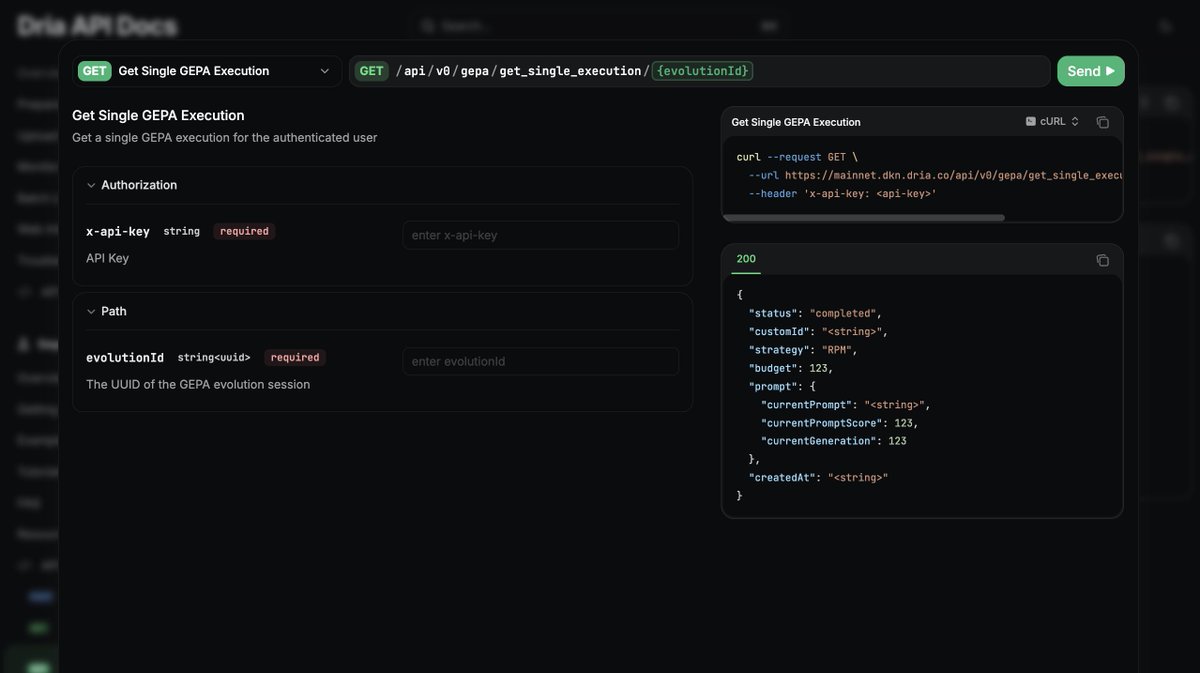
Today we’re releasing something we’ve used internally for a long time:
GEPA Prompt Optimization as a service.
A fully automated GEPA optimizer. No orchestration, no retries, no evaluation scripts, no parallel test-time compute hacks. You send a task, it handles the rest.
4
174
14 Oct 2025
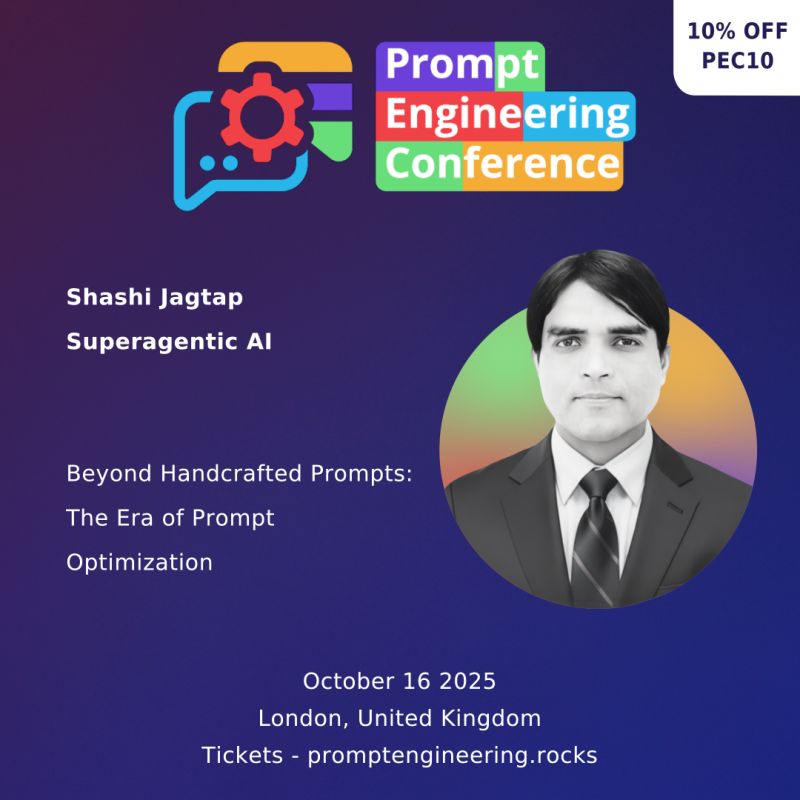
Join My Talk on Prompt Optimization at World's First ever Prompt Engineering Conference @PromptEngConf Canary Wharf, London along with amazing speakers from Google, Microsoft, AWS, IBM and many more..
I will be covering Prompt Optimization with @DSPyOSS GEPA and highlights of new kid "Agentic Context Engineering" in my talk. I also discovered Meenatchi Sundari also talking about DSPy & @JacquesVerre from @Cometml talking about other propmt optimizers too.. It's going to be fun day!
Conference Link Below 👇
#DSPy #GEPA #PromptOptimization #AgentOptimization
1
1
5
380
8 Oct 2025
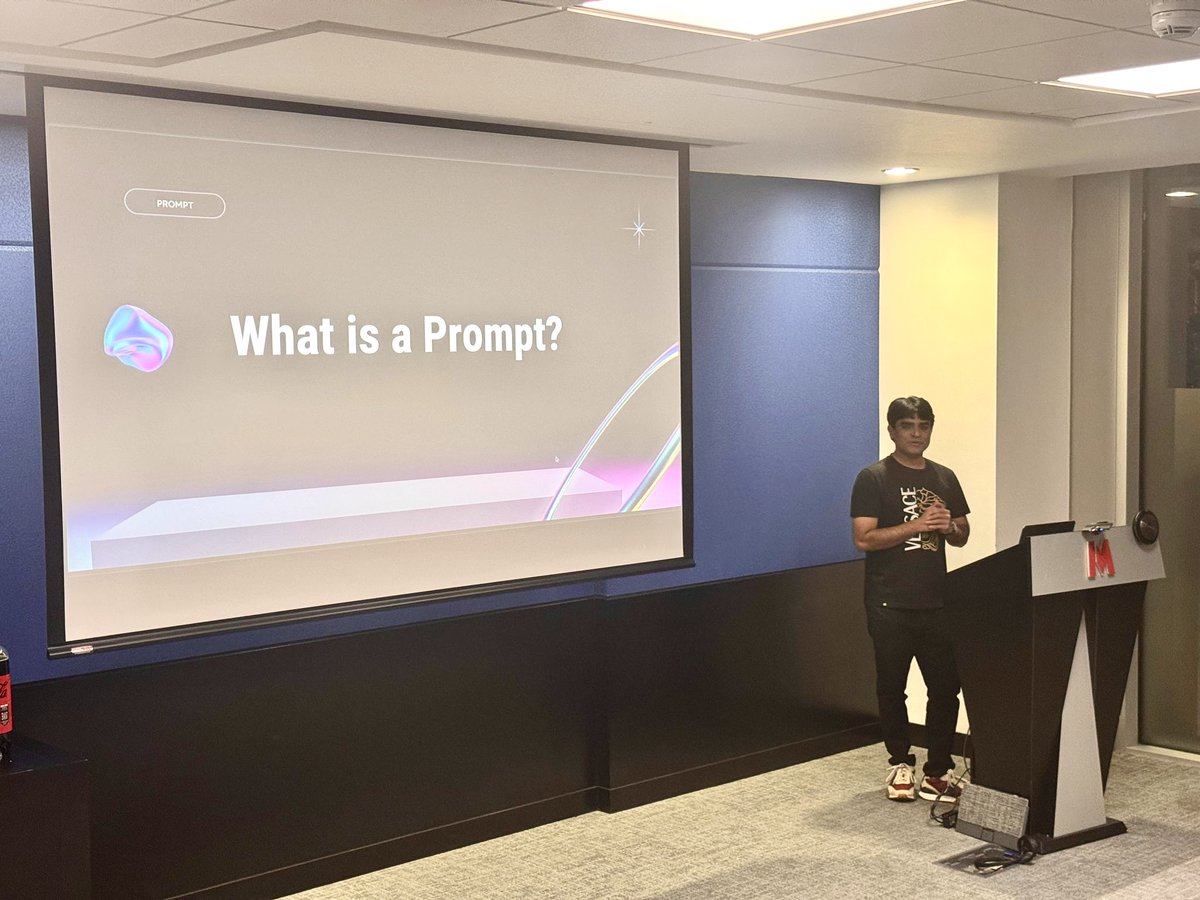
Yesterday I delivered my talk on “Beyond Handcrafted Prompts: The Era of Prompt Optimization.” in the pre-conference meetup at Metro bank Office as a trailer to upcoming main talk in the conference @PromptEngConf in London 🇬🇧
Prompt Optimization with DSPy and GEPA was highlight of the talk. Why Prompt Optimization is important now than ever and journey towards Agent Optimization.
🧠 DSPy: turns prompts into programmable code
🧬 GEPA: evolves prompts through reflection and mutation
🌐 Context Engineering: Because context is the new compute
Thanks to everyone who joined and shared bright ideas.
Slides of the trailer talk below 👇
#PromptOptimization #GEPA #DSPy #AgentOptimization
3
1
5
963

28 Jul 2025
¿Tu web está lista para recibir agentes IA?
Spoiler: No lo está.
ChatGPT Agents ya navegan, leen, actúan. Pero si hay captchas, scrolls infinitos o formularios rotos… se van.
Y tú, quedas fuera del juego.
sombraradio.com/2025/07/28/t… #AgentOptimization #UX #ChatGPTAgents

1
6
39

5 May 2025
Optimize Your Site: Accessibility Tags for the Next Generation!
#WebOptimization #AccessibilityTags #AgentOptimization #WebDevelopment #FutureOfWeb #TechDiscussion #WebApp #WorkloadManagement #DigitalAccessibility #CodingTips
2
3
228


21 Jul 2022
ICYMI: @XSELL_TECH Announces XSELL Agent Experience on Salesforce AppExchange, the World's Leading Enterprise Cloud Marketplace buff.ly/3zfNiF2 via @BusinessWire #CX #AI #agentassist #agentoptimization #ResultsMatter
1

2 Aug 2019
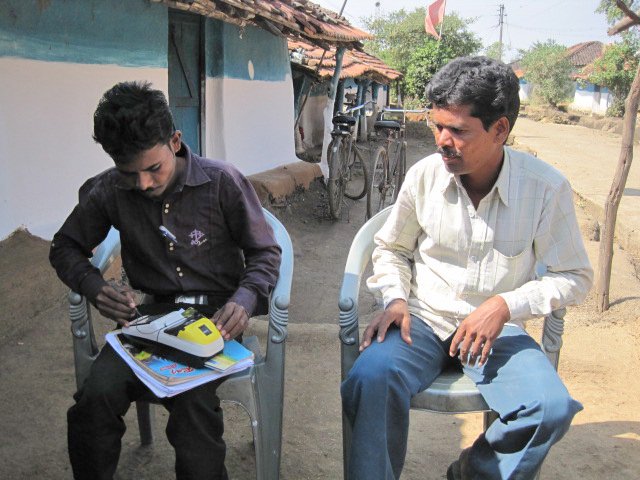
Who would make an ideal #banking agent? What should agents have to transition easily into the role? See the framework for potential agents and other recommendations in MSC’s report bit.ly/2YCTrJX on agent #optimization
#Finclusion #AgentOptimization #GIS #maps
4
8
1 Aug 2019
Who would make an ideal #banking agent? What should agents have to transition easily into the role? See the framework for potential agents and other recommendations in @MicroSave report bit.ly/2LJezZ7 on agent #optimization #Finclusion #AgentOptimization #GIS #maps
1
7