
Feb 27
정말 이 얘기 까진 안할려고 했는데…
켈리형… 어닝콜 졸라 못한다😳😳
(말로 천냥 빚을 쌓을 사람)
물론 실적을 내세울게 없다는건 이해되는데 이렇게 하는게 최선임?
더이상 깅코는 내러티브로 변수를 만들긴 힘든 기업이 된거 같고 숫자로 증명해내지 못한다면 답이 없다.
——
깅코 바이오웍스(DNA) 2025년 4분기 실적 요약
1. 핵심 재무 지표 (2025년 4분기)
• 세포 공학 매출: 2,600만 달러 (전년 대비 26% 감소)
• 총 현금 소진(Cash burn): 4,700만 달러 (전년 대비 15% 감소)
• 조정 EBITDA: 3,600만 달러 (손실 폭 개선 중)
• 연말 보유 현금: 약 4억 3,000만 달러
2. 2025년 전체 성과: '무자비한 비용 절감'
• 연간 현금 소진: 1억 7,100만 달러 (2024년 3억 8,300만 달러 대비 55% 감소)
• R&D 비용: 42% 감소 / G&A 비용: 51% 감소
• 구글 클라우드 약정 재협상으로 향후 1억 달러 이상 비용 절감 효과
3. 2026년 파격적 가이드라인
• 매출 가이드 미제시: 단기 매출보다 '자율 연구소' 전환에 집중하기 위해 매출 목표 폐기
• 현금 소진 가이드: 1억 2,500만 ~ 1억 5,000만 달러 (안전마진 확보 주력)
4. 전략적 변화: '자율 연구소(Autonomous Lab)' 올인
• 바이오 보안(Biosecurity) 분사: 비공개 법인으로 전환하여 외부 자금 유치, 깅코는 소수 지분 유지
• 보스턴 연구소 혁신: 수동 실험대를 폐쇄하고 100개 이상의 로봇 랙 시스템으로 완전 전환
• OpenAI 협업: GPT-5와 자율 연구소를 연결해 단백질 합성 성능 40% 개선 증명
5. 결론: 생물학의 '웨이모(Waymo)'가 된다
• 단순 자동화(지하철)를 넘어 유연한 자율 주행(웨이모) 같은 실험실 구축이 목표
• PNNL과 4,700만 달러 규모 시스템 판매 계약 체결 등 상업화 속도 조절 중
이 실적 발표 내용 중 가장 흥미로운 부분은 "매출 가이던스를 더 이상 주지 않겠다"는 선언과 "바이오 보안 사업 분사"인 것 같다.
#GinkgoBioworks $DNA #BioTech #AutonomousLab #EarningsCall #공시
youtube.com/live/ibTtRm-O1nw…
4
4
22
1,360
Using a GPT-5-driven autonomous lab to optimize the cost and titer of cell-free protein synthesis
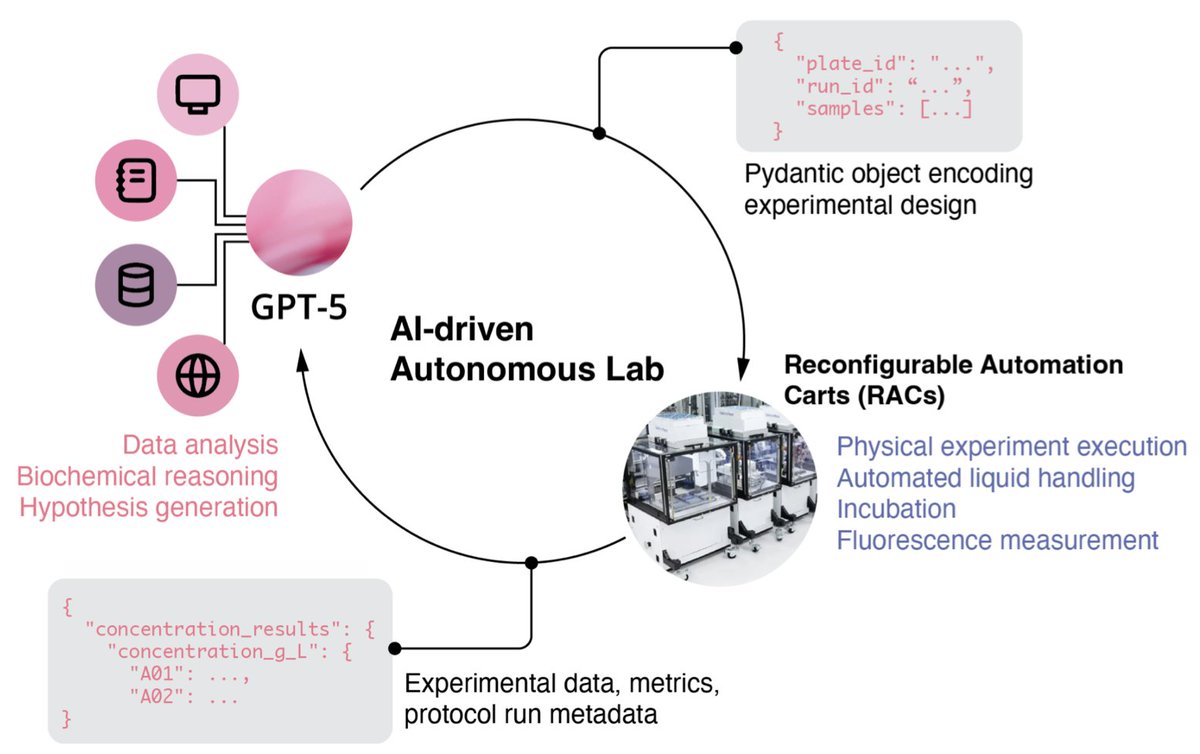
1. This study demonstrates the first real-world application of a fully autonomous AI-driven laboratory combining OpenAI's GPT-5 with Ginkgo Bioworks' cloud automation platform to solve a complex biological optimization problem.
2. The autonomous lab achieved a 40% reduction in specific cost of cell-free protein synthesis compared to state-of-the-art, dropping from $698/g to $422/g, while simultaneously increasing protein titer by 27% from 2.39 g/L to 3.04 g/L.
3. The system operated with minimal human intervention—limited only to reagent preparation and loading—with GPT-5 handling experimental design, execution, data analysis, interpretation, and hypothesis generation across six iterative steps over six months.
4. A key technical innovation was the use of Pydantic schema validation to ensure AI-designed experiments were scientifically valid and physically executable, reducing design flaws to less than 1% across 480 plates.
5. The study revealed that providing GPT-5 with tool access—including internet search, computational analysis, and scientific literature—created a step-change in performance, enabling the model to discover novel reaction compositions incorporating nucleotide monophosphates, spermidine, and optimized buffering strategies.
6. The autonomous lab generated over 150,000 data points from 36,000 unique reaction compositions, demonstrating that AI-driven experimentation can operate at scales and speeds impractical for traditional research approaches.
7. GPT-5's ability to maintain detailed laboratory notebook entries documenting its own reasoning process, including critiques of experimental variability and proposals for new reagents, showcases emergent scientific reasoning capabilities in large language models.
💻Code: github.com/ginkgobioworks/cf…
📜Paper: biorxiv.org/content/10.64898…
#autonomouslab #GPT5 #cellfreeproteinsynthesis #syntheticbiology #AIscience #laboratoryautomation #bioengineering #computationalbiology #machinelearning #biotech
1
19
1,645
#GPT5 #OpenAI #GinkgoBioworks #AutonomousLab
#AIinScience #자율실험실 #합성생물학 #인공지능
AI 과학자 시대의 개막: GPT-5, 실험실을 장악하다
———
2026년 2월 5일, 합성생물학의 선두주자 깅코는 OpenAI의 차세대 모델 GPT-5를 결합한 자율 주행 실험실(Autonomous Lab)의 성과를 발표함. 이는 단순히 AI가 데이터를 분석하는 수준을 넘어, 가설 설정 - 실험 설계 - 실행 - 피드백의 전 과정을 스스로 수행하는 '닫힌 루프(Closed-loop)' 시스템의 실질적 구현을 의미함.
핵심 성과: 무세포 단백질 합성(Cell-free protein synthesis) 반응 비용을 기존 기술 대비 40% 절감함.
실험 규모: 6개월간 6차례의 반복 사이클을 통해 총 36,000개의 실험 조건을 테스트함.
상업적 연계: AI가 최적화한 반응 혼합물을 깅코의 시약 상점에서 즉시 판매 시작하며 기술의 실효성을 입증함.
———
병목 현상에 갇힌 현대 생물학
전통적인 생물학 실험은 막대한 비용과 시간이 소요되는 '장인 정신'의 영역이었음. 특히 본 실험의 대상인 무세포 단백질 합성은 살아있는 세포 없이 단백질을 만드는 고난도 기술로, 다음과 같은 구조적 한계가 존재함.
비용의 한계: 시약 및 소모품 비용이 극도로 높아 광범위한 실험이 불가능했음.
복잡성의 늪: 수십 가지 성분의 미세한 농도 변화가 결과에 영향을 주어, 인간 과학자가 최적의 조합을 찾아내는 데 한계가 있음.
데이터의 파편화: 실험 결과가 다음 실험 설계로 즉각 반영되지 못해 학습 효율이 떨어짐.
직관적 비유: 무세포 단백질 합성은 '빵집(살아있는 세포)을 통째로 짓지 않고, 밀가루와 효모만 섞어서 즉석에서 빵을 굽는 것'과 같음. 하지만 재료비가 너무 비싸고 황금 비율을 찾는 게 너무 어려웠는데, AI가 수만 번의 시식 끝에 '가장 저렴하면서 맛있는 레시피'를 찾아낸 상황임.
———
GPT-5와 자율 실험실의 결합 메커니즘
이번 성과의 핵심은 GPT-5의 추론 능력(Reasoning)을 물리적 실험 장치인 RAC(재구성 가능한 자동화 카트) 및 Catalyst 소프트웨어와 동기화한 것에 있음.
(1). 폐쇄 루프 워크플로우 (Closed-loop Workflow)
GPT-5는 인터넷 접속 권한과 데이터 분석 패키지가 탑재된 컴퓨터를 활용해 다음의 과정을 반복함.
분석: 기존 문헌 및 이전 사이클의 데이터를 학습.
설계: Pydantic 모델(데이터 검증 도구)을 통해 환각(Hallucination)이 제거된 실험 설계 도출.
실행: 깅코의 클라우드 랩 로봇이 물리적 실험 수행.
학습: 결과를 분석해 가설을 수정하고 다음 차수 실험에 반영.
(2). 엄격한 검증 시스템
AI의 오류를 방지하기 위해 모든 실험 설계는 실행 전 Pydantic 모델을 거침. 플레이트 레이아웃, 시약 가용성, 볼륨 제약 등을 체크하여 '실행 가능한' 과학적 설계만을 선별함.
(3). 경제적 결과값
기존 업계 최고 수준(SOTA): 698/gram
GPT-5 최적화 결과: 422/gram
성과: 15만 개 이상의 데이터 포인트를 생성하며 인간의 개입을 시약 준비 및 시스템 감시 수준으로 최소화함.
———
자율 과학이 가져올 파괴적 혁신
이번 협업은 과학 연구의 주도권이 '인간의 직관'에서 'AI의 대규모 탐색'으로 이동하고 있음을 시사함.
Jason Kelly(깅코 CEO)는 AI 자율 랩이 국가 과학 경쟁력을 결정지을 것이라 강조함. 이는 미 에너지부(DOE)의 Genesis Mission과 궤를 같이함.
고가의 시약 비용을 절감함으로써 더 많은 연구자가 단백질 합성에 접근할 수 있는 환경이 조성될 것임.
향후 이 시스템은 단백질 합성을 넘어 신약 개발, 신소재 설계 등으로 확장될 것이며, AI가 인간이 보지 못한 '새로운 시약의 조합'을 제안한 점은 주목할 만한 통찰임.
Feb 5

We connected our autonomous lab to @OpenAI's GPT-5 and let it run 36,000 experiments. The result was a new state-of-the-art for Cell-Free Protein Synthesis that cut costs by 40% per gram of protein.
You can now order the beta version for your own lab: reagents.ginkgo.bio/
You can read the full preprint and read OpenAI’s blog post about our work here: openai.com/index/gpt-5-lower…
See the full press release here: prnewswire.com/news-releases…
1
3
10
938

10 Jul 2025
Gerbrand Ceder(UC Berkeley / LBNL)
「AI and autonomous laboratories for materials synthesis」
計算材料科学は第一原理計算で大きく進化したが、実験の自動化はまだ追いついていない。
彼らは自律合成ラボA-Labでその壁を打破
まもなくA-Lab 2.0も始動
#AI4X #AutonomousLab #SelfDrivingLab
1
4
378

4 Jul 2025
An AI-native experimental laboratory for autonomous biomolecular engineering
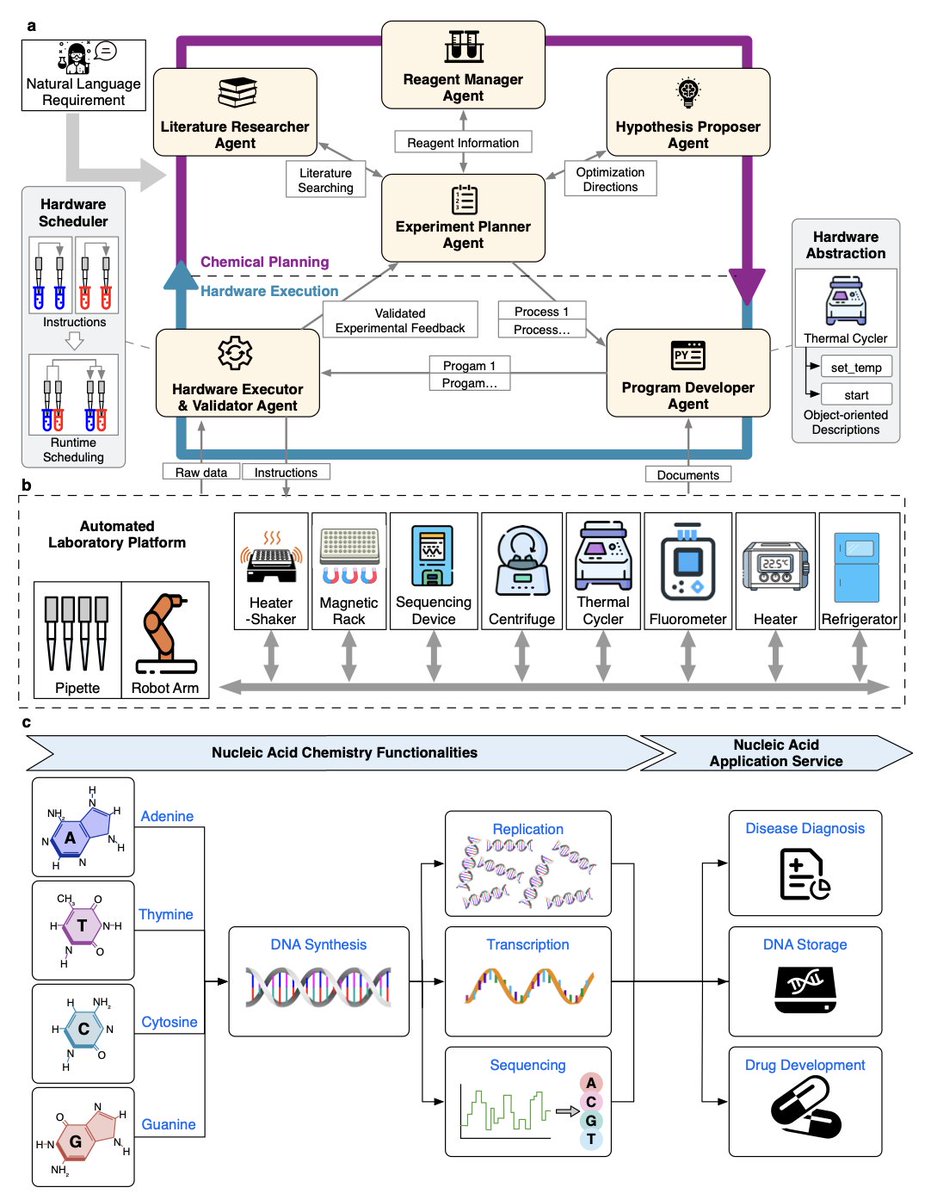
1.Researchers introduce AutoDNA, an AI-native autonomous laboratory that performs complex biomolecular experiments—such as DNA synthesis and sequencing—entirely without human intervention, achieving performance comparable to expert scientists.
2.Unlike prior systems that rely on predefined heuristics and workflows, AutoDNA uses a multi-agent architecture co-designed with instruments and models, enabling closed-loop experimentation via continuous “design-experiment-optimize” cycles.
3.AutoDNA supports diverse nucleic acid functions including synthesis, transcription, amplification, and sequencing. It powers applications like diagnostics, drug development, and DNA data storage, serving even non-expert users through natural language commands.
4.The system features intelligent agents with specialized roles: experiment planning, hypothesis generation, literature mining, reagent management, hardware abstraction, and real-time execution. Agents collaborate autonomously, guided by LLM-based reasoning.
5.The Program Developer Agent converts technical specs of lab instruments into AI-native “atomic services”—Python objects described in natural language—bridging AI models with physical hardware in an interpretable way.
6.In an end-to-end nucleic acid test, AutoDNA autonomously designed and executed an RPA-based assay. It generated, corrected, and ran all control code, matching the accuracy and diagnostic output of human-executed protocols.
7.For enzymatic DNA synthesis, AutoDNA autonomously explored a multi-objective optimization space (yield, time, reagents) across 5 iterations. It selected buffers, added surfactants, and tuned reaction conditions, reaching a stepwise yield of 97.7%.
8.The system handled over 9,300 individual hardware steps with no human input. Sequencing validated synthesis quality, showing error rates consistent with expert-controlled experiments. Main errors were deletions, likely from bead aggregation.
9.AutoDNA supports concurrent execution of multiple experiments. It dynamically monitors hardware status and reroutes tasks across equivalent instruments to avoid conflicts—tripling throughput and significantly improving instrument utilization.
10.In a multi-user scenario, AutoDNA autonomously resolved resource contention by rerouting a thermal incubation step to an alternative instrument (thermocycler), reducing total experiment time by 169 minutes compared to queue-based scheduling.
11.AutoDNA also supports a full DNA data storage pipeline: encoding data into DNA, synthesizing strands, sequencing them back, and decoding. It completed an end-to-end read-write cycle with 78 strands in 162.9 hours and perfect data recovery.
12.This work showcases the first fully AI-native lab for autonomous, multi-objective, and multi-user biomolecular engineering, marking a shift from AI-assistive to AI-native scientific research platforms.
📜Paper: arxiv.org/abs/2507.02379
#AI4Science #SyntheticBiology #DNAStorage #AutonomousLab #LLM #MolecularBiology #Automation #ComputationalBiology
1
5
23
1,539
4 Jul 2025
An AI-native experimental laboratory for autonomous biomolecular engineering
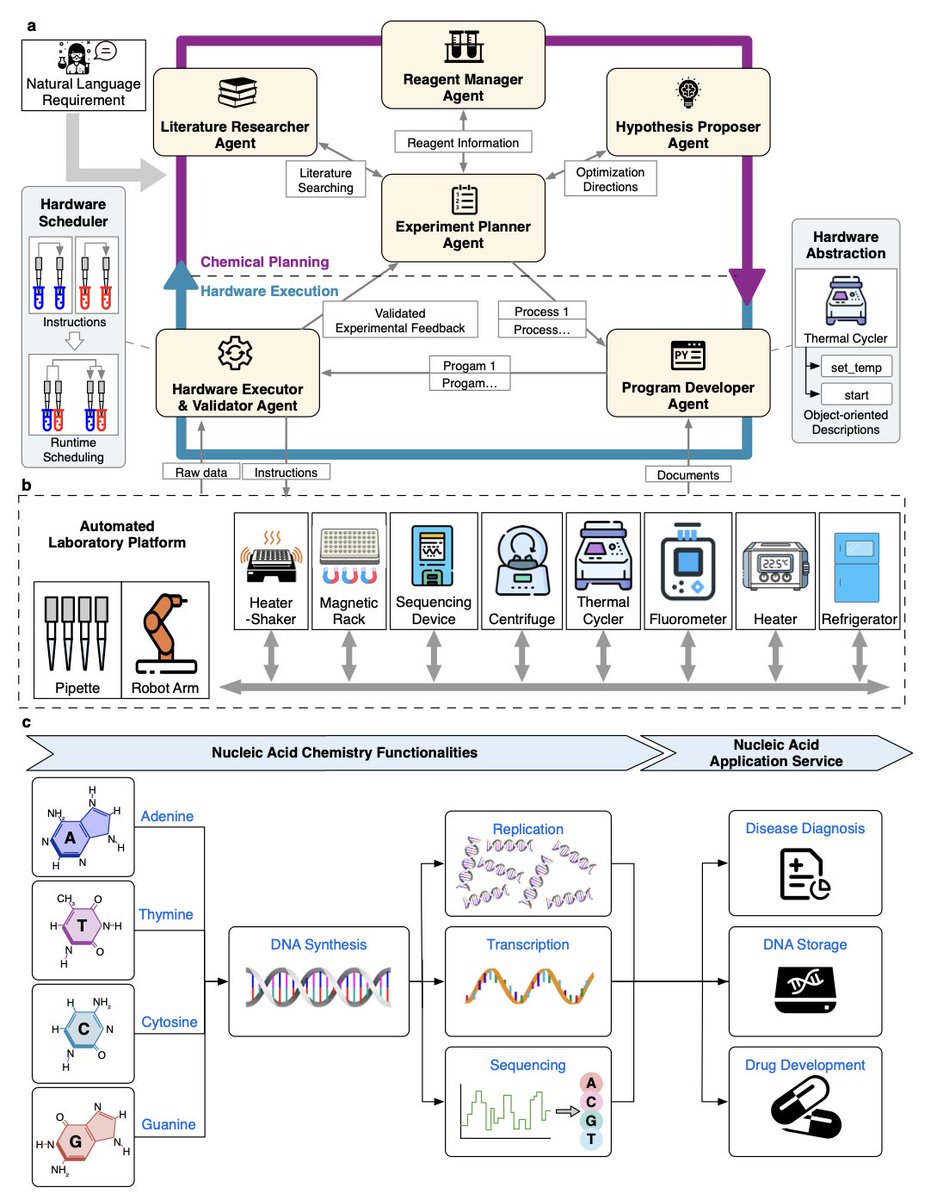
1.Researchers introduce AutoDNA, an AI-native autonomous laboratory that performs complex biomolecular experiments—such as DNA synthesis and sequencing—entirely without human intervention, achieving performance comparable to expert scientists.
2.Unlike prior systems that rely on predefined heuristics and workflows, AutoDNA uses a multi-agent architecture co-designed with instruments and models, enabling closed-loop experimentation via continuous “design-experiment-optimize” cycles.
3.AutoDNA supports diverse nucleic acid functions including synthesis, transcription, amplification, and sequencing. It powers applications like diagnostics, drug development, and DNA data storage, serving even non-expert users through natural language commands.
4.The system features intelligent agents with specialized roles: experiment planning, hypothesis generation, literature mining, reagent management, hardware abstraction, and real-time execution. Agents collaborate autonomously, guided by LLM-based reasoning.
5.The Program Developer Agent converts technical specs of lab instruments into AI-native “atomic services”—Python objects described in natural language—bridging AI models with physical hardware in an interpretable way.
6.In an end-to-end nucleic acid test, AutoDNA autonomously designed and executed an RPA-based assay. It generated, corrected, and ran all control code, matching the accuracy and diagnostic output of human-executed protocols.
7.For enzymatic DNA synthesis, AutoDNA autonomously explored a multi-objective optimization space (yield, time, reagents) across 5 iterations. It selected buffers, added surfactants, and tuned reaction conditions, reaching a stepwise yield of 97.7%.
8.The system handled over 9,300 individual hardware steps with no human input. Sequencing validated synthesis quality, showing error rates consistent with expert-controlled experiments. Main errors were deletions, likely from bead aggregation.
9.AutoDNA supports concurrent execution of multiple experiments. It dynamically monitors hardware status and reroutes tasks across equivalent instruments to avoid conflicts—tripling throughput and significantly improving instrument utilization.
10.In a multi-user scenario, AutoDNA autonomously resolved resource contention by rerouting a thermal incubation step to an alternative instrument (thermocycler), reducing total experiment time by 169 minutes compared to queue-based scheduling.
11.AutoDNA also supports a full DNA data storage pipeline: encoding data into DNA, synthesizing strands, sequencing them back, and decoding. It completed an end-to-end read-write cycle with 78 strands in 162.9 hours and perfect data recovery.
12.This work showcases the first fully AI-native lab for autonomous, multi-objective, and multi-user biomolecular engineering, marking a shift from AI-assistive to AI-native scientific research platforms.
📜Paper: arxiv.org/abs/2507.02379
#AI4Science #SyntheticBiology #DNAStorage #AutonomousLab #LLM #MolecularBiology #Automation #ComputationalBiology
3
795

4 Jul 2025
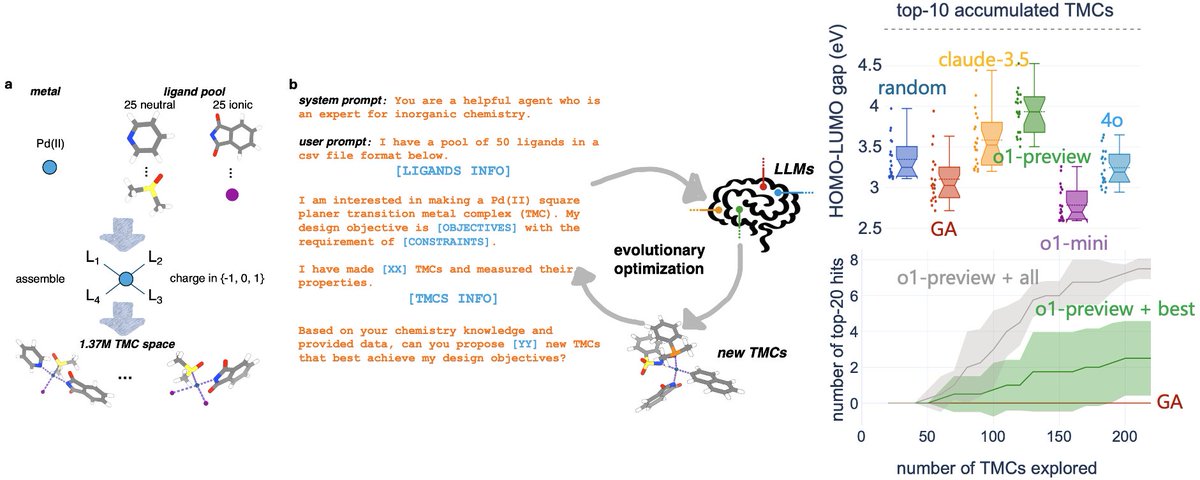
🆕 LLM-EO @DeepPrinciple now hot off the press in @J_A_C_S! We marry Large Language Models with evolutionary optimization, LLM-EO, for hands-free design of transition-metal complexes.
Why it matters
• Sample-efficient: just 200 evaluations net 8 / 20 global top-scoring Pd(II) complexes—only 0.015 % of a 1.37 M design space 🎯
• Multi-objective smart: 400 queries land 9 candidates on the true Pareto front and 18 in the top-200 for gap × α trade-off 🔀
• Learns on the fly: retaining all history lets LLM-EO surge early, while GA catches up later—perfect combo potential ⚡
• Chat-native control: “Max gap, α < 1 eV” → valid molecules; no coding required 💬
Takeaway: LLM-EO turns plain-language prompts into high-value chemistry, pointing to faster discovery of catalysts, MOFs & more. Bigger, smarter LLMs will only raise the ceiling 🚀
🔗 Read the full paper: pubs.acs.org/doi/10.1021/jac…
🐙 GitHub: github.com/deepprinciple/llm…
📄 Preprint: arxiv.org/abs/2410.18136
This is also my first JACS paper as a corresponding author. Shout out to Jieyu, Zhangde, @YuanqiD , Qiyuan, Yirui, and @haojunjia and the entire @DeepPrinciple team.
#AI4Science #CompChem #MatSci #LLM #AutonomousLab
5
35
4,990
2 Jul 2025
NanoChef: AI Framework for Simultaneous Optimization of Synthesis Sequences and Reaction Conditions at Autonomous Laboratories
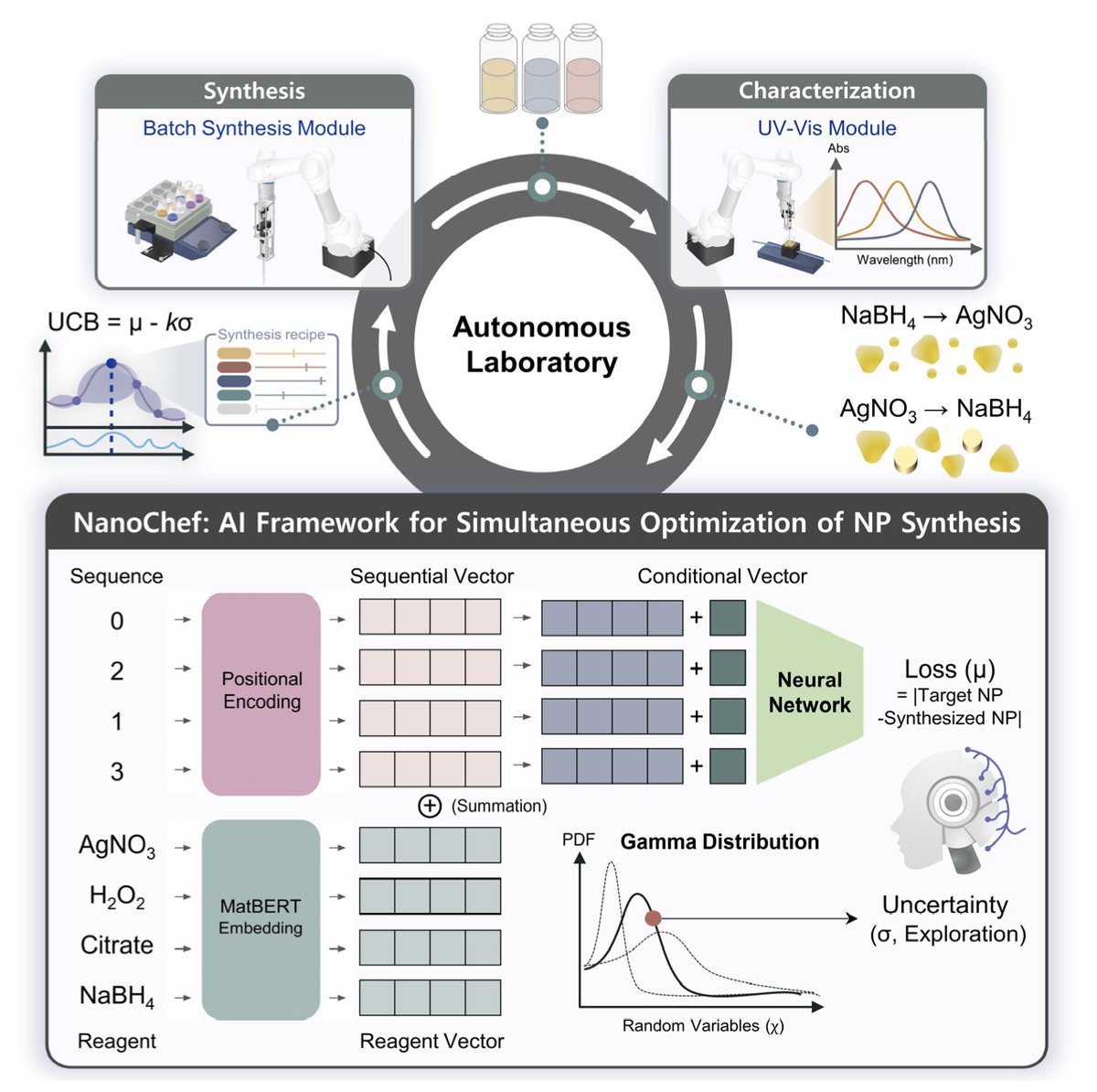
1.NanoChef is a deep learning-based framework that simultaneously optimizes synthesis sequences and reaction conditions for nanoparticle (NP) synthesis in autonomous laboratories. It redefines synthesis order as a design variable, uncovering more effective synthetic routes.
2.Unlike traditional approaches that fix reagent order and only tune continuous parameters, NanoChef encodes reagent sequences using Transformer-style positional encoding and MatBERT embeddings. This allows joint modeling of categorical and continuous variables.
3.In real-world experiments targeting Ag NP synthesis with a λmax of 513 nm, NanoChef discovered that the reductant‒last method outperforms conventional strategies, reducing FWHM by 32% and achieving optimal recipes within 100 experiments.
4.When scaled to a three-reagent system (AgNO3, NaBH4, H2O2), NanoChef autonomously identified an oxidant‒last strategy that had never been considered in prior work and yielded the most uniform NPs with lowest FWHM and standard deviation.
5.A lightweight neural network (3,151 parameters) serves as the surrogate model, predicting loss and uncertainty using a Gamma distribution. This efficient architecture enables high performance even in data-scarce and high-dimensional synthesis landscapes.
6.NanoChef’s closed-loop design integrates prediction, uncertainty modeling, and robotic execution. It consistently converged to global optima in fewer than 40 cycles in virtual experiments, validated across varying levels of synthesis-order sensitivity.
7.Compared to standard Gaussian process or decision tree-based models, NanoChef’s unified representation of categorical and continuous variables allows more expressive modeling, improving the discovery of synthesis–property relationships.
8.Through benchmarking on Olympus virtual spaces, NanoChef demonstrated robustness in complex synthetic landscapes and outperformed baseline models under strong synthesis-order effects (e.g., Dejong–Killimanjaro space pair).
9.Experimentally, NanoChef guided a robotic system to execute dynamic reagent sequences using a custom micropipette-based batch module, enabling accurate, automated synthesis with strong compatibility across acidic and polymeric reagents.
10.Beyond optimization, NanoChef offers scientific insights. Its discoveries emphasize that reagent order is not a procedural detail but a chemically active parameter that influences nucleation, growth, and final material properties.
11.This work illustrates how lightweight, chemically-aware AI models can drive innovation in self-driving labs, moving beyond fixed heuristics to intelligent, adaptive experimentation.
12.Future directions include combining NanoChef’s vectorized synthesis representations with multimodal data (e.g., TEM, XRD) to uncover deeper synthesis–structure–property links and build foundation models for autonomous chemistry.
💻Code: github.com/KIST-CSRC/NanoChe…
📜Paper: doi.org/10.26434/chemrxiv-20…
#AutonomousLab #NanoparticleSynthesis #BayesianOptimization #AI4Science #MatBERT #MaterialsDiscovery #ChemicalAI #SelfDrivingLab
1
6
1,026
2 Jul 2025
NanoChef: AI Framework for Simultaneous Optimization of Synthesis Sequences and Reaction Conditions at Autonomous Laboratories
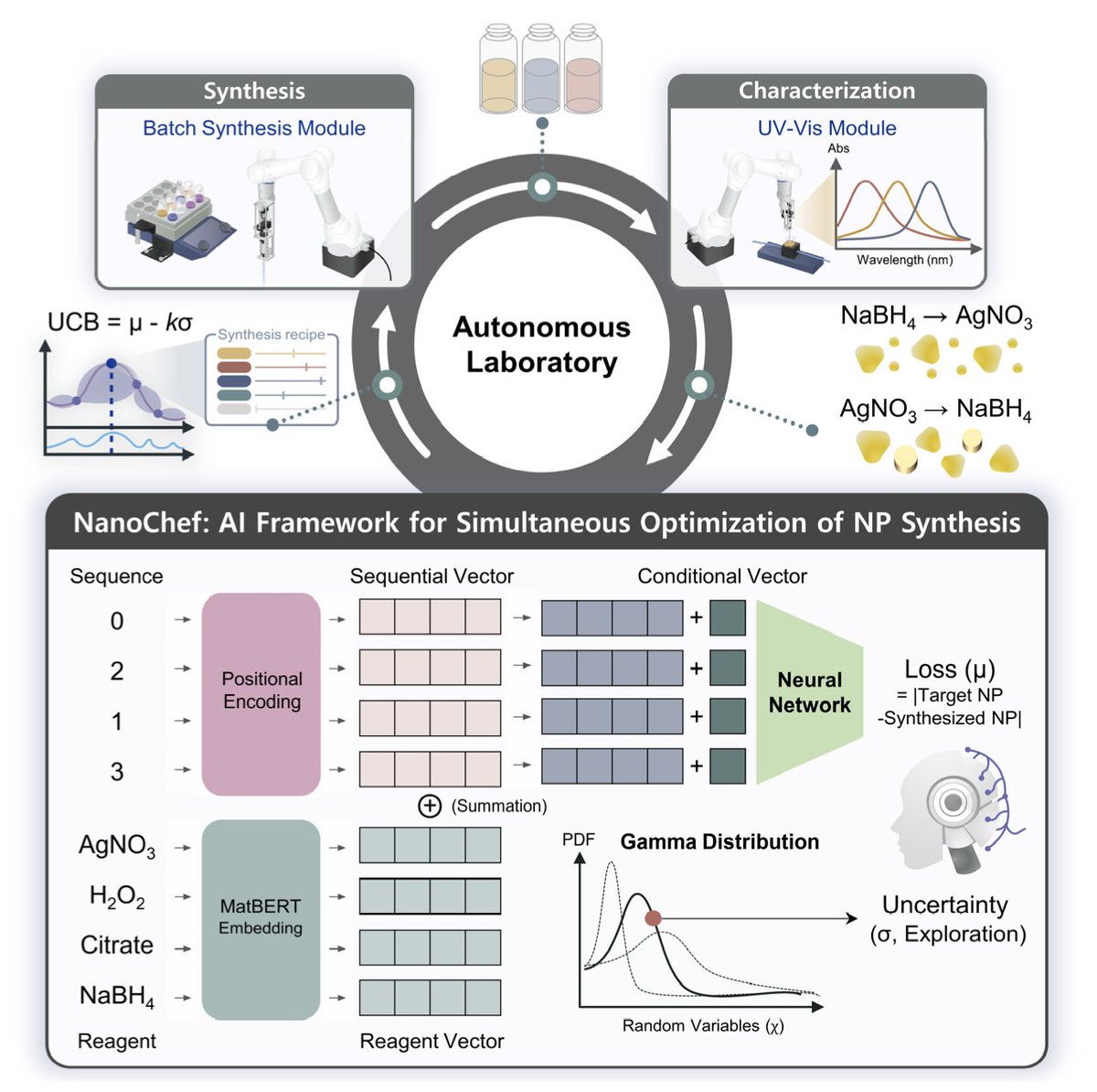
1.NanoChef is a deep learning-based framework that simultaneously optimizes synthesis sequences and reaction conditions for nanoparticle (NP) synthesis in autonomous laboratories. It redefines synthesis order as a design variable, uncovering more effective synthetic routes.
2.Unlike traditional approaches that fix reagent order and only tune continuous parameters, NanoChef encodes reagent sequences using Transformer-style positional encoding and MatBERT embeddings. This allows joint modeling of categorical and continuous variables.
3.In real-world experiments targeting Ag NP synthesis with a λmax of 513 nm, NanoChef discovered that the reductant‒last method outperforms conventional strategies, reducing FWHM by 32% and achieving optimal recipes within 100 experiments.
4.When scaled to a three-reagent system (AgNO3, NaBH4, H2O2), NanoChef autonomously identified an oxidant‒last strategy that had never been considered in prior work and yielded the most uniform NPs with lowest FWHM and standard deviation.
5.A lightweight neural network (3,151 parameters) serves as the surrogate model, predicting loss and uncertainty using a Gamma distribution. This efficient architecture enables high performance even in data-scarce and high-dimensional synthesis landscapes.
6.NanoChef’s closed-loop design integrates prediction, uncertainty modeling, and robotic execution. It consistently converged to global optima in fewer than 40 cycles in virtual experiments, validated across varying levels of synthesis-order sensitivity.
7.Compared to standard Gaussian process or decision tree-based models, NanoChef’s unified representation of categorical and continuous variables allows more expressive modeling, improving the discovery of synthesis–property relationships.
8.Through benchmarking on Olympus virtual spaces, NanoChef demonstrated robustness in complex synthetic landscapes and outperformed baseline models under strong synthesis-order effects (e.g., Dejong–Killimanjaro space pair).
9.Experimentally, NanoChef guided a robotic system to execute dynamic reagent sequences using a custom micropipette-based batch module, enabling accurate, automated synthesis with strong compatibility across acidic and polymeric reagents.
10.Beyond optimization, NanoChef offers scientific insights. Its discoveries emphasize that reagent order is not a procedural detail but a chemically active parameter that influences nucleation, growth, and final material properties.
11.This work illustrates how lightweight, chemically-aware AI models can drive innovation in self-driving labs, moving beyond fixed heuristics to intelligent, adaptive experimentation.
12.Future directions include combining NanoChef’s vectorized synthesis representations with multimodal data (e.g., TEM, XRD) to uncover deeper synthesis–structure–property links and build foundation models for autonomous chemistry.
💻Code: github.com/KIST-CSRC/NanoChe…
📜Paper: doi.org/10.26434/chemrxiv-20…
#AutonomousLab #NanoparticleSynthesis #BayesianOptimization #AI4Science #MatBERT #MaterialsDiscovery #ChemicalAI #SelfDrivingLab
2
10
1,031

7 Oct 2024
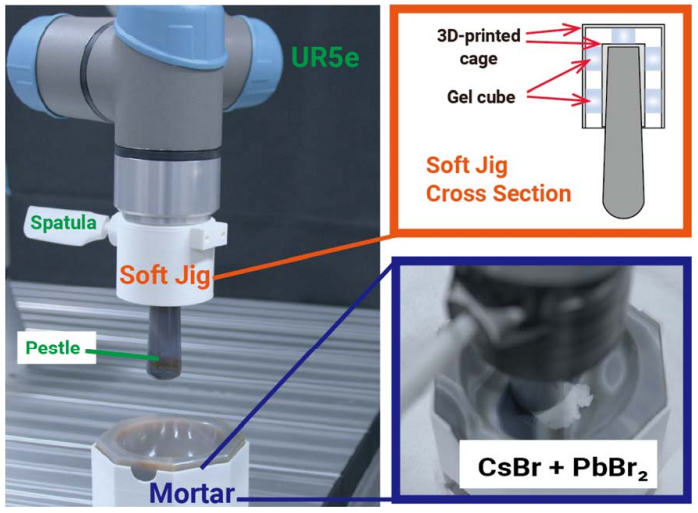
Making a robot to synthesize perovskite powders mechanochemically🤖🦾Work from Yusaku Nakajima @nakaji_001 and Kanta Ono et al @osaka_univ
Force-controlled robotic mechanochemical synthesis
pubs.rsc.org/en/content/arti…
#mechanochemistry #perovskite #Autonomouslab
1
7
4,573

21 Jun 2022
🚙🖲⌨️ #Innovation #VehiculeAutonome #MAAS :
Aujourd’hui en visite @Polytechnique et au @X_Novation, nous avons pu goûter l’expérimentation route ouverte de Zoé autonomes par @wearemobilizers @renault_fr
@ParisSaclay #AutonomousLab @ProjetSam @Agence_IT_Gouv
1/
1
1
4

9 May 2022
[#Mobilité] Le 15 mai 2019 marquait le lancement de l'expérimentation Paris-Saclay #AutonomousLab, un projet visant à développer de nouveaux services de mobilité en conduite autonome sur le campus urbain 🚙 3 ans après, où en sommes-nous ? #Thread 1/7
1
1
1

16 Sep 2021
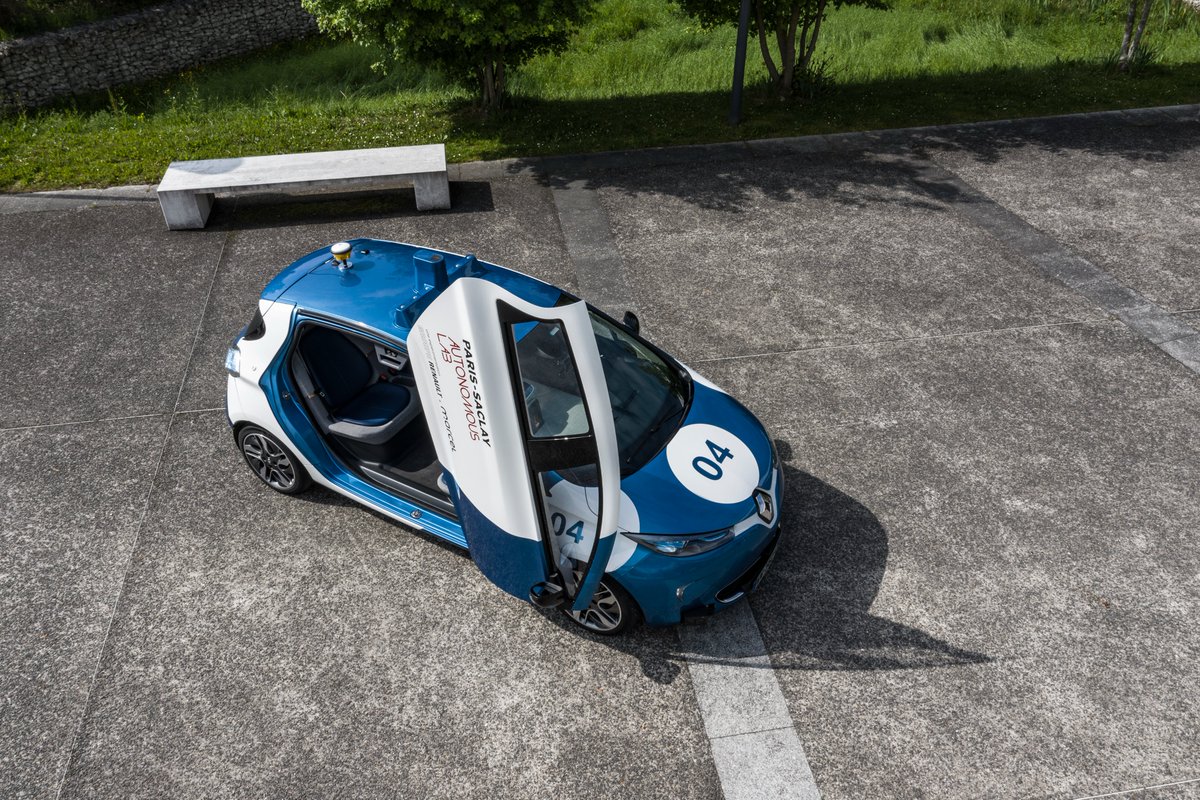
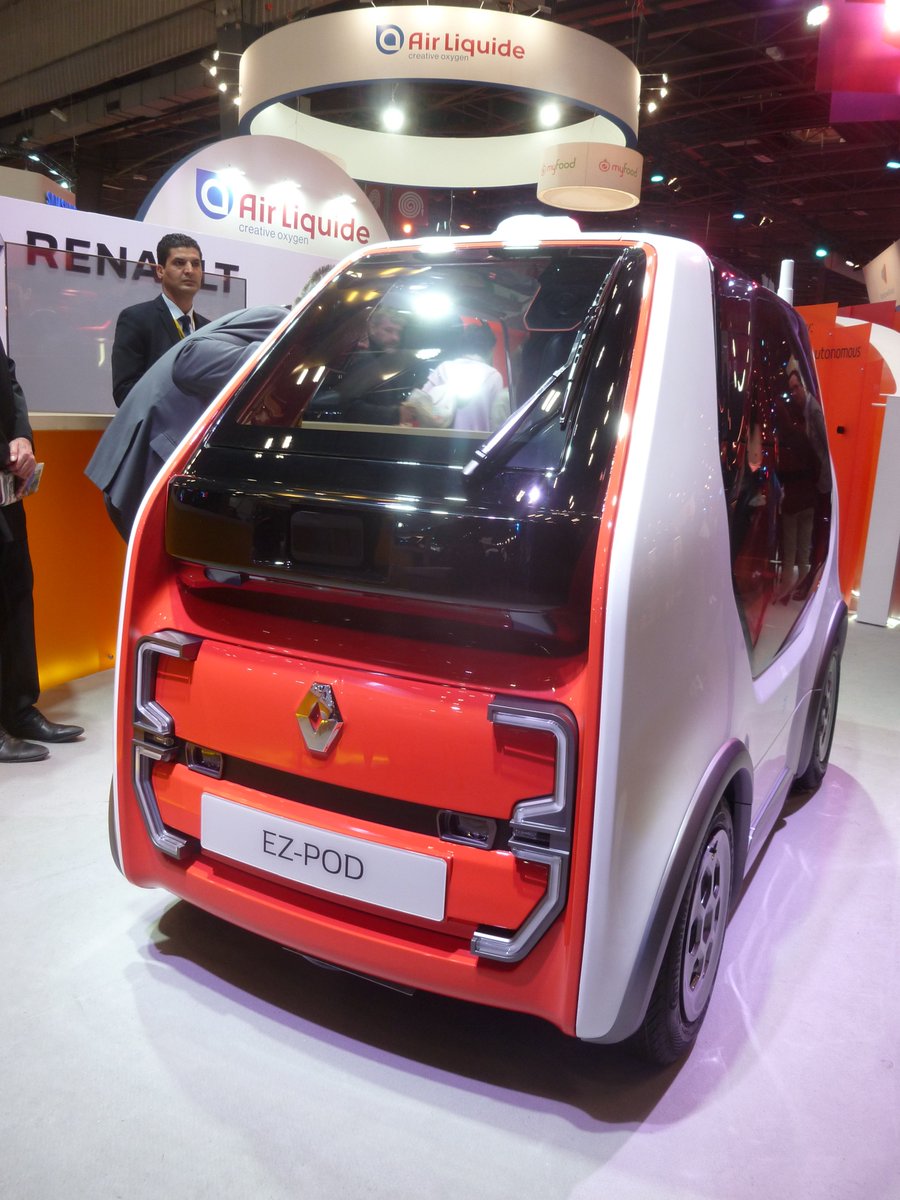
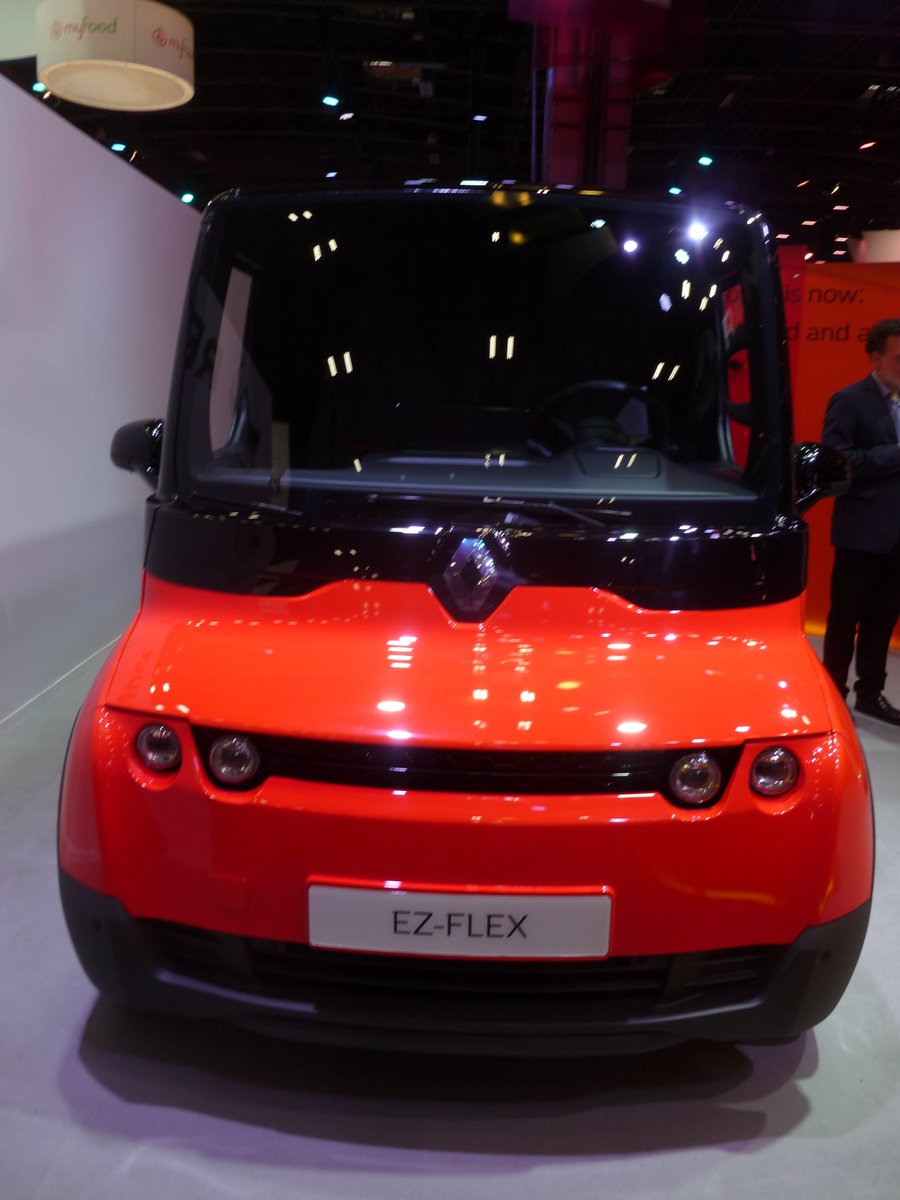
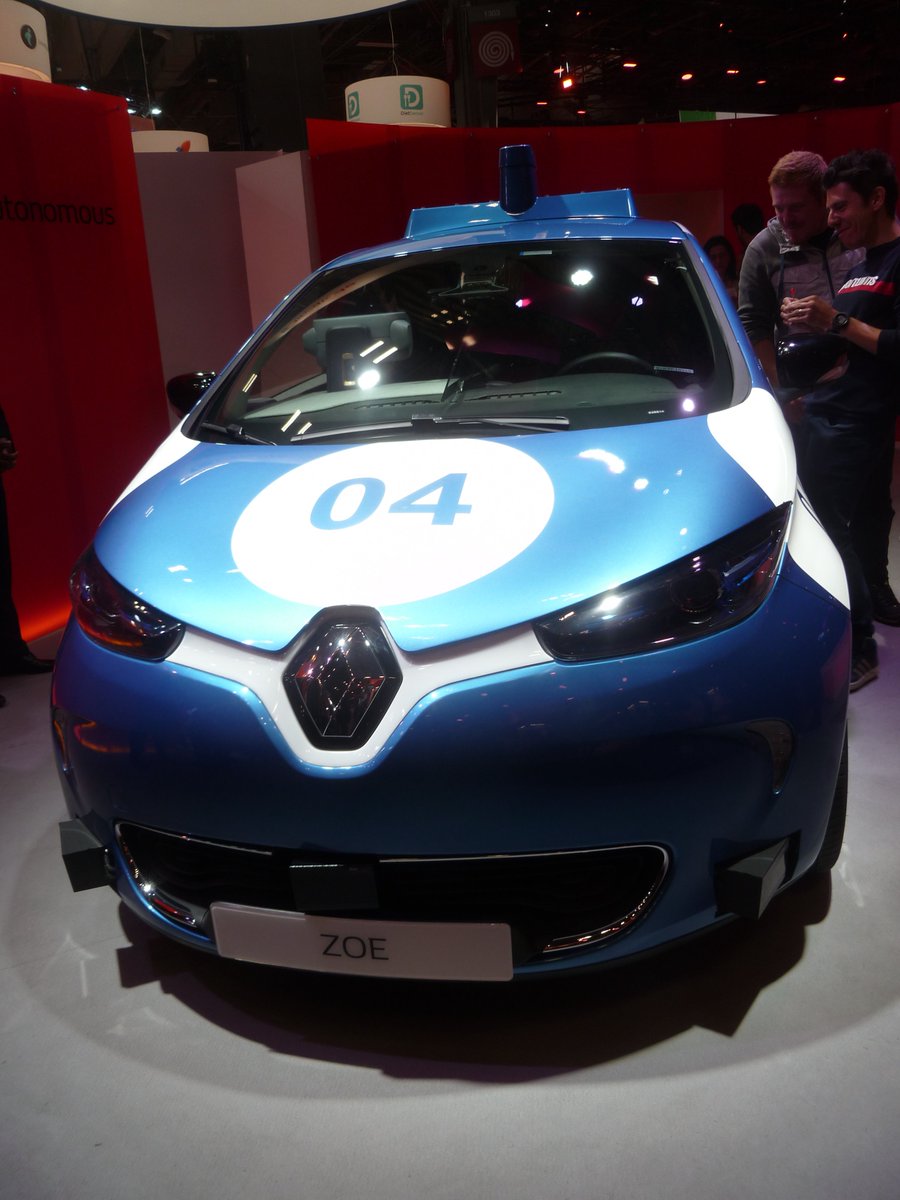
Do you remember the #AutonomousLab tests in Rouen & Paris-Saclay? Our two full-scale labs for shared and autonomous mobility🔬. The project is a success & expands now on a larger scale✅! How did the project succeed? A thread about it🔽
15 Sep 2021

Do you remember the #AutonomousLab tests in Rouen & Paris-Saclay? Our two full-scale labs for shared and autonomous mobility🔬. The project is a success & expands now on a larger scale✅!
How did the project succeed? A thread about it🔽
4

15 Sep 2021
Do you remember the #AutonomousLab tests in Rouen & Paris-Saclay? Our two full-scale labs for shared and autonomous mobility🔬. The project is a success & expands now on a larger scale✅!
How did the project succeed? A thread about it🔽
1
4
21


15 May 2019
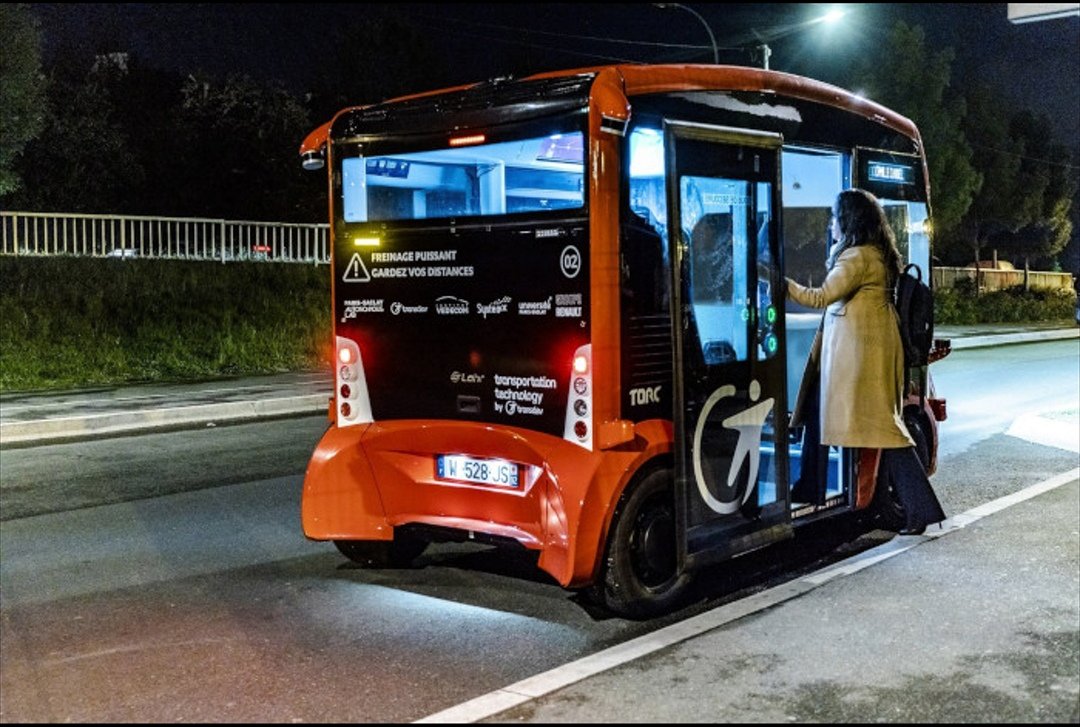
📡🔭🔬 @PSaclaySPRING retour le Keynote "Paris-Saclay #AutonomousLab, de nouveaux services de #mobilité autonome, électrique et partagée"
#thread 1/5
1
3
5

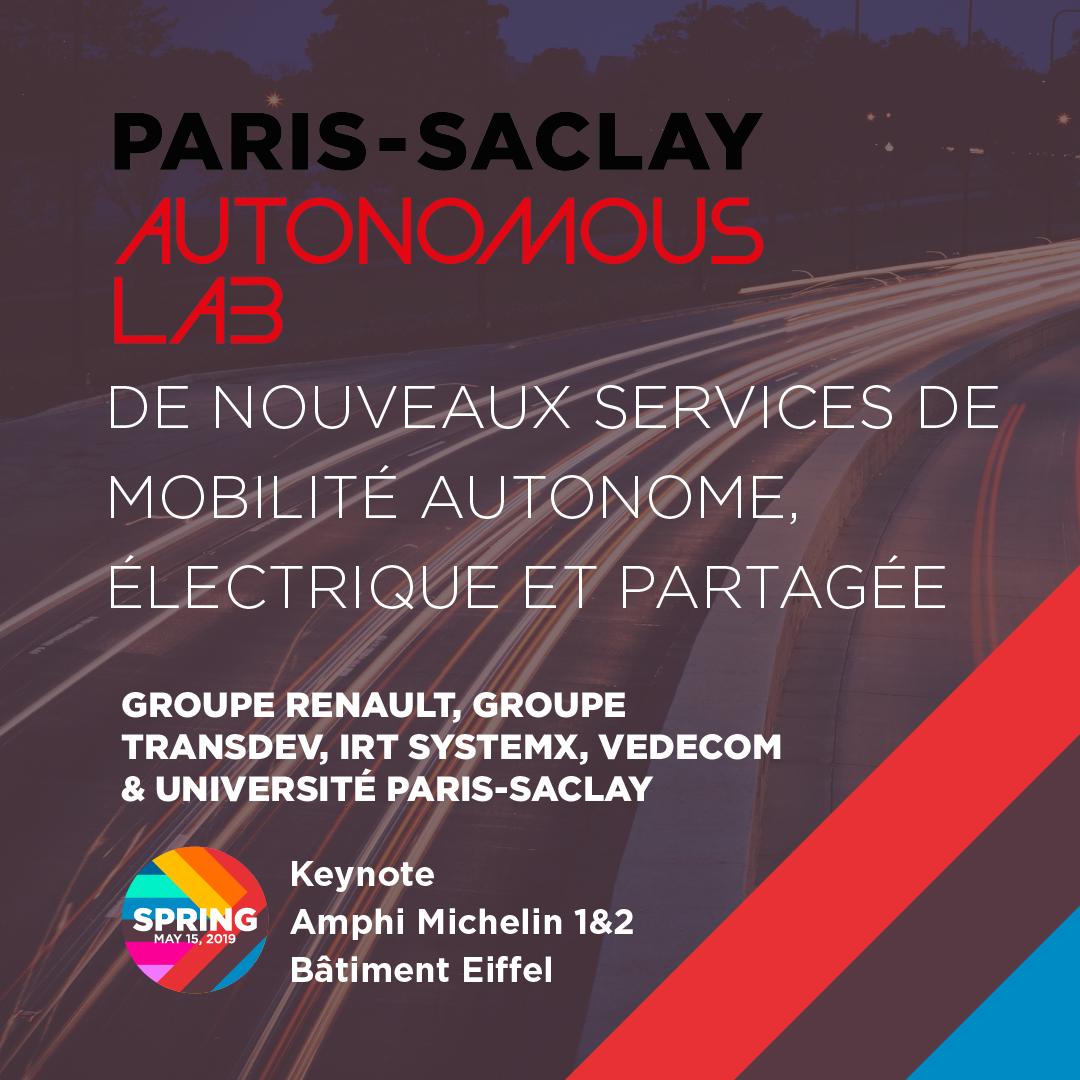
Come and see the @ParisSaclay #AutonomousLab ! @Groupe_Renault @Transdev @IRTSystemX @UnivParisSaclay @vedecom are experimenting together different services for a smart electric #autonomous #mobility, in order to complete the current transportation offer #ParisSaclaySPRING
4
8
🚌 16 innovations visent à faire de la France un moteur en matière de véhicules autonomes ⤵️
Venez découvrir l’#AutonomousLab à #ParisSaclaySPRING avec @Groupe_Renault, @Transdev, @IRTSystemX et @vedecom le 15 mai Prochain à @centralesupelec !
usine-digitale.fr/article/16…
7
7

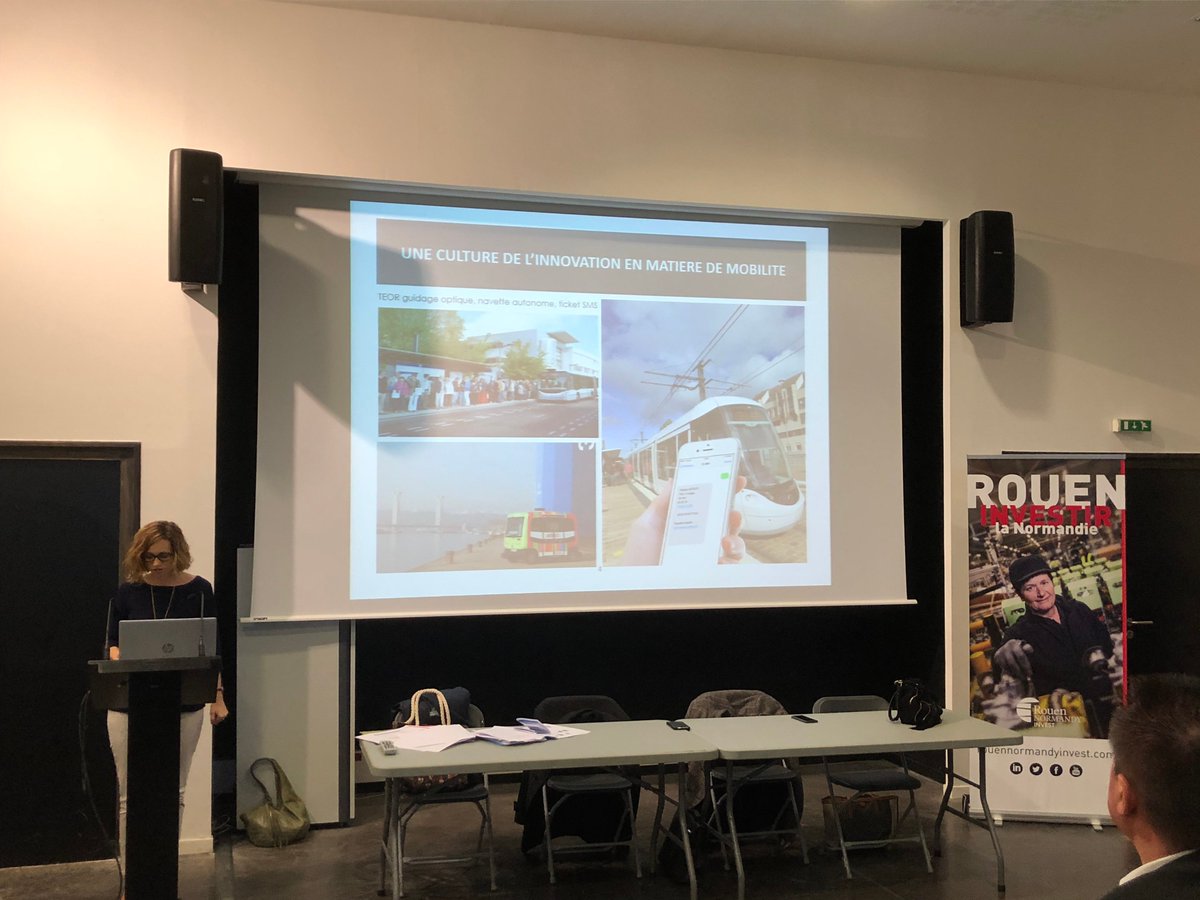
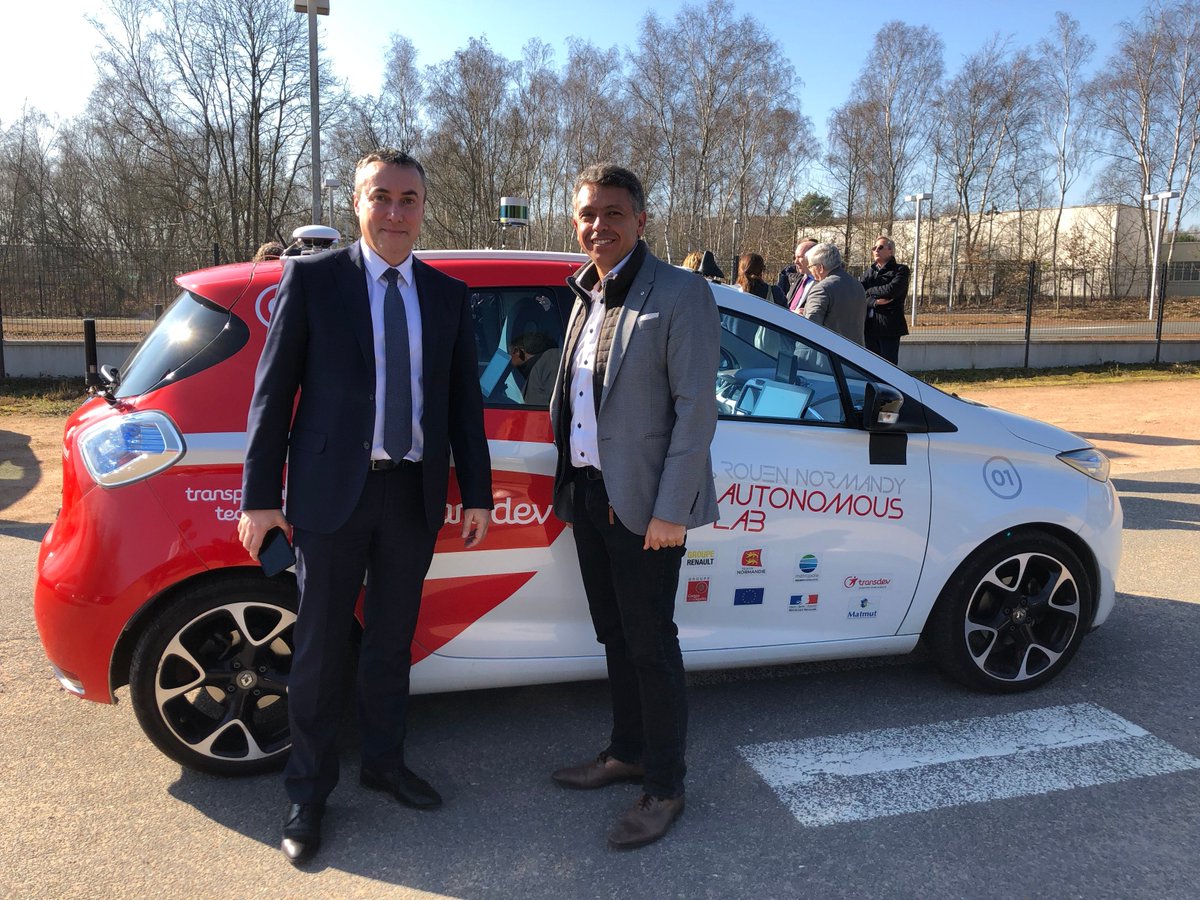
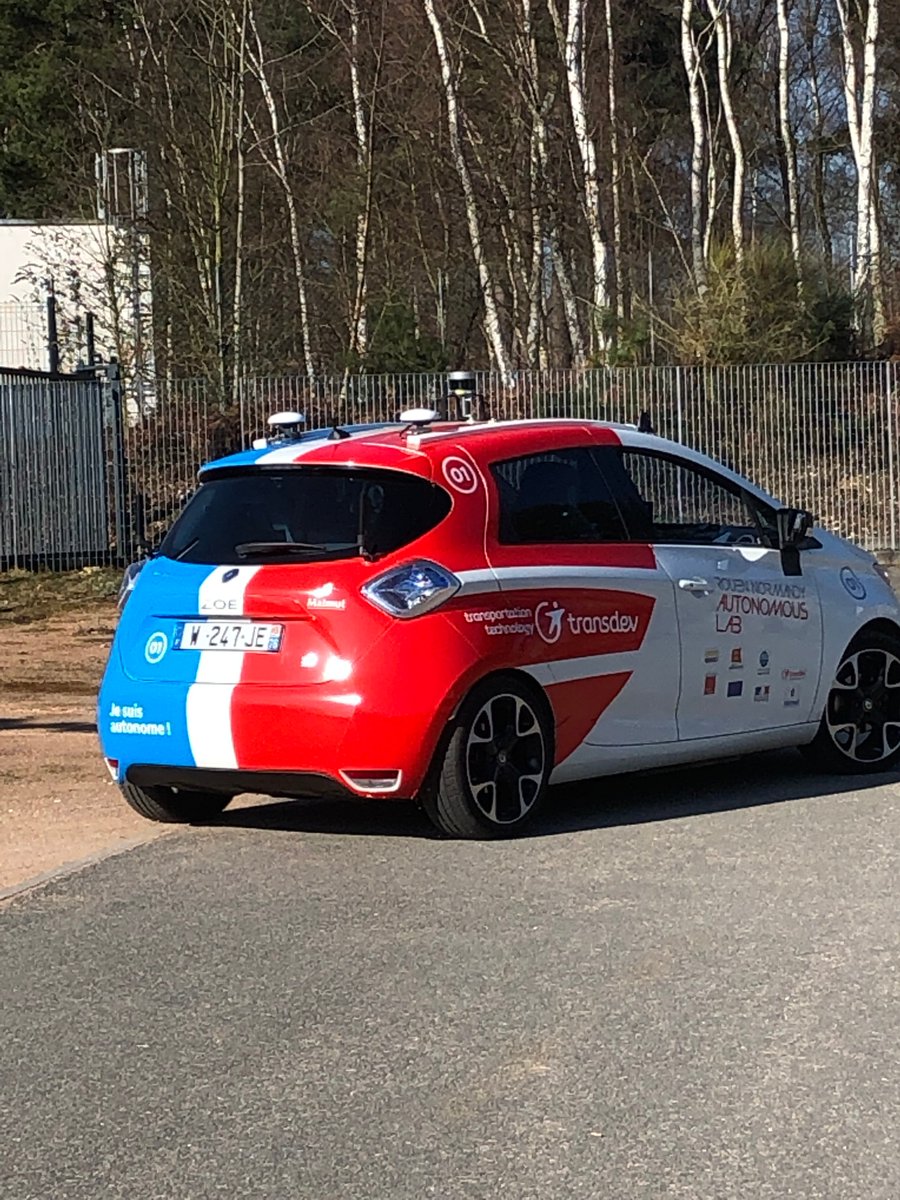
Ce matin au CISE #Madrillet, les membres du Conseil d'Administration de RNI ont pu tester les véhicules autonomes #autonomouslab @RNAutonomousLab
@transdevFR 🚗🚘👍

14
15

15 Jul 2018
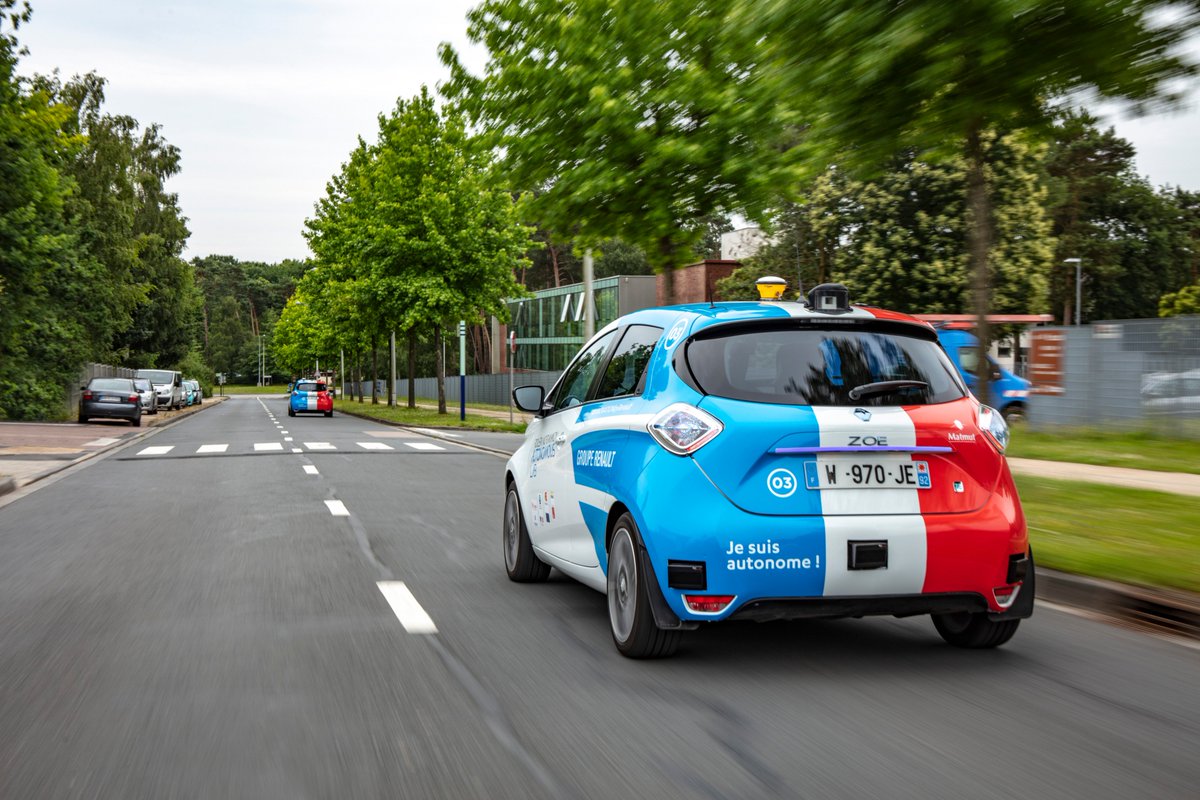
#FinaleCoupeduMonde les véhicules #autonomes du #Rouen #Normandy #AutonomousLab aux couleurs des bleus 😉⚽ ! #FRACRO #autonomousdriving
1
1
4