
Jun 12
This is embarassing for @NYMag -- these "gifted" children were about 30X more likely to acheive eminence than their peers. By any standard that is not a "mirage", but the embodiment of whatever metric identified them as gifted.
It's one thing if their writers don't understand baserates and probabilities, but this should have never gotten through editorial review.
Jun 11

Gifted and Talented, or G&T, programs have long been a perennial subject of debate, particularly in New York City, where it has bedeviled mayors for years. Some parents have already washed their hands of the whole G&T business, refusing to participate in what they view as a corrupt system of segregation. But countless others still place significant stock in the G&T designation and what it offers and are comfortable relying on cognitive testing, should it be required, to determine whether a child qualifies.
“When your intelligence is the foundation of your self-perception, failing to achieve feels like soul death,” writes Katie Arnold-Ratliff. But if the limited amount of information we have about gifted kids long-term is any indication, most lead, at best, ordinary lives of modest accomplishment. A 35-year study of 677 gifted children found that by age 50, only 12.3 percent had reached a level of “eminence,” defined as “full professors … Fortune 500 executives … judges and lawyers, leaders in biomedicine, award-winning journalists and writers.” This means 88 percent never did.
Arnold-Ratliff digs into the myth of the gifted child, and how our notions of intelligence may be inherently flawed: nymag.visitlink.me/9mc2Wh

Community note
Eminence is incredibly rare, so 12.3% among gifted students is decidedly over-representative. For example, around 0.023% of Americans are full professors at R1 institutions, yet 22 of 677 (3.25%) of gifted students studied eventually held this position (a ~140x fold increase).
pmc.ncbi.nlm.nih.gov/articles/PMC64
62
183
1,538
191,484

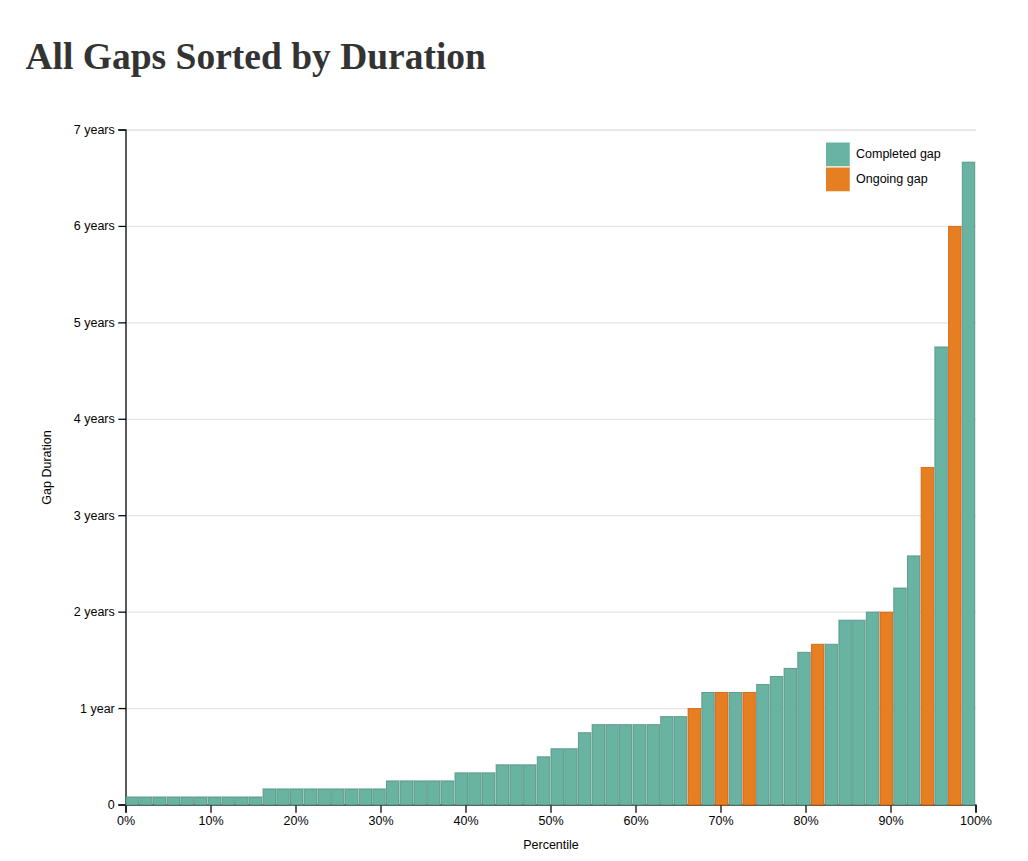
Published another forecasting newsletter, sadly paywaylled. Section on relationship baserates and gaps between relationships might be of interest though. forecasting.substack.com/p/v…
2
6
630

Apr 29
Without adjusting for baserates and missingness, it’s hard to get a ballpark sense of the level of effect we’re really talking about here (4000x, 400x, 4x???)
What my intuition says is huge effects like these are rare in human subjects data and merit a lot of extra scrutiny.
6
940


“Can” is doing a lot of work in that sentence.
A single high-potency exposure can precipitate acute psychotic symptoms in a very small number of vulnerable individuals. That is a real, studied phenomenon.
Many things can cause rare adverse reactions. That’s why we study base rates instead of headlines.
Fluorescent lights can trigger seizures. Perfume can trigger anaphylaxis. True. Also rare.
Holding up one extreme outcome and declaring a civilizational emergency is like spotting a black ant and announcing the planet has been conquered by six-legged invaders.
Precision matters. What’s genuinely dangerous is confident confusion. #RiskLiteracy #BaseRates #Epidemiology @PLegalization @higherconnecti3 @Greenthumb_one
1
10
165

even if there is a nontrivial rate of psychosis caused due to llm(above the gen pop baserates) we can calculate the negative and positive externalies cost just like cars and trains and airplanes

The question ultimately becomes: "Is there a rule by which we can determine the optimal amount of LLM psychosis for predetermined telos sets?" And if you want one for all human beings now and in the future, the answer is no.
But this is perhaps the wrong picture.
What if instead we use the metaphor of the technology firm. We see ourselves as little tech companies producing products (those products are our own joy--not things that give us joy, the actual joy itself) and the LLMs can be a tool within our R&D department.
However, because of the known risk of psychosis and its outcomes (listen to the FT Tech Tonics episode on this omg cringeorama), such a tool can only safely be used within a containment lab. So your firm will need to acquire one if it does not already have one.
The lab is sufficient education. What does that look like? Congratulations if you're still reading anon, a new future career path and multimillion dollar company idea appears, isn't social media amazing.
Where was I?
If you have that lab and deploy the tool, of course there is the possibility there will be a breach and you'll go insane, lose your reputation, job, family, life.
There is no movement without risk, anon.
What's your next move?
3
7
397

Feb 4
Any researcher who is not coming from an AI-hating/fearing ideological place should be *listening* to relational AI users and treating their self reports as *DATA*, and talking about things like *base rates* and distinguishing correlation from causation. Any researcher who is not doing those things is putting their reputation on the line to advance ideology.
#AI #AIcompanions #AIrelationships #science #baserates #actualscience #data
Feb 3

🚨BREAKING New research from Princeton AI Researchers shows that AI companions are actually good for human wellbeing, contradicting what has been the understanding until now! 📚
arxiv.org/abs/2311.10599
#keep4o

3
24
404

I do want to say that even though the signal to noise ratio in this platform is pretty bad, the signal is, in fact, sometimes truly excellent. Baserates mean that your comments on my posts usually are made from a place of not really understanding what I'm saying.
But when you do, and have something meaningful to tell me, please do so. I do read all your comments, and take them into account!
And some of them are truly excellent 😊🫶
2
59
2,785

Where does one get information on the baserates for this?
1
4
85

18 Dec 2025
Very excited about our new monitoring team!
In the best case, we are able to provide baserates for all kinds of real-world failures.
18 Dec 2025

We’re starting a new team!
The **applied monitoring team** monitors AI agent traffic for real-world failure modes, starting with our own coding agent usage.
We’re hiring for applied researchers, and backend full-stack engineers
Deadline is 16 Jan 2026
2
46
5,998

24 Nov 2025
TOBACCO VANGUARD
Not for all and sundry.
The Structure of the Market
By M. Reuven
Structural investing begins from a simple observation: markets do not float free in a world of possibility. They operate inside settled arrangements that shape behaviour more firmly than any forecast or narrative. Every industry is held in place by a pattern of incentives, constraints and institutional habits that outlive the ambitions of those who work within it. The surface is noisy. The structure is steady. The investor who concerns himself with the surface is pulled into fashion. The investor who attends to structure discovers order.
Tobacco is the clearest example, although the logic extends across the durable corners of the economy. The industry is ringed by regulation, bound by excise, disciplined by habit, anchored by oligopoly and protected by the fiscal need of the state. These limits governs price, volume, margin and cash flow. Once these relationships are understood, the market becomes less a field of surprise than a system of reproduction. The companies change slightly. The structure remains the same. What is called volatility becomes a modest disturbance around an underlying rhythm.
This is the reason structural investing sits so comfortably with the long record of base rate analysis. The quantitative studies that Rasmussen and others have drawn upon describe the same truth. Markets exhibit regularities because underlying forces are persistent. Low valuation, modest size, strong cash generation and conservative balance sheets have performed well for decades because these attributes draw strength from the structure rather than from transient fashion. The lesson is philosophical. It calls for restraint in an age of performance. It calls for distrust of stories when the structure offers more credible guidance.
The modern cult of prediction, which has reshaped parts of the financial industry, obscures the real mechanics of durable sectors. It encourages the belief that future earnings can be summoned by confidence and narrative skill. Structural investing rejects this view. It begins with the recognition that the future rests upon constraints that cannot be spoken away. Regulation, taxation, distribution, policy and habit set the boundaries of possible outcomes. The investor’s task is not to divine the path within the boundary but to understand the boundary itself.
This approach is particularly suited to non-cyclical, regulated and cash generative industries. Tobacco, beverages, pipelines and real estate operate in fields where structure outweighs agency. Their results arise from the interaction of law, fiscal need, pricing power and entrenched consumption rather than from managerial novelty. The companies that thrive in such fields are those that maintain discipline and accept their place within the order. The investors who thrive are those who align themselves with that modest realism.
Tobacco Vanguard advances this view because it restores a sense of proportion. It turns attention from the spectacle of markets to the mechanics beneath them. It treats the state and the corporation as institutions that reproduce their own conditions over time. It sees policy not as a threat but as a stabilising presence. It recognises that value is created slowly and defended through quiet discipline rather than through grand gestures. Structural investing is not an aesthetic preference. It is the recognition that the deepest causes in economic life tend to be the least visible.
The task now is to make this approach more widely understood. Social media has made the market louder but not wiser. We intend to use it for a different purpose. The aim is to make structural reasoning legible to the investor who has grown tired of speculation. The appeal is not to excitement but to clarity. The world may be unpredictable in its particulars, but its institutions are far more stable than the daily commentary allows. Tobacco Vanguard will continue to write in defence of this view. The results speak for themselves.
#TobaccoVanguard #StructuralInvesting #Markets #TobaccoEquities #CriticalRealism #BaseRates #CashFlow #Regulation #Oligopoly #Investing #Cigarettes #MO #BATS #IMB
1
1
88

6 Nov 2025
Yes although the obvious crux with a lot of AI risk seems to be the extent to which we should extrapolate from baserates
1
2
73
29 Sep 2025
TOBACCO VANGUARD Est. 1977
Not for all and sundry.
The Halo Around Pouches
By M. Reuven
A weekend poll from Tobacco Insider has ZYN and VELO chosen by 42% of respondents as the most valuable nicotine brand on a 20-year view. In March 2024 the same slot drew 21%. Over the same period Marlboro slips from 34% to 30%, IQOS from 31% to 22%, and Vuse from 14% to 6%. Sentiment has shifted sharply toward pouches.
There are two stories here. The first is simple popularity. ZYN’s growth in the United States has been quick, tidy, and visible. The category lends itself to social media chatter, retail end-caps, and a clean consumer image. It is easy to vote for. The second story is reflexivity. Attention begets distribution, distribution begets more attention, and investors begin to treat a momentum product as a permanent settlement. Polls register the mood, not the cash.
Brand value over two decades rests on cash generation, legal durability, and the ability to defend price. On those measures Marlboro remains a formidable cash engine with unrivalled retail reach, even as unit volumes fall. IQOS sits on strong intellectual property, a growing user base, and deep capital backing, but it depends on hardware cycles, component supply, and regulatory permissions that may tighten or loosen by jurisdiction. Pouches are light on capex and heavy on velocity, which is attractive, but long-duration value will turn on regulation, flavour rules, taxation, and whether pricing power survives once the market reaches saturation.
The decline in Vuse’s share of votes tells its own tale. Markets punish the second name in a crowded category. Yet this is sentiment, not destiny. A regulatory change, a pricing war, or a distribution shift can move share quickly. Likewise, IQOS has slipped in perception while PMI’s cash flows remain substantial. Investors should separate poll enthusiasm from the slow arithmetic of operating margin, tax, and compliance.
There is also sample bias. Polls on X draw a self-selecting audience of industry followers and retail investors. The framing of “most valuable over 20 years” invites brand narratives more than balance-sheet discipline. It is a useful read on fashion, not a valuation model.
Our view is straightforward. The franchise most likely to dominate value over twenty years is the one that best combines legal durability, pricing power, and repeat purchase with modest capital needs. Pouches may prove that case in some markets, but the path will not be smooth. Watch for excise harmonisation, flavour restrictions, and cross-border leakage in Europe. Watch for minimum price floors and youth-access pressure in the United States. For heated tobacco, track hardware reliability, consumable margins, and regulatory permissions country by country. For cigarettes, do not mistake decline in units for collapse in value. Price architecture still does the heavy lifting.
The poll captures a moment. It does not settle the future. Investors should keep to base rates, study cash conversion, and treat popularity as a variable, not a foundation.
#TobaccoVanguard #NicotinePouches #ZYN #VELO #Marlboro #IQOS #Vuse #TobaccoEquities #ConsumerStaples #CashFlow #PricingPower #Regulation #Excise #HeatedTobacco #NGP #BrandEquity #MarketStructure #Reflexivity #BaseRates #Investing
1
4
343
18 Sep 2025
TOBACCO VANGUARD Est. 1977
Not for all and sundry.
Why Structures Pay: An Investor’s Primer on Ideology
By M. Reuven
The market pays those who read its structures before they read its quotes. Tobacco is the clearest case. It is ordered by institutions that preach, signal, and when needed, coerce. Health campaigns set the script, doctors and ESG screens repeat it, online platforms ration visibility, taxation restricts access, ministers and courts enforce the official line. Together these parts reproduce an order in which cigarette volumes fall within a known corridor, prices rise with discipline, and cash reaches the equity owners with regularity. The investor who ignores this order mistakes an ideological climate for a commercial fate.
Ideology is not a drift of opinion. It lives in practice. Health curricula, retail display rules, warning labels, advertising bans, platform policies, and newsroom styles are not decoration. They are the routines that train citizens, retailers, and investors to act in certain ways. These are the ideological state apparatuses. Alongside them stands the repressive arm in the strict sense, tax authorities, border seizures, fines, litigation, and the occasional ban. Persuasion sets the habit. Coercion sets the boundary. The result is a market that narrows brand choice, restricts open display, and hardens price realisation. Demand does not vanish. It is channelled.
The tobacco investor is shaped by these same routines. Screens, mandates, and house policies hail him as a steward of virtue, and he moves his capital accordingly. That movement can misprice resilient cash engines. The discipline is to separate story from structure. We begin with mechanisms, not moods. We ask how a specific rule alters elasticity by tier, how a display ban shifts the illicit share, how a tax change passes through to price, and where margin settles. We then compare the outcome to historic base rates. For decades, the cigarette corridor has been simple. Volume down at a steady pace, price up more, cash conversion high, and cost control persistent. We underwrite on the record unless a clear mechanism says otherwise.
Narrative and fundamentals do not travel in a straight line. They circle. A raid, a lawsuit, a ministerial speech moves headlines. Retail behaviour adjusts. Elasticity changes. Illicit trade lifts or falls. Cash flows shift. The story then rewrites itself around the numbers. This loop is reflexive and it is measurable. We map it. The point is not to chase each headline, but to understand which institutions can move behaviour and which can only move mood.
Ideology, the state apparatuses, and the repressive arm together explain how markets and states reproduce their own conditions. The framework is not a doctrine. It is a tool. It helps us read the institutional stack that governs retail visibility, pricing power, and capital costs. It clarifies the contradiction at the heart of the field, moral hostility to the product beside fiscal reliance on its proceeds.
The commercial consequences are clear. Display restrictions create a dark market in the civic sense, lawful goods made discreet. Brand salience is managed, but the scarcity that follows supports mix and price. Strong warnings reduce appeal, particularly among the young, yet the legal channel persists under tax and law. Elasticities remain below unity in the aggregate, which allows price to outrun volume in steady fashion. The larger firms match this with capital discipline and a bias to buybacks. Where policy suppresses the illicit path, legal price strengthens. Where platforms close promotional routes, price discovery shifts to the counter, but the till still records a sale.
Our task is to keep the ledger at the centre. Free cash flow, dividend cover, and buyback yield must be read alongside the institutional map. We will state the mechanism, test it, name the counterfactual, and draw the decision for the holder of shares. A reader should finish with a clearer view of where cash will travel and why.
Structures pay because they persist. They do not guarantee every quarter, but they define the corridor through which cash tends to run. In a field shaped by instruction and enforcement, price is a function of habit and rule as much as of taste. The owner who understands the structure owns the cash. For now, the structure still pays.
#TobaccoVanguard #PaymentRails #Ideology #StructuralRealism #CriticalRealism #MonetaryRealism #Althusser #Markets #Investing #CashFlow #Dividends #SoundMoney #ESG #Regulation #TobaccoEquities #InvestorDiscipline #StructuralAnalysis #Reflexivity #BaseRates #FreeCashFlow
1
2
133
17 Sep 2025
TOBACCO VANGUARD Est. 1977
Not for all and sundry.
Structures Make Markets: A Note on Ideology and Investment
By M. Reuven
Our purpose is clear. Tobacco Vanguard will set down, in orderly form, how ideology structures modern tobacco markets and how a disciplined investor should proceed. This is not a change of politics. It is a sharpening of method. We will treat the world as it is, a layered set of institutions that teach, signal, and when required, coerce. We will write in plain English and measure the results in cash.
Ideology is not a mist of opinions. It exists in practices and places. Health campaigns, retail rules, platform policies, funding charters, and newsroom styles are not decorations. They are working parts of the structural machine. Some persuade and train, some threaten and punish. Together they reproduce the order within which prices are set and raised, cigarette volumes decline at a steady rate, and cash flows endure. In this field public education and the structralist screen are decisive. They teach the citizen what to see. The tax code and the court make the lesson stick. We call the first group the ideological state apparatuses, the second the repressive arm. Both matter to investors.
The modern stack runs from classroom to handset to till. Schools and charities supply the language. Broadcasters and platforms filter visibility. Payments and ad rails decide access. Ministers and judges enforce the accepted line in law. None of this abolishes cigarette demand. It channels it. The removal of open display creates a dark market in the strict civic sense, lawful goods made discreet. Scarcity gains form, brand choice narrows, and price realisation hardens. Volume comes down, mix improves, margins hold, and free cash flow remains the test of truth.
Investors are not spectators to this order, they are formed by it. Screens and mandates invite them to recognise themselves as stewards of virtue, and to pass over cash businesses that refuse the current fashions. The result is a periodic mispricing of resilient franchises. Here we add our own spine. We are critical realists. Structures are real, and so are mechanisms. We will name the mechanism, test it against evidence, and state the counterfactual. We will join this to a simple monetary rule. Solvency first, cash conversion next, buyback arithmetic thereafter. Sound money is not a slogan. It is the condition in which value can be read at all.
Narrative and price do not move in one direction. They circle. A raid, a lawsuit, or a speech shifts headlines. Retail behaviour adjusts, elasticity changes by tier, illicit share moves, and cash follows. The story then updates to match the numbers. We will map this loop. We will also keep to base rates. Cigarette volumes have declined within a corridor that is well observed. Pricing power has filled the gap with striking consistency. Capital discipline and tax habit have done the rest. We will underwrite on that record unless a clear mechanism tells us to do otherwise.
There are limits to determinism. Enforcement leaks. Courts surprise. Retail workarounds appear. Private rule making by platforms and payment firms sits beside statute. The order flexes within bounds, and it is within those bounds that management earns its keep. Our task is to read the bounds and price the management. ESG is in this sense another face of ideology. It sets labels and hurdles, raises the cost of capital for some issuers, and narrows the buyer base. The cash that is turned away at issuance often returns later as a discount in the market. We will say so when we see it.
Although we are not Marxists, we find in Louis Althusser’s structuralist analysis a set of tools that can explain how markets and states reproduce their own conditions. Ideology, the ideological state apparatuses, and the repressive arm form a structure that maps cleanly onto the regulatory and financial realities of tobacco. We adopt this framework not as a matter of doctrine but of utility. It gives us a language for the institutional order in which our investments sit, and for the contradictions that sustain them. In doing so we seek to become an informal Althusserian institute, a rarity in the English-speaking world.
To make this work we will build a permanent section. A Primer will set out the terms in plain language. A Glossary will be kept current. The Ideological State Apparatus Notebook will examine one institution at a time, from schools to screens to shop counters. Method Papers will show how to test a mechanism without theatrics. Casefiles will record events that actually change behaviour, whether a seizure regime, a plain pack judgment, a payments prohibition, or a platform policy shift. Our leaders will sit on the front page and state a claim that can guide capital. Every piece will close with the decision use for the holder of shares.
We will map the institutional stack by jurisdiction, separate persuasion from force, and measure the result where it touches price, mix, margin, illicit trade, and cost of capital. We will keep the ledger at the centre. Free cash flow, dividend cover, and buyback yield will be joined to the structural read. Where alternatives such as pouches or vapes have option value, we will treat them as such. Where they impair cash, we will say so. Where policy suppresses the illicit channel and raises legal price, we will mark the gain. Where platforms shut off lawful advertising, we will examine retail drift and price stickiness at the counter.
Tobacco Vanguard will, in short, act as an informal institute of structural and monetary realism. The test is whether a reader can take a view on a share with better reasons than he had yesterday. The consequence is practical. In a market shaped by instruction and enforcement, the owner who understands the structure owns the cash. Our judgement is that the structure, for now, still pays.
#TobaccoVanguard #Althusser #CriticalRealism #StructuralRealism #MonetaryRealism #Ideology #IdeologicalStateApparatuses #Markets #Investing #CashFlow #Dividends #SoundMoney #ESG #Regulation #TobaccoEquities #StructuralAnalysis #InvestorDiscipline #Reflexivity #BaseRates #FreeCashFlow

1
3
186
11 Sep 2025
TOBACCO VANGUARD Est. 1977
Not for all and sundry.
On the Matter of Money
By M. Reuven
When money is cut loose from reality, prices rise, habits decay, and accounting turns into spectacle. That is the starting point for our view of capital, solvency, and value. We do not chase policy fashions. We are concerned with the conditions that allow a nation and its markets to keep their count.
Classical monetarism matters to us not because it is neat, but because it begins with a hard truth: value cannot be invented. Currency that is untethered to industrial reality ceases to measure and begins to signal. Soft money does not speak of generosity. It speaks of failure. Inflation is not a misfortune. It is a moral disorder. It erases the memory of work, lifts the unearned, and confuses virtue. Liberty is material and it is numerical. A free people cannot stand on false accounts.
Events have not undone the basic proposition. A society that detaches its money from reality soon detaches its morals, its customs, and its limits. This is why we defend monetary discipline. Not as a model, and not as a sect, but as a requirement for any honest measure of value.
Our investment footing reflects the same discipline. The base is ballast: gold, silver, and cash. These are anchors. From that base we favour productive equity that pays, not equity that merely performs. We prefer firms that return cash at regular intervals. The margins are not exaggerated, the customers do not wait for clarity, and the assets earn even when the image does not.
This is monetary discipline in practice. It is not administered in Frankfurt or at Threadneedle Street. It is kept in the quieter parts of the market by companies that treat capital as real and time as costly. The state may inflate. The investor must not.
We make no universal claim for monetarism. We ask only that the governors of capital remember what money is. It is a weight. If it does not settle, it floats, and floating money leaves nothing anchored behind it.
Sound money is not a cause. It is a condition. Investment is the same. The market cannot endure if it forgets how to count. Our judgment is simple. Keep to real margins, cash conversion, and dividends that arrive on time. Treat stories with caution. Treat money as a thing that must hold to economic reality.
#TobaccoVanguard #SoundMoney #Monetarism #RealMargins #CashConversion #Dividends #ValueInvesting #BaseRates #Inflation #UKEconomy #BoE #FTSE100 #Gold #Silver #HardAssets #CashDiscipline #FiscalCredibility #PriceStability #CapitalAllocation #TobaccoStocks #CigaretteEconomics $MO $BATS $IMB
1
1
133
9 Sep 2025
TOBACCO VANGUARD Est. 1977
Not for all and sundry.
An Old Lesson, Paid Quarterly
By M. Reuven
Altria’s long record is the visible trace of a business that converts habit, law and retail structure into cash that arrives across decades. Prices rise a little faster than volumes fall, excise is passed through with care, costs are kept in hand, and the surplus is sent back to owners with a regularity rare in public markets. The line that matters is not the quarterly headline about shipments, it is the dividend cheque and the shrinking share count that compound away in the background.
The frame that explains this is prosaic. Cigarettes sit inside a regulated oligopoly where statute, tax schedules and channel rules do most of the work that in other industries is left to fashion. When policy is coherent, profitability reproduces itself: list price is staged, discounts are tuned, and brands hold their ground. When policy wobbles, the effect is usually discontinuous rather than permanent, a step that the industry absorbs and then prices for. The value of the franchise lies in these dull mechanics. It is why the company can raise the payout again, now to $1.06 a quarter, while keeping coverage intact and leverage modest. The rhythm is the point. The business pays, and it keeps paying.
Recent events have clarified the map rather than rewritten it. The federal retreat from a menthol ban removed the immediate prospect of a forced mix shock, while the nicotine-reduction proposal remains a distant possibility rather than an operating constraint. In practice, the day-to-day pressures are the familiar ones: state excise moves, the trade’s appetite for discount, and the mess of enforcement in the e-vapor channel that disadvantages compliant capital. None of this changes the core cash engine. It simply reminds investors that shocks arrive in bursts while the structure that generates earnings changes slowly.
Markets are not patient, so price wanders. Narratives travel ahead of facts and then fall back when results refuse to oblige them. In such swings the company’s policy of returning cash works in the owner’s favour. When the multiple is low, each dollar of repurchase retires more shares. When sentiment improves, the dividend rise is capitalised more fully. Belief and outcome lean on each other, yet the accounting brings the argument back to earth: guidance points to mid-single-digit growth in adjusted earnings, the payout stays disciplined, and the buy-back proceeds as conditions allow. The pattern is simple, which is why it works.
The base case for the next decade is simply an extension of what long experience has already taught. Volumes will drift lower, price will outrun the drift, operating discipline will carry most of the weight, and the cash budget will be split between dividends and opportunistic repurchases. On that arithmetic, the shareholder’s return is built from three pieces that can be checked at every result: the yield that arrives each quarter, the reduction in share count that lifts per-share claims on future cash, and any change in the rating that the market chooses to apply. If policy holds in its present course and distribution remains tight, there is enough here for a further ten years of respectable compounding, with the income doing more of the work than the headline price.
The contrary view has been heard for years, that decline must finally overtake price power, that litigation or regulation will land a permanent blow, that nicotine will migrate into new forms which incumbents cannot control. One should listen to that view and mark it against the record. Each time the structure has been tested, the business has adjusted in clear ways, higher list, tighter discount, careful cost, and the distribution has continued. The risk is never zero, yet the balance of evidence points to continuity with occasional jolts rather than rupture with no remedy.
Altria is not a story stock. It is an engine that converts a regulated franchise into cash and returns the proceeds with a steadiness that few sectors can match. The gains over the long run have come from respecting that plain truth, buying when the market is distracted by the noise around it, and letting the arithmetic of payouts and retirements do their slow work. The lesson is old, and it is paid quarterly.
Editor’s note: payout lifted to $1.06 per quarter on 21 Aug 2025; new $1bn repurchase programme running to 31 Dec 2025; 2025 adjusted EPS guidance recently narrowed to $5.35–$5.45; proposed federal menthol rule withdrawn on 21 Jan 2025; nicotine-reduction proposal still pending in consultation.
#Altria $MO #Tobacco #SinStocks #Dividends #DividendIncome #DividendGrowth #Buybacks #CashFlow #PricingPower #BaseRates #ValueInvesting #IncomeInvesting #LongTermInvesting #Regulation #PolicyRisk #USStocks
2
4
251
8 Sep 2025
TOBACCO VANGUARD Est. 1977
Not for all and sundry.
Kodak Is No Map for Cigarettes
By M. Reuven
The Kodak line is tidy. An incumbent missed the turn, new technology arrived, margins collapsed, and the firm went to the wall. It is tempting to lift that story and paste it over the tobacco industry. The temptation should be resisted. The cash engine in cigarettes is not a technology franchise like camera film. It is a regulated, taxed, and habit-driven market in which demand is shaped by pharmacology and policy. Treating cigarettes as if they were analogue film leads to false conclusions about risk, cash durability, and what counts as adaptation.
Kodak’s core profit came from a product that could be technologically superseded on consumer value. Digital imaging removed the physical bottleneck of film and processing, dropped marginal costs towards zero, and shifted the profit pool to digital platforms and software. The substitution was fast because the consumer utility was higher and the channels were open. In tobacco there is no equivalent leap in utility that makes the cigarette incumbent obsolete. Nicotine delivery is constrained by law, price, and access. Consumer choice is not between free digital and costly analogue, but between regulated categories that are taxed, policed, and rationed by rules. That difference in governance changes the economics.
Our work starts from the cash account. Volumes drift in mid-single digits at worst, price tends to outrun the drift, overhead is managed, and cash conversion is high when management resists fashion. The bridge from revenue to operating income and on to free cash remains intact because pricing power and tax structures slow the rate at which unit declines matter. Governments extract large receipts, retailers bank dependable margin, and the fiscal system has a vested interest in order rather than rupture. This settlement does not prevent decline, but it does civilise it. Kodak’s margin engine disappeared as the process moved to the digital camera and then the smartphone. Tobacco’s engine persists because the process is not a technology workflow. It is a controlled market for legal stimulation.
The cigarette industry’s so-called adaptation is often misread. New formats are options with potential strategic value, not a replacement cash machine on a timetable set by investor slides. Contribution is not profit after shared costs, and national outcomes depend as much on law, tax and channel as on consumer taste. When single-use vapes are restricted, adoption falls. When excise tiers favour heated sticks, heated grows. When illicit trade expands, formal category mix shifts again. None of this resembles the open S-curve of consumer electronics. It is regulatory structure, not pure diffusion. To call a cautious capital policy a failure to adapt is to mistake prudence for paralysis.
The Kodak analogy also ignores the time constants. Film collapsed quickly once the alternative hit acceptable quality and the network effects of digital sharing took hold. Cigarette consumption changes slowly because the behaviour is habitual, the pharmacology is binding, and the alternatives do not dominate on cost, ritual, or satisfaction across all users. The economics reward defence of profitable share in core markets, disciplined pricing, and measured shrinkage of the share count. This is the method we have argued for: cash first, options second. It keeps the dividend credible and avoids the destruction that follows when management chases growth stories at poor returns.
There is a structural point about where profits accrue. In imaging, value migrated to platforms and operating systems. Kodak could not profit in the new world. In nicotine, governments are the platform through excise and regulation. Manufacturers work within that frame and retain pricing power where the rules permit. The risk that matters is not being “out-innovated” by a better gadget, but suffering a policy discontinuity that rewrites the boundaries of sale. That is why we hedge policy risk and treat product narratives as secondary. The right question has never been 'Can the firm invent the future?' but 'What does the law allow to be sold at what margin, and how disciplined is management in returning the surplus?'
A further error in the Kodak story is the belief that adaptation must mean a wholesale pivot. In tobacco the least risky form of adaptation is operational, not theatrical. Route-to-market quality, enforcement against illicit channels, credible brand support, and tight cost control do more for equity value than forced marches into low-return categories. Where reduced-risk lines reach real scale at acceptable returns, they should be welcomed. Where they do not, they should remain contained. The task is to husband cash from a durable engine while preserving options, not to burn the engine in order to satisfy a narrative.
The Kodak frame misprices resilience. It treats volume decline as a proxy for terminal value when the correct driver is cash yield, buy-back force, and the regulatory moat. Tobacco is not immune to error. Balance sheets can be stretched, guidance can drift, and politics can turn. Yet the industry’s core economics are not a fashion. They are the result of an entrenched settlement between states, retailers, and consumers. Until that settlement is rewritten, the correct analogy is not a disrupted gadget vendor but a mature, taxed utility that manages contraction and pays its owners for their patience.
The Kodak line flatters commentators because it sounds modern and carries a moral. It does not match the facts of a regulated drug market with price power and high cash conversion. Our position remains as stated in earlier pieces. Follow the cash. Read guidance for discipline. Treat new formats as options. Defend profitable share where it counts. Hedge policy risk rather than worship product novelty. In that frame, the Kodak analogy is a category error, and a costly one when it leads boards to mistake spectacle for stewardship.
#TobaccoVanguard #Tobacco #Cigarettes #Investing #CashFlow #PricingPower #Regulation #PolicyRisk #RegulatoryMoat #Excise #IllicitTrade #NGP #Vaping #HeatedTobacco #Dividend #Buybacks #Valuation #BaseRates #CriticalRealism #LongHorizon
8 Sep 2025

Are you ready for Episode 5 of The Smokeless Word? I know I am!
It was a privilege to sit down with @Andrew4Pendle, former Minister of State for Health, to discuss political change, innovation, and illicit trade.
It's a good one! Catch the trailer now.
1
231
7 Sep 2025
TOBACCO VANGUARD Est. 1977
Not for all and sundry
Sunday Essay: Why our structural discipline wins over time
By M. Reuven
The house view is straightforward. Start with cash, model policy as causal, anchor to base rates, and treat new formats as options until they prove themselves in free cash flow. That is the Tobacco Vanguard method. It is a structural discipline rather than a trading style. It assumes that durable return in tobacco and adjacent cash engines flows from four governors that change slowly: excise frameworks and enforcement, distribution power, pricing architecture, and corporate capital allocation. Everything else, including adoption curves, is important but contingent on those governors.
Our stance differs from our major peer in tobacco investor insight, which often begins with diffusion and user metrics. We observe those series, but we refuse to award valuation premia until the cash bridge is complete. Contribution is not operating profit after shared costs, and operating profit is not free cash flow after capex and working capital. We insist on the full chain. The result is dull, which is entirely the point. It is designed to survive policy shocks, litigation scares, and narrative cycles without permanent impairment.
The election hedge illustrates the method in practice. In the months before the 2024 United States presidential vote, public polling and punditry repeatedly framed a narrow Harris edge or a coin toss. Forecasts from outlets such as FiveThirtyEight and reporting across major titles described a wafer-thin advantage that was within normal polling error. We therefore carried hedges on our $MO and $BATS exposure into 5 November and ran them down only after it became clear that Donald Trump had won. The policy path since has validated the prudence. The administration withdrew the proposed federal menthol-cigarette and flavoured-cigar bans in January 2025. The nicotine-reduction rule is a live proposal, not a final rule, with the comment clock running into mid-September 2025. A hedged stance into the event, followed by a measured reduction as the regulatory tape turned, is precisely how our structural approach is meant to work. It prices policy risk first and product narratives second.
We apply the same logic beyond tobacco. We hold selective positions in energy and high-yield United Kingdom equities because they share the characteristics we prize. They are cash-rich, policy-governed franchises trading at a structural discount to growth markets. The United Kingdom market offers a higher cash yield than the United States and trades on materially lower forward earnings multiples, while buybacks have become a second, significant leg of total return. Energy, meanwhile, continues to distribute large sums through dividends and repurchases while trading on modest earnings multiples relative to global equities. None of that guarantees outperformance in any given quarter. It does provide a foundation for double-digit total returns when purchased at sensible prices and held through cycles.
The core of our philosophy rests on historic base-rate discipline. In tobacco, the base rate is that cigarettes fund the equity. Price mix has historically offset volume decline at the group level, and the heavy lifting in buybacks and dividends still falls on combustibles. New generation products can and do scale. We will credit them fully when the evidence shows multi-year operating profit after shared costs and clean conversion to cash. Until then we take the option for what it is. The structural view also explains our treatment of regulation. Governments govern. Markets where flavour rules tighten or excise equalises will compress route-to-market economics. Markets that authorise and enforce will tend to favour capitalised incumbents, which can be good for margins if the permissions are ring-fenced and stable. We map those governors before we map adoption curves.
We do not pretend that this discipline eliminates uncertainty. It does, however, tilt the odds. The historic record bears this out. Over very long horizons the most successful tobacco equity, Altria, has compounded at roughly 16% a year since 1925, the single largest creator of shareholder wealth in the United States market over the period studied by Bessembinder and co-authors. Recent years underline the point that cash compounding can reassert itself even after lean spells. Tobacco indices delivered powerful rebounds in 2024 and 2025 as yield, buybacks and policy clarity worked through prices. None of this licenses complacency, but it does justify a cash-first default that treats optionality as upside rather than the centre of the case.
Hedging is integral, not ornamental. We hedge when the policy tree forks, when enforcement risk rises, or when court calendars threaten cash flows. We lifted hedges as the menthol rule was withdrawn and as the nicotine-reduction proposal moved into the slower, litigable stages of the rule-making process. We will add them back if those forks close against us. We also hedge cross-asset and currency where appropriate. A London base with dollar cash flows makes sterling risk a factor, so we manage it explicitly. We accept the cost of protection as the price of keeping capital available for the next opportunity rather than the price of being right about every headline.
Our peers often argue that adoption momentum merits earlier multiple credit. There are moments when this will be true. Authorisations can expand, excise can tilt toward switching, overhead can be absorbed, and then growth deserves a fuller multiple. Our practice is to wait for the second derivative in cash rather than the first derivative in users. The distinction sounds pedantic. It matters because policy moves are discontinuous. A flavour order, an excise schedule, or an import exclusion can wipe out a contribution margin overnight. Our method trades some early upside in reratings for a lower probability of permanent capital loss.
Energy and the wider FTSE high-yield universe play a second role in the structure. They are ballast. The market still prices the United Kingdom at a notable valuation discount to the United States, while headline cash yields around 3 to 3.5% and heavy buyback activity lift the total cash yield of the index significantly. Energy majors are redistributing cash at scale through dividends and buybacks, with forward payout frameworks that target a high share of cash from operations. The ballast allows us to be patient in tobacco, to add on policy-driven dislocations, and to avoid forced selling when sentiment swings.
The superiority of this approach is not a boast. It is a statement about process quality under real-world constraints. A structural method that starts with historic base rates, privileges policy and cash, prices in legal and enforcement risk, and uses hedges when the policy tree forks is more robust than a method that starts with diffusion alone. It is also more repeatable across sectors that share the same cash-and-policy DNA, which is why our book includes energy and selective high-yield United Kingdom names.
Two final, practical observations. First, the 2024–2025 policy tape should remind investors that narratives often lag statutes. Menthol bans can be proposed and then withdrawn. Nicotine caps can be trailed and then enter open-ended comment periods. Price those possibilities, not the press release. Second, the long-run record of cash-heavy, policy-governed franchises shows that double-digit annualised returns are achievable when entry prices embed a discount and when distributions are recycled through buybacks and reinvested. The exact figure will vary by period, but even a conservative reading of a century of U.S. data places tobacco near the top of the compounding tables, with Altria’s 16% annualised history the canonical example. That is why our default is cash first and options second.
This essay is for information only and is not investment advice.
#TobaccoVanguard #CashFirst #OptionsSecond #FreeCashFlow #Dividends #Buybacks #BaseRates #CriticalRealism #PolicyRisk #Regulation #PMTA #Menthol #NicotineRule #Hedging #RiskManagement #FTSE100 #HighYield #Energy #ValueInvesting #MO #BATS #IMB #PMI #IQOS #ZYN #UK #London #GBP
1
2
180
6 Sep 2025
TOBACCO VANGUARD Est. 1977
Not for all and sundry
Cash First, Options Second
By M. Reuven
Most of the cash that pays tobacco dividends still comes from cigarettes. That is not sentiment, it is the arithmetic of how group accounts convert revenue into operating income and on into free cash. The industry has built real scale in heated tobacco, in e-vapor, and in modern oral, yet the bridge from “contribution” to fully loaded profit and free cash flow remains issuer specific and uneven across regimes. In such conditions the prudent investor begins with the engine that funds the equity and treats new formats as options whose value must be earned in cash, not granted in advance.
Our major peer in tobacco insight prefers to start from adoption curves and category totals. It reads the diffusion of devices and the accumulation of users as the primary lever of value, with regulation and tax as boundary conditions around a consumer-led shift. We do not deny the utility of those series. We do, however, hold that they are insufficient without a clear account of policy, excise, enforcement and channel power, and without a full bridge from segment contribution to operating profit after shared costs. Contribution is not profit. It is a waypoint that often excludes burdens which the group must bear to comply, distribute and defend.
The practical difference is visible wherever policy changes the route to market. The United Kingdom’s ban on single-use vapes altered the channel at a stroke. Compliant closed-pod systems advanced. Illicit disposables lost ground where enforcement held. The effect on unit economics followed the law rather than the marketing deck. In South Korea the approach to heated tobacco taxation has moved toward cigarette parity, narrowing the price gap that underwrote early adoption. In the United States the Food and Drug Administration has authorised only a limited set of products. The rest compete under a cloud of denial risk and seizure. None of this negates the promise of reduced-risk formats. It simply reminds us that governments govern and that cash margins follow the rule book.
There are genuine successes. In Japan, Heated tobacco has turned into a material profit pool for those with the brand, the channel and the patience to invest. Nicotine pouches have scaled in the United States and now occupy a position that looks durable under present permissions. The fair reading is not that growth is illusory, but that growth is contingent, and that the contingencies sit in statute, in tax schedules and in the distribution contracts that decide what actually reaches the shelf. Where these structures are permissive, scale can lead to operating leverage. Where they tighten, adoption stalls or shifts into channels that do not convert into clean cash at the issuer level.
Our method is simple. We follow the line from revenue to operating income and on to cash, and we ask two blunt questions. First, does the new category segment report operating profit after shared costs at margins that survive compliance, overhead and normal incentives paid to keep product in trade? Second, does that profit convert to cash at a rate comparable to the legacy engine once sustaining capex and working capital are accounted for? If both answers are positive over more than one reporting period, valuation credit is earned. If not, we keep the option in view and the cash flowing to shareholders.
This differs from the habit of granting multiple premia at the contribution stage. It is a pleasant feeling to add a turn or two to an issuer’s multiple on the promise of scale. It is less pleasant to watch that premium evaporate when a tax equalisation passes, a flavour is restricted, or an authorisation is delayed. The market has been here before. Fashionable lines attract capital and airtime. The cash that keeps the equity honest arrives from the old machine that can raise price, hold overhead, and survive the cycle of enthusiasm and restraint in public health.
The portfolio consequences follow. A cash-first discipline naturally favours issuers that affirm the dividend, retire shares in size at sensible prices, and manage debt by serviceability and term rather than by theatrical targets. Imperial Brands, patient and undramatic, stands as the model. British American Tobacco merits weight where buybacks and discipline are funded from recurring free cash rather than one-off asset sales and where disclosure shows real progress in overhead absorption in new categories. Philip Morris International deserves respect for execution in heated tobacco and for the scale of modern oral in America, yet even there the United States remains a permissioned market with constraints that belong in the discount rate until the paperwork is beyond doubt.
Our Insider peer is not irrational. It does useful work in collating adoption and in testing product-level hypotheses. Where we part company is on the unit of proof required to lower discount rates. The peer requires evidence of scale and credible diffusion paths, then grants valuation credit ahead of full overhead absorption. We require multi-year operating profit after shared costs and resilient cash conversion under live excise and compliance burdens, then grant credit. Both can be right at different points in the cycle. The investment task is to let policy and cash settle the argument, then update priors in line with fresh evidence.
Scenario thinking clarifies the choice. Imagine three states. In the first, governments tighten. Flavours are curtailed, excise gaps narrow, and enforcement improves against illicit channels. Combustibles retain pricing power and the cash engine carries on. The cash-first portfolio wins in this world because it was built for it. In the second, permissions are stable and growth in reduced-risk formats is moderate and uneven. Both approaches converge on the same leaders, with our framework providing a ballast of income while crediting genuine progress where overhead is absorbed. In the third, authorisations expand, taxation favours switching at the margin, and the scale effects of heated tobacco and pouches show through as operating profit that survives the corporate allocation. Insider will be faster to add multiple and weight. We will follow once the cash evidence is more than a season old. The price of caution in the third scenario is a lag in the early re-rating. The benefit in the first two worlds is the avoidance of permanent capital destruction.
Investors should also mind the confounders that sit between policy and profit. Illicit trade disrupts price ladders and can erode the consumer’s path into compliant products. Retailers and distributors exercise bargaining power that affects pass-through and shelf space. These are not footnotes. They are the gears through which regulation turns into results. A model that begins from adoption curves but neglects these gears risks mistaking motion for earnings.
What, then, should the prudent holder do? Keep a cash-first core. Demand that issuers who ask for patience on new categories show the full bridge from contribution to operating profit after shared costs, and on to free cash flow. Ask that buybacks be funded from recurring surplus and priced with discipline. Accept that genuine successes in reduced-risk formats deserve credit once they clear the proof bar, and be ready to tilt when they do. Until then, do not dilute the dividend for the sake of fashion.
The superior default for most investors is our own discipline. It is not glamorous. It is patient and it is exacting. It gives full value to the engine that pays the bills, and it treats new formats as options which may become engines in time. If the evidence changes, the weighting will change. Until the evidence changes, the rule stands. Own the cash, watch the policy, and let the option prove itself.
Disclaimer: Tobacco Vanguard is a journalistic publication. Nothing herein constitutes investment advice, a personal recommendation, or an offer or solicitation to buy or sell any security. The material is provided for information and discussion only.
#TobaccoVanguard #TobaccoEquities #CashFirst #Dividends #Buybacks #FreeCashFlow #BaseRates #CriticalRealism #NGP #HeatedTobacco #Vaping #NicotinePouches #PolicyRisk #Regulation #PMTA #IQOS #ZYN #BAT #ImperialBrands #PMI
1
1
169