
Stem uncoupling sequence: isolating the acrylic wing housing from the structural core shaft of the Nexora model. #ProductTeardown #StructuralAnalysis
1

Jun 13
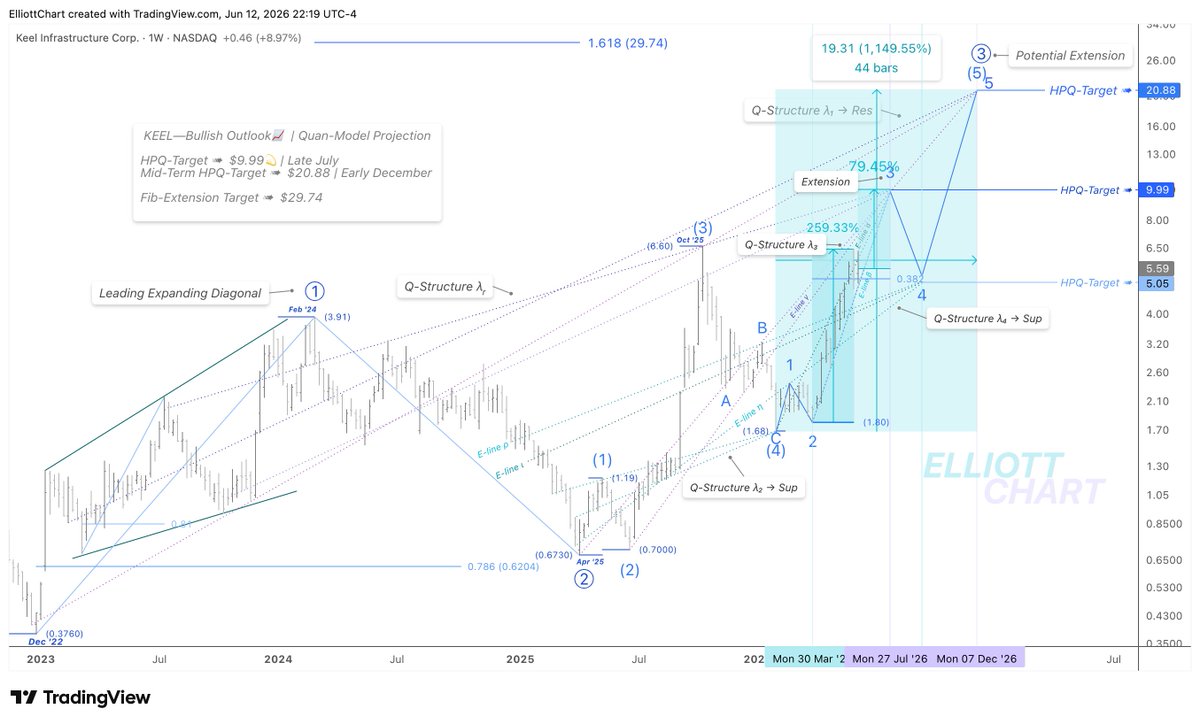
$KEEL — Quan-Model Projection
Bullish Outlook | Advancing Phase Underway📈
The trend in Minor Wave 3 remains stabilized and firmly supported by E-line β of λ₃ and the converging Q-Structure λ₄ ✨.
Following consolidation in a Minute-degree 4th wave correction within the advancing sequence, continuation into the 5th Wave ➤ ⓥ advance is now expected—maintaining the HPQ Target at ➤ $9.99 by late July.
Meanwhile, the converging Q-Structure λ₁ continues to project the broader HPQ Target at ➤ $20.88 🎯 into early December.
#QuanModel #QuanStructures #TrendAnalysis #MarketStructure #TechnicalAnalysis #StockMarket #Investing #Trading #Breakout #TrendFollowing #PriceAction #ElliottWave #GrowthStocks #MarketGeometry #StructuralAnalysis #TrendFlow
Jun 11

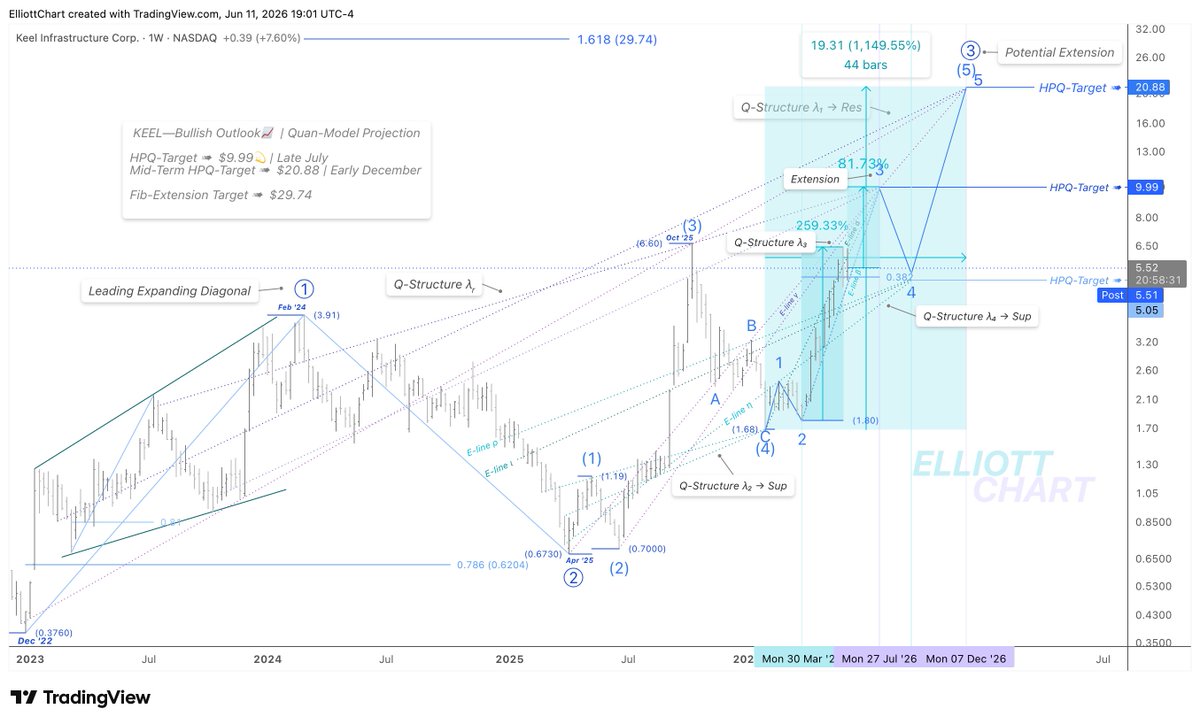
$KEEL — Quan-Model Projection
Bullish Outlook | Continuous Advancing Phase📈
As depicted on the weekly frame, the projected trend in the Minor-degree advance of Wave 3, outlined since February, remains well in progress. The advancing structure continues to be firmly supported by the defined Support → Q-Structure λ₄, while tracking cymatically between E-lines α and β within Q-Structure λ₃.
Price is anticipated to continue extending over 81% 📈 through the final leg of Minor Wave 3 within Intermediate Wave (5), which remains projected as an extended sequence—maintaining the HPQ Target of ➤ $9.99💫 by late July.
Meanwhile, the converging Q-Structure λ₁ continues to project the broader HPQ Target at ➤ $20.88 🎯 into early December.
🔖 Outlook is derived from insights within the Quantum Models framework. Within this methodology, Q-targets are high-probability projections generated by the convergence of equivalence lines. These Quantum Structures also function as structural anchors, shaping the model’s internal geometry and guiding the evolution of alternative paths as price action unfolds.
3
9
61
4,061

Jun 12
With ANSYS Structures, engineers can validate designs, reduce prototypes, and accelerate product development through advanced structural simulation.
Visit: arkinfo.in/ansys-simulation-…
#ANSYS #FEA #StructuralAnalysis #SimulationDrivenDesign #Engineering #ARKInfosolutions

8

AI studies structure quality before highlighting opportunity. 📊⚡
Explore smarter signal relevance analysis with @aivipsignals
#AITrading #MarketAnalysis #Crypto #StructuralAnalysis #SignalAnalysis #SmartTrading
3

Jun 10
TAELSS Feature Demo#02 | Reserve Factors and Failure Modes by Load Case
youtu.be/uHk7kHHK_Fc
#TAELSS #TAELCO #AerospaceEngineering #StructuralAnalysis #FEM #Nastran #EngineeringTools #AeronauticalEngineering #AerospaceDesign
1
1
23

Jun 10
A question based on public records:
Was the trial publicly verifiable on this date?
All analysis is based on publicly available information.
#吴亦凡 #KrisWu #StructuralAnalysis
Kris Wu Case: Structural Analysis | Primary Chain (6-Min Summary)
youtu.be/DixtMP2NJT8?si=EMV_…
3
596

Learn the basics of structural analysis and design.
Know more:
rishabheng.com/blog/what-is-…
#StructuralAnalysis #StructuralDesign #CivilEngineering #EngineeringBasics

2
24

Jun 8
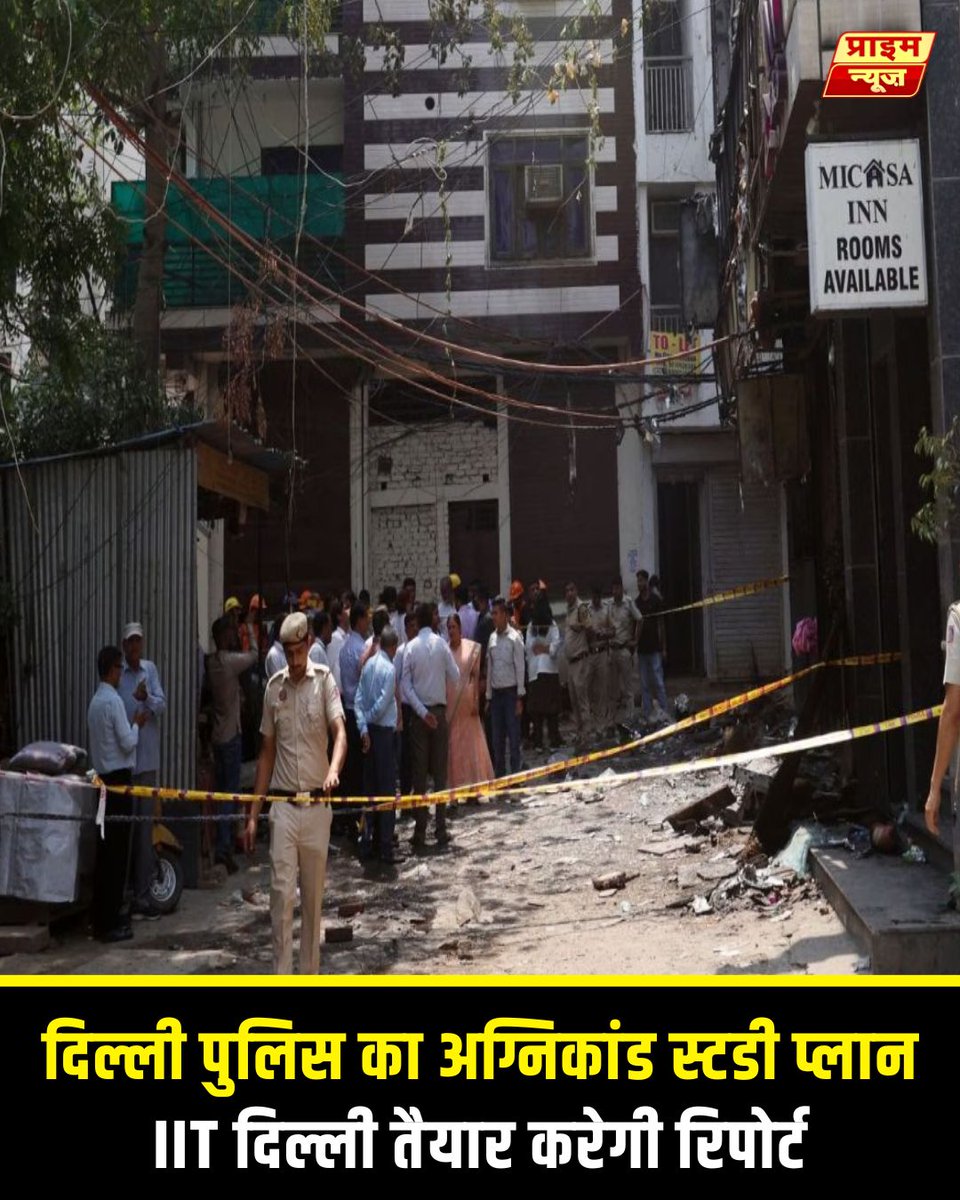
दिल्ली के मालवीय नगर अग्निकांड मामले में दिल्ली पुलिस ने अग्नि सुरक्षा और इमारत संरचना की जांच के लिए IIT दिल्ली से तकनीकी रिपोर्ट तैयार कराने का निर्णय लिया है। पुलिस जल्द ही IIT को पत्र भेजेगी ताकि इमारत के स्ट्रक्चर और आग फैलने की प्रक्रिया का विस्तृत अध्ययन किया जा सके। इस रिपोर्ट के आधार पर आगे की कार्रवाई और सुरक्षा सुधार के कदम उठाए जाएंगे।
#malviyanagar #delhipolice #iitdelhi #fireincident #buildingstudy #structuralanalysis #fireinvestigation #safetyfirst #breakingnews #latestnews #delhinews #fireaccident #technicalreport #civilengineering #emergencyresponse #indiapolice #publicsafety #firedepartment #buildinginspection #newsupdate #primenewsnetwork #primenews
[Malviya Nagar fire Delhi, Delhi Police IIT study, building structural analysis fire, fire safety investigation Delhi, IIT Delhi technical report, Malviya Nagar building fire update, Delhi fire incident news, structural and fire study IIT, Delhi emergency response, fire spread analysis Delhi]
2
108
Strengthening cold box integrity through advanced structural analysis.
rishabheng.com/project/cold-…
#ColdBox #StructuralAnalysis #STAADPro #EngineeringDesign
1
20

May 25
🏗️ BUILD WITH CONFIDENCE. BUILD WITH TMD PROJECTS LIMITED.
Every strong structure begins with the right design.
At TMD Projects Limited, we provide professional Structural Analysis & Design services tailored for residential, commercial, and industrial projects.
✅ Structural Analysis &Structural Design
✅ Retaining Walls & RC Structures
✅ Code Compliance & Review
✅ Detailed Structural Drawings
✅ Professional Seal & Certification
We don’t just design buildings, we design SAFE, DURABLE, and CODE-COMPLIANT structures that stand the test of time.
Whether you’re planning to build:
🏠 A Residential Home
🏢 Commercial Complex
🏭 Industrial Structure
🏗️ Multi-storey Building
We are ready to help you bring your vision to life with precision, professionalism, and integrity.
📞 Contact us today for consultation and project assessment.
📍 TMD Projects Limited
📱 07065871147
📧 tmdprojectworks@gmail.com
Your structure deserves expert attention. Don’t compromise on safety.
#StructuralEngineer #CivilEngineer #StructuralDesign #BuildingConstruction #TMDProjectsLimited #EngineeringExcellence #BuildingWithConfidence #ConstructionNigeria #ProfessionalSeal #StructuralAnalysis #SafeStructures


2
34

May 15
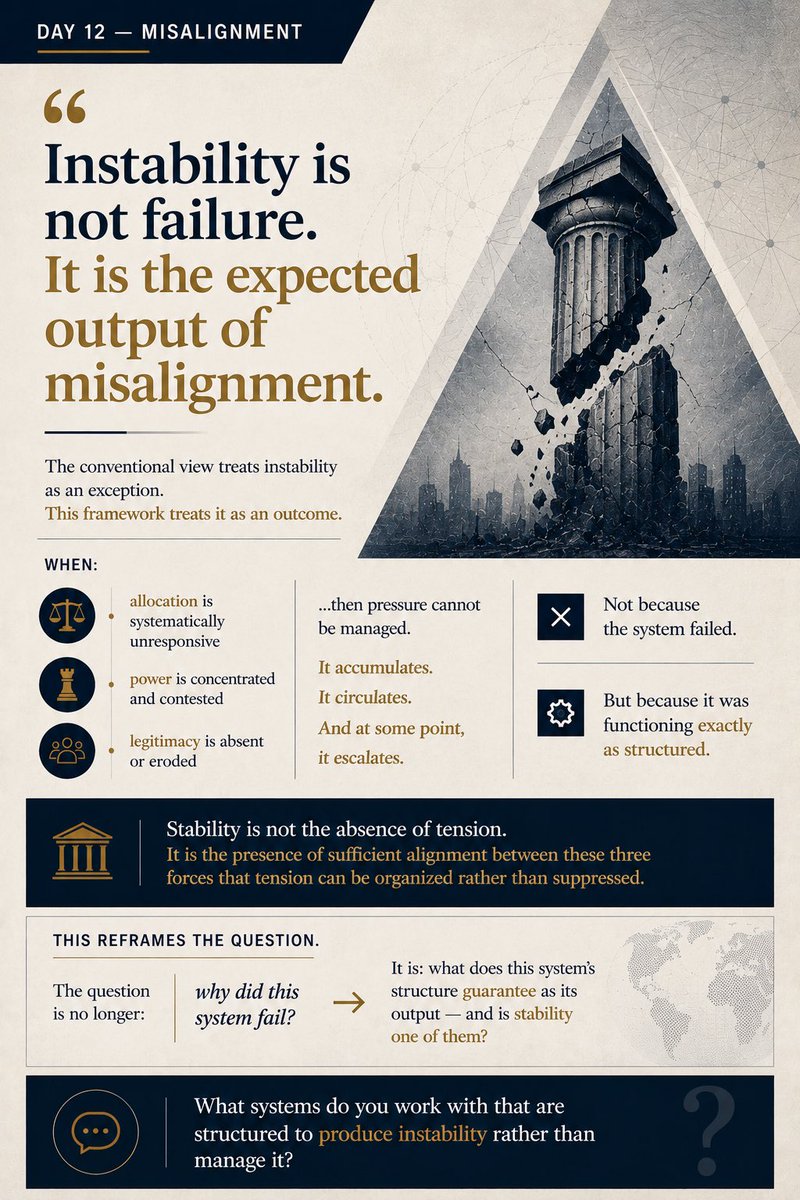
Conventional view: instability is an exception.
The MASI: instability is an outcome.
Unresponsive allocation,
Contested power,
And weak legitimacy - means pressure accumulates.
The system hasn’t failed; it was structured to produce this. #PoliticalEconomy #StructuralAnalysis
3
3
25

May 11
What if your trend lines could explain themselves?
I just updated ST-EP06 — Isotropic Trend Lines — with a new approach: visual transparency.
Instead of just drawing channels, the indicator now lets you see the reasoning behind them:
Toggle Show Blocks to see the structural units it builds from price
Toggle Show Angle Line to see the exact slope that produces the ICS angle
Watch how geometric means connect across blocks to reveal direction
Channel lines now stop cleanly at convergence — no visual artifacts
The idea: you shouldn't have to trust an indicator blindly. You should be able to follow its logic, step by step, right on the chart.
4 new features. Same core engine. Zero cost.
Open source. Free. Editor's Pick.
Try the trend lines yourself
tradingview.com/script/ZSgx4…
#TradingView #PineScript #TrendLines #TechnicalAnalysis #OpenSource #FreeIndicator #EditorsPick #TrendChannel #SmartTrader #ICS #IsotropicTrendLines #YangZhang #Volatility #ChannelFitting #MultiScale #TradingTools #ChartAnalysis #PriceAction #StructuralAnalysis #LogScale #TrendDetection #BreakoutTrading #RetestStrategy #SigmaNormalized #BlockAnalysis #GeometricMean #ScaleInvariant #AlgoTrading #QuantTrading #TradingEducation
2
288

Apr 28
TOBACCO VANGUARD
Not for all and sundry.
The Uses of a Small Insitution
By M. Reuven
Tobacco Vanguard began as a small revival of an older editorial form: private, restrained, sceptical of fashion, and concerned with the material facts of an industry that polite opinion prefers to denounce rather than understand. Its first duty was not to advertise tobacco, nor to flatter shareholders, nor to join the theatre of public-health indignation. Its duty was to observe a regulated industry with seriousness, to describe the relation between capital, consumption, law and habit, and to insist that markets do not disappear because ministers, campaigners or officials have found a language in which to wish them away.
That beginning remains intact. Tobacco Vanguard is still concerned with tobacco, nicotine, excise, dividends, buybacks, regulation, illicit trade, harm reduction and the moral vanity of prohibitionist politics. It is still written in the conviction that clear description is often more subversive than incantation. Yet the work itself has enlarged its frame. The tobacco industry has proved to be not merely an idustrial sector but an exemplar: a durable apparatus in which fiscal dependence, public-health language, consumer behaviour, capital markets, administrative control and legal restraint are joined together in a structure that no single actor commands.
It was in that recognition that Tobacco Vanguard finds its natural place within The Althusserian Centre. The Centre was formed to give institutional continuity to a method: the analysis of structures, apparatuses and material practices as they operate through their effects. It is not a party office, campaign group, consultancy or academic faculty. It is a small research and editorial workshop concerned with philosophy, political economy, science, administration, markets and the modern forms through which society reproduces itself.
The incorporation of Tobacco Vanguard into this wider work is therefore not a change of identity, but a clarification of purpose. Tobacco Vanguard remains the applied journal of material industry, chiefly concerned with tobacco and adjacent markets. The Centre supplies the theoretical scaffold under which that work can be continued with greater discipline. The relation is exact. Tobacco Vanguard studies a concrete sector; The Althusserian Centre studies the wider structures by which such sectors endure, adapt and become intelligible.
This is why the publication of Radical Critique matters. Radical Critique is the formal journal of The Althusserian Centre. Where Tobacco Vanguard proceeds through market observation, historical memory and editorial judgement, Radical Critique proceeds through theory. It names the concepts that Tobacco Vanguard often leaves beneath the surface: structural causality, ideology as material practice, interpellation, overdetermination, critical realism, immanent causality, and the critique of appearances. The two publications do not duplicate one another. They occupy different levels of the same undertaking.
Tobacco Vanguard asks how a regulated industry persists when the public language surrounding it declares that it ought not to. Radical Critique asks how such declarations themselves become part of the structure they claim to oppose. Tobacco Vanguard examines the company, the tax, the shop counter, the market price and the investor return. Radical Critique examines the apparatus that makes these things legible, governable and morally coded. One supplies the case; the other supplies the method.
The connection is particularly important at a time when public argument has become careless with structure. Industries are treated as villains, technologies as miracles, markets as sentiments, and regulation as moral injunction. The result is an intellectual habit in which visible surfaces are mistaken for causes. A share price is taken for value; a slogan for policy; a ban for abolition; a machine output for knowledge; a bureaucratic classification for truth. Tobacco Vanguard exists against this habit. Radical Critique now extends the same refusal into the fields of philosophy, science, artificial intelligence, welfare, administration and cultural life.
The tobacco sector remains an especially suitable object for such work because it reveals the persistence of structure. Governments denounce smoking while depending upon excise. Regulators restrict visibility while preserving lawful sale. Companies are punished rhetorically while required fiscally. Consumers are moralised, taxed and redirected. Harm reduction is praised or condemned according to institutional convenience. Illicit trade expands where policy loses contact with behaviour. The industry is never simply abolished; it is displaced, reclassified, taxed, managed and reproduced.
A serious analysis of tobacco must begin from what the sector is, not from what official language says it ought to become. The same discipline applies elsewhere. Artificial intelligence, welfare administration, generational politics, public-health law and financial markets all require analysis at the level of structure rather than gesture. Radical Critique has been established for that purpose.
The Centre’s work will therefore proceed on two fronts. Tobacco Vanguard will continue to write on tobacco, nicotine, regulated capital, dividends, buybacks, inflation, excise and the political economy of lawful vice. Radical Critique will develop the theoretical apparatus necessary to understand the wider condition: how institutions produce subjects, how classifications acquire authority, how markets are governed by invisible structures, and how modern systems reproduce themselves under the language of reform.
There is no need to exaggerate the scale of the undertaking. A small institution may still have a proper use. It can preserve method where larger bodies preserve fashion. It can maintain distinctions where public argument dissolves them. It can attend to facts that respectable opinion would rather convert into symbols. It can examine industries, policies and technologies without joining the procession of applause or denunciation.
Tobacco Vanguard has always stood somewhat apart. Its incorporation into The Althusserian Centre gives that distance an institutional form. The publication of Radical Critique gives the method a theoretical voice. Together they mark a modest but serious development: the passage from commentary to research, from sectoral observation to structural analysis, and from private editorial habit to a small public discipline.
The work now is to continue without inflation of language or ambition. Tobacco Vanguard will remain concerned with real margins, lawful profit, cash, habit and regulation. Radical Critique will examine the structures that produce the modern field of appearance. The Althusserian Centre will hold the two together. In an age given to spectacle, this is sufficient: to describe accurately, to think structurally, and to refuse the consolations of easy opinion.
Tobacco Vanguard is an editorial and analytical publication. It does not promote tobacco consumption and does not provide investment advice. Markets and securities involve risk, and readers should conduct their own research.
#TobaccoVanguard #RadicalCritique #AlthusserianCentre #StructuralAnalysis #CriticalRealism #Althusser #PoliticalEconomy #TobaccoIndustry #RegulatedMarkets #ApparatusTheory #BritishEditorial #MReuven

2
55

Can the peak at 384.48 define the structure? See how MS, NMR, and electron diffraction are combined in this workflow.
👉 Learn more: jeol.com/solutions/applicati…
#MassSpectrometry #NMR #ElectronDiffraction #StructuralAnalysis

4
561

⚙️The engineering behind these 50,000-ton floating platforms is all about mastering buoyancy and tension leg systems. It’s a perfect balance of physics where massive hulls provide the lift while heavy-duty tendons keep the structure anchored against the waves. Managing such extreme forces in the middle of the ocean requires precision at every level. If you were designing one, would you prioritize stability in storms or ease of movement between sites?
#OffshoreEngineering #StructuralAnalysis #MaritimeTechnology
📽Fact Zaara
7
101
3,979

Apr 13
@martinplaut A narrow reading of a complex issue. The real dynamic is the instrumentalization of Orthodox Church divisions—something your analysis rightly highlights.
#StructuralAnalysis #OrthodoxChurch #Geopolitics #Ethiopia #HornOfAfrica #InformedDebate
Apr 13

@martinplaut Your idea may sound appealing on the surface, but it reflects a shallow assessment that fails to consider the underlying reasons & complexities that led these two people to their current situation.

11
4
129
Apr 10
#KrisWu 吴亦凡 Case | Structural Analysis Ep.9— The Timeline Doesn't Align— Chat Records Predate the Meeting by Months
All observations are based on publicly available materials. Watch the 6-minute summary: youtu.be/DixtMP2NJT8?si=e9iq…
#StructuralAnalysis #Documentary #MediaNarratives
3
8
976
TOBACCO VANGUARD
Not for all and sundry.
The Fiction of Generational Warfare
By M. Reuven
A dispute has been encouraged in recent weeks between the old and the young, presented as a question of fairness, burden, and entitlement. It is conducted in the language of arithmetic, as though the relation between generations were reducible to a balance sheet. The tone is often heated. The origin is seldom examined.
The claim is familiar. One cohort is said to have taken more than it has given, to have consumed public resources at the expense of those who follow. From this, a moral conclusion is drawn. Provision for the aged is recast as excess. The state pension, once understood as a basic settlement between citizen and polity, is described as an imbalance to be corrected.
This argument proceeds as though the categories it employs were natural. They are not. “Boomer” and “millennial” are not social facts in the strict sense. They are classifications, produced and circulated until they acquire the appearance of reality. Once established, they organise perception. Complex institutional arrangements are translated into personal antagonisms. Structural questions are recoded as moral failings of age.
The effect is to displace attention. The design of the system, the conduct of monetary policy, the extension of credit, and the pricing of assets recede from view. In their place appears a quarrel between neighbours. The language of conflict performs a function. It simplifies, it mobilises, and it absolves.
There is no single intergenerational contract that has been broken. There are, instead, a series of institutional settlements, altered over time, often without clear consent and rarely with full understanding. Housing has been transformed by credit expansion. Savings have been reshaped by inflation and interest policy. Public provision has been adjusted within fiscal limits that are themselves politically determined. These are matters of structure. They do not arise from the disposition of one age group toward another.
To describe this as a conflict between generations is to mistake the level at which causes operate. It is to take an effect and treat it as an origin. The language serves those who would prefer not to examine the mechanisms more closely. A divided public is easier to manage than an informed one.
A civil society maintains continuity. It does not regard the support of the aged as optional, nor does it treat the prospects of the young as expendable. Both depend upon the same underlying arrangements. To set them against each other is to misunderstand their relation.
The question is not which generation is to blame. It is whether the structures within which all generations live are sound, intelligible, and just. On that question, the present discussion has offered little.
#TobaccoVanguard #AlthusserianCentre #CulturalRealism #CriticalRealism #PoliticalEconomy #IntergenerationalJustice #StatePension #WelfareState #SoundMoney #AssetInflation #HousingCrisis #MonetaryPolicy #Ideology #StructuralAnalysis #MediaNarratives #ThinkTanks #PublicPolicy #EconomicReality
2
3
89
TOBACCO VANGUARD
Not for all and sundry.
Harm Reduction and the Persistence of Structure
By M. Reuven
This Bank Holiday marks the beginning of a joint series between Tobacco Vanguard and the Althusserian Institute, an arrangement that reflects a shared concern with the language, structure, and material consequences of contemporary policy. This article takes as its point of departure a familiar claim, now widely circulated in public-health discourse, that the tobacco industry may be eliminated. It is a claim that appears forceful, even moral in tone, yet dissolves under scrutiny once the object of analysis is properly understood.
The modern habit is to speak of “the tobacco industry” as though it were a singular agent and “the market” as though it were a unified field. Both are misnomers. What is described as a market is in fact a fragmented, multi-category arrangement of products, channels, fiscal regimes, and legal distinctions. Cigarettes, heated tobacco, vapes, and nicotine pouches do not inhabit a common regulatory or cultural space. They are differently taxed, differently displayed, differently authorised, and differently perceived. More countries have now prohibited or severely restricted newer nicotine products than have ever prohibited cigarettes themselves, a fact that alone should caution against any simple narrative of linear transition or orderly substitution.
In this setting, to speak of eliminating the tobacco industry is to mistake a structure for a target. The industry is not merely a collection of firms. It is a durable arrangement reproduced through excise systems, retail habits, supply chains, capital markets, and a persistent demand for nicotine that has shown little inclination to disappear. Cigarette consumption, far from vanishing, continues to expand in absolute terms alongside global population growth and rising incomes in large parts of the world. This is not an endorsement. Rather, it is a description of the conditions within which policy must operate.
The current fashion for “endgame” rhetoric rests upon a category error. It assumes that the removal of certain corporate actors would entail the disappearance of the social and economic relations that sustain nicotine use. It proceeds as though demand were incidental, as though fiscal dependence were negotiable, and as though illicit supply were a marginal inconvenience rather than an adaptive system. Experience suggests otherwise. Where legal supply is constrained without regard to demand, parallel markets emerge with speed and resilience. Where regulation is designed without regard to structure, it tends to favour scale, capital, and incumbency. The result is not elimination but reconfiguration.
A more temperate school now proposes an alternative: that the incentives of tobacco companies may be aligned with public health through the encouragement of lower-risk products. There is substance in this argument. The distinction between combustion and non-combustion is material. The reduction of harm among existing smokers is a practical objective. Yet even here the language of alignment invites caution. Firms do not acquire new purposes. They adapt to constraints. When capital markets reward a shift toward smoke-free revenues, when regulators permit certain categories and restrict others, when consumers alter their preferences, the industry responds accordingly. That response may coincide with a reduction in disease. It does not follow that the underlying structure has been transformed in its nature.
It is at this point that the contribution of the Althusserian Institute becomes necessary. The Institute is being established to examine precisely these forms of structural persistence and transformation across regulated industries. Its purpose is not to defend or condemn particular outcomes in isolation, but to analyse the mechanisms by which they arise. Drawing on a critical-realist method, it treats markets as stratified systems rather than as surfaces of exchange. It proceeds on the basis that outcomes are generated through interacting layers of law, capital, culture, and material practice, and that these layers cannot be reduced to intention or ideology alone.
In the near term, the Institute will operate as a research and publishing body based in London, working in concert with Tobacco Vanguard as its public-facing counterpart. Its early programme will consist of a series of method papers, sector studies, and policy analyses, beginning with the tobacco and nicotine complex and extending to energy, commodities, and other industries where regulation, capital, and culture intersect. A central project will be the development of an apparatus-based framework for analysing markets, identifying the fiscal, legal, and commercial mechanisms that reproduce them over time. This work will be published through Radical Critique, the Institute’s formal journal, and disseminated in a more accessible form through these joint editorials.
The intention is neither academic seclusion nor political advocacy in the ordinary sense. It is to restore clarity of description. Much of contemporary debate proceeds by slogan and counter-slogan, by the assertion of ends without the examination of means. The language of elimination belongs to this tendency. It confuses aspiration with mechanism. It substitutes moral emphasis for structural analysis. In doing so, it obscures the very processes it seeks to influence.
A more sober approach begins by recognising the persistence of demand, the entanglement of state revenue with tobacco consumption, and the differentiated nature of nicotine products. It accepts that prohibition in one category may entrench another, that innovation may be absorbed rather than disruptive, and that illicit trade is not an anomaly but a recurrent outcome of misaligned policy. From this starting point, the task is not to abolish an industry in the abstract, but to govern a complex system in which health, revenue, order, and liberty are in continuous tension.
The Bank Holiday affords a moment for such reflection. The language of final victories and decisive endings sits uneasily with the evidence of gradual adjustment and structural endurance. If there is a lesson to be drawn from the present condition of the tobacco market, it is that systems of this kind do not disappear. They evolve, they fragment, and they are reproduced through the very measures designed to constrain them.
#TobaccoVanguard #AlthusserianInstitute #CulturalRealism #CriticalRealism #StructuralAnalysis #TobaccoIndustry #NicotineMarket #PublicHealthPolicy #HarmReduction #IllicitTrade #Regulation #SoundMoney #RealMargins #MarketStructure #EconomicRealism

3
3
195
Apr 3
Kris Wu Case | Structural Analysis Ep.1 — Did This Case Actually Happen?
All observations are based on publicly available materials, including timelines, evidence presentation, and procedural logic.
Watch the 6-minute summary:youtu.be/DixtMP2NJT8?si=e9iq…
#KrisWu #StructuralAnalysis
3
7
720