
Uncertainty Estimation for Molecular Diffusion Models
1. The paper addresses a practical gap in 3D molecular diffusion generation: pretrained diffusion models can output chemically invalid/unstable molecules, but they provide no principled per-sample signal of “this generation is likely low quality,” which is crucial when downstream evaluation (docking, wet lab) is expensive.
2. The authors propose a post-hoc uncertainty estimator that works with an existing pretrained molecular diffusion model (no retraining): fit a Laplace approximation around the denoiser’s MAP parameters and use it to quantify how variable the denoiser’s noise predictions are during sampling.
3. Core idea: for selected denoising timesteps, sample multiple parameter vectors from the approximate posterior q(θ), compute multiple noise predictions ε_t^m = f_{θ_m}(x_t, t), and take the elementwise sample variance across these predictions; then aggregate over timesteps, atoms, and feature dimensions into a single scalar uncertainty score per generated molecule.
4. The uncertainty is computed along the generation trajectory, motivated by the intuition that “internally uncertain” samples should induce more unstable/variable denoising behavior; empirically, only a small subset of timesteps is needed, reducing overhead.
5. On QM9, the resulting uncertainty score is informative of sample quality: it shows statistically significant negative Spearman correlations with molecular stability, atom stability, and validity, and it is consistently more predictive than diffusion negative log-likelihood (NLL) as a per-sample quality indicator.
6. Concrete QM9 correlations (Spearman ρ): for EDM, uncertainty vs. molecular stability is −0.284 (vs. NLL −0.150); for GeoLDM, −0.333 (vs. NLL −0.171). Similar gaps hold for atom stability and validity, suggesting likelihood is a weaker “verifier” than the proposed uncertainty for these quality metrics.
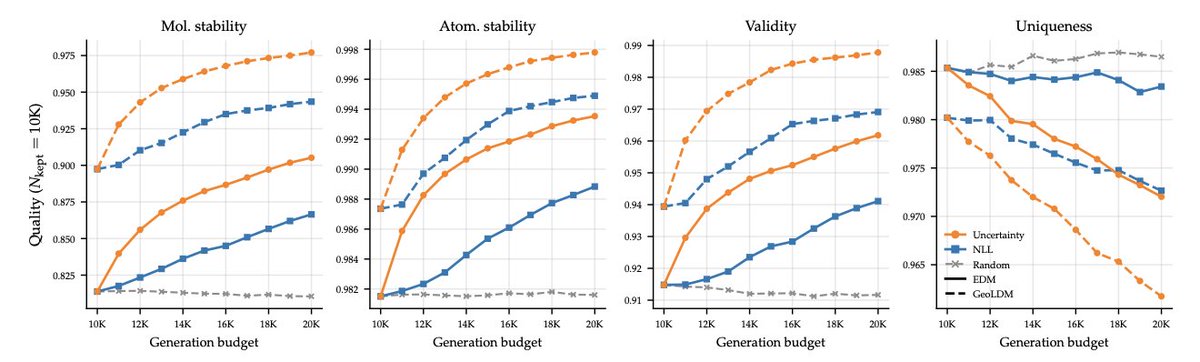
7. The paper then uses uncertainty for test-time scaling: oversample N molecules (10K→20K) and keep the 10K lowest-uncertainty samples. This improves stability/validity on QM9 for both EDM and GeoLDM, outperforming NLL-based filtering, with a modest tradeoff of ~1% drop in uniqueness.
8. The gains can be material relative to changing the base generator: for EDM on QM9, oversampling to 20K and filtering back to 10K yields ~10% molecular stability improvement, ~1% atom stability improvement, and ~5% validity improvement—comparable in magnitude to switching from EDM to GeoLDM at the same 10K budget.
9. Limitations and ablations: the filtering benefits do not transfer to GEOM-Drugs (larger, more complex molecules), where neither uncertainty- nor NLL-based filtering beats random subsampling. Ablations also show the Fisher-based Laplace covariance is not essential (isotropic perturbations around MAP perform similarly), implying the score may behave more like a sensitivity-to-perturbation measure than strict Bayesian epistemic uncertainty; signal concentrates near the clean end of the trajectory (late denoising steps).
📜Paper: arxiv.org/abs/2606.13451
#DiffusionModels #MolecularGeneration #ComputationalChemistry #UncertaintyEstimation #TestTimeScaling #BayesianDeepLearning #GenerativeModels #3DGeometry #QM9 #GEOMDrugs
1
15
1,212

10 Dec 2024
#BayesianDeepLearning #PEFT #TrustworthyLLM #BaysianLLM We are excited to present our "🔵BLoB: Bayesian Low-Rank Adaptation by Backpropagation for Large Language Models" at #NeurIPS2024.
4
3
12
3,579
30 Apr 2024
#BayesianDeepLearning #InterpretableML #ConceptInterpretation #HumanAICollaboration Achieving the balance between accuracy and interpretability in machine learning models is a notable challenge. Models that are accurate often lack interpretability,
1
2
5
339

30 Oct 2023
🧩 How does #BayesianDeepLearning handle the wild terrain of real-world o.o.d. data? Novel work from our student Florian Seligmann with the #WILDS 🐾 datasets: Exploring transformers, finetuning and last-layer methods while ensembling it all! #NeurIPS2023 arxiv.org/abs/2306.12306
3
12
1,122

5 Apr 2023
🌎🔬🗺️🧐 Learn how Artificial Intelligence can improve geological mapping in this fascinating online lecture featuring Charlie Kirkwood from the University of Exeter! 🤖📈🌋
📽️Watch now: youtu.be/ubcLZ8mjtIw
#geologicalmapping #AI #Bayesiandeeplearning #spatialconsistency

3
5
288

18 Mar 2023
#highlycitedpaper
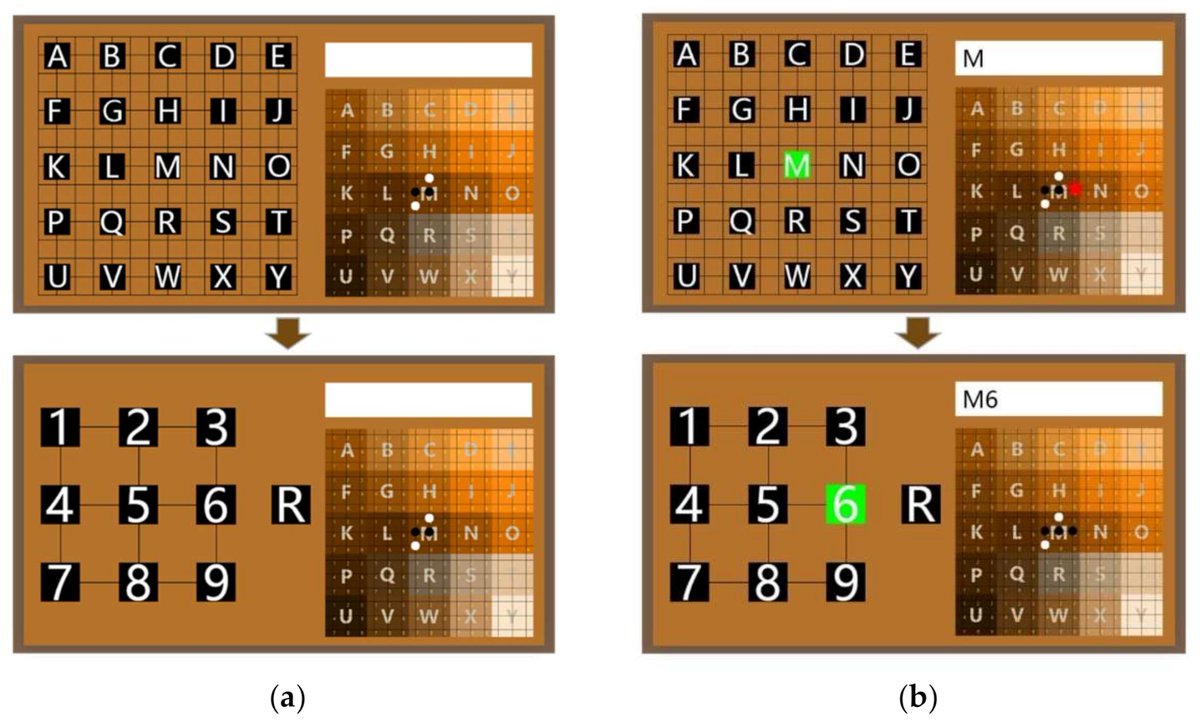
The MindGomoku: An Online P300 #BCI Game Based on #BayesianDeepLearning
mdpi.com/1424-8220/21/5/1613
#braincomputerinterface #electroencephalogram #EEG #P300 #BCIgame
1
209

29 Aug 2022
MCMC
Markov chain Monte Carlo
The Markov-chain Monte Carlo Interactive Gallery, by Chi Feng: chi-feng.github.io/mcmc-demo…
Wikipedia: en.wikipedia.org/wiki/Markov…
MCMC.Eth BayesianInference.Eth BayesianDeepLearning.Eth
#BayesianInference #BayesianDeepLearning #MCMC

2
3

29 Aug 2022
MCMC
Markov chain Monte Carlo
The Markov-chain Monte Carlo Interactive Gallery, by Chi Feng: chi-feng.github.io/mcmc-demo…
Wikipedia: en.wikipedia.org/wiki/Markov…
MCMC.Eth BayesianInference.Eth BayesianDeepLearning.Eth
#BayesianInference #BayesianDeepLearning #MCMC

1
3
8

29 Aug 2022
MCMC
Markov chain Monte Carlo
The Markov-chain Monte Carlo Interactive Gallery, by Chi Feng: chi-feng.github.io/mcmc-demo…
Wikipedia: en.wikipedia.org/wiki/Markov…
MCMC.Eth BayesianInference.Eth BayesianDeepLearning.Eth
#BayesianInference #BayesianDeepLearning #MCMC

1
3
Bayesian Deep Learning
Bayesian deep learning allows to reach a realistic expression of uncertainty when training deep neural networks
BayesianDeepLearning.Eth | DeepNeuralNetworks.Eth
#BayesianDeepLearning #DeepNeuralNetworks #MontrealAIMetaverse

2
2
2 Feb 2022
Bayesian Deep Learning
Bayesian deep learning allows to reach a realistic expression of uncertainty when training deep neural networks.
BayesianDeepLearning.Eth | DeepNeuralNetworks.Eth
#BayesianDeepLearning #DeepNeuralNetworks #MontrealAIMetaverse

3
4

16 Nov 2021
Accepted at the #BayesianDeepLearning workshop @NeurIPSConf #NeurIPS2021 ! With Maria Perez-Ortiz, @OmarRivasplata , Emilio Parrado-Hernandez and @johnshawetaylor

Progress in Self-Certified Neural Networks
deepai.org/publication/progr…
by Maria Perez-Ortiz et al. including @bguedj
#NeuralNetwork #ComputerScience
1
1
25

17 Aug 2021
Want to learn about VAEs and generative modelling? Jave a look at Jakub Tomczak's blog, jmtomczak.github.io/blog.htm… @jmtomczak #DeepLearning #BayesianDeepLearning
1
22
87

30 Jul 2021
With #BayesianDeepLearning, we no longer have mere model weights - we have _distributions_ over our weights. After all, what is a model but a guess at the "model of the Gods" which would result from training over "all possible data".
1
2

10 Apr 2021
Postdoc, RA & Ph.D. positions in Learning with Less Data: #AutoML #ActiveLearning #BayesianOptimization #BayesianDeepLearning @NUSComputing
See groups.google.com/u/3/g/ml-n…
#NeurIPS2021 #ICML2021 #AAAI2021 #IJCAI2021 #UAI2021 #AISTATS2021
1
2
7
31 Mar 2021
This allows the AI system to accurately infer whether patients are using devices such as insulin pens and inhalers on time, and whether they are doing every step correctly. Another fun fact: our system works 24/7, and it is camera-free!
#MLHealth #BayesianDeepLearning @MIT_CSAIL
1
2

18 Jan 2021
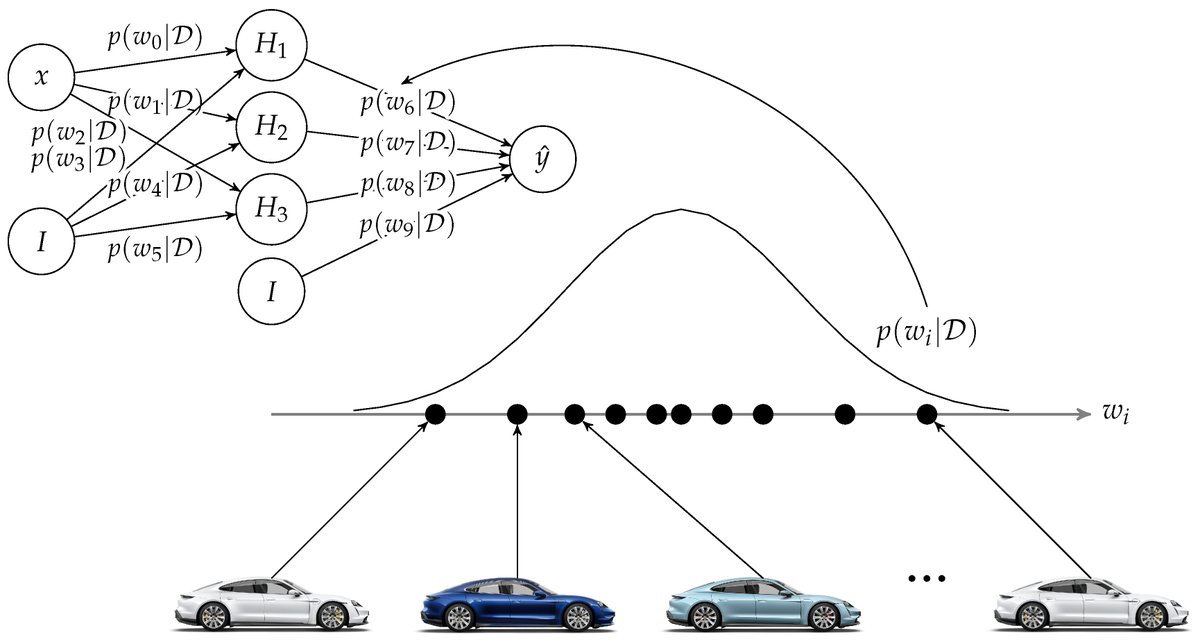
#mdpientropy "Probabilistic Predictions with Federated Learning" mdpi.com/1099-4300/23/1/41
#probabilisticmachinelearning
#federatedlearning
#Bayesiandeeplearning
#predictiveuncertainty
5

BayesianDeepLearning関連の論文リスト。タイトルと推論手法のリストだけだけどグループ化されてまとめてくれるのありがたい。 / 1件のコメント b.hatena.ne.jp/entry?url=htt… “GitHub - js05212/BayesianDeepLearning-Survey: Bayesian Deep Learning: A Survey” (1 user) htn.to/3hVH6ZCtPR
1
8

14 Dec 2019
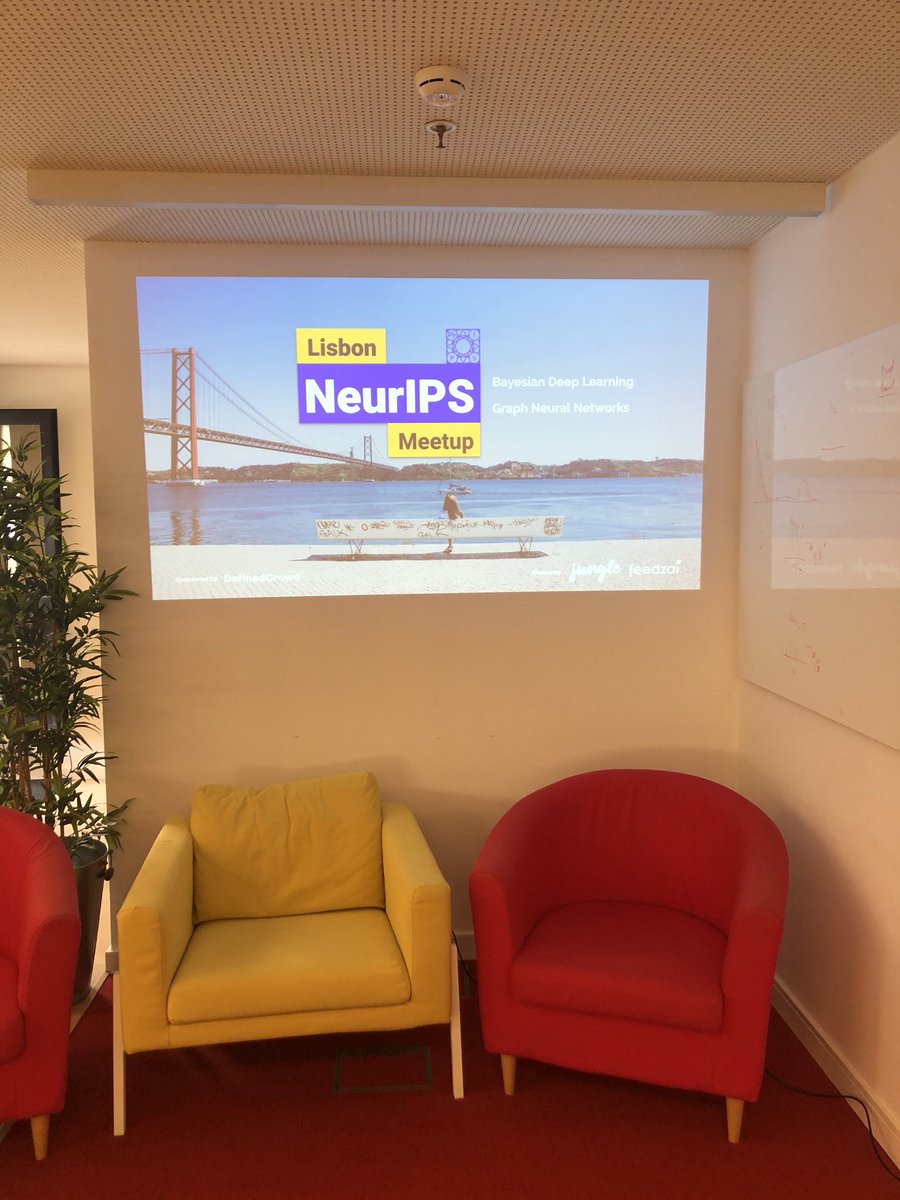
Only a few more hours until #NeurIPS2019 Lisbon kicks off in @feedzai office! We are ready for you 🙌🏽 #BayesianDeepLearning
2

10 Oct 2019
Happy to share ‘Increasing Expressivity in a Hyperspherical VAE’ will be presented @ #neurips19 in the workshop on #BayesianDeepLearning ! (w/ @jmtomczak @egavves) 🇨🇦
w: arxiv.org/abs/1910.02912
TL;DR: scale hyperspherical VAE to higher dimensions using product-distributions
9
30