
Jun 11
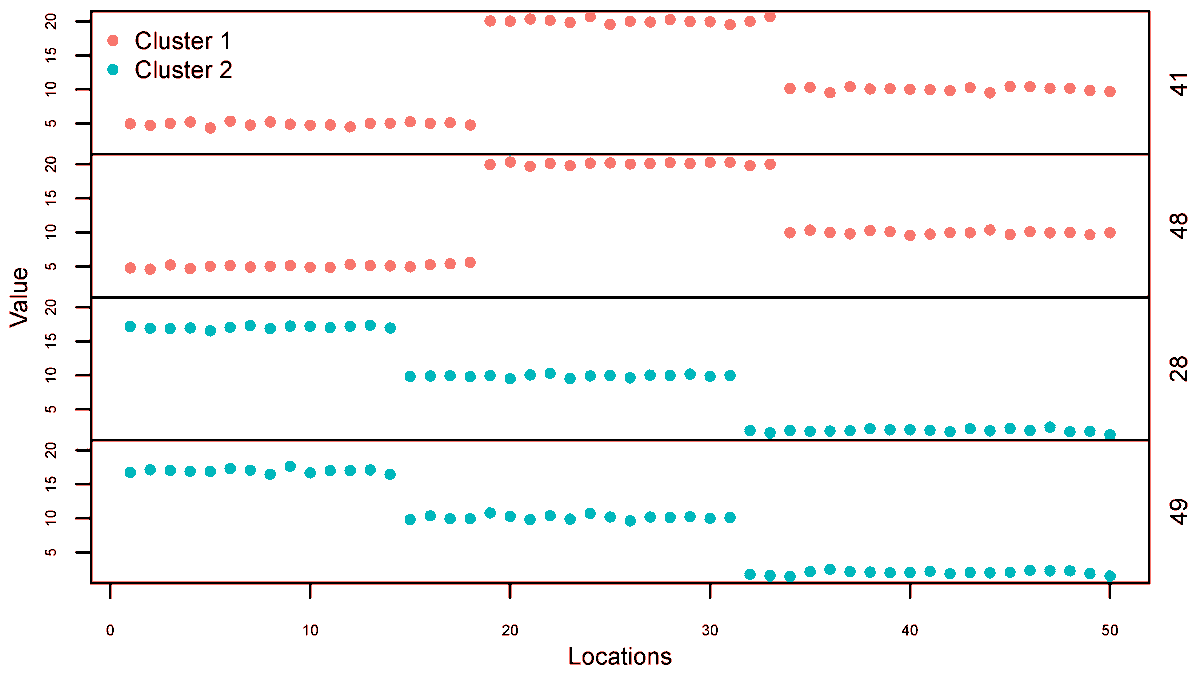
📝A Bayesian Approach for Clustering Constant-Wise Change-Point Data
👥by Ana Carolina da Cruz and Camila P. E. de Souza
#ChangePointModels; #ModelBasedClustering; #BayesianInference; #DirichletProcess
📖brnw.ch/21x3gJm
101


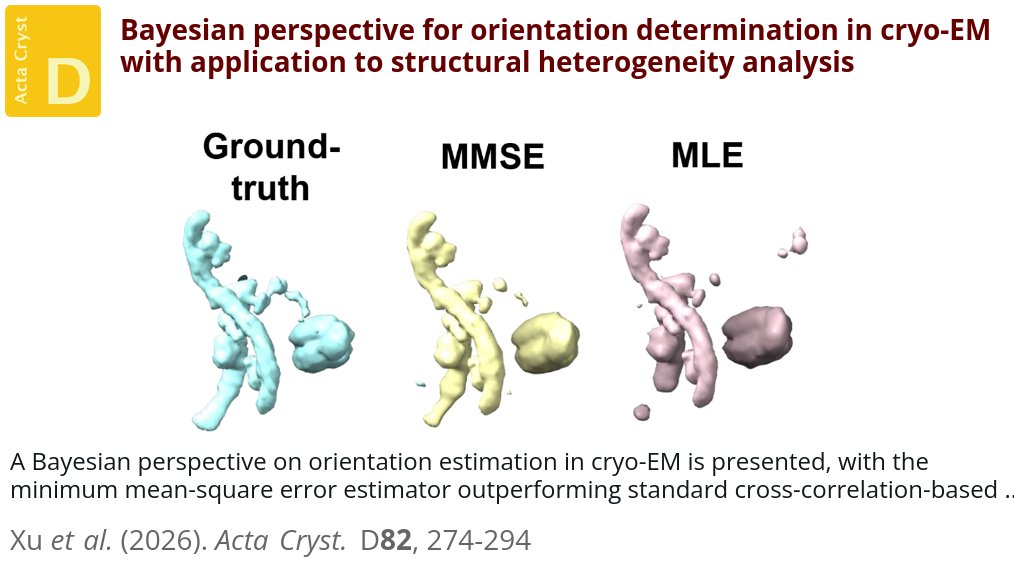
A better way to estimate molecular orientations and reveal structural heterogeneity in cryo-EM @princeton @telavivuni1 @ActaCrystD @IUCr #OrientationEstimation #CryoElectronMicroscopy #BayesianInference doi.org/10.1107/S20597983260…
3
5
408

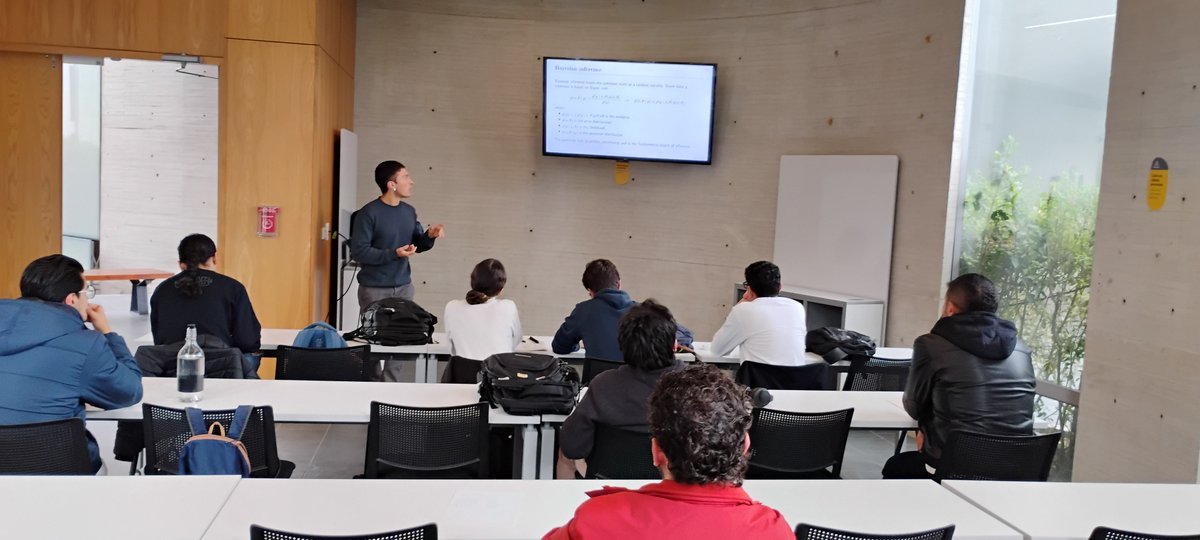
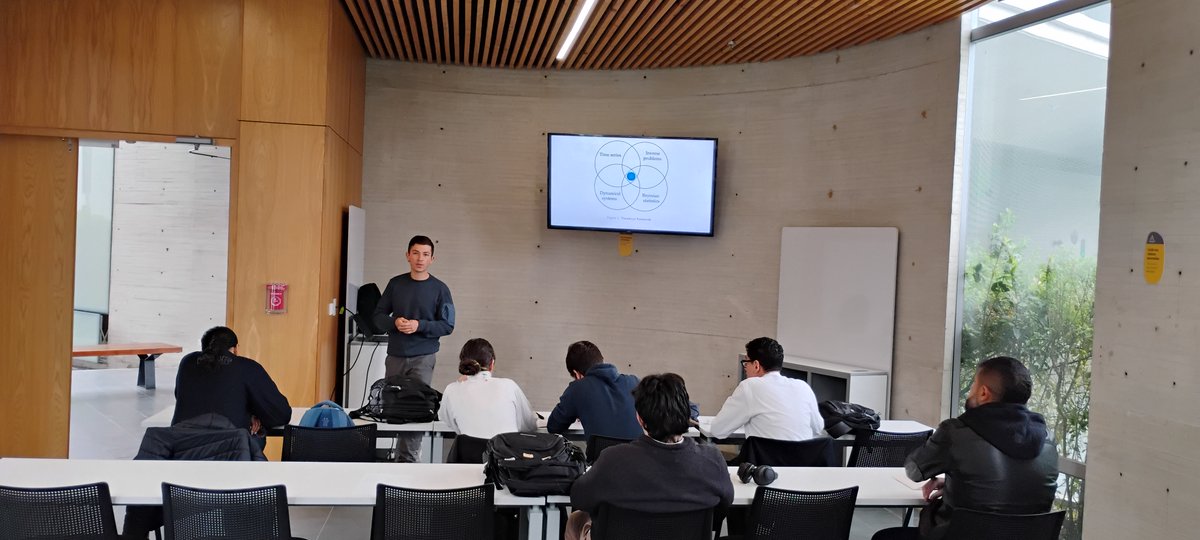
📷 En el Seminario de Matemática Aplicada de la UNAL, Carlos Nosa presentó una charla sobre inferencia bayesiana secuencial y estimación de parámetros en sistemas dinámicos.
#UNAL #MatemáticaAplicada #FacultadDeCiencias #Seminario #Investigación #BayesianInference #Ciencias
1
3
95

May 1
Bayesian Theory: The Core Driver of Quantitative Research 📊
Bayesian inference permeates the full quantitative research pipeline, emerging as a foundational methodology reshaping industry paradigms and academic frontiers.
Core Applications:
🌪️ Volatility Modeling: Renaissance leverages MCMC for dynamic posterior iteration; GARCH Quant builds Bayesian GARCH-family models to capture fat tails, leverage effects, and tail risks
📈 Factor Optimization: Citadel applies Bayesian screening for quality factors; AQR uses Bayesian weighting for risk-parity enhancement
🛡️ Model Robustness: Real-time Bayesian updates adapt to regime shifts; Two Sigma calibrates ML hyperparameters to reduce overfitting
🏗️ Cross-Asset Risk: AQR employs Bayesian Copula to model nonlinear dependencies and estimate VaR/CVaR precisely
🔄 Core Value: Dynamic market adaptation, small-sample robustness, and probabilistic uncertainty-driven decisions 💪🧠
#BayesianQuant #BayesianInference #QuantitativeResearch #MCMC #RiskManagement
3
26

Apr 16
Watched your MCMC sampler fail after 20 min?
INFERLOG HOLMES flags convergence issues in real time, 30 seconds into sampling.
Full webinar recording with the researchers Chris Fonnesbeck and Oriol Abril Pla now available to watch
👉dub.link/yQBb0F5
#BayesianInference
2
204

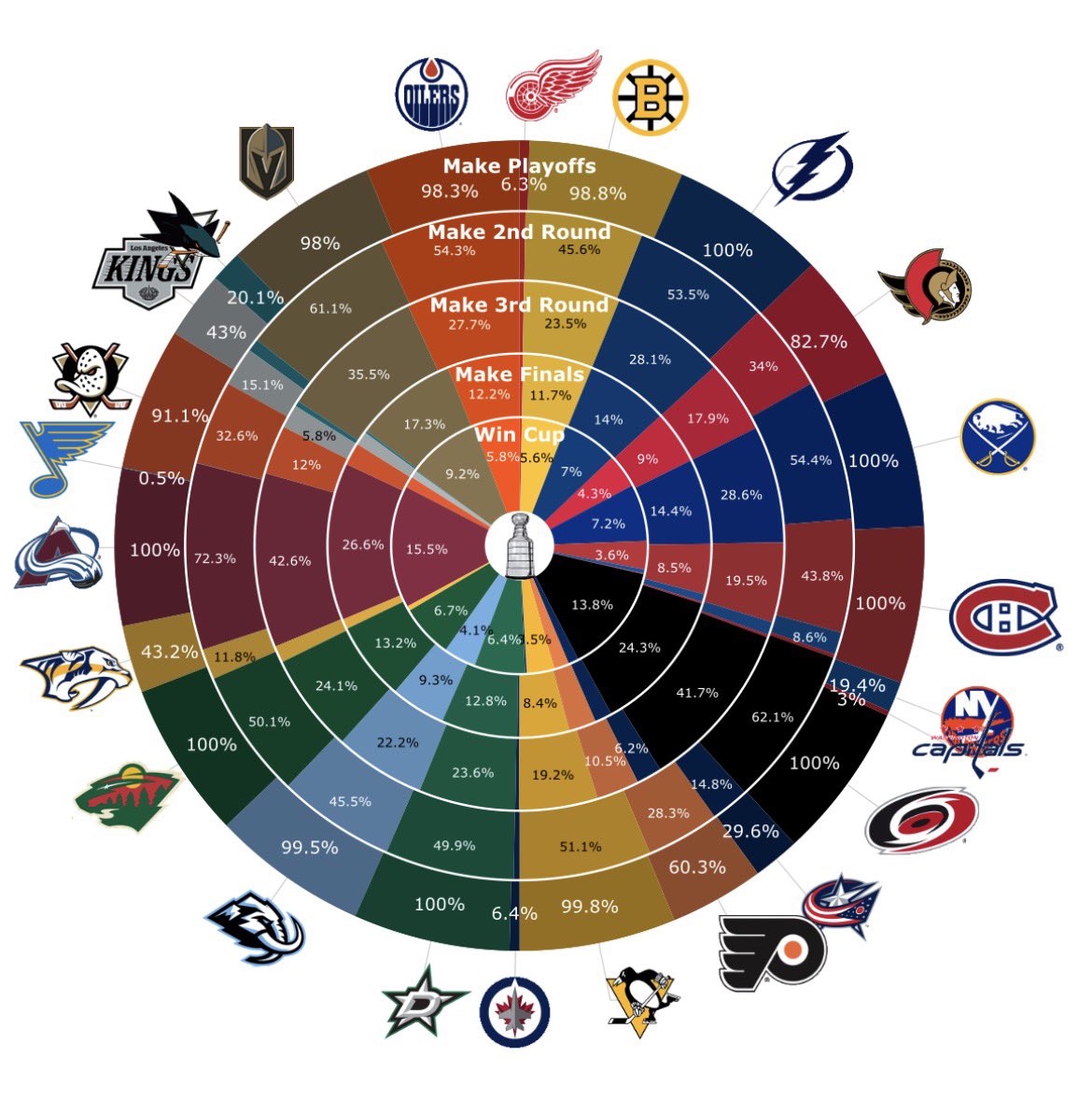
With my new master’s-level education and research skills, I can confidently interpret that a 99.5% chance of the Mammoth making the playoffs is, indeed, more likely than not.
#TusksUp
#BayesianInference #HierarchicalLinearModeling #MultivariateAnalysis #RobustMethodology

3
125

Predicting Biomedical Interactions with Bayesian inference over Graph Convolutional Network Structures
1. The authors identify a persistent bottleneck in graph neural network (GNN) application to biological networks: selecting the optimal number of graph‑convolution (GC) layers. Too few layers miss higher‑order interactions, while too many cause over‑smoothing and loss of predictive power.
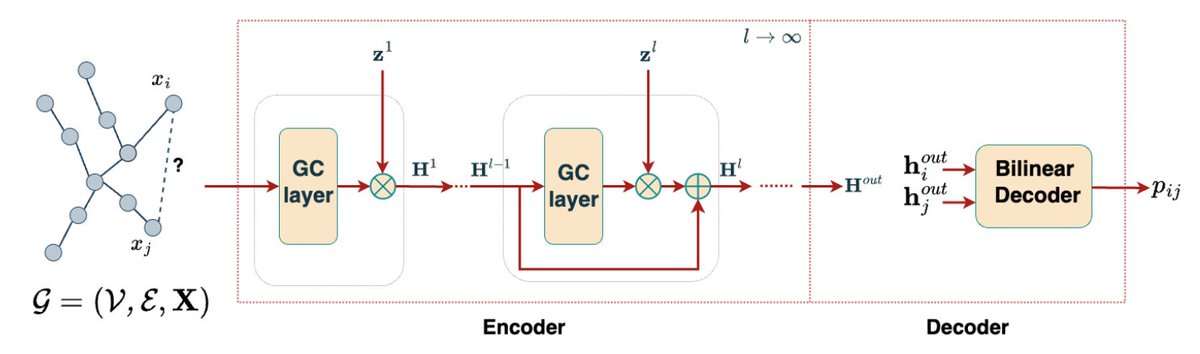
2. To solve this, they introduce a Bayesian model‑selection framework that jointly infers the appropriate depth of a GC encoder and applies dropout regularization, allowing the network to adapt its complexity directly from the data rather than relying on heuristic layer counts.
3. The depth is modeled as a stochastic process via a beta process over layers, inducing layer‑wise activation probabilities. A conjugate Bernoulli process then gates neuron activations, effectively creating an encoder capable of an infinite number of layers in theory while only activating a sparse subset in practice.
4. For reconstructing interactions, a bilinear decoder maps node representations into edge probabilities. This end‑to‑end encoder‑decoder architecture eliminates the need for separate embedding and classifier stages.
5. The authors employ structured stochastic variational inference to approximate the intractable marginal likelihood, using a concrete Bernoulli relaxation for efficient gradient‑based optimization of both depth and dropout parameters.
6. Across four publicly available biomedical interaction datasets (DTI, DDI, PPI, GDI), the Bayesian GCN outperforms DeepWalk, node2vec, L3, VGAE, and fixed‑depth GCNs, achieving gains in AUPRC ranging from ~2–20% and AUROC improvements up to ~3%.
7. The framework also delivers better calibrated predictions: Brier scores are consistently lower than those of a fixed‑depth GCN, indicating more reliable confidence estimates for interaction probabilities.
8. Robustness tests show the method maintains high performance even on highly sparse networks, thanks to its dynamic neuron activation that scales with available training edges, whereas a fixed‑depth GCN activates all neurons regardless of sparsity.
9. Visualizing drug embeddings with t‑SNE reveals that the Bayesian GCN produces clearer, well‑separated clusters for drug categories, suggesting that the learned representations capture pharmacological similarities more faithfully than a conventional GCN.
10. Finally, the model’s novel predictions—both drug‑drug and gene‑disease associations—receive higher confidence scores and are corroborated by recent literature, underscoring the practical value of the inferred depth and structure.
💻Code: github.com/kckishan/BBGCN-LP…
📜Paper: arxiv.org/abs/2211.13231
#GraphNeuralNetworks #BiomedicalComputing #DeepLearning #Bioinformatics #MachineLearning #ModelSelection #GraphConvolutionalNetworks #BayesianInference #DrugDiscovery #GeneDiseaseAssociations
3
15
1,387
Sheng Xu et al.: Bayesian perspective for orientation determination in cryo-EM with application to structural heterogeneity analysis #BayesianInference #CryoElectronMicroscopy @princeton @telavivuni1... #IUCr journals.iucr.org/paper?S205…
4
290

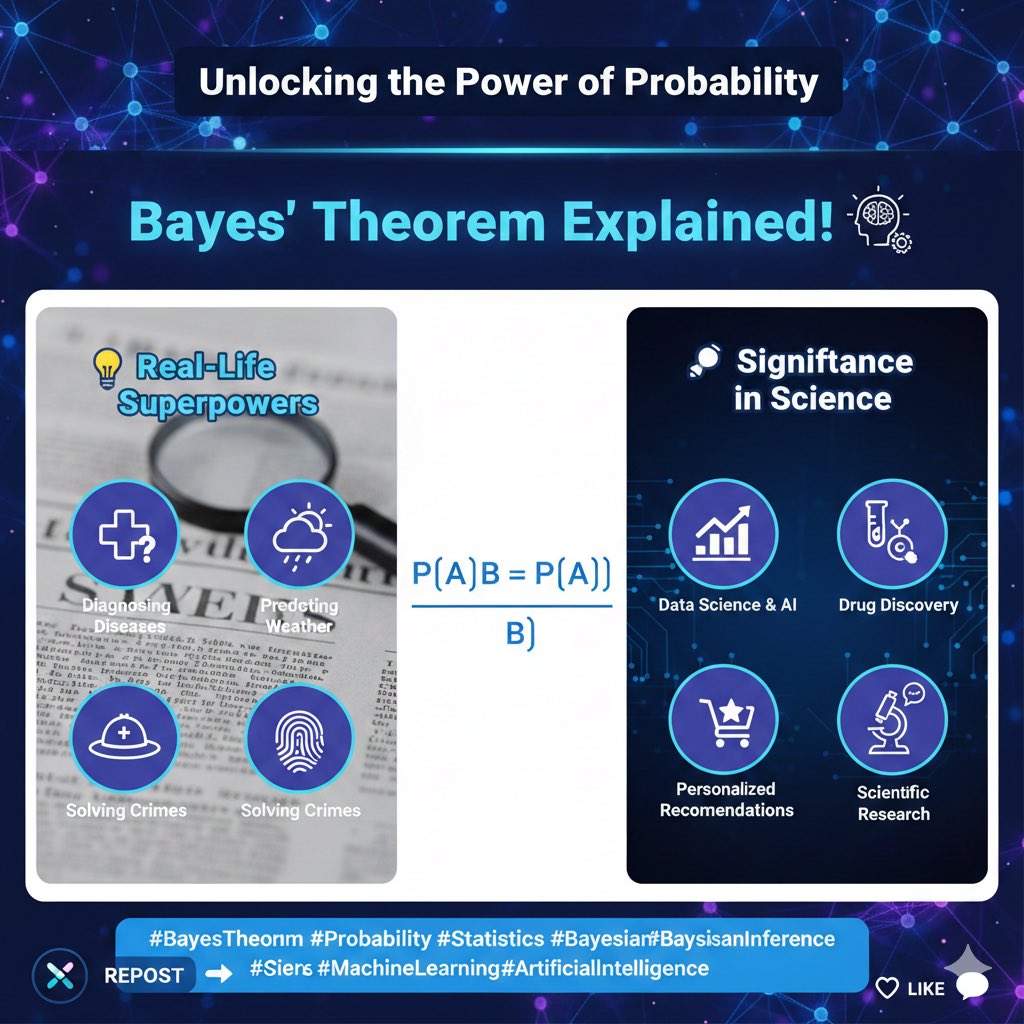
Unlocking the Power of Probability: Bayes' Theorem Explained!
Ever wonder how we update our beliefs with new evidence?
Enter #BayesTheorem! 🤯
This mathematical gem helps us refine probabilities as we gather more information, making it incredibly powerful in real life and modern science!
💡 Real-Life Superpowers:
From diagnosing diseases to spam filtering emails, Bayes' Theorem is working behind the scenes! Imagine predicting the weather or even solving a crime – it's all about updating our initial hunches with new data. 🕵️♀️☁️
🔬 Significance in Science:
Bayes' Theorem is a cornerstone of #DataScience, #MachineLearning, and #ArtificialIntelligence. It's crucial for:
• Medical Diagnostics: Interpreting test results and assessing disease probability.
• Scientific Research: Drawing conclusions from experiments and refining hypotheses.
• Personalized Recommendations: Powering the suggestions you get on streaming services and shopping sites!
• Drug Discovery: Identifying promising compounds with higher success rates.
It's not just a formula; it's a way of thinking that allows us to make better, more informed decisions in a world full of uncertainty.
Dive deeper and discover the elegance of updating your worldview with evidence!
#Probability #Statistics #BayesianInference #Science
3
13
1,812
Unlocking the Power of Probability: Bayes' Theorem Explained!
Ever wonder how we update our beliefs with new evidence?
Enter #BayesTheorem! 🤯
This mathematical gem helps us refine probabilities as we gather more information, making it incredibly powerful in real life and modern science!
💡 Real-Life Superpowers:
From diagnosing diseases to spam filtering emails, Bayes' Theorem is working behind the scenes! Imagine predicting the weather or even solving a crime – it's all about updating our initial hunches with new data. 🕵️♀️☁️
🔬 Significance in Science:
Bayes' Theorem is a cornerstone of #DataScience, #MachineLearning, and #ArtificialIntelligence. It's crucial for:
• Medical Diagnostics: Interpreting test results and assessing disease probability.
• Scientific Research: Drawing conclusions from experiments and refining hypotheses.
• Personalized Recommendations: Powering the suggestions you get on streaming services and shopping sites!
• Drug Discovery: Identifying promising compounds with higher success rates.
It's not just a formula; it's a way of thinking that allows us to make better, more informed decisions in a world full of uncertainty.
Dive deeper and discover the elegance of updating your worldview with evidence!
#Probability #Statistics #BayesianInference #Science
Feb 14

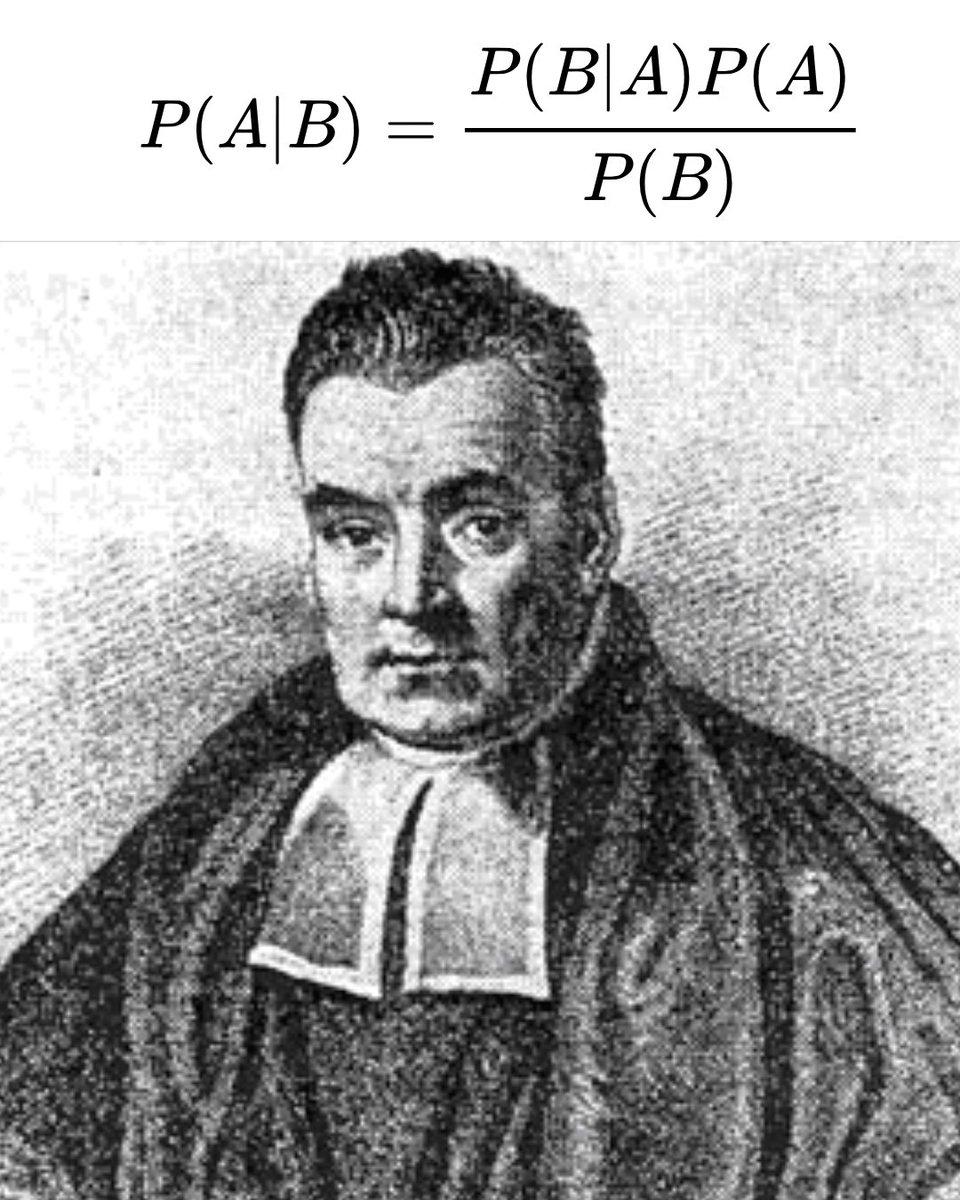
Bayes’ theorem is probably the single most important thing any rational person can learn.
So many of our debates and disagreements that we shout about are because we don’t understand Bayes’ theorem or how human rationality often works.
Bayes’ theorem is named after the 18th-century Thomas Bayes, and essentially it’s a formula that asks: when you are presented with all of the evidence for something, how much should you believe it?
Bayes’ theorem teaches us that our beliefs are not fixed; they are probabilities. Our beliefs change as we weigh new evidence against our assumptions, or our priors. In other words, we all carry certain ideas about how the world works, and new evidence can challenge them.
For example, somebody might believe that smoking is safe, that stress causes mouth ulcers, or that human activity is unrelated to climate change. These are their priors, their starting points. They can be formed by our culture, our biases, or even incomplete information.
Now imagine a new study comes along that challenges one of your priors. A single study might not carry enough weight to overturn your existing beliefs. But as studies accumulate, eventually the scales may tip. At some point, your prior will become less and less plausible.
Bayes’ theorem argues that being rational is not about black and white. It’s not even about true or false. It’s about what is most reasonable based on the best available evidence. But for this to work, we need to be presented with as much high-quality data as possible. Without evidence—without belief-forming data—we are left only with our priors and biases. And those aren’t all that rational.
1
3
201
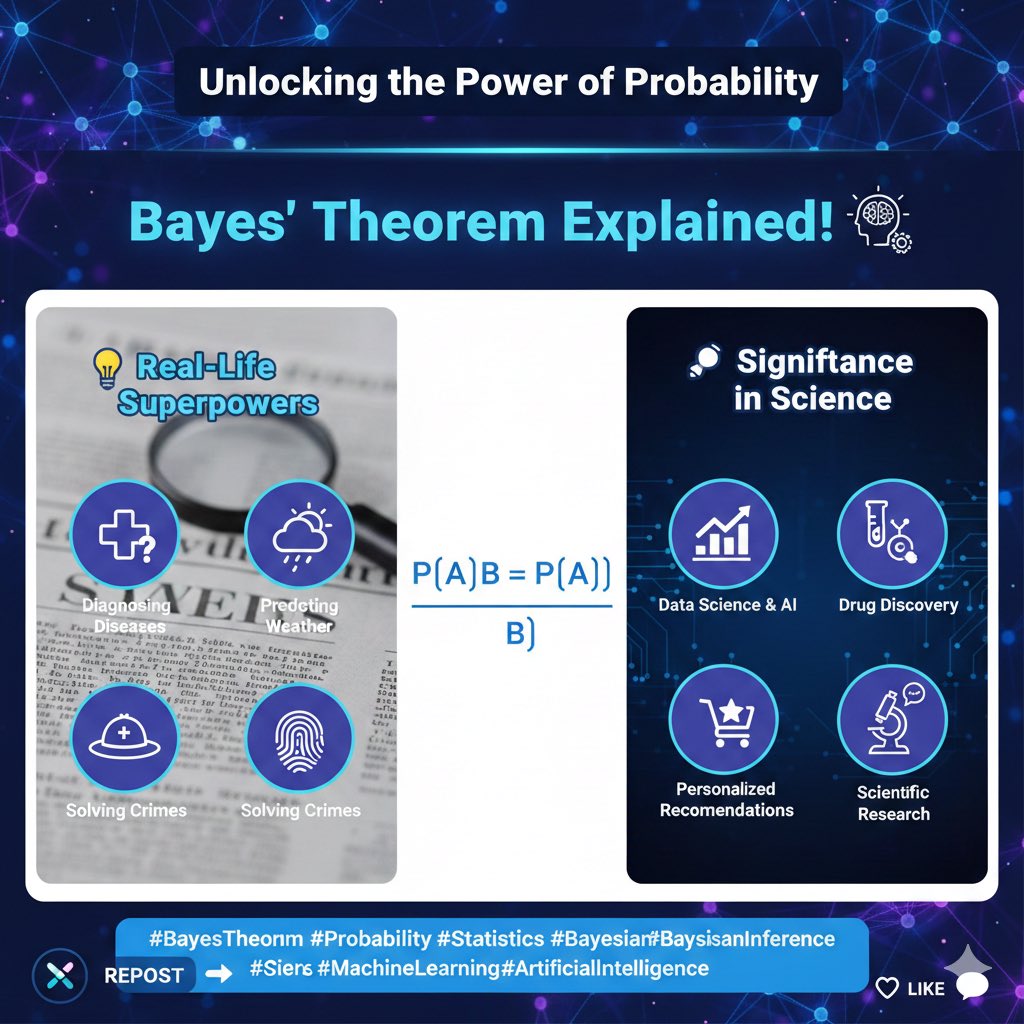
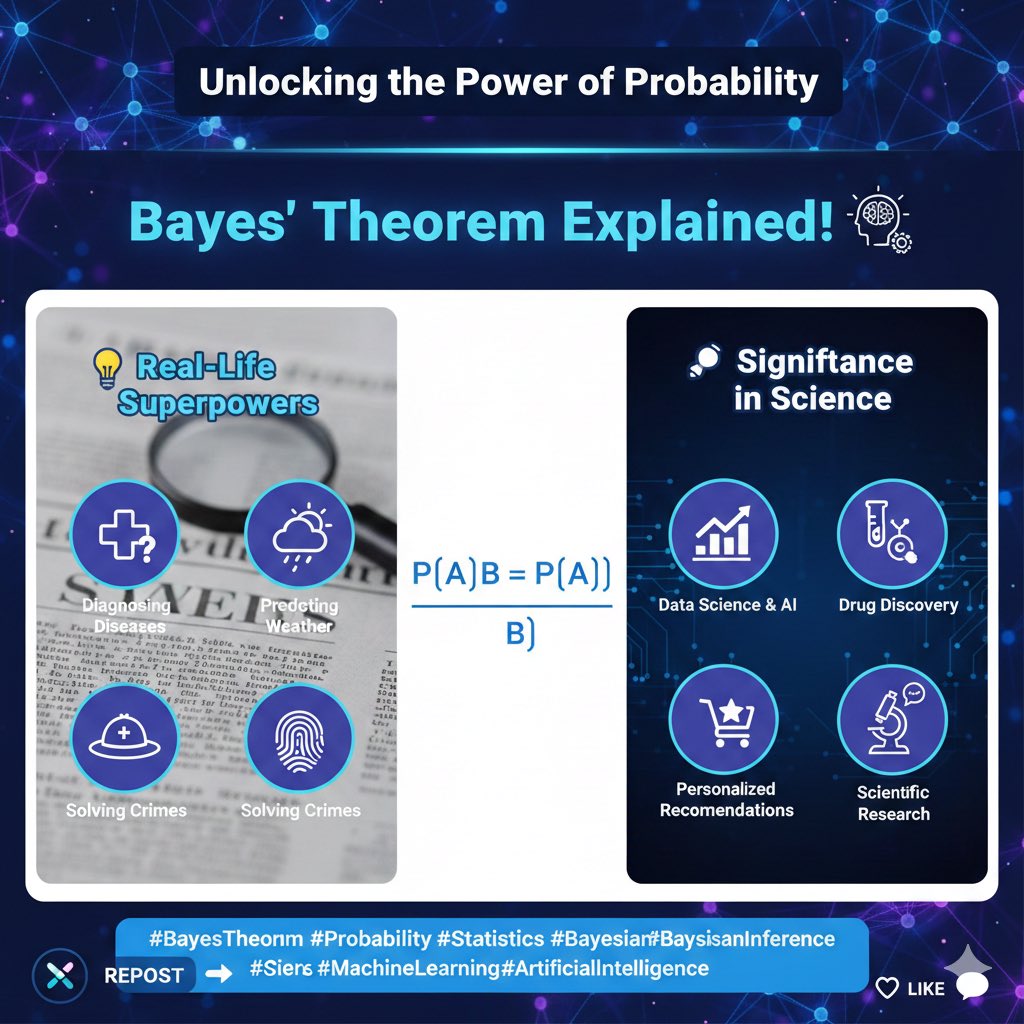
Unlocking the Power of Probability: Bayes' Theorem Explained!
Ever wonder how we update our beliefs with new evidence?
Enter #BayesTheorem! 🤯
This mathematical gem helps us refine probabilities as we gather more information, making it incredibly powerful in real life and modern science!
💡 Real-Life Superpowers:
From diagnosing diseases to spam filtering emails, Bayes' Theorem is working behind the scenes! Imagine predicting the weather or even solving a crime – it's all about updating our initial hunches with new data. 🕵️♀️☁️
🔬 Significance in Science:
Bayes' Theorem is a cornerstone of #DataScience, #MachineLearning, and #ArtificialIntelligence. It's crucial for:
• Medical Diagnostics: Interpreting test results and assessing disease probability.
• Scientific Research: Drawing conclusions from experiments and refining hypotheses.
• Personalized Recommendations: Powering the suggestions you get on streaming services and shopping sites!
• Drug Discovery: Identifying promising compounds with higher success rates.
It's not just a formula; it's a way of thinking that allows us to make better, more informed decisions in a world full of uncertainty.
Dive deeper and discover the elegance of updating your worldview with evidence!
#Probability #Statistics #BayesianInference #Science
2
4
22
4,467
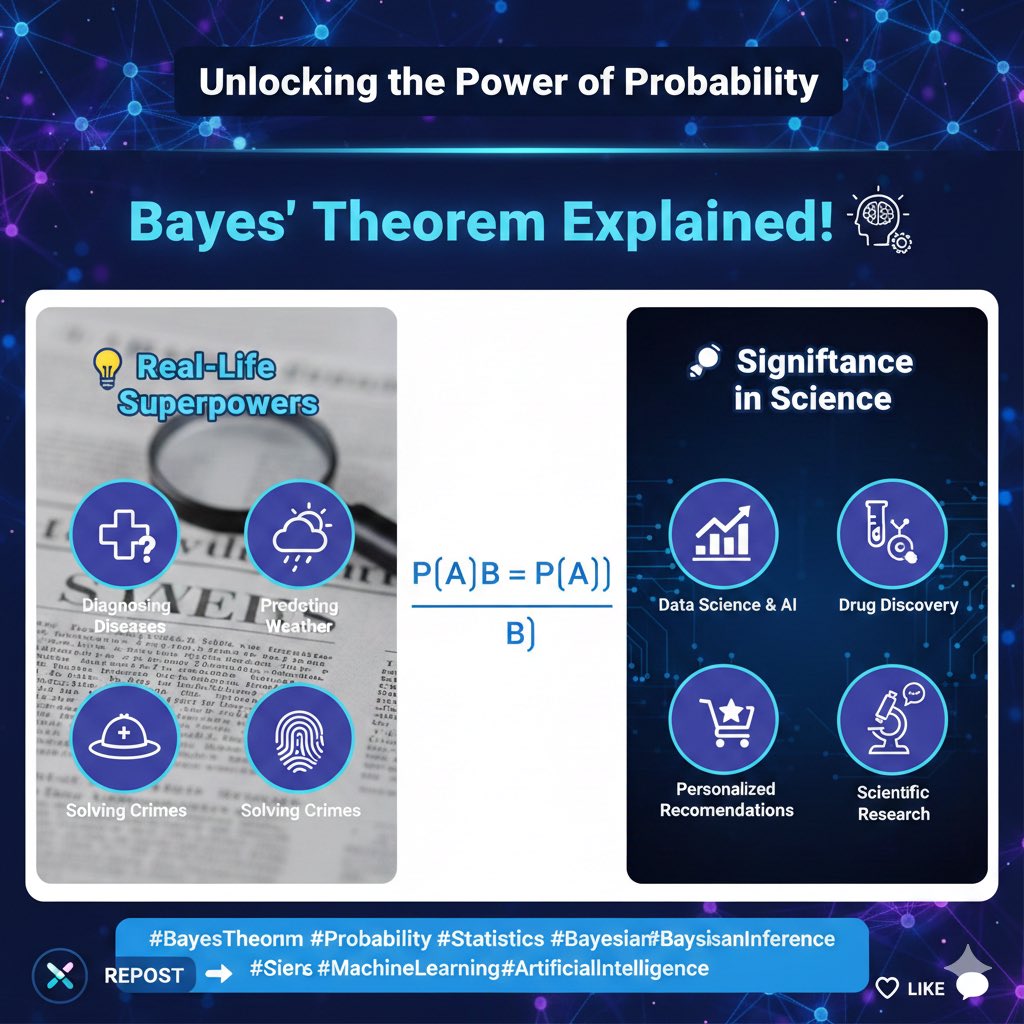
Unlocking the Power of Probability: Bayes' Theorem Explained!
Ever wonder how we update our beliefs with new evidence?
Enter #BayesTheorem! 🤯
This mathematical gem helps us refine probabilities as we gather more information, making it incredibly powerful in real life and modern science!
💡 Real-Life Superpowers:
From diagnosing diseases to spam filtering emails, Bayes' Theorem is working behind the scenes! Imagine predicting the weather or even solving a crime – it's all about updating our initial hunches with new data. 🕵️♀️☁️
🔬 Significance in Science:
Bayes' Theorem is a cornerstone of #DataScience, #MachineLearning, and #ArtificialIntelligence. It's crucial for:
• Medical Diagnostics: Interpreting test results and assessing disease probability.
• Scientific Research: Drawing conclusions from experiments and refining hypotheses.
• Personalized Recommendations: Powering the suggestions you get on streaming services and shopping sites!
• Drug Discovery: Identifying promising compounds with higher success rates.
It's not just a formula; it's a way of thinking that allows us to make better, more informed decisions in a world full of uncertainty.
Dive deeper and discover the elegance of updating your worldview with evidence!
#Probability #Statistics #BayesianInference #Science
5
4
8
1,217
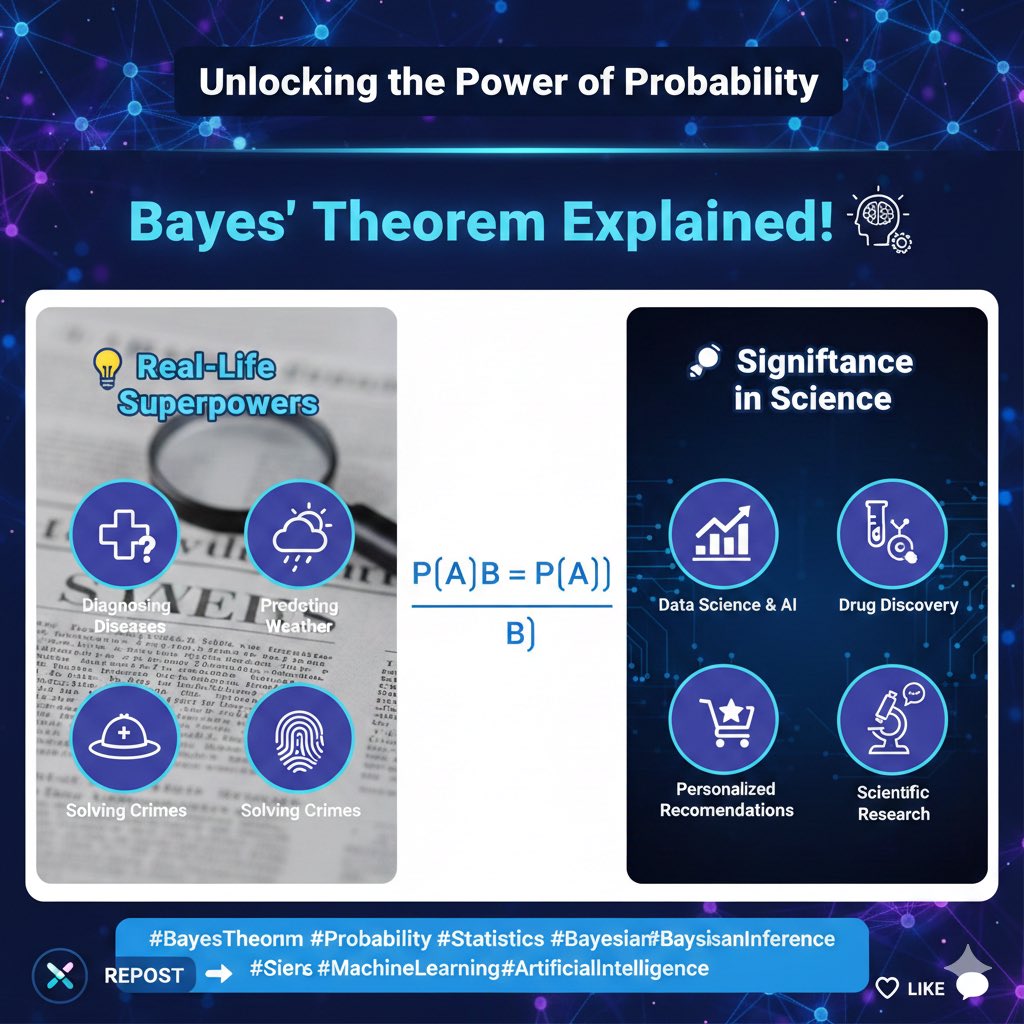
Unlocking the Power of Probability: Bayes' Theorem Explained!
Ever wonder how we update our beliefs with new evidence?
Enter #BayesTheorem! 🤯
This mathematical gem helps us refine probabilities as we gather more information, making it incredibly powerful in real life and modern science!
💡 Real-Life Superpowers:
From diagnosing diseases to spam filtering emails, Bayes' Theorem is working behind the scenes! Imagine predicting the weather or even solving a crime – it's all about updating our initial hunches with new data. 🕵️♀️☁️
🔬 Significance in Science:
Bayes' Theorem is a cornerstone of #DataScience, #MachineLearning, and #ArtificialIntelligence. It's crucial for:
• Medical Diagnostics: Interpreting test results and assessing disease probability.
• Scientific Research: Drawing conclusions from experiments and refining hypotheses.
• Personalized Recommendations: Powering the suggestions you get on streaming services and shopping sites!
• Drug Discovery: Identifying promising compounds with higher success rates.
It's not just a formula; it's a way of thinking that allows us to make better, more informed decisions in a world full of uncertainty.
Dive deeper and discover the elegance of updating your worldview with evidence!
#Probability #Statistics #BayesianInference #Science

1
137

Feb 3
A finale for our high-dimensional series
We’ve seen the weird business with high-dimensional unit balls and Gaussian shells. Now let’s watch it happen.
This animation shows a Markov chain exploring a high-dimensional Gaussian, then projecting that motion onto the familiar 3D bell. The path never settles on the peak. It circles in a bright ring out on the slope, because in high dimensions the typical states live on a thin shell. Run the same idea in 3D and it behaves the way your intuition wants. The chain spends plenty of time near the visible peak.
This knocks out a few comfy myths.
First, the classic idea that a Gaussian prior keeps parameters near zero mostly breaks in big models. The prior doesn’t park you near zero. It concentrates you on a thin shell with almost fixed norm, far from the origin.
Second, the mode is not representative. The density is highest at the centre, but a typical draw from the distribution, and a typical state of your sampler, lives nowhere near it.
Third, it shows how 1D textbook plots mislead you. The bump you draw is not where probability lives in high dimensions. The real story is the typical set on the shell. That’s where inference, optimisation, and the model’s behaviour actually happen.
#HighDimensionalSpace #ProbabilityTheory #BayesianInference #MCMC #GaussianDistributions #MachineLearning
10
40
279
9,974
Feb 2
The most important tool in Probability and Statistics - Markov Chain Monte Carlo (MCMC) Method
Fresh out of undergraduate Probability and Stats courses, it’s easy to feel invincible. You’ve tamed Gaussians, gammas, betas, all those neat closed-form toy distributions.
Then research hits and you meet the harsher truth. Real posteriors and energy landscapes are jagged, asymmetric, multimodal, and too high-dimensional to integrate or sample from directly. You can’t compute the normalising constant. You can’t do the integrals by hand. And i.i.d. samples are basically science fiction.
Markov Chain Monte Carlo is the hack we invented to survive that reality. Instead of drawing perfect samples, you send a carefully designed random walk wandering through the landscape, then use its long-run positions as your window into the target distribution.
Here’s the problem. Standard trace plots and diagnostics can still cheerfully lie to you. High-dimensional geometry can make a chain that looks healthy while it’s effectively frozen. Multimodal targets, bad tuning, and hidden correlations can quietly wreck your posterior summaries.
This series is about those blind spots. We’ll use visuals like this one to show how MCMC actually moves, where the guarantees get slippery, and how to think clearly about convergence and diagnostics in serious Bayesian, physics, and ML work.
#BayesianInference #MCMC #MonteCarloMethods #ProbabilityLandscape #StatisticsEducation #ComputationalScience
8
118
716
32,308

Delayed Rejection Adaptive Metropolis ( DRAM) MCMC on the Banana distribution.
DRAM combines co-variance adaption and delayed rejection to efficiently sample highly nonlinear posteriors in MCMC.
github: github.com/SaiSampathKedari/…
#MCMC #BayesianInference #MonteCarlo #StatisticalComputing #ProbabilisticModeling
2
234


19 Dec 2025
⚠️#NewPaperAlert🚨
Improved taxonomic and gene sampling advance the knowledge of deep relationships within #Macrodasyida (#Gastrotricha)
By Cesaretti et al.
doi.org/10.1111/cla.70013
#Cladistics #Phylogenetics #MolecularSystematics #Taxonomy #Parsimony #BayesianInference #Science

2
7
224
19 Dec 2025
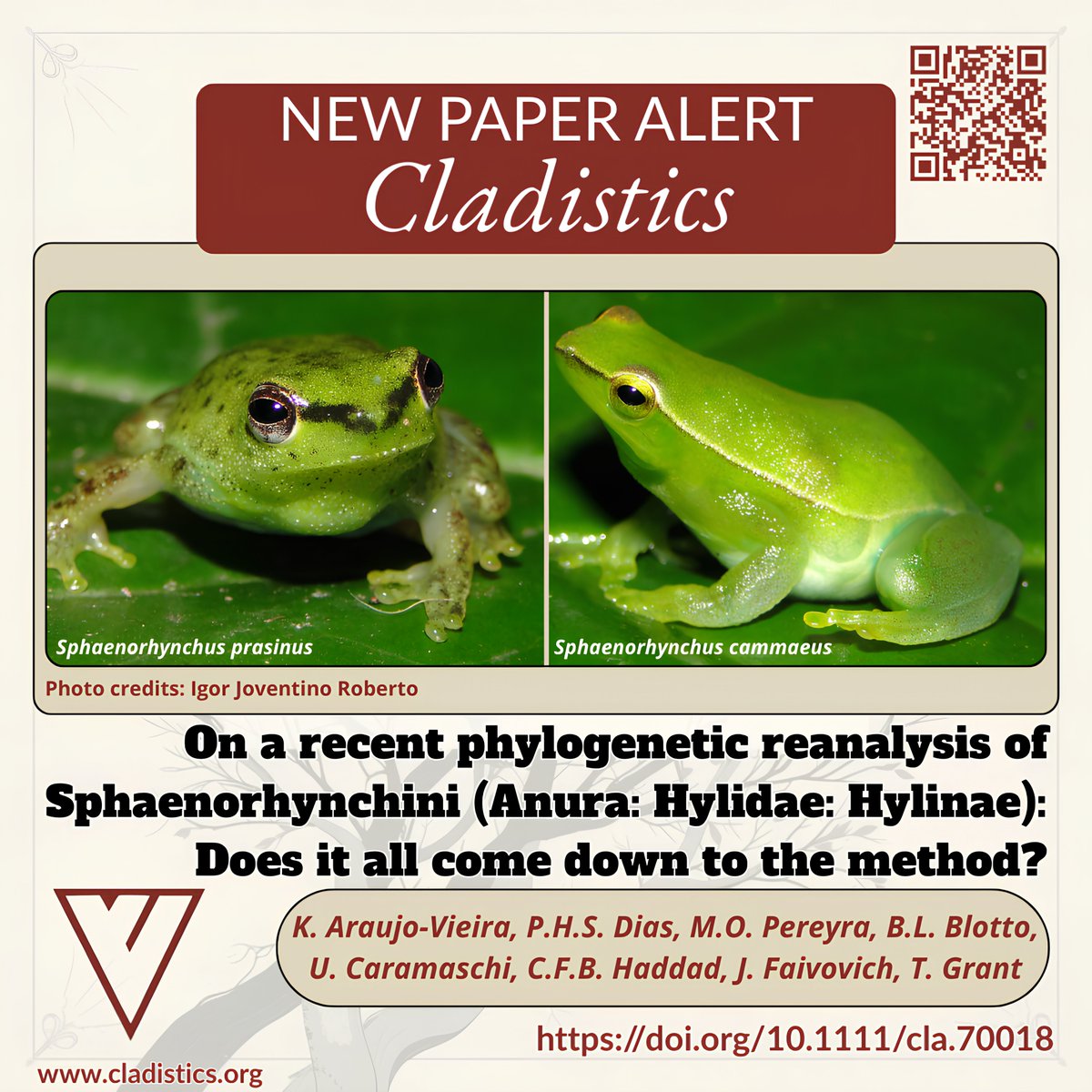
⚠️#NewPaperAlert🐸
On a recent phylogenetic reanalysis of #Sphaenorhynchini (#Anura: #Hylidae: #Hylinae): Does it all come down to the method?
By Araujo-Vieira et al.
doi.org/10.1111/cla.70018
#Cladistics #Phylogenetics #Parsimony #BayesianInference #PhylogeneticCongruence
2
3
80