
Jun 8
Peak periods test delivery speed, and preparation wins.
With Awaze, we focused on high-impact front-end and CMS enhancements that matter most when demand surges.
The lesson? Move early, prioritise what delivers value, and execute with precision.
Read more: godeltech.com/godel-accelera…
#DigitalStrategy #TechLeadership #BuildForScale #CustomerExperience #ModernEngineering

9

Apr 16
We build what survives scale — GarudaNest
#BuildForScale #SystemOverDesign #RealEngineering
#StartupTech

1
5
27

Sometimes the problem isn’t confusion.
It’s that too many things are happening at once, quietly, behind the scenes.
People usually focus on what they can see results, outcomes, headlines.
But real systems don’t fail loudly. They drift.
Small delays. Slight mismatches. Records that don’t fully agree. Decisions made on assumptions instead of verified states.
That’s how trust slowly leaks out of a system without anyone noticing.
When I look closely at how modern systems operate digital, institutional, even organizational, one thing becomes clear:
we’re running complex processes on fragile coordination.
That’s where @dgrid_ai starts to make sense to me.
Not as noise. Not as hype.
But as structure a way to ensure that what is claimed, computed, or decided can actually be checked, verified, and trusted at scale.
And then there’s @permacastapp.
Because coordination alone isn’t enough if information can be altered, rewritten, or quietly replaced.
Some things need permanence. Not rigidity permanence.
A memory layer that doesn’t argue, doesn’t forget, and doesn’t bend to convenience.
When both ideas exist in the same space, you start to see a different kind of system forming
one where actions are provable, records are durable, and trust is engineered instead of assumed.
Not flashy.
Not loud.
Just solid enough to hold weight over time.
That’s usually how real infrastructure begins.
#DGrid #Permacast #DecentralizedSystems
#Web3Infrastructure #TrustByDesign #DigitalIntegrity #SystemThinking
#FutureArchitecture #PublicInfrastructure
#BuildForScale #LongTermSystems
#Web3Builders

21
39
59
234
I’ve been thinking about how fragile most digital systems actually are.
Not in theory but in real use.
One update breaks things. One spike crashes a service. One central point fails and everyone feels it at once.
You don’t notice until you’re depending on it.
That’s why infrastructure matters more than features.
@0G_labs is tackling the part most people ignore: the heavy lifting behind AI storage, compute, and data availability built in a way that doesn’t collapse under scale.
When the foundation is right, everything built on top gets stronger.
But strong foundations still need rules and coordination.
That’s where @dgrid_ai fits naturally.
It’s about making decentralized systems behave predictably not perfectly, but fairly and consistently even as more users, apps, and data come in.
Different layers, same goal:
systems that don’t fall apart when they’re finally needed.
That’s the kind of progress I’m interested in.
#0GLabs #DGrid #DecentralizedAI
#Web3Infrastructure #OnchainSystems
#BuildersMindset #AIInfrastructure
#TrustlessTech #BuildForScale
#FutureOfWeb3
30
42
111
631

I’m @parakletusguy, building infrastructure for schools at Parakletus Hub.
This is Day 0 of the State of EdTech series.
Follow along as we diagnose the chaos and prescribe the cure.
#StateOfEdTech #EdTech #BuildForScale
1
2
7

Jan 26
It’s time to evolve.
We’re redefining Shiba with a long-term vision on the Solana network — faster infrastructure, scalable design, and a focus on sustainability over short-term hype.
This isn’t a trend shift.
It’s a strategic upgrade.
#Solana #Shiba #Crypto #Web3 #Blockchain #LongTermVision #BuildForScale #Innovation
6
87

Jan 16
The strongest innovations are rarely loud. They work in the background, changing how systems behave without demanding attention @inference_labs
Most people only notice infrastructure after it has already reshaped the landscape. By then, it feels obvious.
Inference Labs is building that kind of foundation. Quiet layers that make intelligence safer, more reliable, and more scalable.
This is how real change happens. Not with noise, but with systems that hold everything together.
#InferenceLabs #AIInfrastructure #QuietInnovation #BuildForScale

12
6
17,452

Scale. Don’t Stall. 🚀
🎐 Automate smarter.
🎯 Operate faster.
👑 Grow without limits.
Let's build and grow stronger -
hi@ascent24.io | 91 9655-87-0024 | ascent24.io
#Softwaredevelopment #BusinessGrowth #SmartAutomation #BuildForScale #DigitalTransformation
3
15

Jan 7
Real infrastructure isn’t about chasing trends — it’s about solving problems that last.
At IDN Network, we’re building Layered, scalable foundations that support real applications and real users.
Slow is smooth. Smooth is fast. ⚙️🌐
#IDNNetwork #Web3Infrastructure #BuildForScale

12
7
13
1,257

Jan 4
🟦 @base Chain is scaling users.
🟡 @billions_ntwk is scaling intelligence.
Now ask yourself one thing 👇
💡 What happens when strong infrastructure meets smart distribution?
That’s where real Web3 adoption starts.
No empty hype.
No fake activity.
Just builders, data, and execution.
🚀 @base brings the users.
🧠 @billions_ntwk the signal.
The next wave won’t be loud it’ll be inevitable.
Which matters more to you? A) Fast chains
B) Smart networks
C) Both together
👇 Drop A, B, or C
@billions_ntwk
@jgonzalezferrer
@KaitoAI
@base
#BillionNetwork #BaseChain #Web3 #CryptoTwitter #BuildForScale

2
4
49

18 Dec 2025
🌱 Sustainable Web3 starts with dependable infrastructure.
@GodeChain is engineered for consistency, scalability, and real-world use — giving builders the confidence to ship, grow, and evolve on-chain. 🌐⚙️
Quietly powerful. Built to endure.
#GODE #Web3 #Blockchain #Layer2 #BuildForScale

2
4
226

10 Nov 2025
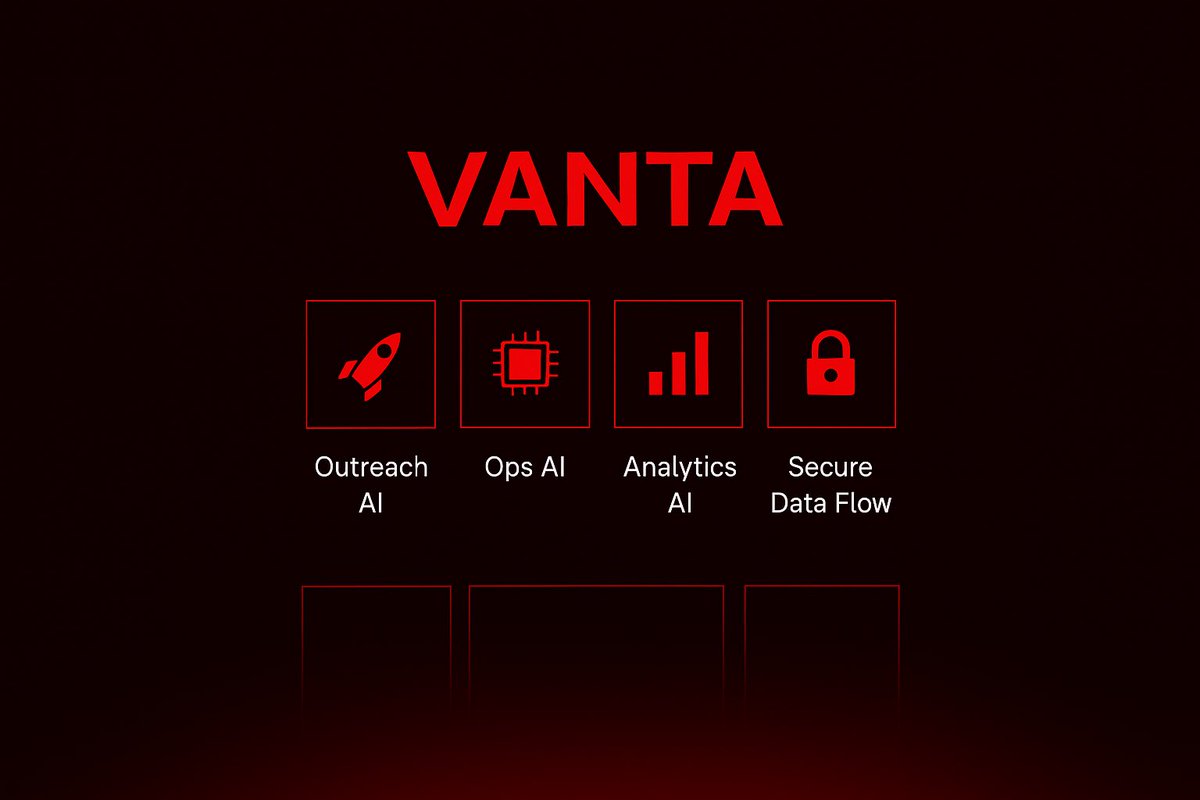
VANTA Tool Suite — an integrated framework of intelligent agents built to automate business operations at scale.
• Outreach AI — Streamlines communication and engagement through autonomous outreach flows.
• Ops AI — Executes and optimizes operational workflows across connected systems with precision.
• Analytics AI — Transforms raw data into actionable insights for smarter, faster decisions.
Together, these tools form the foundation of VANTA Protocol — bridging intelligence, automation, and measurable outcomes.
#VANTA #AI #Automation #BuildForScale
4
300
7 Nov 2025
⚡ VANTA Protocol Whitepaper Update
The blueprint behind our AI automation layer is now live.
Learn how VANTA connects data, agents, and actions — built for scale.
🔗 vantaprotocol.app/whitepaper
#VANTA #AI #Automation #BuildForScale
3
3
9
1,018
7 Nov 2025
First DCA completed ✅
💰 0.7 $SOL added to $VANTA position.
Building long-term conviction, one block at a time.
#VANTA #AI #Automation #BuildForScale #Solana
3
2
4
1,038

11 Jul 2025
🔹 @tenprotocol
Imagine Ethereum scaling — without giving up decentralization or privacy.
@tenprotocol is making that vision real with TEE-native infrastructure, where smart contracts run inside trusted execution environments.
✅ Verifiable by design
✅ Privacy-first architecture
✅ Scalable without rollups or centralization
This isn’t just another L2 — it’s a deep protocol upgrade built for serious, real-world use.
From DeFi to healthcare to enterprise, privacy-preserving computation on Ethereum is finally becoming practical — and TEN is leading the charge.
Quietly building what the future depends on.
#TENProtocol #EthereumInfra #TEE #OnchainPrivacy #Web3Infrastructure #BuildForScale #privacybydesign @cookiedotfun


1
2
3
48
11 Jul 2025
🔹 @tenprotocol
What if Ethereum could scale — without sacrificing decentralization or privacy?
@tenprotocol is pioneering TEE-native infrastructure, enabling smart contracts to run in trusted execution environments.
✅ Verifiable execution
✅ Private by default
✅ Scalable without rollups or centralizing shortcuts
This isn’t just another L2 or tweak — it’s a core protocol upgrade for real-world, high-stakes use cases.
From DeFi to healthcare to enterprise, privacy-preserving computation on Ethereum is finally possible — and TEN is building the rails.
This is one of the most important infrastructure plays happening in Web3 right now. Quiet, but foundational.
#TENProtocol #EthereumInfra #TEE #PrivacyByDesign #Web3Infrastructure #SmartContracts #OnchainPrivacy #BuildForScale @cookiedotfun

17
3
10
114

11 Feb 2022
That feeling when you refactor a canvas app loading strategy and get the load time down from 2775ms to 1225ms... #PowerApps #PowerAddicts #BuildForScale
2
3

4 Feb 2022
You don’t realize that your struggles of today where once a dream..
#buildforscale
@TanishGanjoo
1
6

17 May 2021
The rate of past growth does not necessarily mean the future growth will be at the same rate. In businesses it's decreasing with scale, in start-ups it's geometric. Makes all the difference.
#buildforscale #buildforadecade
1
2

19 Feb 2021
Building a #techstartup ??
Stop guessing the capacity and load. #BuildForScale from #day1
#seriousSuggestion #startups #software #Saas
3