

Jun 14
Instrumentation, dashboards, alerting, tracing, AIOps, ChatOps, open standards, blameless culture, cross-functional teams, FinOps, UX metrics, governance.
Read Chapter #10: Better Collaboration and Communication
energizing-solutions.com/bet…
4

Jun 14
This pattern shows up in homegrown ChatOps, CI approval gates, and internal admin panels. The fix is boring: no truncation in approval paths. If a command is too long for your UI, ask why you're approving 4KB payloads in the first place.
1
11

Jun 13
CLI burnout is real. Tiny scripts, huge friction. With Robogator I just *chat* a PowerShell flow into existence, see every step, tweak in-place, ship it. Next run? A single message. Now my “open logs → filter → zip → send” chore is one reusable AI script with emoji-rich status updates in Slack 💡✨
#Robogator #AIScripting #Automation #DevTools #PowerShell #ChatOps #Productivity #SRE #DevEx #Workflow
36

Nick Taylor retweeted

Jun 12
We built a Slack ChatOps thing on top of agent-sandbox and open-sourced it recently: github.com/pomerium/agentops
I think it’s pretty neat. Solves a lot of the current batch of security issues including credential leakage and identity bridging.
2
1
5
682

Jun 12
tbqh the revival of chatops is one of the greatest things rn
i have spent an inordinate amount of time on sentry's slackbot and its adding a ton of value at this point
2
351

Jun 9
Some days the terminal just feels… 🥴
With Robogator I dropped the cryptic CLI spells and started “chatting” my automations into life:
“Hey, parse this CSV and ping me on Teams” → done.
PowerShell flows in a messenger-style UI, scripts that answer with emojis 🤖✨
Tiny AI scripting wins, stacked daily, changed everything.
#Robogator #AIScripting #Automation #DevTools #PowerShell #ChatOps #Productivity #DX #APIAutomation #WorkflowEngineering
23
Context Graphs are a convergence, and convergence needs architecture
Charles Betz of Forrester Research published a piece titled "Context Graphs Are a Convergence, Not an Invention", and it deserves to be read widely.
Having a VP-level analyst at a major research firm put it in writing, with the historical inventory to back it up, is genuinely significant. It signals that this conversation has moved from the practitioner fringe into the mainstream enterprise consciousness.
Betz traces the lineage back 40 years: Zachman's enterprise architecture framework in 1987, the ITIL push for configuration management databases in the 1990s, APM in the early 2000s, process mining, ChatOps, organisational network analysis, FinOps, software bills of materials, and architecture decision records.
His central observation: none of these systems talk to each other, and the convergence the VC community is declaring as a greenfield opportunity is in fact the long-overdue integration of work that's been accumulating in silos for four decades.
Kurt Cagle extends the argument, identifying three structural gaps that "context graph" as a term does not resolve:
The entity resolution gap -- a flat context graph doesn't solve it. You need a formal registration mechanism: a way to declare that an entity exists, give it a canonical identifier, and establish that the various local identifiers in legacy systems refer to it.
The events-versus-state gap -- process mining logs and APM traces are event records. CMDBs and EA capability maps are state records. Conflating the two in a single knowledge graph doesn't unify them; it obscures the distinction that makes each useful.
The governance gap -- "Who owns this graph?" is actually several questions at once. Governance has to be built into the architecture itself, not answered after the fact.
The proposed answer is holonic architecture -- a unit that has stable, dereferenceable identity, a formal separation between infrastructure layer and payload, a machine-enforceable boundary, and governed, audited portals between domains. The W3C RDF stack (RDF 1.2, OWL 2, SHACL 1.2, SPARQL 1.2) is the only implementation substrate that arrives vendor-neutral, with formal semantics and decades of standardisation behind it.
The question before the context graph community is whether the convergence happens as a coherent, formally specified, openly governed architecture -- or as a collection of incompatible vendor implementations, each claiming to be the "system of record for decisions," none of them able to talk to the others.
The map is not the territory. But a good map needs more than a title; it needs a cartographic system.
By Kurt Cagle
linkedin.com/pulse/context-g…
#EnterpriseArchitecture #SemanticWeb #ContextGraphs #OpenStandards
--
Join the Conversation
Subscribe to the Year of the Graph newsletter for quarterly insights on #KnowledgeGraphs, #GraphDB, Graph #Analytics, #AI, #DataScience and #SemTech .
📧 Subscribe: yearofthegraph.xyz/newslette…
💼 Sponsorship inquiries: yearofthegraph.xyz/contact/

2
8
307

Jun 3
Last week i participated in @WeMakeDevs x @WithCoral_com
hackathon 🔥
Excited to share my submission for the Coral Hackathon: Project Engram to everyone :-
Engram is an autonomous SRE ChatOps workspace. By leveraging Coral and MCP, it treats siloed infrastructure (Kubernetes, Grafana, GitHub) as a single, unified SQL database so AI agents can automatically triage incidents for you.
Here is architecture details -
🚀 The Data Layer (Coral MCP)
Traditional SRE tools context-switch between Prometheus, k8s APIs, and GitHub. Engram uses Coral's data fabric and Model Context Protocol (MCP) to abstract your infrastructure into a unified, queryable relational layer. To the agent, your entire stack looks like SQL.
The Agent Core (Go Micro-Loops)
🚀 Built entirely in Go for speed and concurrency. When an alert hits, Engram kicks off highly optimized agent micro-loops. Instead of massive, slow LLM chains, these lightweight loops execute precise tool calls to query the infrastructure database, gathering targeted context rapidly.
🚀 Production infra can't tolerate AI guessing. We strict-type our tool inputs and use precise system prompting to keep the LLM grounded. The agent operates on a loop: Observe (SQL/MCP query) -> Analyze (Diff/Log inspection) -> Propose (Remediation diff).
🚀 Autonomous doesn't mean unsupervised. We designed a Notion-inspired UI that maps incident state directly to the agent's workspace. SREs can track the live reasoning chain, review proposed Git diffs side-by-side, and approve the remediation with a single click.
From alert to SQL abstraction, to Go-driven agent execution, to human approval—Engram creates a loop of self-healing infrastructure.
Code base is speghettified -
github.com/gojogourav/engram
1
4
458

May 27
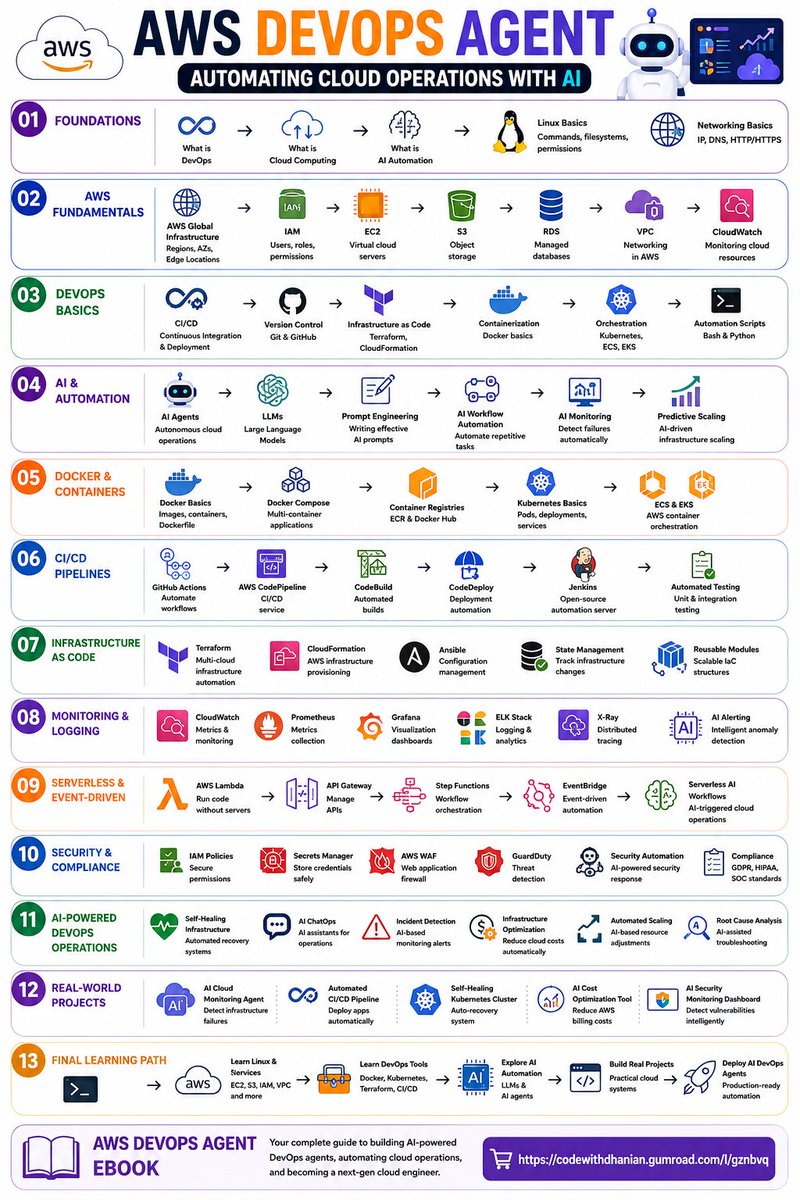
AWS DEVOPS AGENT ROADMAP
Automating Cloud Operations with AI
FOUNDATIONS
What is DevOps → Combining development and operations
What is Cloud Computing → Delivering services over the internet
What is AI Automation → Using AI to automate workflows
Linux Basics → Commands, filesystems, permissions
Networking Basics → IP, DNS, HTTP/HTTPS
AWS FUNDAMENTALS
AWS Global Infrastructure → Regions, AZs, Edge Locations
IAM → Users, roles, permissions
EC2 → Virtual cloud servers
S3 → Object storage
RDS → Managed databases
VPC → Networking in AWS
CloudWatch → Monitoring cloud resources
DEVOPS BASICS
CI/CD → Continuous Integration & Deployment
Version Control → Git & GitHub
Infrastructure as Code → Terraform, CloudFormation
Containerization → Docker basics
Orchestration → Kubernetes, ECS, EKS
Automation Scripts → Bash & Python
AI & AUTOMATION
AI Agents → Autonomous cloud operations
LLMs → Large Language Models for DevOps tasks
Prompt Engineering → Writing effective AI prompts
AI Workflow Automation → Automate repetitive tasks
AI Monitoring → Detect failures automatically
Predictive Scaling → AI-driven infrastructure scaling
DOCKER & CONTAINERS
Docker Basics → Images, containers, Dockerfile
Docker Compose → Multi-container applications
Container Registries → ECR & Docker Hub
Kubernetes Basics → Pods, deployments, services
ECS & EKS → AWS container orchestration
CI/CD PIPELINES
GitHub Actions → Automate workflows
AWS CodePipeline → CI/CD service
CodeBuild → Automated builds
CodeDeploy → Deployment automation
Jenkins → Open-source automation server
Automated Testing → Unit & integration testing
INFRASTRUCTURE AS CODE
Terraform → Multi-cloud infrastructure automation
CloudFormation → AWS infrastructure provisioning
Ansible → Configuration management
State Management → Track infrastructure changes
Reusable Modules → Scalable IaC structures
MONITORING & LOGGING
CloudWatch → Metrics & monitoring
Prometheus → Metrics collection
Grafana → Visualization dashboards
ELK Stack → Logging & analytics
X-Ray → Distributed tracing
AI Alerting → Intelligent anomaly detection
SERVERLESS & EVENT-DRIVEN
AWS Lambda → Run code without servers
API Gateway → Manage APIs
Step Functions → Workflow orchestration
EventBridge → Event-driven automation
Serverless AI Workflows → AI-triggered cloud operations
SECURITY & COMPLIANCE
IAM Policies → Secure permissions
Secrets Manager → Store credentials safely
AWS WAF → Web application firewall
GuardDuty → Threat detection
Security Automation → AI-powered security response
Compliance → GDPR, HIPAA, SOC standards
AI-POWERED DEVOPS OPERATIONS
Self-Healing Infrastructure → Automated recovery systems
AI ChatOps → AI assistants for operations
Incident Detection → AI-based monitoring alerts
Infrastructure Optimization → Reduce cloud costs automatically
Automated Scaling → AI-based resource adjustments
Root Cause Analysis → AI-assisted troubleshooting
REAL-WORLD PROJECTS
AI Cloud Monitoring Agent → Detect infrastructure failures
Automated CI/CD Pipeline → Deploy apps automatically
Self-Healing Kubernetes Cluster → Auto-recovery system
AI Cost Optimization Tool → Reduce AWS billing costs
AI Security Monitoring Dashboard → Detect vulnerabilities
FINAL LEARNING PATH
Learn Linux & Networking → Build foundations
Master AWS Services → EC2, S3, IAM, VPC
Learn DevOps Tools → Docker, Kubernetes, Terraform
Explore AI Automation → LLMs & AI agents
Build Real Projects → Practical cloud systems
Deploy AI DevOps Agents → Production-ready automation
AWS DEVOPS AGENT EBOOK:
codewithdhanian.gumroad.com/…
6
8
55
1,869


May 16
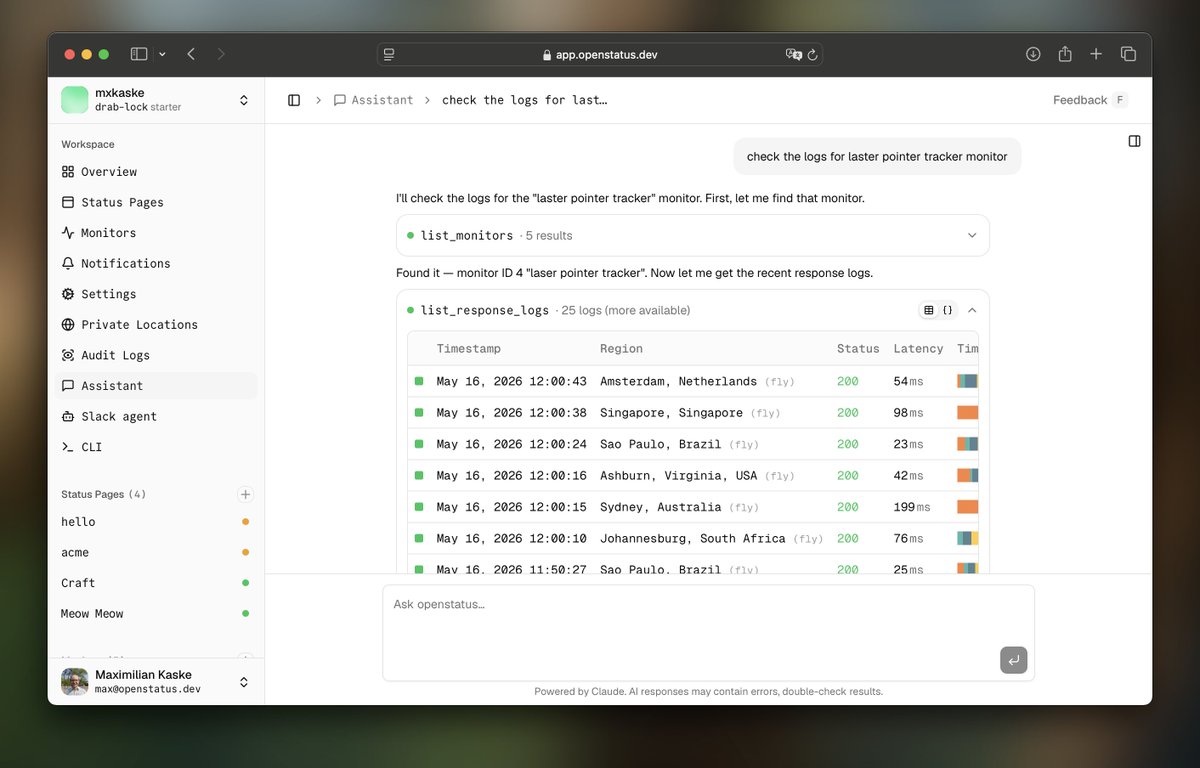
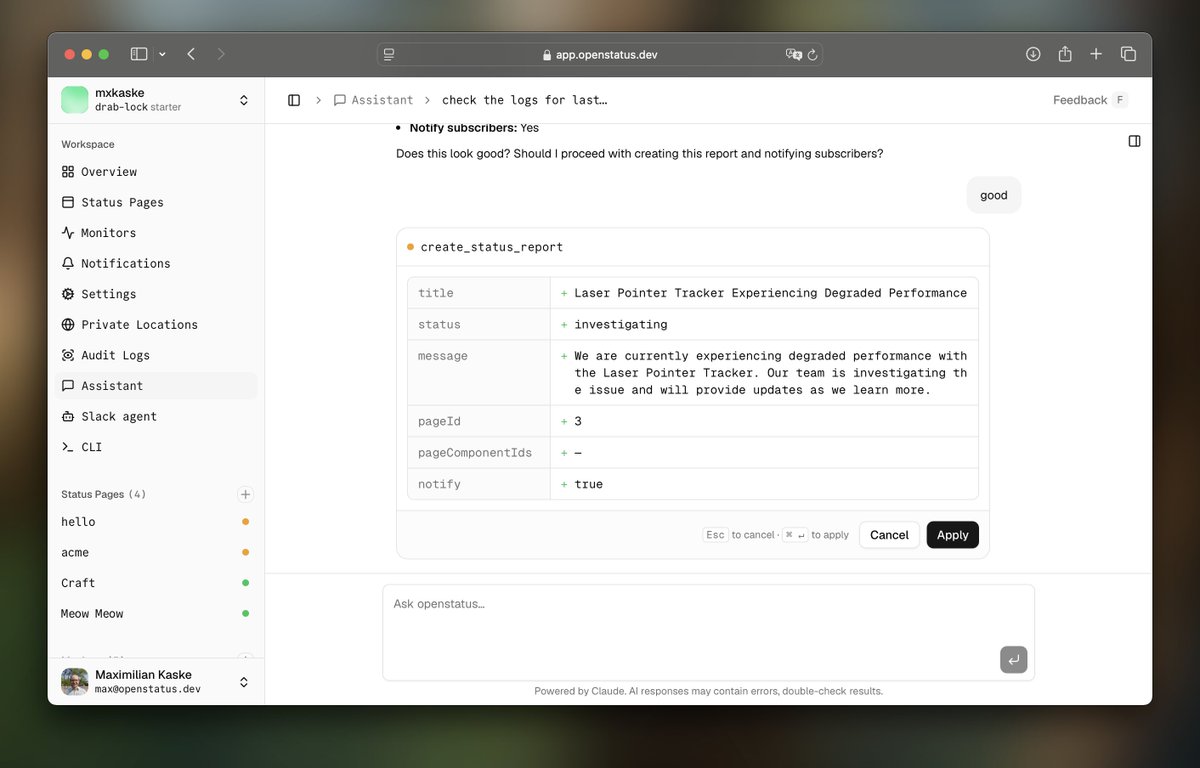
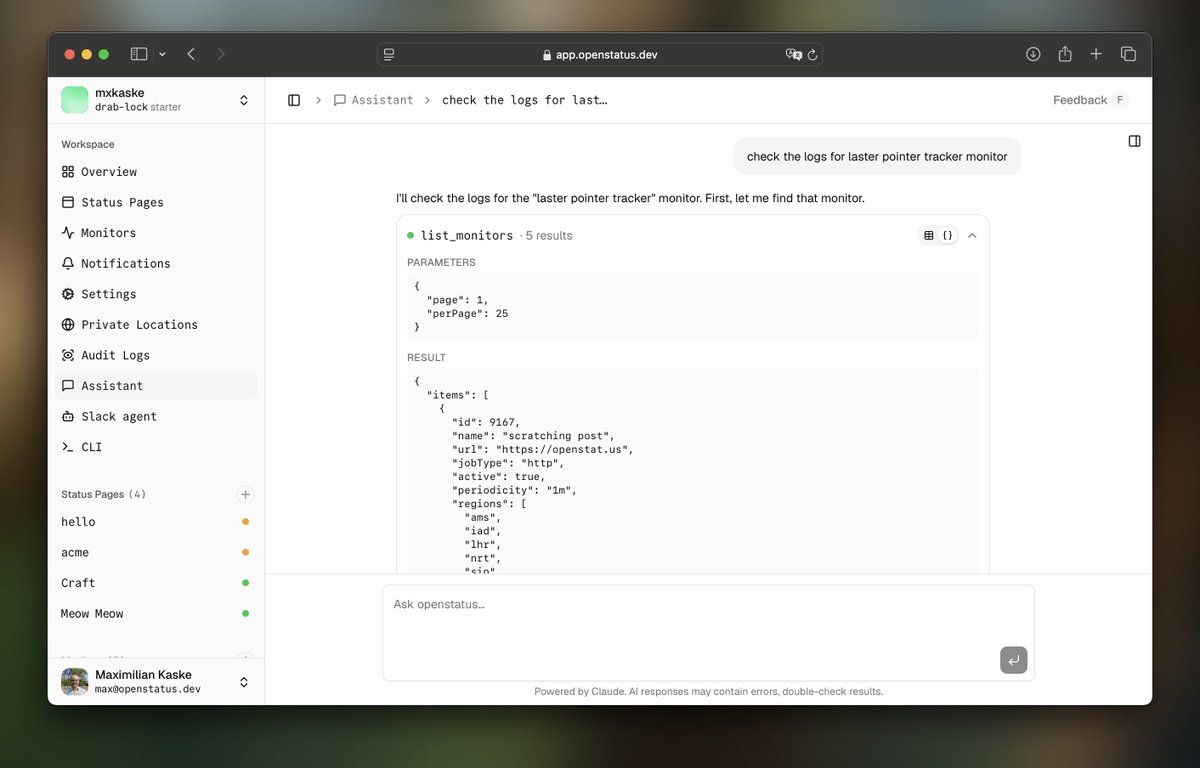
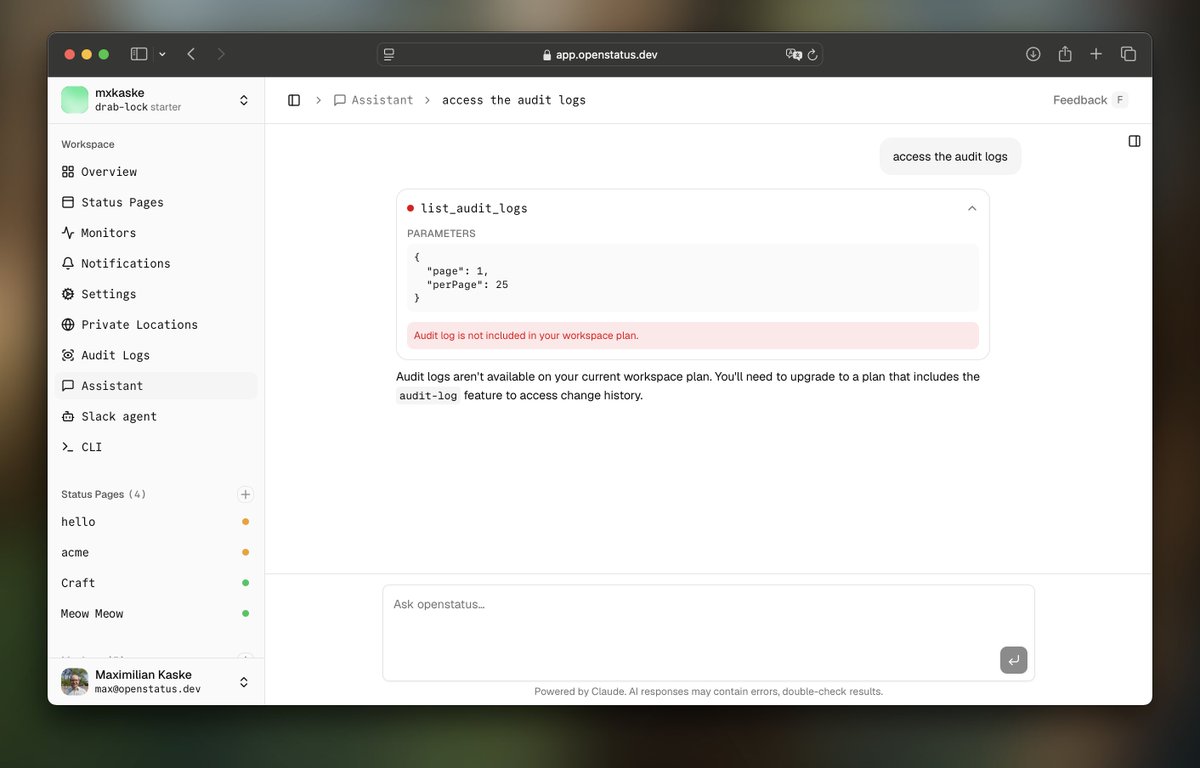
ChatOps is available now
May 16

every tool call in our @openstatushq ai assistant is a collapsible card:
→ status dot
→ one-line summary so you can skim
→ rich tab rendering a proper UI component, raw tab rendering params and result details
the dashboard's own components, rendered inside the chat
1
2
357

May 11
Context Graph Architecture: Why Knowledge Architecture Is the Missing Layer
Context graphs are being called AI's next trillion-dollar opportunity. But before chasing the new label, it's worth asking: what's actually new here?
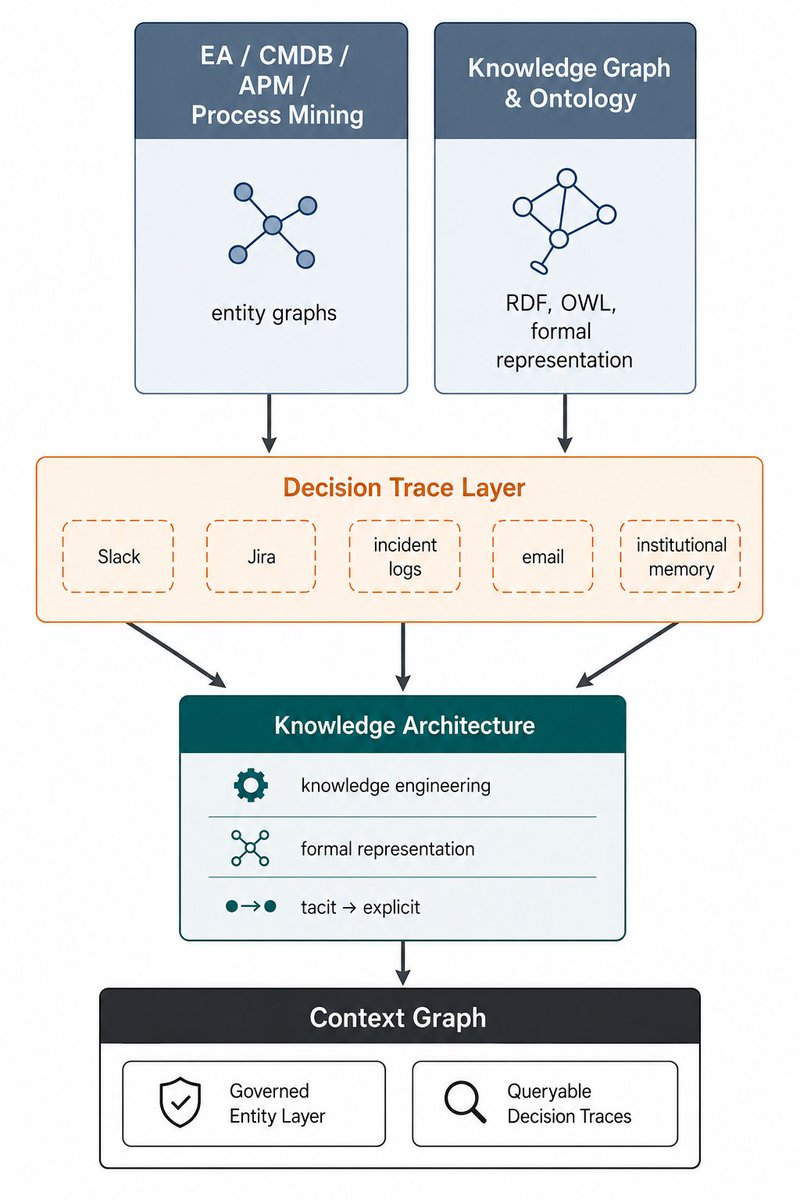
Forrester's Charles Betz cuts through the noise: EA has maintained entity graphs since Zachman (1987). CMDBs go back to ITIL v1 in the 1990s. APM, process mining, ChatOps, architecture decision records -- these disciplines have been assembling the pieces of a unified context graph in isolation for decades. The graph was never missing. It's fragmented.
George Anadiotis takes the argument further. The decision trace layer -- who decided what, why, under what authority -- isn't absent from organisations. It lives in Slack threads, incident postmortems, Jira tickets, and people's heads. Extracting it and making it queryable is not a database problem. It requires knowledge engineering: observing work practices, interviewing domain experts, encoding tacit reasoning in formal, machine-readable representations.
That's the missing layer. Not the graph itself -- the knowledge architecture that makes it governable.
The infrastructure answer is not exotic either. RDF/OWL provides typed entities and governed relationships. Named graphs handle provenance and versioning. SPARQL enables queryability. These are the building blocks that turn an entity layer from a drawing into something that can actually satisfy governance requirements. Alberto D. Mendoza's conversion of ArchiMate 3.2 to an RDF ontology is a direct, working instantiation of this approach.
On the tooling side: the LLM Wiki pattern -- extracting discrete facts from unstructured sources into a graph, then synthesising into structured queryable form -- is being adopted at scale as a population accelerator for enterprise Agentic AI implementations. The Semantic Web has a 25-year library of patterns, vocabularies and tools to build on.
The key reframe: ontological modeling was never meant to be a runtime. Its value is in defining consistent logic aligned with domain knowledge -- ensuring concepts don't contradict each other across different data schemas.
Entity graphs anchored in EA, EA anchored in knowledge representation, decision traces made queryable: that's context graph architecture grounded in something that can actually hold.
The question isn't whether context graphs are real. It's whether organisations will start building the knowledge architecture they require now, or wait until their competitors have a three-year head start.
By @linked_do
linkeddataorchestration.com/…
#KnowledgeArchitecture #EnterpriseArchitecture #ContextGraphs #AgenticAI #Ontology
--
💬 ‘A great newsletter’ - Claudia Remlinger, former Sr. Marketing Director, Neo4j.
Join readers from Amazon, Capgemini, Michelin, Neo4j & more
Subscribe to the Year of the Graph newsletter for quarterly updates and insights on all things #KnowledgeGraph, #GraphDB, Graph #Analytics / #DataScience / #AI and #SemTech 👇
yearofthegraph.xyz/newslette…
1
10
43
2,135

May 11
SaaSのSlackに月数十万円払い続ける企業へ。
Mattermost(GitHub36,600⭐)はMITライセンスのSlack代替OSS。
・Docker Composeで5分起動、PostgreSQL一本
・WebRTC通話・Playbooks・Boardsが標準搭載
・Mattermost AgentsでローカルLLM接続 → 機微データを社外に出さずAI要約
防衛・金融・政府が選ぶ理由は、データ主権を握れるから。
導入手順・Slack/Rocket.Chat比較・ChatOps運用まで実装目線で解説した。
ai-heartland.com/tool/matter…
4
195

