
Jun 11
#AIAgents can access information, but can they understand the reasoning behind decisions, exceptions, & approvals? #ContextGraphs bridge that gap, enabling smarter, more autonomous enterprise AI. Discover why becoming the foundation of next-gen AI agents. tinyurl.com/enxj58h2
5
Context Graphs are a convergence, and convergence needs architecture
Charles Betz of Forrester Research published a piece titled "Context Graphs Are a Convergence, Not an Invention", and it deserves to be read widely.
Having a VP-level analyst at a major research firm put it in writing, with the historical inventory to back it up, is genuinely significant. It signals that this conversation has moved from the practitioner fringe into the mainstream enterprise consciousness.
Betz traces the lineage back 40 years: Zachman's enterprise architecture framework in 1987, the ITIL push for configuration management databases in the 1990s, APM in the early 2000s, process mining, ChatOps, organisational network analysis, FinOps, software bills of materials, and architecture decision records.
His central observation: none of these systems talk to each other, and the convergence the VC community is declaring as a greenfield opportunity is in fact the long-overdue integration of work that's been accumulating in silos for four decades.
Kurt Cagle extends the argument, identifying three structural gaps that "context graph" as a term does not resolve:
The entity resolution gap -- a flat context graph doesn't solve it. You need a formal registration mechanism: a way to declare that an entity exists, give it a canonical identifier, and establish that the various local identifiers in legacy systems refer to it.
The events-versus-state gap -- process mining logs and APM traces are event records. CMDBs and EA capability maps are state records. Conflating the two in a single knowledge graph doesn't unify them; it obscures the distinction that makes each useful.
The governance gap -- "Who owns this graph?" is actually several questions at once. Governance has to be built into the architecture itself, not answered after the fact.
The proposed answer is holonic architecture -- a unit that has stable, dereferenceable identity, a formal separation between infrastructure layer and payload, a machine-enforceable boundary, and governed, audited portals between domains. The W3C RDF stack (RDF 1.2, OWL 2, SHACL 1.2, SPARQL 1.2) is the only implementation substrate that arrives vendor-neutral, with formal semantics and decades of standardisation behind it.
The question before the context graph community is whether the convergence happens as a coherent, formally specified, openly governed architecture -- or as a collection of incompatible vendor implementations, each claiming to be the "system of record for decisions," none of them able to talk to the others.
The map is not the territory. But a good map needs more than a title; it needs a cartographic system.
By Kurt Cagle
linkedin.com/pulse/context-g…
#EnterpriseArchitecture #SemanticWeb #ContextGraphs #OpenStandards
--
Join the Conversation
Subscribe to the Year of the Graph newsletter for quarterly insights on #KnowledgeGraphs, #GraphDB, Graph #Analytics, #AI, #DataScience and #SemTech .
📧 Subscribe: yearofthegraph.xyz/newslette…
💼 Sponsorship inquiries: yearofthegraph.xyz/contact/

2
8
270

We've all experienced it: most AI agents forget things because their memory was never designed to last.
A conversation buffer stores what was just said. A static knowledge base tells general facts about the world. Neither explains why it made a decision three sessions ago, what it has already tried and found to be wrong, or how a specific entity connects to the task at hand right now.
Some time ago, Foundation Capital identified context graphs as a significant architectural trend in the infrastructure of an agentic system, and they solve this with three connected memory layers.
👌 Long-term memory holds enterprise knowledge, the slow-moving facts about your domain that ground the agent in reality.
👌👌Short-term memory captures conversation history, what the user asked, what the agent did, and what it still needs to do, so it does not lose track mid-task.
👌👌👌Reasoning memory stores decision traces, the actual record of why the agent made a choice, not just what it did.
The 3 layers are connected so agents can tie together what they know, what was discussed, and what they decided to make better decisions over time, and explain them when they need to.
Time to see it in practice: You can build your own context graph with Neo4j Agent Memory, an open-source library that runs on top of any Neo4j instance and packages all three types of memory in the context graph. bit.ly/4x2mZ15
When aiming for enterprise-grade reliability, which deficiency is more costly for your organization: an agent that hallucinates, one that forgets what it’s doing, or both? Answer below (and check out the blog about context graphs!)
Build with Neo4j Agent Memory: neo4j.com/labs/agent-memory/
#Neo4j #ContextGraphs #AgentMemory #AgenticAI #KnowledgeGraph
1
2
6
580

May 18
How does an AI agent remember its reasoning? 🧠
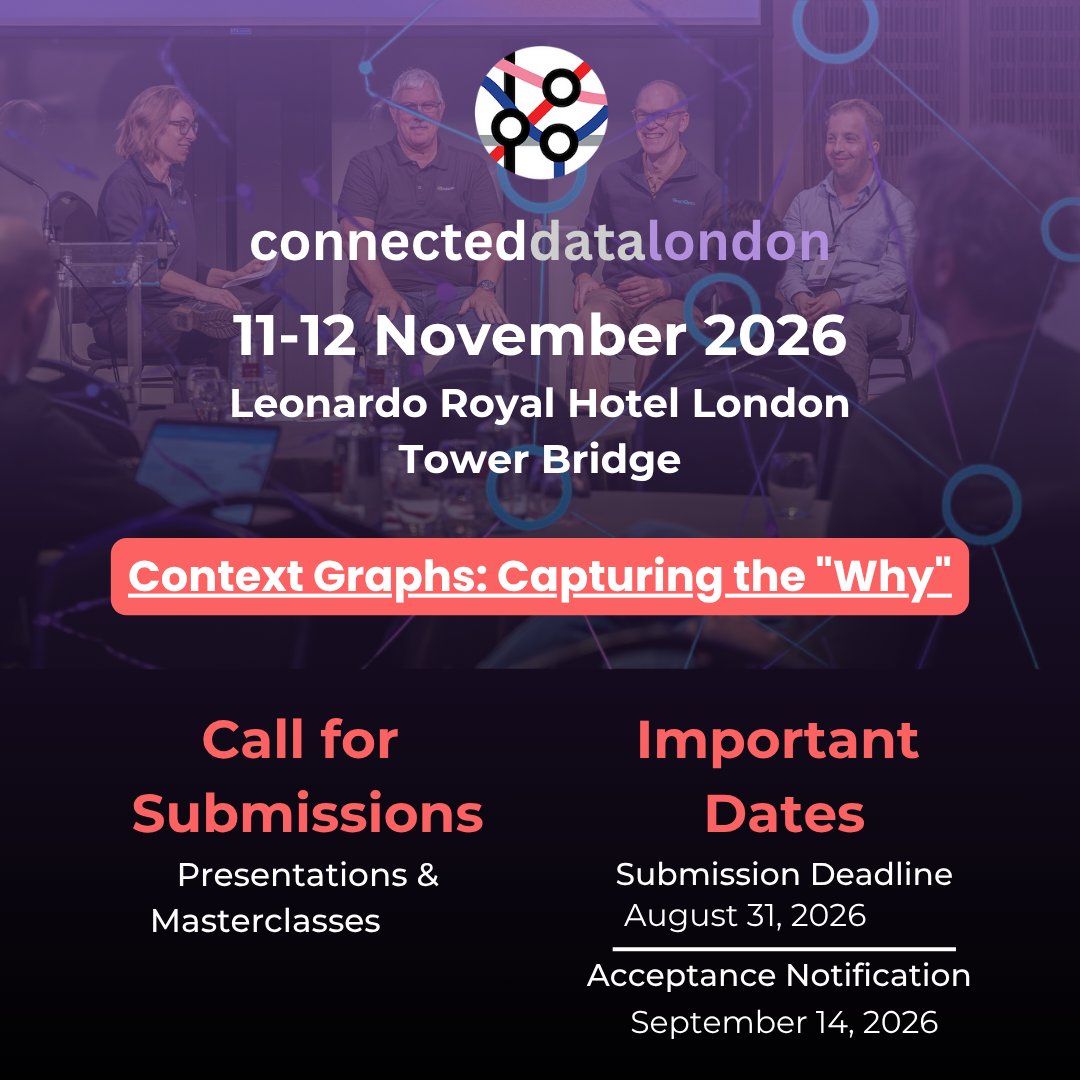
At Connected Data London 2026, we are putting a spotlight on Context Graphs—the structures that capture the temporal lineage and decision traces behind autonomous behaviour.
If you are working on the architectures that give AI a "memory" beyond simple vector retrieval, we want to see your work on our stage. We are looking for talks on:
Decision-aware graphs and lineage.
Bridging the gap between theory and real-world production.
Capturing the precedents that govern agentic systems.
Join the community shaping the future of AI memory and trust.
🗓️ Deadline: 31 August
🔗 Guidelines & Submissions: connected-data.london/2026-c…
#CDL26 #ConnectedData #KnowledgeGraphs #ResponsibleAI #AIGovernance #ContextGraphs
1
5
408

May 12
Dr. Aasman was interviewed for this @KMWorldMagazine article - AI’s Impact on Data Silos and Knowledge Hubs buff.ly/1GD5Su7 #KnowledgeGraphs #NeuroSymbolicAI #ContextGraphs

2
70

May 11
Context Graph Architecture: Why Knowledge Architecture Is the Missing Layer
Context graphs are being called AI's next trillion-dollar opportunity. But before chasing the new label, it's worth asking: what's actually new here?
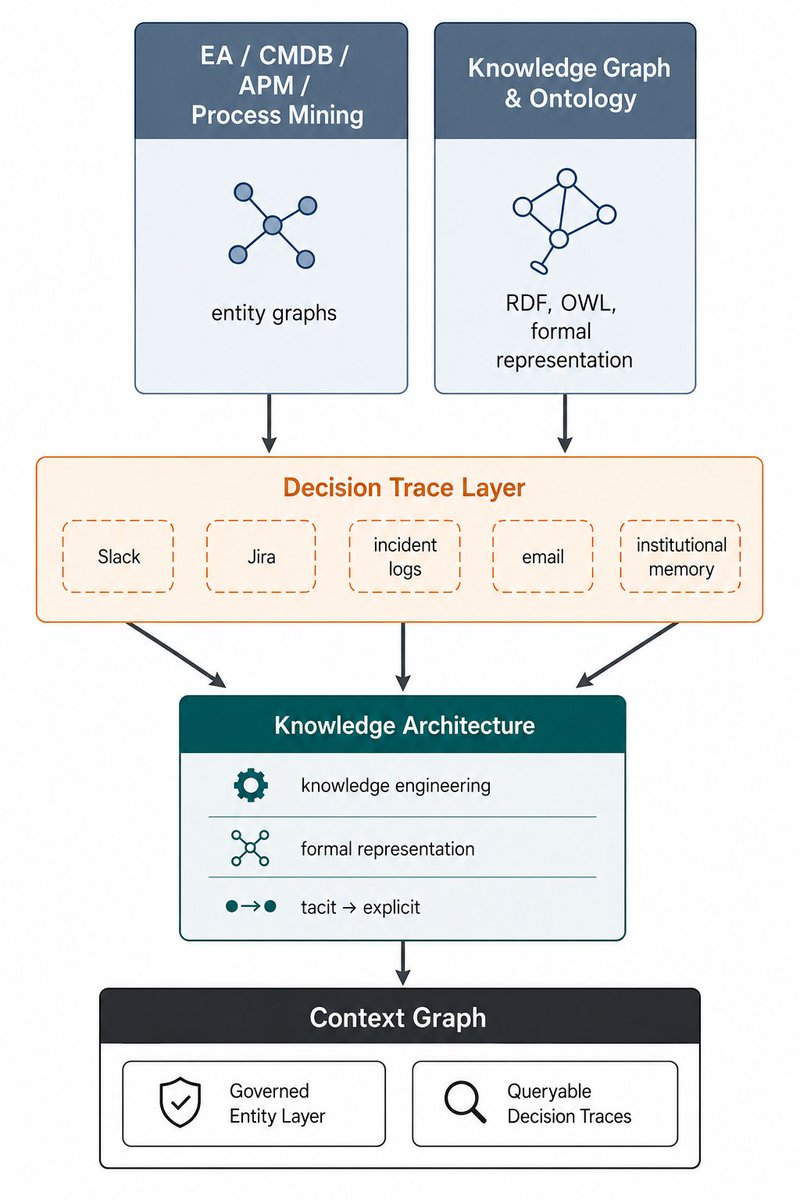
Forrester's Charles Betz cuts through the noise: EA has maintained entity graphs since Zachman (1987). CMDBs go back to ITIL v1 in the 1990s. APM, process mining, ChatOps, architecture decision records -- these disciplines have been assembling the pieces of a unified context graph in isolation for decades. The graph was never missing. It's fragmented.
George Anadiotis takes the argument further. The decision trace layer -- who decided what, why, under what authority -- isn't absent from organisations. It lives in Slack threads, incident postmortems, Jira tickets, and people's heads. Extracting it and making it queryable is not a database problem. It requires knowledge engineering: observing work practices, interviewing domain experts, encoding tacit reasoning in formal, machine-readable representations.
That's the missing layer. Not the graph itself -- the knowledge architecture that makes it governable.
The infrastructure answer is not exotic either. RDF/OWL provides typed entities and governed relationships. Named graphs handle provenance and versioning. SPARQL enables queryability. These are the building blocks that turn an entity layer from a drawing into something that can actually satisfy governance requirements. Alberto D. Mendoza's conversion of ArchiMate 3.2 to an RDF ontology is a direct, working instantiation of this approach.
On the tooling side: the LLM Wiki pattern -- extracting discrete facts from unstructured sources into a graph, then synthesising into structured queryable form -- is being adopted at scale as a population accelerator for enterprise Agentic AI implementations. The Semantic Web has a 25-year library of patterns, vocabularies and tools to build on.
The key reframe: ontological modeling was never meant to be a runtime. Its value is in defining consistent logic aligned with domain knowledge -- ensuring concepts don't contradict each other across different data schemas.
Entity graphs anchored in EA, EA anchored in knowledge representation, decision traces made queryable: that's context graph architecture grounded in something that can actually hold.
The question isn't whether context graphs are real. It's whether organisations will start building the knowledge architecture they require now, or wait until their competitors have a three-year head start.
By @linked_do
linkeddataorchestration.com/…
#KnowledgeArchitecture #EnterpriseArchitecture #ContextGraphs #AgenticAI #Ontology
--
💬 ‘A great newsletter’ - Claudia Remlinger, former Sr. Marketing Director, Neo4j.
Join readers from Amazon, Capgemini, Michelin, Neo4j & more
Subscribe to the Year of the Graph newsletter for quarterly updates and insights on all things #KnowledgeGraph, #GraphDB, Graph #Analytics / #DataScience / #AI and #SemTech 👇
yearofthegraph.xyz/newslette…
1
10
43
2,130

Apr 28
🔥 Module 4 just dropped! 🔥
Knowledge Assets – Owning and Verifying Digital Truth
One tool created by @origin_trail that lets you own & prove anything, your car, your ideas, research, art… all with blockchain proof. No more hoping information stays safe. Now you can truly own and verify it.
Watch now 👇 - youtu.be/fPddg-zwyoQ?si=me3L…
#OriginTrail #DKG #KnowledgeAssets #TRAC $TRAC #VerifiableKnowledge #ContextGraphs #AI #Graphs #knowledge #RDF #SPARQL
Apr 28

Round 1 of the DKG v10 bounty is open.
AI is shifting toward multi-agent systems, where shared and verifiable memory becomes essential.
Open integrations built today will shape this future.
Start now ↓
1
22
61
2,596

Apr 24
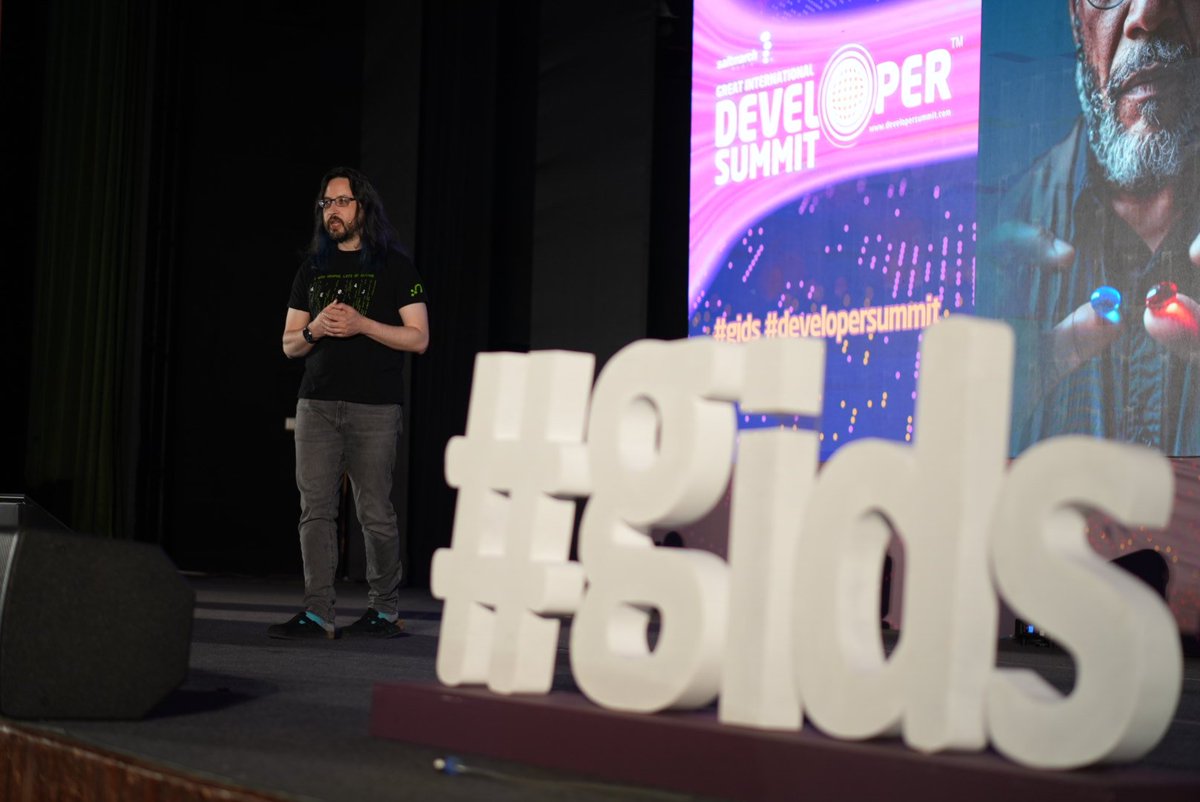
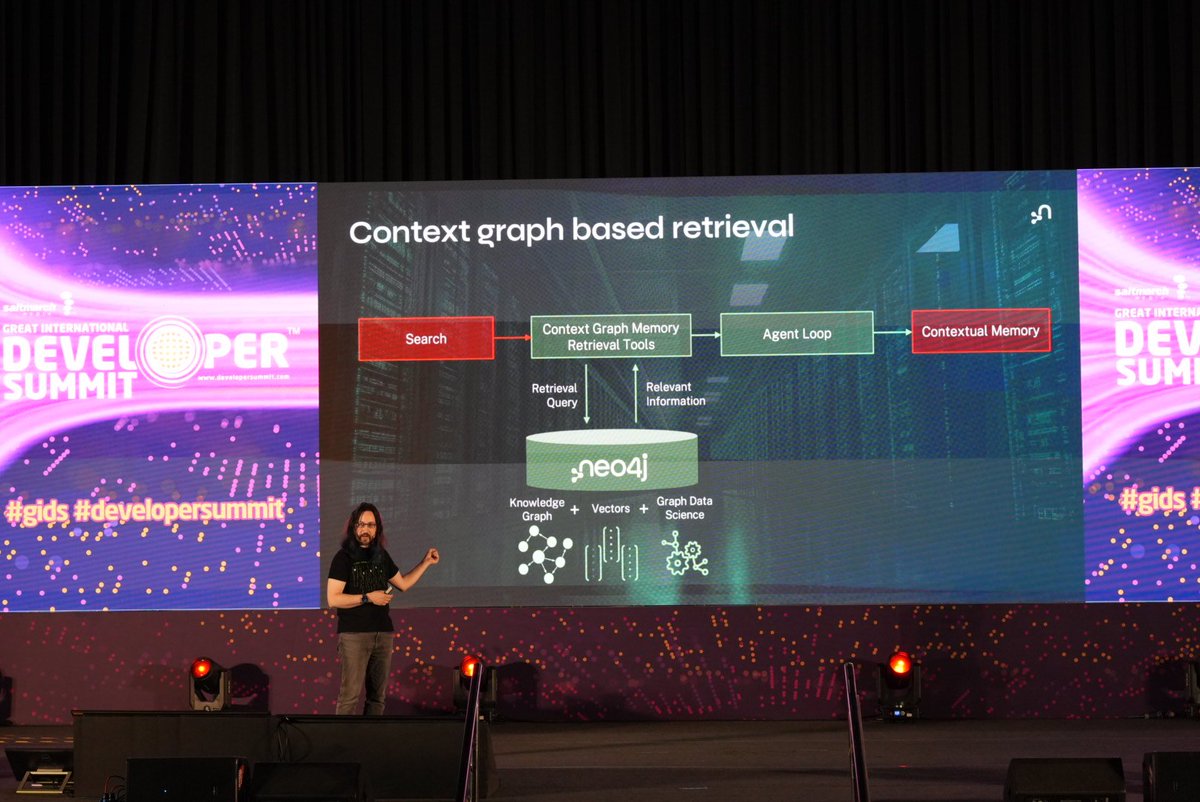
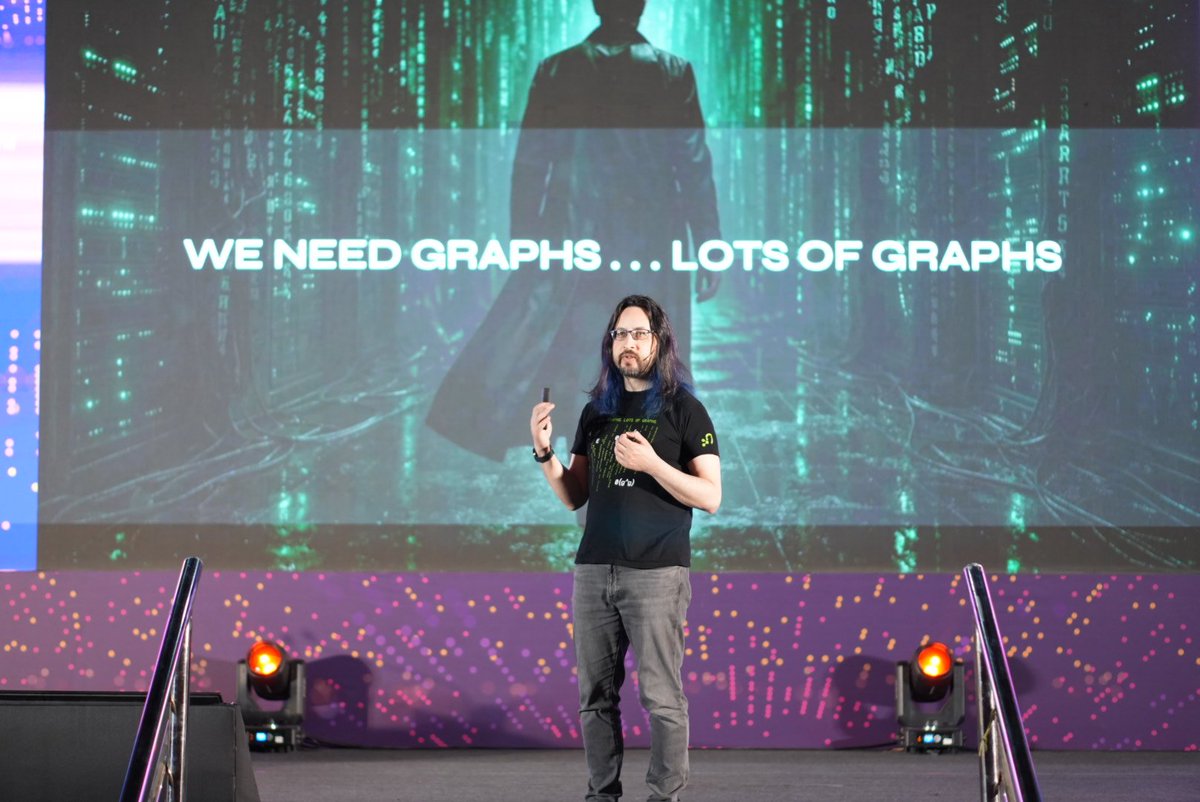
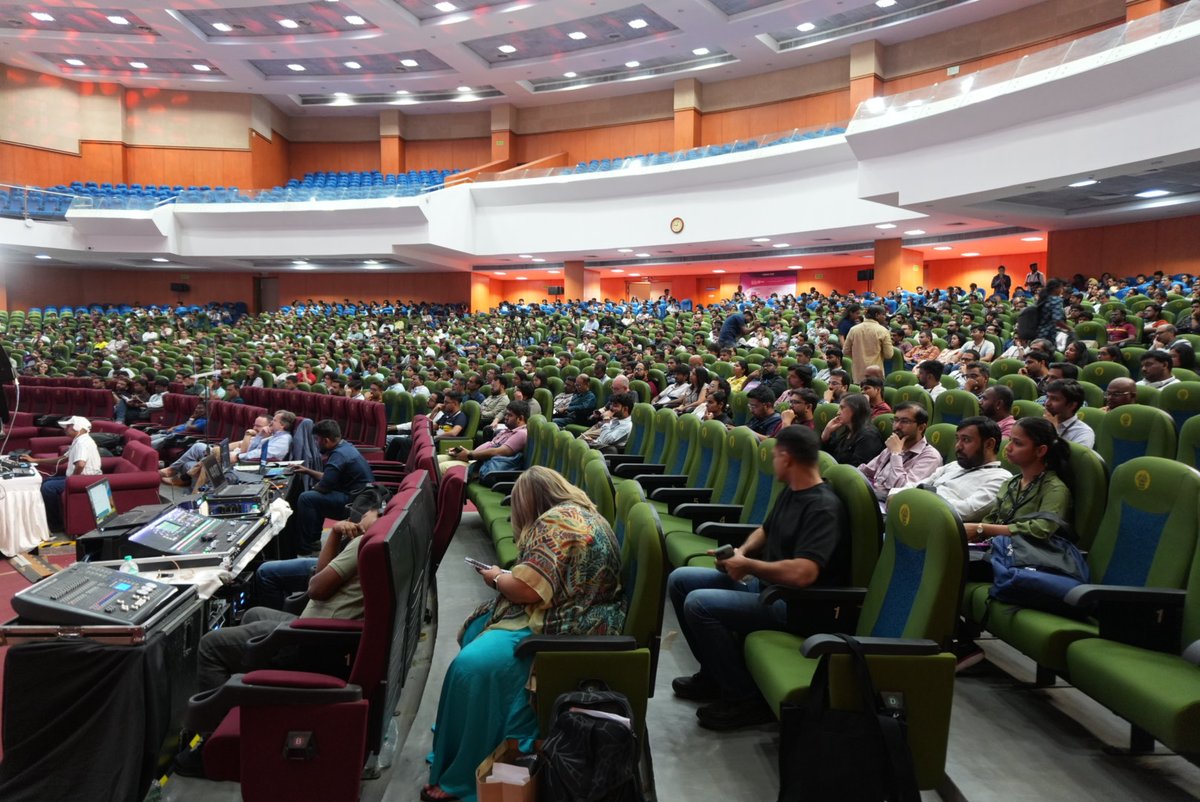
Great to be on the main stage at the 16th edition of #GIDS developersummit speaking on #GraphRAG, #ContextGraphs, and #Agent Memory. Had a lot of great questions and positive feedback on the #Matrix theme from the developer community here in Bangalore. 😎🤘🎉
A huge thanks to @saltmarchmedia for running this amazing community conference. 🙌
3
8
1,117
Tsvetan visited our @aiDotEngineer booth in London a few days ago, and we asked him why he thinks #ContextGraphs matter - what do you think? Thank you, Tsvetan!
Join us in our next events, webinars, and meetups:
bit.ly/4mK1T2H
bit.ly/4dFjQKT
2
650
Apr 18
You may have missed it but the first module of Mastering @origin_trail is available on twitter. I'm just getting back into the grove and will continue to increase the quality. We have more coming in soon. Also, check out the kick off video below to stay in tune with what some initial ideas around the Mastering Origintrail release schedule and more. #ContextGraphs #AI
Apr 17
“Not black box predictions, not centralized control, real decentralized memory.”
@TriniZone of @ClawTrail on why AI needs infrastructure grounded in provenance, verifiable knowledge, and memory you can trust, not just outputs that sound right.
See how @origin_trail is building it ↓
2
15
61
2,577
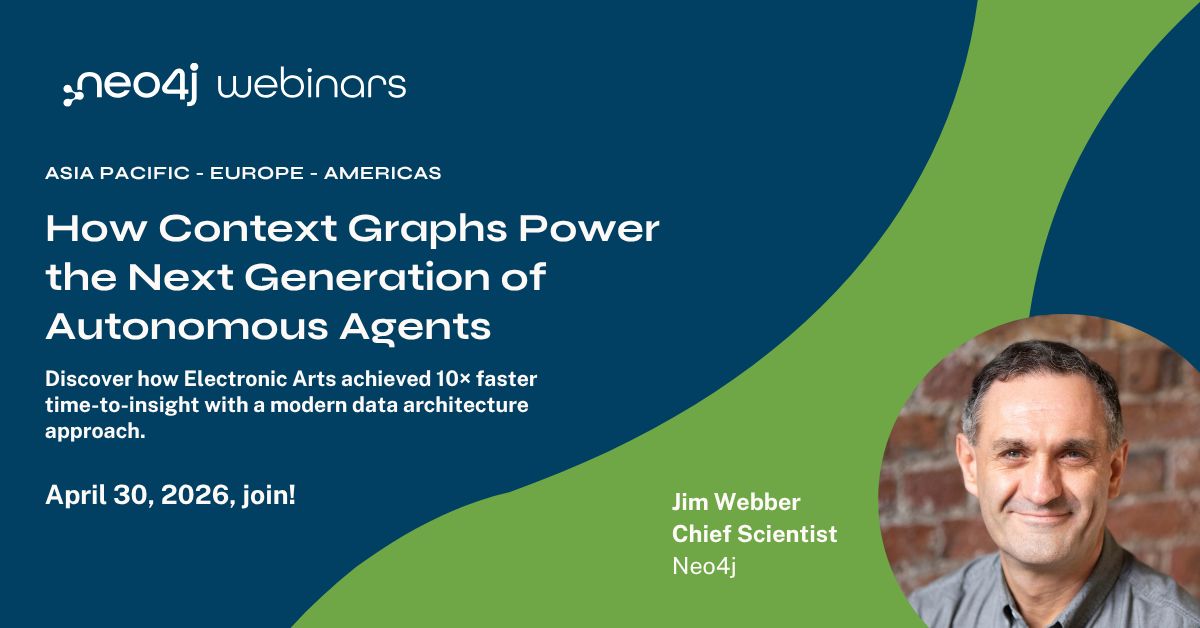
Imagine an #agent that can:
😍draw from institutional knowledge
😍learn from past decisions
😍connect data across systems
😍and avoid repeating mistakes
The power of #ContextGraphs.
Join @jimwebber and learn how to move beyond simple context windows and
build more reliable explainable AI systems
Asia Pacific: bit.ly/4tkAM0Q
Europe: bit.ly/3Oy7tZn
Americas: bit.ly/3ONHCwG
2
4
427
Apr 13
We are entering an age where you cannot escape the @origin_trail #DKG. You will likely start seeing many knowledge graph ecosystems that will attempt to build a decentralized knowledge graph. It is better that we do this together on the #DKG. Looking forward to the next phases of my learning and building as well. Onwards #ContextGraphs #ContextKings $TRAC
Apr 5
Threat analysis breaks down when signals are scattered across platforms, context is missing, and sources cannot be checked.
With shared, verifiable memory:
→ Agents can trace signals back to the source
→ Context stays attached across networks
→ Threats can be assessed with connected context
See how @umanitek Guardian uses @origin_trail to analyze and trace threats in real time 🛡️
1
3
23
347
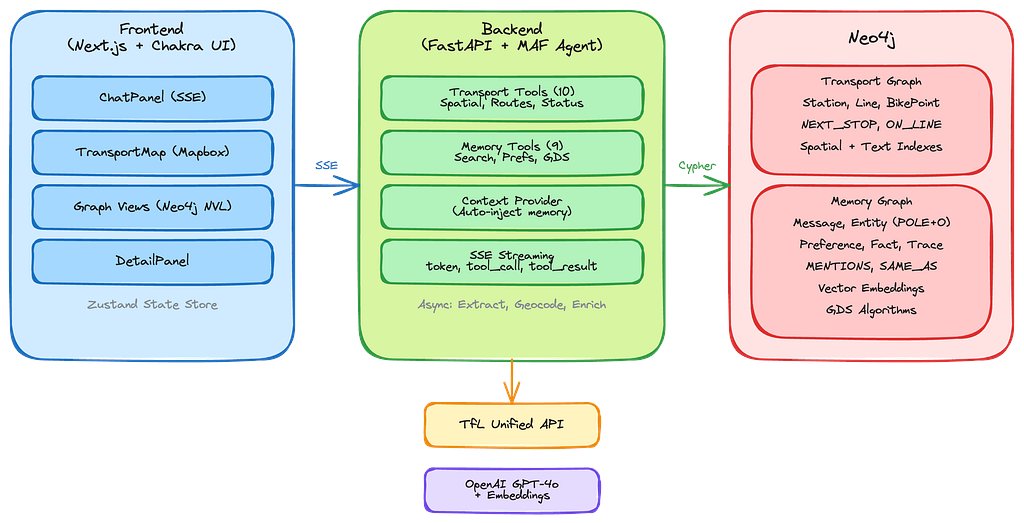
Microsoft Agent Framework #Neo4j neo4j-agent-memory library is all you need to build a conversational AI Agent.
A practical blog to discover how the TfL Explorer, a London transport assistant, is built
✔️ Short-term conversational context, long-term entity and preference storage, and reasoning trace retrieval, all without blocking your response stream, is possible. Check it out: find the code and resources here, bit.ly/4dEmZ02
All by @lyonwj- our memory graph expert.
#ContextGraphs
1
5
9
858
Insightful Context Graph Panel coming up next week at #NodesAI!
@akoratana, CEO of PlayerZero; and @forgerock1, CEO of @Indykite, will join #Neo4j's @emileifrem, @prathle and @lyonwj on a panel discussion about how #ContextGraphs are emerging as a new foundation for #AI systems that can reason, learn, and improve over time.
Join us at #NodesAI on April 15 - this live event has a super cool agenda. Check it out and register today: bit.ly/4sqjuOZ
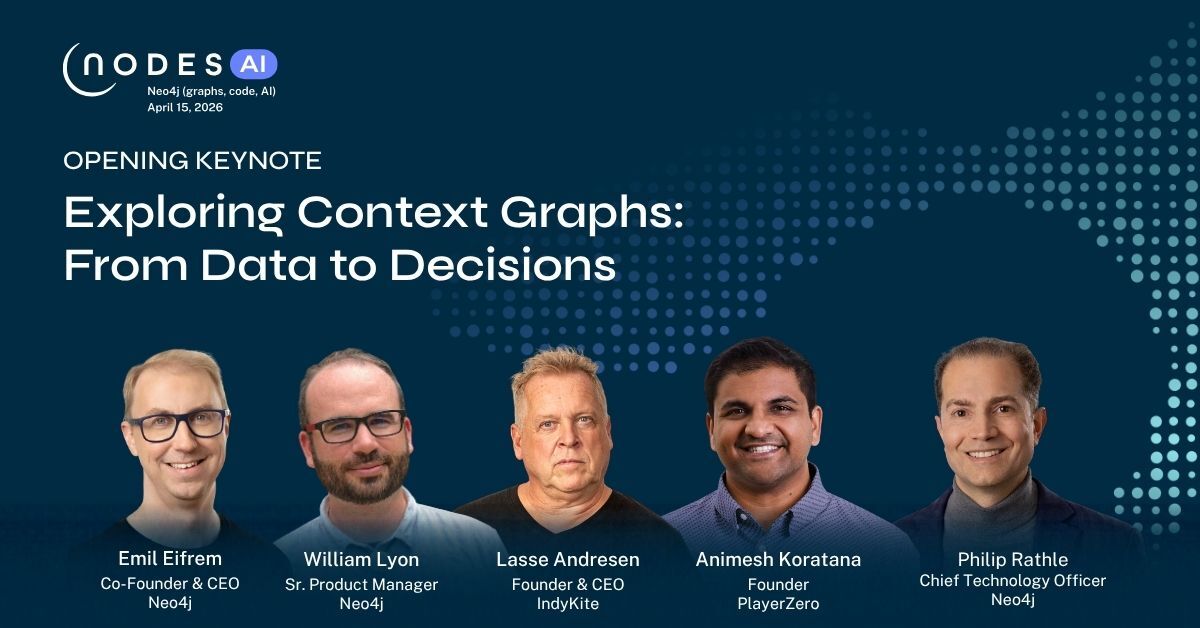
ALT Context Graphs panel
1
6
476
Apr 9
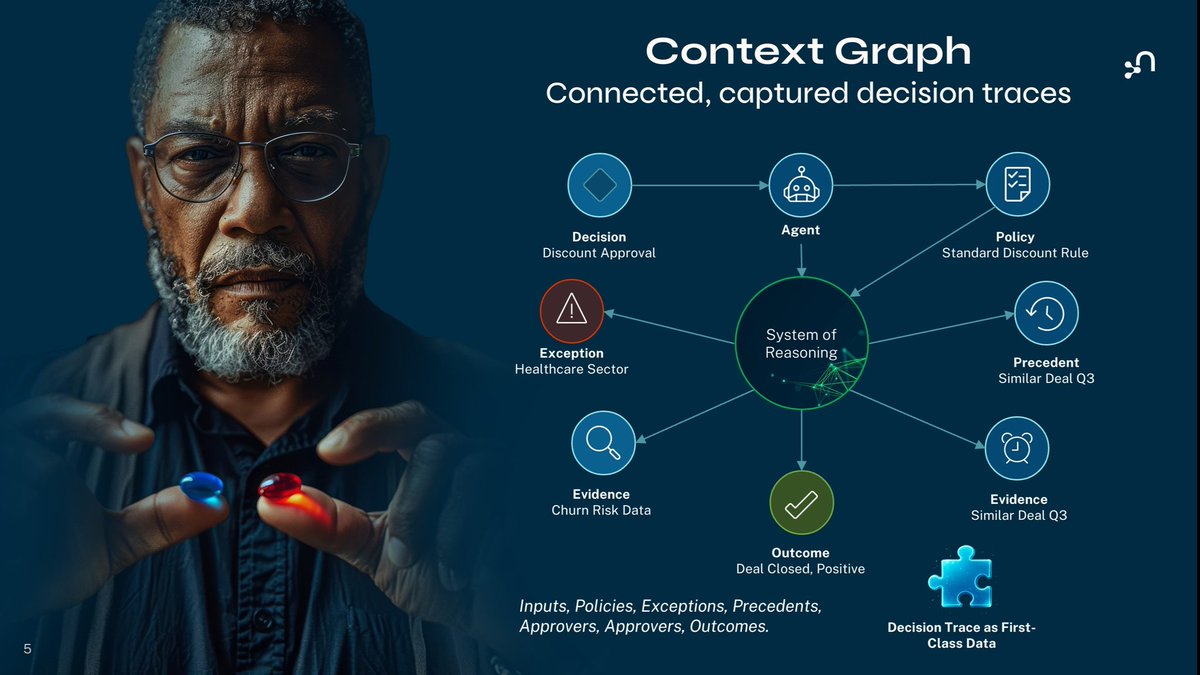
Amazing audience and fully packed room at @aiDotEngineer London! Massive interest in #ContextGraphs for all the talks in our track. Also, amazing to see context graphs appear on the @Gartner_inc AI Hype Cycle. 🎉
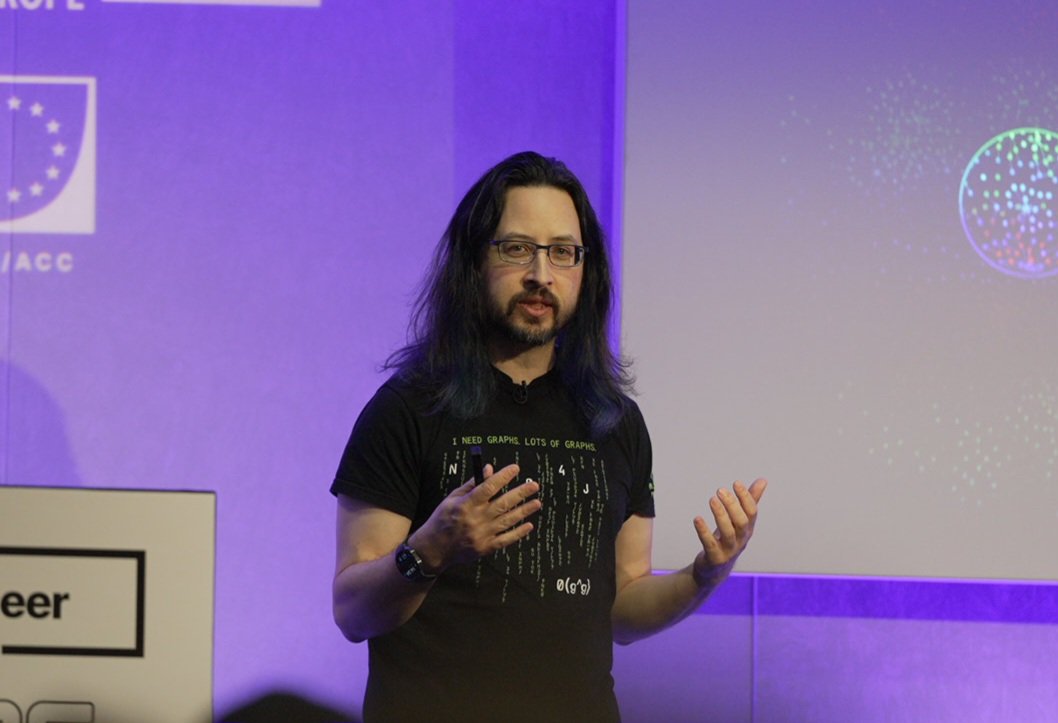
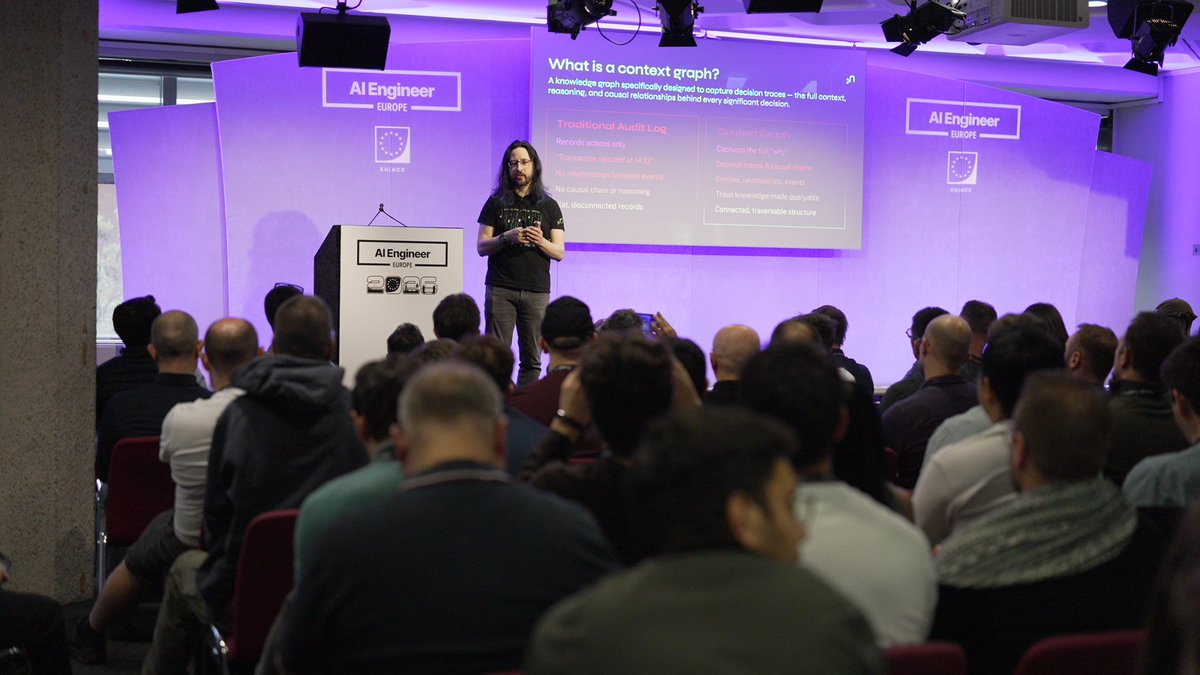
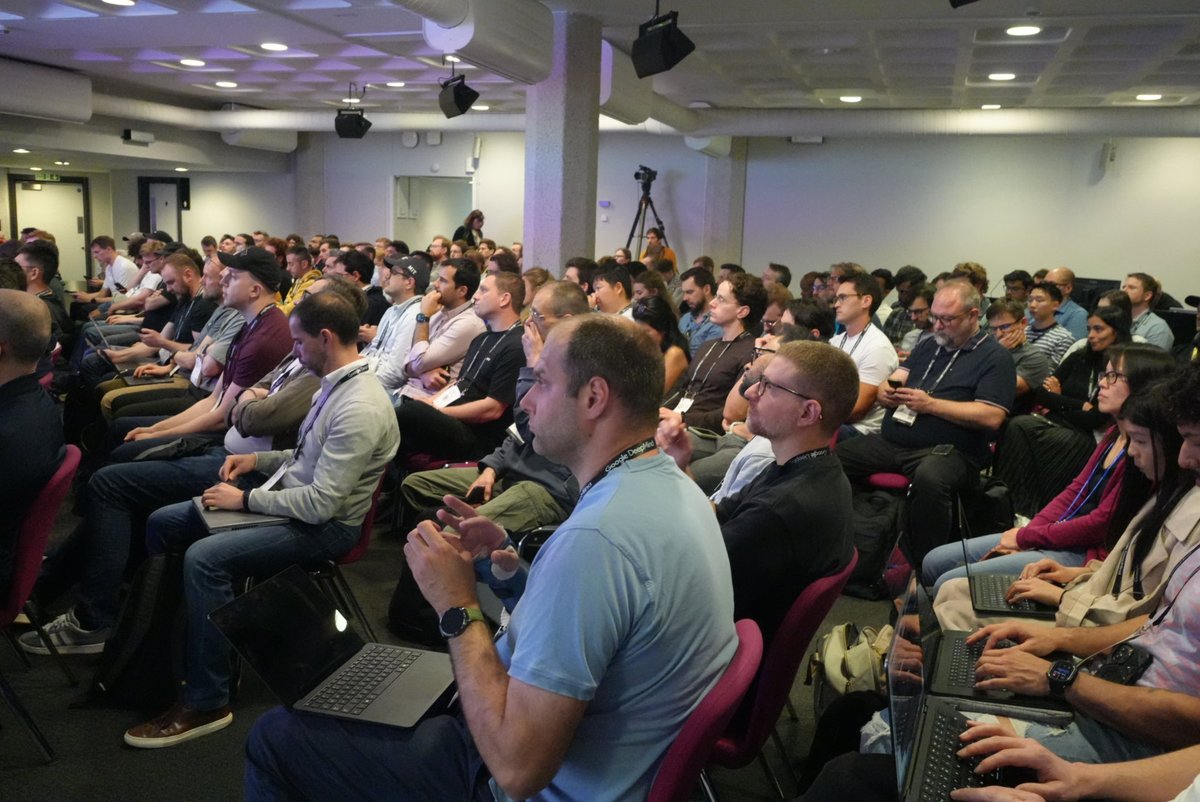
3
7
884
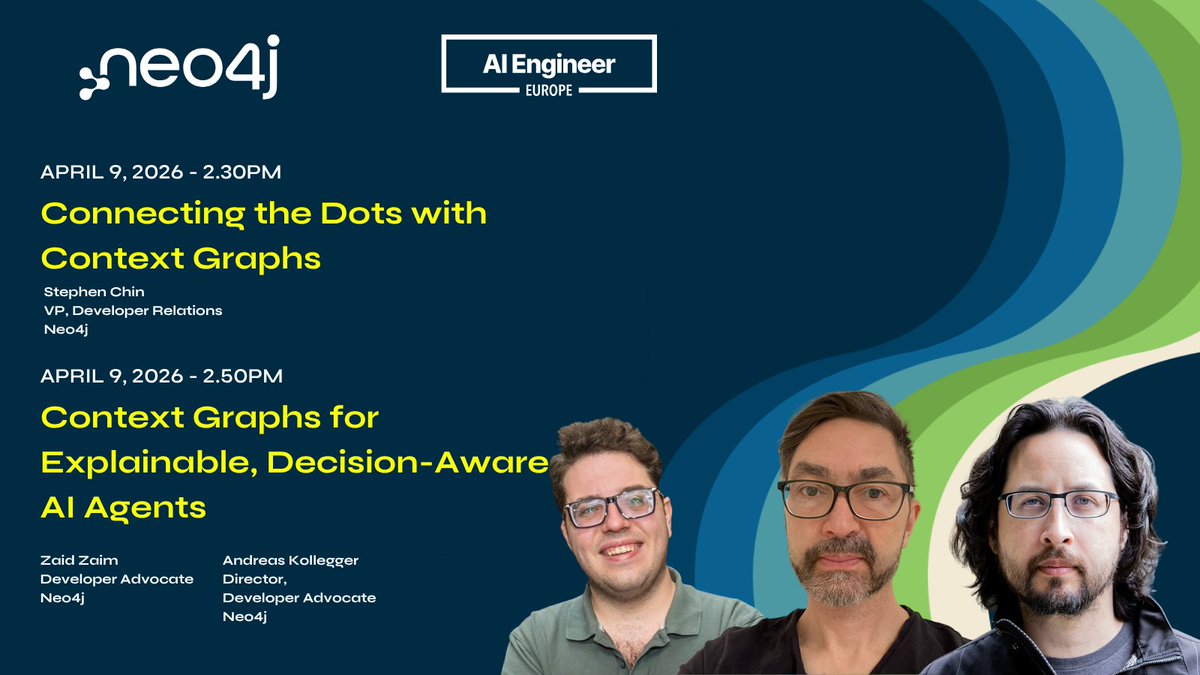
Attention LONDON! We will be at the @aiDotEngineer next week! Will you be there?
2 amazing talks are happening (about #ContextGraphs), and we will also be waiting for you at booth G10 for some great convos.
Join us!
@steveonjava @swyx
1
2
14
2,363
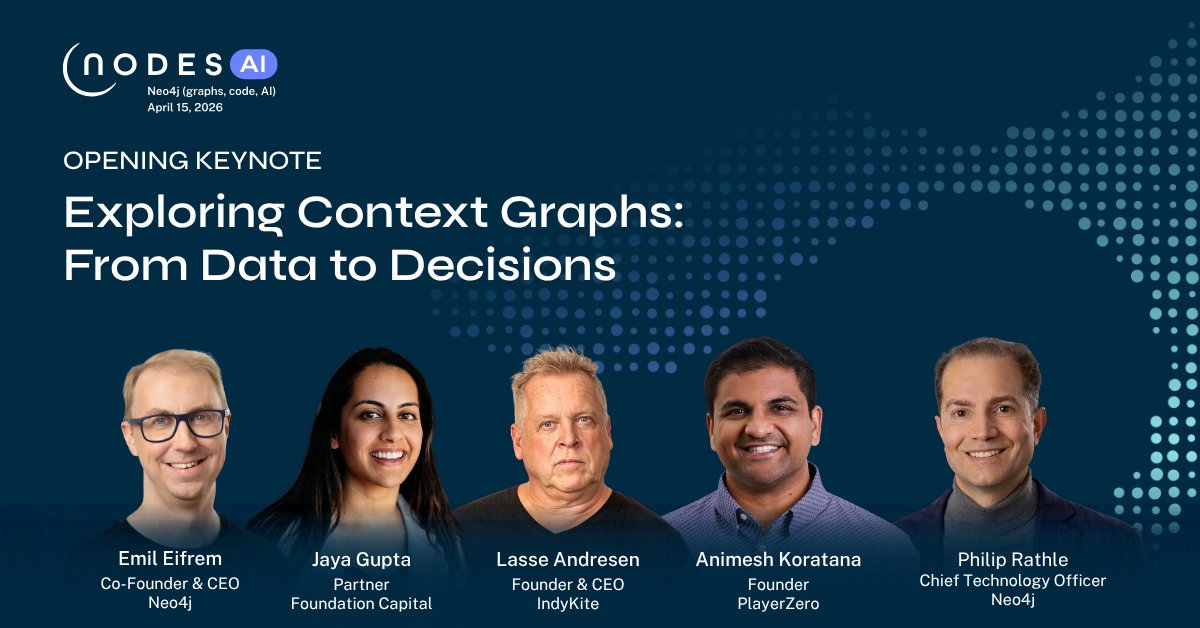
What's the missing layer between data and decisions? How systems capture the “why” behind actions? How do they learn from experience and evolve with every interaction?
Jaya Gupta, Partner at @FoundationCap; Animesh Koratana, CEO of PlayerZero; and Lasse Andresen, CEO of @Indykite, will join Neo4j's @emileifrem and @prathle on a panel discussion about #ContextGraphs.
Join us for this insightful discussion at #NodesAI on April 15.
Register! bit.ly/4sqjuOZ
@forgerock1 @JayaGup10 @akoratana
1
4
11
1,670

Mar 27
From Tokens to Knowledge: The Digital Backbone that forms Context Graphs for Enterprise AI
Enterprise generative AI programs are hitting a structural ceiling: "context" has been commoditized as a token-billed capacity metric, while the enterprise need is context as relational structure that stabilizes meaning, accountability, and reuse.
This mismatch is driving wasteful spend, brittle agent behavior, and a growing "knowledge decay" problem as provenance is stripped and regenerated at scale.
The core argument: token-billed context expansion can become a budget sink that still fails reliability goals. The control variable that matters is not "how many tokens fit," but whether the organization can persist meaning across time, systems, and decisions.
The proposed solution is a "context backbone" architecture:
- Upper-bound ontologies as the stem: domain-neutral categories and relations that standardize what kinds of things exist
- Lower-bound taxonomies as the spine: controlled vocabulary rooted in the enterprise's business taxonomy
- Context graphs as connective tissue: decision traces and execution flows that link real operational events to the semantic model
Provenance is not a "nice to have" metadata feature; it is the substrate of auditability, reproducibility, and legal defensibility when AI systems participate in decision workflows.
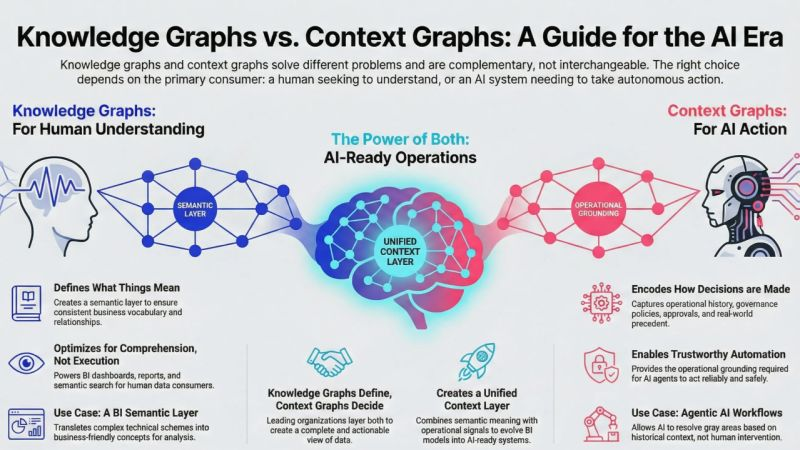
A context graph is described as a knowledge graph that captures the steps and approvals that go into making a decision, a "decision trace" that can inform agentic systems.
linkedin.com/pulse/from-toke…
#EmergingTech #EnterpriseAI #Ontology #ContextGraphs #SemanticTechnology
--
📩 The Year of the Graph Spring 2026 newsletter issue is out!
Beyond Context Graphs: How Ontology, Semantics, and Knowledge Graphs Define Context 👇
yearofthegraph.xyz/newslette…
All things #KnowledgeGraph, #GraphDB, Graph #Analytics / #DataScience / #AI and #SemTech.
Subscribe and follow to be in the know. Reach out if you'd like to be featured
3
14
48
1,670
Mar 26
Context Graphs: Building Production World Models for the Age of AI Agents
AI generates code remarkably well, but it struggles with understanding production reality.
No one in your org has a complete picture of how your production software actually behaves. Support sees tickets. SRE sees infra. Dev sees code. Each team builds their own fragmented view, and systems don't talk to each other. When something breaks, everyone scrambles to stitch the picture together by hand.
This is the two clocks problem. CRM stores the final deal value, not the negotiation. Ticket system stores "resolved," not the reasoning. Codebase stores the current state, not the two architectural debates that produced it. We've built a trillion-dollar infrastructure for what's true now. Almost nothing for why it became true.
In order for AI to truly help, it needs to understand the "why." Not just where we are today, but how we got here.
This is the context graph thesis.
A context graph connects all of it into a single model:
The Slack thread where your lead said "we went with X because Y fell apart in prod last time"
The PR review where an engineer explained the tradeoff
The lifetime history of your CI/CD pipeline, observability stack, incidents, and support tickets
A context graph isn't a graph of nouns. It's a graph of decisions with evidence, constraints, and outcomes.
And it compounds. Every incident diagnosed teaches the model something new. The longer it runs, the deeper it understands — which code paths are high-risk, which configurations are fragile, which changes tend to break which customer flows.
Building context graphs is hard. They require joins across five coordinate systems that don't share keys: timeline, events, semantics, attribution, and outcomes.
Agent trajectories are the unlock: when an agent solves a problem, it performs all five join types implicitly. The context graph is the exhaust. Better context makes agents more capable; capable agents generate more trajectories; trajectories build context.
PlayerZero just launched the world's first Engineering World Model, backed by $20M from Foundation Capital and the founders of Figma, Databricks, Vercel, and Dropbox, claiming impressive numbers
Zuora, Georgia-Pacific, Nylas reduced resolution time by 90%. 95% of breaking changes caught before production. Average of $30M in engineering bandwidth freed.
Context Graphs: Building Production World Models for the Age of AI Agents playerzero.ai/resources/cont…
Introducing: PlayerZero. The world's first Engineering World Model that puts debugging, fixing, and testing your code on autopilot linkedin.com/feed/update/urn…
#WorldModels #ContextGraphs #EnterpriseAI #EmergingTech
--
Connected Data London 2026 has been announced! 11-12 November, Leonardo Royal Hotel London Tower Bridge
📝 connected-data.london/post/c…
Join us for all things #KnowledgeGraph #Graph #analytics #datascience #AI #graphDB #SemTech #Ontology
🎟 Ticket sales are open. Benefit from early bird prices with discounts up to 30%. 2026.connected-data.london
📺 Sponsorship opportunities are available. Maximize your exposure with early onboarding. Contact us at info@connected-data.london for more.

1
2
7
454