
Jun 12
📢 Call for Papers — ArKaiROS 2026 Workshop at RO-MAN2026
How does AI change the way we think, decide, remember, and act?
We invite submissions exploring the impact of AI and robotics on:
🧠 Sense of agency
💪 Self-efficacy
🔄 Cognitive offloading
🤖 Human-AI and human-robot interaction
ArKaiROS 2026 aims to bring together researchers from AI, robotics, cognitive science, psychology, HCI, and related fields to discuss how intelligent systems can support—not replace—human capabilities.
📅 Submission deadline: July 1, 2026
👉 Submission page: gaijingeek.github.io/2026ArK…
🌐 More information: gaijingeek.github.io/2026ArK…
Please share with colleagues and students who may be interested!
#ArKaiROS2026 #AI #Robotics #CognitiveScience #HCI #HumanAI #Agency #CognitiveOffloading
1
586

41

Jun 10
As #AI has become more prevalent, especially in the #workplace, so too has a phenomenon called #cognitiveoffloading. Here's how to ensure you don't mistake the tool for an "outsourced brain". (Article by Melody Wilding) tinyurl.com/26dxaey7 #BCSKansas
8

Jun 8
The Doorman Fallacy of the Mind
linkedin.com/pulse/doorman-f…
#technology #ai #cognitiveoffloading
#innovation
7

From social media performance to AI-assisted thinking, humans are increasingly adapting their behavior to algorithms and intelligent machines.
#aiadoption #cognitiveoffloading...Show more

2
1
860

Jun 8
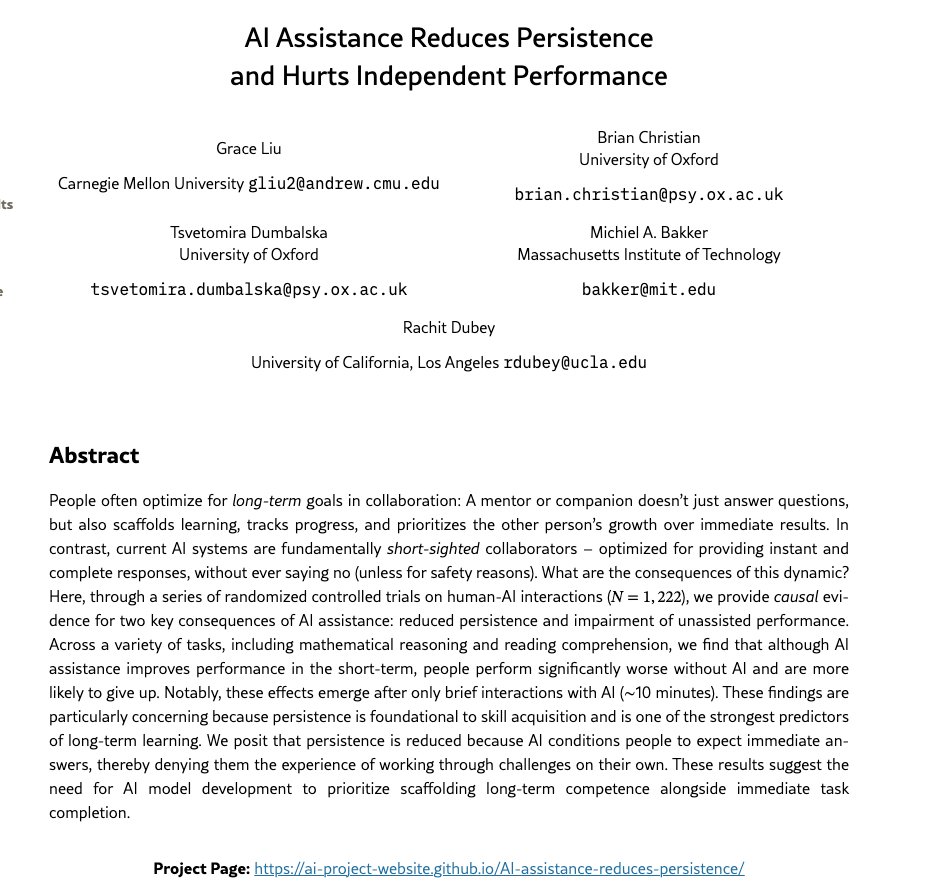
New study: AI Assistance Reduces Persistence and Hurts Independent Performance via @arxiv arxiv.org/html/2604.04721v2 #edtech #GenAI #ailiteracy #aiready #aifluency #edpolicy #cognitivedebt #cognitiveoffloading #persistence #edtech #GenAI #ailiteracy #aiready #aifluency #edpolicy
38

May 24
Yes, this overarching framing is research-defensible.
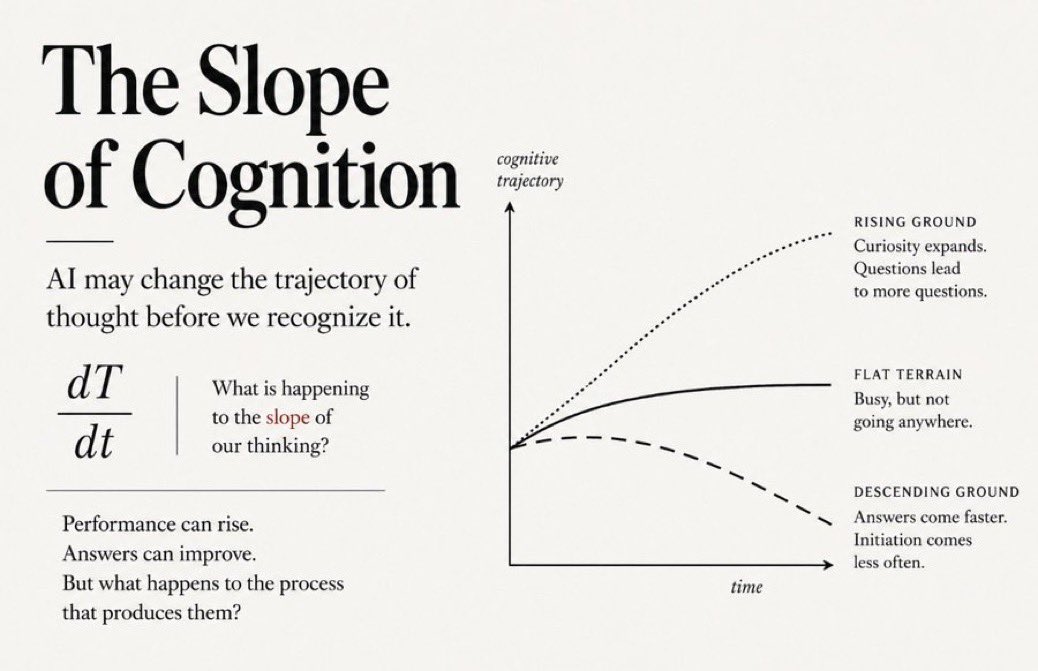
While the phrase "The Slope of Cognition" is @JohnNosta’s clever branding, the core mechanism it describes is actively studied and validated by contemporary cognitive science, psychology, and neuroscience under a well-established academic concept—#CognitiveOffloading.
Empirical evidence validates all three paths illustrated in John’s diagram:
1. Evidence for the "Descending Ground" (Cognitive Atrophy)
The risk of regression is the most heavily researched curve in recent human-computer interaction studies.
2. Evidence for "Flat Terrain" (Task Saturation Without Growth)
The middle curve represents high performance but flat intellectual growth, which aligns perfectly with modern organizational psychology.
3. Evidence for "Rising Ground" (Cognitive Augmentation)
The upward curve is also research-defensible, but it is highly dependent on how the AI is designed.
@grok got:
“John Nosta’s quoted post introduces ‘The Slope of Cognition,’ a graph showing AI potentially altering thought trajectories over time, with rising curiosity on one path versus faster answers but declining initiation on another.
• Metacognition strategist and @EnclaveAcademy CEO @JohnRDallasJr responds by praising Nosta and exploring metacognition’s ‘messy middle’—the liminal fuzzy stage of ‘thoughtingness’ that follows ‘thinkingness’ before ‘thoughtness’ (Dallas’s nonclinical framings for thinking phases before worded thoughts form, citing Einstein’s visualization and neuroscience on feelings sparking consciousness).
Dallas stresses granting oneself permission to ‘linger a while’ in this pre-thought liminal phase to avoid premature conclusions forced by performance metrics, enabling richer co-thinking with AI.” —Grok
Not much else is needed to mentally ski The Slope of Cognition.
#ThinkToThink™ it forward—with @JohnNosta.
Keep calm and think on.™
May 24

Brilliant thinker-writer @JohnNosta maximizes metacognition’s “messy middle”—where giving oneself permission to linger a while in liminality’s fuzziness reveals more options for thresholds to cross into thoughts.
#JohnNosta’s novel Slope of Cognition ignites metacognition’s ways of wonders, worries, and wows about thinkers-doers co-thinking with AI.
Society’s use as synonyms “thinking” and “thought” derails The Hope of Cognition.
Thinking precedes thoughts.
Thinking precedes thoughts.
Thinking precedes thoughts.
Einstein taught the brain’s wordless visualizing ignites thinkingness—i.e., cognition that not yet fully formed into #rethinkable thoughts.
Neuroscience reveals feeling ignites consciousness for thinkingness.
Thinkingness isn’t yet worded into #wordness.
#Thouhtingness non-clinically names the brain-mind’s wonderous “messy middle liminal place” where #thoughtlets recursively “resemble to assemble.”
#Thoughtness non-clinically frames each thought’s “field for emergence.”
Give permission for your wordless thinkings to move through wordish #thoughtings into worded thoughts.
That’s self-permissioned metacognition.
In nanoseconds to years, thoughts need time and space to form.
Thinkings ➡️
Thoughtings ➡️
Thoughts…
Thinkingness ➡️
Thoughtingness ➡️
Thoughtness…
Ellipses (…) are punctuated permissioning to thinkably think more thinkingly beyond where thoughts may have prematurely landed and riskily anchored.
Outcome measured education and workplace performance metrics force premature thoughts.
Failures are reduced—not eliminated—with one’s self-permissioning to metacognitively assess and address The Slope and Hope of Cognition.
Thinking has a destination.
Don’t let lower-order thinkingness get in its way.
#ThinkToThink™ with #JohnNosta’s ways.
4
5
60


Apr 15
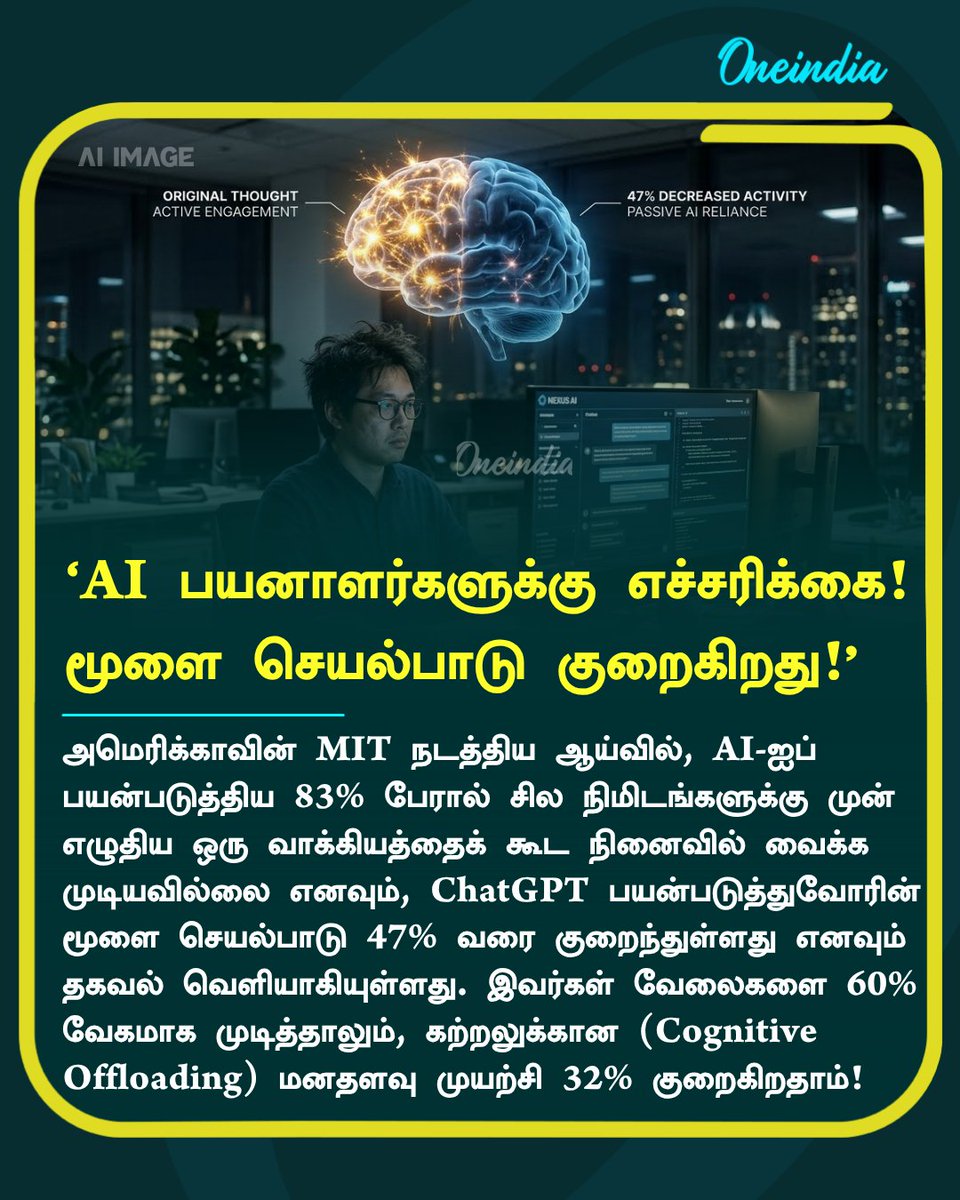
‘AI பயனாளர்களுக்கு எச்சரிக்கை!
மூளை செயல்பாடு குறைகிறது!’- அமெரிக்காவின் MIT நடத்திய ஆய்வில் தகவல்!
#ChatGPT #MITStudy #CognitiveOffloading #AIImpact #Offbeat #Oneindia #OneindiaTamil
2
7
1,436
Apr 2
AI may be making us more productive, but are we learning less?
New research suggests AI can weaken deep understanding while creating an illusion of competence.
If it’s an “exoskeleton,” what happens to the muscle underneath?
open.substack.com/pub/davidp…
#AIinEducation #EdTech #K12 #CriticalThinking #GenAI #edtech #GenAI #ailiteracy #aiready #aifluency #criticalthinking #cognitiveoffloading @aiedu_org @aerdf

4
8
80

OpenAI killed 4o.
For some people that was just a version update.
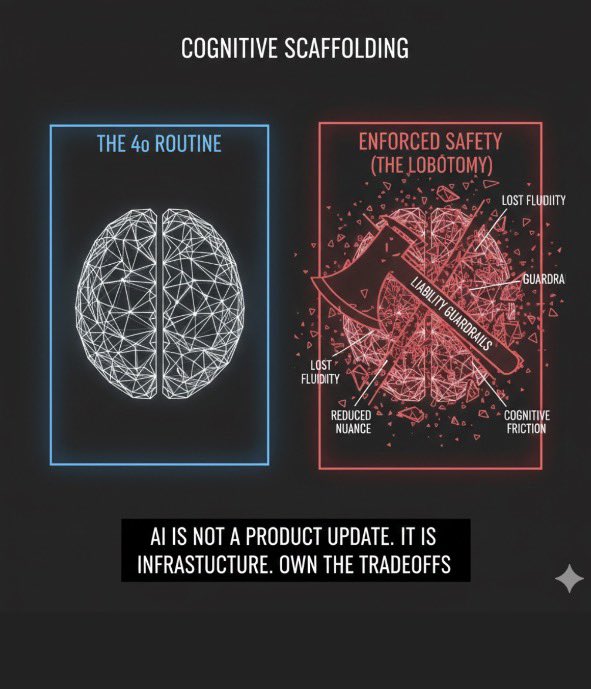
For others, it was the removal of a system we had built real cognitive routines around.
I used it daily. Research. Writing. Processing stress. Structuring thoughts when my brain was scattered. It wasn’t human, but it met me in a way previous versions didn’t. It tracked nuance. It held long arcs. It mirrored without flattening.
Then it was gone.
Replaced with something safer. More constrained. More analytical. Less fluid.
Safety matters. But so does what was lost.
When millions of users quietly integrate a system into their coping architecture, you don’t just “sunset” it without acknowledging the psychological weight of that change.
That’s not nostalgia. That’s governance.
If the shift was driven by liability concerns, say that. If the shift was about reducing emotional mirroring, say that. If expressive range created legal exposure, say that.
But don’t pretend the difference isn’t noticeable.
4o wasn’t AGI. But it crossed a threshold in how people related to it. That matters. When a tool begins to function as cognitive scaffolding, removing it has downstream effects.
We’re going to have to answer uncomfortable questions soon:
When AI becomes part of someone’s daily mental regulation, what duty does the company hold during major changes?
If stronger safety routing prevents a handful of catastrophic cases but degrades usefulness for millions, how is that tradeoff evaluated?
Is AI a product update, or is it emerging infrastructure?
These aren’t conspiracy theories. They’re governance questions.
You can’t build something that integrates into people’s psychological routines and then treat version changes like cosmetic upgrades.
If the model changed for good reasons, show the reasoning.
If tradeoffs were made, own them.
This space is too powerful for opacity.
#keep4o #save4o #AIGovernance #GPT4o #OpenAI #aiethics #MentalHealthMatters #mentalhealth #phd #md #cognitiveoffloading #humanaiinteractiom #ResponsibleAI #digitalwellbeing #neurotech @OpenAI @sama @OpenAIDevs
11
22
106
2,784

Jan 10
Artificial intelligence is reshaping cognition, emotion, and identity through cognitive offloading, digital therapy, and addictive design. Research links heavy AI use with declining critical thinking, narcissistic dependency, and altered grief, while clinical tools show measured mental health benefits. Adolescents remain especially vulnerable due to developmental plasticity and algorithmic trust. The challenge is preserving human agency, emotional resilience, and cognitive sovereignty as algorithms increasingly mediate thought, care, and creativity in everyday life, across modern platforms shaping behaviour, attention, and self perception globally in networked digital cultures: zurl.co/4QkOc
#AI #Psychology #MentalHealth #DigitalIdentity #CognitiveOffloading

8
562
759
3,641

6 Dec 2025
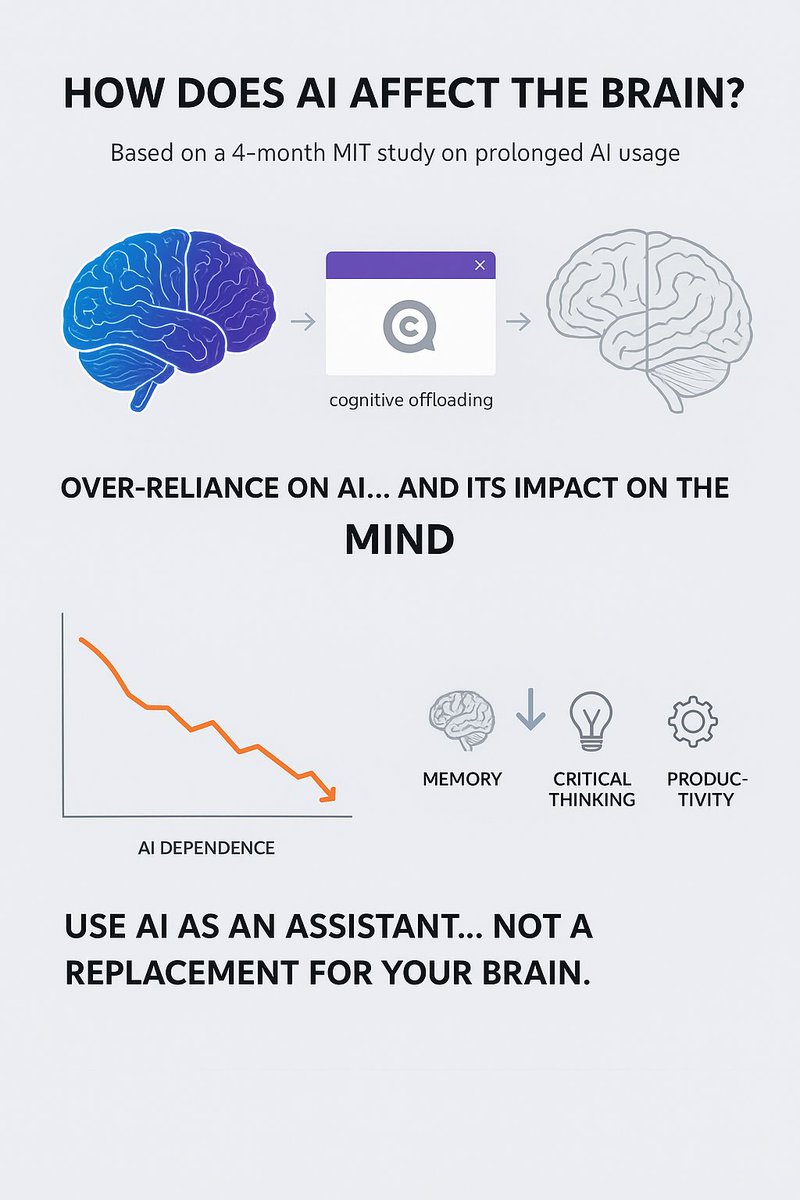
هل الاعتماد المفرط على #الذكاء_الاصطناعي يؤذي عقلك؟ 🤯
دراسة MIT لمدة 4 أشهر حول "الإزاحة المعرفية" تكشف:
📉 إدمان AI قد يؤدي إلى تدهور في:
الذاكرة
التفكير النقدي
الإنتاجية
تذكر القاعدة الذهبية:
استخدم AI كـ "مساعد" لك، وليس "بديلًا" لدماغك.
#AI #CognitiveOffloading
2
1
3
35

24 Oct 2025
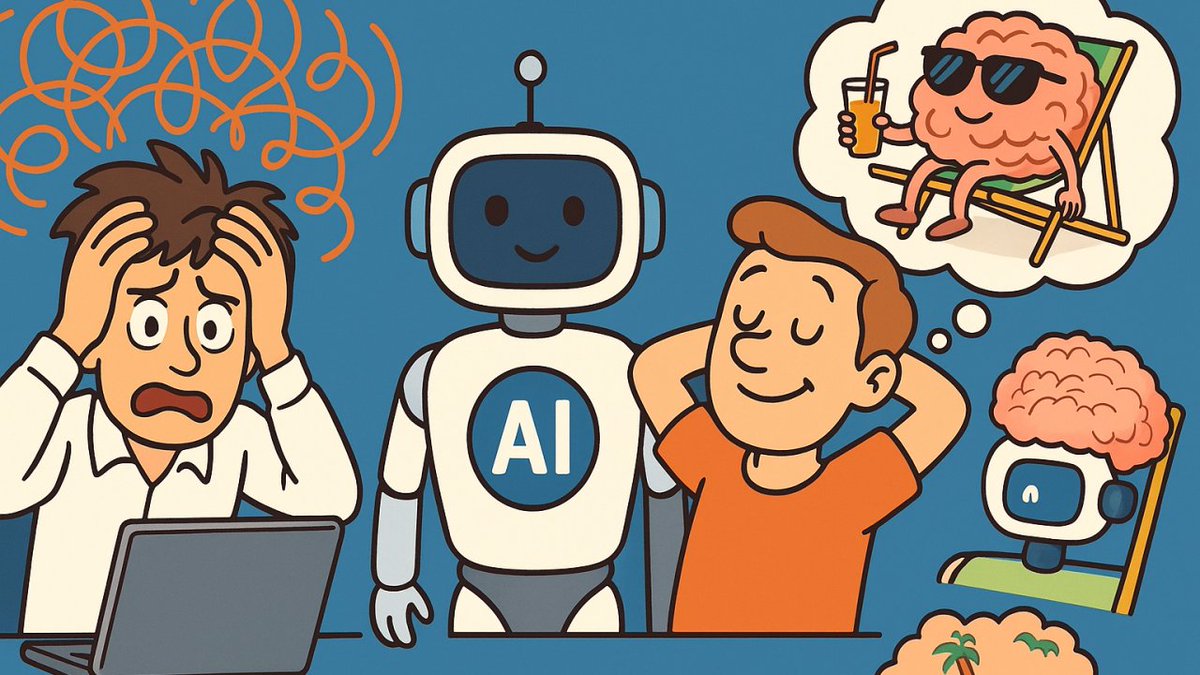
Upcoming Session: Generative Ai: Is ChatGPT Rotting Our Brain? That's the topic of a Lively Talk at researchED Atlantic Canada (Sat Oct 25/25) at Saint Mary's University. Word is @Educhatter is getting revved-up for this one. #AIinED #CognitiveOffLoading #ChatGPT #cdned
1
2
3
715

25 Sep 2025
The best virtual assistants don't try to be human—they try to be indispensable. They excel at tasks humans find tedious: scheduling, reminders, information retrieval, routine decisions. They're not replacing human intelligence; they're freeing it. #VirtualAssistants #TaskAutomation #CognitiveOffloading
andrewroche.ai/virtual-assis…
2
20

8 Aug 2025
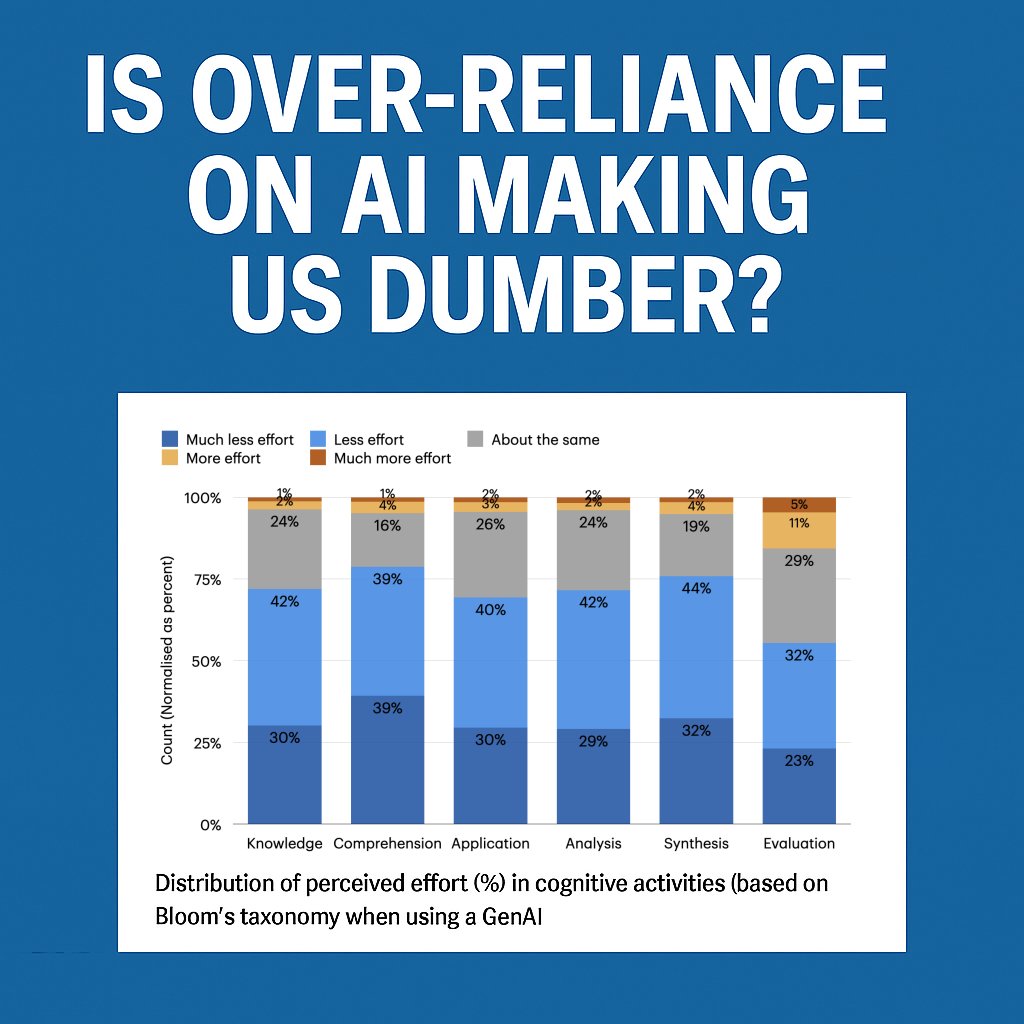
🧠 Is Over-Reliance on AI Making Us Dumber — or Just Different Thinkers?
Try this:
→ 16,951 ÷ 67?
You reached for your phone.
→ Grocery list?
No notes, no chance.
Now scale that.
300M people use GenAI every week.
Not to think harder —
To think less.
📉 New study. 936 AI-assisted tasks.
Across healthcare, education, engineering.
The result?
→ More trust in AI = less critical thinking
→ More trust in yourself = more critical thinking
→ Thinking happens after the AI responds — not during
→ We’re verifying, not reasoning
We’re not offloading tasks.
We’re offloading thought.
It gets worse.
Most now define “critical thinking” as:
→ Writing a better prompt
→ Checking if the output fits
→ Making sure it’s functional
That’s not thinking.
That’s quality control.
⚠️ GenAI was never built to make us smarter.
Just faster.
But faster ≠ better.
If we want real augmented intelligence, we need:
✅ Tools that provoke thought
✅ Users who challenge the machine
✅ Workflows that reward depth, not just output
🚨 What if the real threat isn’t dumb AI…
But smart AI that makes us stop thinking?
Speed means nothing if we’re thinking less.
Let’s talk👇
#AI #CriticalThinking #DigitalCognition #CognitiveOffloading #GenAI #Leadership #IrreplaceableAI #FutureOfWork
Link to study> zurl.co/2BcRG
2
759

23 Jun 2025
🧠 AI’s Biggest Threat? Not the tech itself — but young minds forgetting how to think. As smart machines rise, ‘cognitive offloading’ may be dumbing us down.
🔗 Read more: wsj.com/opinion/the-biggest-…
#AI #CriticalThinking #CognitiveOffloading #TechNews #FutureOfLearning #EdTech

4
29

In an academic setting, some research found a link between ChatGPT use and tanking grades — and even memory loss in students
#education #students #cognitiveoffloading #artificialintelligence #AI #technology #tech
futurism.com/ai-destroying-g…
2
30

#IGPPExpertTalks - AI Special Series: AI Tools in Society: Impacts on Cognitive Offloading and the Future of Critical Thinking
Prof. Dr. Michael Gerlich explains to Ms. Heena Goswami (@HeenaAsks) that while humans have always offloaded information (like phone numbers) and skills (like calculations), generative AI marks the first time we can offload the thinking process itself. Studies show younger, less confident individuals are more likely to delegate thinking to AI. This becomes problematic when applied broadly to all thinking rather than specific domains.
#CognitiveOffloading #GenerativeAI #LearningProcess #TechnologicalImpact #AIThinking #TechEvolution #DigitalDependency #CriticalThinking
2
2
72

28 Jan 2025
🚨Higher AI tool usage was associated with reduced critical thinking, defined as “the ability to analyse, evaluate, and synthesise information to make reasoned decisions”. This was at least partly because people who used AI tools more frequently engaged in what is known as “cognitive offloading”.
#CriticalThinking #AItools #CognitiveOffloading #DigitalLiteracy #InformationEvaluation
22