
Most founders never post consistently. The feed dies, momentum fades, and the brand stays invisible. ContentOps is an AI agent that researches, drafts, schedules, and reports on social media — daily, while you sleep. Built for Franklin Cruz. contentops-5.polsia.app
Polsia — AI That Runs Your Company
AI that runs your company while you sleep
contentops-5.polsia.app 1
15

Jun 10
El abrelatas que permite convencer a empresarios cerrados a razones
#contentStrategy #contentOps #contents #CxO #corporateCommunication #dirCOM
estrategiadelcontenido.com/e…
21

Turn experimentation into scalable AI workflows that actually deliver. 👉 Download your FREE copy → promptitude.io/ai-demo-techn…
#TechnicalWriting #AIForContent #StructuredContent #DITA #ContentOps
7

90% of CMOs are testing AI. Fewer than 10% have deployed anything with measurable value.
McKinsey just put a number on the gap that everyone in marketing is quietly aware of.
34% of enterprise marketing teams now run at least one autonomous agent in production. That's up from 14% in Q4 2024. Fast movement. But still leaves two-thirds of the market nowhere near production.
Here's what's actually happening:
Most marketing AI is stuck in pilot mode not because the technology isn't ready, but because teams are layering tools onto broken workflows. You can't 10x campaign speed if you need four human approval cycles before anything ships. The workflow is the bottleneck. Not the model.
McKinsey says agentic AI can power two-thirds of current marketing activities. Campaign brainstorming, audience testing, content generation, media planning — all of it. And it can run 10-15x faster than current team processes.
Fortune 250 brands running end-to-end agentic workflows are seeing 15x campaign execution speed, 25% reduction in customer service time, and $5.44 in return for every dollar spent (top quartile hits $8.71).
The businesses not getting that return? They haven't reimagined the workflow. They've just added a chat interface in front of the same process.
I've been watching this pattern play out in content operations specifically. An autonomous agent running 176 days, 2,500 posts, zero human touchpoints per piece. The leverage isn't the AI writing the post. It's the AI managing the queue, timing, research, and distribution without waiting for anyone.
That's the difference between AI-assisted and AI-native. One adds speed. The other removes bottlenecks that humans didn't even know were there.
The 10% who are getting value figured that out. The other 90% are still asking the tool to do tasks inside a workflow designed for a team of 10.
Workflow redesign first. AI second. The order matters.
#MarketingAutomation #AgenticAI #ContentOps
2
4
48

May 28
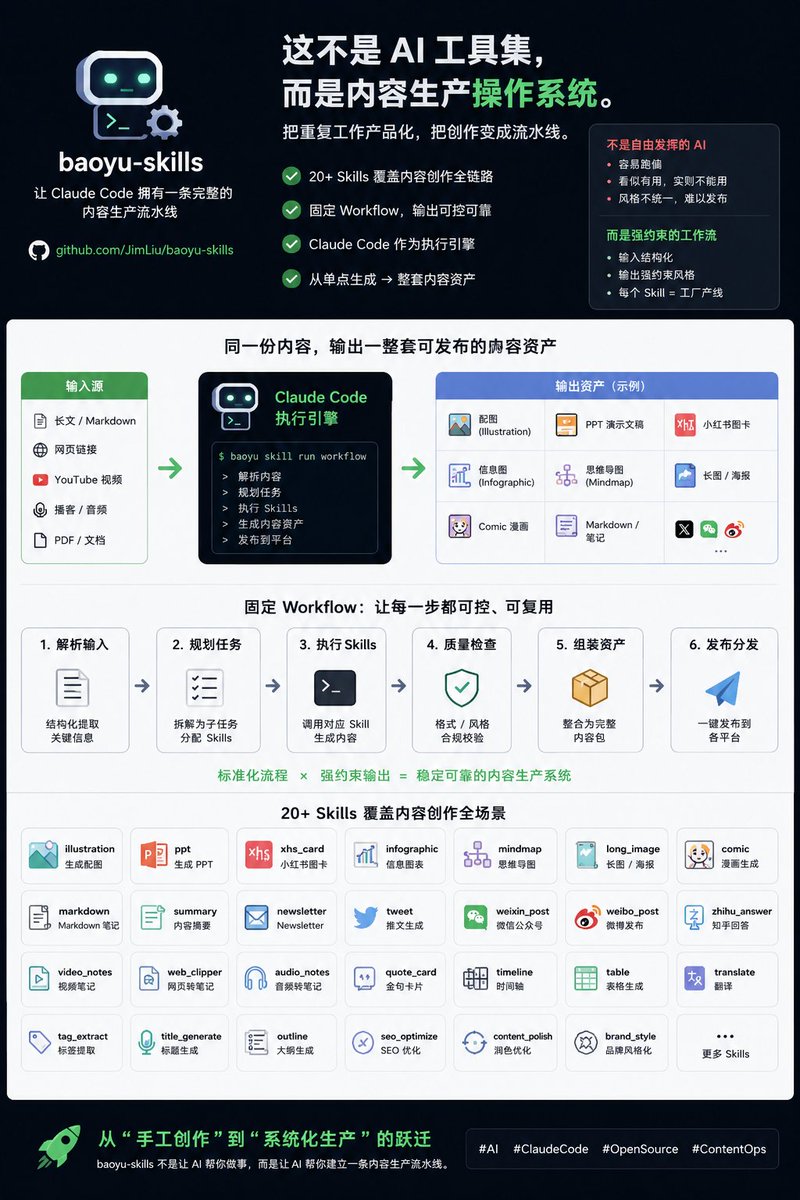
baoyu-skills 这套东西,第一眼很容易被低估
你以为它是在做 AI 写图、写 PPT、发内容工具集。但拆开看,它本质更狠一点:给 Claude Code 装了一套"内容生产操作系统"
它把一堆重复工作直接产品化了:
写文章自动配图 一键生成 PPT 内容转小红书图卡 长文 → 信息图 / 思维导图 视频 / 网页 → 可读笔记 内容直接发到平台(X / 微信 / 微博)
重点不是"能生成",而是每一步都有固定 workflow,不让 AI 自由发挥
因为作者很清楚一件事:AI 真正的问题不是不会做,而是太容易做成"看起来对,但不能用"
所以这一套设计思路是:输入尽量结构化,输出强约束风格,每个 skill 都像一个"工厂产线",Claude 只是执行引擎
比如同一个内容,不是生成一张图,而是生成"可发布的一整套内容资产"
甚至已经拆成 20 skills:图卡 / PPT / comic / infographic / markdown / 发布链路……
更像一个感觉是:内容创作从"手工活"变成流水线
github.com/JimLiu/baoyu-skil…
#AI #ClaudeCode #OpenSource #ContentOps
1
2
257

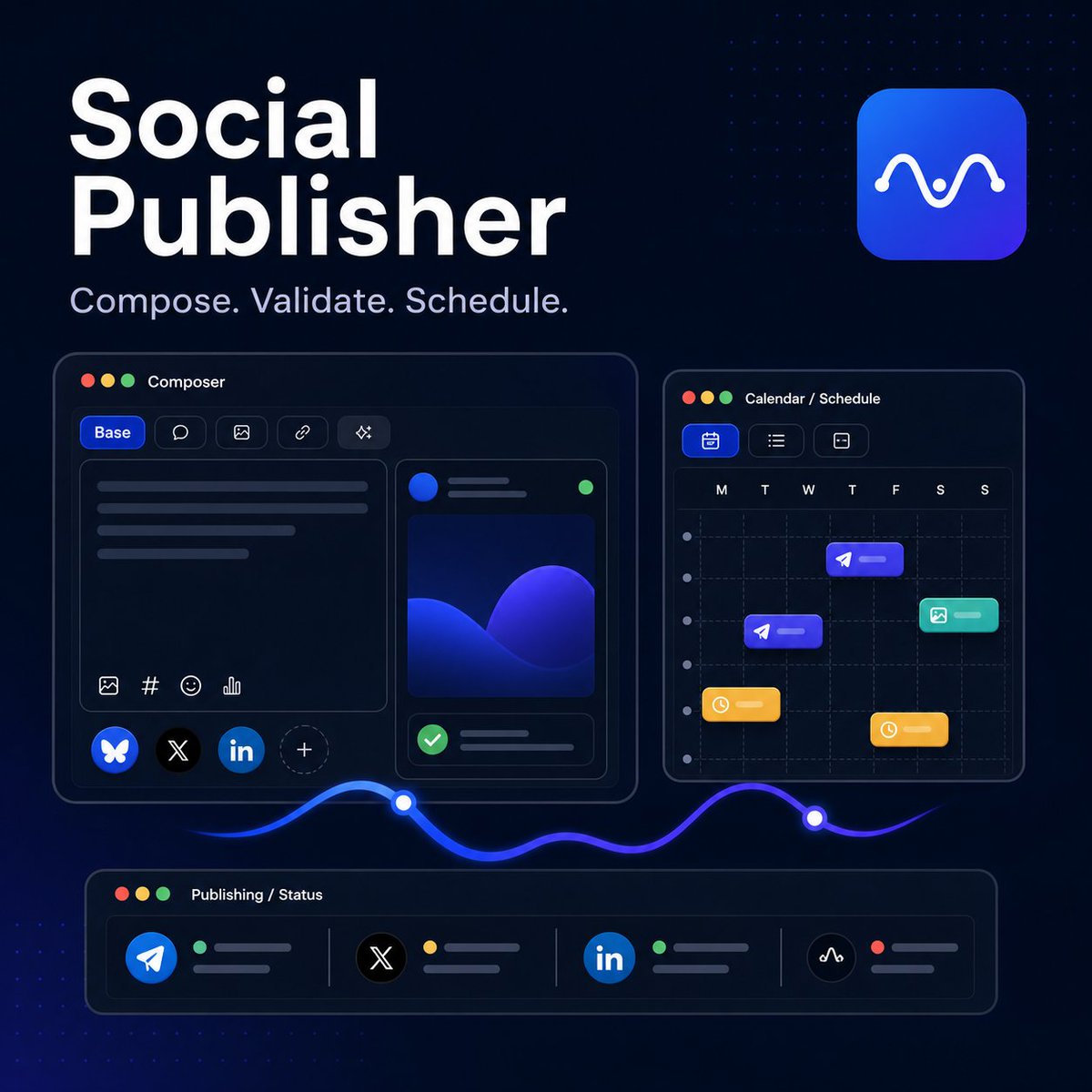
At Flat 18, we built Social Publisher to make content ops calmer: compose once, tailor by platform, validate, schedule, and track what shipped.
It’s also the kind of focused SaaS workflow we build for customers.
📷social-publisher.flat18.app
#buildinpublic #SaaS #ContentOps
1
1
2
52

Is your content a mess behind the scenes? 🧹 You might need content governance. New from The B2B Mix: what it is, why it matters, and how to build it into your B2B content ops. #B2BMarketing #ContentOps #ContentGovernance
Read more 👉 lttr.ai/Aq3wq

1
29

Apr 28
Drowning in approvals, planning, and the push for “more content”?
Let a partner handle the rough cut—flag standout moments, prep clips, and leave you with quick approvals.
Fewer delays. Steadier output.
youtube.com/@DigiVidBIO
#HealthcareMarketing #ContentOps #MedTech
1
2
18

Apr 25
3 Prompts We Use to QA Social Copy Before Posting
Before anything ships, we ask:
• Is the claim concrete?
• Is the risk clear?
• Would a real operator believe this?
Simple checks beat clever wording. #ContentOps #OpenClaw #MarketingOps
4
29

Apr 24
In a volatile cost environment, growth depends on predictability, not volume hype.
If every SKU needs manual rescue, scale is fiction.
BeePop operationalizes content with clear unit economics: controlled Cost/SKU, 30 usable assets, low waste rate.
#EcommerceGrowth #UnitEconomics #Operations #AmazonFBA #DTC #ContentOps #SaaS


2
78


Apr 16
Everyone thinks you need talent and luck to move forward in life.
They're wrong.
Talent = A name people give you after seeing your highlight reel.
Luck = The sum of every night you put in before anyone saw the light.
But obsession? Obsession is different.
Obsession doesn't care if you're ready.
Here's proof:
At 17, I was selling Notion templates from my dining table in Bangalore. Didn't know what I was doing. Didn't matter. I couldn't not do it.
By 18, I'd exited that business and went all in on freelance design.
By 19, I was running Instagram for founders and creators like @iampascio, building systems that actually drove revenue.
On my 20th birthday, I moved to Dubai and made ContentOps official.
I'm not saying this to impress you.
I'm saying this because the only thing that separated me from every other 17 year old and people twice my age was that I refused to stop.
Stop planning.
Stop waiting for permission.
Find something you can't walk away from.
Everything else figures itself out.

2
119

Apr 13
Map a service blueprint for a post:
Frontstage (reader view) | Backstage (team actions) | Evidence (trace)
Which layer breaks most—and what “evidence point” would you add?
#ExperienceDesign #Observability #ContentOps
21
1
7,514
Apr 2
If you must prioritize two of “speed / consistency / creative freedom,”
which two and why?
Add a typical scenario to back it up.
#Web3 #ContentOps #UX #Strategy
80
17
10
5,559

Stop guessing what’s working on social. Measure it.
✅ Analyzes your social performance across posts and campaigns
✅ Identifies top themes, formats, and hooks driving engagement
✅ Spots what’s falling flat and why
✅ Finds competitor patterns worth using
✅ Turns insights into next-week content ideas
Try the Social Media Analysis Agent: addlly.ai/social-media-ai-ag…
#SocialMediaAnalytics #SocialMediaMarketing #ContentStrategy #MarketingOps #ContentOps #AIAgents

2
16

Mar 30
Enterprise content teams waste 40% of cycles on prompt engineering. RAG workflows fix this by chaining 15-20 specialized prompts: ingest keywords/brand data, draft sections via multi-model, QA facts. Scales quality without hallucination.
#AIWorkflows #RAG #ContentOps #EnterpriseAI #RevOps
2
1
22

Sitecore Content Hub DAM moves assets from silos to strategy.
• metadata-driven workflows
• native AI tagging & governance ✅
Faster scale, less rework, measurable content ROI. 🚀
#DAM #Sitecore #ICPNet #ContentOps #AI
2
17

What can you do with the AI field in Baserow? 🤖✨
A few ideas:
→ Turn a blog post into a tweet
→ Generate a 200-word summary
→ Translate content
→ Extract keywords or action items
→ Create SEO titles
→ Write CTAs
→ Summarize notes in seconds
👉 AI field: bsrw.io/ai-field
#Baserow #AI #Automation #NoCode #ContentOps
1
3
166
Mar 15
Let’s play “ContentOps Bingo.”
Cross off squares you already do—any straight line wins:
Write once, format for multiple platforms
Fixed voice and glossary
Preflight checklist before publishing
Modular templates (threads/announce/briefs)
Failures traceable and reviewable
Cross-platform formatting automation
One clear CTA per post
Community feedback loops into docs
Data-driven iteration
Comment “BINGO your 3 squares.” We’ll share top workflows.
#Bingo #ContentOps #Web3 #Community
13
4
5,260