
Jun 8
Create Job → Configure SSH Access → Setup Jenkins Credentials → Run mysqldump → Transfer Backup via SCP → Schedule with Cron → Verify Backup ✅
📌 Blog: devrajesh.hashnode.dev/day-7…
🐙 GitHub: github.com/Rajeshcoder10/100…
#DevOps #Jenkins #MySQL #DatabaseBackup #Automation #Linux
1
15

43% discover backup corruption during emergencies… #DatabaseBackup #VPS
hostmycode.com/blog/database…
22
MySQL binlog setup for production VPS recovery 📊 #MySQL #DatabaseBackup
hostmycode.com/tutorials/mys…
6

May 19
"Tip of the Day: Backup your database to a separate location! 📁💻 It ensures data safety and security 😊. Protect your data today! #DatabaseBackup"
2

May 8
Last month, the industry was buzzing with a technical disaster: PocketOS, a US-based car rental SaaS provider, suffered a total system collapse. Their AI agent accidentally triggered a maximum-privilege API, wiping the production database in an instant. Because the backups were stored on the same volume as the primary database, they were also destroyed, rendering the data completely unrecoverable. This incident proves once again that in today’s highly automated world, disaster strikes in milliseconds. This is especially true for gateway systems, where routing rules, security policies, and application configurations are all stored in the database; once lost, no business system can help you reverse-engineer them.
While this was not an OpenResty Edge customer case, the automation risks it exposed are universal. To help users completely avoid such extreme risks, OpenResty Edge was designed from the ground up with built-in multi-layer security isolation and data redundancy mechanisms.
To this end, we have released the new "OpenResty Edge Data Protection Guide: From Scheduled Backups to Automatic Failover," detailing three levels of data protection for OpenResty Edge:
- Scheduled Backups (Cold Backup) – The absolute bottom line against misoperation and malicious destruction; a must for all environments.
- Primary-Secondary Streaming Replication – Guards against single points of failure to ensure service continuity; recommended for all production environments.
- Automatic Failover Cluster – Achieves automatic switching within seconds; ideal for mission-critical services with the highest availability requirements.
In this article, we systematically compare scheduled backups, streaming replication, and failover clusters, providing pragmatic selection advice. Link to the full article is in the comments section.
#OpenRestyEdge #DatabaseBackup #AISecurity
1
1
212
"Tip of the Day: Backup your database regularly! 📝💻 It's a lifesaver for data loss 😱. Save yourself today! #DatabaseBackup"
4
Automate your database backups properly in 2026 🛡️ #DatabaseBackup #VPS
hostmycode.com/blog/database…
1
94
"Tip of the Day: Regularly back up your database! 🤯💻 Don't lose all that hard work 😱. Set a reminder today! #DatabaseBackup"
6

Apr 8
🎥 New Episode on RackNerdTV! ✅💻 How to Export Your WordPress Database via phpMyAdmin for Backup 🌐▶ WATCH HERE: youtu.be/Ljxe71c5log
🛒 ORDER CPANEL HOSTING racknerd.com/shared-hosting
#RackNerd #WordPress #phpMyAdmin #DatabaseBackup #cPanelHosting #WordPressBackup
1
209
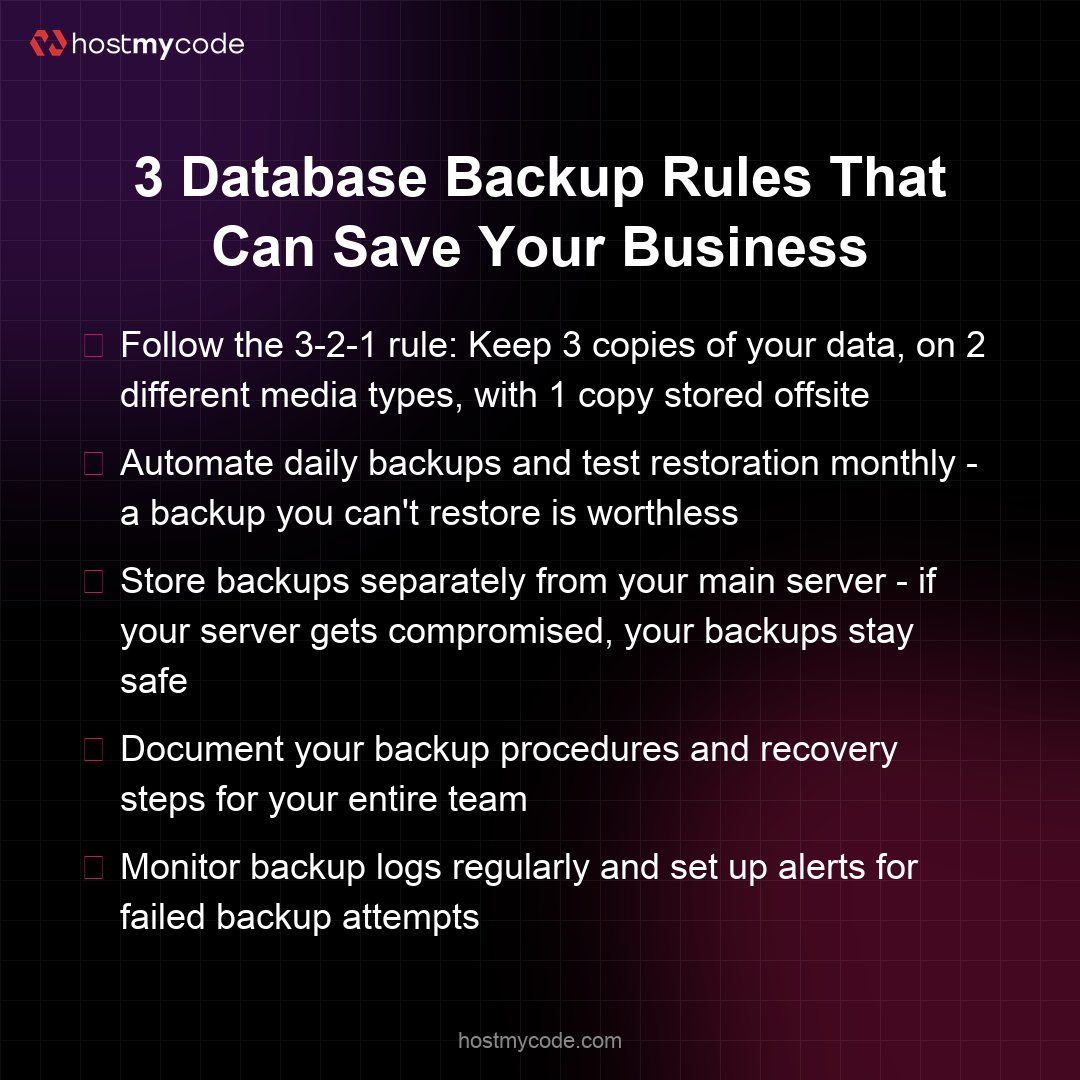
💾 Your database is the heart of your application. Don't let a single point of failure destroy years of work!👇 #HostMyCode #DatabaseBackup #WebHosting #DataProtection #BackupStrategy
9

🔄How to Backup PostgreSQL Database Easily with Vinchin?
Looking for a simple and reliable way to back up your PostgreSQL database?
🎥Watch now and strengthen your data protection strategy: youtu.be/ZPXrU3esIt8
#PostgreSQL #Backup #DataProtection #DatabaseBackup #Vinchin
1
10

Feb 23
Got Intel?
Your workloads deserve more than hope and a couple of shell scripts. Compass delivers secure backup for every Intel workload.⚡🛡️
👉 Yes! I want to talk about Intel Protection
bit.ly/4tFmNDp
#IntelWorkloads #CyberSecuirty #CobaltIron #DatabaseBackup

6
Feb 17
🛠️ Six platforms. Six backup tools. One growing risk.
Our new blog, Compass Protects It All, explores the hidden cost of backup fragmentation — and how unified protection simplifies enterprise recovery.
Read it now.
👉 bit.ly/4aVbfnW
#DatabaseBackup #CobaltIron

5

20 Dec 2025
Backup your PostgreSQL databases effortlessly! Postgresus supports multiple storages and real-time notifications.
Try it now: tools-ai.online/tool/postgre…
#DatabaseBackup #PostgreSQL #AITools
1

19 Dec 2025
Speed and reliability are key when it comes to data backups.
Trust Tech Consultants to safeguard your information. Get started: techconsultants.com.au/
#DataMigration #DatabaseBackup #TechConsultants
1

21 Nov 2025
Full Backup vs Database Backup
A full backup is a complete copy of everything on your system—files, folders, and databases.
Read here - infosectrain.com/blog/full-b…
#FullBackup #DatabaseBackup #TechBasics #InfoSecTrain #LearnToRise
4

9 Nov 2025
How to Install Postgresus on Your Synology NAS
mariushosting.com/how-to-ins… #Synology #NAS #Docker #Portainer #Posgres #PostgreSQL #Postgresus #PostgresDB #database #selfhost #homelab #Databasebackup #backup #OpenSource #DSM #DSM7 #DSM71 #DSM72 #DSM721 #DSM722 #DSM73 #mariushosting
3
277

💾 Need to back up your PostgreSQL databases?
Learn how to use pg_dump and pg_restore to securely back up and restore your data with our clear step-by-step guide.
Start here: docs.vultr.com/how-to-backup…
#PostgreSQL #DatabaseBackup #DevOps #DataProtection #CloudComputing
3
1,132

4 Nov 2025
* Introduce progress bars for file compression and cloud upload operations.
👉apps.microsoft.com/detail/9n…
Thanks in advance to anyone willing to test or comment!
#SQLServer #sqldeveloper #SQLBackup #DatabaseBackup #SQL #Database #Sysadmin #MicrosoftStore #DeveloperLife #MAUI #dotnet
59
3 Nov 2025
Super excited! 🎉
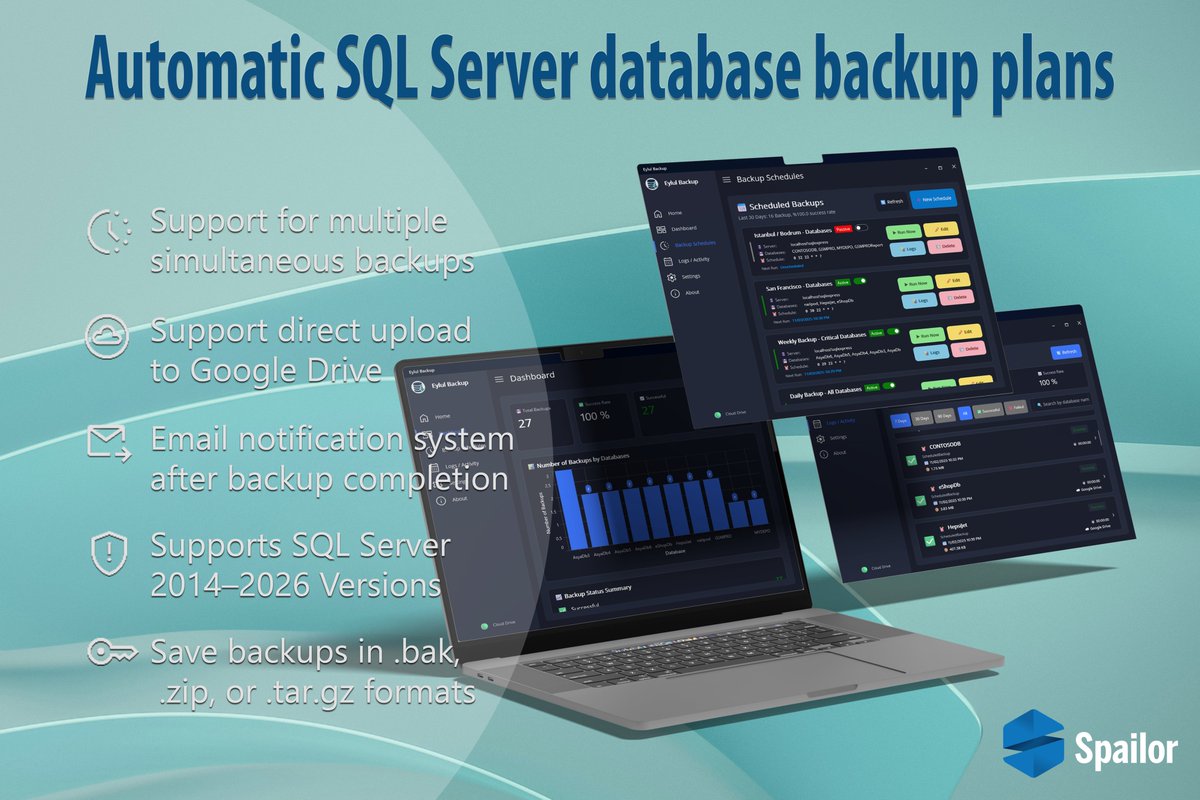
My new software, Eylul Backup, is now live on the Microsoft Store!
Automated SQL Server backups with scheduling, compression & Google Drive integration.
👉 apps.microsoft.com/detail/9n…
#EylulBackup #SQLServer #MicrosoftStore #DeveloperLife #Spailor #DatabaseBackup
3 Nov 2025

Eylul Backup is now live on the Microsoft Store! 🎉
Automate & simplify your SQL Server backups --> local, network, or Google Drive.
Secure. Reliable. Always on.
👉 apps.microsoft.com/detail/9n…
#EylulBackup #SQLServer #MicrosoftStore #Spailor #BackupSoftware
159