
Apr 30
⚡️ Efficient Chain, Real-World Reach: ATT Global × @GXChainGlobal
We're pleased to connect ATT Global's RWA and DePIN-powered advertising ecosystem — designed to unlock Web2 traffic through physical advertising touchpoints — with REI Network (@GXChainGlobal), the lightweight, developer-friendly, Ethereum-compatible blockchain built to address high costs and low efficiency in public chain infrastructure. ⚙️
REI @GXChainGlobal offers a low-cost, free-to-develop environment that supports DeFi, GameFi, and NFT applications, enabling rapid deployment and migration. Through this alignment, we explore how real-world advertising engagement might one day interact with efficient, accessible blockchain rails — bridging consumer attention with high-performance infrastructure.
Different layers, shared momentum. Where visibility meets velocity. Where ads find their optimal chain. 📡
#ATTGlobal #RWA #DePIN #EthereumCompatible #Web3
21
170
249
43,551

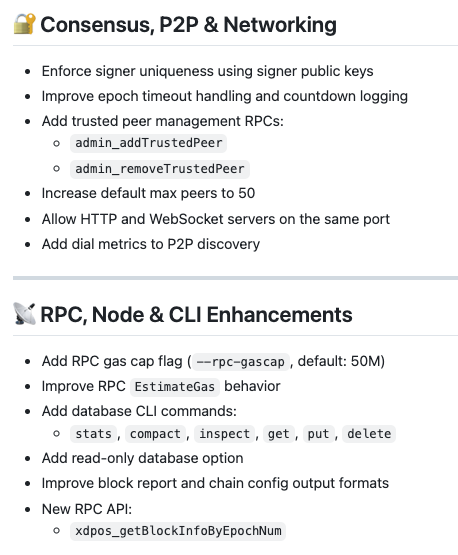
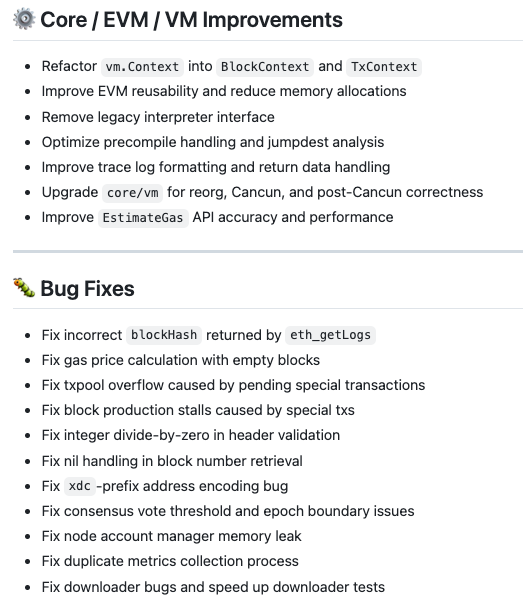
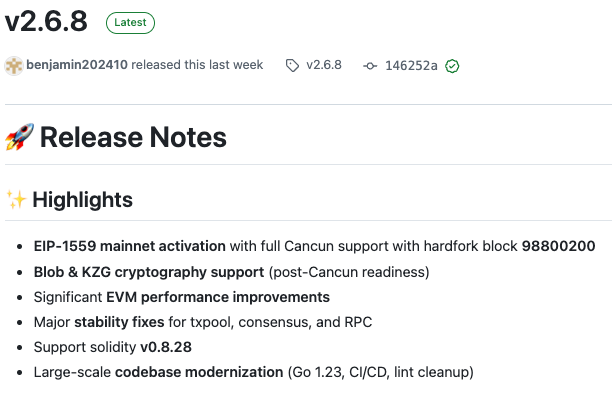
XDC Network v2.6.8 – Cancun Upgrade is LIVE!
This major upgrade delivers:
🔹 EIP-1559 activation on mainnet
🔹 Faster EVM execution
🔹 Stronger consensus stability
🔹 Go 1.23 Solidity 0.8.28 support
🔹 Cleaner codebase & improved RPC
⏳ Hard fork at block #98,800,200
More info: xdc.dev/anilchinchawale/xdc-…
#XDC #CancunUpgrade #Blockchain #EVM #EthereumCompatible

4
29
125
10,057

. @0xMiden testnet v0.12 introduces encryptionready address formats n private transport layer developed with Nethermind, enabling seamless, secure note routing that keeps private data encapsulated during network propagation
it supports ECDSA signing via specialised precompiles for Keccak hashing, offloading these operations from VM to accelerate proving times while maintaining Ethereumcompatible security for hardware wallets n passkeys
miden partners with Gateway.fm for node infrastructure n Ligero for postquantum secure proofs, combining scalable privacy with compliant enterprise features like tokenised RWAs n regulatoryready compliance tools
@MemeMax_Fi pays users for creating, posting memes or executing meme trades, turning internet culture into direct financial rewards

2 Dec 2025

[왜 STARK기반인가? - @0xMiden ]
벌써 마이든 3번째 글입니다!
이게 그냥 zk 롤업 정도로 생각했는데, 파다 보니까 방향성이 너무 다르더라고요.
Client-side Proving이니 Notes 모델이니… 처음엔 “뭐지?” 싶다가도
하나씩 이해되니까 이거 진짜 제대로 만들고 있다는 느낌이 확 와요 ㄷㄷ
특히 Miden이 실행을 온체인에 의존하지 않고
사용자 기기에서 굴리는 구조라는 게 저는 제일 흥미롭더라고요.
보통 L2들은 다 글로벌 상태 묶여서 병목 생기는 게 당연한데
Miden은 그걸 Notes로 쪼개버려서 병렬로 처리하는 게…
아 이게 말이 쉽지 실제로 구현하려면 미친듯이 까다로운데
그걸 다 자체 VM STARK 기반으로 맞춰놓은 거 보면서 좀 감탄했습니다.
그리고 STARK 기반으로 간 이유도 이해되더라고요.
Trusted Setup 필요 없고, 병렬화 잘 되고, 로컬 증명에도 딱 맞고…
이거 완전 Miden 철학이랑 방향성 그대로 반영된 선택이구나 싶었습니다.
그냥 “빠른 증명”이 아니라 아예 유저 중심 체인을 만들려는 느낌?
사실 저는 이런 조용한 프로젝트가 더 무서운 것 같습니다.
대놓고 마케팅 하는 스타일도 아니고, 개발자 이벤트나 기술 문서 중심이라
딱 기술만 쌓는 팀 특유의 향이 난다 해야 하나… 그런 느낌이에요.
언젠가 한 번 크게 “어? 이거 뭐지?” 하면서 시장이 따라붙을 것 같은 그런 체인.
아무튼 주말인데,,, 주말 잘 보내시고! 쉬엄쉬엄 가시죠!

2
3
17

30 Nov 2025
Developers, it’s time to migrate your dApps to KONET! With full EVM compatibility, KONET makes it easier than ever to scale and deploy your Ethereum-based projects 🚀💻✨
KONET ensures that your existing Solidity projects and tools like Truffle, Remix, and Hardhat integrate seamlessly, enabling a smooth transition to a high-performance blockchain without the need to learn new languages 🔗⚙️⚡
Why KONET?
EVM compatibility for a smoother transition 🧩
No need for new frameworks 🛠️
Faster, scalable infrastructure 📈🔥
#KONET #EVM #Web3Builders #BlockchainDev #Solidity #EthereumCompatible #HighPerformanceChain #Web3Ecosystem #BuildOnKONET #CryptoDevCommunity
20
3
6
100,257
one of best decisions of legend
wish i would have followed him longback, would have not missed this alpha
@MemeMax_Fi is Web3 social gaming platform built on telegram Sui blockchain that blends meme culture with player driven economy, offering taptoearn gameplay where players join factions, compete in PvP n PvE battles, mint NFTs stake tokens n participate in governance voting to earn real rewards while enjoying low-cost, fast blockchain interactions n communitydriven decisions
@0xMiden is innovative zkEVM L2 scaling solution that employs STARKbased virtual machine where users locally execute transactions n generate ZK proofs these proofs r then aggregated onchain to enable privacypreserving, highthroughput n costefficient Ethereumcompatible rollups with mainnet launch expected around early 2026
@HeyElsaAI combines AIpowered DeFi assistance with secure MPC wallets tht eliminate seed phrases, allowing users to automate complex trading n yield strategies using natural language commands while benefiting from realtime risk scoring n compliance checks across multiple chains
24 Nov 2025

It's interesting that @MemeMax_Fi and @MemeMax_intern asked about my profit story,
because buying $M was genuinely one of the best buys I've ever made recently.
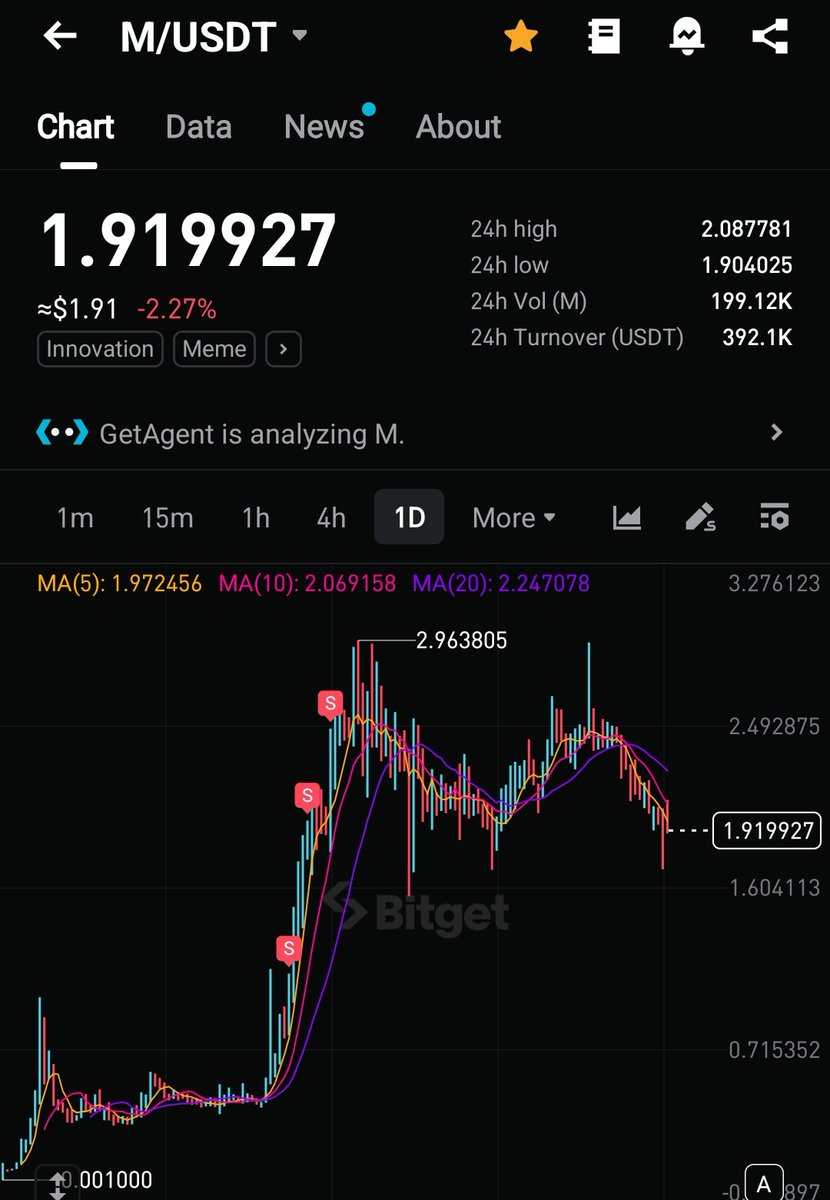
I bought M below $0.1 to trade meme tokens on the Memecore network.
At the time, there was an ongoing their creator campaign that gave onchain activity advantages, so it made perfect sense.
After that, M showed an insane rally and broke through $1. 😱
During that run, I even increased my M holdings by trading other native meme tokens on the network.
Since I never sold a single token during the initial pump,
I had to endure the massive drop after it first touched $1.
But Later, the token broke $1 again and kept climbing all the way up to around $3.👀😱👻
I started selling small portions gradually once it re-broke $1,
but I still hold about 50% of the very first M I ever bought.
Trading that the value of my remaining holdings keeps rising even while I'm doing partial sells,
That's truly an incredibly enjoyable experience.😆
Actually, it's not a huge amount of money,
but $M is still much happiness for me.👍
6
7
88
28 Nov 2025
KONET is not just a blockchain; it's a revolution in how decentralized platforms should work 🚀✨
Connecting creators, businesses, and consumers directly without intermediaries, KONET offers a transparent and fair environment for all 🤝🌐
KONET’s scalability, interoperability, and decentralized governance set the stage for a new generation of applications that are built to scale and drive real-world change ⚙️📈🔥
Key Features:
Scalable and enterprise-ready 🏗️⚡
Fully compatible with Ethereum-based applications 🔗💼
Community-driven decentralization 🗳️✨
Let’s build the future with KONET!🌟🚀
#KONET #Web3 #Blockchain #Decentralization #Interoperability #ScalableBlockchain #EthereumCompatible #Web3Builders #CryptoInnovation #FutureTech
23
4
10
666


18 Oct 2025
@megaeth is the official account for MegaETH Labs, creators of MegaETH a real-time, Ethereumcompatible blockchain achieving sub-millisecond latency and 100K TPS. it uses specialized nodes and a hyper-optimized EVM to deliver Web2-level speed and scalability.

1
2
10

15 Oct 2025
@zama FHE enables computations on encrypted data without decryption, ensuring privacy for applications like confidential smart contracts.
Key products include fhEVM, a framework for Ethereumcompatible chains, Concrete ML for privacypreserving machine learning, and TFHErsm
52
59
8,704

15 Oct 2025
gZama fam 🙌🏽
@zama_fhe is an open source cryptography company specializing in Fully Homomorphic Encryption (FHE) for blockchain and AI.
FHE enables computations on encrypted data without decryption, ensuring privacy for applications like confidential smart contracts.Key products include fhEVM, a framework for Ethereumcompatible chains, Concrete ML for privacypreserving machine learning, and TFHErs, a Rustbased encryption library.
Founded in 2020, Zama raised $73 million in Series A funding in 2024 and $57 million in Series B in 2025, achieving unicorn status with over $150 million total funding. Their protocol supports up to 1000 transactions per second onchain.
#ZamaCreatorProgram

95
7
176
8,297

12 Sep 2025
🟣⚡ WHY $NAKAMCOIN CHOSE POLYGON OVER SOLANA ⚡🟣
Like choosing the RIGHT mentor in anime! 🎌💜
POLYGON = THE PERFECT SENSEI FOR ANIME TOKENS! 👨🏫🚀
🔗 JOIN THE POLYGON FAMILY: dapp.quickswap.exchange/swap…
🎯 WHY POLYGON WINS FOR LONG-TERM: 🎯
✅ ULTRA-LOW FEES - Anime fans can afford to transact!
✅ ETHEREUM COMPATIBILITY - Access to ALL DeFi tools!
✅ ZERO NETWORK OUTAGES - Reliable like Tanjiro's blade!
✅ ANIME PARTNERSHIPS - Disney, gaming studios already here!
✅ MASS ADOPTION READY - Built for billions, not just degens!
SOLANA = FAST BUT BREAKS. POLYGON = FAST AND RELIABLE! ⚡🛡️
🌟 LONG-TERM VISION: 🌟
🎮 Anime gaming integration - Polygon leads in gaming!
🎬 Movie ticket payments - Real utility for anime fans!
🎨 NFT marketplace - Best ecosystem for creators!
🌍 Global anime economy - Polygon scales without limits!
WE'RE NOT JUST BUILDING A TOKEN - WE'RE BUILDING THE FUTURE! 🚀💎
📢 POLYGON ECOSYSTEM LEGENDS: 📢
@sandeepnailwal @0xPolygon @QuickSwap @CryptoWendyO @MMCrypto @DefiIgnas @GCRClassic
WHO ELSE BELIEVES POLYGON IS THE ANIME BLOCKCHAIN?! 🎌⚡
🔥 Like choosing Kakashi over Orochimaru as sensei! 🔥
POLYGON = RELIABLE POWER. SOLANA = FLASHY BUT RISKY! 💜
🔗 EXPERIENCE THE DIFFERENCE:
dapp.quickswap.exchange/swap…
💜 True nakama choose quality over hype! 💜
#NAKAMCOIN #PolygonOverSolana #AnimeBlockchain #LongTermVision #ReliablePower #EthereumCompatible #MassAdoption #AnimeEconomy #NoOutages #QualityOverHype #PerfectSensei #PolygonFamily #SmartChoice #FutureReady #MATIC #Polygon
25
10
30
736

29 Aug 2025
🚀 Accelerating Blockchain with @monad Parallel Execution
Imagine a blockchain that doesn’t make you wait — that processes thousands of transactions at lightning speed. That’s Monad.
As a Layer 1 blockchain, Monad pioneers Parallel Execution, a game-changing mechanism that allows multiple transactions to be processed simultaneously, not sequentially. The result? A blazing-fast throughput of up to 10,000 TPS.
No more bottlenecks. No more slow confirmations.
Just pure speed and efficiency — without sacrificing Ethereum compatibility.
Whether you're building dApps, trading on-chain, or pushing the limits of DeFi, Monad offers a seamless, scalable, and cost-efficient foundation.
✨ Think Ethereum… but faster. Smarter. Parallel.
#Monad #ParallelExecution #Layer1 #EthereumCompatible #BlockchainInnovation
1
1
54

3 Aug 2025
Smart contracts deserve smarter infrastructure.
@monad introduces parallel EVM without sacrificing simplicity.
That means faster apps, lower costs, and better UX all fueled by $MON
#Monad #MON #EthereumCompatible

1
4
71

30 Jul 2025
Bitcoin was Digital Gold BOB is making it programmable money.
Once it could only be observed,
Now it will be useful, too, with the smartness of Ethereum! 💥
BOB is actually a hybrid rollup:
👉 Bitcoin's security
👉 Ethereum's smart contract
👉 And ultra-fast challenge resolution with Zero-Knowledge Proof
Everything together, in one place.
Transactions can be challenged by spending only 0.5 ETH, meaning fraud can be caught quickly, while the cost is also low.
It's as fun as Dogecoin.
But the technology inside is serious:
RISC Zero, OP Kailua, zkVM are all cutting-edge tools used by BOB.
BOB = Memes meet Machines
When fun meets brains.
Bitcoin DeFi is not a fantasy, it's becoming a reality.
Are you still just watching, or will you participate?
#BuildOnBOB #BitcoinFi #zkProof #EthereumCompatible #DeFi
30 Jul 2025

bob rules
blockworks.co/news/zk-breakt…
11
1
11
512

29 Jul 2025
Think Ethereum, but 100x faster.
@monad keeps everything you love about the EVM just makes it massively more efficient.
🔹 10,000 TPS
🔹 1-second blocks
🔹 Full Ethereum support
🔹 No code changes needed
Build faster. Run smoother. Scale smarter.
Backed by $MON
#Monad #EthereumCompatible #FastChain #Web3ExecutionLayer
2
10
29 Jul 2025
🚀 Accelerating Blockchain with @monad Parallel Execution
Imagine a blockchain that doesn’t make you wait — that processes thousands of transactions at lightning speed. That’s Monad.
As a Layer 1 blockchain, Monad pioneers Parallel Execution, a game-changing mechanism that allows multiple transactions to be processed simultaneously, not sequentially. The result? A blazing-fast throughput of up to 10,000 TPS.
No more bottlenecks. No more slow confirmations.
Just pure speed and efficiency — without sacrificing Ethereum compatibility.
Whether you're building dApps, trading on-chain, or pushing the limits of DeFi, Monad offers a seamless, scalable, and cost-efficient foundation.
✨ Think Ethereum… but faster. Smarter. Parallel.
#Monad #ParallelExecution #Layer1 #EthereumCompatible #BlockchainInnovation

40
38
287

29 Jul 2025
Citrea: The zkEVM Revolution That Reimagines Bitcoin as a Global Settlement Layer
Bitcoin was born with a singular purpose — a decentralized, trustless monetary system that eliminates the need for central banks. Over time, it proved itself as the most secure, immutable, and censorship-resistant blockchain in existence.
But as the crypto economy expanded, Bitcoin’s limitations became increasingly clear:
. No expressive smart contracts.
. No support for composable DeFi.
. No native token standards like ERC-20 or NFTs.
. No seamless way to leverage BTC in decentralized applications.
Citrea is the first project that solves these limitations without sacrificing Bitcoin’s core values. It builds a fully-featured zkEVM rollup, powered by zero-knowledge cryptography, that settles directly on Bitcoin. This means full Ethereum compatibility — Solidity, smart contracts, dApps, even DeFi — but anchored to the Bitcoin blockchain.
Let’s explore how Citrea is redefining the future of Bitcoin-based applications.
The zkEVM Rollup Model Explained
At the heart of Citrea is a zkEVM (zero-knowledge Ethereum Virtual Machine). This is a smart contract execution environment that mimics Ethereum’s behavior — but every transaction and contract execution is proven using zero-knowledge proofs and posted to Bitcoin for finality.
Here's what makes it revolutionary:
. Developers use existing Ethereum tooling (Solidity, Hardhat, MetaMask).
. Transactions are bundled off-chain and executed on the zkEVM layer.
. A zk-SNARK proof is generated to prove that the computation was valid.
. That proof is embedded into a Bitcoin transaction using Taproot-compatible scripts.
. Bitcoin miners confirm the transaction, giving the rollup Bitcoin-grade security.
This is not emulation. This is full zk-verifiable smart contract computation, secured by the most immutable chain ever created.
Why Citrea Avoids the Pitfalls of Other Bitcoin L2s
There have been many attempts to build on or around Bitcoin. Most fall into one of the following categories:
1. Federated Sidechains – rely on multisig setups and centralized trust (e.g., Liquid).
2. Merged-Mined Chains – require changes to Bitcoin miner incentives (e.g., RSK).
3. Bridged L1s – operate independently, with weak guarantees (e.g., Stacks).
4. Wrapped BTC on Ethereum – introduces custodial risk (e.g., WBTC).
All of these approaches require trust in external validators, bridges, or governance bodies.
Citrea takes a different route:
. No change to Bitcoin’s consensus.
. No need for trusted third parties.
. No bridge to maintain or attack.
. No federation to break trust assumptions.
Instead, Citrea uses math, not governance, to guarantee validity. Every execution is verified cryptographically. Every state change is permanently committed to Bitcoin.
This makes Citrea more decentralized than any other Bitcoin Layer 2 — and even most Ethereum L2s.
Bringing Native BTC Into Smart Contracts
One of Citrea’s most transformative features is the ability to use real BTC — not wrapped, not synthetic — inside smart contracts.
Here’s how it works:
. BTC is locked using Bitcoin’s native scripting on L1.
. Citrea’s zkEVM recognizes and verifies the lock using zk-proofs.
. A corresponding amount of BTC is minted as a native asset inside the zkEVM.
. This BTC can then be used for swaps, lending, staking, and governance.
. When users want to withdraw, the wrapped BTC is burned and native BTC is released trustlessly.
This unlocks the full capital efficiency of BTC — the world’s most valuable crypto asset — without ever leaving the Bitcoin blockchain.
A Developer’s Dream: Full Ethereum Compatibility, Secured by Bitcoin
Citrea’s design makes it extremely attractive to developers:
. Use Solidity, Vyper, and existing EVM libraries.
. Deploy smart contracts as easily as on Ethereum.
. Leverage infrastructure like Chainlink oracles and The Graph.
. Build DeFi protocols, NFT marketplaces, games, and DAOs — all on a Bitcoin settlement layer.
For Ethereum developers, there is no learning curve. For Bitcoiners, there is no compromise on security.
This creates an ecosystem where innovation can flourish without abandoning decentralization.
Real Use Cases Powered by Citrea
With full EVM compatibility and trustless Bitcoin settlement, Citrea enables an explosion of new use cases:
. Decentralized Lending: Use BTC as collateral without trusted intermediaries.
. Derivatives & Options: Build advanced financial primitives backed by real Bitcoin.
. DAOs: Govern treasuries, protocols, and communities using zk-secured votes.
. NFTs on Bitcoin: Issue verifiable, programmable digital assets with Bitcoin L1 finality.
. Stablecoins: Mint and trade Bitcoin-native stablecoins trustlessly.
. Gaming Economies: Host play-to-earn games secured by Bitcoin’s economic layer.
Citrea opens the door to a fully expressive Bitcoin-native dApp layer, something previously thought impossible.
Security Model: Why ZK Proofs Matter
Zero-knowledge proofs are the foundation of Citrea’s security. Rather than trusting servers, multisigs, or validator committees, Citrea proves correctness using cryptography.
Every batch of transactions includes a zk-SNARK:
. Verifies that all state changes follow the smart contract logic.
. Prevents any malicious execution or double-spending.
. Guarantees that what’s posted to Bitcoin is mathematically correct.
This is not just safer — it’s more efficient. Bitcoin becomes the global court of arbitration for the zkEVM world.
Citrea’s Decentralization Roadmap
Citrea starts with a centralized sequencer for speed, but is designed for full decentralization:
. Sequencers will become permissionless and decentralized.
. zk-proof generation will be open to a global prover market.
. The protocol will be governed by the community through on-chain mechanisms.
. All components — from data availability to gas pricing — are being designed to minimize centralization.
Unlike many rollups that delay decentralization, Citrea embraces it from day one.
Strategic Importance for Bitcoin’s Future
Citrea doesn’t just make Bitcoin programmable. It makes it relevant in the next phase of crypto:
. Competing L1s like Ethereum, Solana, and Avalanche have captured most developer mindshare.
. New L2s like zkSync and Arbitrum offer faster, cheaper execution layers.
. Bitcoin risks becoming a passive asset unless it evolves.
Citrea ensures that Bitcoin is not just sound money, but the foundation of a new, expressive financial system. It enables global-scale smart contract platforms without compromising decentralization.
Bitcoin becomes not just the settlement layer — but the global trust anchor for the next internet.
Conclusion: Bitcoin as a Civilization Layer
Citrea does not dilute Bitcoin. It amplifies it.
By using zk-rollups and EVM compatibility, Citrea transforms Bitcoin from a static store of value into a living, evolving base layer for all forms of digital coordination.
. Programmable DeFi.
. Trustless governance.
. Interoperable applications.
. Bitcoin-native smart assets.
. Global decentralized infrastructure.
The future is not Bitcoin or Ethereum. It is Bitcoin with Ethereum expressiveness, delivered through zero-knowledge cryptography, anchored in finality, and executed without compromise.
Citrea is not just a rollup — it's Bitcoin's next chapter.
#Citrea #Bitcoin #zkEVM #BitcoinL2 #SmartContracts #ZeroKnowledge #zkRollups #Web3 #CryptoInfrastructure #EthereumCompatible #BTC #TrustlessSystems #DeFiOnBitcoin #ProgrammableBitcoin #Layer2Revolution #CryptoFuture @citrea_xyz
2
31

27 Jul 2025
🚀 Scaling Web3? Build on BOB. @build_on_bob combines the best of Bitcoin's security with Ethereum's flexibility — giving developers the ultimate hybrid Layer 2 to build fast, scalable, and secure dApps. 🔗 Build smarter. Scale faster. #BuildOnBOB #BitcoinL2 #EthereumCompatible
1
2
36

21 Jul 2025
Your smart contract your rules hidden from prying eyes @tenprotocol gives you the power of privacy Ethereum compatibility
Next-gen contracts for next-gen builders💎 @cookiedotfun
#TENProtocol #PrivacyIsPower #EthereumCompatible
3
1
8
261

18 Jul 2025
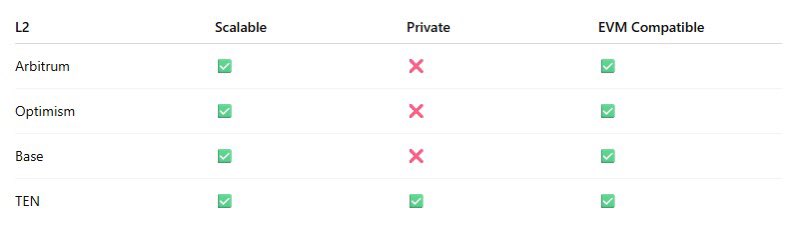
Ten Protocol has raised $9M from top-tier backers,a strong vote ofconfidence in their vision.With privacy gaps in public DeFi, @tenprotocol offers a breakthrough-an encrypted Layer2powered byTEEs,fully Ethereumcompatible for seamless privacy and scalability.Explore @cookiedotfun
27
22
34
257