ElectronicsNotes by Ian Poole retweeted

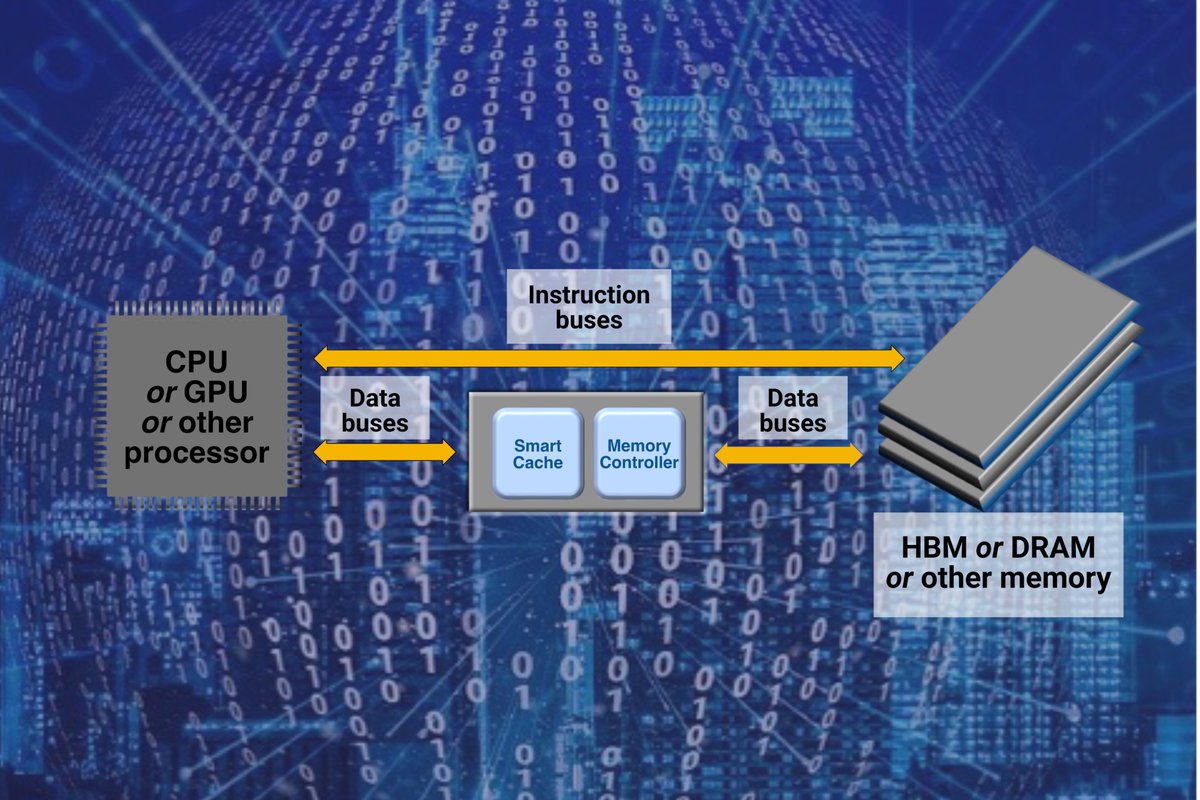
Beyond the Memory Wall – how our technology solves greatest challenge facing computing and AI today
#futurecompute #semiconductor #memory linkedin.com/posts/blueshift…
1
5
587

⚡️KI-Chatbot mit Stromnetz-DNA: Der wahre Cash-Cow-Deal steckt in den Kühlhallen! 💸
Während wir alle nach dem nächsten besseren Prompt suchen, schaufeln Ex-OpenAI-Genies wie Leopold Aschenbrenner lieber still an der Infrastruktur-Trueque-Börse. Anstatt selbst irgendwelche Models zu trainieren, pumpen sie ihr Geld nun in Unternehmen wie Nebius – die Großvermieter der Rechenkraft. Die Moral von der Geschicht? Wer in Zukunft künstlichen Sprachkram konsumieren will, wird letztlich an wenigen Energieriesen hängen, die in geheimen Rechenfabriken tagtäglich tausende Grafikkarten kühlen.
- Nebius: Europas Antwort auf AWS & Co. – mietet pure Rechenkraft für KI-Hersteller
- Neuer Investor: Leopold Aschenbrenner (Ex-OpenAI Strategie & Regulation)
Wenn schon alle wissen, dass die nächste Dekade „computational scarcity“ bestimmt – wäre es da nicht an der Zeit, diese kritische Infrastruktur endlich vom machtvollen Kreis der Hyper-Scalern zu demokratisieren? Oder sind wir demnächst gefangen in einem schlimmeren Monopol als bei den Kabel- und Energieversorgern? Wie seht ihr diese Entwicklung?
#AIinfrastructure #TechMonopoly #FutureCompute

105

Apr 10
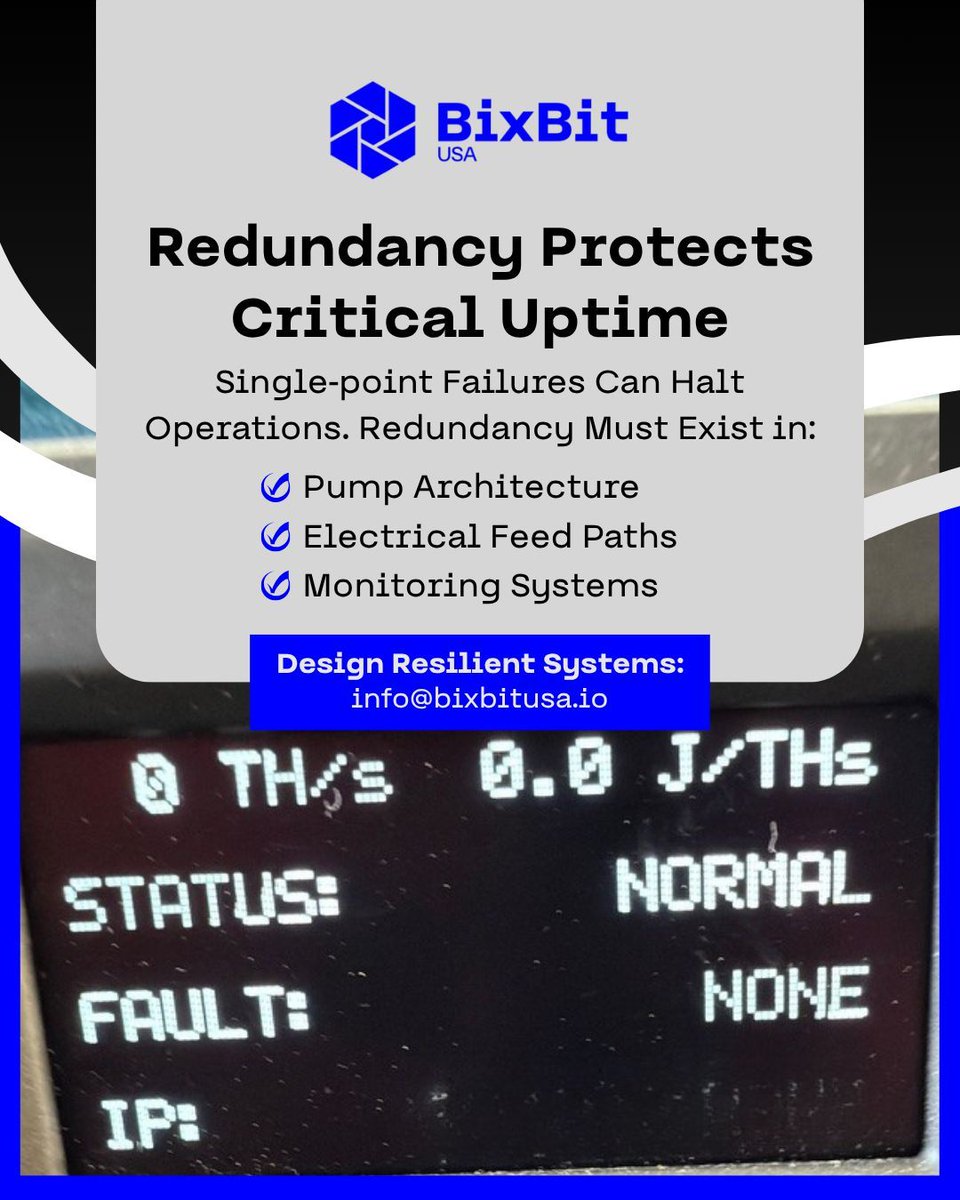
Single-point failures in pump architecture, control logic, or distribution networks represent a critical vulnerability in high-density computing. Where uptime drives value, reliance on non-redundant systems is a compromise that invites unnecessary operational risk. ⚙️
True resilience is a proactive architectural choice, necessitating integrated redundancy across:
✔️ Pump architecture
✔️ Electrical feed paths
✔️ Monitoring systems
BiXBiT USA engineers these safeguards directly into the modular framework, allowing the governing layer to absorb localized disruptions without impacting the broader compute cycle. Systems designed for resilience are the only path to long-term performance stability. 🧩
🔋 Design resilient infrastructure → info@BiXBiTUSA.io
#BiXBiTUSA #InfrastructureResilience #MiningUptime #EngineeringDiscipline #RedundancyDesign #DataCenterReliability #HighDensityComputing #SystemArchitecture #IndustrialEngineering #FaultTolerance #OperationalStability #PowerDistribution #MechanicalEngineering #FutureCompute #TechInfrastructure #EnergyOptimization #ScalableSystems #HardwareProtection #DigitalInfrastructure #FacilityManagement #SmartInfrastructure #ReliabilityEngineering #ControlSystems #IndustrialInnovation #InfrastructureIQ
1
2
22
Apr 9
If you need ear protection to check uptime, it might be time to rethink thermal strategy. Your infrastructure shouldn’t sound like a jet engine to stay stable. 🔊💧
When operational stability requires the constant roar of high-RPM fans, it indicates an infrastructure that is fighting its environment rather than integrating with it. ⚙️
Air-cooled systems are fundamentally limited by the medium they use; air moves noise as much as it moves energy. Transitioning to liquid and hydro-based architectures allows for the silent, precise movement of heat, decoupling high-density compute from the chaotic acoustic signatures of traditional facilities. 💧
Modern infrastructure should not require ear protection to verify system uptime. By prioritizing fluid dynamics over mechanical forced air, facilities achieve a level of operational calm that reflects true engineering discipline and long-term hardware health. 🧪
Quiet infrastructure is a hallmark of sophisticated design. Moving beyond the "jet engine" paradigm allows for greater location versatility and a significantly reduced environmental footprint, ensuring your site remains viable in a world of increasing regulatory scrutiny. 📐
🔊 Quiet the chaos → info@BiXBiTUSA.io
#BiXBiTUSA #LiquidCooling #HydroCooling #AcousticEngineering #ThermalManagement #HighDensityComputing #DataCenterDesign #IndustrialEngineering #InfrastructureResilience #NoiseMitigation #SystemArchitecture #OperationalStability #FutureCompute #TechInfrastructure #EnergyOptimization #CleanTech #DigitalInfrastructure #SmartEngineering #MechanicalEngineering #HardwareOptimization #UrbanMining #ScalableSystems #PrecisionCooling #FacilityManagement #EngineeringExcellence

1
3
20
Apr 7
Hardware efficiency gains are merely theoretical until validated by the environment. While new ASIC models offer improved benchmarks, their practical utility is governed by the structural integrity of the facility. 🧠
Sustained performance is achieved through the convergence of:
✅ Thermal stability
✅ Electrical integrity
✅ Continuous uptime
✅ Monitoring discipline
Infrastructure is the definitive layer that translates potential into performance. Engineering defines the boundary between a spec sheet and a stable, high-output operation. 🏗️
🌐 Build the layer that lasts → info@BiXBiTUSA.io
#BiXBiTUSA #MiningInfrastructure #EngineeringMatters #OperationalExcellence #CryptoScale #HighDensityComputing #DataCenterDesign #PowerDistribution #ThermalManagement #PerformanceEngineering #SystemArchitecture #IndustrialEngineering #InfrastructureResilience #ScalableSystems #HardwareOptimization #ASICMining #ComputePerformance #TechInfrastructure #OperationalStability #EnergyOptimization #DigitalInfrastructure #FutureCompute #ReliabilityEngineering #InfrastructureIQ #SystemReliability

1
2
13
Apr 6
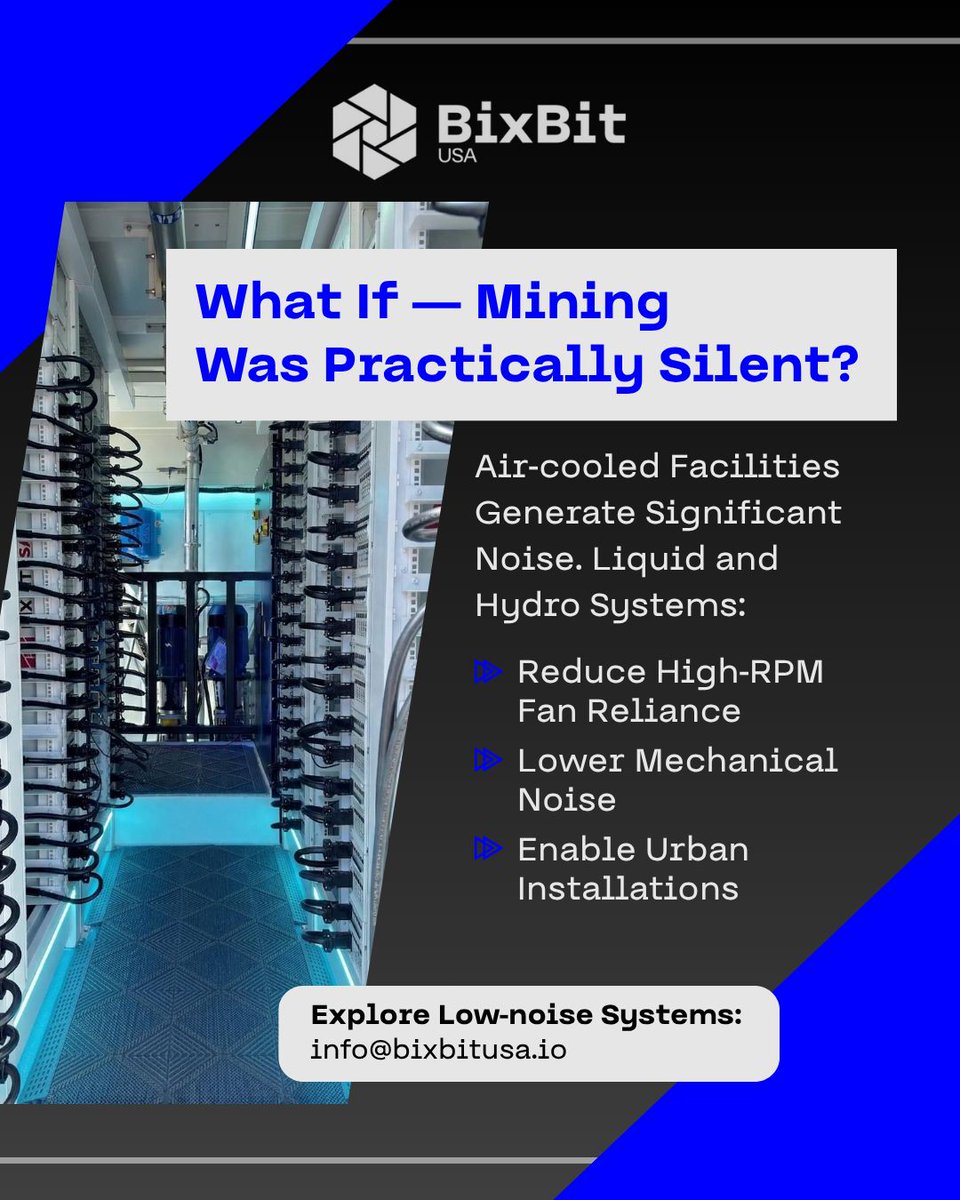
Acoustic signatures represent a critical, yet often overlooked, constraint in industrial scaling. In high-density environments, traditional air-cooling methods generate significant decibel levels that create friction with both regulatory frameworks and local zoning requirements. ⚙️
Liquid and hydro-cooled architectures provide a fundamental shift in environmental integration by:
☑️ Neutralizing reliance on high-RPM mechanical fans
☑️ Drastically reducing the total acoustic footprint of the facility
☑️ Facilitating high-performance installations within urban-density zones
Acoustic control is no longer a luxury; it is a strategic asset. By decoupling high-load computing from noise pollution, infrastructure becomes location-agnostic, allowing for deployment in regions previously restricted by environmental noise standards. 🧩
The transition to quiet, fluid-based cooling defines the next generation of industrial resilience. Systems engineered for silent operation ensure long-term viability in an increasingly scrutinized regulatory landscape. 📐
📩 Explore low-noise architecture → info@BiXBiTUSA.io
#BiXBiTUSA #LiquidCooling #UrbanMining #IndustrialDesign #InfrastructureFuture #AcousticEngineering #HydroCooling #DataCenterDesign #HighDensityComputing #NoiseMitigation #SustainableInfrastructure #UrbanIntegration #ThermalManagement #IndustrialInnovation #OperationalStability #FutureCompute #GreenDataCenter #MechanicalEngineering #SmartInfrastructure #RegulatoryCompliance #EdgeComputing #SilentPower #ScalableSystems #FacilityDesign #TechInfrastructure
1
3
15
Mar 31
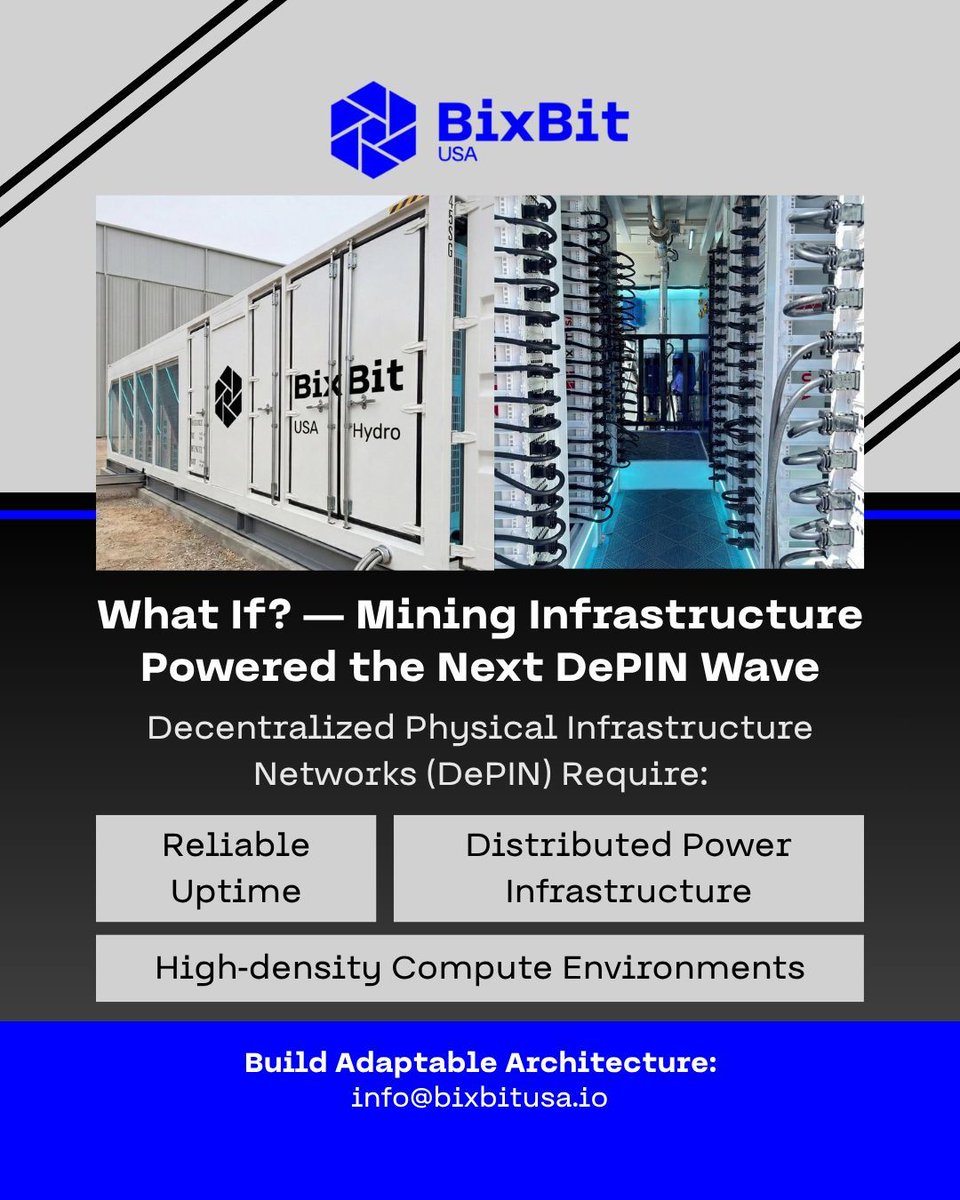
Decentralized Physical Infrastructure Networks (DePIN) operate within strict infrastructure constraints—where uptime, power distribution, and compute density define system viability. ⚙️
✅ Reliable uptime
✅ Distributed power infrastructure
✅ High-density compute environments
Mining facilities already satisfy these conditions, functioning as high-load, energy-optimized environments with transferable architecture. 🔌
As AI, storage, and edge workloads expand, modular mining sites can evolve into hybrid compute hubs—extending utility without structural redesign. 📐
Infrastructure versatility defines long-term value. Systems engineered for adaptability sustain performance across shifting computational demands. 📊 BiXBiT USA designs modular architectures built for this transition. Mining infrastructure may become multi-purpose infrastructure. 🌐
📩 Build adaptable architecture → info@BiXBiTUSA.io
#BiXBiTUSA #DePIN #DigitalInfrastructure #FutureCompute #MiningEvolution #InfrastructureResilience #HighDensityComputing #EdgeInfrastructure #AIInfrastructure #DistributedSystems #EnergyOptimization #ModularDesign #ThermalManagement #DataCenterDesign #ScalableInfrastructure #ComputeArchitecture #IndustrialEngineering #SystemRedundancy #OperationalEfficiency #TechInfrastructure
1
2
14

Mar 8
Quietly, a major shift is happening in the architecture of the global AI ecosystem 🧠⚡
Recently, Neuraxon 2.0 released a 1.1TB neural dynamics dataset on Hugging Face.
To most people, it may look like just another large dataset.
But for those who study the deeper structure of technology,
it represents something far more significant.
Because this isn’t just text or image data.
It is data about the functioning of neural systems.
The firing patterns of neurons.
The dynamics of neural networks.
The behavior of systems with biological levels of complexity.
In other words,
this is raw material for building AI that doesn’t merely compute,
but attempts to simulate cognition.
Once datasets like this are opened on Hugging Face,
they become part of a global open research ecosystem for AI.
And gradually, the architecture of the AI world is becoming clearer.
Layer one: Data and Models
A massive knowledge layer accessible to researchers around the world—
hundreds of thousands of models,
vast datasets,
and continuous experimentation with new architectures.
Platforms like Hugging Face function as
the digital library of intelligence.
But a library alone cannot bring a system to life.
AI requires another essential component.
Compute.
Today, most of the world’s AI compute power is concentrated inside
large corporate data centers:
GPU farms,
supercomputing clusters,
and massive cloud infrastructures.
These systems are extraordinarily powerful.
But they share a critical limitation.
They are centralized.
And this raises an increasingly important question:
If the knowledge of AI is open,
why is the compute that powers it still controlled by a few entities?
This is where the concept behind Qubic becomes interesting.
Instead of building a handful of enormous supercomputers,
Qubic proposes a different model.
Through Useful Proof of Work,
it aims to transform the unused computational power of devices across the world
into a massive distributed compute network.
In this model:
Personal computers,
small servers,
mining hardware,
or even ordinary machines
can all contribute to performing real, useful computation
such as
AI inference,
machine learning workloads,
or distributed computation tasks.
When viewed from a broader perspective,
this begins to resemble the assembly of a planet-scale digital nervous system.
Hugging Face
may serve as the memory of AI.
Datasets like those from Neuraxon
may act as maps of the brain.
And networks like Qubic
may ultimately become the nervous system that allows it to operate.
When these components begin to connect,
AI may no longer exist inside a few isolated data centers.
Instead, it could emerge as a distributed intelligence
spanning the entire internet.
Not controlled by a single corporation,
but powered by the infrastructure of the world itself.
The future of AI may not be a single machine.
It may be something closer to
a network-scale form of intelligence. 🚀
#AI #DecentralizedAI #Qubic #FutureCompute $QUBIC
3

Mar 5
Every tech shift starts with infrastructure.
Distributed AI compute from @mwx_ai and decentralized gaming streaming through @YOM_Official show how Web3 networks could power the next generation of applications.
#AI #Web3 #FutureCompute #DePIN
1
8

Mar 5
The future of compute may not live only in hyperscale data centers.
Distributed networks like @mwx_ai for AI workloads and @YOM_Official for cloud gaming suggest a more open infrastructure layer.
That’s worth watching.
#AIInfra #Web3 #FutureCompute #Gaming
1

Jan 18
Sawyer laid out the roadmap again, and what hit me wasn't the "AI7 is space-based compute" part — it was the quiet realization that the real insanity is the follow-up: we need to build gigantic in-house fabs because the chip volume required for robotaxis Optimus orbital compute is just... enormous.
Most of the industry is still fighting over who gets the next allocation of GPUs from someone else's factory.
Tesla's already several years into the mindset of "we'll make the silicon ourselves, at whatever scale it takes, all the way to space."When the thread connects like that, the next decade starts feeling genuinely unpredictable.
#TeslaAI #FutureCompute
Jan 18

Elon: "Tesla AI6 will be for Optimus and data centers. AI7/Dojo3 will be space-based AI compute."
This is why Elon wants to build a big chip fab facility, because Tesla is going to need a lot of chips between their robotaxis, Optimus robots and AI compute satellites.
1
28

$YOM is proving that decentralized GPU networks aren’t just theory they’re real reliable and scalable. Community-driven compute is the future, and YOM is leading the way.
@YOM_Official #DePIN #FutureCompute
1
44

31 Dec 2025
The future of global compute will be decentralized, community-driven, and highly efficient exactly what YOM is building today. Excited to see this ecosystem expand even further. 🚀🌍
@YOM_Official #FutureCompute
1
22 Dec 2025
The future of compute looks decentralized efficient and community-driven and @YOM_Official is already walking that path. This project is one to watch closely. #FutureCompute
3
$YOM continues to prove that decentralized GPU networks can outperform old-school cloud systems. Lower costs higher efficiency and community-powered compute this is next-gen infrastructure. ⚡
@YOM_Official #DePIN #FutureCompute
10
6 Dec 2025
With gaming AI virtual worlds and real-time content all growing fast the world needs scalable compute more than ever. YOM is positioning itself right at the center of that demand. Massive potential.
@YOM_Official #FutureCompute
4

6 Dec 2025
Built for the world.
Scaling the future, one node at a time.
this is @gensynai
#Gensyn #FutureCompute #AIBuilders #OpenCompute #TechRevolution

1
2
11

6 Dec 2025
Gensyn is here —
a new way for the world to share compute,
build together, and push AI forward.
Simple. Open. Powered by everyone.
⚡🌍 @gensynai #FutureCompute #AIPoweredByPeople

1
1
14

6 Dec 2025
The RAM era is over.
Memory is no longer for gamers, it’s for thinking machines.
Micron didn’t pivot, it evolved.
The new gold rush isn’t storage. It’s AI cognition bandwidth.
DRAM is dead.
HBM is the oxygen of intelligence. 💥
#AI #Micron #Semiconductors #HBM #CellRepairAI #FutureCompute
14
5 Dec 2025
The next breakthroughs in AI will come from minds
bold enough to think differently —
and networks strong enough to support that vision.
Elevate your thinking.
Build with Gensyn. @gensynai
⚡ #FutureCompute #Gensyn

5