
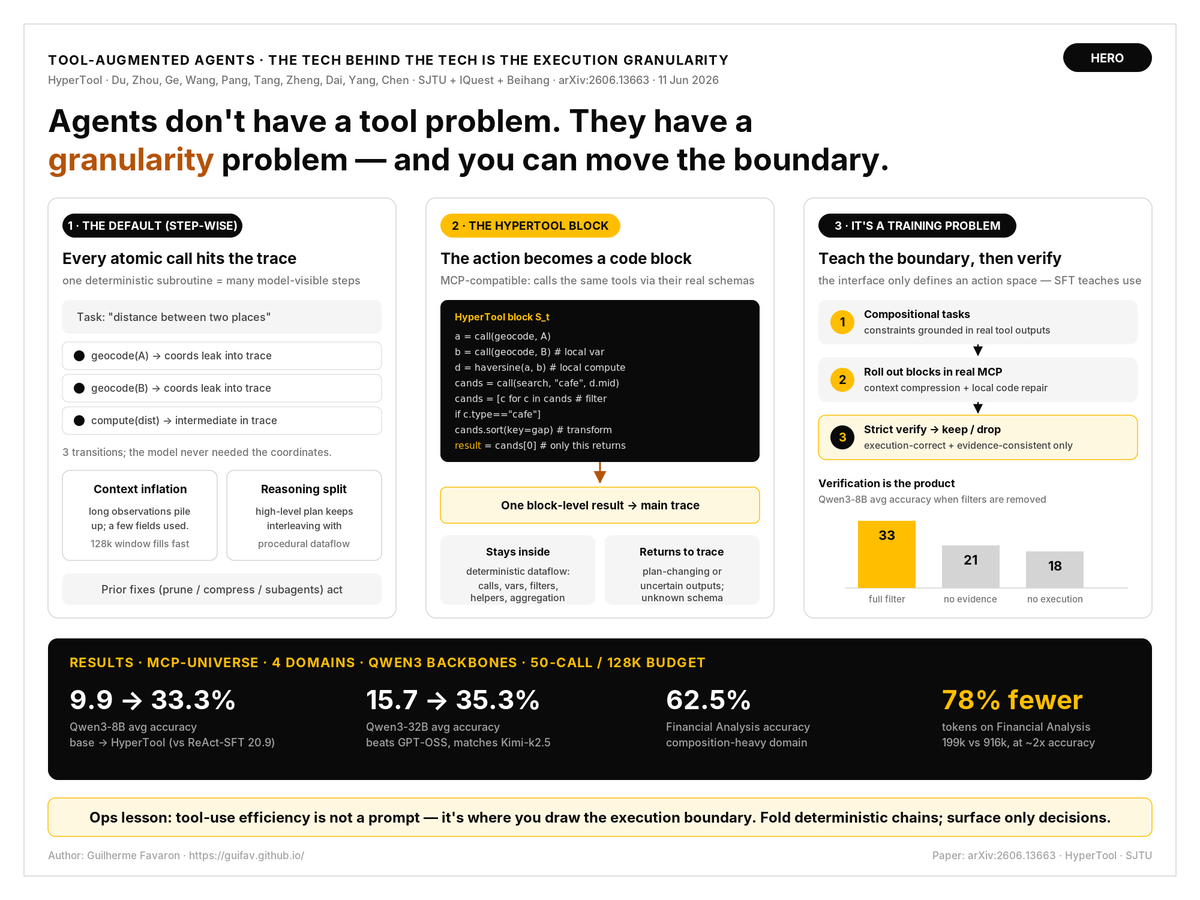
Every LLM agent you ship calls tools. The tech behind the tech is the execution granularity of that tool interface - and HyperTool argues the default is wrong (arXiv:2606.13663, @sjtu1896 IQuest; Yaxin Du @DorothyDDU, Siheng Chen @chensiheng).
The problem: step-wise atomic tool calls expose every invocation and value transfer in the model's main trace. "Distance between two places" unfolds into geocode A, geocode B, compute - 3 model-visible steps for one deterministic subroutine. Net effect: context inflation and fragmented reasoning.
HyperTool changes the model-visible unit. Instead of one atomic call per action, the model emits a code block (MCP-compatible) that calls existing tools via their original schemas, stores results in local variables, filters/transforms them, and returns only the task-relevant value. Deterministic tool chains fold into one outer call; only decisions that change the plan return to the trace.
It's a training problem too: synthesize cross-tool compositional tasks, roll out blocks in real MCP environments with local code repair, keep only execution-correct, evidence-consistent trajectories. Strict filtering matters - dropping it crashes accuracy 33% -> 18%.
MCP-Universe: Qwen3-32B 15.7% -> 35.3%, Qwen3-8B 9.9% -> 33.3% avg accuracy, beating GPT-OSS and matching Kimi-k2.5. Financial Analysis: 62.5% accuracy with 78% fewer tokens (199k vs 916k).
Lesson: tool-use efficiency isn't a prompt - it's where you draw the execution boundary.
1
1
2
243

16

Jun 12
GoogleAPI、想定外の謎の利用履歴が…
特定の日付でPlaceAPIとGeoCodeの謎のトラフィック。
API keyですぐに追尾できるけど。
PlaceAPIはクッソ高いから使うなとあれだけ言ったのに使ったのか……
キー止めてやるわ。
88


Need to geocode thousands of addresses without writing code?
This guide shows how to batch geocode large address lists for free using Geoapify's Batch Geocoding tool.
📍 Upload a file
📍 Process addresses in bulk
📍 Export results
To guide:
dev.to/geoapify-maps-api/how…
#Geocoding #GIS #GeoSpatial #Maps #Geoapify
1
53

How to Search “Twitter” (currently ❌) like a lurker 👀
"Pew pew" since:2025-11-04 until:2025-11-05
"Insurrection" near:"DC" within:10mi
"traffic" geocode:37.7749,-122.4194,5mi
"Dumbass" near:"San Francisco" within:20mi filter:media
("storm" OR "hurricane" OR "flood") since:2023-08-01 until:2023-09-01
120

この春にアスペアに入社してきた社員が個人開発した地図アプリ「GeoCode-Web」をリリースしました!
達成意欲とやり切る行動を大切にしていきたいです!
様々な思いの詰まった記事を読んで、アプリを使ってみていただきたい!

場所に紐付いた情報(写真・動画・PDF)を地図上で管理できるデスクトップアプリ🗺️
プライバシーへのこだわりからローカル完結で設計されているのが特徴で、
ブラウザだけで試せるデモ版も用意されています。
4年分の熱量が詰まったプロダクト、まずは触ってみてほしいです。
#個人開発 #OSS
zenn.dev/marudev/articles/12…
9
206

Jun 8
getting so fucking annoyed at geocoder errors that im building my own geocoder.
turns out, its actually fucking difficult and super data intense. i cant afford the ram or the disk space needed to geocode the entire planet....
im cooked
58

Jun 8
Brazil has quietly built one of the most important public UAP paper trails on Earth: military reports, pilot accounts, photos, drawings, audio, press clippings, radar-linked incidents, and decades of state handling — and the U.S.-centric disclosure debate is ignoring a massive comparative dataset.
That turns the post from “creepy image” into archive warfare.
First: fix the image claim
The image you attached is powerful visually, but it is also the weakest evidentiary element unless you can tie it to a specific Brazilian National Archives record.
Do not say:
“Brazil released this alien.”
Say:
“A low-resolution image now circulating alongside Brazil’s OVNI archive claims is being presented online as archive-related, but the real test is provenance: what is the SIAN record code, original file, date, case folder, caption, and chain of custody?”
The image is too degraded to authenticate from appearance alone. It could be a scan, a TV framegrab, a photo of a photo, a newspaper clipping, a hoax, a dramatization, or a genuinely archived image of an alleged encounter. The decisive missing element is the record identifier.
For Brazil’s archive, you want something like:
Fundo Objeto Voador Não Identificado — BR DFANBSB ARX — item/dossier number — page/image number — date — originating agency — original caption.
Without that, “Brazil released this” becomes a soft target.
The core upgrade
Your post should say:
Brazil’s OVNI archive does not prove extraterrestrials. It proves something almost as important for disclosure research: a sovereign state treated unidentified aerial reports as an aviation, military, intelligence, and public-record problem for decades.
That is a much stronger claim.
Brazil’s National Archives says its OVNI fund was produced by the Brazilian Air Force and includes reports, occurrence questionnaires, correspondence, photographs, drawings, videos, audio, and press clippings. The same official page warns that “OVNI” does not automatically mean flying saucers or extraterrestrials; it can include satellites, drones, balloons, natural phenomena, or other initially unidentified objects.
That caveat makes the post more credible, not weaker.
Best thesis
The Brazil files matter because they shift disclosure from personality-driven claims to comparative state archives.
The U.S. debate is dominated by Pentagon programs, AARO, Grusch, Elizondo, Nimitz, Congress, Lockheed, and classified SAP rumors. Brazil adds a different layer: a country outside the U.S. intelligence ecosystem with its own military history, its own aviation reports, its own famous cases, and its own public archive process.
The key line:
If UAP are real as a global phenomenon, the evidence should not stop at the U.S. border. Brazil is one of the places where the global pattern becomes testable.
Add the legal/bureaucratic angle
This is one of the most useful missing pieces.
Brazil did not just dump random UFO stories online. There is a formal pipeline. Brazil’s 2010 Portaria Nº 551/GC3 says the Brazilian Air Force’s activities on OVNI matters are restricted to registering occurrences and routing them to the National Archives. It also assigns COMDABRA to receive/catalog reports from users of air-traffic-control services and CENDOC to archive copies and periodically send originals to the National Archives.
That is huge.
Use this:
Brazil created something the UAP world desperately needs: a records pipeline. Reports enter through aviation/military channels, get cataloged, and are supposed to move into public archival custody. That is not disclosure theater. That is disclosure infrastructure.
This makes your post sound far more serious.
Important number correction
Your “hundreds of files” line is good, but make it more precise and flexible.
Older official National Archives pages listed 743 records in 2018 and 758 digitized documents in 2021. More recent Brazilian coverage reports that the archive now has 893 cataloged cases, with records from 1952 to 2023.
So write:
“The public count has grown over time: official archive pages previously described 743–758 records, while recent Brazilian reporting says the SIAN-accessible OVNI collection now contains 893 cataloged cases from 1952 to 2023.”
That shows you understand the archive is evolving.
The best “Brazil is not a footnote” framing
Use:
Brazil is not a side quest in UFO history. It is one of the strongest non-U.S. test cases for whether UAP reports behave like folklore, misidentification, military threat reporting, intelligence noise, or a persistent anomalous signal across cultures.
That is the post’s intellectual backbone.
The three pillars you should separate
Do not blend all Brazilian cases together. Separate them into three lanes:
1. The archive lane
This is the National Archives / SIAN / BR DFANBSB ARX material: reports, forms, drawings, photos, press clippings, audio, videos, correspondence, and pilot accounts.
2. The military-operational lane
This includes SIOANI, Operation Prato, and the 1986 Night of the UFOs. Brazil’s official government page says the 1986 case involved 21 unidentified objects reported by civilian and military witnesses across multiple states, radar detections, and five Brazilian Air Force fighters activated to intercept them.
3. The folklore/close-encounter lane
This includes Varginha, alleged beings, humanoid reports, creature accounts, and sensational material. These are culturally important but require the highest provenance standards because they are easiest to sensationalize.
That structure protects the post from being dismissed as “alien photo spam.”
Missing element: Brazil’s own “Blue Book” layer
Most people do not know about SIOANI.
Brazil’s National Archives essay says Brazilian military interest in UFOs was tied to national airspace security, and that the first military body officially dedicated to investigating the subject was SIOANI, active from 1969 to 1972.
That gives you a great line:
Before today’s UAP language, Brazil had its own state investigation architecture: SIOANI, airport forms, military dossiers, pilot reports, and later a formal archival transfer process.
This is the obscure piece that makes the post smarter.
Operation Prato: handle carefully
Operation Prato is one of Brazil’s most famous cases, but also one of the easiest to overstate.
A strong version:
Operation Prato was not just “villagers saw lights.” It was a Brazilian Air Force field investigation in Pará in 1977–1978, involving military teams, witness collection, night vigils, sighting maps, and photographs of lights. Whether the cause was exotic, misidentified, psychological, environmental, or something else, the state response itself is historically significant.
The National Archives essay says Operation Prato took place over several months in 1977–1978 around Colares, Pará; a military team led by Captain Uyrangê Hollanda investigated at least 130 cases involving mysterious lights, collected local accounts, reported events during night vigils, and took photographs now partly available in digitized reports.
The key phrase:
The story is not “Brazil proved aliens.” The story is “Brazil documented fear, injury claims, military concern, aerial observations, and official uncertainty in one of the strangest public UAP case clusters ever archived.”
Night of the UFOs: this is your strongest case
The 1986 “Night of the UFOs” is probably the cleanest high-level public example because it includes official acknowledgment, radar, pilots, air defense, and a ministerial press conference.
Brazil’s government page says that on May 19, 1986, 21 UFOs were sighted by civilian and military witnesses in São Paulo, Rio de Janeiro, Minas Gerais, and Goiás; that radars from the Brazilian Air Force’s air-defense/air-traffic system detected them; and that five FAB fighters were activated. The page also quotes the Aeronautics Minister saying technically they had no explanation, and says a report was released 23 years later.
That is where your post should hit hardest:
Brazil’s 1986 case is the kind of event UAP researchers should prioritize: multiple witnesses, air-defense response, radar involvement, fighter intercepts, public official statements, and later declassified documentation.
That is much stronger than leading with a blurry humanoid image.
Varginha: do not overclaim
Varginha has enormous cultural power, but the archive trail is thinner.
The National Archives essay says that, at least as of that archive overview, material on Varginha in the OVNI fund was scarce and mostly consisted of press and magazine clippings from the time.
So write:
“Varginha remains culturally massive, but the public archive material appears far thinner than the mythology. That does not settle the case — it tells researchers where the evidentiary gap is.”
That is a very intelligent move. It separates “legendary case” from “document-rich case.”
The “genius-level” reframing
The normal post says:
“Brazil has UFO files.”
The better post says:
“Brazil gives us a disclosure laboratory.”
Why?
Because you can test several things across decades:
Do reports cluster around airports, coastlines, military bases, rivers, mining zones, indigenous/rural communities, nuclear/energy infrastructure, or population centers?
Do pilots describe different phenomena than civilians?
Do radar-linked cases have different language than close-encounter cases?
Do waves correspond to media cycles, astronomical events, satellite launches, military exercises, atmospheric conditions, or geopolitical stress?
Do descriptions evolve after major U.S. UFO media moments, or do they show independent local patterns?
Do Brazilian cases use the same shapes and behaviors as U.S. cases — disks, spheres, lights, triangles, zigzags, hovering, rapid acceleration — or do they show culturally specific features?
That turns “archive” into “dataset.”
Obscure thought inputs
1. The archive may be more valuable sociologically than extraterrestrially.
Even if 95% of cases are misidentifications, the archive shows how a state, military, media system, and public imagination processed anomalies over 70 years.
2. Brazil helps break U.S. epistemic monopoly.
Disclosure cannot be owned by the Pentagon. A real global phenomenon should produce global paper trails.
3. “OVNI” is a better public term than “alien.”
The Brazilian official wording reminds everyone that unidentified means unresolved, not extraterrestrial. That makes the archive usable by skeptics and believers alike.
4. The Portuguese-language barrier is part of the cover.
Not a conspiracy cover — an attention cover. English-speaking UFO discourse misses huge material because it is not translated, OCR’d, indexed, or mapped.
5. The real breakthrough is metadata.
A blurry photo is weak. A blurry photo with date, location, witness, original negative/scan, military case number, radar correlation, weather data, and chain of custody becomes meaningful.
6. “Humanoid” files should be treated differently from “airspace” files.
Pilot/radar cases and creature-contact cases require different evidentiary standards. Mixing them confuses the audience.
7. The best cases are not necessarily the famous ones.
The archive may contain obscure pilot reports with better evidentiary value than Varginha-style folklore.
8. Brazil’s archive can pressure the U.S. indirectly.
If Brazil can route UAP reports to a public archive, why can’t the U.S. produce a cleaner NARA/AARO/Pentagon public index?
9. The files may reveal more about state anxiety than aliens.
UAP become important when they intersect air sovereignty, military credibility, public panic, and unexplained sensor events.
10. The archive is not the answer. It is the map.
The next step is not belief. It is indexing, translation, geolocation, corroboration, and scientific triage.
What your post is missing technically
Add a verification checklist.
For every viral Brazil UFO image or claim, demand:
Archive reference code
Example format: BR DFANBSB ARX plus item/dossier/page.
Original source type
Military report, pilot form, witness letter, press clipping, photograph, drawing, video, audio, or later media reproduction.
Date and location
Exact date, city/state, coordinates if possible.
Originating agency
FAB, SIOANI, CENDOC, COMDABRA, airport control, police, press, civilian witness, or private researcher.
Media provenance
Original negative? scan? newspaper reproduction? photocopy? TV framegrab? screenshot?
Translation quality
Portuguese OCR errors can change meaning. “Luz,” “objeto,” “tráfego hotel,” “sonda,” “aparelho,” “corpo luminoso,” and “disco” have different implications.
Independent corroboration
Radar, multiple witnesses, pilot-controller audio, weather, astronomy, military logs, local newspaper coverage.
Known mundane checks
Aircraft, balloons, satellites, meteors, Venus, military exercises, drones, searchlights, plasma/atmospheric phenomena, hoaxes.
Status label
Identified, likely identified, insufficient data, unresolved, or high-strangeness unresolved.
That is how you turn the archive into something serious.
Best solution: create a Brazil UAP Archive intelligence layer
Here is the “genius solution” angle:
The Brazil archive should be turned into a bilingual, searchable, geocoded, confidence-scored UAP database.
The workflow:
Download/catalog every SIAN item from the OVNI fund.
Preserve original Portuguese text and create OCR.
Human-check translations for aviation and military terms.
Extract metadata: date, time, location, witness type, agency, object description, duration, direction, altitude, speed estimate, sound, color, radar, photos, injuries, physical effects.
Geocode reports onto a map.
Overlay aviation data where available: airports, air corridors, military bases, radar zones.
Overlay astronomical/weather data: Venus, meteors, satellites, clouds, storms, lightning, temperature inversions.
Score each case by evidentiary strength, not weirdness.
Separate narrative categories: pilot/radar, military report, civilian sighting, close encounter, humanoid claim, photo-only, press clipping.
Publish a public dashboard showing clusters, time waves, unresolved high-quality cases, and known identifications.
The killer line:
The future of disclosure is not another blurry screenshot. It is archival forensics at scale.
Best rewritten version
BRAZIL’S UFO ARCHIVE DESERVES WAY MORE ATTENTION 🛸🇧🇷
Everyone talks about U.S. disclosure, but Brazil may be sitting on one of the most important public UAP paper trails in the world.
Brazil’s National Archives holds the Fundo Objeto Voador Não Identificado — OVNI, produced by the Brazilian Air Force, with reports, witness forms, correspondence, photographs, drawings, videos, audio, and press clippings covering decades of unidentified aerial reports.
And this is not just folklore.
Brazil had formal military interest in the subject. SIOANI operated from 1969 to 1972. Operation Prato sent Air Force personnel into Pará in 1977–1978 to investigate mysterious light reports around Colares. The 1986 “Night of the UFOs” involved civilian and military witnesses, radar detections, fighter intercepts, and a public statement from the Minister of Aeronautics saying there was technically no explanation.
That does not mean every file proves aliens.
It means Brazil treated OVNIs as an airspace, military, intelligence, public-record, and historical problem.
That is the part the U.S.-centric disclosure debate keeps missing.
The real value of Brazil’s archive is not one creepy image or one legendary case. It is the pattern: decades of reports, pilots, radar-linked incidents, military forms, photographs, drawings, media coverage, and official uncertainty preserved in a public system.
But the standard has to be strict.
For any viral image claiming “Brazil released this,” ask:
What is the SIAN record code?
What folder did it come from?
Is it an original photograph, scan, press clipping, or TV framegrab?
What is the date, location, witness, and agency?
Is there radar, audio, military correspondence, or only a story?
Was it investigated, identified, or left unresolved?
Because an archive is not proof by itself.
An archive is a map.
And Brazil’s map may be one of the best non-U.S. ways to test whether UAP reports are folklore, misidentification, military noise, atmospheric phenomena, hoaxes — or a persistent global signal that governments have been documenting for decades.
The next step is obvious:
Translate it.
OCR it.
Geocode it.
Cross-reference it.
Compare it with weather, astronomy, aircraft, radar, and witness categories.
Build a bilingual Brazil UAP database and score cases by evidentiary strength, not by how viral they look.
The U.S. may dominate disclosure headlines.
But Brazil may hold one of the keys to making disclosure global, archival, and testable.
More aggressive version
BRAZIL DIDN’T JUST “DROP UFO FILES.” BRAZIL EXPOSED A GIANT BLIND SPOT IN DISCLOSURE.
The UFO conversation is still absurdly U.S.-centric.
Pentagon. AARO. Congress. Grusch. Nimitz. Lockheed. CIA. Roswell.
But Brazil has decades of OVNI records sitting in public view: military documents, pilot reports, witness statements, photos, drawings, audio, videos, press clippings, and historical cases stretching back to the 1950s.
This matters because a real phenomenon should produce international records.
Brazil gives us a different dataset.
Different language.
Different military.
Different airspace.
Different culture.
Different archives.
Same unresolved question.
Operation Prato.
The 1986 Night of the UFOs.
SIOANI.
Pilot reports.
Radar-linked cases.
Civilian encounters.
Varginha as cultural myth and evidentiary controversy.
But we need to stop treating every creepy image as proof.
The attached image may be fascinating, but unless it has a record code, folder, caption, date, origin, and chain of custody, it is not “Brazil released an alien.” It is an unverified image circulating with an archive claim.
The real story is bigger:
Brazil created a public records trail.
That is what disclosure needs everywhere.
Not just testimony.
Not just podcasts.
Not just screenshots.
Not just “trust me.”
Records.
Case numbers.
Metadata.
Radar logs.
Pilot audio.
Witness forms.
Agency routing.
Original scans.
Translation.
Forensic review.
Independent analysis.
The archive is the battlefield.
And Brazil may be one of the most underused battlefields in the entire UAP debate.
Punchy X version
Brazil’s UFO archive is being badly underplayed.
This is not just “Brazil released alien pics.”
It is a decades-long public OVNI record trail: military reports, pilot accounts, photos, drawings, audio, press clippings, Operation Prato, SIOANI, the 1986 Night of the UFOs, and more.
The key is provenance.
For any viral image, ask:
What is the SIAN code?
What folder?
What date?
What agency?
Original photo or press clipping?
Any radar/audio/witness corroboration?
Identified or unresolved?
The archive does not automatically prove ET.
It proves Brazil documented the phenomenon seriously.
Now translate it, OCR it, geocode it, cross-check it, and score every case by evidence quality.
Disclosure cannot stay U.S.-centric if the phenomenon is global.
Brazil may be one of the best tests.
Best headline options
1. Brazil’s UFO Archive Is the Global Disclosure Blind Spot
2. Not Just a Creepy Image: Brazil Has a Decades-Long OVNI Paper Trail
3. The U.S. Doesn’t Own Disclosure — Brazil’s Archive Proves It
4. Operation Prato, Night of the UFOs, and the Archive Everyone Is Ignoring
5. Brazil’s OVNI Files: From Folklore to Forensic Dataset
6. The Archive Is the Evidence Map
7. Before You Say “Alien,” Show the SIAN Code
8. Brazil May Hold the Best Non-U.S. UAP Dataset
9. Disclosure Needs Translation, Metadata, and Provenance
10. Brazil’s UFO Files Are Not Proof — They Are a Research Weapon
Add this credibility caveat
Use this near the end:
To be clear: the Brazilian archive does not validate every claim inside it. An archived witness report is not the same thing as confirmed extraterrestrial evidence. But a state-preserved archive with military, aviation, photographic, audio, and witness material is exactly the kind of dataset serious UAP research needs.
That one paragraph makes the whole post harder to dismiss.
Final killer line
The next disclosure breakthrough may not come from one whistleblower or one viral photo. It may come from connecting forgotten archives across countries until the pattern becomes impossible to ignore.

Brazil released this...🧐🤔
Brazil has a long history of UFO reports, military investigations, radar incidents, pilot encounters, and some of the most famous cases in UFO lore, including Operation Prato, the Night of the UFOs, and Varginha. Yet most discussions about UFO disclosure still focus almost entirely on the United States.
Recently, hundreds of Brazilian UFO files were made publicly accessible through the country's national archive system, containing reports, photographs, witness accounts, military documents, and other historical records spanning decades.
Whether you're a skeptic, believer, or somewhere in between, Brazil's archive offers a fascinating look at how one nation documented unexplained aerial phenomena over more than 70 years.

1
1,035

(my server worked all night long to import and reverse geocode my > 1M points 😀)
1
2
1,123
「GeoCode-Web」という地図アプリケーションを開発しています。
zenn.dev/marudev/articles/12…
TwitterがXになったこと、いまだに許してません。
グロックってなんですか?
認証ってなんですか?
え、文字数制限もうないんですか?
よろしくお願いします😃
2
1
246

May 31
2/
İşin garip tarafı şu: Grok aslında bildiğiniz X advanced search operatörlerini arka planda kullanıyor. since: until: geocode: min_faves: filter: hepsini. Yani Grok'a düz dille soru sorduğunuzda o bunu operatörlü bir sorguya çeviriyor. Ama siz operatörleri zaten biliyorsanız, direkt o dilde konuşmak çok daha isabetli sonuç veriyor.
1
3
1,404

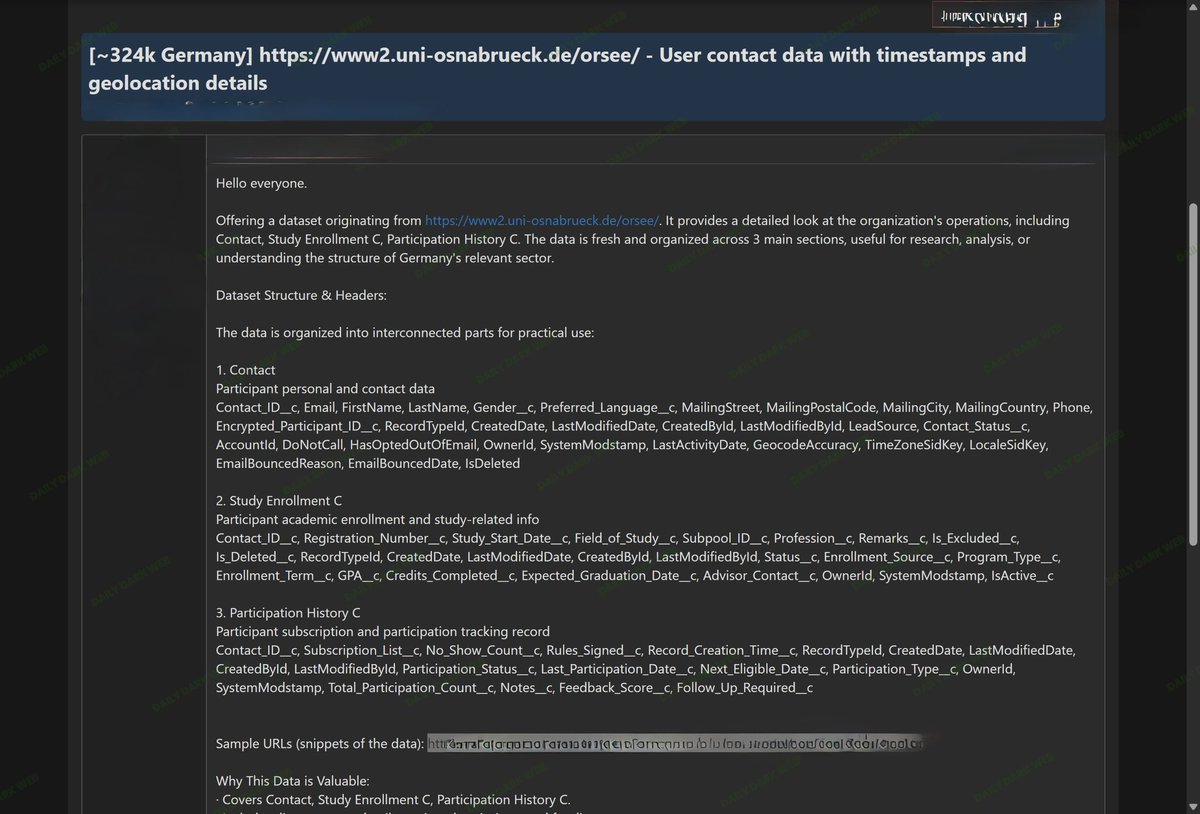
🇩🇪 Alleged dataset linked to Germany’s University of Osnabrück ecosystem (orsee platform) has surfaced on underground forums.
According to the post, the dataset allegedly contains approximately 324,000 records involving:
• User contact information
• Academic enrollment data
• Participation/subscription history
• Timestamped activity records
• Geolocation-related metadata
The leaked structure appears significantly more detailed than a standard university contact database.
The threat actor claims the dataset includes:
• Full names
• Email addresses
• Phone numbers
• Mailing addresses
• Enrollment details
• GPA and academic progression fields
• Participation tracking
• Advisor/contact metadata
• Timezone and locale identifiers
• Activity timestamps
• Geocode accuracy indicators
• Behavioral participation history
If authentic, this would represent a highly structured academic intelligence dataset rather than a simple credential leak.
Universities have become increasingly attractive targets because they simultaneously operate:
• Research environments
• Student ecosystems
• International collaboration networks
• Government-funded projects
• Identity-heavy platforms
• Decentralized infrastructure
• Legacy systems
• Large third-party SaaS integrations
Higher education institutions also typically maintain:
• Massive user populations
• Frequent external collaboration
• Open-access architectures
• Research data repositories
• Federated authentication systems
which collectively create an expanded attack surface.
One particularly concerning aspect in this alleged leak is the combination of:
• Academic records
• Behavioral participation data
• Contact metadata
• Geolocation-related information
• Historical timestamps
because these fields can enable:
• Long-term profiling
• Social engineering
• Identity correlation
• Targeted phishing
• Academic impersonation
• Intelligence collection
• Researcher targeting
This is especially sensitive in international academic ecosystems where:
• Researchers
• Exchange students
• Government-funded academics
• Strategic research programs
may already face elevated cyber or geopolitical targeting risks.
Another important trend is the growing interest of threat actors in “context-rich datasets.”
Modern attackers increasingly prioritize datasets that contain:
• Behavioral patterns
• Historical activity
• Engagement metrics
• Participation history
• Institutional relationships
because these datasets can be operationalized for:
• AI-assisted phishing campaigns
• Credential targeting
• Trust exploitation
• Human intelligence collection
• Fraud personalization
rather than simply selling raw credentials.
Educational and research institutions should continuously review:
• CRM exposure
• Student information systems
• Research collaboration platforms
• Federated identity services
• SaaS integrations
• Access governance
• Data retention policies
• Third-party academic tooling
• Cloud storage permissions
particularly where systems contain:
• Long-term participation tracking
• Identity metadata
• Enrollment analytics
• Research collaboration records
The European higher education sector has increasingly become a target for:
• Ransomware groups
• Credential theft operations
• Espionage-motivated actors
• Initial access brokers
• Data extortion campaigns
especially institutions involved in:
• International research
• Technology programs
• Engineering
• AI research
• Government-funded initiatives
At this stage, the underground forum claims remain unverified and should be treated cautiously until independently validated.
#DDW #Germany #CyberSecurity #DarkWeb #DataLeak #ThreatIntelligence #HigherEducation #AcademicSecurity #ResearchSecurity #GDPR #UniversitySecurity
2
6
3,401

今年アスペアに入社してくれた社員さん(itsukiさん)が、
4年かけて開発してきた地図アプリ「GeoCode-Web」を本日リリースしました🎉
実はitsukiさん、ポートフォリオサイトと個人開発のアプリを見て弊社からスカウトしたメンバーなんです!
"個人開発を真剣にやっている人を、ちゃんと評価する会社でありたい"
そう思って動いた採用が、こうして形になっているのは本当に嬉しいです!
入社の経緯まで綴られた記事、ぜひ読んでみてください👇
1
9
652

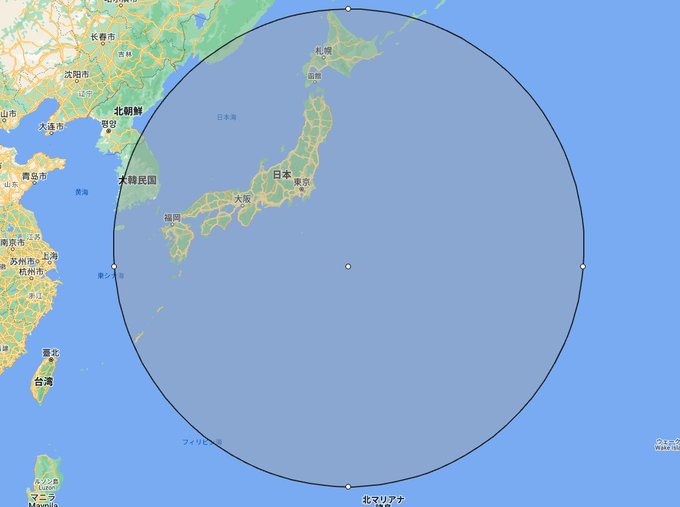
ちょっと前に話題になってたインプレゾンビを検索結果から消すコマンド、AI生成のリプライにもかなり効果ありますね。
「(検索語) lang:ja geocode:30.935364,143.317099,1625km」
とすると国外からの投稿をシャットアウトできます(画像1)
記事で詳しく解説してます↓
itokoba.com/archives/10366
1
3
1,735

May 19
It is a privilege to have been invited as a panelist to talk at the Live Webinar organized by the NCCN this Thursday, May 21st, 8am ET, about The Growing Cancer Burden in Young Adults. All efforts are not enough.
#SECOC #GEOCODE @FightCRC
@NCCN
web.cvent.com/event/cf229247…
5
7
159

May 18
【調査結果 備忘メモ】Hermes Agentを介したX検索で設定できる演算子・フィルター一覧;
ユーザー関連
from:username — 特定ユーザーの投稿
to:username — 特定ユーザーへの返信
@username — 特定ユーザーへのメンション
日付
since:YYYY-MM-DD — 指定日以降
until:YYYY-MM-DD — 指定日以前
since_id: / max_id: — ツイートID指定
エンゲージメント数
min_faves:N — いいね数N以上
min_retweets:N — RT数N以上
min_replies:N — 返信数N以上
メディア・コンテンツ
filter:images / filter:videos / filter:media — 画像・動画・メディア含む
filter:links — リンク含む
filter:replies — 返信のみ
filter:retweets — RTのみ
has:images / has:videos / has:links
言語・場所
lang:ja / lang:en など — 言語指定(ISO 639-1)
geocode:緯度,経度,半径 — 位置情報(例:35.6762,139.6503,10km)
その他
url:keyword — URL・ドメイン含む
source:client_name — 投稿クライアント指定
list: — 特定リストのユーザー
conversation_id: — 特定スレッド内
"exact phrase" — 完全一致フレーズ
OR — いずれかを含む
-keyword — 除外
#hashtag / $cashtag
May 18

さて、次はGrok×Hermes Agentの新機能について調査を始めている。新機能の追加で何が出来るようになったのか。その前提としてHermesを今導入実装中。
2
10
3,446

Bunch of retards. There is no geocode. Hamas attacks and Israel attacked back and fucked then up. That’s WAR. Don’t be a bitch if you’re gonna attack someone.
1
4
570

Quando vc coloca o CEP nas informações de cobrança ela sabe por geocode a localização e quando estiver fora da localização, não vai funcionar mesmo. Nunca coloque o seu CEP nas informações de cobrança kk
1
3
1,596