


it's basing here IMO
1
14
? retweeted

commncez à embrasser ldos dvos meufs en levrette apr on avancera en tant ke societer
18
287
3,435
149,280


that lost ki d who prob was graped by yuge di ldos saved the right fr
Jun 13

The butterfly effect is so funny because Xavier “Vivian” Musk decided to LARP as a woman, leading to Elon becoming radicalised agains the woke mind virus, buying Twitter, saving online free speech, waking up the world, getting Trump elected, and probably ultimately saving the west.
We have a lot to thank him for actually. 😂👏
43
ف retweeted

Jun 12
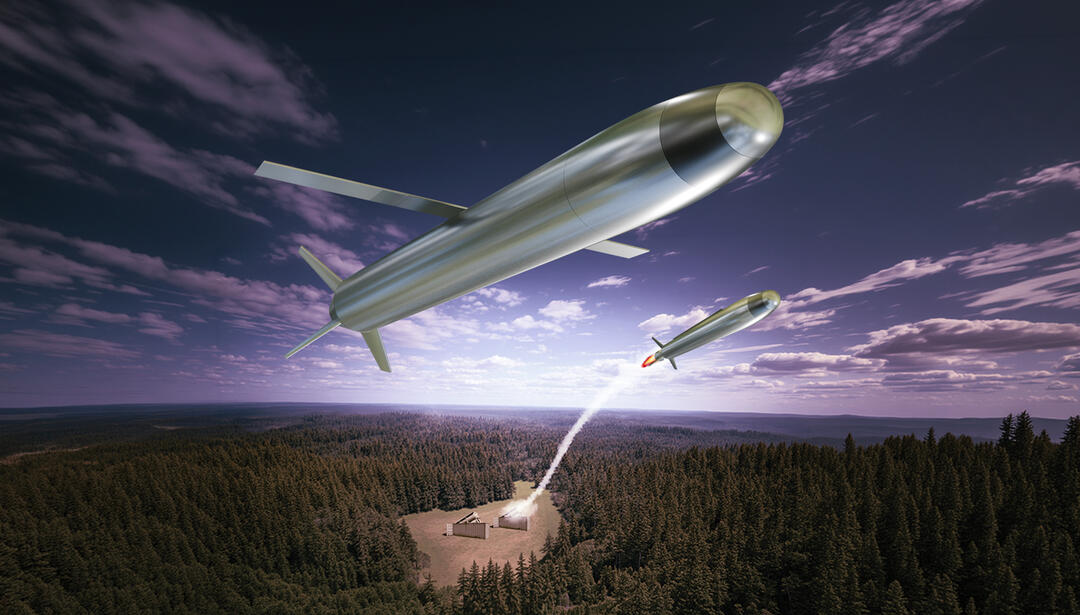
لمحة عن شركة $LDOS وكيف تتحول لتصبح منصة تكنولوجية متكاملة للأنظمة الرقمية والدفاعية الفيدرالية.
تعمل في مجالات الدفاع, وتكنولوجيا المعلومات الأمنية والحلول العلمية لخدمة الحكومات والقطاعات الحيوية.
سهم الشركة يتداول بالقرب من الأدنى السنوي عند 124$ تابع لتعرف أكثر عنها...


2
3
18
16,764

gracias dios x darme amigas como agus y valen q me siguen para todos ldos JAJAJJAJAJAJ
29

22h
Claude Mythos / Fable current restriction:
Spent some more time thinking about implications ..,here are additional ideas...obv this is a day to day dynamic scenario..
**Note there is a high chance Fable/Mythos is back online Monday, however i still treat this news as hints into the future ...,
potential trend: if AI may be evolving from a model race into a distribution, compliance, and sovereignty race....,
“Who controls access, trust, compliance, security, infrastructure, and deployment?”
The Gatekeepers
$MSFT — The biggest winner if AI becomes regulated. Azure Government, OpenAI distribution, enterprise identity, security, and compliance make Microsoft a natural AI gatekeeper.
$AMZN — AWS becomes a trusted intermediary for approved AI access. Bedrock, GovCloud, monitoring, and data sovereignty become increasingly valuable.
$GOOGL — Gemini, Google Cloud, TPUs, and public sector infrastructure position Google as one of the few fully integrated AI providers.
$ORCL — Sovereign cloud may become one of the most important themes of the decade. Oracle is already deeply embedded in regulated and government workloads.
The AI Governance Layer
$PLTR — Perhaps the purest play. If organizations need permissioning, audit trails, monitoring, and secure deployment of frontier models, Palantir sits directly in that workflow.
$IBM — The anti-frontier AI trade. IBM benefits if enterprises prioritize governed, auditable, explainable AI over the largest possible models.
$SNOW — As companies become cautious about sending sensitive data to external models, Snowflake benefits from bringing AI directly to enterprise data.
The Security Winners
$CRWD — Frontier AI raises cyber risk. Every increase in AI capability likely increases demand for AI-native cybersecurity.
$PANW — AI governance, model security, network protection, and zero-trust architecture become more critical.
$CSCO — Enterprises need visibility into where AI is running, who is accessing it, and how data moves across networks.
The Infrastructure Winners
$NVDA — Every sovereign AI effort, private AI deployment, and approved government model still needs compute.
$AMD — Smaller models may broaden inference demand beyond hyperscalers into enterprises, edge devices, and private clouds.
$DELL — Private AI factories, enterprise servers, and on-prem inference infrastructure.
$HPE — GreenLake, private cloud AI, edge deployments, and regulated enterprise environments.
The Small Model Winners
$META — If frontier access becomes restricted, open-weight models like Llama become even more important as alternatives
$AAPL — On-device AI becomes more attractive when privacy, control, and regulatory certainty matter.
$QCOM — Edge AI, AI PCs, smartphones, and local inference all benefit from the rise of efficient small models.
$ARM — The architecture underneath much of the world’s edge AI ecosystem.
The Government Integrators
$BAH — Agencies don’t just buy models. They hire consultants and integrators to deploy them securely.
$LDOS — Deep exposure to defense, intelligence, and federal AI implementation.
The most overlooked implication:
If businesses fear that a frontier API could be restricted, suspended, or regulated overnight, many will choose models they can fully own, audit, and operate themselves.
That could drive a massive shift toward:
• Private AI
• Sovereign AI
• On-prem AI
• Edge AI
• AI security
• Open-weight models
3
3,402
22h
spent some more time thinking about implications ..,here are additional ideas...obv this is a day to day dynamic scenario...***there is a high chance Fable/Mythos is back online Monday, however i still treat this news as hints into the future ...,
**if AI may be evolving from a model race into a distribution, compliance, and sovereignty race....,
“Who controls access, trust, compliance, security, infrastructure, and deployment?”
The Gatekeepers
$MSFT — The biggest winner if AI becomes regulated. Azure Government, OpenAI distribution, enterprise identity, security, and compliance make Microsoft a natural AI gatekeeper.
$AMZN — AWS becomes a trusted intermediary for approved AI access. Bedrock, GovCloud, monitoring, and data sovereignty become increasingly valuable.
$GOOGL — Gemini, Google Cloud, TPUs, and public sector infrastructure position Google as one of the few fully integrated AI providers.
$ORCL — Sovereign cloud may become one of the most important themes of the decade. Oracle is already deeply embedded in regulated and government workloads.
The AI Governance Layer
$PLTR — Perhaps the purest play. If organizations need permissioning, audit trails, monitoring, and secure deployment of frontier models, Palantir sits directly in that workflow.
$IBM — The anti-frontier AI trade. IBM benefits if enterprises prioritize governed, auditable, explainable AI over the largest possible models.
$SNOW — As companies become cautious about sending sensitive data to external models, Snowflake benefits from bringing AI directly to enterprise data.
The Security Winners
$CRWD — Frontier AI raises cyber risk. Every increase in AI capability likely increases demand for AI-native cybersecurity.
$PANW — AI governance, model security, network protection, and zero-trust architecture become more critical.
$CSCO — Enterprises need visibility into where AI is running, who is accessing it, and how data moves across networks.
The Infrastructure Winners
$NVDA — Every sovereign AI effort, private AI deployment, and approved government model still needs compute.
$AMD — Smaller models may broaden inference demand beyond hyperscalers into enterprises, edge devices, and private clouds.
$DELL — Private AI factories, enterprise servers, and on-prem inference infrastructure.
$HPE — GreenLake, private cloud AI, edge deployments, and regulated enterprise environments.
The Small Model Winners
$META — If frontier access becomes restricted, open-weight models like Llama become even more important as alternatives
$AAPL — On-device AI becomes more attractive when privacy, control, and regulatory certainty matter.
$QCOM — Edge AI, AI PCs, smartphones, and local inference all benefit from the rise of efficient small models.
$ARM — The architecture underneath much of the world’s edge AI ecosystem.
The Government Integrators
$BAH — Agencies don’t just buy models. They hire consultants and integrators to deploy them securely.
$LDOS — Deep exposure to defense, intelligence, and federal AI implementation.
The most overlooked implication:
If businesses fear that a frontier API could be restricted, suspended, or regulated overnight, many will choose models they can fully own, audit, and operate themselves.
That could drive a massive shift toward:
• Private AI
• Sovereign AI
• On-prem AI
• Edge AI
• AI security
• Open-weight models
2
223

Jun 13
A atlética kodama declara que hoje é o dia oficia ldos ex namorados!!! Podem se declarar a vontade.
 IV ★
IV ★
1
10
320
VIKITA retweeted

Jun 12
But who told them to use d*ldos and v*brators .....
Our parents could not complain mbuu 1 mins .......
1
1
1
136
Jun 13
لمحة عن شركة $LDOS الامريكية
Jun 12

لمحة عن شركة $LDOS وكيف تتحول لتصبح منصة تكنولوجية متكاملة للأنظمة الرقمية والدفاعية الفيدرالية.
تعمل في مجالات الدفاع, وتكنولوجيا المعلومات الأمنية والحلول العلمية لخدمة الحكومات والقطاعات الحيوية.
سهم الشركة يتداول بالقرب من الأدنى السنوي عند 124$ تابع لتعرف أكثر عنها...
3
7,113

Jun 13
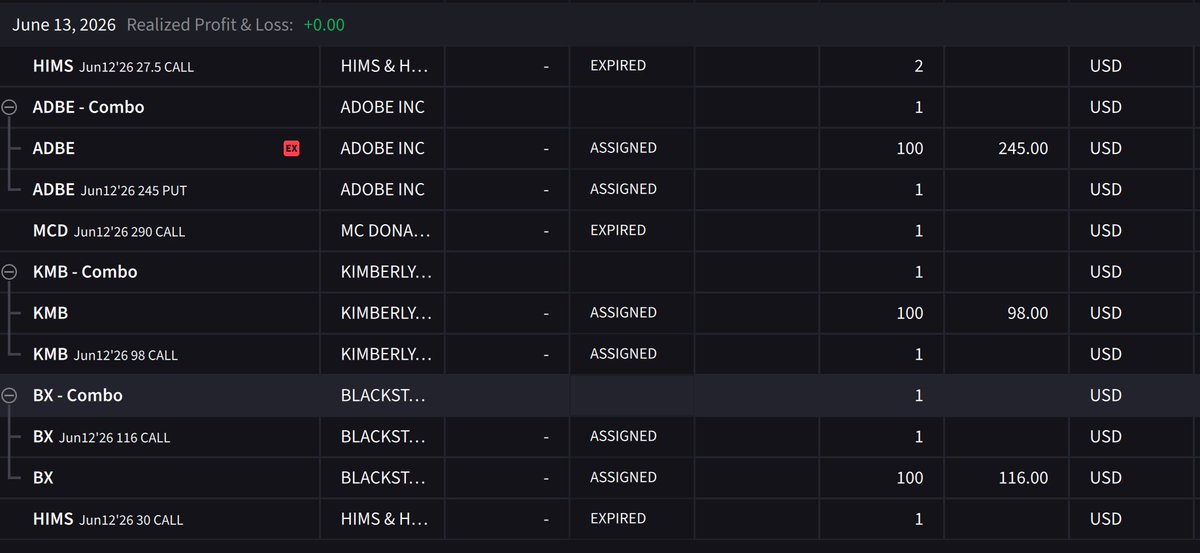
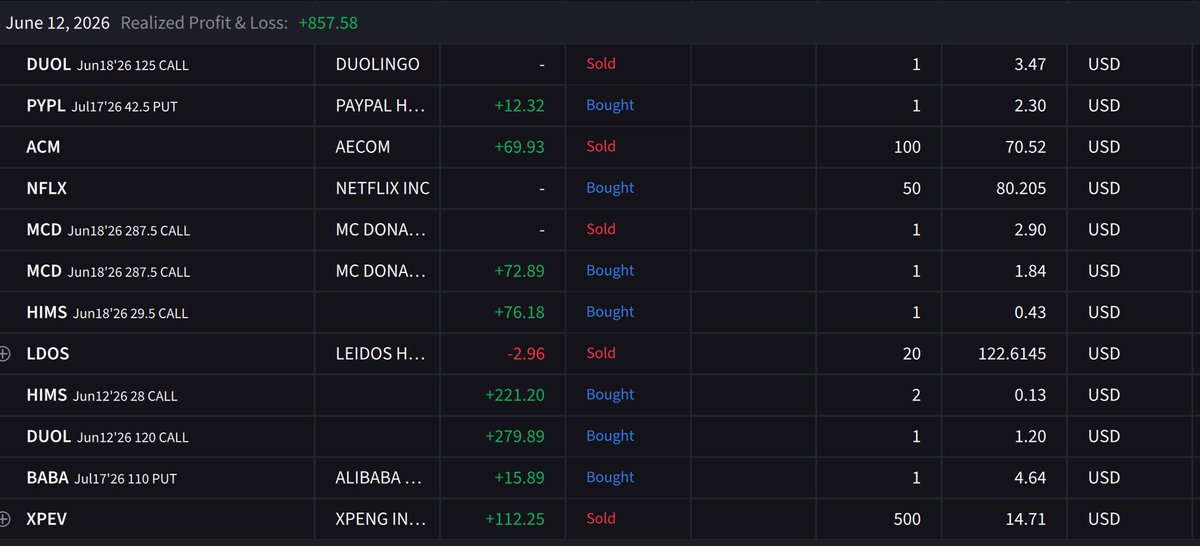
June 12 Realized P&L: $857.58 ✅
June 13 Realized P&L: $0.00 (expirations)
Equity:
BUY $NFLX 50 x $80.205 → $4,010
Options:
SELL $DUOL Jun18'26 125 CALL 1x $3.47
BUY $PYPL Jul17'26 42.5 PUT 1x $2.30 ( 12.32 realized)
SELL $ACM 100 x $70.52 ( $69.93 realized)
SELL $MCD Jun18'26 287.5 CALL 1x $2.90
BUY $MCD Jun18'26 287.5 CALL 1x $1.84 ( 72.89 realized)
BUY $HIMS Jun18'26 29.5 CALL 1x $0.43 ( 76.18 realized)
SELL $LDOS 20 x $122.61 (-$2.96 realized)
BUY $HIMS Jun12'26 28 CALL 2x $0.13 ( 221.20 realized)
BUY $DUOL Jun12'26 120 CALL 1x $1.20 ( 279.89 realized)
BUY $BABA Jul17'26 110 PUT 1x $4.64 ( 15.89 realized)
SELL $XPEV 500 x $14.71 ( $112.25 realized)
June 13 (options expirations):
$HIMS Jun12'26 27.5 CALL 2x EXPIRED
$MCD Jun12'26 290 CALL 1x EXPIRED
$HIMS Jun12'26 30 CALL 1x EXPIRED
June 13 (options assignments):
$ADBE BUY 100 shares @ $245.00 = -$24,500 (put assignment)
$KMB SELL 100 @ $98 → $9800 (call assignment)
$BX SELL 100 shares @ $116.00 = $11,600 (call assignment)
Total Net Cash from the three combos today: -$24,500 (ADBE) $9800 (KMB) $11,600 (BX) = -$3,100
145

Jun 12
#米国株 #usstocks
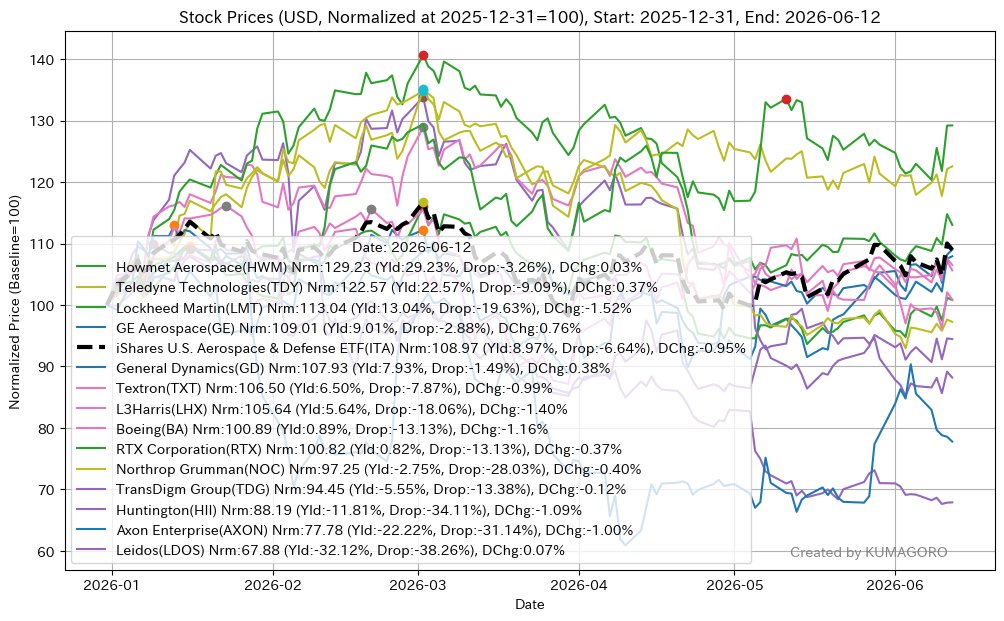
防衛・航空関連企業 / Defense and Space-related companies
Legend (sorted by Yld, Date: 2026-06-12)
Howmet Aerospace(HWM) Yld:29.23%, Drop:-3.26%), DChg:0.03%
Teledyne Technologies(TDY) Yld:22.57%, Drop:-9.09%), DChg:0.37%
Lockheed Martin(LMT) Yld:13.04%, Drop:-19.63%), DChg:-1.52%
GE Aerospace(GE) Yld:9.01%, Drop:-2.88%), DChg:0.76%
iShares U.S. Aerospace & Defense ETF(ITA) Yld:8.97%, Drop:-6.64%), DChg:-0.95%
General Dynamics(GD) Yld:7.93%, Drop:-1.49%), DChg:0.38%
Textron(TXT) Yld:6.50%, Drop:-7.87%), DChg:-0.99%
L3Harris(LHX) Yld:5.64%, Drop:-18.06%), DChg:-1.40%
Boeing(BA) Yld:0.89%, Drop:-13.13%), DChg:-1.16%
RTX Corporation(RTX) Yld:0.82%, Drop:-13.13%), DChg:-0.37%
Northrop Grumman(NOC) Yld:-2.75%, Drop:-28.03%), DChg:-0.40%
TransDigm Group(TDG) Yld:-5.55%, Drop:-13.38%), DChg:-0.12%
Huntington(HII) Yld:-11.81%, Drop:-34.11%), DChg:-1.09%
Axon Enterprise(AXON) Yld:-22.22%, Drop:-31.14%), DChg:-1.00%
Leidos(LDOS) Yld:-32.12%, Drop:-38.26%), DChg:0.07%
1
87

JoeFree retweeted

Jun 11
$LDOS... took a starter position on it.
I was hoping to get it on super sale... and maybe I'll get the qty I want if the market stays volatile. But at 11x, I'd feel like an idiot if I didn't have any.
2
1
6
751
Jun 12
شركات مستفيدة من #SPACEX عن طريق الشراكات والإتفاقيات بينهم 🚀🛰️
شركة $STM توفر رقائق (chips) راديوية وإلكترونية لأقمار Starlink والأجهزة الأرضية.
شركة $GOOG استثمرت حوالي 900 مليون دولار في 2015 (مع Fidelity)، وتملك حوالي 6-7% من سبيس إكس.
شركة $LDOS شراكات غير مباشرة وفي مجال الدفاع/الفضاء.
شركة $TSLA شراكة قوية جداً ومتداخلة مع سبيس إكس (SpaceX) بسبب إيلون ماسك.
شركة $ASTS تعاون محتمل في الاتصالات المباشرة من الفضاء.
شركة $RDW توفر بنية تحتية ومكونات فضائية لمهمات.
شركة $MTRN تبيع مواد وسبائك خاصة مقاومة للحرارة تستخدم في صاروخ Starship.
شركة $HON مورد أنظمة تحكم وإلكترونيات طيران.
شركة $SATS اشترت سبيس إكس spectrum (ترددات لاسلكية) منها بقيمة حوالي 17 مليار دولار (نصفه نقدي ونصفه أسهم في سبيس إكس).
Jun 11
لمحة عن الاكتتاب الأضخم في التاريخ شركة سبيس إكس | #SPACEX
الحدث الاستثماري الأضخم 🔔
تتجه الأنظار إلى بورصة ناسداك حيث تستعد SpaceX لطرح أسهمها غدًا وبتقييم حدود 1.75 تريليون دولار وسعر 135$ للسهم..
لو مهتم في الشركة تابع معي هذه اللمحة..
4
3
36
17,175
