
@SoSoValueCrypto
🔥 SoSoValue 仮想通貨スポットライト情報 | 6月15日
Top 3 📈 - LRTFi 11.83% / ETF Candidates 11.26% / LSDFi 10.98%
Top 3 📉 -
#SoSoValue についての重要情報をさらに探る: sosovalue.com/shares/XtALbB
26

Jun 10
@SoSoValueCrypto
🔥 SoSoValue 仮想通貨スポットライト情報 | 6月10日
Top 3 📈 -
Top 3 📉 - DeFAI -16.33% / PerpDEX -9.40% / LSDFi -6.90%
#SoSoValue についての重要情報をさらに探る: sosovalue.com/shares/XtALbB
23


7/
The ecosystem reflects the infrastructure:
→ Helix: flagship DEX, derivatives & spot trading
→ Hydro Protocol: liquid staking & LSDfi
→ DojoSwap: AMM
→ Mito: launchpad & vaults and lots more are driving ecosystem growth across every DeFi vertical.
1
11
20

May 30
If you think liquid staking is just about earning passive yield while keeping your tokens moving, it’s time to look deeper.
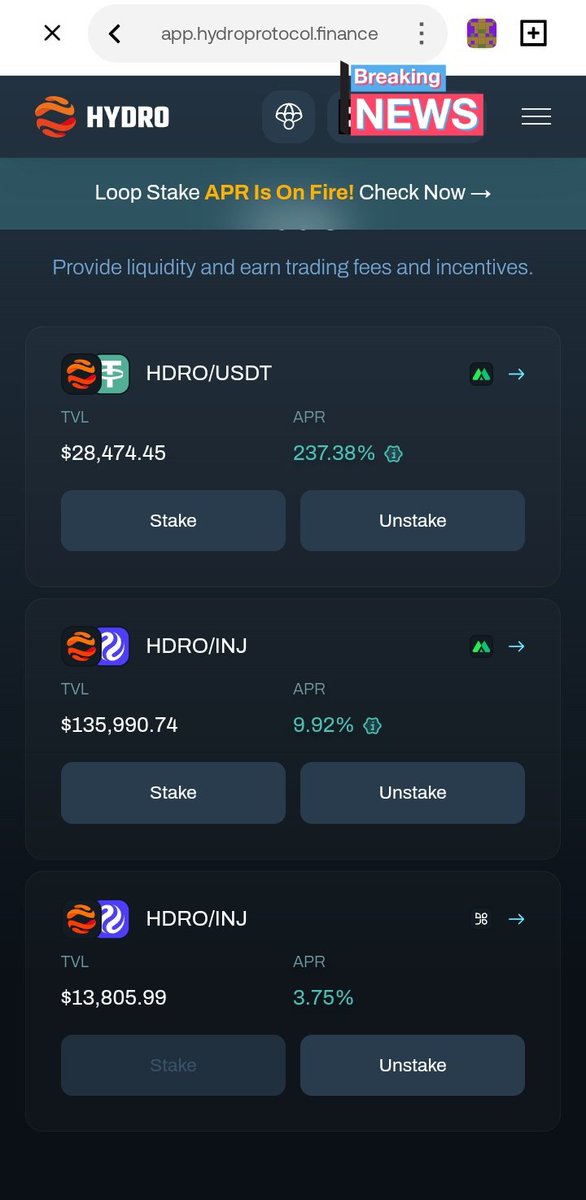
On @injective, @hydro_fi isn't just an app it is the foundational LSD and LSDFi infrastructure layer driving the network's economic momentum.
Here is a quick look at the elite financial mechanics making Hydro protocol incredibly bullish.
❖ The Core Engine:
Liquid Staking $hINJ Hydro solves the opportunity cost of traditional staking where your tokens are frozen.
🔹1:1 Minting:
You deposit native $INJ, and the smart contract programmatically mints $hINJ on a strict 1:1 ratio.
🔹 Instant Liquidity:
You continuously earn network staking rewards while holding a fluid asset $hINJ that can be instantly deployed into external money markets like Neptune or automated trading loops.
🔹 Optimized Security:
Hydro automatically delegates your underlying $INJ strictly to top-tier validators maintaining >99\% uptime and ultra-low commissions.
❖ Auto-Compounding & Farming:
Hydro protocol eliminates the structural inefficiencies of manual yield gathering:
🔹Auto-Compounding:
No more claiming rewards manually and burning gas to restake. Hydro protocol automates this routine on-chain to mathematically maximize your compound net APY.
🔹The Yield Farm:
Users can stake their minted $hINJ into dedicated farming pools to capture an additional layer of yield paid out in the protocol’s native token, $HDRO.
❖ Real Yield Assets (RYAs):
To graduate past basic inflationary rewards, Hydro engineered a novel financial asset called the Real Yield Asset (RYA).
Think of an RYA like an indexed crypto ETF. It aggregates diverse, non-inflationary yield streams into a single token "basket".
These components combine validator staking rewards, perp DEX fee shares, and highly lucrative yields from Real-World Assets (RWAs) like tokenized treasuries.
Hydro protocol is rapidly scaling its mission to become the premier money market for on-chain Real World Assets on $INJ while aggressively expanding outward to tap deep cross-chain liquidity from Ethereum.
By fundamentally stacking structural staking rewards on top of real-world yield, Hydro isn't just optimizing APY it's securing the monetary future of the entire Injective ecosystem.

May 30

Most people see lending protocols as simple digital pawnshops. But under the hood, @neptune_finance is building a highly sophisticated credit infrastructure layer optimized for capital efficiency.
If you want to understand how money markets actually scale on the fastest L1, let’s break down the mechanics.
Traditional finance relies on direct peer-to-peer matching, which is slow and illiquid.
But Neptune utilizes a Shared Liquidity Pool model, Lenders supply assets like $INJ, $ATOM, and stablecoins into unified smart contracts.
In return, they receive nTokens (e.g., nINJ) interest-bearing receipt assets that appreciate in value relative to the underlying token as interest accumulates.
Borrowers access these pools instantly by depositing over-collateralized assets to secure their debt, eliminating the need for a counterparty wait time.
----------- • < ◇ > • -----------
➔ PID-Controlled Interest Rates
Fixed or linear interest rates often fail during high market volatility, leading to liquidity crises.
Neptune solves this using a PID (Proportional-Integral-Derivative) controller algorithm that dynamically adjusts rates based on real-time Market Utilization (U):
U ={Total Borrowed Assets}\t{Total Deposited Assets}
◇Low Utilization: Rates drop automatically to make borrowing cheap and incentivize capital movement.
◇High Utilization: If liquidity thins out, the algorithm aggressively spikes interest rates. This rewards lenders with massive yields to attract fresh capital while forcing borrowers to repay and protect the pool from insolvency.
----------- • < ◇ > • -----------
➔ Institutional Risk Management
Neptune separates itself from basic money markets through advanced account structuring:
◇Cross-Margin Accounts: Users can bundle different assets (e.g., $INJ and $ATOM) to back a single borrow position, maximizing capital efficiency and reducing isolated liquidation risks.
◇Isolated Subaccounts: Traders can create distinct subaccounts within a single wallet interface.
This allows them to run high-leverage, high-risk strategies in one pocket without exposing their safer, long-term passive lending collateral.
----------- • < ◇ > • -----------
Neptune is built natively on @injective Tendermint-based L1 infrastructure, it acts as a foundational Lego block for advanced DeFi strategies.
Traders can take Liquid Staking Tokens (LSTs) like Hydro’s hINJ or yINJ, deposit them into Neptune as collateral, borrow stablecoins, and route that liquidity back into DEXs like @HelixMarkets for yield looping all with sub-second execution and near-zero gas fees.
@neptune_finance isn’t just a dApp; it’s the institutional-grade credit rail that keeps capital fluid across the entire @injective ecosystem.

3
2
20
1,444

May 28
Meme 创造流量。
Lista 创造收益。
Vault 将它们沉淀为储备。
这或许是 FLAP 上第一次,
有人真正把 Meme 与 LSDfi Treasury 融合在一起。
$VAULT

3
44
May 28
Meme 创造流量。
Lista 创造收益。
Vault 将它们沉淀为储备。
这或许是 FLAP 上第一次,
有人真正把 Meme 与 LSDfi Treasury 融合在一起。
$VAULT

3
42

May 27
很多人可能还没有意识到,FLAP @flapdotsh 推出的 Lista 流动性质押金库,真正重要的地方其实不是“分红”,而是:
它第一次尝试把 Meme 社区流量,
真正接入 BNB Chain 的链上收益体系。
在过去,Meme 和 DeFi
在大多数时候其实是割裂的。
Meme 负责:
热度、传播、社区、交易量。
而 DeFi 负责:
质押、收益、资金效率、链上基础设施。
双方都很强,
但始终没有真正融合。
所以大部分 Meme 最终都只能停留在:
短期情绪、流动性博弈、以及快速轮动上。
因为它们无法真正进入链上的收益循环。
但这一次,
FLAP 做了一件很有意思的事情:
它没有继续沿用传统的 BNB / USDT 分配逻辑。
而是直接把 Meme 的交易税,
接入 Lista DAO @lista_dao 的 slisBNB 生息体系。
这背后的逻辑其实很深。
因为这意味着:
Meme 社区产生的交易行为,
开始持续流向 BNB 的链上质押生态。
交易量越高,
进入 Lista 的 BNB 就越多。
而 slisBNB,
又会随着时间持续累积质押收益。
也就是说:
过去只会“消耗流动性”的 Meme 交易,
第一次开始反向增强 BNB Chain 的收益基础设施。
这是一个很微妙、
但可能非常重要的变化。
因为从生态角度看:
FLAP 提供的是:
BNB Chain 最活跃的 Meme 社区流量。
Lista DAO 提供的是:
BNB Chain 的 LSDfi 与生息基础设施。
而这个模板,
则第一次把两者真正连接了起来。
所以它的意义,
可能已经不只是一个“新税币玩法”。
而是在尝试回答一个问题:
Meme,
能不能不只是短期投机工具;
而是真正成为:
BNB Chain 链上收益体系的一部分。
所以真正值得关注的或许是
BNB Chain 的 Meme 生态,是否会由此进入下一阶段?
C总曾提出的 Meme 3.0
是否已经在不知不觉间悄然到来?
更有意思的是:
FLAP 此前在@EASYResidency毕业演示时
展示的正是这一税币机制
并且在之后获得了@yzilabs 的战略投资
如今 FLAP 和 Lista DAO
都属于币安@binance 官方支持的生态。
而像 $VAULT 这样的项目,
在我看来,其实已经可以被看作:
币安链上生态内部,
一次非常典型的 Meme × LSDfi 融合实验。
如果这个模式能够跑通,
那么未来 BNB Chain 上的 Meme,
可能会开始从:
“单纯制造波动”
逐渐转向:
“持续向链上收益体系导入流动性与质押需求。”
而这,
或许才是这个模板真正的前瞻性之所在。
@eth_cedric @irene_cc06
@webhogwatrs

6
11
23
997

May 15
2026-05-15 #Web3 #交互任务
1️⃣ Ethena Season 3 @ethena_labs
合成美元与收益协议第三阶段积分活动
任务:持有 USDe / 参与质押 / 获取 Season 积分 / 保持活跃
链接:ethena.fi/
2️⃣ Resolv Protocol @resolvlabs
稳定币收益与 Delta Neutral 策略协议
任务:存入稳定币 / 获取积分 / 持续交互
链接:resolv.xyz/
3️⃣ Term Finance @term_labs
固定收益与链上借贷协议
任务:存入资产 / 借贷操作 / 提升活跃等级
链接:term.finance/
4️⃣ Morpho Blue @MorphoLabs
去中心化借贷优化协议主网活跃阶段
任务:存款 / 借贷 / 长期链上交互 / 积分累积
链接:morpho.org/
5️⃣ Dolomite Margin @Dolomite_io
保证金交易与借贷协议
任务:存款 / 借贷 / 多次交互 / 获取长期资格
链接:dolomite.io/
6️⃣ Lista DAO @lista_dao
稳定币借贷与 LSDfi 协议
任务:质押 BNB / 借出 lisUSD / 获取积分资格
链接:lista.org/
7️⃣ Venus Prime @VenusProtocol
BNB Chain 借贷与收益协议 Prime 阶段
任务:存入资产 / 借贷 / 保持长期资金活跃
链接:venus.io/
8️⃣ Elixir Network @elixir
机构级流动性与稳定币收益协议
任务:存入稳定币 / 获取积分 / 提升活跃度
链接:elixir.xyz/
#Crypto #AirdropHunter #DeFi #Stablecoin
5
1,909

May 13
每日快讯看 #非小号 !5月13日资讯小报
热门榜
BTC (比特币) - 现价约 $61,150: 大盘近期处于震荡盘整期,链上活跃度略有回落,但恐慌贪婪指数依然处于“贪婪”区间。市场正在蓄力,机构层面的 ETF 资金博弈仍在继续。
ETH (以太坊) - 现价约 $2,885: 受到华尔街机构持续布局 RWA(真实世界资产)赛道的利好刺激,以太坊生态的资金关注度居高不下。
SUI (Sui) - 现价约 $1.13: 今日市场绝对的焦点!因纳斯达克上市机构持仓引发了经典的“供应冲击 (Supply Shock)”,SUI 盘中一度暴涨 31%,全网热度爆表。
HYPE (Hyperliquid): 市场首个 Hyperliquid ETF 挂牌上市,打破了去中心化衍生品协议(DEX)与传统金融的次元壁。
涨幅榜
LUNC (Terra Luna Classic): 12.43% (沉寂已久的老币突然发力,社区炒作资金再次回流)
UNI (Uniswap): 8.23% (DeFi 龙头展现强劲韧性)
SUI (Sui): 7.17% (经历盘中飙升后回落企稳,日内整体涨幅依然可观)
LDO (Lido DAO): 2.30% (LSDFi 赛道资金稳步流入)
TRX (波场): 2.14%
热点快讯
华尔街“抢滩登陆”,RWA 赛道迎两项重磅利好传统金融巨头正在加速拥抱 Web3。稳定币发行商 Circle 在资产管理巨头贝莱德(BlackRock)的支持下,推出了全新的“Arc”区块链。与此同时,摩根大通(JPMorgan)也紧随其后,在以太坊上推出了其第二支代币化货币市场基金(JLTXX)。传统金融体系的资金正在加速上链。
首个 Hyperliquid ETF 上市,表现“非常稳健”去中心化衍生品交易平台 Hyperliquid 迎来历史性时刻,其首个 ETF 正式进入传统交易市场,华尔街分析师评价其首日交易表现“非常扎实”。这是 DeFi 走向主流合规的重要里程碑。
币安 5.13 全球峰会,CZ 等大咖共探 Web3 未来币安于今日举办了“Binance Online”全球直播峰会。CZ(以币安及 Giggle Academy 创始人身份)、何一(Yi He)等行业领袖悉数登场,重点探讨了机构入场、AI 与 Crypto 的深层融合以及稳定币的演进方向。
CFTC 站台 Kalshi,预测市场迎合规曙光在围绕预测市场司法管辖权的法律斗争中,美国商品期货交易委员会(CFTC)在俄亥俄州表态支持 Polymarket 的强劲对手 Kalshi。这一监管层面的积极信号,或将为今年持续爆火的 Web3 预测市场扫清部分合规障碍。
更多行业热门前沿
关注非小号:FXH.AI
3
1,440

感谢 @Foresight_News 搭建这个高质量的创作者共创平台,与各位伙伴共同复盘 Kelp DAO、Drift 连环安全事件后,Biteye观察到行业已形成高度一致的共识:这轮暴雷并非 DeFi 的危机,而是Defi从「野蛮生长」走向「成熟重定价」的必然催化剂。以下是小编总结的几个共识👇
1️⃣市场心态正在完成一次结构性切换 - 从「收益优先」转向「风险收益比优先」。
2️⃣真正的链上金融与过去靠代币补贴堆叠的 yield farming 正在被清晰切割。
3️⃣可组合性曾是 DeFi 的最大骄傲,如今被重新认知为‘风险的可组合性’:跨链底层信任假设被严重低估,再质押/LSDFi 本质上是同一笔资产的隐形杠杆叠加,一旦底层脱锚,风险就会像连锁反应一样快速蔓延至整个生态。
4️⃣普通散户高 APY 流动性挖矿的时代红利已基本结束。主流稳定币 LP 的真实年化已压至 3-8%(扣除 gas、无常损失、尾部风险后更低),而 RWA/tokenized Treasury 提供了风险更透明、收益更确定的替代方案。
5️⃣未来 DeFi 的机会,不再属于追逐补贴的赌徒,而是属于那些愿意把链上当作基础设施、主动理解信任假设、严格执行最小权限原则、并接受合理风险收益比的长期主义者。
6️⃣这轮洗牌虽带来阵痛,却正在加速行业重建信任:更透明的信息披露、更严谨的权限模型、AI 辅助下的智能审计,以及对‘非人类签名者’的全新授权框架。
Biteye 很荣幸能与 Foresight News 一起见证并记录这一转变 - DeFi 没有倒退,它正在长大。

9
11
1,949

May 12
🤨链上安全频发,我们对黑客真的束手无策吗?
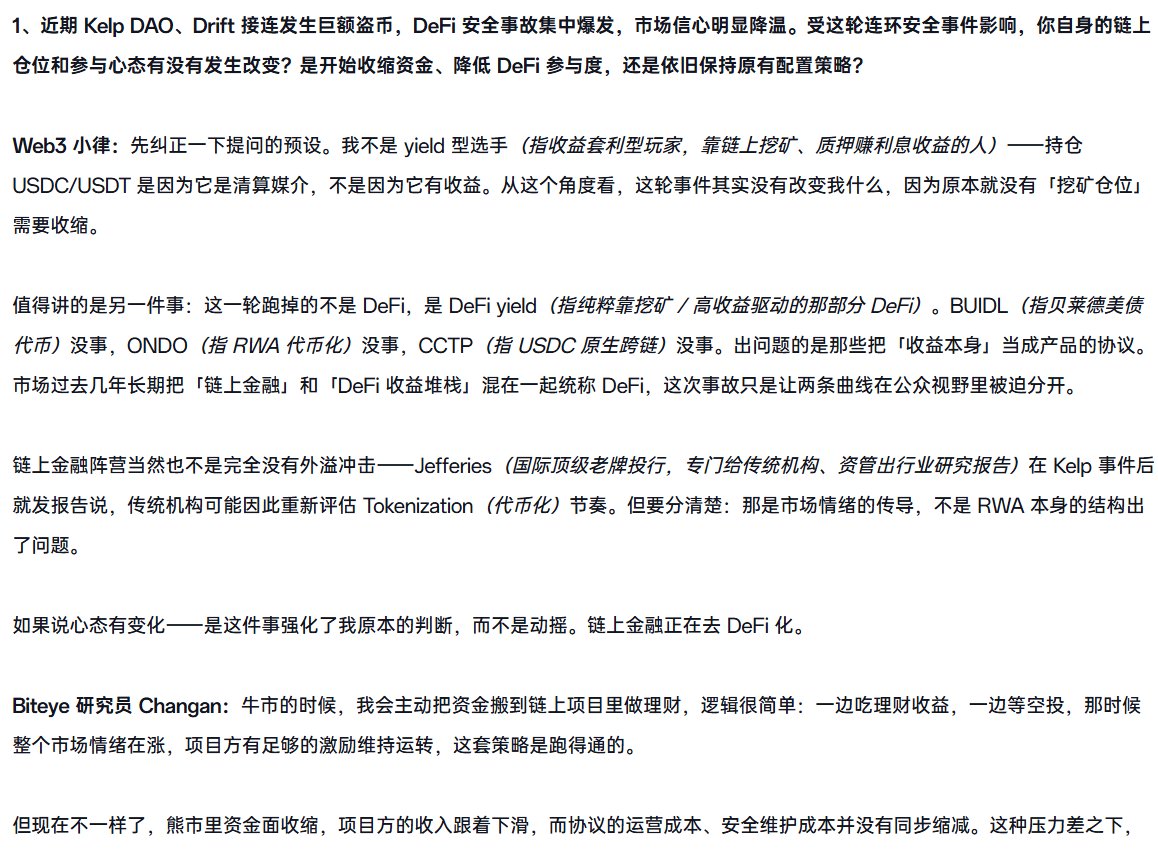
近期 DeFi 行业暴雷事件密集上演,Kelp DAO、Drift 等项目接连遭遇巨额盗币,安全防线频频失守,不仅导致市场信心大幅受挫,也让行业再次陷入对风险与价值的深度思考。
本期「创作者说」聚焦「DeFi 安全」,我们邀请到了 2026 年 4 月 Foresight News 优秀创作者榜单中的 Web3 小律 @Will_7th 、 @BiteyeCN 研究员 Changan 、 @0xBlockBooster 研究员 Kevin、 @Grvt_zh 深研学院、 @0xUClub 的 Oscar、 @Biya_News 、 @JeanW0708 、富贵 以及 币贝研究院 @Bitbase_cn 加入到本期讨论中。
我们抛出以下 5 个问题,看看老师们都给出了哪些精彩见解:
1⃣「盗币是否改变仓位心态」
2⃣「跨链是否被过度炒作」
3⃣「LSDFi 是收益还是风险」
4⃣「散户还可以挖 DeFi 矿吗」
5⃣「AI DeFi 安全利弊如何」
9
4
13
2,791

May 11
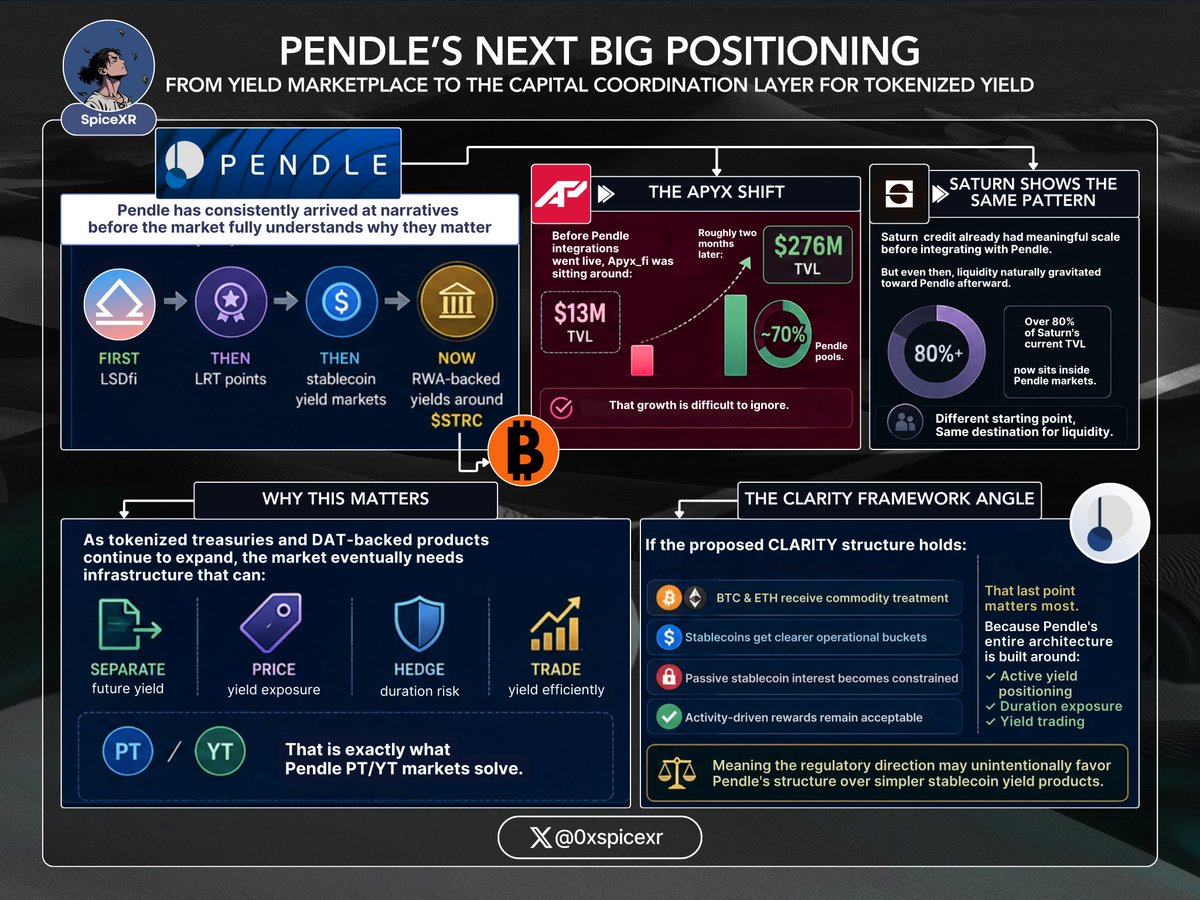
It’s becoming clear that @pendle_fi has a consistent habit of arriving at narratives before the market fully understands why they matter
We saw it with LSDfi
Then LRT points
Then stablecoin yield markets
Now, it’s happening again with RWA-backed yields around $STRC
What’s becoming increasingly clear is that pendle is no longer just a yield marketplace riding narratives. It’s becoming the capital coordination layer for tokenized yield itself
The recent @apyx_fi and @saturn_credit growth makes that hard to ignore
Before Pendle integrations went live, Apyx was sitting around $13M tvl. Roughly two months later, it crossed $276M, with almost 70% of that liquidity now concentrated inside @pendle_fi pools
Saturn tells an equally important story, but from a different angle
Unlike Apyx, Saturn already had meaningful scale before integrating with Pendle. Yet despite that, liquidity naturally gravitated toward Pendle afterward, with over 80% of Saturn’s current tvl now sitting inside Pendle markets
As tokenized treasuries and DAT-backed products continue to expand, the market eventually needs infrastructure that can separate, price, hedge, and trade future yield exposure efficiently
That is exactly what @pendle_fi PT/YT markets solve
The proposed CLARITY framework is a major example here
If the current structure holds:
> BTC and ETH fall under commodity treatment
> Stablecoins get clearer operational buckets
> Passive stablecoin interest becomes constrained
> Activity-driven rewards remain acceptable
it could unintentionally favor Pendle’s architecture over simpler stablecoin yield products
Institutions entering onchain finance won’t just need exposure to tokenized assets
They’ll need fixed yield venues, duration markets, and liquidity layers sophisticated enough to structure those positions efficiently
@pendle_fi is already positioning itself there before most people realize the shift is happening
And if protocols like Apyx and Saturn are early indicators, the market may already be choosing where tokenized yield liquidity wants to live
25
51
269
103,559

Scaling innovation with artistic precision. 🦾 @PrismaXai
Prisma X is crafting the next masterpiece in decentralized finance.
We aren't just building a protocol; we're designing the future of liquidity.
The evolution is on-chain. 🎨#PrismaX #Web3 #LSDfi #DeFi #ScalingFuture

1
7
76

May 8
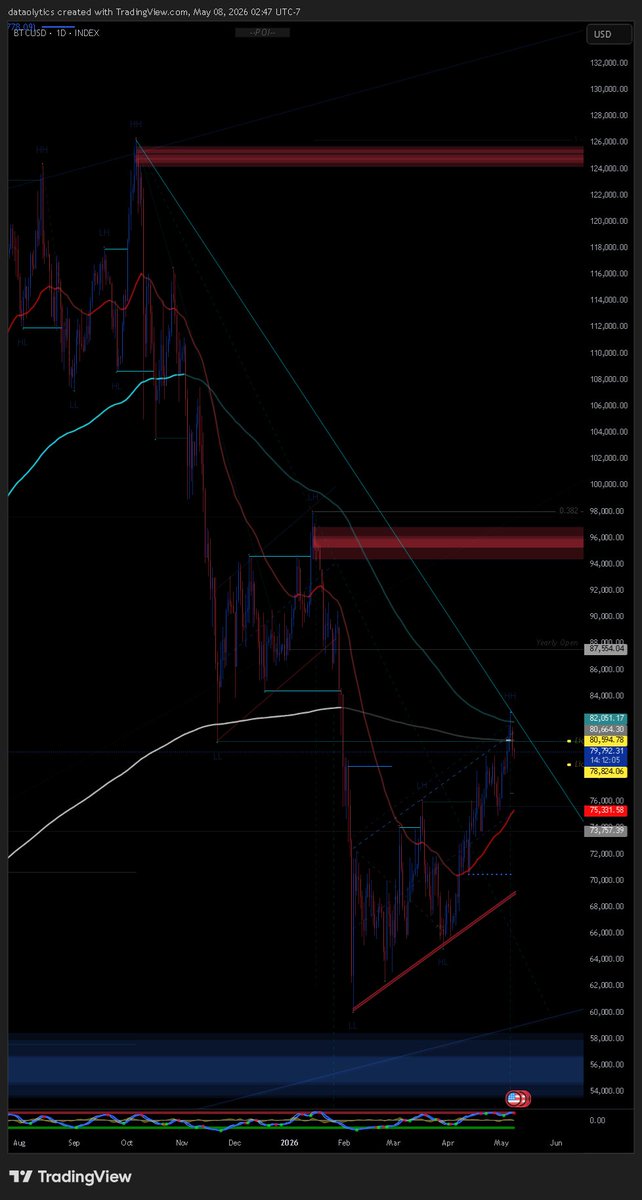
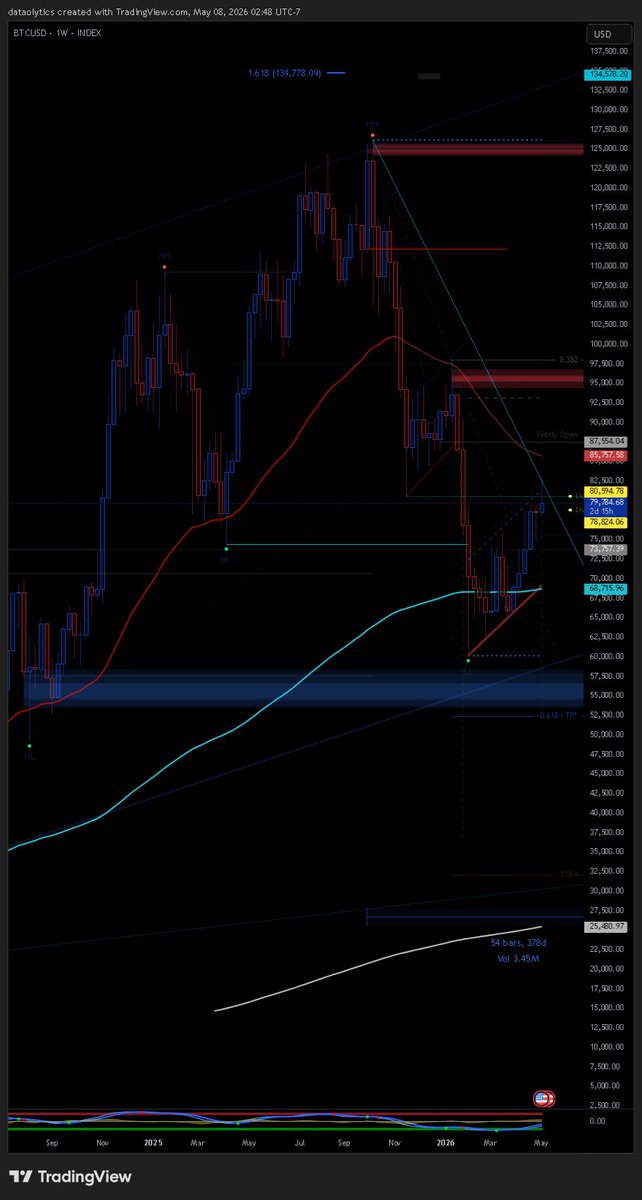
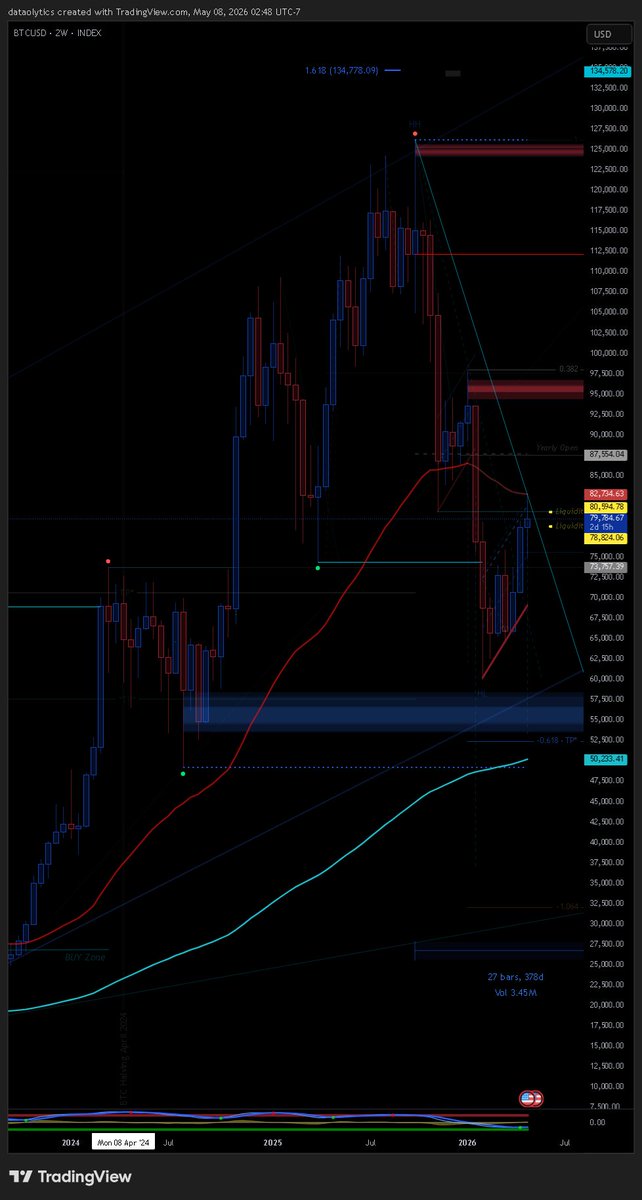
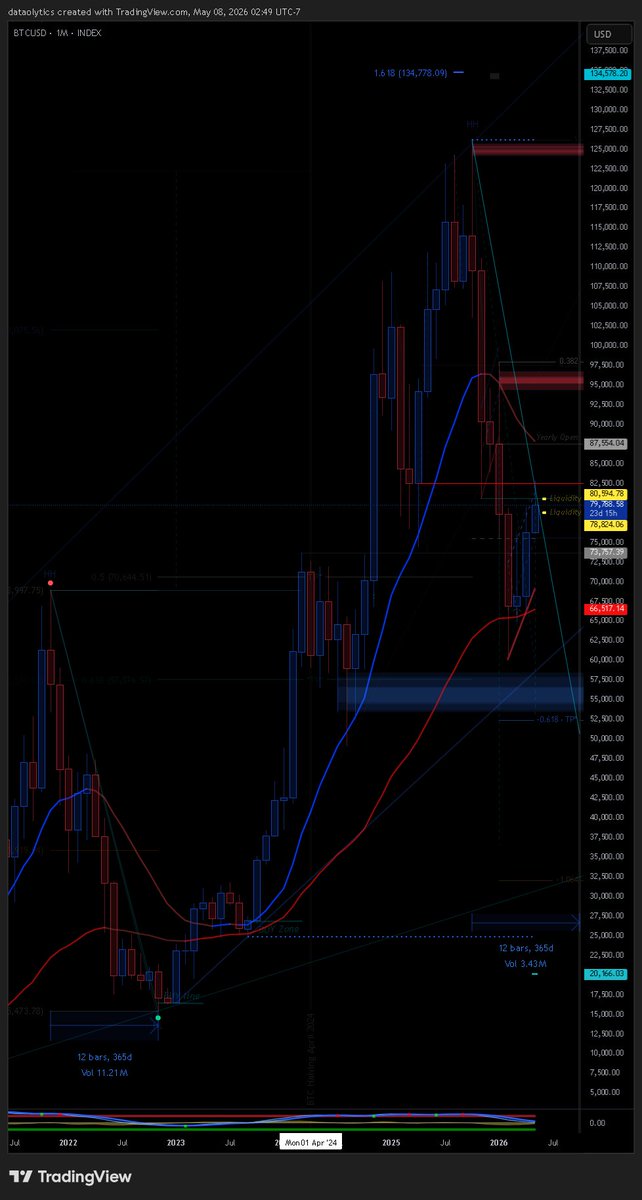
May, Week 2 2026
#Crypto
#DigitalAssets
CORE MARKET (LIQUIDITY ANCHORS)
$BTC $ETH $XRP
$SOL $BNB
L1 / L2 / INFRASTRUCTURE (REAL ROTATION LAYER)
$AVAX SUI SEI $APT $ARB $OP
$INJ KAS $QNT $HBAR $ATOM $POL
TIA TAO $NEAR $ONDO
$TIA - modular data layer leader
$SEI - trading-focused high velocity L1
$SUI - institutional high-performance L1 leader
$KAS - PoW infrastructure momentum leader
$TAO - decentralized AI infrastructure layer
AI / DATA / COMPUTE (PRIMARY GROWTH NARRATIVE)
RNDR FET TAO
GRT TRAC OCEAN
AKT IO GRASS
ARKM RAY AXL
RNDR - institutional GPU / AI proxy leader
TAO - decentralized machine learning network
FET - AI agent infrastructure narrative
IO - GPU compute marketplace
GRASS - AI data acquisition layer
ARKM - on-chain intelligence leader
DEFI / REAL YIELD / FINANCIAL LAYER
AAVE MKR SNX
ONDO CFG RUNE
PYTH PENDLE JTO
PENDLE - yield expansion / LSDfi leader
GMX - perps DEX liquidity leader
DYDX - institutional derivatives layer
JTO - Solana staking MEV infrastructure
ONDO - RWA yield leader
TOKENIZED REAL WORLD / EQUITIES / COMMODITIES
Metals / Commodities
$PAXG $\XAUT $\GLDX
$XAG $\XPD $\XPT
$USO CL $\BZ $\NATGAS
Indices
$SPY $QQQ $DXY $VIX
$EWJ $EWY
Stocks / AI / Digital Asset Exposure
$AAPL $TSLA $META $MSFT $GOOGL
$NVDA $AMD $AMZN $PLTR $MSTR
$COIN $HOOD $NFLX $TSM $MU
$ORCL $BA $SMCI $ARM
GAMING / CONSUMER / METAVERSE
IMX BEAM MANA
SAND AXS ILV
IMX - gaming infrastructure leader
BEAM - ecosystem expansion rotation asset
ILV - AAA gaming beta exposure
MEMES / HIGH BETA
DOGE SHIB PEPE
BONK WIF PENGU
BRETT MOG POPCAT
WIF - Solana meme liquidity leader
BRETT - Base ecosystem meme beta
MOG - ETH/Base meme liquidity engine
POPCAT - volatility expansion leader
PENGU - consumer meme attention rotation
PRIVACY / SPECIALTY
XMR - Monero
QNT - interoperability infrastructure
HBAR - enterprise settlement network
HIGH BETA / SPECULATIVE ROTATION
HYPE
PURR
WLFI
NIGHT
UNI
ENA
STRK
==========
Momentum narrative structure intact
HIGH PROBABILITY CONTINUATION
Bittensor (TAO)
Narrative: Decentralized AI infrastructure
Why: AI sector leadership strongest relative strength structure
Render (RNDR)
Narrative: GPU / AI compute
Why: Institutional AI proxy with sustained trend continuation
Sui (SUI)
Narrative: High-performance L1
Why: Persistent liquidity inflows strong ecosystem growth
Pendle (PENDLE)
Narrative: Yield / tokenized rates
Why: Sticky capital strong real yield narrative
Injective (INJ)
Narrative: DeFi derivatives infrastructure
Why: Strong trend structure smart money rotation
Sei (SEI)
Narrative: Trading-focused L1
Why: High beta expansion phase still active
Ondo (ONDO)
Narrative: Tokenized real-world assets
Why: RWA narrative strengthening globally
Fetch .ai (FET)
Narrative: AI agents automation
Why: Lagging AI beta catching secondary rotation
Jito (JTO)
Narrative: Solana staking / MEV infra
Why: Solana ecosystem continuation beneficiary
Starknet (STRK)
Narrative: ZK Ethereum scaling
Why: Repricing potential if ETH beta rotation expands
==========
CLEAN STRUCTURE TAKEAWAY
AI leads: TAO → RNDR → FET
RWA / Yield follows: ONDO → PENDLE → CFG
L1 momentum: SUI → SEI → INJ
ETH beta setup: STRK → ARB → OP
Meme liquidity: DOGE → WIF → PEPE → BONK
MACRO ROTATION THEMES THIS WEEK
• AI remains dominant institutional narrative
• RWAs continue gaining regulatory TradFi attention
• Solana ecosystem maintaining strongest meme liquidity
• Ethereum beta rotation attempting re-expansion
• Gold / hard assets remain macro hedge backdrop via PAXG / XAUT
• High beta altcoins still sensitive to BTC dominance swings
1
2
300
May 2
May, Week 1
#Crypto
#DigitalAssets
CORE MARKET (LIQUIDITY ANCHORS)
$BTC $ETH $XRP
$SOL $BNB
L1 / L2 / INFRASTRUCTURE (REAL ROTATION LAYER)
$AVAX $NEAR $APT $ARB $OP $DOT
$INJ $KAS $QNT $HBAR $ATOM $POL
$TIA - Celestia (modular data layer leader)
$SEI - trading L1 (high velocity rotation)
$SUI - high-performance L1 leader
AI / DATA / COMPUTE (PRIMARY GROWTH NARRATIVE)
$RNDR $FET $TAO
$GRT $TRAC $OCEAN
$AKT $AXL $RAY
$ARKM - on-chain intelligence leader
$IO - io .net GPU compute
$GRASS - AI data feeds
DEFI / REAL YIELD / FINANCIAL LAYER
$AAVE $MKR $SNX
$ONDO $CFG $RUNE
$PYTH
$PENDLE - yield expansion leader (critical cycle asset)
$GMX - perps DEX leader
$DYDX - institutional derivatives layer
-------
TOKENIZED REAL WORLD / EQUITIES / COMMODITIES
Metals / Commodities
PAXG XAUT GLDX
XAG XPD XPT
USO CL BZ NATGAS
Indices
SPY QQQ EWJ EWY
Stocks
AAPL TSLA META MSFT GOOGL
NVDA AMD AMZN PLTR MSTR
ORCL MU COIN HOOD NFLX TSM BA
-------
GAMING / CONSUMER / METAVERSE
$MANA $SAND $AXS $ILV
IMX - gaming infra leader
BEAM - gaming ecosystem rotation asset
MEMES / HIGH BETA
DOGE SHIB PEPE
BONK PENGU
WIF - Solana meme leader
BRETT - Base meme leader
MOG - Base/ETH meme liquidity engine
POPCAT - volatility leader
PRIVACY / SPECIALTY
XMR - Monero
HYPE
PURR
WLFI
NIGHT
UNI
==========
Momentum narrative structure intact HIGH PROBABILITY CONTINUATION
1. Render (RNDR)
Render
Narrative: AI GPU compute
Why: Institutional AI proxy, strong trend continuation
2. Bittensor (TAO)
Bittensor
Narrative: Decentralized AI / ML network
Why: Highest beta AI leader, explosive expansion cycles
3. Injective (INJ)
Injective
Narrative: DeFi derivatives chain
Why: Clean trend structure, smart money accumulation
4. Pendle (PENDLE)
Pendle
Narrative: Yield / LSDfi
Why: Sticky capital, sustained trend behavior
5. Sei (SEI)
Sei
Narrative: Trading-focused L1
Why: Early-stage expansion phase
6. Arbitrum (ARB)
Arbitrum
Narrative: Ethereum L2 scaling
Why: Accumulation → breakout rotation setup
7. Fetch .ai (FET)
Fetch .ai
Narrative: AI agents
Why: Secondary AI rotation lagging RNDR/TAO
8. Sui (SUI)
Sui
Narrative: High-performance L1
Why: Strong liquidity momentum structure
9. Jito (JTO)
Jito
Narrative: Solana staking / MEV infra
Why: Beneficiary of Solana ecosystem growth
10. Starknet (STRK)
Starknet
Narrative: ZK Ethereum scaling
Why: Early-cycle L2 repricing potential
CLEAN STRUCTURE TAKEAWAY
AI leads: TAO → RNDR → FET
DeFi follows: INJ → PENDLE → SEI
Beta expansion: SUI → STRK → ARB
1
1
5
448


Apr 25
Lista DAO $LISTA - functions as the open-source decentralized stablecoin lending protocol powered by LSDfi.
lista.org/
7
242