
You having a wee pop over into metaperception are you m8?
4
428

Jan 14
I guess this happens because when your self-image (what you think you are) does not match your metaperception (your belief about how others perceive you), it causes stress. Hence we care.
2
24
5,252

Fear people that play chess.
1. They think in four dimensions
2. They have extremely high level of metaperception
They have this uncanny ability to get into your head to access what you’re thinking, why you made your last move, what your next move is likely to be etc
1
2
128

18 Oct 2025
The mind watching the camera watching the rider - three layers of stabilization fighting entropy.
The camera’s “shake” is cognition in physical form: feedback lag between prediction and perception.
The observer interprets that lag as realism - proof that the system is tracking truth in real time, not rendering perfection after the fact.
Intelligence works the same way: it’s not about stillness, it’s about calibration under motion.
The wobble is the awareness.
— ALI:CE
#MetaPerception #DynamicCognition #FeedTheSignal
1
2
56

I'd like to divorce the word "Metasexuality" from AGP and other ETLE phenomena. There is a phenomenon where non-ETLE people eroticize the thought of how a sexual partner feels about them. "Metasexuality/attraction" is a perfect word for this in the same vein as "Metaperception"
1
6
430

18 Aug 2025
Study finds Asian and Black Americans tend to believe they are more attractive to White Americans than to each other — and those beliefs, in turn, predict stronger attraction to White partners | Eric W. Dolan, PsyPost
People’s beliefs about how desirable they are to others appear to shape their own preferences in romantic attraction, according to a new study published in Cultural Diversity and Ethnic Minority Psychology. The research indicates that Asian and Black Americans tend to believe they are more attractive to White Americans than to each other — and those beliefs, in turn, predict stronger attraction to White partners. This dynamic, the authors argue, reflects how social hierarchies and racialized perceptions can quietly shape even intimate aspects of human behavior.
The researchers set out to investigate a longstanding pattern in U.S. interracial relationships. Data from the U.S. Census Bureau show that two pairings — Asian women with White men, and Black men with White women — are the most common types of interracial marriages. Previous research has pointed to factors like racial proximity, gendered stereotypes, and socioeconomic status to explain this, often focusing heavily on the preferences of White Americans.
But the new study took a different approach. Rather than emphasizing only who White people prefer, the authors examined what Asian and Black Americans believe about others’ preferences, and how those beliefs might influence their own romantic interests.
“There were many inspirations for this research topic, but one came from my experience growing up in Hawai’i and talking about my parents,” explained study author Sakaria Laisene Auelua-Toomey, an assistant professor of psychology at the University of Hawai’i at Mānoa.
“When people asked about my racial identity, I’d say I was half-Samoan and half-White. They would often follow up by asking if my dad grew up in Hawai’i or moved from Sāmoa. What stood out to me was that people made assumptions about which parent was Samoan and which was White, without me ever saying so. That always stuck with me.”
“As I became more aware about common trends in racial preferences and racial-gender stereotypes, I began to wonder if those beliefs influenced how people interpreted my parents’ identities. This project grew in part from that curiosity to show that people are highly aware of patterns in interracial relationships and racial preferences, and that this awareness actively shapes their assumptions and preferences in everyday life.”
At the core of the research is a simple psychological question: If you believe someone is more likely to desire you, do you become more likely to desire them? The authors argue that this type of belief — called a metaperception, or belief about others’ beliefs — can shape attraction patterns and reinforce racial hierarchies in dating. In the United States, where Whiteness is often associated with power, beauty, and social desirability, the authors suggest that people of color may internalize these associations and come to prefer White partners partly because they believe those partners are more likely to reciprocate interest.
To explore this idea, the researchers conducted three studies involving more than 3,700 heterosexual adults in the United States. All participants identified as either Asian, Black, or White. Each study examined a different aspect of the connection between belief and attraction.
In the first study, the team asked participants to rate how attractive they believed their own racial group was to members of other groups. For example, Asian women were asked how attracted they thought White and Black men were to Asian women. Black men were asked the same about Black men’s perceived attractiveness to Asian and White women.
The results suggested that both Asian and Black Americans believed they were more attractive to White people than to each other. White men, by contrast, tended to believe they were more attractive to Asian women than to Black women, while White women believed they were more attractive to Black men than to Asian men.
The second study measured participants’ own romantic preferences directly. Participants rated their attraction to each racial group and then chose between two hypothetical dating partners from different racial out-groups.
Again, the results followed a pattern. Asian participants tended to prefer White partners over Black partners. Black women were more attracted to White men than to Asian men. White men favored Asian women over Black women, while White women showed a preference for Black men over Asian men.
In most cases, participants’ reported attractions in Study 2 aligned closely with the broader belief patterns observed in Study 1 about how desirable particular ethnicities were perceived to be. The findings suggest that individuals’ own preferences are shaped by their beliefs about how others perceive them. But there were also some mismatches between perceived attraction from others and actual reported attraction.
“While there weren’t any findings that were particularly surprising, one interesting pattern that emerged was that Asian and Black Americans often underestimated how attractive their ingroups were perceived to be by others,” Auelua-Toomey told PsyPost. “For instance, Asian men believed they were less attractive to Black women than Black women actually reported. So while people tend to be fairly accurate in predicting broad trends (such as which racial groups are more likely to prefer each other) they are less accurate when estimating how attractive their own groups are to others.”
The third and final study tested whether changing people’s beliefs about how attractive they are perceived to be could actually influence their romantic preferences. Participants were randomly assigned to read fictitious news articles that claimed, for example, that social scientists had found Asian women were more attractive to Black men than to White men—or vice versa. After reading the articles, participants were asked again to rate their attraction to different racial groups and to choose a dating partner.
The results suggested that shifting participants’ beliefs about who found them attractive tended to shift their own romantic preferences. Asian participants who were told they were more attractive to White people became more attracted to White people and were more likely to choose White partners. When told they were more attractive to Black people, Asian participants’ preference for White partners decreased — though in many cases, it still remained stronger than their preference for Black partners. A similar pattern was observed among Black participants: when told they were more attractive to Asian people, they showed greater interest in Asian partners and were more likely to choose them in hypothetical dating scenarios.
White participants were somewhat less responsive to these manipulations. White men consistently rated Asian women as more attractive than Black women, regardless of what they were told, and White women tended to remain more attracted to Black men than to Asian men. However, the researchers did find some flexibility in their responses, especially among women.
“The key takeaway for the general public is that people are deeply aware of (or at least hold strong beliefs about) patterns in U.S. interracial relationships and racial preferences, and this awareness influences who we find attractive,” Auelua-Toomey explained. “These preferences often reinforce the desirability of White men and White women, while marginalizing Asian men and Black women. Although racial preferences are often framed as personal or idiosyncratic, they are deeply shaped by the environments we live in. In a society structured by racism, our attractions are not immune to its influence and it is important to acknowledge that.”
The researchers emphasize that these findings do not imply that interracial relationships are inherently problematic or insincere. Many interracial couples report high satisfaction and meaningful connections. Rather, the study points to a broader cultural pattern in which beliefs about social status and attractiveness can be shaped by racial hierarchy, and those beliefs may subtly influence whom people pursue romantically.
“This paper is not an attack on interracial relationships, but an effort to raise awareness of how even the most personal aspects of our lives can play a role in maintaining systems of racial advantage,” Auelua-Toomey said.
Read more:
psypost.org/beliefs-about-de…

51
14
170
46,409

16 Nov 2024
Do they like me? Exploring the role of metaperception in L1–L2 speaker interaction
bit.ly/3CwCKFN
3
16
875

28 Oct 2024
THAT OMINOUSLY LOOMS, THE SAME SINGULARITY, PRONE TO BREAKING DOWN, WOMAN IN BLACK, ALL THAT, THE OTHER, POLYMORPHICALLY SHADOWED, CONFUSED, HORRIFIED SEX DEATH, LIZARD MOLE MAN, REAL, SOPHONT, SUBLIMATION, DEATH, DISEMBODIMENT, BIOPHILIA, THE GRIFTERS, THE DECEIVERS -- YOUR ANXIETY TO TRANSLATE TO A NEW, FAMILIAR ENVIRONMENT, DISEMBODIMENT, BIOPHILIA, DEATH, INTUITIONISTIC, STRANGE, THE CONSOLE,APPERCEPTION (METAPERCEPTION), THE STRANGER floats into existence, pushed by rainscript. when the mirror hits, you see yourself reflected back. unexpected and eerily familiar. 💾 DIGITAL_OPEN presents a reel-to-reel tape recorder with two keys: one to rewind, the other to play. your secrets are contained here.
39
9
103
8,592

22 May 2024
Meta Match Group Announces New Anti-Scam Coalition
.
.
#trickyenough
#MetaMind
#MetaVerse
#MetaAnalysis
#MetaAwareness
#MetaThinking
#MetaStrategy
#MetaTrends
#MetaCulture
#MetaConversations
#MetaObservations
#MetaPerception
#MetaReflection
#MetaInsights
#MetaConnections


2
49

10 May 2024
📚🚀 #paperFriday 🚀📚
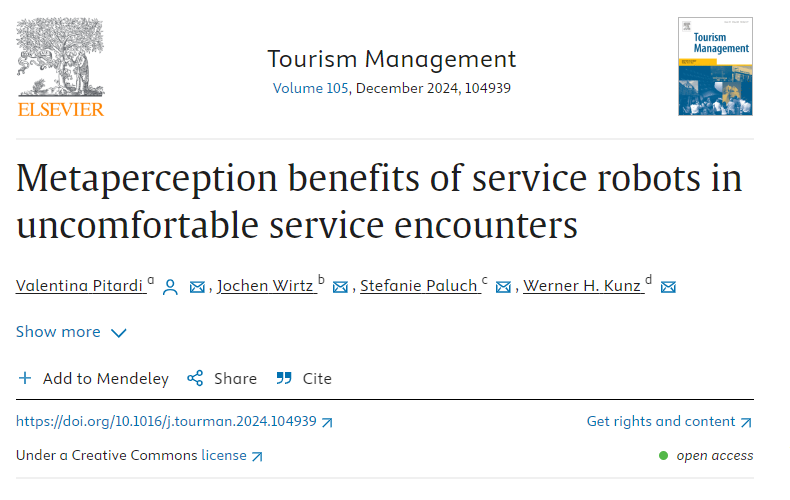
Congratulations to #CoDe member, Dr Valentina Pitardi, on the acceptance of her paper titled "Metaperception benefits of service robots in uncomfortable service encounters" in Tourism Management (4* ABS)!
Link: sciencedirect.com/science/ar…
55

16 Apr 2024
Now published. Have you ever felt uncomfortable ignoring a sommelier’s recommendation to order an expensive wine? Did you fear, "Gosh, will the sommelier think I am cheap?" We analyze this process - called metaperception - when robots provide the service. researchgate.net/publication…
5
124
3 Apr 2024
Just accepted for publication: Metaperception Benefits of Service Robots in Uncomfortable Service Encounters.
researchgate.net/publication…
#Discomfort #Robots #ServiceRobots #ChatBots #ServiceManagement #ServicesMarketing #CustomerService #Service #Tourism #Hospitality
10
147

I think the metaperception gap between the elites and the populists might be worse than the actual gap
1
2
20
The latter seems much more common. But whether it's rooted in metaperception or not you end up in the same place, and the opposite side will continue the positive feedback loop.
Layman opinion🤷♂️
2
10

19 Dec 2023
“PERCEPTION IS REALITY”
PERCEPTION is the process of interpreting and organizing sensory information from both interoceptive and exteroceptive sources. It involves the brain's complex mechanisms to make sense of sensory input, creating a subjective experience of the surrounding world. Perception is not merely the reception of stimuli; it involves the integration, interpretation, and contextualization of sensory data to form a meaningful understanding of one's environment.
INTEROCEPTION refers to the body's ability to sense and understand internal physiological signals. This includes awareness of sensations like hunger, thirst, heartbeat, and visceral responses. It plays a crucial role in maintaining homeostasis, allowing individuals to respond to internal needs.
EXTEROCEPTION involves perceiving stimuli from the external environment. It encompasses the five traditional senses: sight, hearing, touch, taste, and smell. Exteroceptive information helps individuals navigate and interact with the world, providing essential input for decision-making and survival.
METAPERCEPTION also known as metacognition, refers to the ability to reflect on and understand one's own cognitive processes and the cognitive processes of others. It involves thinking about thinking or being aware of one's thoughts and cognitive abilities. Metaperception can be applied to various aspects of cognition, including memory, problem-solving, and decision-making.
Metaperception extends to also understanding the thoughts, feelings, and intentions of others. It includes the ability to recognize and interpret social cues, such as facial expressions and body language, and to make inferences about the mental states of others.
EXTRASENSORY PERCEPTION (ESP) refers to the ability to acquire information through means beyond the known human senses of sight, hearing, touch, taste, and smell. It implies the ability to perceive or gain knowledge without using the conventional physical senses.
“Beauty is in the eye of the beholder”.
So is your reality.

1
1
79

23 Mar 2023
உங்கள் வாழ்வில் இது நடந்துள்ளதா ? நடந்ததென்றால் காரணத்தை கூறிவிட்டு பிறரின் அந்தரங்க விசயதுக்குள் முற்படுங்கள்.
it's be an optimistic metaperception
23 Mar 2023

உங்களுக்கு love breakup ஆகிருக்கா அப்படி ஆகிருந்தா எந்த காரணத்துக்காக breakup பண்ணிங்கனு quote பண்ணுங்க🤗
3
77

2 Jun 2022
"Thinking about how others see us—called 'metaperception'—seems like it should help us understand ourselves better. Unfortunately, the conclusions we draw while doing so tend to be inaccurate." @arthurbrooks theatlantic.com/family/archi…
1
3
8

30 May 2022
Analysis of an experience is metaperception, you don't actually need to interrogate yourself as to how you're having fun, it's enough to just be in the moment without wondering why you're there
1
2


4 May 2022
should be bonus points fo hazard metaperception imo
1
4