
📢 BIG NEWS: Oracle AI Trade unveils its advanced AI investment ecosystem 🚀
👥 Invited: @_2703_ @mixbytes @tiffanywaugh x.com/i/spaces/1yxBeejQMvEJN
📌 More Info in Article Below 👇👇👇

1


MixBytes joins the @circle Alliance Program.
300 smart contract audits since 2017, trusted by Lido, Aave, Curve, Fluid, 1inch and more we're here to make #USDC infrastructure safer alongside a community of global builders.
Full profile: partners.circle.com/partner/…
1
5
307

The Day ETH Staking Broke
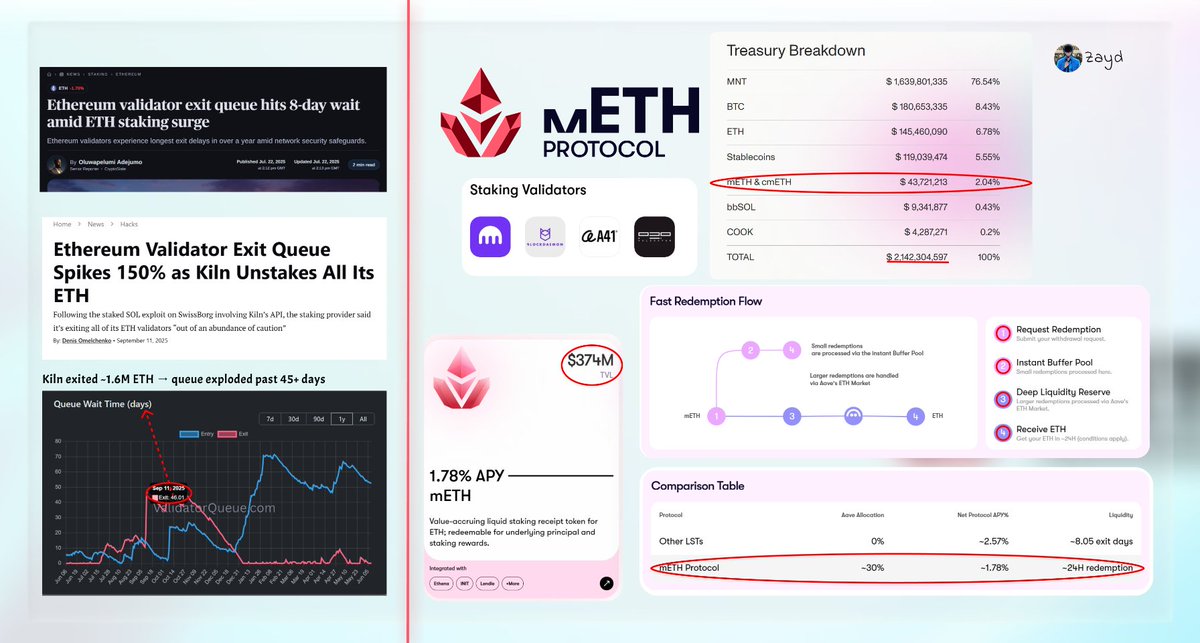
In September 2025, a validator operator called Kiln pulled roughly 1.6 million ETH out of the network after a security incident.
The exit queue stretched past a month.
If you were staking directly (or holding most liquid staking tokens) your position was effectively locked.
You couldn't get your ETH back for over a month without selling into the market.
Here's why that happens.
Ethereum limits how many validators can exit per day. It's a deliberate security feature with the goal of stopping bad actors from doing damage and then racing out before slashing catches up.
The trade-off is simple: when one large operator exits, everyone else in line waits.
That's the part most liquid staking protocols skip.
The token itself can trade, but the underlying $ETH still sits in the same validator queue as native staking.
Now let's zoom out...
Why does anyone stake ETH?
When you stake ETH, the network pays you for helping secure it.
Rewards come from three sources:
-> newly issued ETH the protocol creates each epoch,
-> priority fees users attach to transactions to get processed faster, and
-> MEV, value validators capture from ordering transactions inside a block.
You earn in ETH -> Your stack grows while you hold ->
That's the trade-> Your ETH works -> You get paid -> You stay exposed to ETH upside the whole time.
That combination (yield, liquidity, and utility) is why 39.3 million ETH is staked right now, roughly 32% of the eligible supply.
Someone might say: "32% is solid, not unsustainable.
The protocol will gradually onboard more validators and won't need to extract staking from users."
Fair point
But the issue was never that 32% is unsustainable today.
The bigger opportunity is the other 68% that isn't staking yet.
And the catch is always the same: your capital is locked while it earns.
Getting it back requires joining an exit queue and that queue does not always cooperate.
As Ethereum keeps onboarding validators and activity grows, those queues stretch further before they ease.
Other approaches exist. Some sell the receipt token on the open market for faster access, that brings slippage and price risk. Others lean on internal queues that still blow out when demand spikes.
“mETH took a different route. It kept part of the reserves both productive and immediately usable through the Buffer Pool.
@mETHProtocol (mETH) made a structural choice insteadtook a different route...
-> keep part of the reserves both productive and immediately usable.
In October 2025 they activated the Liquidity Buffer.
By December they expanded it into the Buffer Pool.
A meaningful slice of the ETH (around 20–30%) sits in Aave's ETH lending market, earning supply yield while it waits. When you redeem mETH for ETH, small and medium requests pull straight from the buffer.
Larger ones tap Aave's deep reserves.
The result is a target of roughly 24-hour redemptions that does not depend on selling the receipt token or waiting through long validator queues.
Since the Buffer Pool upgrade, median redemption times have remained in the low 20s of hours even during periods of elevated withdrawals, while the protocol continued to process requests without depeg.
Underneath it sits the operator and security stack.
mETH runs Tier-1 node operators including A41, P2P(.)org, Blockdaemon, stakefish, and Kraken Staked, with custody partners like Copper.
Zero slashing incidents to date. Over $5.2 million spent on audits and security programs with firms including Hexens, MixBytes, Secure3, and Verilog.
A public dashboard and on-chain proof of reserves let anyone watch buffer capacity and redemption queues in real time.
In March 2026, the SEC and CFTC jointly clarified that standard liquid staking arrangements generally don't involve the offer or sale of securities. mETH was already built for that posture.
And the team isn't just shipping it for others. Mantle Treasury (one of the largest on-chain treasuries in crypto) holds over $43 million in mETH and cmETH.
They run their own treasury on the same rails they're asking allocators to trust.
ETH staking is shifting from "yield on capital you can't touch" to treasury infrastructure that stays liquid and usable.
The protocols that win the next phase are the ones that solved the exit constraint before large allocators started asking out loud.
mETH solved it last year.
When the next exit queue spike hits, the question isn’t whether you can earn yield.
It’s whether you can actually get your ETH back when you need it.
Jun 11

ETH staking is moving beyond yield alone.
“The next phase is about stronger security, deeper liquidity, and better distribution.” - @Defi_Maestro
Read more below on how mETH Protocol is building for 2026.
3
2
3
247

Jun 11
Audits describe a snapshot. Reaction time decides what survives the next incident. We added a Guardian Layer on Surf accounts that pulls funds from stressed positions inside 90 seconds. The audit answers yesterday's question. The Guardian Layer answers tomorrow's.
34

number of audits completed by the top lending protocols on @solana (top tier firms only)
1) @kamino —> 20 audits/security reviews from 6 top tier audit firms
- @osec_io
- @sec3dev
- @offside_labs
- @Certora
- @AckeeBlockchain
- @Rx_Security
2) @jup_lend —> 7 external audits from 4 top tier audit firms
- @osec_io
- @Offside_Labs
- @MixBytes
- Zenith
3) @humafinance —> 8 completed audits from 4 top tier audit firms (Includes Evm & Stellar smart contracts)
- @sec3dev
- @HalbornSecurity
- @spearbit
- @Certora
4) @onrefinance —> 5 completed audits from 2 top tier audit firms
- @Quantstamp
- @AckeeBlockchain
5) @hylo_so —> 2 major audits completed from 2 top tier audit firms
- @osec_io
- @accretion_xyz
6) @HastraFi —> not publicly disclosed but DeFiLlama states there are audits completed





total yield paid out to users by top lending protocols on solana
data from defillama and protocol dashboards as of June 2026
1) @kamino —> estimated $150m in yield paid out to LPs since launch
2) @jup_lend —> roughly $22m in cumulative yield paid out to users
3) @humafinance —> $13.4m usdc 23 million $HUMA in yield paid out to LPs
4) @onrefinance —> $16m in yield paid out to depositors
5) @HastraFi —> roughly $9m in cumulative yield paid out
6) @hylo_so —> roughly $4.5m in cumulative yield paid out to users
there’s never been a better time to put our stablecoin to work and let them earn for us!
20
3
42
2,147

🔎 One thing I think the market is still underestimating:
Oracle networks don't become valuable just because they have good technology.
They become valuable when they create strong economic incentives around that technology.
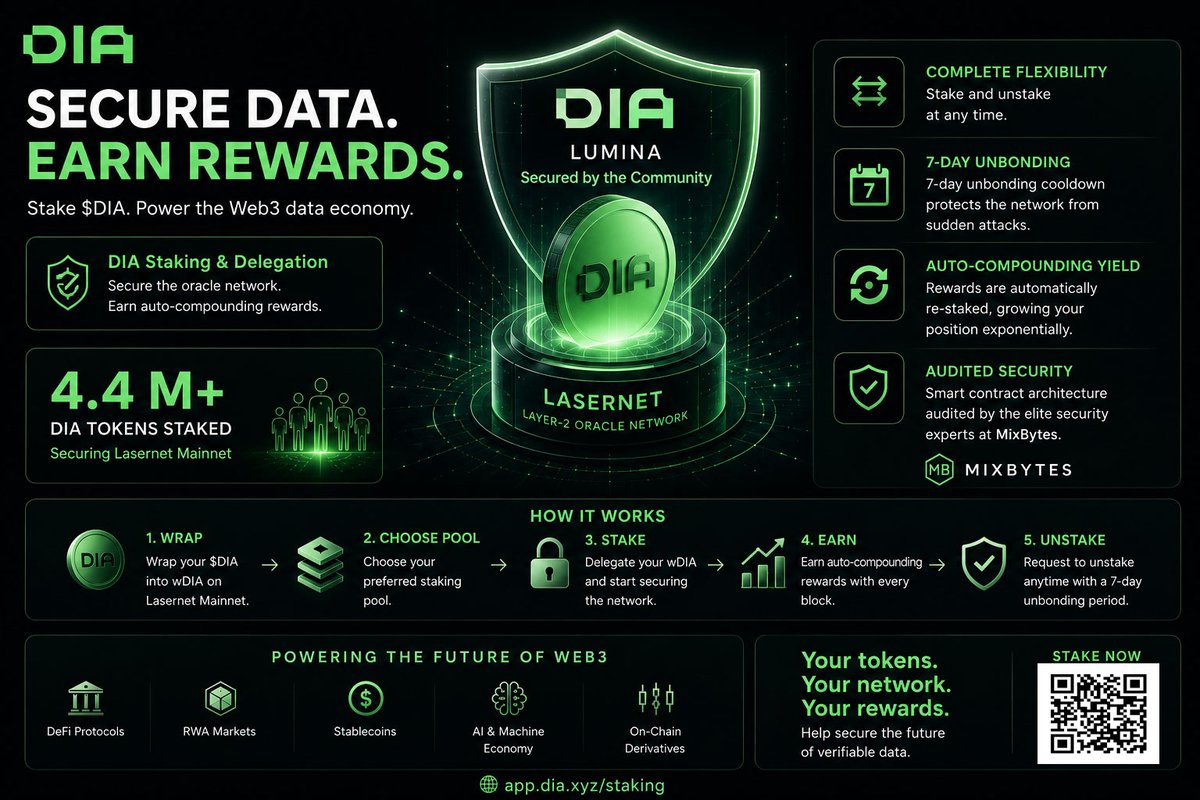
That's why I've been paying more attention to $DIA and what they're building around Lasernet. 🟢
Most people know @DIAdata_org for oracles.
Far fewer understand that the network now has a live staking layer designed to economically secure the data infrastructure itself.
⚡ In simple terms:
➡️ More value flowing through the network
➡️ More data being secured
➡️ More importance is placed on the staking layer
A few things that stood out to me:
1️⃣ Flexible staking
• No fixed lockups
• Stake when you want
• Unstake when you want
2️⃣ Security-first design
• 7-day unbonding period
• Helps protect network security
3️⃣ Compound growth
• Auto-compounding rewards 🔄
• No manual claiming and restaking
4️⃣ Audited infrastructure
• Smart contracts audited by MixBytes ✅
💡 The auto-compounding feature is especially interesting.
It's a simple feature.
But over time, it's one of those things that quietly makes a huge difference.
Instead of rewards sitting idle...
They automatically go back to work.
📈 More rewards generate more rewards.
What interests me most isn't the yield.
It's the bigger picture.
We're moving toward a world where:
🏦 RWAs rely on verifiable data
🤖 AI systems consume trusted data
💵 Stablecoins require transparent verification
🌐 DeFi protocols depend on accurate pricing
At that point, Oracle networks stop being niche infrastructure.
They become critical infrastructure.
And critical infrastructure needs economic security.
That's where staking becomes much more than a reward mechanism.
It becomes part of the network's security model.
📊 Current snapshot:
🔒 4.4M DIA already staked securing Lasernet
Still early.
But worth paying attention to if you believe verifiable data becomes one of the foundational layers of the next crypto cycle.
$DIA 🚀
4
8
122


May 26
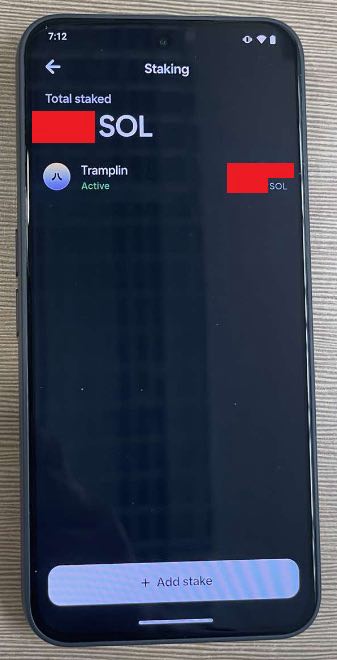
Thấy Toly với anh em nhắc Tramplin nhiều quá, sẵn tay đang cầm con Solana Mobile Seeker, mình vào staking thử.
Thay vì ăn lãi vài % APY nhỏ giọt, dự án này biến staking thành các đợt xổ số hấp dẫn mà gốc vẫn an toàn tuyệt đối.
Không cần wrap, không đổi sang LST. SOL vẫn nằm nguyên trong tài khoản stake của mình, dev không có quyền chạm vào. Thích là unstake thoải mái, không lock cứng.
@Tramplin_io là Winner Solana Mobile Hackathon, Top 8 Validator có nhiều delegator nhất mạng Solana.
Tramplin được kiểm toán bởi MixBytes (chung nhà với Lido, Curve).
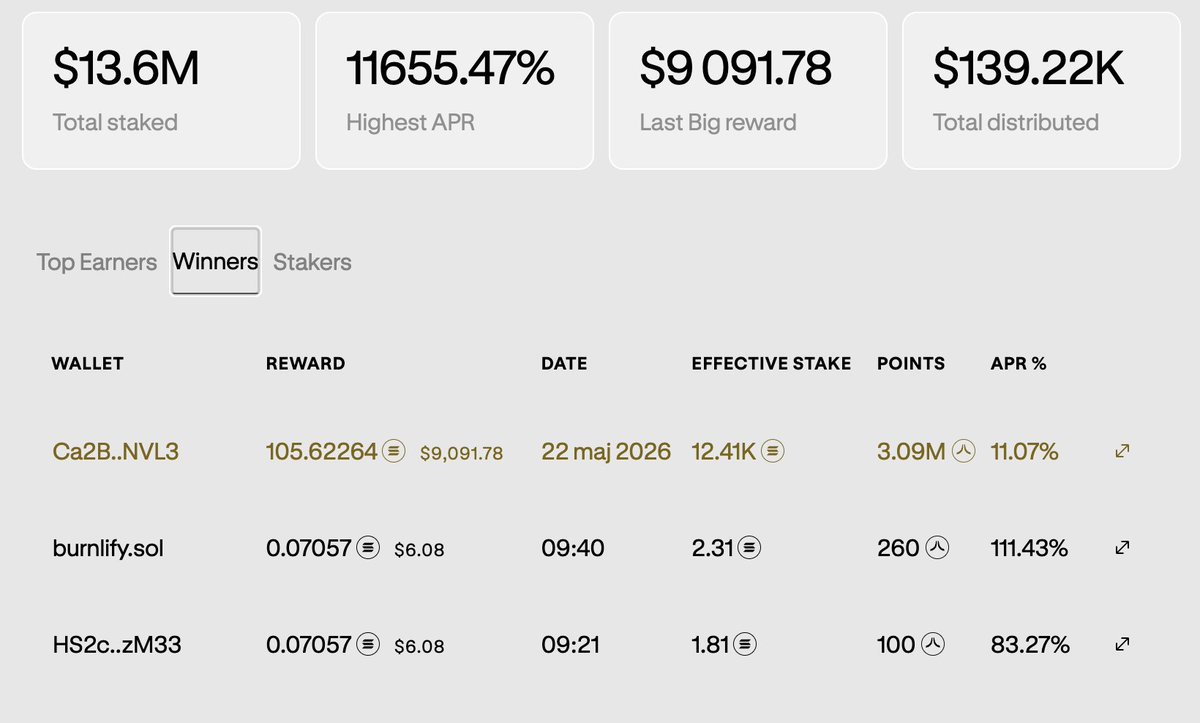
Tramplin gom toàn bộ reward staking lại để làm giải thưởng cho 3 Pool draw liên tục:
- Regular (20 phút/ 1 lần): Cơ hội chia đều cho tất cả (cho dù bạn stake 1 SOL hay nhiều hơn).
- Theo Epoch (2-3 ngày): Giải lên tới $1.45K
- Big Pool: Giải jackpot lớn tích lũy dần (đang treo khoảng $1.17K).
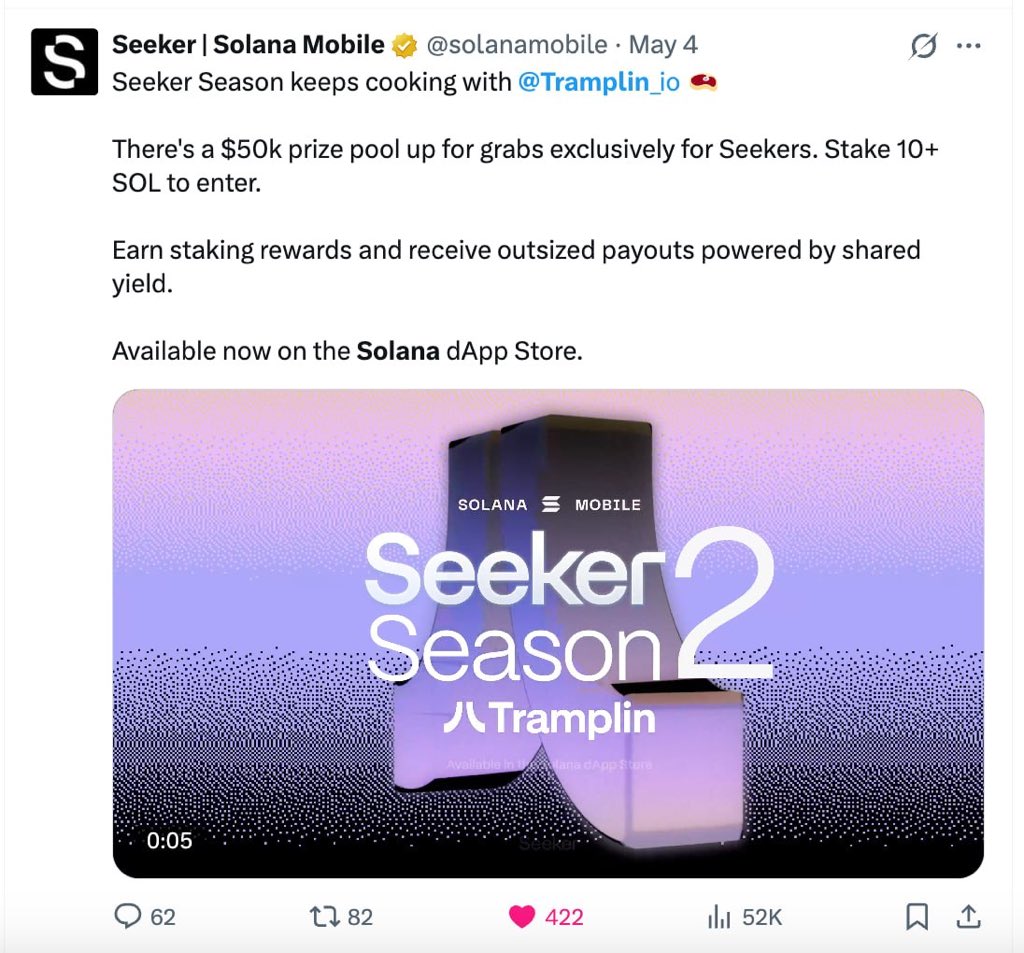
Ngoài ra, Tramplin đang collab trực tiếp với @solanamobile . Chỉ cần stake tối thiểu 10 SOL là có suất tham gia pool thưởng $50K dành riêng cho người sở hữu Mobile Solana Seeker. Vừa được quay số, vừa tích points để nhận phần thưởng khi Tramplin TGE.
Hiện tại còn rất sớm, TVL của họ đã chạm $13.6M với hơn $139K được phát ra.
Anh em nào đang hold SOL cho dài hạn thì vào tham gia theo link xịn:
tramplin.io?ref=84b1637010ee…
Đây chỉ là thông tin, không phải lời khuyên đầu tư, DYOR
Feb 10

Sau bao ngày chờ đợi, mình đã chính thức sở hữu em điện thoại Solana Seeker. Coi như một món quà Tết của @solanamobile 😄
Điều hơi tiếc nuối là mình nhận được điện thoại quá muộn, tận 20 ngày sau TGE của $SKR, nên không kịp tham gia để nhận airdrop Seeker season 1 với pool thưởng 2 tỷ $SKR (lỡ mất vài nghìn $ airdrop). 🥲
Tuy nhiên, Seeker season 2 vừa mới bắt đầu, anh em nào đang sở hữu Seeker thì nhanh tay tham gia để lụm tiền nhé.💰
46
3
45
953

May 25
Tramplin - Staking tham gia phần thưởng trên Solana
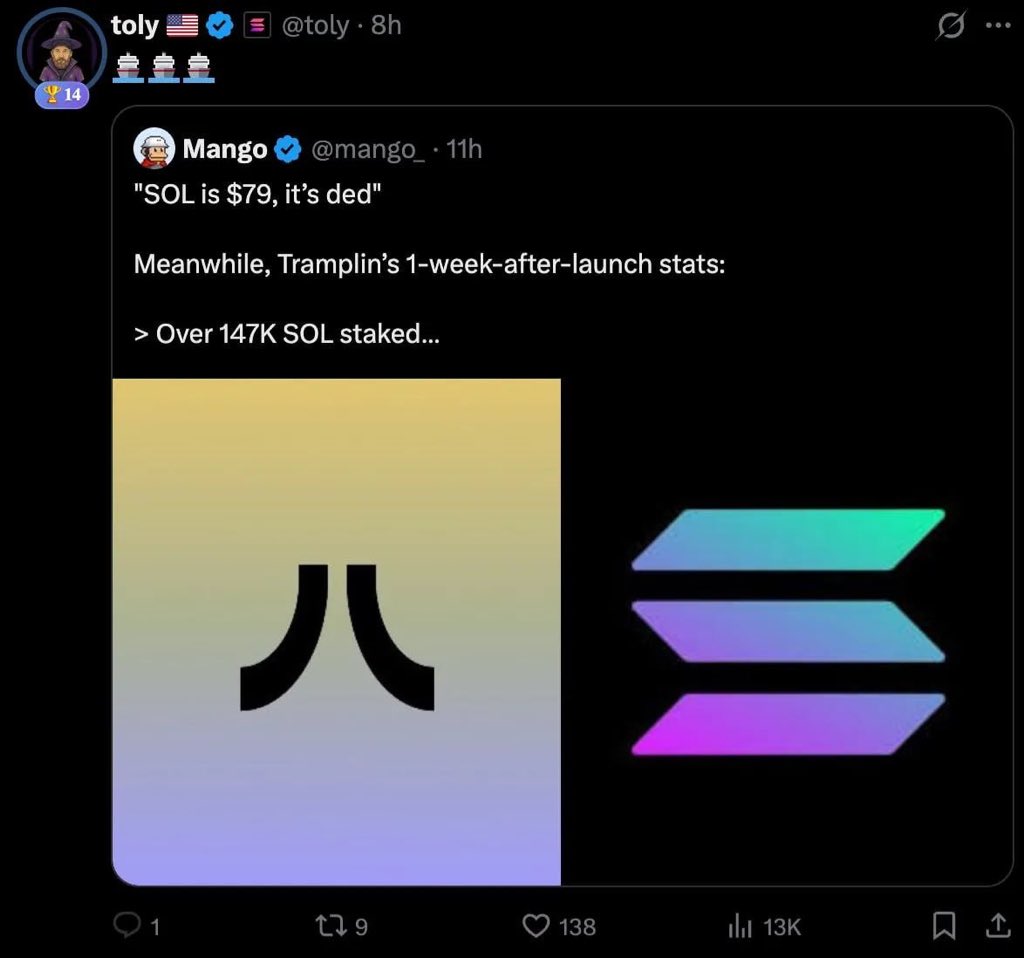
Mình còn ít $SOL, thấy Co Founder của Solana Toly với Solana nhắc đến nhiều con @Tramplin_io tìm hiểu cũng khá hay, anh em nào đang hold SOL có thể xem qua thử nhé
Tramplin là một nền tảng native staking trên Solana, cơ chế thấy khá ổn, thay vì nhận lãi staking mỗi ngày, Tramplin gom lại thành pool rồi chia thưởng. $SOL vẫn nằm trong ví, không phải gửi vào contract, không bị can thiệp nên thấy an toàn hơn mấy kèo stake kiểu cũ, Tramplin cũng được MixBytes (bên audit cho Lido, Curve) audit.
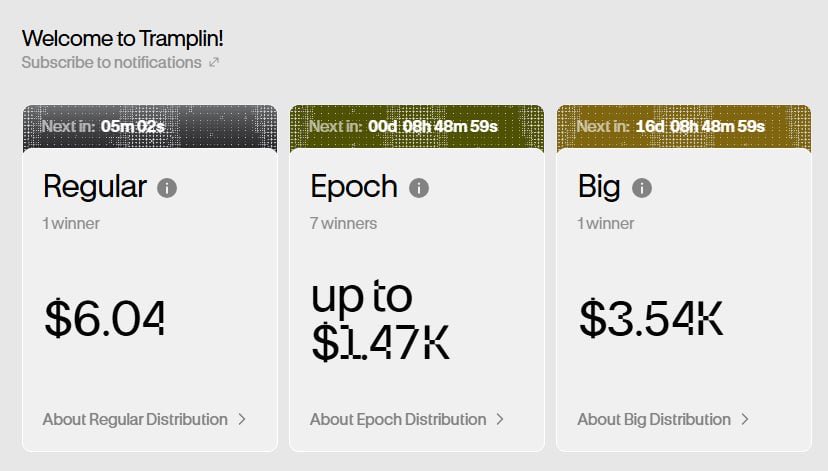
Tramplin hiện tại đang có 3 pool chính:
1. Regular Draw (Săn thưởng mỗi 20 phút):
- Cái này phù hợp cho anh em có 1 ít SOL: Ai cũng sẽ có cơ hội trúng ngang nhau
- Dù ae stake 1 SOL hay 10 SOL thì xác suất trúng cũng như nhau
- Mỗi lần trúng giải sẽ nhận được ~ $16.68
2. Epoch Draw (khoảng 2 ngày)
- 7 winners
- Chia từ $25 - 1k$ mỗi winner
3. Big Draw (hàng tháng):
- Hiện tại Pool đang treo giải ~8300$
- Chỉ cần giữ stake trong 1 tháng là có vé
Epoch và Big được tính điểm theo mức đặt cược (mức đặt cược càng cao = vị trí càng tốt)
Lưu ý quan trọng: Ae có thể unstake $SOL bất kỳ lúc nào nếu muốn
Hướng dẫn tham gia
- Anh em truy cập link tramplin.io/?ref=danhtran68 (connect ví)
- Nhập số lượng SOL muốn stake (tối thiểu 1 SOL)
- Points sẽ được phân bổ sau khi một epoch kết thúc
Hiện vẫn còn early, tỉ lệ trúng vẫn cao, mình thử tham gia ít thôi, sau lỡ nó ra token nữa được airdrop thì ngon
Ngoài ra Tramplink cũng hợp tác với Seeker Solana Mobile của Solana làm event pool thưởng 50k$ nên cũng khá uy tín
📌 Tất nhiên đó là 1 bài cung cấp thông tin, tất cả nội dung mình chia sẻ đều mang tính chất tham khảo và cung cấp thêm góc nhìn về thị trường. Không phải lời khuyên đầu tư.
Crypto luôn có rủi ro, anh em hãy tự tìm hiểu, cân nhắc kỹ và chịu trách nhiệm với quyết định của mình
23
1
35
1,641

May 20
🥂to great partners and the team @MixBytes it is essential to work together to build sustainable, long term systems
1
2
36

May 16
Deep dive on Shift Audit by @MixBytes - the firm behind security reviews for @LidoFinance, @aave, @CurveFinance, and @1inch.
Done before a single dollar is deposited.
The full breakdown: what they found, what we fixed, and what an audit doesn't cover.
1
3
12
288

May 15
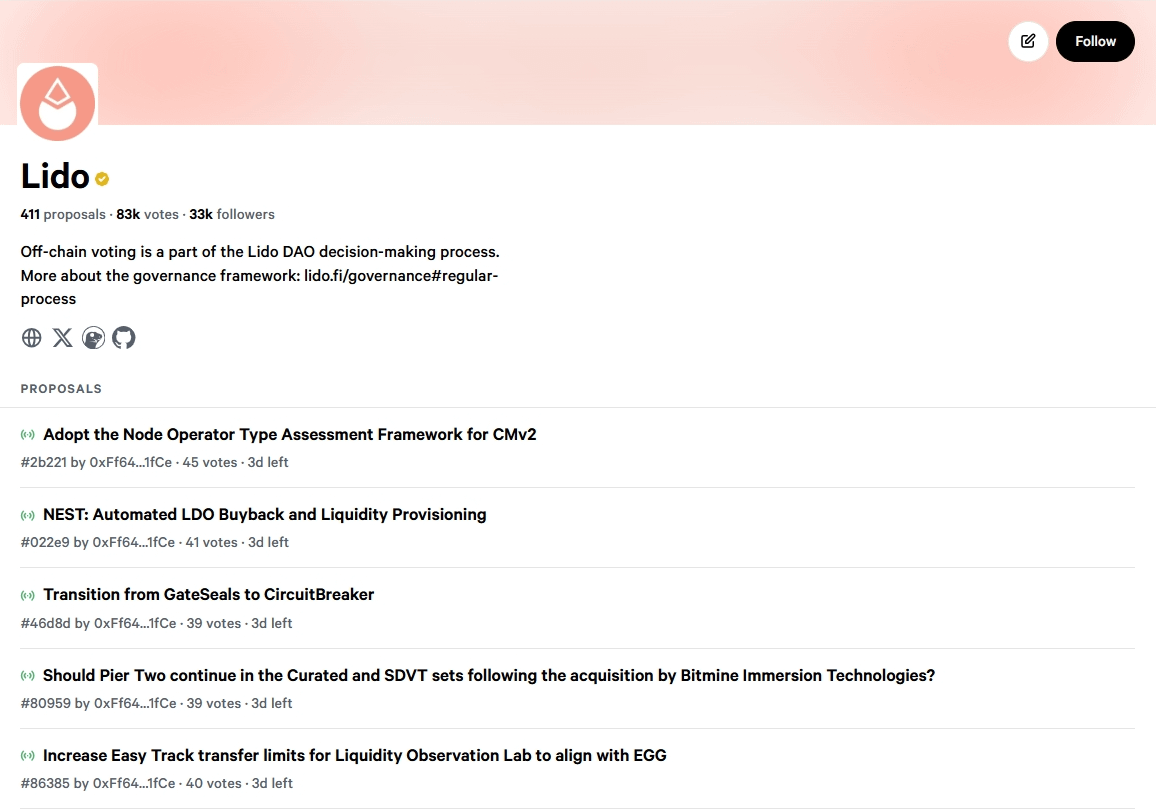
@LidoFinance is running five governance votes, all closing May 18 at 16:00 UTC. Four are routine. NEST - Network Economic Support Tokenomics - is the highlight; automated $LDO buyback and liquidity provisioning.
First proposed by @SteakhouseFi: under NEST, when staking revenue clears a $40M annual baseline, 50% of the surplus routes through @CoWSwap to buy $LDO and pair it with stETH on @CurveFinance. Hard caps $50K daily, $10M yearly. Cumulative model - weak periods recover before buybacks resume.
NEST is passing 94.2% across 41 voters. but the forum is more nuanced.
@Pol_Lanski (FOR with 6.25M $LDO) supports NEST as a starting point but acknowledges the trigger conditions sit far from current market reality.
@bcvfinance pushes back: "If buybacks are mainly used to compensate for weak governance, weak transparency, and weak tokenholder alignment, then they do not solve the actual problem."
@TariQuin replies: "NEST is not about whether LDO is undervalued right now, and it's not a substitute for governance quality (...) It creates a rule-based on-chain link between protocol surplus and LDO."
@DefiIgnas pushed for LDO-valuation triggers (LDO/ETH or onchain P/E) so buybacks fire when LDO is actually undervalued, not just when ETH pumps. @SteakhouseFi considers appealing but too complex for v1.
The other four, passing near-unanimously so far:
- Node Operator Framework: 6 defined operator types, reassessed twice yearly by the Curated Module Committee.
- GateSeals to CircuitBreaker: 5 expiring single-use pause contracts replaced by 1 permanent manual pause (21-day window, annual liveness checks). Audited by @cyfrin, @Certora, @MixBytes - no critical findings.
- @PierTwo_com Continuation: validator continues in Lido's node sets after the @BitMNR acquisition (now part of MAVAN).
- Easy Track Limits: stETH transfers 6K to 8K per 6 months, $8M stablecoin route added for an already-approved $LDO accumulation.
Proposal links:
1. Adopt the Node Operator Type Assessment Framework for CMv2: snapshot.box/#/s:lido-snapsh…
2. NEST: Automated LDO Buyback and Liquidity Provisioning: snapshot.box/#/s:lido-snapsh…
3. Transition from GateSeals to CircuitBreaker: snapshot.box/#/s:lido-snapsh…
4. Should Pier Two continue in the Curated and SDVT sets following the acquisition by Bitmine Immersion Technologies?: snapshot.box/#/s:lido-snapsh…
5. Increase Easy Track transfer limits for Liquidity Observation Lab to align with EGG: snapshot.box/#/s:lido-snapsh…
1
3
962

