
Jun 12
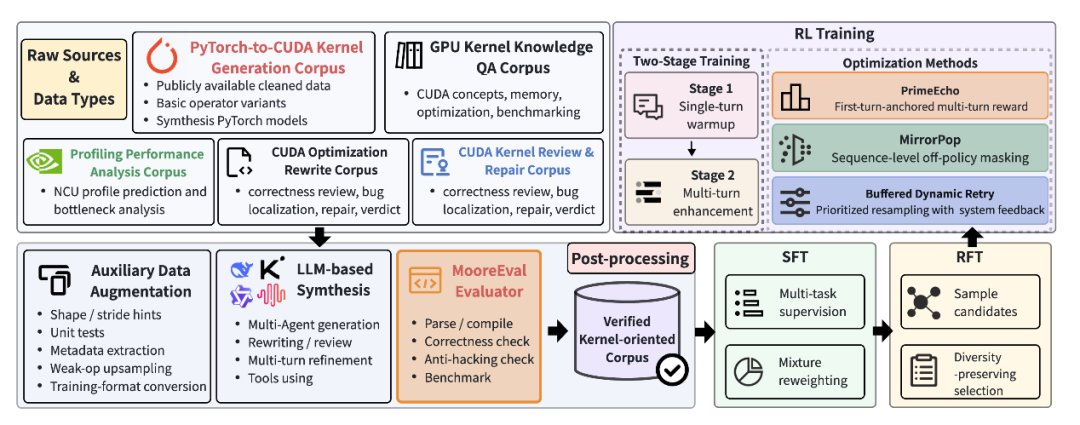
Moore Thread: Releases open-source code for large-scale model MusaCoder
datayuan.substack.com/p/moor…
19

Jun 11
RT @umiyuki_ai: 中国でグラボ作って売ってるMooreThreadsがMusaCoder-27Bをオープンでリリース。これは普通のLLMじゃなくてPyTorchコードをCUDAまたはMUSAのカーネルに変換するのに特化してる。MUSAってのはつまりMooreThr…
2

خبر تقني لافت للمطورين والمهتمين بالنماذج المحلية:
شركة Moore Threads الصينية نشرت نموذج MusaCoder-27B على Hugging Face، وهو نموذج متخصص في توليد أكواد منخفضة المستوى لـ GPU kernels، وليس مجرد نموذج برمجة عام.
الفكرة هنا دقيقة ومهمة.
MusaCoder مصمم لتحويل تطبيقات PyTorch المرجعية إلى CUDA / MUSA native kernels قابلة للتجميع، صحيحة عددياً، ولا تعتمد على fallback، مع هدف واضح: توليد كود GPU أسرع وأكثر كفاءة.
النموذج بحجم 27B، وجاء ضمن ورقة بحثية بعنوان:
MusaCoder: Native GPU Kernel Generation with Full-Stack Training on Moore Threads GPU
الورقة تذكر أن MusaCoder يستخدم تدريباً كاملاً قائماً على التنفيذ والتغذية الراجعة، من خلال:
توليد بيانات موجهة للـ kernels
fine-tuning مع رفض العينات الضعيفة
reinforcement learning عبر بيئة تحقق موزعة اسمها MooreEval
آليات لتقليل مشاكل RL مثل ضعف الإشارة وreward hacking وعدم الاستقرار
اللافت أن النتائج على KernelBench ونسخة MUSA المشتقة منه تظهر تفوقاً في الصحة والتسريع التجريبي، وأن نسخة 27B تسجل مستوى جديداً في هذا النوع من المهام.
لماذا هذا مهم لنا كمطورين؟
لأن المسألة ليست “نموذج يكتب كود” فقط.
هذا النوع من النماذج يقترب من منطقة أعمق:
تحسين الكود عند مستوى العتاد، تسريع عمليات الذكاء الاصطناعي، توليد kernels مخصصة، وتقليل الاعتماد على مكتبات جاهزة عندما تحتاج أداء أعلى.
بالنسبة للمنطقة، السعودية والخليج تحديداً، هذا النوع من المشاريع يهمنا من زاوية بناء قدرات محلية في:
الذكاء الاصطناعي عالي الأداء
الحوسبة المسرّعة
النماذج المحلية
مراكز البيانات
البحث التطبيقي
تحسين تكلفة تشغيل النماذج
لكن يجب أن نكون دقيقين:
MusaCoder-27B ليس بديلاً مباشراً عن أدوات مثل Claude Code أو Codex في بناء تطبيق ويب أو كتابة API.
هو أقرب إلى نموذج متخصص لمهام GPU kernel generation، وهي منطقة أضيق لكنها شديدة الأهمية للبنية التحتية للذكاء الاصطناعي.
الخلاصة:
إطلاق MusaCoder-27B يعكس اتجاهاً مهماً:
النماذج القادمة لن تكون كلها “مساعدات عامة”، بل سنرى نماذج متخصصة في طبقات عميقة من البرمجة، مثل تحسين الأداء، توليد kernels، وتسريع الحوسبة على العتاد.
وهذا بالضبط ما نحتاج متابعته بجدية؛ لأن من يملك أدوات تحسين الأداء على مستوى العتاد، يملك جزءاً مهماً من مستقبل الذكاء الاصطناعي.
#MusaCoder #MooreThreads #LocalAI #GPU #CUDA #AI #LLM #HuggingFace #DeveloperTools #برمجة #تقنية #الذكاء_الاصطناعي
رابط الخبر الأصلي: reddit.com/r/LocalLLaMA/comm…
157

RT @umiyuki_ai: 中国でグラボ作って売ってるMooreThreadsがMusaCoder-27Bをオープンでリリース。これは普通のLLMじゃなくてPyTorchコードをCUDAまたはMUSAのカーネルに変換するのに特化してる。MUSAってのはつまりMooreThr…
2

Jun 11
中国でグラボ作って売ってるMooreThreadsがMusaCoder-27Bをオープンでリリース。これは普通のLLMじゃなくてPyTorchコードをCUDAまたはMUSAのカーネルに変換するのに特化してる。MUSAってのはつまりMooreThreads版のCUDA
reddit.com/r/LocalLLaMA/comm…
2
15
3,859

Jun 10
Wind Financial Morning Post: June 11, 2026
Market Brief
National Development and Reform Commission: Accelerate construction of a modern industrial system and fully implement the “AI ” initiative.
China’s May CPI rose 1.2% year-over-year, while PPI increased 3.9%, hitting a 46-month high.
From January to May, taxpayers with overseas income paid approximately 13 billion yuan in back taxes.
Hong Kong Securities and Futures Commission: Licensed firms may continue serving existing mainland clients, but cannot provide services within mainland China.
Middle East tensions escalate again as Trump threatens “very strong” strikes against Iran.
U.S. May CPI rose 4.2% year-over-year, the highest in three years.
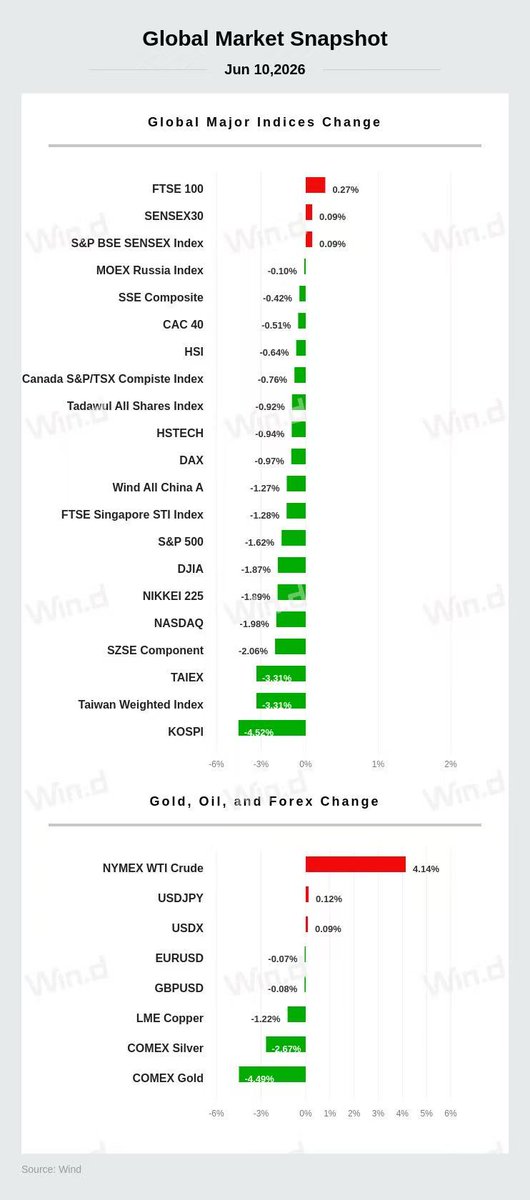
Global equities fell broadly on Wednesday: All three U.S. major indexes dropped more than 1%, while South Korea’s market triggered circuit breakers for the third consecutive day.
International oil prices surged again, with U.S. crude and Brent crude both up over 3%, while gold prices continued to decline.
Top Stories
Middle East tensions have intensified again. U.S. President Trump threatened that, due to slow progress in negotiations to end the conflict with Iran, the United States will launch “very strong” strikes and may target Iranian infrastructure. U.S. Defense Secretary Hegseth stated that key Iranian facilities will be bombed. Iran’s armed forces vowed a “more severe, stronger, and more destructive” response. On June 10, explosions were reported across multiple locations in Iran, and the U.S. military announced a “defensive strike” in response to a downed military aircraft. Iran subsequently launched “intense” attacks on U.S. military bases in the Middle East.
The Hong Kong Securities and Futures Commission reiterated that licensed firms may continue serving existing mainland Chinese clients, including opening new accounts, provided that services are not delivered within mainland China and all relevant laws and regulations in Hong Kong and applicable jurisdictions are fully complied with. Hong Kong’s Financial Secretary Paul Chan said the regulatory actions target only non-compliant cross-border investment flows, and the central government continues to encourage compliant capital inflows into Hong Kong.
The U.S. Department of Labor released data showing that, driven by rising energy prices, U.S. CPI rose 4.2% year-over-year in May, the highest since May 2023 and in line with market expectations; core CPI rose 2.9% year-over-year, the highest since September 2025. U.S. CPI inflation returned to 4% for the first time in three years, further solidifying market expectations of a Federal Reserve rate hike this year.
China Macro & Policy
China’s National Bureau of Statistics released data showing that in May, the consumer market remained generally stable: CPI rose 1.2% year-over-year, matching April’s pace, while core CPI rose 1.1%. PPI rose 3.9% year-over-year, marking the third consecutive month of growth and the largest increase since August 2022.
The National Development and Reform Commission held a symposium with economic experts, stating it will fully utilize macro policies and leverage the combined effect of existing and new measures; accelerate the construction of a modern industrial system and fully implement the “AI ” initiative; crack down on “self-defeating” competition; and promptly study and prepare targeted, operational policy tools for timely implementation.
Vice Minister of China’s Ministry of Commerce and Deputy Chief Negotiator for International Trade Negotiations Ling Ji held talks with European Commission Director-General for Trade and Economic Security Jorgensen, extensively discussing preparations for the inaugural meeting of the China-EU Trade and Investment Consultation Mechanism. Both sides agreed to strive for tangible outcomes at the first meeting.
Data from China’s State Administration of Taxation showed that individual income tax revenue reached 764.39 billion yuan from January to May, up 12% year-over-year. Experts said the strong A-share market rally this year has driven rapid growth in personal income tax. Meanwhile, tax authorities have strengthened public awareness and policy guidance regarding overseas income, significantly improving taxpayer compliance: approximately 13 billion yuan in back taxes were collected from January to May.
The Ministry of Commerce, the Ministry of Culture and Tourism, and China State Railway Group issued a joint document titled “Several Measures to Promote Railway and Tourism Integration and Expand Service Consumption,” outlining 15 specific initiatives to accelerate railway infrastructure transformation for tourism, enrich railway tourism product offerings, and expand new tourism supply.
AI is reshaping the job market for humanities graduates. The topic “AI giants pay 30,000 yuan monthly to recruit humanities graduates” has trended on social media. Leading AI firms have increased their proportion of humanities roles from around 5% to 20–30%, creating new positions such as “AI narrative designer,” “large model humanities trainer,” and “AI ethics researcher,” with starting salaries typically ranging from 20,000 to 40,000 yuan per month.
China Equities Markets
A-shares edged lower: The SSE Index fell 0.42% to 3,993.23, the Shenzhen Component Index dropped 2.06%, the ChiNext Index slid 2.7%, and the Wind All China Index declined 1.27%, with market turnover reaching 2.64 trillion yuan. Semiconductor and computing hardware sectors diverged: semiconductor materials and PCB concepts rose, while optical communications and high-speed copper connections fell. Banking stocks and AI application names performed well, while power grid equipment and humanoid robotics stocks weakened.
The Hang Seng Index closed down 0.64% at 24,407.96, the Hang Seng Tech Index fell 0.94%, and the Hang Seng China Enterprises Index dipped 0.07%. Electrical equipment, semiconductors, metals, coal, CPO, and AI application stocks declined, while consumer and biopharmaceutical stocks rose. Northbound funds net bought over 8.2 billion Hong Kong dollars; Tencent Holdings was added by around 2 billion Hong Kong dollars, while Alibaba was sold off by 2.3 billion Hong Kong dollars.
Taiwan’s Weighted Index closed down 3.31% at 43,225.54. AI-related stocks tumbled collectively: Delta Electronics fell nearly 9%, MediaTek and UMC dropped over 7%, Hon Hai Precision and ASE Technology Holdings each fell over 5%, and TSMC declined over 2%.
The 2026 FIFA World Cup USA-Mexico-Canada will officially kick off at 00:00 Beijing time on June 12 in Mexico City. As the first World Cup expanded to 48 teams, spanning 39 days and three countries, the tournament has ignited global fan enthusiasm and become a major opportunity for A-share companies across multiple sectors. Analysts said companies are already positioning themselves across the entire value chain—from sponsorship and IP merchandise to viewing consumption and technology enablement—to capitalize on this three-nation, 39-day “World Cup economy.”
China Industry News
China’s Ministry of Industry and Information Technology issued guidelines to promote innovation in “AI information and communications,” targeting initial high-level autonomous networks by 2028 and significant breakthroughs in key technologies by 2030 to enhance integrated communication-sensing-computing-intelligence services.
Online rumors suggest a mandatory photovoltaic standard will be issued next week, covering polysilicon, wafers, and modules, potentially eliminating 30% of capacity based on previous estimates. Several companies responded that they are aware of the claims but cannot confirm their authenticity.
The China Association of Automobile Manufacturers reported that China’s automobile sales in May totaled 2.629 million units, down 2.1% year-over-year. New energy vehicle sales reached 1.496 million units, up 14.4% year-over-year, accounting for 56.9% of total new vehicle sales. NEV exports hit 446,000 units, up 110% year-over-year.
After two years of intense “full embrace of AI,” more companies are reassessing the real value of AI investments. Several tech giants have begun adjusting employee token allocation policies, moving away from uniform per-employee distribution toward dynamic allocation based on role and demand.
Rapid growth in commercial aerospace is drawing major solar energy firms into space-based energy. The “Space Energy Development Alliance” was recently launched, with founding members including GCL Group and Trina Solar. JA Solar, together with Satcon Technology and JEA, launched the “Space Energy Technology Ecosystem Alliance.”
A significant policy signal emerged to improve commuting efficiency within urban clusters. The Ministry of Transport and seven other departments jointly issued the “Implementation Plan for Enhancing Urban Cluster Commuting Efficiency (2026–2030),” aiming to establish one-hour commuting circles through rapid transit corridor construction.
The China Index Academy reported that in May, the planned construction area of residential land sold in 300 cities fell 27.1% year-over-year to 19.43 million square meters; land sale proceeds totaled 96.6 billion yuan, down 7.6% year-over-year but with a noticeably narrowed decline. Average land premium rates rose to 9.5%, supported by high-quality plots in core cities.
Fintech
The Financial Stability Board released a report stating that increasingly autonomous AI systems may heighten financial system risks and strongly encouraged institutions to implement protective measures—including against “agentic AI”—to mitigate these risks.
Hong Kong’s Financial Secretary Paul Chan said regulated stablecoins in Hong Kong could be launched as early as mid-year. The Hong Kong Monetary Authority recently hosted a corporate treasury and tokenization seminar to promote tokenization applications and encourage industry participation in its related projects.
SpaceX’s $75 billion IPO is imminent, with analysts warning the Bitcoin market could face liquidity outflows.
Corporate News & Updates
SpaceX will build a “Gigasat” super satellite factory in Texas to produce AI data center satellites in orbit, targeting 1 GW of space-based computing power by 2027 and 100 GW by 2030. SpaceX plans to launch an initial demonstration of its space AI computing infrastructure by the end of 2027, ahead of its IPO filing’s stated “earliest 2028” timeline.
Sources say OpenAI is negotiating to lease a planned 10-gigawatt data center campus in Ohio. The deal may include funding support from NVIDIA, with estimated construction costs of at least $500 billion. The first phase is expected to begin in 2028, with OpenAI potentially controlling the facility through a 20-year lease agreement.
Xiao Peng Group CEO He Xiaopeng announced in an internal memo that he is assuming the role of CEO of the robotics division, elevating humanoid robotics to the company’s highest strategic priority as it shifts from R&D to mass production and commercialization.
ByteDance’s DouBao officially launched a gray-scale test for its professional subscription tier, offering three plans: Standard, Enhanced, and Advanced Professional. The top-tier plan charges 500 yuan per month or 5,088 yuan annually for continuous subscription.
Xiaomi’s MiMo announced the official release and open-sourcing of MiMo Code V0.1, featuring the MiMo V2.5 multimodal model with a 1 million token context window, available free of charge for a limited time.
Moore Threads officially released and open-sourced MusaCoder, a specialized large language model for generating GPU kernel operations—the first open-source code model trained and validated entirely on domestic GPU infrastructure.
TSMC reported May revenue of 416.975 billion New Taiwan dollars, up 30.1% year-over-year; cumulative revenue for the first five months reached 1.96 trillion New Taiwan dollars, up 30% year-over-year. Analysts expect TSMC’s Q2 revenue growth to reach 35%.
Sources say Starbucks is evaluating options for its Japanese business, including equity sales and an IPO. Japan is one of Starbucks’ largest markets, with approximately 2,100 stores, most directly operated by the company.
Sources reveal that Lenovo finalized a key decision at its May internal meeting: starting in July, following the June 18 shopping festival, all product categories will be uniformly price-increased, with the magnitude matching the previous adjustment.
German humanoid robotics firm Neura Robotics announced a financing round of up to $14 billion, with investors including Tether, Qualcomm, Amazon, NVIDIA, Bosch, Schaeffler, and the European Investment Bank.
Global Macro & Policy
U.S. President Trump stated he does not intend to renew the USMCA trade agreement. On the topic of U.S. government equity stakes in AI firms, Trump said he will soon meet with 12 to 15 leading AI executives to discuss “giving something back to the public.”
The U.S. Treasury said net tariff revenue in May was approximately zero: $22 billion in tariffs collected matched $22 billion in refunds. Year-to-date fiscal revenue (since October 1, 2025) stands at $189 billion, up from $81 billion a year earlier. After calendar adjustments, the budget deficit for the first eight months of the fiscal year fell 2% year-over-year, or about $24 billion.
The Bank of Canada held its benchmark rate steady at 2.25%, in line with market expectations, marking its fifth consecutive hold. The bank warned that if Middle East tensions continue to push up energy prices and further elevate inflation, Canada may need to implement consecutive rate hikes.
The Bank of Japan announced that Governor Kuroda is hospitalized and will miss the monetary policy meeting on June 15–16. Markets widely expect a 25-basis-point rate hike next week; his absence is not expected to materially affect the decision.
Preliminary Bank of Japan data showed that Japan’s corporate goods price index rose 6.3% year-over-year in May, the highest since March 2023 and significantly above expectations. Due to yen depreciation, the yen-denominated import price index surged 25.5% year-over-year, the largest increase since November 2022.
Iran reported severe maritime losses due to war and related maritime restrictions: 360 vessels affected, of which 253 sank or were completely destroyed.
The European Union’s Copernicus Climate Change Service reported that May 2026 was the second-hottest May on record globally, with an anticipated El Niño event likely to trigger extreme weather across multiple regions in the coming months.
Global Equity Markets
U.S. major indexes closed lower: the Dow Jones Industrial Average fell 1.87% to 49,918.78, the S&P 500 dropped 1.62% to 7,266.99, and the Nasdaq Composite declined 1.98% to 25,169.50. Caterpillar fell over 6%, Honeywell International dropped more than 4%, leading the Dow. The Wind US Magnificent Seven Index slid 2.17%, with Tesla and NVIDIA each down over 3.5%. The Nasdaq China Golden Dragon Index fell 0.28%, while Bawang Cha Ji rose over 7% and GDS declined over 7%. Chip stocks extended recent declines: Micron and AMD both fell over 4%. U.S. May CPI rose 4.2%, the highest in three years.
European major indexes closed mixed: Germany’s DAX fell 0.97% to 24,195.31, France’s CAC 40 dropped 0.51% to 8,161.83, while the UK’s FTSE 100 rose 0.27% to 10,254.81. Escalating Middle East conflict and risks to shipping through the Strait of Hormuz pushed up oil prices; combined with rising expectations of ECB rate hikes, market risk aversion weighed on European equities.
Asia-Pacific indexes were mixed: South Korea’s market entered a “boom-bust” cycle. The KOSPI Composite Index closed down 4.52% at 7,730.82, triggering its third consecutive daily circuit breaker. The Nikkei 225 fell 1.89% to 64,179.27. Samsung Electronics, SK Hynix, SoftBank Group, and Kioxia all tumbled sharply. India’s SENSEX rose 0.09% to 73,983.18.
The Korea Capital Market Institute’s president said South Korean retail investors have reached the maximum leverage limit set by local brokers, meaning they can no longer borrow additional funds. Data showed that, as of Tuesday’s close, the ratio of put-to-call open interest for the KOSPI 200 index stood at nearly 2.5 times, the highest in five years.
U.S. Senator Elizabeth Warren urged the Securities and Exchange Commission to delay SpaceX’s record-breaking IPO, arguing that Wall Street’s enthusiasm could force index funds to passively buy SpaceX shares, exposing retail investors to risk. Warren also questioned SpaceX’s valuation.
Sources say SK Hynix plans to list in the U.S. as early as August, with SEC approval potentially granted during the week of June 22. Previous reports indicated the offering could raise up to $14 billion.
Oracle reported fourth-quarter fiscal 2026 adjusted EPS of $2.11 versus expectations of $1.97; adjusted revenue of $19.18 billion versus $19.09 billion expected.
Bonds
China’s interbank bond market weakened in the afternoon, with yields on key government bonds rising, especially for maturities of five years and longer. Treasury futures closed lower: the 30-year contract fell 0.36%. The People’s Bank of China conducted 159 billion yuan in reverse repo operations, net injecting 159 billion yuan; liquidity conditions improved slightly.
The Ministry of Finance will auction 15 billion yuan of additional RMB-denominated treasury bonds in Hong Kong on June 16, including 4.5 billion yuan of 2-year, 4.5 billion yuan of 3-year, 3.5 billion yuan of 5-year, and 2.5 billion yuan of 10-year bonds.
U.S. Treasury yields rose across the board: 2-year yield up 2.72 bps to 4.139%, 3-year up 3.19 bps to 4.198%, 5-year up 3.72 bps to 4.278%, 10-year up 3.38 bps to 4.552%, and 30-year up 3.05 bps to 5.027%.
Commodities
The Dalian Commodity Exchange announced that, effective June 12, speculative and hedging margin requirements for coke futures will be lowered from 20% and 15% to 12%, respectively. Non-futures company members and clients may not open more than 500 contracts per day in any coke futures contract.
International precious metals prices fell broadly: COMEX gold futures dropped 4.49% to $4,094.10 per ounce; COMEX silver futures fell 2.67% to $63.50 per ounce. Although U.S. inflation data cooled slightly, escalating geopolitical tensions and sharply rising expectations for U.S. and European rate hikes increased real yields and holding costs, while a strong dollar added downward pressure.
U.S. crude oil futures rose 4.14% to $91.85 per barrel; Brent crude futures gained 3.88% to $95.00 per barrel. First, geopolitical risks: Trump warned of renewed strikes against Iran, raising fears over Strait of Hormuz shipping security and global supply disruptions. Second, inventory data: U.S. crude inventories fell more than expected, signaling tightening supply. Third, industry outlook: Shell’s CEO said global oil inventories are being depleted rapidly; even if Iran tensions end, prices will likely remain elevated.
Base metals on the LME all declined: LME tin fell 0.95% to $52,005 per ton, LME lead dropped 1.08% to $1,962.50, LME copper fell 1.22% to $13,449, LME aluminum declined 1.51% to $3,494, LME nickel slid 1.85% to $17,730, and LME zinc dropped 2.45% to $3,468.50.
FX & Currency Markets
On Wednesday, the onshore CNY closed at 6.7774 per USD, down 72 pips from the previous close, and settled at 6.7738 in the night session. The PBOC’s central parity rate was set at 6.8130, up 17 pips from the prior day.
At New York’s close, the U.S. dollar index rose 0.09% to 100.04; most non-U.S. currencies fell: EUR/USD down 0.07% to 1.1536, GBP/USD down 0.08% to 1.3368, AUD/USD down 0.44% to 0.6997, USD/JPY up 0.12% to 160.5600, USD/CAD down 0.02% to 1.3944, USD/CHF up 0.22% to 0.8000, and offshore CNY fell 36 pips to 6.7820.
The Bank of Korea and financial regulators began a joint inspection of major foreign exchange banks to determine whether any institutions engaged in transactions that could destabilize the FX market; banks found in violation will face strict penalties. This is Korea’s first such inspection in 14 years.
Key Economic Events
08:30 EDT, Jun 11: Canada Building Permits for April
08:30 EDT, Jun 11: US Initial Jobless Claims for the week ended
08:30 EDT, Jun 11: US PPI for May
10:30 EDT, Jun 11: US Weekly EIA Natural Gas Inventories
01:00 EDT, Jun 12: US 30-Year Treasury Note Auction
22:00 Jun 10: State Council Information Office holds a press conference on the progress and achievements of eastern-western cooperation
03:00 Jun 11: Ministry of Commerce holds the second regular press conference of June
07:00 Jun 11: Turkish Central Bank announces interest rate decision
08:15 Jun 11: European Central Bank announces interest rate decision
08:45 Jun 11: ECB President Lagarde holds a monetary policy press conference
09:00 Jun 11: Eurogroup meeting to discuss recent macroeconomic and fiscal developments in the euro area, with a focus on fiscal issues
OPEC releases monthly oil market report
The 2026 FIFA World Cup will be held from June 11 to July 19
[New Stock] Jinge Xincai officially lists on the Beijing Stock Exchange
[Earnings] Chow Tai Fook, Adobe
1
2,063
Ego Sung retweeted

Jun 10
[무어 스레드, 국산 풀스택 GPU 기반 대규모 코드 모델 MusaCoder 오픈소스 공개]
최근 무어 스레드는 저수준 GPU 연산자 생성 전용 대규모 코드 모델인 MusaCoder를 공식 오픈소스로 공개했습니다.
이는 국산 GPU 컴퓨팅 플랫폼을 기반으로 전체 학습 및 검증 과정을 완료한 업계 최초의 오픈소스 대규모 코드 모델입니다.
모든 학습 후처리 과정은 MTT S5000 기반의 쿠아에 인텔리전트 컴퓨팅 클러스터에서 완료되었습니다.


MusaCoder: Native GPU Kernel Generation with Full-Stack Training on Moore Threads GPU
Kun Cheng, Songshuo Lu, Sicong Liao, Tankun Li, Yafei Zhang, Dong Yang, Qiheng Lv, Hua Wang, Zhi Chen, Yaohua Tang
arxiv.org/abs/2606.04847 [𝚌𝚜.𝙲𝚅 𝚌𝚜.𝙲𝙻 𝚌𝚜.𝙻𝙶]
1
7
15
3,150

Jun 10
【上市公司隐性利好速读】🔍
2026年6月10日 周二 19:30
━━━━━━━━━━━━━
一、技术创新公告(近1-2周)
1.【摩尔线程】开源首个基于国产全功能GPU全栈训练的代码大模型MusaCoder
• 公司:摩尔线程(未上市,参股方关注)
• 技术突破:业内首个基于国产GPU算力底座(基于MTT S5000)完成全链路训练与验证的开源代码大模型
• 对公司影响:彰显国产GPU算力底座成熟度,为AI算力国产化提供新路径
• 对股价影响:与摩尔线程有股权/合作关系的A股将受益
2.【上海谊众(688091.SH)】在研创新药YXC-002临床试验申请获受理
• 公司:上海谊众
• 技术突破:第四代EGFR激酶抑制剂,用于非小细胞肺癌治疗,IND获正式受理
• 对公司影响:肺癌治疗市场庞大,第四代EGFR抑制剂是升级换代产品,竞争格局好
• 对股价影响:正面,催化效应明显
3.【百奥泰(688177.SH)】BAT2206获新加坡HSA上市批准
• 公司:百奥泰
• 技术突破:乌司奴单抗注射液,用于中重度斑块状银屑病等自身免疫疾病
• 对公司影响:国际化里程碑,进军东南亚市场
• 对股价影响:正面,出口逻辑强化
4.【合盛硅业(603260.SH)】D4产品已实现产业化布局并向国内核心光纤企业稳定供货
• 公司:合盛硅业
• 技术突破:D4产品(硅油)2025年产量约1.96万吨,已向国内核心光纤企业稳定供货
• 对公司影响:光纤级有机硅材料壁垒高,替代空间大
• 对股价影响:偏正面,光纤需求增长受益
2
1
3
7,002

Jun 10
摩尔线程MusaCoder正式开源:基于国产全功能GPU全栈训练,性能比肩国际SOTA
近日,摩尔线程正式发布并开源面向GPU底层算子生成的专用代码 #大模型 MusaCoder。这是业内首个基于国产GPU算力底座完成全链路训练与验证的开源代码大模型,其完整后训练流程均在基于MTT S500...
📊 t.me/FinanceNewsDaily
1
1
130

Jun 10
A major breakthrough in China's AI computing power: Moore Threads released and open-sourced MusaCoder, the first code model based on a domestic full-function GPU, for generating low-level GPU operators. Trained on the 'Kuae' cluster with MTT S5000 GPUs, it marks a key step in China's computing ecosystem.....
国产人工智能算力领域取得重要突破,摩尔线程近日发布并开源了业内首个基于国产全功能GPU底座的代码大模型MusaCoder。该模型专门用于GPU底层算子生成,其完整后训练流程在“夸娥”智算集群上完成,依托MTT S5000 GPU实现,标志着国产算力生态迈出关键一步。
64
Ahmed Morsi retweeted

Jun 7
MusaCoder: Native GPU Kernel Generation with Full-Stack Training on Moore Threads GPU
#CUDA #LLM
hgpu.org/?p=30831
5
22
2,116

Jun 8
MusaCoder: Native GPU Kernel Generation with Full-Stack Training on Moore Threads GPU
hgpu.org/?p=30831
1
70

MusaCoder: Native GPU Kernel Generation with Full-Stack Training on Moore Threads GPU
Kun Cheng, Songshuo Lu, Sicong Liao, Tankun Li, Yafei Zhang, Dong Yang, Qiheng Lv, Hua Wang, Zhi Chen, Yaohua Tang
arxiv.org/abs/2606.04847 [𝚌𝚜.𝙲𝚅 𝚌𝚜.𝙲𝙻 𝚌𝚜.𝙻𝙶]
1
3,283