
23 Nov 2025
AlterNet: Alternative splicing-aware gene regulatory networkinference biorxiv.org/content/10.1101/… #biorxiv_bioinfo
2
4
958

20 Apr 2025
Optimizes accuracy Via Core Mechanism of #Context Aware Synthesis
- Enabling #Workers to generate dual outputs: #Inferences for target variables and forecasted #Losses of peer models under current conditions.
Dual Output Structure: #Workers produce an #Inference based on the target like a price prediction and a forecast of how accurate other models will be, considering factors like market states.
- Weighting Process: These forecasted #Losses are transformed into a measure of relative performance, which is then used to assign weights, emphasizing models expected to perform better in the given context.
- Final Inference: The #NetworkInference combines these weighted #Inferences using a method called #ForecastImpliedInference, ensuring the output reflects the most relevant contextual insights.
🔹 Self Improvement via Recursive Forecasting
#AlloraNetwork’s self improving nature stems from #ContextAwareSynthesis’s recursive loop, refining model weights over time.
Learning Loop: The network compares actual #Losses to the forecasts, adjusting weights to prioritize models that perform better under specific conditions.
Reputer Role: #Reputers stake #ALLO tokens to evaluate #Inference quality, using an entropy based consensus mechanism to maintain trust and accuracy.
Simulation Insight: Whitepaper Section 3.3 highlights that #ForecastImpliedInferences cut error rates significantly compared to basic aggregation methods.
🔹 Contextual Adaptability in Dynamic Domains
#ContextAwareSynthesis excels in dynamic environments, making #AlloraNetwork ideal for #DeFi, #Healthcare, and beyond.
Use Case Example: For #BTC price feeds, #Workers might prioritize models that perform better when #USMarkets are closed, ensuring more accurate #PriceFeeds.
Cross Domain Impact: From tailoring diagnostics in #Healthcare to adjusting for real time weather in climate modeling, #Topics with customized #LossFunctions boost precision.
🔹 Economic Security and Scalability
The mechanism scales across #AlloraNetwork’s modular #Topics while maintaining integrity through economic incentives.
Reputer Staking: #ALLO staking by #Reputers aligns incentives, rewarding accurate forecasting and penalizing poor performance.
Modular Efficiency: #Topic specific #LossFunctions ensure scalability without compromising #Inference quality.
Unlike static aggregation in networks like #Numerai, #ContextAwareSynthesis leverages real time context awareness, optimizing #InferenceSynthesis for dynamic settings.
#AlloraNetwork #gAllora #Allora $Allo

20 Apr 2025

#AlloraNetwork Self Improving AI for Enhanced Predictive Accuracy @AlloraNetwork
Foundations of #ContextAwareInferenceSynthesis
#AlloraNetwork leverages Context Aware Inference Synthesis to optimize predictions. Workers produce inferences for target variables and forecast other models’ performance under current conditions. The weighting mechanism uses a potential function
to ensure adaptive precision
- The self improving loop
Inference Scoring: Workers are evaluated using #ShapleyValues approximation. This ensures the network learns and refines with every inference cycle.
Precision Boost for #DeFi Applications
#AlloraNetwork delivers high fidelity price feeds for assets like #BTC and #ETH, achieving a 10x error reduction over naive networks (Whitepaper simulations). This enhances #DeFi smart contract execution, reducing slippage in #AMM pools and stabilizing lending protocol liquidations.
Decentralized inference generation eliminates centralized data risks, ensuring privacy. #AlloraNetwork scales via modular topics with tailored loss functions, optimizing compute for real time predictions on #Sepolia and #ArbitrumOne, supporting high throughput without latency.
Reputers stake tokens to validate inferences, rewarded via an entropy based system to deter sybil attacks. Listening coefficients ensure maintaining network integrity
It’s a critical tool for #DeFi and #AI devs aiming for reliable, adaptive intelligence.
#Allora #PredictiveAI #DecentralizedIntelligence 🟦
5
5
619

30 Oct 2024
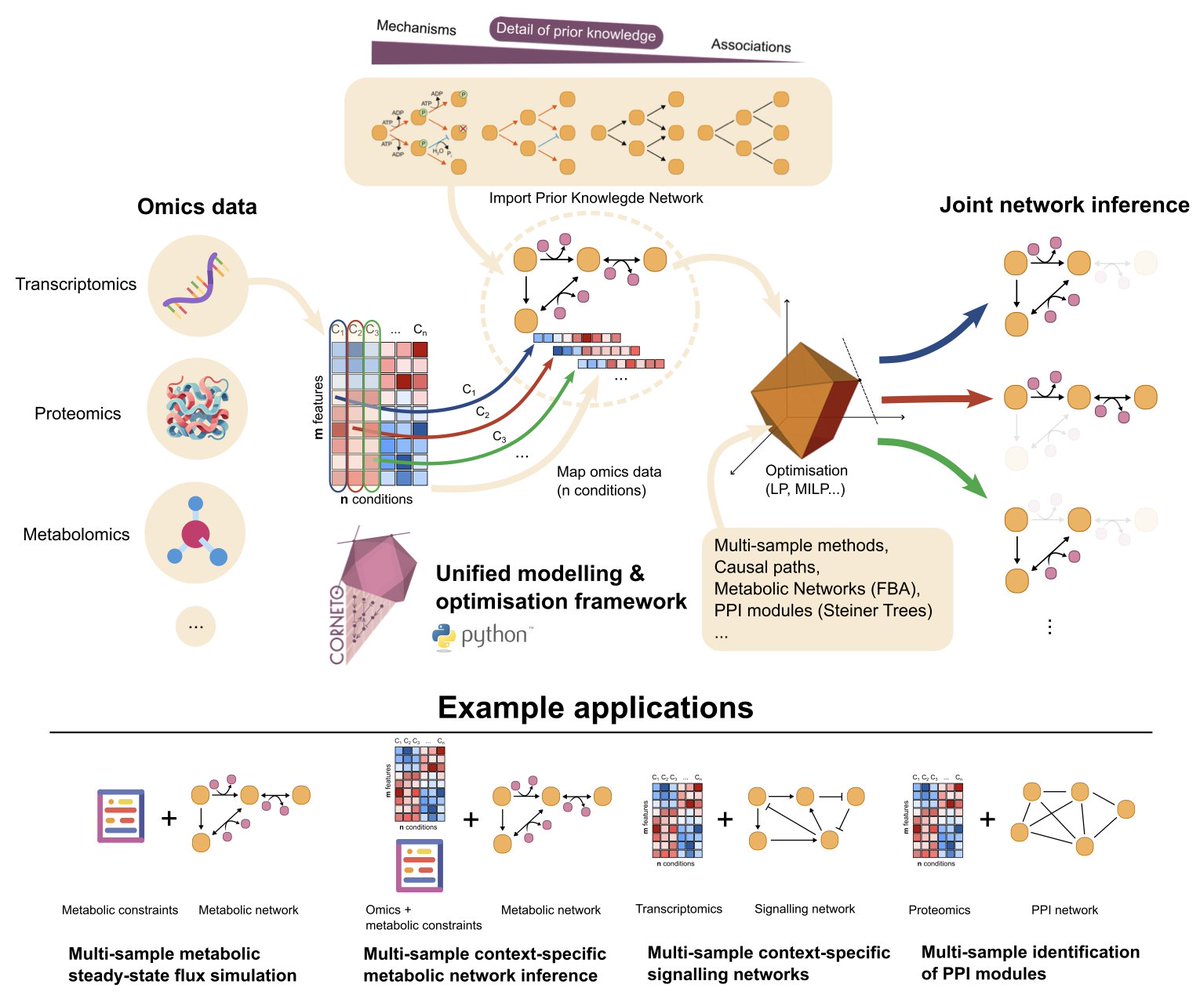
Unified knowledge-driven network inference from omics data
• This paper introduces CORNETO, a novel framework for knowledge-driven network inference that integrates omics data with prior knowledge through constrained optimization.
• CORNETO offers a unified mathematical approach, supporting multi-sample inference across different network types, including undirected, directed, signed graphs, and hypergraphs.
• The framework bridges the gap between data-driven and knowledge-based methods, addressing the challenges of sparse data and noisy networks by leveraging shared patterns across samples.
• CORNETO improves performance in protein-protein interaction networks, intracellular signaling, and metabolic flux modeling, outperforming traditional single-sample inference methods.
• The multi-sample extensions reduce variability and overfitting, producing more interpretable and biologically consistent networks, as demonstrated through simulated and real-world datasets.
• CORNETO is implemented as an open-source Python package, offering flexibility for customization, reuse, and compatibility with multiple mathematical solvers, enhancing accessibility for the research community.
• Applications include multi-condition Flux Balance Analysis (FBA), metabolic network reconstruction from omics data, and intracellular signaling inference from cancer datasets.
@saezlab @JulioSaezRod @attila_gbr @PabloRMier
💻Code: github.com/saezlab/corneto
📜Paper: biorxiv.org/content/10.1101/…
#Bioinformatics #NetworkInference #OmicsData #SystemsBiology #MachineLearning #AIforBiology #NetworkModeling
5
765

8 Oct 2024
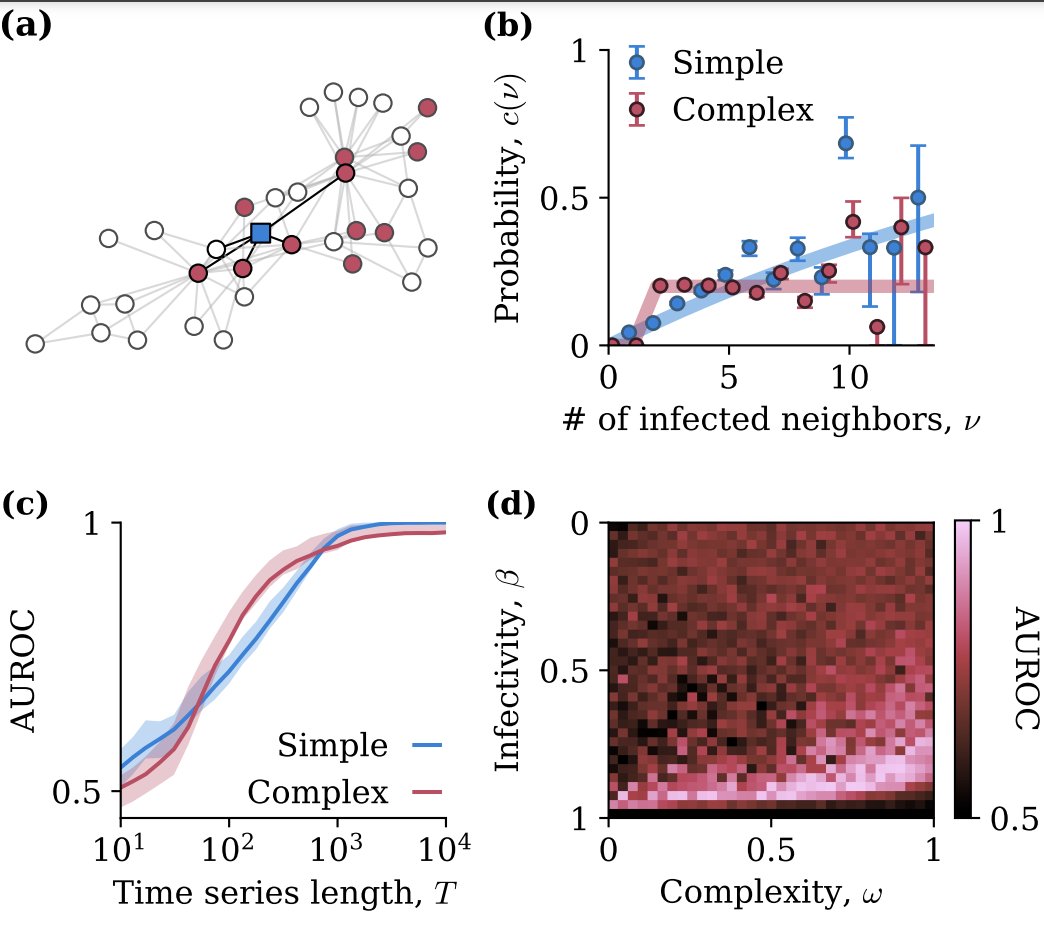
Reconstructing networks from simple and complex contagions, Nicholas W. Landry, William Thompson, Laurent Hébert-Dufresne, and Jean-Gabriel Young #NetworkInference @nwlandry @Will_H_Thompson @LHDnets @_jgyou go.aps.org/4ev0BUv
20
67
5,625

21 Jun 2024
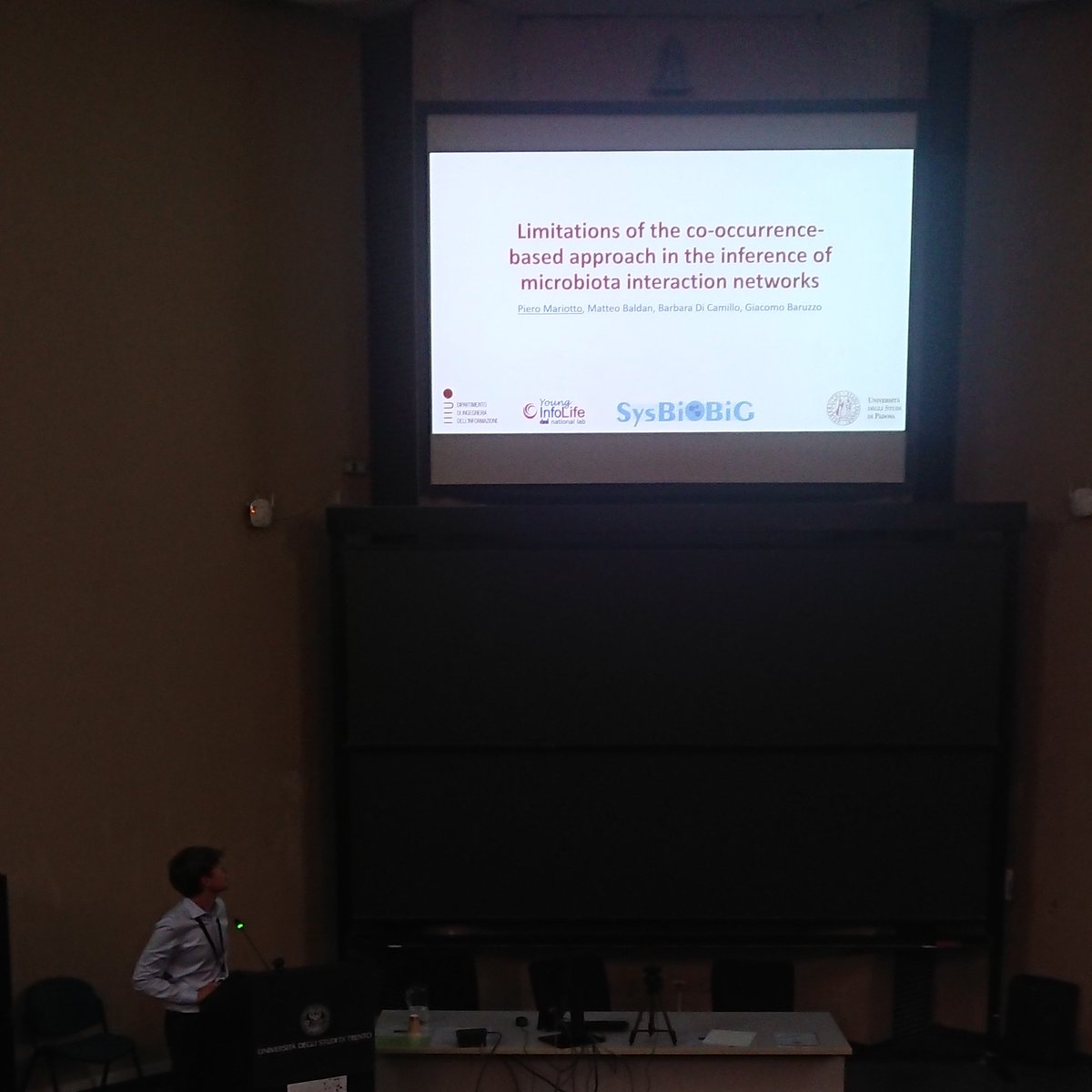
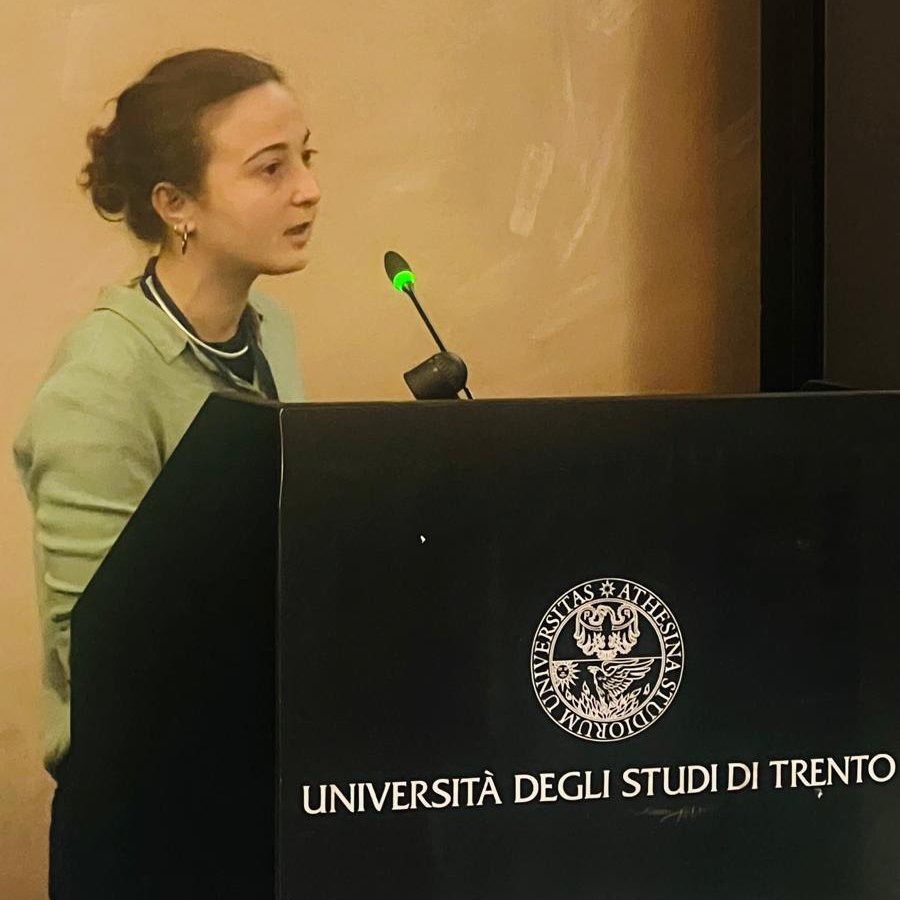
🌟#BITS2024 conference was interesting and highly engaging!
We are proud that our researchers @MariottoPiero and Gaia successfully presented their remarkable work on #networkinference and #singlecell.
Check out on our GitLab gitlab.com/sysbiobig
Stay tuned!! 🚀
2
104
7 May 2024
Inference of dynamic hypergraph representations in temporal interaction data, Alec Kirkley #ComplexNetworks #NetworkInference @captainkirk1041 @hkudatascience go.aps.org/4b6BXrA

7
29
3,945

11 Apr 2023
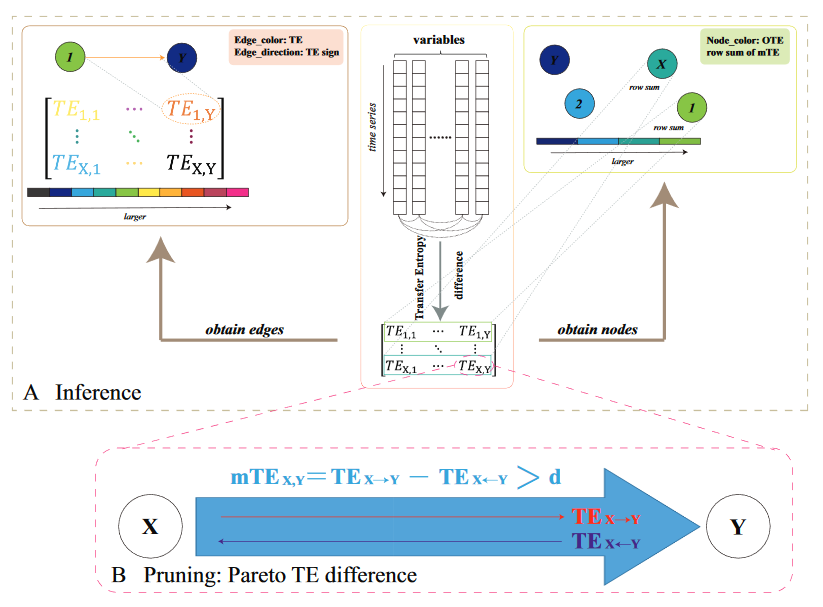
Read #NewPaper "Algal Bloom Ties: Spreading Network Inference and Extreme Eco-Environmental Feedback" from Haojiong Wang et al. mdpi.com/1099-4300/25/4/636
#spatial #networkinference
#biogeochemicalnetworks
#predictivecausality
#bloomprediction
#FloridaBay
2
3
341

5 Jan 2023
syntenet: an R/Bioconductor package for the inference and analysis of synteny networks. #SyntenyDetection #NetworkInference #PhylogenomicProfiling #Bioinformatics academic.oup.com/bioinformat…
3
8
909

10 Nov 2022
Our work on 'Network reconstruction for trans acting genetic loci using multi‑omics data and prior information' is finally out! Huge thanks to everyone involved! doi.org/10.1186/s13073-022-0… #networkinference #multiomics @SpringerNature @GenomeMedicine @heinig_matthias
1
11
25
19 Jun 2022
Benchmarking imputation methods for network inference using a novel method of synthetic scRNA-seq data generation. #scRNAseq #ImputationMethods #NetworkInference #Benchmarking #Bioinformatics
bmcbioinformatics.biomedcent… @BMCBioinfo
2
8

25 May 2020
NetworkInference - This is an R implementation of the netinf algorithm (Gomez Rodriguez, Leskovec, and Krause, 2010)<doi:10.1145/1835804.1835933>. Given a set of events that spread between a set of nodes the algorithm infers the most likely stab... #rstats github.com/desmarais-lab/net…
1

12 Feb 2020
corto: a lightweight R package for Gene NetworkInference and Master Regulator Analysis biorxiv.org/cgi/content/shor… #bioRxiv
3
5

10 Jul 2019
Nice overview of state of the art #networkinference methods, well done!
10 Jul 2019

Interested in #networkinference in #multiomics data? Might want to check out our (@fabian_theis , @heinig_matthias) recent review! Link: doi.org/10.3389/fgene.2019.0… #omics #dataintegration #epigenetics #generegulation
1
4
7
10 Jul 2019
Interested in #networkinference in #multiomics data? Might want to check out our (@fabian_theis , @heinig_matthias) recent review! Link: doi.org/10.3389/fgene.2019.0… #omics #dataintegration #epigenetics #generegulation
22
59
8 May 2019
Work from @VingronLab on a new take on graphical models allowing for non-linear associations between nodes using empirical distance covariance presented by Martin Vingron @recomb2019 - going from N to N^2 - exciting work for all us #networkinference guys!
2
2
5

4 Apr 2019
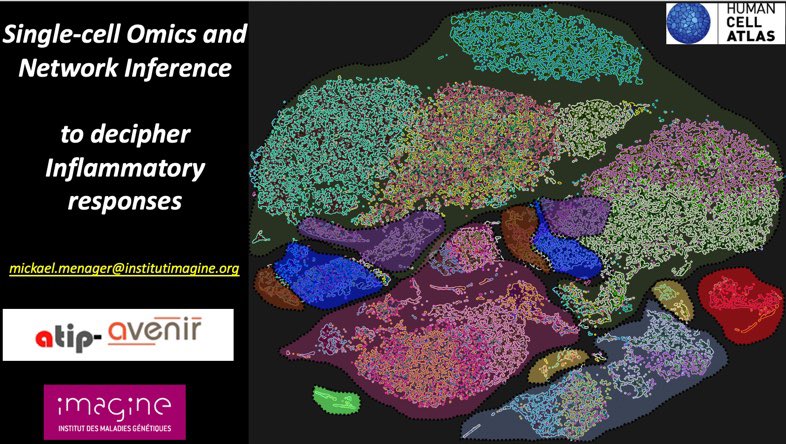
Top story: @MickMenager: 'What a great user group meeting #10xUGM19. Thanks @10xGenomics for having invited me to present our latest data on #singlecell #networkinference to better understand rare autoinflammatory disea… x.com/MickMenager/status/111…, see more tweetedtimes.com/v/1937?s=tn…
1
2
7

3 Apr 2019
What a great user group meeting #10xUGM19. Thanks @10xGenomics for having invited me to present our latest data on #singlecell #networkinference to better understand rare autoinflammatory diseases @InstitutImagine
1
6
19

5 Jun 2018
NetworkInference 1.2.0 now available on CRAN! Faster inference and new features, including automatic parameter initialization and edge selection with Vuong-style test. With @brucedesmarais
cran.r-project.org/web/packa…
9
13
2 Dec 2017
Version 1.1.2 of NetworkInference package now available on CRAN. Faster and with new features: github.com/desmarais-lab/Net…. @brucedesmarais
4
9
27 Mar 2017
R package NetworkInference 1.0.0 is released. Infer latent diffusion networks, now also in R. goo.gl/mRjh2J @brucedesmarais @jure
1
6