
7 Dec 2025
🚀 When Academic Writing Meets Agentic AI — PaperDebugger Turns Overleaf Into a Fully Autonomous Co-Author.
Academic writing has always suffered from one big bottleneck: tooling that lives outside the writing environment. Copy–paste workflows, broken context, lost revision histories, the entire process is fragmented.
PaperDebugger changes that. Completely.
This new system brings a plugin-based, multi-agent AI stack directly inside Overleaf, giving researchers something we’ve been waiting for:
👉 Real editing
👉 Real critique
👉 Real research assistance
👉 All happening in-editor, context-aware, and applied through deterministic diff-based patches.
What makes this system special isn’t just LLMs, it’s the deep orchestration layer behind them.
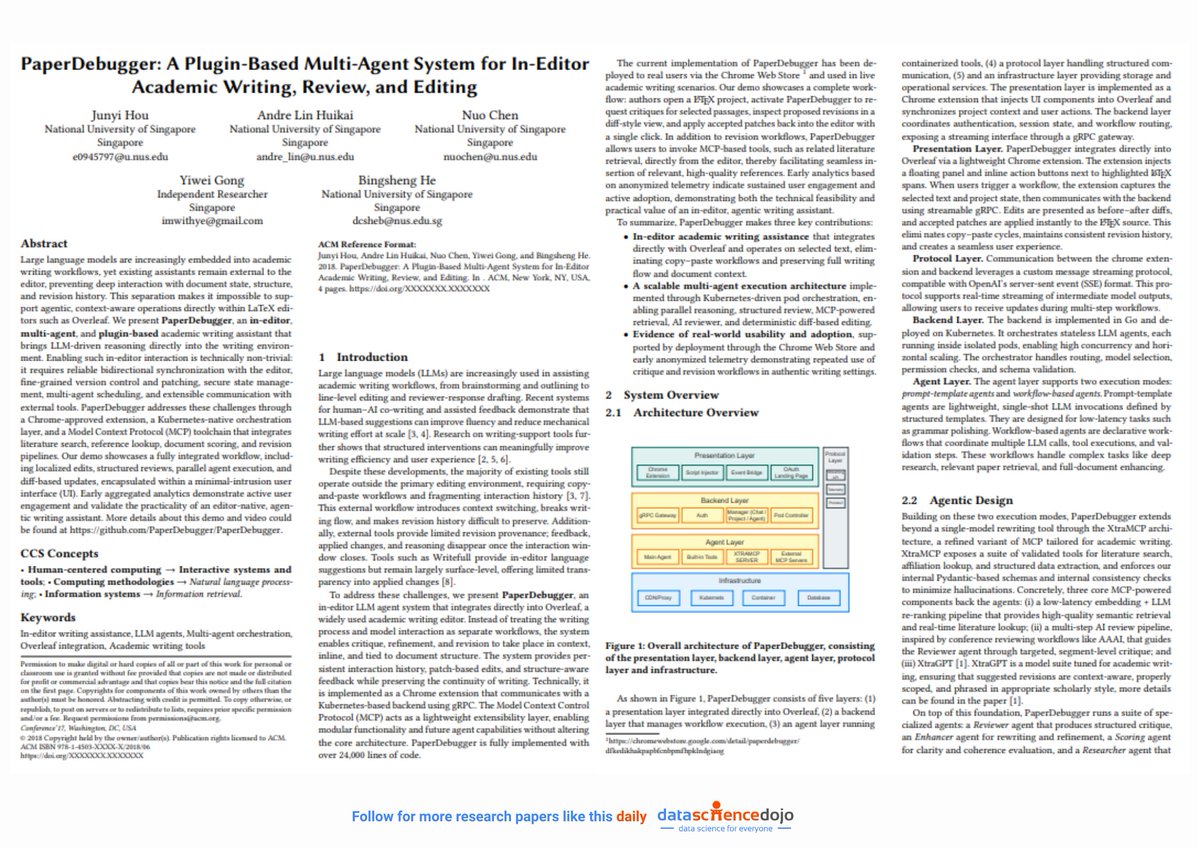
PaperDebugger runs on a Kubernetes-native backend, uses the Model Context Protocol (MCP) for tool interoperability, and coordinates specialized agents for critique, rewriting, research retrieval, and structured reviews, all streaming back into Overleaf through a Chrome-approved extension.
The result?
A writing loop where you highlight text → trigger an agent → inspect before/after diffs → apply a patch with one click.
No copy–paste. No switching windows. No context loss.
Even more impressive: PaperDebugger doesn’t stop at editing.
Its Researcher agent can perform deep semantic literature search, retrieve relevant papers, generate comparisons, and build structured related-work maps — turning Overleaf into a research cockpit, not just an editor.
Early telemetry shows real-world traction: dozens of active users, hundreds of projects, and thousands of patch-level interactions — clear evidence that academic writing is moving toward agentic, in-editor intelligence.
If Overleaf was the workspace, PaperDebugger just made it the workflow.
#PaperDebugger #AIWritingTools #AgenticAI #OverleafAI #LLMAgents #MCP #AcademicWriting #AIResearchTools #MultiAgentSystems #AIInEditor #AIProductivity #ResearchWorkflows #AIForScientists #KubernetesAI #LLMEngineering
3
1
1,002