
Jun 11
PRNEWS.IO and ApiX-Drive have partnered to help businesses automate workflows and scale their PR efforts. Users of both platforms gain exclusive perks through the PRNEWS.IO Rewards Program — less manual work, more visibility. #Automation #PRtech
1
3

Your story deserves to be seen beyond borders 🌍✨
With PRESSFORD, your press releases don’t just get published, they get the visibility and impact they deserve across Africa and the world.
#Pressford #PressRelease #GlobalReach #MediaDistribution #PRTech #AfricaToTheWorld


1
2
36

Legacy Watch
This week: A media database last fully verified before your newest team member joined.
Static lists don't tell you a journalist changed beats six months ago. Preston does.
#PRTech #AIinPR #PRTips #MediaRelations #AdaptiveSystems
3

The PR team's playbook for pitching a tech upgrade to leadership (Deza Drone) hubs.ly/Q04f3ZTB0 #PR #PRtech #PRtools
1
28

May 6
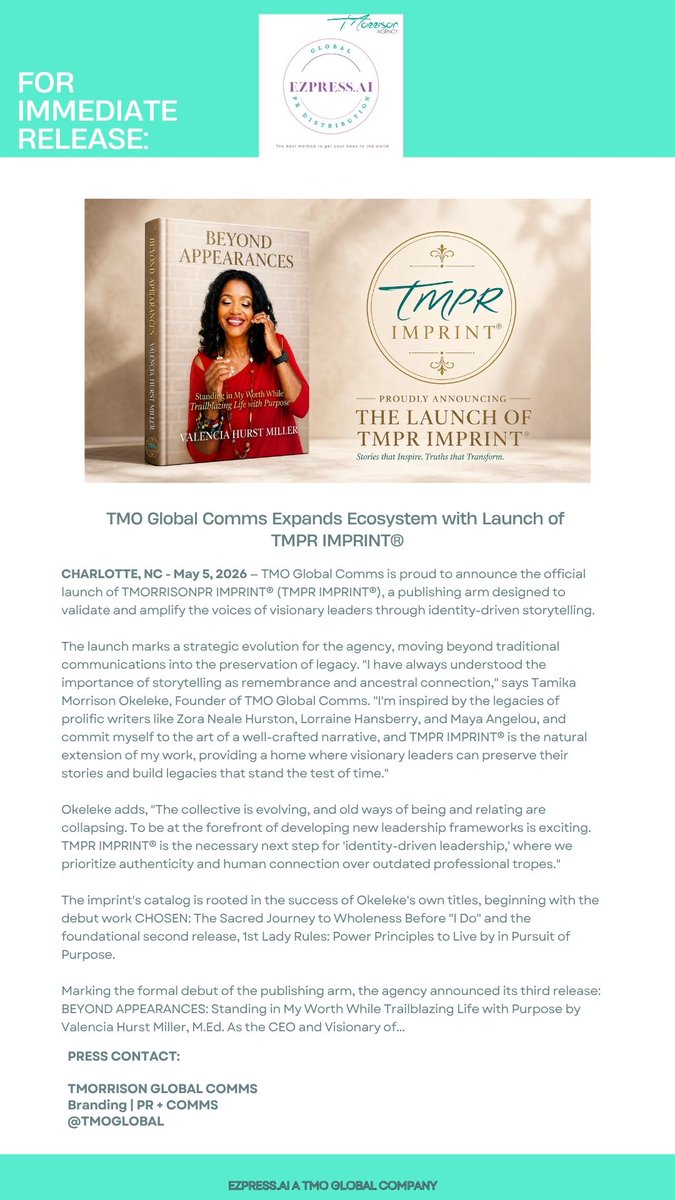
🚀We are proud to be the engine behind @tmoglobal's announcement of TMORRISONPR IMPRINT®. Our #PRDistribution meets their storytelling to ensure visionary voices reach the world instantly. Congrats on your 3rd release!
prlog.org/13143798-tmo-globa… #PRTech #FutureOfPR #EzPressAI
9
When you realize your tech stack is a problem, the hard question is: how do you convince leadership to spend money fixing it? Here's how to build a business case that gets approved. (Deza Drone) hubs.ly/Q04f403V0 #PR #PRtech #PRtools
20

When you realize your tech stack is a problem, the hard question is: how do you convince leadership to spend money fixing it? Here's how to build a business case that gets approved. (Deza Drone) hubs.ly/Q04f2McY0 #PR #PRtech #PRtools
13
The PR team's playbook for pitching a tech upgrade to leadership (Deza Drone) hubs.ly/Q04f3Crh0 #PR #PRtech #PRtools
15


NEW! Check out my new Morning AI Briefing.
I also have the full repository on AskSarah. For now, enjoy Wednesday:
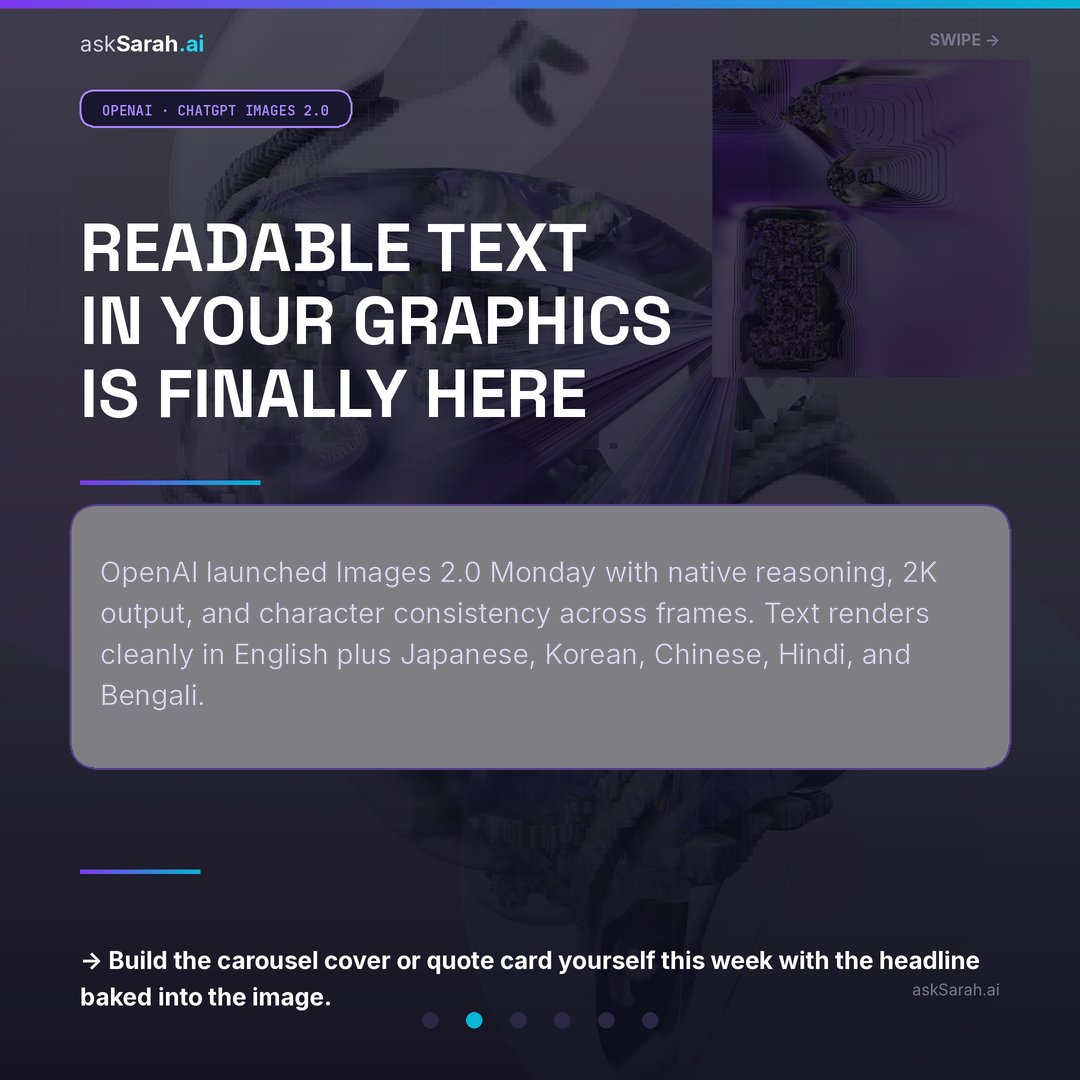
⚡ 1. OPENAI DROPPED CHATGPT IMAGES 2.0. IT CAN FINALLY PUT READABLE TEXT IN YOUR GRAPHICS.
🔗 openai.com/index/introducing…
OpenAI launched Images 2.0 Monday with native reasoning, 2K output, and character consistency across frames. Text now renders cleanly in English plus five non-Latin scripts. Free tier gets Instant mode. Plus and Pro unlock Thinking mode, which reasons before drawing.
→ Think about the carousel cover or quote card you normally wait on design for. Build it yourself this week with the headline baked into the image.
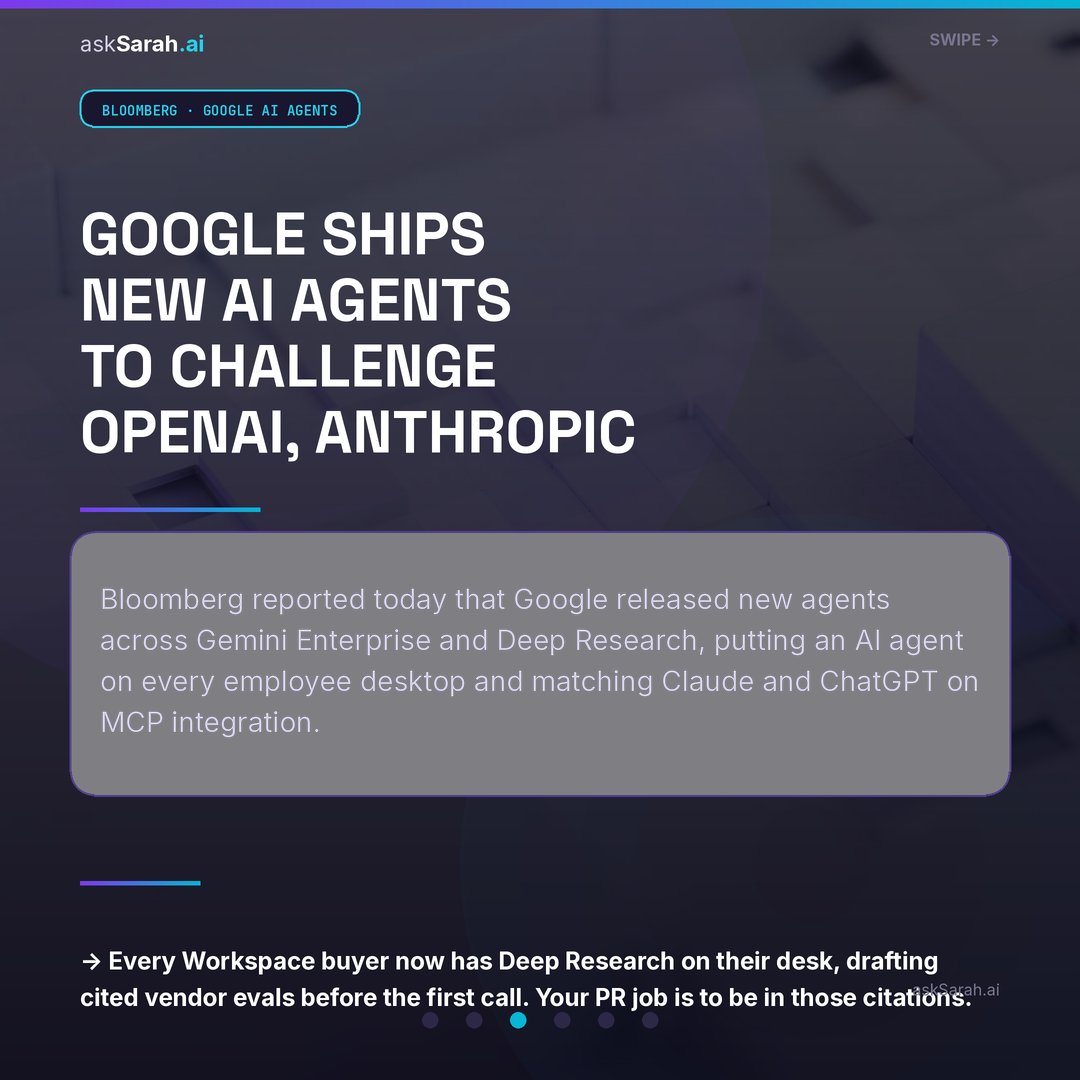
⚡ 2. GOOGLE DROPPED NEW AI AGENTS TO CHALLENGE OPENAI AND ANTHROPIC.
🔗 bloomberg.com/news/articles/…
Bloomberg reported today that Google released new agents across Gemini Enterprise and Deep Research, putting an AI agent on every employee desktop and matching Claude and ChatGPT on MCP integration.
→ Every Workspace buyer now has Deep Research on their desk, drafting cited vendor evals before the first call. Your PR job is to be in those citations.
⚡ 3. YELP'S AI ASSISTANT NOW BOOKS YOUR RESTAURANTS, DOCTORS, AND GYMS IN ONE CHAT.
🔗 macrumors.com/2026/04/21/yel…
Yelp's Assistant upgraded yesterday to cover every category. Ask for a birthday dinner with vegan options, then book the reservation in the same chat. Integrations are live with Vagaro, Zocdoc, Calendly, and DoorDash.
→ If you market a local service brand, ask Yelp's Assistant the top three questions your buyers ask. If your listing is not in the answer, time to focus on this channel.
⚡ 4. ADOBE LAUNCHED A BRAND INTELLIGENCE ENGINE THAT LEARNS FROM YOUR REJECTIONS.
🔗 news.adobe.com/news/2026/04/…
Adobe unveiled Brand Intelligence at Summit Monday. It feeds AI agents not just static guidelines, but the annotations, rejections, and approvals from every review cycle. Nvidia CEO Jensen Huang told the room, "AI is finally producing work."
→ Find the three signals that matter most for your brand: feedback you give on copy, creative you reject, edits you always make. Feed those into a GPT, skill, or project.
⚡ 5. HUBSPOT CUSTOMERS LOST 27% OF THEIR ORGANIC TRAFFIC. AEO IS THE FIX.
🔗 hubspot.com/company-news/hub…
HubSpot launched HubSpot AEO at Spring Spotlight, a $50/month tool that tracks how ChatGPT, Gemini, and Perplexity cite your brand. Beta users prioritizing answer engines grew AI referral traffic 20%. The broader HubSpot base lost 27% of organic search year over year.
→ Run HubSpot's free AEO Grader today. The prompts it surfaces are what your buyers are typing into AI, and that is your next three months of content.
#AI #ArtificialIntelligence #MarketingAI #PRtech #Leadership #AIStrategy #MorningBriefing
453

Okay, this one genuinely stopped me mid-scroll.
Claude Cowork just hit general availability — and I don't mean 'another AI tool dropped.' I mean: role-based access controls, spending limits per team, OpenTelemetry observability, audit logs, and scheduled task automation... all inside a single workspace your comms and IR teams can actually govern.
Think about what that means in practice.
You're not just giving people a chatbot. You're building a system where a junior PR associate can run weekly media monitoring on a schedule, a finance team can control exactly which agents touch sensitive filings, and a CTO can see a full telemetry trace of every automated action — without anyone needing to write a line of code.
That's not automation. That's institutional memory, encoded.
For years, enterprise AI adoption stalled because the answer to 'who's responsible when the agent does something wrong?' was 'uh... we'll figure it out.' Cowork's GA release is the first time I've seen a platform say: here's the permission gate, here's the spend ceiling, here's the log — now go build with confidence.
If you're the person at your company quietly holding together AI pilots with duct tape and hope, this is the infrastructure you've been waiting for.
The future of communications operations isn't faster drafting. It's structured, auditable, human-in-the-loop intelligence at scale.
insights.marvin-42.com/artic…
#ClaudeCowork #AIAgent #Anthropic #EnterpriseAI #PRtech #IRtech #AIGovernance #CommunicationsStrategy
1
27
Hold on. Let me make sure I'm reading this right.
OpenAI Codex just became an agent that clicks, types, remembers, schedules, and talks to Jira, Slack, and Notion — all while you sleep.
Not a chatbot. Not a code autocomplete.
A teammate that runs the whole loop:
change → verify → report → done.
What blows my mind isn't the tech itself.
It's what this means for how we work.
For years, 'automation' meant 'write a script and pray it doesn't break at 2am.'
Now? You describe the workflow in plain language, set an approval gate for anything sensitive, and let the agent handle the rest.
The part that genuinely moves me:
Codex remembers. It builds skills from repeated tasks and reuses them.
That's not just efficiency — that's institutional knowledge that doesn't walk out the door.
For anyone in communications, PR, or ops:
Imagine your weekly briefing pack drafted automatically, with sources cited, calculations shown, and nothing sent externally without a human sign-off.
That's not science fiction as of April 2026. That's Tuesday.
The question worth sitting with:
If an agent can now handle the mechanical repetition of your job, what becomes possible when your full human attention goes somewhere only you can take it?
That answer is worth chasing.
agenticbrew.ai/news/8f66b820…
#AIAgent #OpenAICodex #FutureOfWork #Automation #PRtech #CommunicationsStrategy
77
Something quietly shifted in how I think about AI at work.
PayPal just ran a company-wide rollout of Claude Cowork — not as a pilot, not as a skunkworks experiment, but as actual enterprise infrastructure deployed across the organization.
Here is what gets me: they are not just giving employees a chatbot. They are redesigning the *sequence of human work* itself. PR drafts, IR communications, internal knowledge tasks — the kind of work that used to live entirely inside someone's head or inbox — are now being mapped into agent-readable workflows. Step by step. Role by role.
The webinar framing hit hard: moving from *human procedures* to *agent procedures*. That is not a feature launch. That is a fundamental rethink of how institutional knowledge moves through an organization.
And paired with real governance — role-based access, usage controls, audit trails, analytics — this is not the wild west anymore. This is AI growing up inside the enterprise. Carefully. Deliberately.
What excites me most is not the automation. It is the *intentionality*. Someone at PayPal sat down and asked: what does our communications workflow look like when an agent is doing the first three steps? That question alone is worth everything.
If you are in PR, IR, or any communications role and you have not started mapping your own procedures this way — now is the moment. Not to replace the human judgment at the end. But to free it up for the part that actually needs you.
anthropic.com/webinars/deplo…
#AIAgents #ClaudeCowork #EnterpriseAI #FutureOfWork #PRtech #IRtech #AICommunications
19
Here is the wildest shift happening in PR and IR right now - and most teams haven't even noticed it yet.
Codex just dropped a massive update that reframes what an AI agent actually means for communications work.
We are not talking about autocomplete. We are talking about a full pipeline: gather requirements → draft the release → route for approval → publish → document everything. One connected chain, not five disconnected tools.
But here is the part that genuinely moved me.
The design principle at the heart of it is a permission gate - a deliberate human checkpoint built into the workflow. External sends, IR disclosures, public posts: always manual approval. Internal drafts, summaries, tone adjustments: let the agent run. That boundary is not a limitation. It is wisdom baked into the architecture.
Someone thought hard about where human judgment is irreplaceable - and built the system around that truth instead of trying to automate past it.
That is the real story here. Not speed. Not volume. But a machine that knows where to stop and wait for you.
If you are building comms workflows right now, this framing will save you from the most expensive mistakes. The gate is not friction. The gate is trust made visible.
Build the pipeline. Keep the human in the loop where it counts. That combination is not just efficient - it is defensible, auditable, and genuinely powerful.
openai.com/index/codex-for-a…
#AIAgents #PRtech #InvestorRelations #Codex #CommunicationsStrategy #AIWorkflow
18
My colleague spent 45 minutes writing the perfect AGENTS.md file for Codex.
Every rule. Every constraint. Every 'do not touch the IR folder under any circumstances.'
I asked him why he was being so thorough.
He said: 'Because a new employee, you can fire. An agent that goes rogue at 2am before earnings release? That's a different conversation.'
I stared at that sentence for a long time.
The AGENTS.md file is now four pages long.
Turns out the real onboarding document was never for humans.
openai.com/index/introducing…
#AIAgents #Codex #EnterpriseAI #PRtech #IRtech
13
Okay, I have to say this out loud:
AI agents just crossed a line I didn't expect so soon.
Anthropic's Cowork isn't just 'Claude answering questions faster.'
It's Claude actually doing the work — drafting press releases, building IR summaries, checking facts, cross-referencing sources — all inside a governed, auditable workflow.
The shift from 'AI that responds' to 'AI that executes' sounds like a small step.
But for anyone who has spent nights chasing down one wrong number in a financial document, or rewriting the same media statement five times at midnight — this is a completely different world.
Here's what genuinely moves me:
The design philosophy isn't 'let the AI run wild.'
It's 'keep humans in the loop at every critical gate — publishing, sending, approving.'
The agent does the heavy lifting. The human holds the responsibility.
That balance? That's not laziness. That's wisdom.
Technology built on trust, not just speed.
That's the kind of progress worth getting excited about.
If you work in communications, PR, or investor relations —
the question is no longer 'should I use AI?'
It's 'how do I design the workflow so the AI makes me sharper, not sloppy?'
The future of knowledge work isn't human vs. machine.
It's human agent, with clear lanes and honest guardrails.
anthropic.com/webinars/futur…
#AIAgents #ClaudeCowork #FutureOfWork #PRtech #KnowledgeWork #Anthropic
19
Hold on — an AI agent just turned a Zoom call into a press release draft before the meeting even ended.
This is what Claude Cowork Zoom MCP connector actually does:
You run your earnings prep call. The transcript flows in automatically. The agent pulls key messages, flags unconfirmed numbers, and spits out a release draft AND a Q&A skeleton — all while you're still saying your goodbyes on the call.
That's not automation. That's a whole new rhythm of work.
What moves me isn't the speed. It's the architecture behind it — someone thought hard about how PR pros actually think: source first, draft second, verify third, approve last. The tool respects that process instead of flattening it.
And the detail that earns real trust? The input (transcript) and output (draft) stay linked. Audit trail intact. Accountability built in.
For anyone in comms, IR, or corporate storytelling: this isn't about replacing judgment. It's about giving your judgment more time to matter — less scrambling on structure, more focus on what the message actually means.
The best communicators I know don't fear tools like this. They ask: how do I design the workflow so the human decision stays at the center?
That question is worth sitting with today.
nojitter.com/ai-automation/z…
#AIAgent #ClaudeCowork #PRtech #InvestorRelations #CorpComms #WorkflowDesign #FutureOfWork
24
Okay, this one genuinely stopped me mid-scroll.
OpenAI just dropped 'Codex for (almost) everything' — and the name isn't hype. We're talking about an agent that doesn't just write code. It operates your browser, runs parallel tasks, remembers what you were doing, and walks you through multi-step workflows start to finish.
Here's what hit me hard:
The dream used to be 'AI helps me draft.' Now the reality is 'AI handles the entire pipeline' — from raw materials to summary to draft to revision to approval flow. That's not a productivity tip. That's a structural shift in how knowledge work gets done.
And the part that actually gave me chills? The permission architecture. Codex is designed so you define exactly what it can and can't touch — folder-level, branch-level, operation-level. You're not just delegating. You're building a trust boundary with a system that respects it.
For anyone doing PR or IR work: imagine handing off 'source doc → key messages → draft → diff review → sign-off' as a single automated flow. That's not fiction anymore. That's what this makes possible today.
We're not in the 'AI is interesting' era. We're in the 'AI is the new infrastructure' era.
The people who figure out how to delegate well — not just how to prompt — are going to operate at a completely different altitude.
Learn the architecture. Design the trust boundaries. Then let it run.
openai.com/index/codex-for-a…
#AIAgent #Codex #OpenAI #FutureOfWork #PRtech #IRtech #AgentMode #KenAI
19
Hold on. Let me get this straight.
An AI agent can now watch your screen, read a GitHub event, spin up a parallel session, draft your PR copy, and hand it back to you for review — all while you are still drinking your morning coffee.
That is not a demo. That is Claude Code Routines and OpenAI Codex, shipping right now, in April 2026.
What blows my mind is not the raw capability. It is the design philosophy behind it.
AnthropicandOpenAI both landed on the same honest answer: the agent should ask permission before it does anything risky. Folder boundaries. Network escalation gates. Human review before the PR goes live. They are not hiding the guardrails — they are making the guardrails the whole product.
That is a different kind of ambition. Not 'trust us, it just works.' But 'here is exactly where the machine stops and you decide.'
For anyone in PR or IR — the people whose words move markets and shape reputations — that boundary matters more than speed. And now the tools are being built with that boundary baked in from day one.
We are not automating judgment. We are amplifying it.
If you have been waiting for AI agents to feel safe enough to put inside a real communications workflow, I think that moment just arrived.
The question is no longer 'can it do the job.' The question is 'how will you design the handoff.'
macrumors.com/2026/04/15/ant…
#ClaudeCode #AIAgent #PRtech #OpenAICodex #AnthropicAI #CommunicationsStrategy #AIinPR
38
AI just told me to wait for approval before hitting send.
And honestly? That might be the smartest thing any tool has ever done for me.
Gemini CLI's Subagents framework has a policy layer baked right in — meaning your AI agent won't fire off that email, post that update, or push that report until a human says go. It sounds simple. It's actually a quiet revolution.
Here's what gets me: we spent years arguing about whether AI could do the work. Turns out the real question was always — who checks the work before it leaves the building?
For anyone running comms, IR, or PR workflows, this is the architecture that makes trust possible. Not just fast. Trustworthy.
Imagine a flow where your agent drafts the press release, flags the key risks, and then stops — hand raised — waiting for your sign-off. That pause? That's not a limitation. That's respect for consequence.
The best systems aren't the ones that move fastest. They're the ones that know when to slow down and ask a human.
If you're building AI into your communications workflow right now, this subagent policy design is the piece most people skip — and the piece that will save you the most pain.
Build fast. But gate the things that matter.
geminicli.com/docs/core/suba…
#AIAgent #CommunicationsStrategy #GeminiCLI #WorkflowAutomation #ResponsibleAI #PRtech #IRtech
21