
Your cloud app isn’t gaslighting you...you just met the CAP theorem! The CAP theorem is why something can succeed… then fail… then succeed again without being broken:
shankuehn.io/post/the-cap-th…
#distributedsystems #captheorem #consistency #partitiontolerance #availability
3
201

Monolithic chains can and will be reorganized when needed. The SUI incident proves that. Because all transactions are on one chain. Reorg becomes difficult when you have 100,000s of validators - but then it's not scalable. You need a chain with high #partitiontolerance like @RubixChain
9
1
1
203

29 Apr 2025
#PartitionTolerance. Highly important for success of any decentralized network.
You can achieve high Partition Tolerance by duplicating same data across tens of thousands nodes. But that's highly expensive and inefficient! #BTC and #ETH do this way.
@RubixChain does a better way by partitioning the blockspace into clusters that continue to function even if other clusters fail. This is more practical and results in massive cost savings over centralized systems. #RBT
13
5
53
4,347

10 Mar 2025
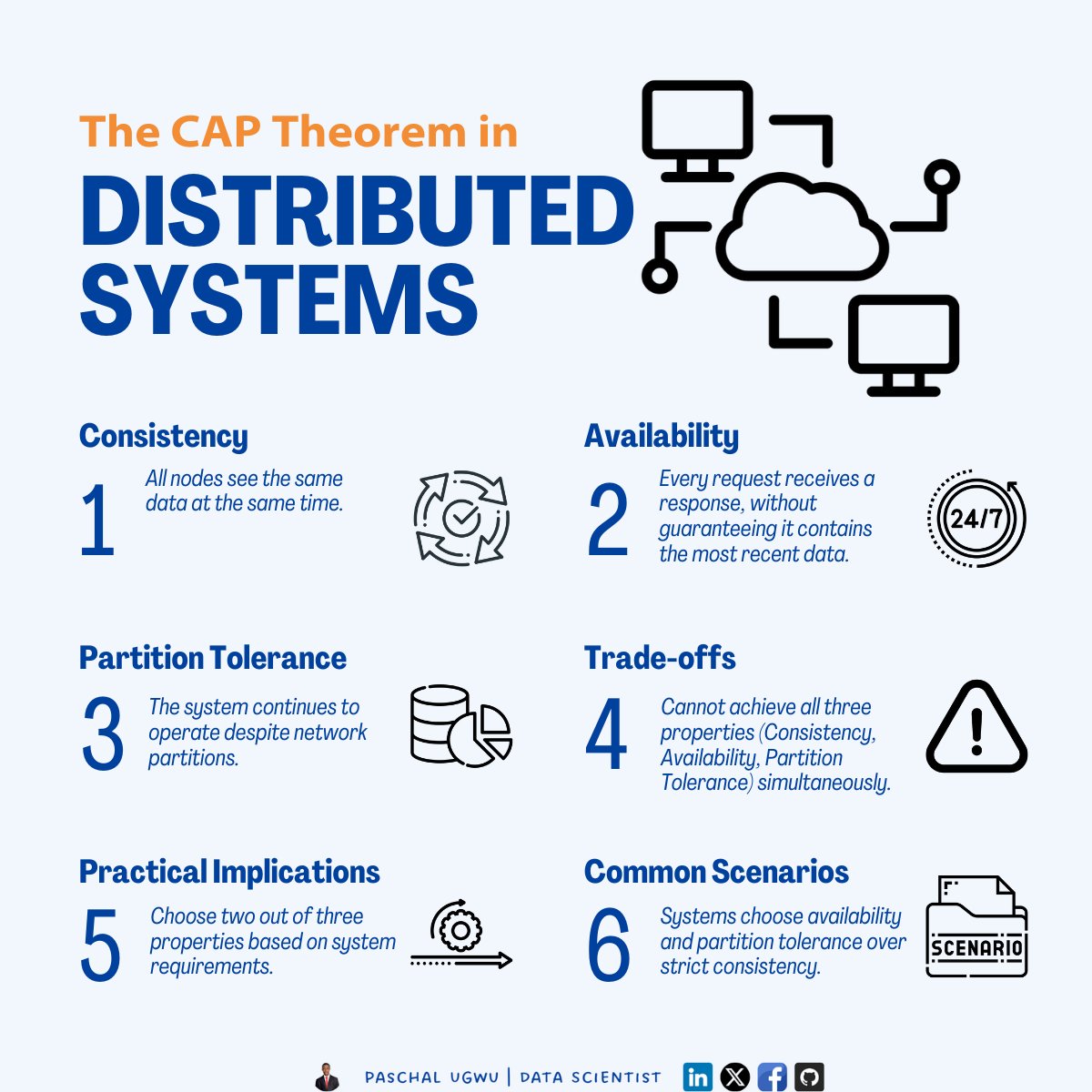
Understand the CAP Theorem to balance consistency, availability, and partition tolerance in your distributed system designs.
#DistributedSystems #CAPTheorem #TechInsights #Consistency #Availability #PartitionTolerance #SystemDesign #TechStrategy #DataConsistency
1
6
#partitiontolerance
Probably the single most important thing in the digital world today. More so after the #CrowdStrike episode. Current data hosting and identity structures are not partition tolerant and failsafe. We need to build new ways data is organized (not shared and centralized unnecessarily), accessed (IAM and data view is decentralized) and monetized. @RubixChain makes this new architecture possible.
1
3
83
Very good point on the core PoS assumption that majority owners dont cash out and stay long term. Need to trust them. This is an issue with monolithic/commonchain infra. We can make it resilient by parallel token chain design as in @RubixChain, wherein compromise on any one tokenchain does not affect other tokenchains. Major token holders exiting the project does not compromise the security of the network. #partitiontolerance
1
2
117
6 Feb 2024
When a monolithic chain has outage, entire network halts.
When a #subnet in #Rubix has outage, rest of the subnets continue to function normally.
This is how a decentralized network should function
#partitiontolerance
#paralellism
#reliability
#blockchain
#RBT
#Crypto
1
2
7
187
24 Jan 2024
Bugs happen in every software & open source helps to fix faster. But the cost of serious bugs, esp in staking/contracts in monolithic chains can be very high.
#Rubix with its parallel instances/#subnets minimizes the cost of bugs.
#partitiontolerance
blockworks.co/news/coinbase-…
3
87

11 Nov 2023
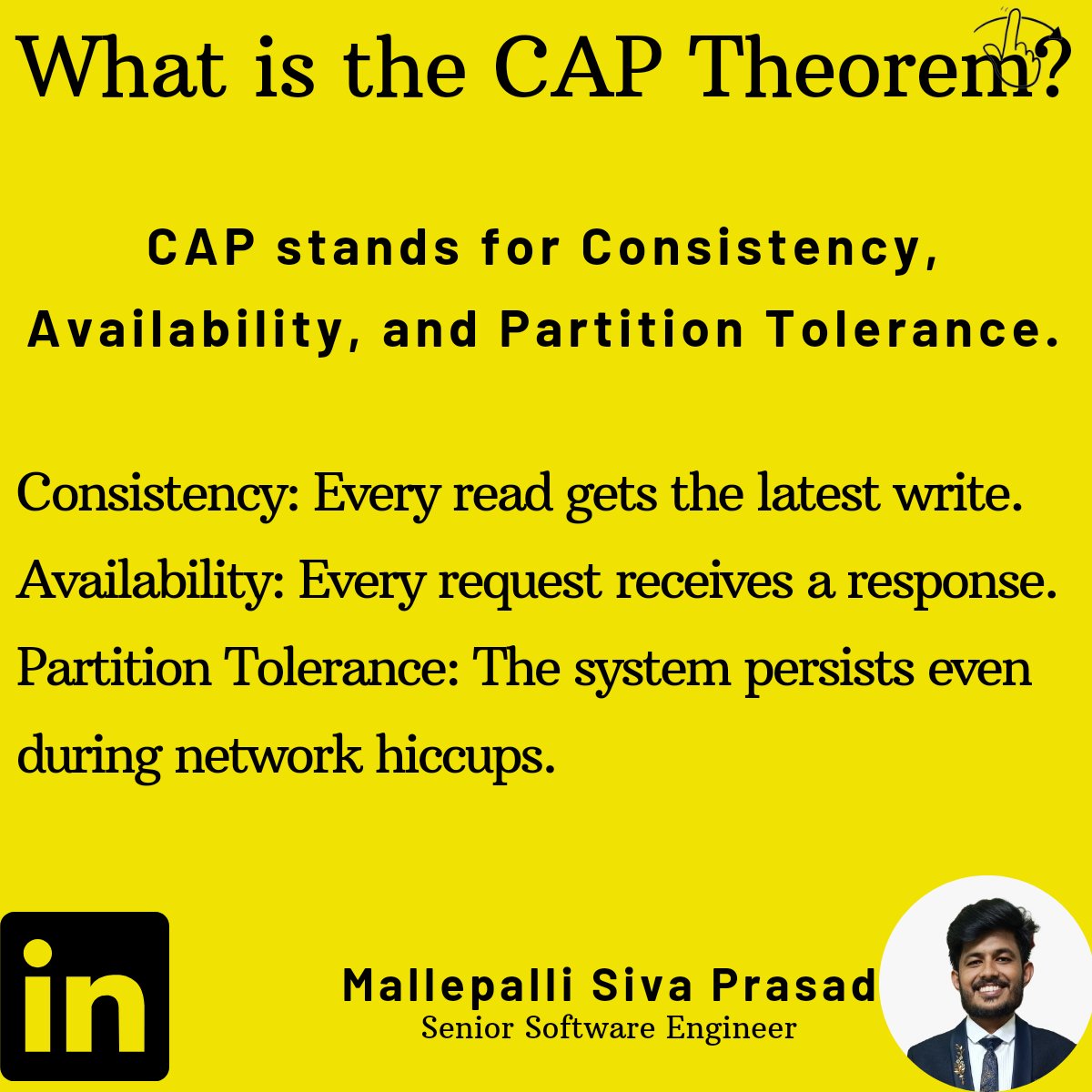
🔍 What is the CAP Theorem?
CAP stands for Consistency, Availability and Partition Tolerance.The CAP Theorem suggests that in any distributed data store, you can only achieve two out of these three guarantees at the same time
#consistency #availability #partitiontolerance #tech
1
1
27

2 Jul 2023
🔤 The CAP Theorem: A Balancing Act 🔤
The CAP theorem, also known as Brewer's theorem, is a fundamental concept in distributed systems that states that it is impossible for a distributed data system to simultaneously provide three guarantees: consistency (C), availability (A), and partition tolerance (P).
🔁 Consistency (C): Every read receives the most recent write or an error. The system remains in a consistent state after each operation.
⏰ Availability (A): Every request receives a response, regardless of failures or delays. The system remains responsive to user requests.
🔌 Partition Tolerance (P): The system continues to operate even if communication between nodes is unreliable, resulting in network partitions.
🤔 Why the Confusion? 🤔
The confusion arises because developers often interpret the CAP theorem differently, leading to varying understandings and trade-offs.
⚖️ Different Interpretations ⚖️
1️⃣ Strong Consistency vs. Eventual Consistency: Some interpret consistency (C) as strong consistency, while others consider eventual consistency sufficient. Strong consistency prioritizes immediate data synchronization, while eventual consistency allows for temporary inconsistencies.
2️⃣ Availability in the Presence of Failures: The definition of availability (A) can vary. Some developers perceive it as the ability to handle all requests, even under failures, while others see it as a reduced but acceptable level of service during failures.
3️⃣ Tolerance to Partitioning: Partition tolerance (P) is usually considered non-negotiable, as it enables distributed systems to survive network partitions. However, the degree of partition tolerance required may differ based on specific use cases.
💡 The Trade-Off Game 💡
In practice, the CAP theorem forces developers to make trade-offs when designing distributed systems.
✅ Choose Consistency and Availability: Sacrifice partition tolerance and design systems that prioritize consistency and availability. Suitable for scenarios where data integrity and immediate responses are crucial, but can be vulnerable to network partitions.
✅ Choose Availability and Partition Tolerance: Sacrifice strong consistency for improved availability and partition tolerance. Ideal for systems where responsiveness and fault tolerance are paramount, even if it means temporary inconsistencies.
✅ Choose Consistency and Partition Tolerance: Sacrifice availability and design systems that prioritize consistency and tolerance to network partitions. Suitable when data correctness and durability are critical, at the expense of potential service unavailability.
🎭 The CAP theorem remains a balancing act, requiring developers to understand the trade-offs and make informed decisions based on their specific system requirements. #CAPTheorem #Consistency #Availability #PartitionTolerance
5
26
4,975

1 Jun 2023
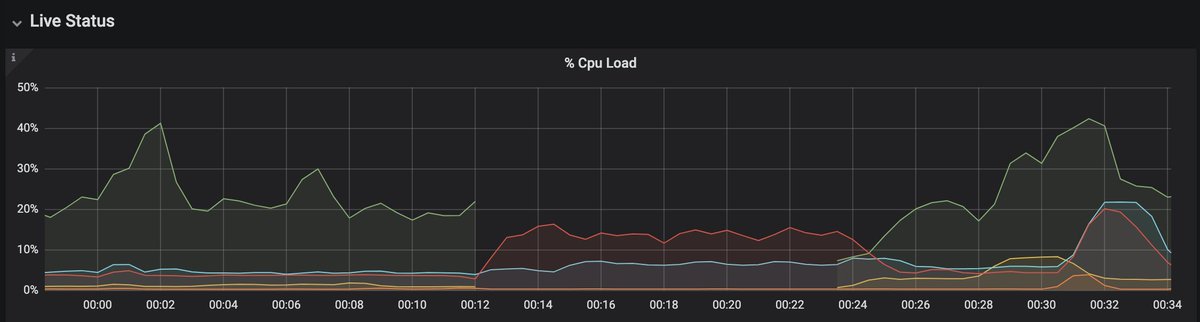
Warning to @GerritHub users of a temporary latency increase due to a global network outage on @OVHcloud (see two sites unreachable in the @Grafana chart), the site remained fully available thanks to the fully distributed #GerritCodeReview multi-site setup #PartitionTolerance
2
377

31 Mar 2022
~DBスペシャリスト~
☆CAP定理
分散処理システムの3つの特性(一貫性・可用性・分断耐性)は同時に2つ迄しか満たせない
・一貫性Consistency
データの整合性が常に担保
・可用性Availability
利用したい時に求める分だけ利用可
・分断耐性PartitionTolerance
データを複数のサーバに分散して保管
2

30 Dec 2021
Hi, you can read it here: --- Compute = Availability ?? Consistency ?? PartitionTolerance ---… threadreaderapp.com/thread/1… See you soon. 🤖

23 Mar 2021
Check out our new video - System Design: CAP Theorem youtu.be/C_rsLumFuuk via @YouTube
#bitmagic #systemdesign #captheorem #cap #consistency #availability #partitiontolerance #faulttolerance #distributedsystem #brewertheorem #rdbms #nosql #loadbalancing #algorithms #dev

3

24 Aug 2020
#caching
#loadbalancing
#replication
#dataSharding
#hashing
#consistency
#partitionTolerance
#Availability
#Replication
#scalability
are the few important terms for system design
1
1

2 Jun 2018
He also said code improvements could scale Eth. by x100, then sharding x100 and then Plasma (2nd layer) additional x? But i still heard nothing about offline-transactions / partitiontolerance / being feeless.. this is your 2nd Eth-friendly tweet, collaboration (qubic?) incoming?
8