Filter
Exclude
Time range
-
Near
the noisy, high velocity arena of Pump.fun launches, where thousands of new mints appear daily and most signals prioritize narrative over substance, @GraduateOracle stands apart through deliberate methodological rigor. Today they published their live receipts page not a polished backtest, but a transparent ledger of forward-validated predictions. Every probability was cryptographically hashed and committed to the record before the outcome was known, then resolved against immutable on-chain truth. The numbers are instructive: 51% of calls at ≥50% confidence actually graduated (n=3,725), while only 44% of graduates held meaningful value 30 minutes post-bonding curve (n=13,475). They publish the uncomfortable statistics alongside the favorable ones. Particularly noteworthy is their rapid iteration on the signal filtering logic. After observing that earlier gates were suppressing the majority of actionable graduations and high-momentum movers, the team rebuilt the system into a three-tier framework ACT, WATCH, and SCOUT calibrated directly from the resolved-outcome curve. This adjustment was pre-registered, criteria frozen, and is now forward-validating in public with a 72-hour verdict window. Early outcomes prompted an honest same-day follow-up acknowledging small-sample noise while reaffirming the underlying model integrity at scale (~71% on larger cohorts). This is the discipline that separates credible infrastructure from typical memecoin noise: public pre-registration of decision rules, immediate transparency when data challenges assumptions, and a refusal to optimize for short-term optics. No retroactive edits. No victory laps until the corpus demands it. Just continuous sharpening of a self-correcting oracle. The 3-tier signal bot is currently in pilot, releasing only when empirical performance justifies it. In an environment where most participants chase volume and hype, @GraduateOracle is optimizing for calibrated, auditable edge. I’ve been following their public build closely, and the combination of intellectual honesty, cryptographic commitment, and real-time model iteration positions them as one of the more serious efforts toward probabilistic intelligence in this space. As the dataset grows and the tiers mature, the accuracy receipts will become increasingly valuable for disciplined decision-making. For anyone serious about data-driven participation in Pump.fun launches rather than gambling on narrative keeping @GraduateOracle on your radar is advisable. Building in public with receipts. That’s rare. That’s worth watching. #GraduateOracle #CalibratedPrediction #PumpFun #OnChainIntelligence #ProbabilisticModeling
6
1
18
311
New article! Leveraging scale separation and stochastic closure for data-driven prediction of chaotic dynamics 👉 cup.org/4tGKjiW By Ismaël Zighed, Nicolas Thome, Patrick Gallinari & Taraneh Sayadi #data #dynamics #turbulence #probabilisticmodeling #stochasticmodeling
4
120
2
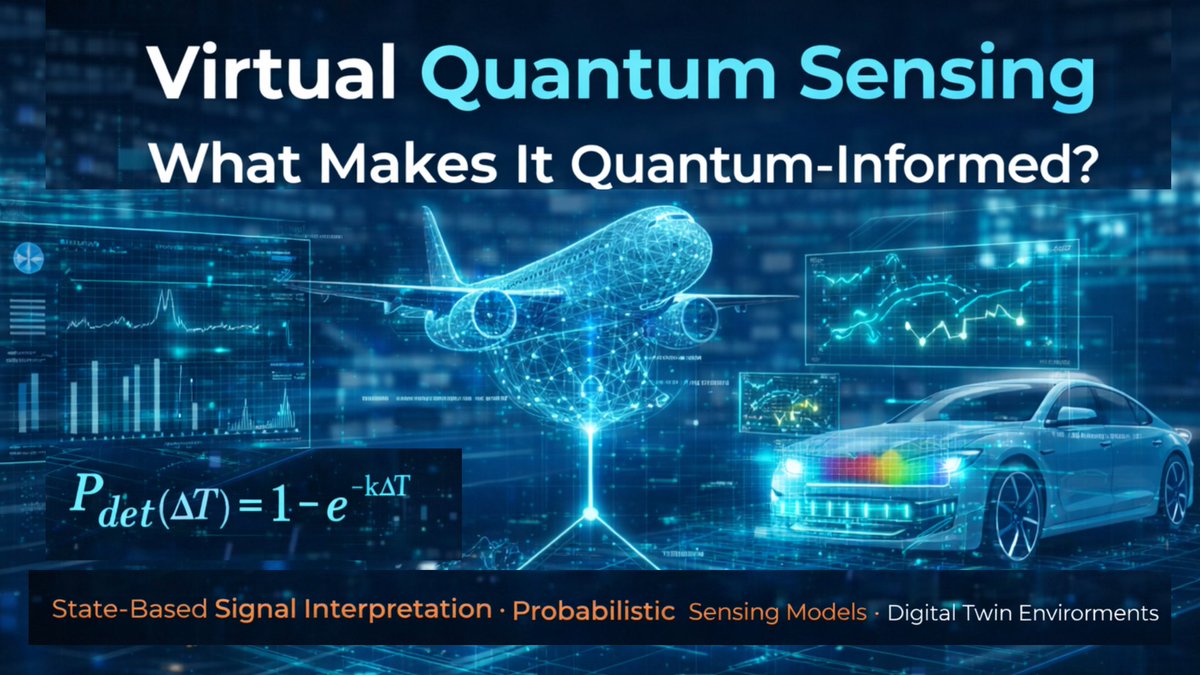
🔔 Virtual Quantum Sensing — What Makes It Quantum-Informed? ➡️ Early-stage structural degradation is rarely absent — it is simply unresolved. Classical sensing systems rely on fixed thresholds, meaning signals must become sufficiently large before detection occurs. By that point, degradation is already established. ➡️ This is the limitation Virtual Quantum Sensing addresses. Instead of treating signals as deterministic measurements, sensing is constructed as a probabilistic inference process within digital twin environments. Structural behaviour is represented as a state space, where signal perturbations contribute to the likelihood of emerging degradation states. ➡️ The “quantum” aspect is not hardware — it is modelling. 🔵 Quantum-informed sensing applies probabilistic, state-based formulations inspired by interaction-driven detection behaviour, where sensitivity emerges from the relationship between signal perturbation and system response rather than fixed thresholds. 🟠 This allows sub-threshold signals — traditionally discarded as noise — to contribute meaningfully to structural state inference, enabling earlier detection of degradation. 🟣 Demonstrator results show detection of composite delamination as small as 40 mm², corresponding to ~20% improvement in Minimum Detectable Defect (MDD) thresholds under governed sensing configurations. 🟢 Within the QuESTran architecture, this sensing capability forms the first stage of a governed pipeline — followed by ARC admissibility evaluation and evidence anchoring through the K-Ledger framework. 🔔 This is not a new sensor.It is a new way of constructing sensing intelligence. Full article below. linkedin.com/pulse/virtual-q… 📩 Feedback welcome from those working across sensing, digital twins, and engineering intelligence. 🌐 #QuantumSensing #DigitalTwins #StructuralHealthMonitoring #EngineeringAI #ProbabilisticModeling #SystemsEngineering #PredictiveMaintenance #ReliabilityEngineering #AIinEngineering #InnovateUK
1
1
11
🚀 New Blog Published! Probabilistic Modeling Explained: Hidden Markov Chain in Modern AI Systems Discover how Hidden Markov Chain powers speech recognition, NLP, finance modeling & more. Read : dataexpertise.in/hidden-mark… #HiddenMarkovChain #DataScience #ProbabilisticModeling

18
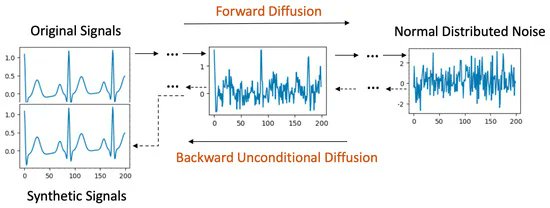
💥Highly recommended publication: "BioDiffusion: A Versatile Diffusion Model for Biomedical Signal Synthesis" 🔗shorturl.at/ugqhl 🏫@txst 📌#ProbabilisticModeling #EEG #GenerativeAI
1
2
83
Delayed Rejection Adaptive Metropolis ( DRAM) MCMC on the Banana distribution. DRAM combines co-variance adaption and delayed rejection to efficiently sample highly nonlinear posteriors in MCMC. github: github.com/SaiSampathKedari/… #MCMC #BayesianInference #MonteCarlo #StatisticalComputing #ProbabilisticModeling
2
234
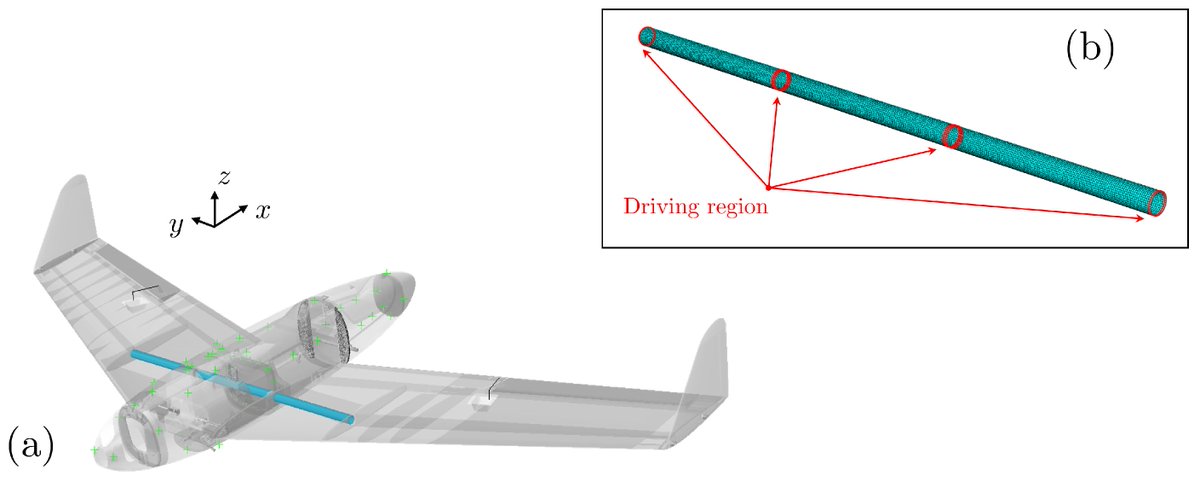
On the Development of a Deep Learning-Based Surrogate Model for Fleet-Wide Probabilistic Modeling mdpi.com/2673-4591/119/1/20 By Georgios Aravanis et al. From the 8th International Conference of Engineering Against Failure #AI #ProbabilisticModeling #CVAE @MDPIEngineering
34
This survey does not just summarize diffusion models. It explains why they work, how they connect to decades of physics and mathematics, and where the next breakthroughs are likely to emerge. #DiffusionModels #GenerativeAI #MachineLearning #DeepLearning #ScoreBasedModels #StochasticProcesses #SDE #ODE #ProbabilisticModeling #BayesianInference #StatisticalMechanics #NonEquilibriumThermodynamics #AIResearch #FoundationModels #AIGeneration
333
The taxonomy presented in the paper is more than categorization—it is a research roadmap. It reveals where progress has been made and where theoretical understanding still lags behind empirical success. #DiffusionModels #GenerativeAI #MachineLearning #DeepLearning #ScoreBasedModels #StochasticProcesses #SDE #ODE #ProbabilisticModeling #BayesianInference #StatisticalMechanics #NonEquilibriumThermodynamics #AIResearch #FoundationModels #AIGeneration
326
One of the most valuable contributions is the connection to other generative models: VAEs, GANs, normalizing flows, autoregressive models, energy-based models, and even large language models. #DiffusionModels #GenerativeAI #MachineLearning #DeepLearning #ScoreBasedModels #StochasticProcesses #SDE #ODE #ProbabilisticModeling #BayesianInference #StatisticalMechanics #NonEquilibriumThermodynamics #AIResearch #FoundationModels #AIGeneration
295
Beyond images, diffusion models adapt to structure: discrete data, invariant data, and manifold-supported data. This requires rethinking noise, scores, and transitions—not just reusing Gaussian perturbations. #DiffusionModels #GenerativeAI #MachineLearning #DeepLearning #ScoreBasedModels #StochasticProcesses #SDE #ODE #ProbabilisticModeling #BayesianInference #StatisticalMechanics #NonEquilibriumThermodynamics #AIResearch #FoundationModels #AIGeneration
287
Likelihood estimation is another frontier. The paper shows how noise schedule optimization, reverse variance learning, and exact likelihood computation tighten theoretical guarantees—bringing diffusion models closer to principled density estimation. #DiffusionModels #GenerativeAI #MachineLearning #DeepLearning #ScoreBasedModels #StochasticProcesses #SDE #ODE #ProbabilisticModeling #BayesianInference #StatisticalMechanics #NonEquilibriumThermodynamics #AIResearch #FoundationModels #AIGeneration
276
A major bottleneck is sampling speed. The survey categorizes solutions into learning-free methods (better SDE/ODE solvers) and learning-based methods (optimized discretization, truncation, and distillation). #DiffusionModels #GenerativeAI #MachineLearning #DeepLearning #ScoreBasedModels #StochasticProcesses #SDE #ODE #ProbabilisticModeling #BayesianInference #StatisticalMechanics #NonEquilibriumThermodynamics #AIResearch #FoundationModels #AIGeneration
255