
Respectfully, it really isn't.
Signalling to students the intent of your lesson and why it's important is, like, a perfectly reasonable thing to do.
And if you were attending classes in a particular field you might like the teacher to do the same.
Jun 13

Love this from @Counsell_C:
Writing lesson objectives on the board at the start of a lesson is like telling the punchline of a joke, before telling the joke
Petty Tyrant retweeted

Extent to which White House allies are signalling this is a culture war issue, not a technical one, is striking.
[2024: SpaceX launch delayed because of environmental group concerns over damaged nests.]

21h

Extent to which White House allies are signaling that this is a culture war issue, not a technical one, is striking
4
13
388
15,133

THE POTTER WHO INVENTED VIRTUE SIGNALLING AND ACTUALLY DESERVED IT.
HOW A MAN FROM STAFFORDSHIRE GAVE THE ABOLITION MOVEMENT ITS MOST POWERFUL SYMBOL.
There is a modern belief that changing the world requires a social media account, a carefully curated profile picture, and a willingness to explain complex moral questions in 280 characters.
The eighteenth century had a different approach. It involved pottery.
Josiah Wedgwood, born in Burslem in 1730, became the most famous potter in England by doing something rather unfashionable. He was competent. In fact, he was so competent that he helped transform pottery from a craft into an industry. He introduced division of labour, measured costs, improved manufacturing processes, and even developed a heat gauge for kilns impressive enough to earn him a Fellowship of the Royal Society in 1783.
Having mastered the difficult task of making plates, cups and bowls efficiently, he then turned his attention to something considerably more important.
In 1787, Wedgwood joined the newly formed Society for the Abolition of the Slave Trade. At the time, slavery was not merely tolerated. It was profitable. Entire industries depended upon it. Vast fortunes rested upon the assumption that some human beings could be treated as property.
Wedgwood disagreed.
Rather than deliver endless speeches, he commissioned a small jasperware medallion. It depicted a kneeling African man in chains with a simple question around the edge.
"Am I not a man and a brother?"
Five words.
No shouting. No slogans. No bureaucratic report stretching to six hundred pages. Just five words that forced people to confront a moral reality many preferred not to think about.
Then he did something even more remarkable.
He paid for them himself.
He never sold them. He gave away thousands. He distributed them throughout Britain and even sent a batch across the Atlantic to Benjamin Franklin.
Soon they appeared everywhere. People wore them as brooches, pinned them to clothing, displayed them on snuff boxes and incorporated them into jewellery. The medallion became the symbol of the abolitionist movement.
Today, political campaigns spend fortunes hiring consultants to create logos that people forget before lunch. Wedgwood produced one that helped change history.
Arguably, it was the first truly successful political logo. Every awareness ribbon, campaign badge, wristband and social cause symbol owes something to a Staffordshire potter who realised that ideas travel faster when people can carry them.
What makes the story especially powerful is that Wedgwood did not need to get involved.
He was already successful. He could have continued selling fine pottery to wealthy customers and enjoyed a comfortable life. History is full of people who looked at injustice and decided it was somebody else's problem.
Wedgwood chose differently.
He used his skills, his reputation and his resources to advance a cause he believed was morally right. He did not command an army. He did not hold political office. He did not possess vast governmental power.
He had a kiln, a business and a conscience.
That proved enough.
The lesson remains relevant. Most people will never become prime ministers, presidents or revolutionary leaders. But almost everyone possesses some skill, some influence or some opportunity to improve the world around them.
The question is whether they choose to use it.
Josiah Wedgwood could have made more dinner plates.
Instead, he helped give a movement its face.
The world remembers him for both.
[If you agree with the sentiment described above, then please 'quote', ‘restack’, 'share', 'repost' or 'forward'. The Left will accept these ideas when they are trending on social media. So, make it trend.
If you are going to comment, then please be polite. Agreement is not required, but politeness is a must. Those who are impolite, rude, or insulting to others will be blocked; not because we do not agree with your viewpoint, but because rudeness will not be tolerated.]
4

At some point we need medical research into why anyone voted once, let alone 3 times, for a narcissistic, sanctimonious, virtue signalling, silver spooned airhead. He has his daddy’s name and his mommy’s brain.
5

Ah yes the "far right", aka, those who are not willing to Sacrifice their own at the altar of virtue signalling.
They are people who say we don't mind other cultures but want to be treated equally in their own countries.
They are people who will celebrate other cultures but are asking for policy that wont erode or erase their own.
Scum of the earth they are
11

You could have been a soldier in saving this country Jacob but you threw it away to be part of the tory betrayal and now you're counter signalling the only option that will revive our nation.
Shame on you.
4


Narcissists can rarely tolerate having their own flimsily-constructed virtue signalling challenged by reality being pointed out. The poor man has little option but to block you, as much to maintain his own cognitive dissonance as to hide your irrefutable critique from his audience.
9
Trudeau is a narcissistic, sanctimonious, virtue signalling, silver spooned airhead. He has his daddy’s name and his mommy’s brain.
7

Yup. Virtue signalling creates class distortion and backlash
3

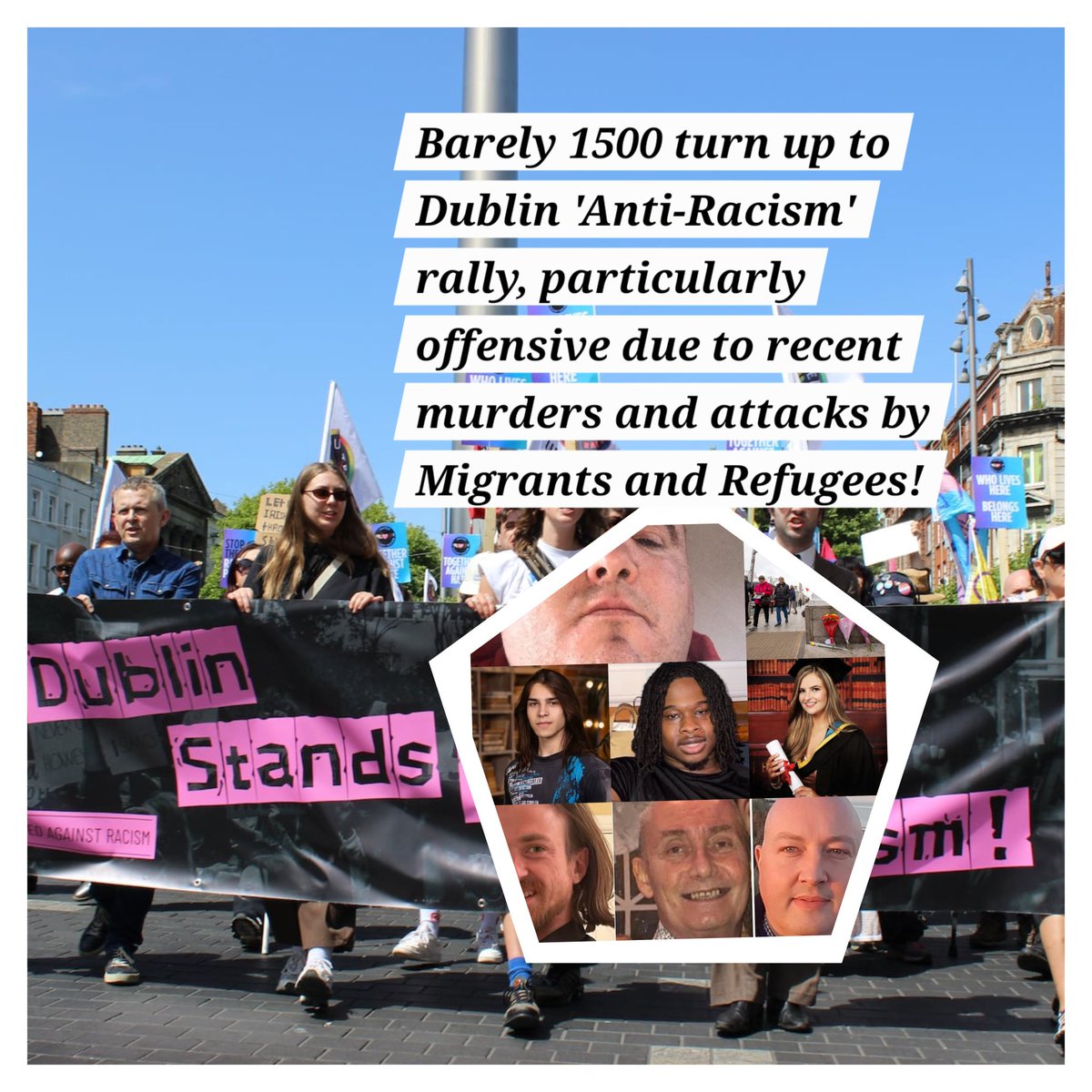
Low Turnout Exposes Hypocrisy of Establishment 'Anti-Racism' March in Dublin
Despite frantic mobilisation by establishment parties, trade unions, NGOs, and state-funded activists, barely 1,500 people bothered to turn out for today's so-called "United Against Racism" march in the capital.
Organisers and their cheerleaders in the Irish Times desperately inflated the figure to "up to 2,000," but photos and eyewitness accounts from O'Connell Street to the Custom House told a different story, a sparse, ragtag gathering of the usual suspects politicians, union hacks, and professional protestors, failing to drum up any real public support.
The timing could not be more insulting to ordinary Irish people.
This performative spectacle comes hot on the heels of horrific violence linked to foreign nationals and migrants:
- The brutal murder of Alex Coughlan, a 37-year-old family man beaten to death in Blanchardstown by teenagers from migrant backgrounds.
- The savage maiming of Stephen Ogilvie in Belfast, where a Sudanese asylum seeker allegedly stabbed and slashed him, leaving him blinded in one eye and with severe injuries.
- And other recent tragedies amid a wave of stabbings and assaults that have left communities reeling.
While Irish victims and their families grieve, the establishment marches not against the crime tearing through our streets, but against "racism" code for any concern about mass immigration, failed integration, and skyrocketing violence.
Speakers whined about "fear in my home" from supposed racist rhetoric, yet remain silent on the very real terror ordinary Dubliners and Irish families face from unchecked migration.
This pathetic turnout is a clear message from the Irish public: We're fed up with the gaslighting.
No amount of union busing, NGO funding, or media spin can hide the reality on the ground. Ireland has had enough of open borders, soft-on-crime policies, and elites who prioritise virtue-signalling over the safety of their own people.
Real Irish News stands with the victims and the silent majority demanding change. Enough is enough.
11
Low Turnout Exposes Hypocrisy of Establishment 'Anti-Racism' March in Dublin
Despite frantic mobilisation by establishment parties, trade unions, NGOs, and state-funded activists, barely 1,500 people bothered to turn out for today's so-called "United Against Racism" march in the capital.
Organisers and their cheerleaders in the Irish Times desperately inflated the figure to "up to 2,000," but photos and eyewitness accounts from O'Connell Street to the Custom House told a different story, a sparse, ragtag gathering of the usual suspects politicians, union hacks, and professional protestors, failing to drum up any real public support.
The timing could not be more insulting to ordinary Irish people.
This performative spectacle comes hot on the heels of horrific violence linked to foreign nationals and migrants:
- The brutal murder of Alex Coughlan, a 37-year-old family man beaten to death in Blanchardstown by teenagers from migrant backgrounds.
- The savage maiming of Stephen Ogilvie in Belfast, where a Sudanese asylum seeker allegedly stabbed and slashed him, leaving him blinded in one eye and with severe injuries.
- And other recent tragedies amid a wave of stabbings and assaults that have left communities reeling.
While Irish victims and their families grieve, the establishment marches not against the crime tearing through our streets, but against "racism" code for any concern about mass immigration, failed integration, and skyrocketing violence.
Speakers whined about "fear in my home" from supposed racist rhetoric, yet remain silent on the very real terror ordinary Dubliners and Irish families face from unchecked migration.
This pathetic turnout is a clear message from the Irish public: We're fed up with the gaslighting.
No amount of union busing, NGO funding, or media spin can hide the reality on the ground. Ireland has had enough of open borders, soft-on-crime policies, and elites who prioritise virtue-signalling over the safety of their own people.
Real Irish News stands with the victims and the silent majority demanding change. Enough is enough.
13

Mental illness is in fact brain illness - the brain is an organ that can malfunction, often in subtle ways but as so complex, subtle issues can have massive downstream impact. Lower or higher levels of certain neurotransmitters, poor signalling etc
1
4
Donald Hughes retweeted

Privacy as a Fundamental Right? The Government’s Terrible Privacy Track Record Suggests Virtue Signalling Over a Genuine Commitment
michaelgeist.ca/2026/06/priv…
3
3
42

Privacy as a Fundamental Right? The Government's Terrible Privacy Track Record Suggests Virtue Signalling Over a Genuine Commitment michaelgeist.ca/2026/06/priv… via @mgeist: @privacylawyer
8

The r word is a slur dingdong, so some research before saying anything. Also I am not a preteen I am 19 as clearly stated on the bio. Also I am not signalling shit, I am just not racist and believe that everyone should be equal. But again statistically it’s white men.
2


What is wrong with spending the money to improve the lives of Welsh people.
We are for the uninitiated, the oldest indigenous people of Europe.
They are supposed to be the government of Wales. Not vertue signalling benefactors to the third frigging world...
Cymru am byth.
2

See if you keep dancing to that tune when it's one of your loved ones. Virtue signalling dipshit.
2