Filter
Exclude
Time range
-
Near
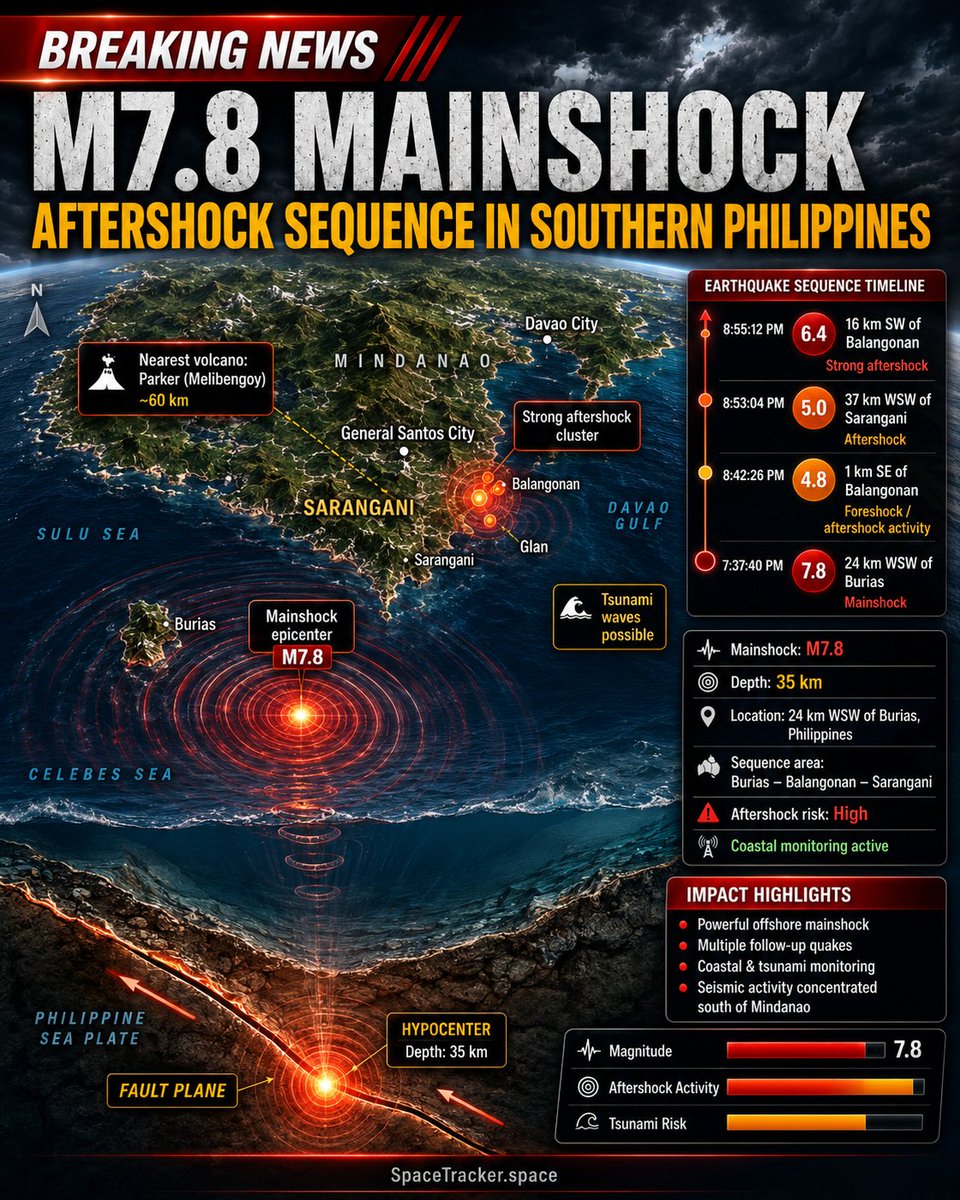
🚨 BREAKING EARTHQUAKE UPDATE - SOUTHERN PHILIPPINES 🚨 M7.8 Mainshock New M6 Aftershock Zone Near Mindanao Processed by spacetracker.space A major earthquake sequence is unfolding near southern Mindanao, Philippines, after a powerful M7.8 offshore quake struck near the Burias / Sarangani region. The latest live monitor screen now shows a new M6.4 reading near Balangonan, Philippines, following the earlier M7.8 event near Burias. This points to an active aftershock sequence in the same regional seismic zone. ━━━━━━━━━━━━━━━━━━━━━━ ⚠️ LIVE QUAKE STACK ━━━━━━━━━━━━━━━━━━━━━━ πŸ”΄ Mainshock: M7.8 πŸ“ Near Burias, southern Philippines ⬇️ Depth: ~35 km 🌊 Tsunami waves possible πŸŒ‹ Nearest volcano: Parker / Melibengoy 🟠 New M6 event: M6.4 πŸ“ SW of Balangonan, Philippines ⚠️ Strong follow-up shaking possible πŸ“‘ Situation still updating ━━━━━━━━━━━━━━━━━━━━━━ πŸ“Š POWER BAR SIGNAL ━━━━━━━━━━━━━━━━━━━━━━ Mainshock Force β–ˆβ–ˆβ–ˆβ–ˆβ–ˆβ–ˆβ–ˆβ–ˆβ–ˆβ–‘ M7.8 / Major Aftershock Activity β–ˆβ–ˆβ–ˆβ–ˆβ–ˆβ–ˆβ–ˆβ–ˆβ–‘β–‘ High Tsunami Concern β–ˆβ–ˆβ–ˆβ–ˆβ–ˆβ–ˆβ–ˆβ–‘β–‘β–‘ Regional coastal watch Volcano Proximity β–ˆβ–ˆβ–ˆβ–ˆβ–ˆβ–‘β–‘β–‘β–‘β–‘ Parker / Melibengoy nearby Public Alert Level β–ˆβ–ˆβ–ˆβ–ˆβ–ˆβ–ˆβ–ˆβ–ˆβ–‘β–‘ Serious monitoring phase ━━━━━━━━━━━━━━━━━━━━━━ 🌊 TSUNAMI WATCH ━━━━━━━━━━━━━━━━━━━━━━ A large offshore earthquake can disturb the seafloor and push water outward. That does not always mean a destructive tsunami, but it means coastal communities must take official warnings seriously. People near low-lying coasts should watch for: β€’ Sudden sea retreat β€’ Unusual waves β€’ Fast water rise β€’ Strong aftershocks β€’ Emergency evacuation orders If you are near the coast: move higher, move inland, and follow official tsunami bulletins. ━━━━━━━━━━━━━━━━━━━━━━ πŸŒ‹ NEAREST VOLCANO HIGHLIGHT ━━━━━━━━━━━━━━━━━━━━━━ The closest major volcano system to highlight is Parker Volcano / Mount Melibengoy, located in southern Mindanao. There is no confirmed eruption signal from this quake, but strong earthquakes near volcanic regions can trigger landslides, crater-lake disturbance, or increased monitoring around volcanic systems. Scientists will watch for: β€’ Volcanic tremor β€’ Gas changes β€’ Ground swelling β€’ New earthquake swarms β€’ Landslides near steep slopes β€’ Crater-lake disturbance ━━━━━━━━━━━━━━━━━━━━━━ πŸ›°οΈ WHY THIS MATTERS ━━━━━━━━━━━━━━━━━━━━━━ This is not a small isolated tremor. This is a major offshore seismic sequence in one of Earth’s most active tectonic regions. The Philippines sits on the Pacific Ring of Fire, where powerful earthquakes, volcanoes, and tsunami-producing faults can overlap. The next hours are critical for: ⚠️ Aftershocks 🌊 Wave readings 🚨 Coastal evacuation updates πŸŒ‹ Volcano monitoring πŸ“‘ Official agency revisions ━━━━━━━━━━━━━━━━━━━━━━ 🚨 FINAL ALERT LINE ━━━━━━━━━━━━━━━━━━━━━━ A powerful M7.8 earthquake has struck southern Mindanao, with the live monitor now showing a new M6 event nearby. Tsunami monitoring remains important, aftershock risk is high, and coastal communities should follow official alerts immediately. SpaceTracker.space #BreakingNews #PhilippinesEarthquake #Mindanao #Burias #Balangonan #Sarangani #M78 #Earthquake #Aftershocks #Tsunami #TsunamiWatch #RingOfFire #PHIVOLCS #USGS #PacificTsunami #VolcanoWatch #ParkerVolcano #MountMelibengoy #Matutum #DisasterAlert #EarthScience #GeoScience #SeismicActivity #NaturalDisaster #EmergencyAlert #WorldNews #LiveEarthquake #EarthquakeMonitor #SpaceTracker #SpaceTrackerSpace
4
4
2,392
🚨 BREAKING EARTHQUAKE ALERT - SOUTHERN PHILIPPINES 🚨 Processed by: spacetracker.space Powerful M7.8 Quake Strikes Near Burias, Mindanao -Tsunami Waves Possible A major magnitude 7.8 earthquake struck near Burias, southern Mindanao, Philippines, shaking a highly active section of the Pacific Ring of Fire. The earthquake was reported at about 35 km depth, close enough to raise serious concern for coastal shaking and possible sea-level disturbance. Early tsunami monitoring indicated that waves could affect some regional coasts, especially near the Philippines, Indonesia, and Malaysia. ━━━━━━━━━━━━━━━━━━━━━━ ⚠️ QUICK TECH DASHBOARD ━━━━━━━━━━━━━━━━━━━━━━ πŸ“ Epicenter: WSW of Burias, Philippines 🌎 Region: Southern Mindanao / Celebes Sea zone πŸ“ Magnitude: M7.8 ⬇️ Depth: ~35 km 🌊 Tsunami: Possible regional waves πŸŒ‹ Nearest major volcano: Mount Melibengoy / Parker Volcano ⚑ Main risk: Coastal impact strong aftershocks ━━━━━━━━━━━━━━━━━━━━━━ πŸ“Š POWER BAR SIGNAL ━━━━━━━━━━━━━━━━━━━━━━ Magnitude Force: β–ˆβ–ˆβ–ˆβ–ˆβ–ˆβ–ˆβ–ˆβ–ˆβ–ˆβ–‘ 7.8 / Major Tsunami Potential: β–ˆβ–ˆβ–ˆβ–ˆβ–ˆβ–ˆβ–ˆβ–‘β–‘β–‘ Elevated β€” coastal watch needed Aftershock Risk: β–ˆβ–ˆβ–ˆβ–ˆβ–ˆβ–ˆβ–ˆβ–ˆβ–‘β–‘ High aftershock probability Volcano Proximity: β–ˆβ–ˆβ–ˆβ–ˆβ–ˆβ–‘β–‘β–‘β–‘β–‘ Parker / Melibengoy ~60 km range Regional Alert Level: β–ˆβ–ˆβ–ˆβ–ˆβ–ˆβ–ˆβ–ˆβ–ˆβ–‘β–‘ Serious monitoring phase ━━━━━━━━━━━━━━━━━━━━━━ 🌊 TSUNAMI WATCH ━━━━━━━━━━━━━━━━━━━━━━ A quake this strong can disturb the seafloor if the fault motion pushes water upward. That does not always mean a destructive tsunami, but it does mean coastal communities must treat the first alerts seriously. People near low-lying coastlines should watch for: β€’ Sudden sea retreat β€’ Unusual waves β€’ Rapid water rise β€’ Strong aftershocks β€’ Official evacuation orders The most important rule: do not wait for social media confirmation. Follow official tsunami bulletins immediately. ━━━━━━━━━━━━━━━━━━━━━━ πŸŒ‹ NEAREST VOLCANO HIGHLIGHT ━━━━━━━━━━━━━━━━━━━━━━ The nearest major volcanic system to the epicentral zone is Mount Melibengoy, also known as Parker Volcano, in southern Mindanao. This does not mean an eruption is happening. However, strong earthquakes near volcanic regions can increase monitoring attention because shaking may trigger landslides, crater-lake disturbance, or hydrothermal changes. Scientists will now watch for: β€’ Volcanic tremor β€’ Ground deformation β€’ Gas changes β€’ Landslides β€’ Crater lake disturbance β€’ New local earthquake swarms ━━━━━━━━━━━━━━━━━━━━━━ πŸ›°οΈ WHY THIS EVENT MATTERS ━━━━━━━━━━━━━━━━━━━━━━ The Philippines sits on one of the most active earthquake belts on Earth. A major offshore quake near Mindanao is not just a local shaking event β€” it becomes a regional ocean-monitoring event. This is the type of earthquake where minutes matter. Coastal zones must stay alert. Emergency teams must monitor aftershocks. Scientists must watch both tsunami sensors and nearby volcano systems. ━━━━━━━━━━━━━━━━━━━━━━ 🚨 FINAL LINE ━━━━━━━━━━━━━━━━━━━━━━ A powerful M7.8 earthquake near southern Mindanao has placed the region under serious seismic and tsunami monitoring. The event is major, the location is sensitive, and the next hours are critical for aftershocks, wave readings, and official safety updates. Credit: SpaceTracker.space #BreakingNews #PhilippinesEarthquake #Mindanao #Burias #Earthquake #M78 #Tsunami #TsunamiAlert #PacificRingOfFire #PHIVOLCS #USGS #VolcanoWatch #ParkerVolcano #MountMelibengoy #Matutum #SeismicActivity #Aftershocks #NaturalDisaster #DisasterMonitoring #EarthScience #GeoScience #SpaceTracker #SpaceTrackerSpace #AmmarA #WorldNews #EmergencyAlert #BreakingEarthquake #Philippines #Indonesia #Malaysia #PacificTsunami #ScienceNews #LiveEarthquake #EarthquakeMonitor #Tectonics #RingOfFire #Volcano #TsunamiWatch #ClimateAndEarth #HazardWatch
4
6
1,122
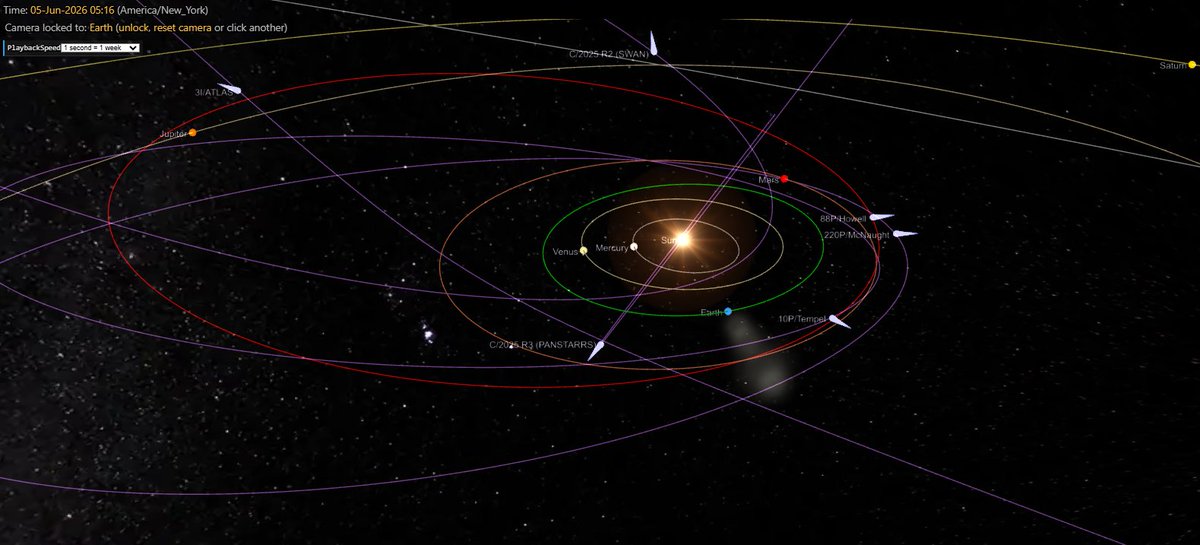
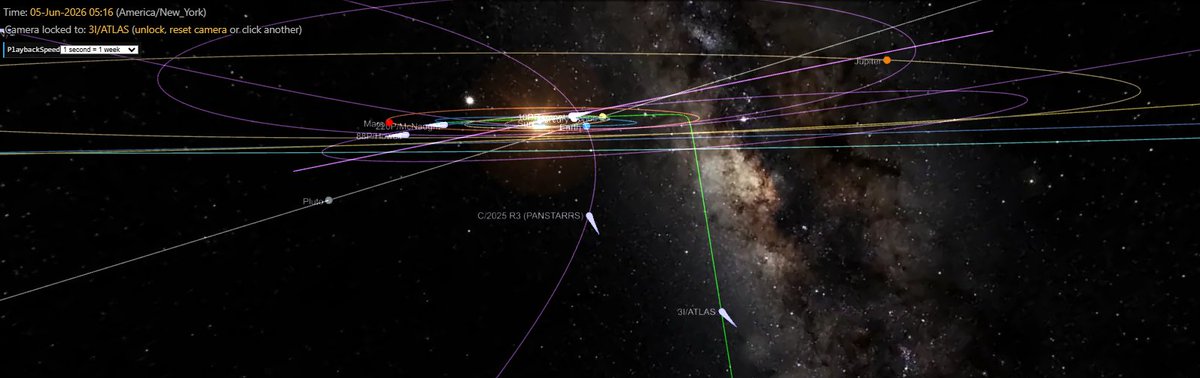
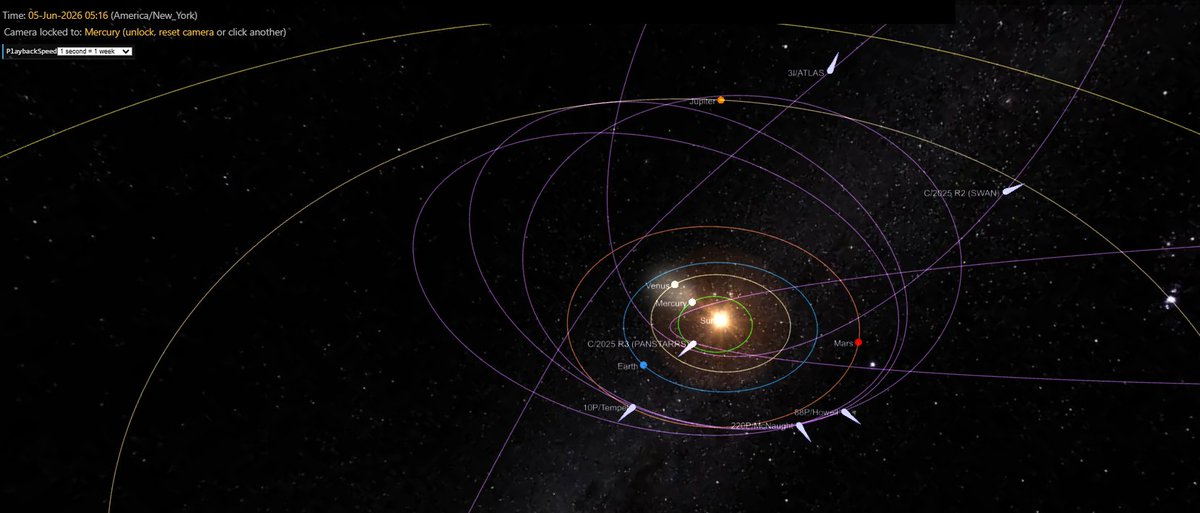
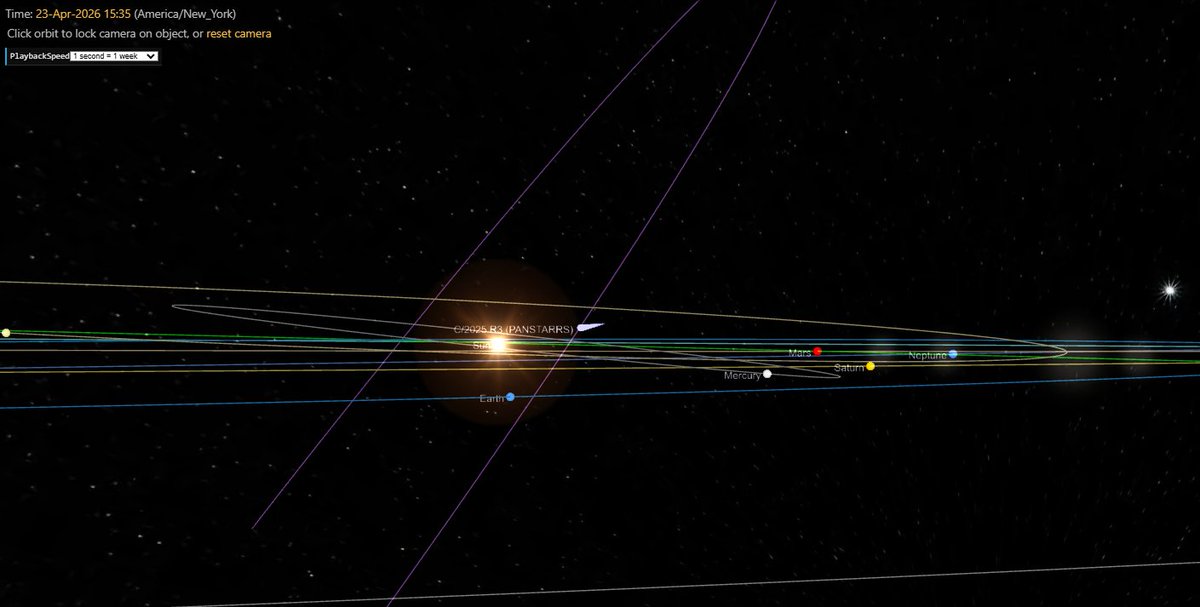
πŸš¨β˜„οΈ BREAKING COMET TRAFFIC MAP: Six Comets Cross the Inner Solar System in One View Processed by spacetracker.space A rare orbital snapshot from June 5, 2026 shows a crowded comet scene around the inner solar system: 3I/ATLAS, C/2025 R2 SWAN, C/2025 R3 PANSTARRS, 10P/Tempel 2, 88P/Howell, and 220P/McNaught. This is not an impact warning. It is something more scientifically interesting: six icy bodies from different origins moving through the same solar arena. Pillar 1 -The Interstellar Visitor 3I/ATLAS is the rarest object in the frame. NASA identifies it as only the third known interstellar object observed passing through our solar system. It was discovered on July 1, 2025, by ATLAS in Chile, reached perihelion around Oct. 30, 2025, and moved at about 68 km/s near perihelion. It came no closer than about 1.8 AU from Earth, so it was never a threat. Pillar 2 -The Bright Long-Period Comets C/2025 R2 SWAN came from a long-period orbit and was discovered in SOHO/SWAN data. It passed perihelion near 0.5 AU from the Sun and made a close-but-safe Earth approach around 0.261 AU / 39 million km in October 2025. NASA’s APOD described its greenish coma and tail, making it one of the visually dramatic recent comets. Pillar 3 -PANSTARRS, the 2026 Showpiece C/2025 R3 PANSTARRS became one of the major comet stories of 2026. It reached perihelion around April 19–20, 2026, about 0.499 AU from the Sun, then passed closest to Earth around April 26–27, roughly 70–72 million km away. Reports described a green coma, dust tail, and ion tail, especially during the solar-wind interaction after perihelion. Pillar 4 -The Heavyweight: 10P/Tempel 2 10P/Tempel 2 is the mass champion of this group. It is a Jupiter-family comet discovered in 1873, returning every 5.36 years. Its 2026 perihelion is on Aug. 2, with closest Earth approach on Aug. 3 at about 0.414 AU. Published modeling gives it a mass of about 3.5 Β± 1.5 Γ— 10¹⁴ kg, making it far better constrained than most comets in this screenshot. Pillar 5 -Howell: The Mission Candidate 88P/Howell is another Jupiter-family comet, discovered in 1981 by Ellen Howell. It reached perihelion on March 18, 2026, at about 1.358 AU from the Sun. Its diameter is listed around 4.4 km, and it has been considered interesting enough for sample-return mission concepts. Pillar 6 -The Surprise Outburst: 220P/McNaught The current headline object is 220P/McNaught. It is a Jupiter-family comet approaching perihelion on June 14, 2026, at about 1.56 AU from the Sun. Just before perihelion, observers reported a major outburst: the comet brightened by hundreds to thousands of times, with reports from roughly magnitude 18 to 11 and possibly as bright as 8.2. The real story: this map shows three comet families in one frame - interstellar, Oort/long-period, and Jupiter-family periodic comets. Some are ancient returners. One is an interstellar escapee. One suddenly erupted. Together they show how active, layered, and alive the solar system really is. Scientific note: comet masses are difficult to measure. Except for well-studied objects like 10P/Tempel 2, most comet masses remain uncertain because we often see the glowing coma and tail more easily than the hidden nucleus. NASA explains that comets develop comae and tails as solar heating releases gas and dust from icy nuclei. Extended hashtags #Comet #Comets #Astronomy #Space #SpaceScience #SolarSystem #3IATLAS #ATLAS #InterstellarObject #SWAN #PANSTARRS #Tempel2 #Howell #McNaught #220PMcNaught #CometOutburst #Astrophotography #Skywatching #PlanetaryScience #NASA #SOHO #JPL #OortCloud #JupiterFamilyComet #SpaceNews #ScienceNews #CosmicDiscovery #SpaceTracker #spacetrackerspace
4
1,305
πŸš¨β˜„οΈ FIREBALL OVER MAYON VOLCANO Space, Earth, and Fire in One Unbelievable Frame Processed and visually rebuilt by SpaceTracker.space On the night of May 25, 2026, the Philippines witnessed one of the most dramatic natural scenes of the year: a bright meteor/fireball streaking across the sky above Mayon Volcano, while the volcano remained under active unrest. The event was captured by the PHIVOLCS LigΓ±on Hill camera at around 10:33 PM Philippine time. In the footage, the fireball appears to drop near the northern slope of Mayon, creating the shocking illusion that a meteor may have struck the volcano. But after reviewing available data, officials clarified that the object disintegrated in the atmosphere and did not impact the volcano. That makes the video even more powerful. This was not a volcanic explosion. It was not a UFO. It was not a confirmed ground impact. It was a real meteor burning through Earth’s atmosphere, perfectly aligned from the camera’s viewpoint with one of the most iconic active volcanoes on Earth. SpaceTracker 8K Visual Rebuild To better study and present the scene, SpaceTracker rebuilt the original clip into a high-detail 8K-style visual reconstruction using Grok. This enhancement was created to improve visual clarity, contrast, atmosphere, and public presentation. It helps viewers better understand the motion, brightness, and alignment of the fireball over Mayon Volcano. Important note: the 8K rebuild is a visual enhancement and reconstruction, not new official evidence. The original footage remains the source event, while the SpaceTracker version is designed for clearer public viewing and scientific-style visualization. Why This Moment Went Viral What makes this event so rare is the combination of two natural forces in one frame: Space above. Fire below. A meteor entered Earth’s atmosphere. Mayon Volcano glowed below. For a few seconds, the sky became a stage where cosmic motion and geological power crossed paths. Scientifically, meteors often burn up high in the atmosphere before reaching the ground. The bright streak was caused by a small space rock entering at high speed, heating intensely, breaking apart, and producing a brilliant flash of light. From the camera’s perspective, the fireball appeared close to Mayon. In reality, it likely occurred much higher in the atmosphere, with the volcano simply aligned beautifully in the background. Final SpaceTracker Assessment This is not an impact story. It is a perspective story. A rare atmospheric fireball passed over the Philippines at the same moment an active volcano was being monitored. The alignment created one of the most cinematic natural videos of 2026. Sometimes the universe does not need special effects. Earth and space create their own. Processed and visually rebuilt by SpaceTracker.space 8K-style enhancement using Grok for public visualization #MayonVolcano #Meteor #Fireball #Philippines #PHIVOLCS #PhilSA #Volcano #Astronomy #SpaceNews #Skywatching #CosmicEvent #EarthScience #Geology #MeteorWatch #Albay #Mayon #VolcanoWatch #SpaceTracker #SpaceTrackerSpace #Grok #8KEnhancement #ScienceNews #BreakingNews #NaturePower #Space #Astrophotography #NightSky #EarthAndSpace #ViralVideo #ScienceTwitter #XNews #AstronomyNews #Volcanology #MeteorSighting
5
2,440
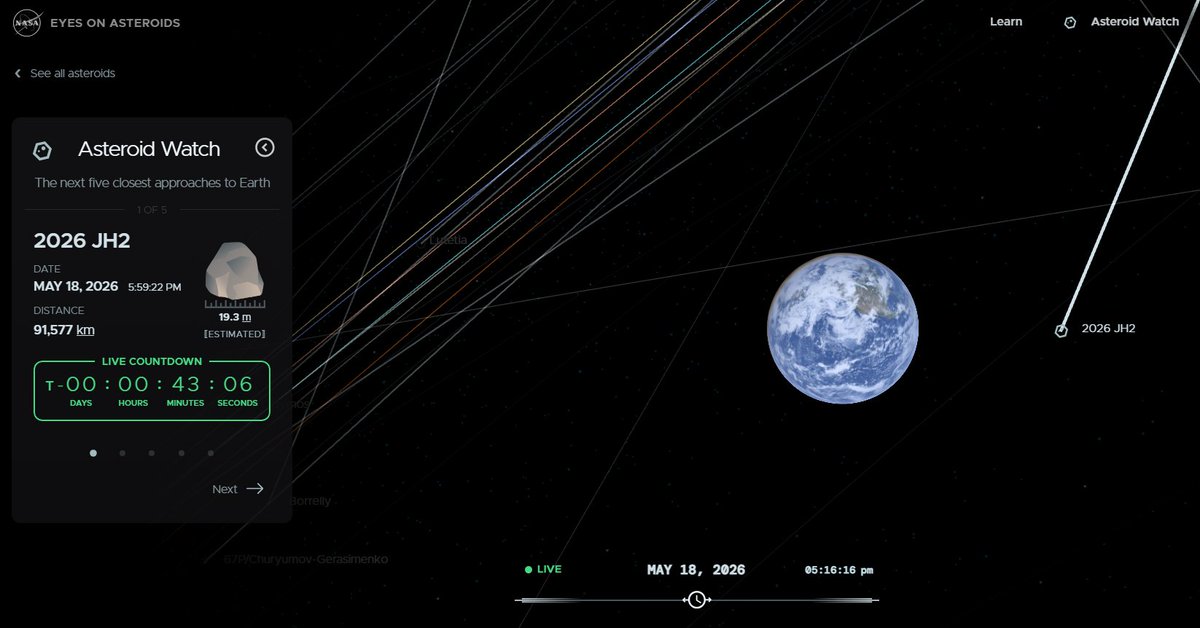
πŸš¨β˜„οΈ BREAKING: Asteroid 2026 JH2 Makes a Very Close Pass by Earth Today πŸ”¬ Processed by: SpaceTracker.space πŸ“Œ Quick Details πŸͺ¨ Object: 2026 JH2 πŸ“… Date: May 18, 2026 πŸ“ Estimated Size: 19.3 m 🌍 Closest Distance: 91,577 km πŸ›°οΈ Status: Safe flyby πŸ‘οΈ Live Monitoring: Ongoing πŸ” Why it matters πŸ‘€ All eyes are on asteroid 2026 JH2 as it makes a close approach to Earth on May 18, 2026. This space rock is estimated at about 19.3 meters wide, making it an almost 20-meter asteroid passing through Earth’s cosmic neighborhood. While it is not a threat, it is still a striking reminder of how active near-Earth space really is. ⚠️ Objects of this size may be small compared to giant asteroids, but they are still important for planetary defense tracking. 🌌 A pass this close gives skywatchers and researchers another real example of how near-Earth objects move through our region of space. πŸ“‘ It also shows why constant monitoring is essential. 🧠 SpaceTracker Observation At nearly 20 meters in diameter, 2026 JH2 is large enough to grab serious attention, even though this flyby is considered safe. Its passage is a powerful reminder that Earth is surrounded by moving objects we must continue to watch carefully. πŸ‘οΈ Our eye is on it. πŸ“ Live monitored and processed by SpaceTracker.space #Breaking #Asteroid #2026JH2 #AsteroidWatch #NearEarthObject #NEO #SpaceTracker #SpaceTrackerSpace #NASA #PlanetaryDefense #Astronomy #SpaceNews #Earth #Cosmos #SkyWatch #Science #Space #AsteroidFlyby #BreakingNews #LiveSpace
5
8
1,460
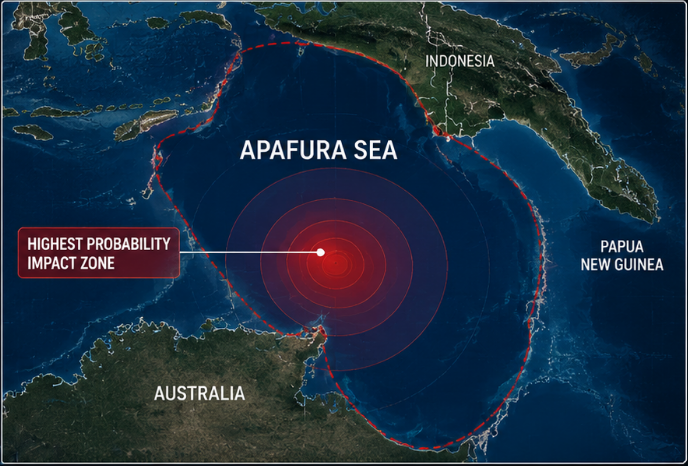
🚨 BREAKING: First Confirmed Earth-Impact Asteroid Since 2024: One meter size 2026 JN4 Burned Over the Arafura Sea, northern Australia Processed by spacetracker.space πŸ“Š Quick facts β˜„οΈ Asteroid: 2026 JN4 πŸ“… Date: May 15, 2026 πŸ“ Listed distance: 0 LD πŸš€ Velocity: 23.1 km/s πŸ“ Diameter: ~1 m πŸ›°οΈ Class: Apollo NEO On May 15, 2026 at 13:44 UTC, a tiny asteroid named 2026 JN4 entered Earth’s atmosphere over the Arafura Sea, between northern Australia, Indonesia, and Papua New Guinea. Early data lists it as only about 1 meter wide, moving around 23.1 km/s. This was not a city-killer asteroid. It was a meter-scale object, the kind that usually burns high in the atmosphere as a bright fireball. But scientifically, it is important because systems including ESA Meerkat and JPL Scout flagged a high impact probability before entry, making 2026 JN4 a predicted impactor rather than a surprise fireball. The β€œ0 LD” distance in the close-approach table means the object’s path intersected Earth’s atmosphere, not that a large asteroid struck the ground. JPL’s Small-Body Database lists 2026 JN4 as an Apollo-class Near-Earth Object, and JPL’s database is updated as new observations become available. Why it matters 2026 JN4 shows the new reality of planetary defense: even tiny objects can now be detected, tracked, and sometimes predicted before they hit the atmosphere. Most of the danger from objects this small is not a crater. It is a flash, a fireball, and a reminder that Earth is constantly moving through small debris from the Solar System. #Asteroid #2026JN4 #EarthImpact #Fireball #SpaceNews #Astronomy #NEO #PlanetaryDefense #NASA #JPL #ESA #Meteor #ArafuraSea #SpaceTracker #SpacetrackerSpace #breaking @news #trendingnow #trends
11
26
10,651
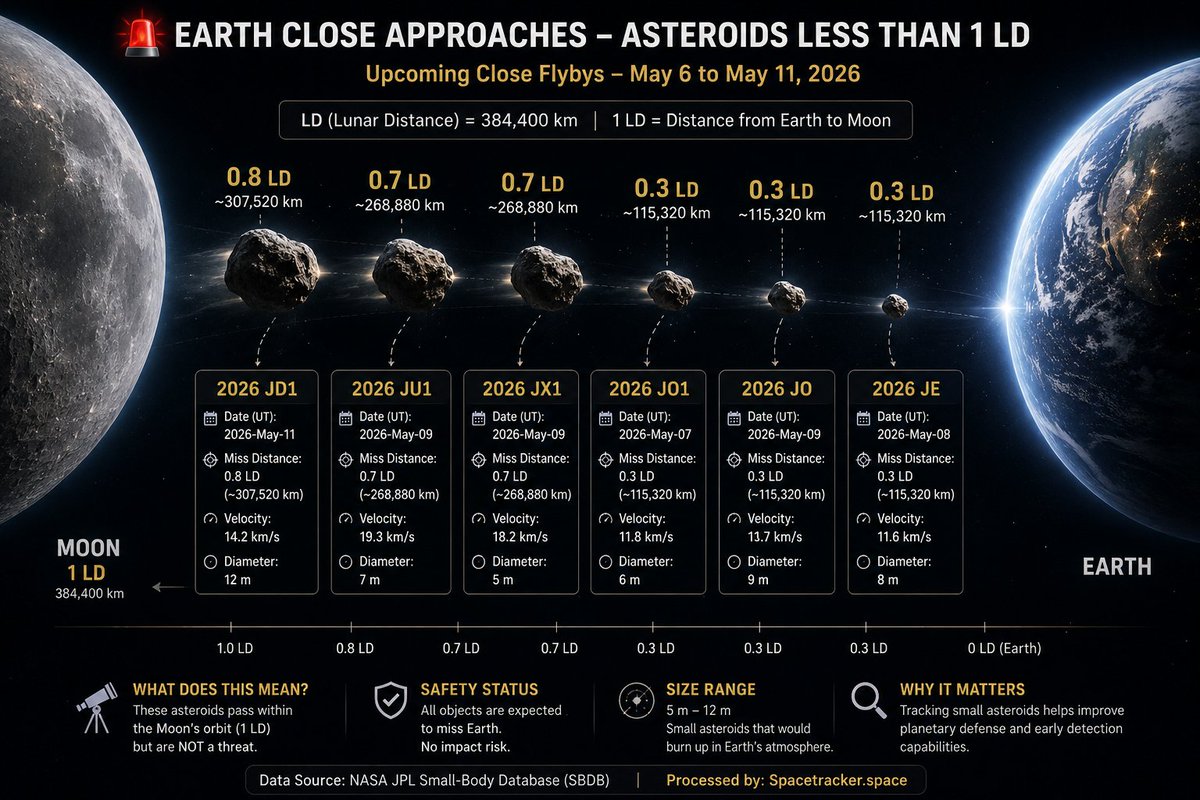
🚨🌍 MULTIPLE ASTEROIDS TO PASS INSIDE THE MOON’S ORBIT Processed by Spacetracker.space NASA tracking several close flybys between May 7–11, 2026 A cluster of small Near-Earth Objects will make extremely close passes by Earth over the next few days β€” with several moving INSIDE lunar distance (1 LD = 384,400 km). The closest objects include: β˜„οΈ 2026 JO1 πŸ“ 0.3 LD (~115,000 km) πŸ“ ~6 meters πŸš€ 11.8 km/s πŸ“… May 7, 2026 β˜„οΈ 2026 JO πŸ“ 0.3 LD πŸ“ ~9 meters πŸš€ 13.7 km/s πŸ“… May 9, 2026 β˜„οΈ 2026 JU1 πŸ“ 0.7 LD πŸ“ ~7 meters πŸš€ 19.3 km/s πŸ“… May 9, 2026 β˜„οΈ 2026 JX1 πŸ“ 0.7 LD πŸ“ ~5 meters πŸš€ 18.2 km/s πŸ“… May 9, 2026 β˜„οΈ 2026 JD1 πŸ“ 0.8 LD πŸ“ ~12 meters πŸš€ 14.2 km/s ⚠️ None are impact threats, but these flybys reveal how active and crowded Earth’s local space environment really is. Most of these objects are so small they would likely burn up in the atmosphere if they entered Earth’s path, producing bright fireballs rather than ground impacts. Still, what makes this event remarkable is the number of close approaches happening within just a few days. πŸ›°οΈ Some are passing closer than major satellite regions. 🌌 Many were likely discovered only shortly before arrival. πŸ”­ This is exactly why planetary defense tracking matters. Processed by Spacetracker.space #AsteroidAlert #BreakingNews #NASA #Space #Astronomy #NEO #PlanetaryDefense #SpaceNews #Asteroid #Earth #Moon #Cosmos #Science #SpaceTracker #SpacetrackerSpace
2
1
6
2,213
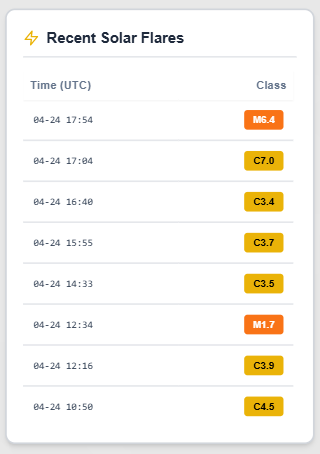
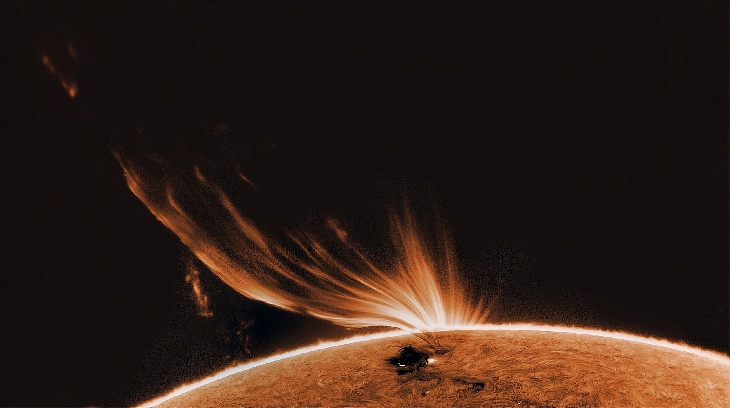
🚨 BREAKING SOLAR UPDATE πŸ”₯ Solar Storm Check, April 24, 2026 Processed by spacetracker.space The Sun just fired an X2.5 flare and a massive limb eruption, with plasma rising nearly 190,000 km above the solar edge. NOAA reported a strong X2.5 solar flare at 08:13 UTC, classified as R3 Strong radio blackout, from near the northwest solar limb, close to active region AR4419. Your flare panel also shows several later flares, including M6.4 at 17:54 UTC and M1.7 at 12:34 UTC, meaning the Sun stayed active after the X-class eruption. What the attached solar image shows The first image looks like a large limb eruption / prominence spray lifting above the Sun’s edge. It appears like plasma is being pulled upward and outward by magnetic field lines, forming a huge fan-shaped structure. Based on scaling from the visible solar limb: FeatureApprox. projected sizeHighest visible plasma arc above limb~170,000 to 190,000 kmBright fan length from base to far-left plume~270,000 to 285,000 kmVertical central plume height~95,000 to 100,000 km That means the visible eruption is roughly 13 to 15 Earth diameters tall, because Earth’s diameter is about 12,742 km. Important: this is a projected estimate from one image. Because the eruption is on the solar limb, the true 3D size could be larger. How long did it last? From a single still image, we cannot measure the full duration. But the image timestamp appears close to the major X2.5 flare time. NOAA says the X2.5 peak was 08:13 UTC, while the image filename indicates around 08:33 UTC, so if this is the same event, the eruption was still visibly active about 20 minutes after the flare peak. That suggests a powerful, extended eruption, not just a short flash. Earth impact forecast NOAA’s 3-day forecast says the strongest observed Kp in the previous 24 hours was only Kp 3, below geomagnetic storm level. For April 24, the expected maximum is around Kp 4, which is active but generally below G1 storm level. However, NOAA also notes isolated G1 to G2 geomagnetic storming is possible late April 25 into early April 26 due to glancing CME arrivals. #SolarStorm #SpaceWeather #Sun #SolarFlare #XClassFlare #NOAA #AuroraWatch #Astronomy #SpaceTracker #SpaceTrackerSpace
2
11
893
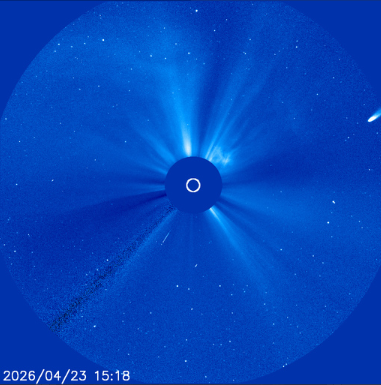
🚨 VIRAL COMET ALERT: LASCO C3 has now captured **Comet C/2025 R3 (PanSTARRS)** live near the Sun Processed by SpaceTracker.space **πŸ“:** A rare long-period visitor survived perihelion and is now sliding through the SOHO coronagraph field as it passes almost directly between Earth and the Sun. **Highlights** β˜„οΈ Discovered by Pan-STARRS on Sept. 8, 2025 β˜„οΈ Perihelion: Apr. 19, 2026 β˜„οΈ Closest to Earth: Apr. 26, 2026 β˜„οΈ Current geometry is extreme: nearly on the Earth-Sun line β˜„οΈ SOHO/LASCO C3 is now one of the best ways to track it 🚨 BREAKING: SOHO/LASCO C3 is now capturing **Comet C/2025 R3 (PanSTARRS)** live as it sweeps past the Sun. This is one of the most dramatic phases of the comet’s journey. After reaching perihelion on April 19, the comet survived its close solar pass and is now moving through a powerful viewing geometry almost directly between Earth and the Sun. That matters because this alignment can make comet dust flare brighter through **forward scattering**, even while the comet becomes harder to see from the ground due to intense solar glare. What makes R3 special is not a confirmed β€œmystery mass” or exotic behavior, but the timing and geometry: * a rare long-period comet * a deep inner-solar-system dive * now entering the coronagraph view right after perihelion * and heading toward closest approach to Earth on April 26 This is exactly why space-based instruments are so important. While many skywatchers on Earth are now losing it in the sunrise glare, SOHO is taking over the watch. If the comet holds together and keeps enough dust, late April into early May could still deliver a final visual chapter for observers, especially farther south. Space is moving fast this month: MAPS disintegrated near the Sun, but **R3 PanSTARRS survived** and is now writing its own solar escape scene live in LASCO. Processed by SpaceTracker.space #Comet #CometR3 #Panstarrs #C2025R3 #LASCO #SOHO #NOAA #NASA #SpaceWeather #Astronomy #Astrophotography #Skywatching #SolarSystem #BreakingNews #SpaceTracker #SpaceTrackerSpace
3
10
1,288
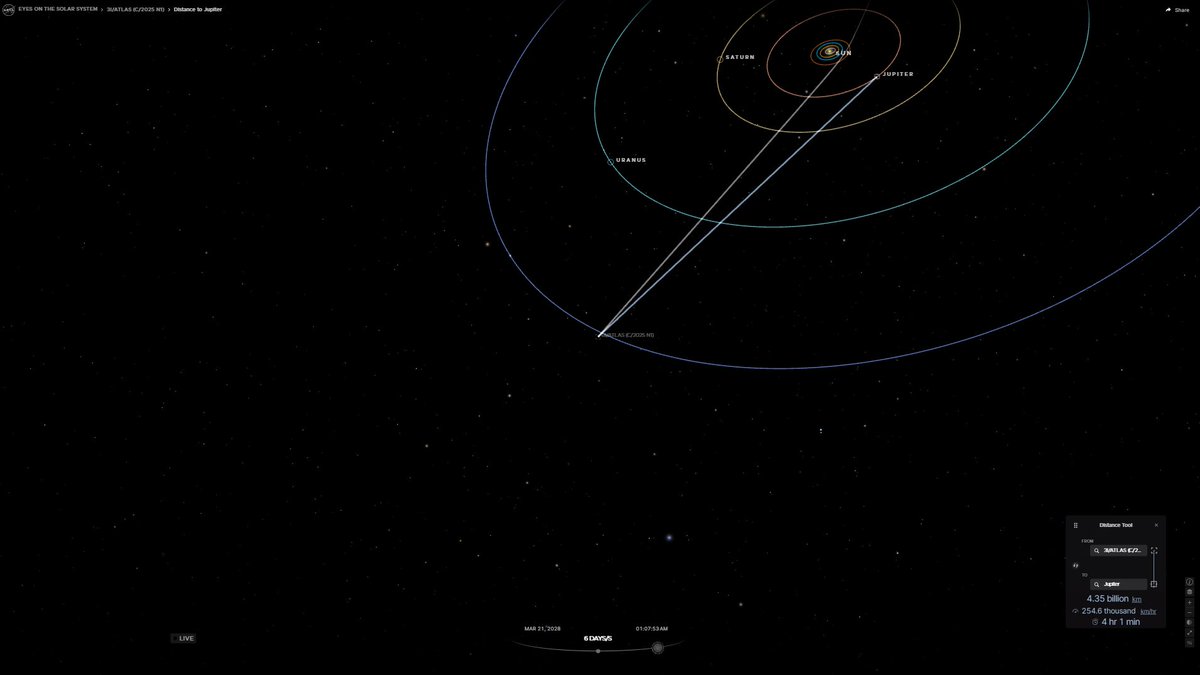
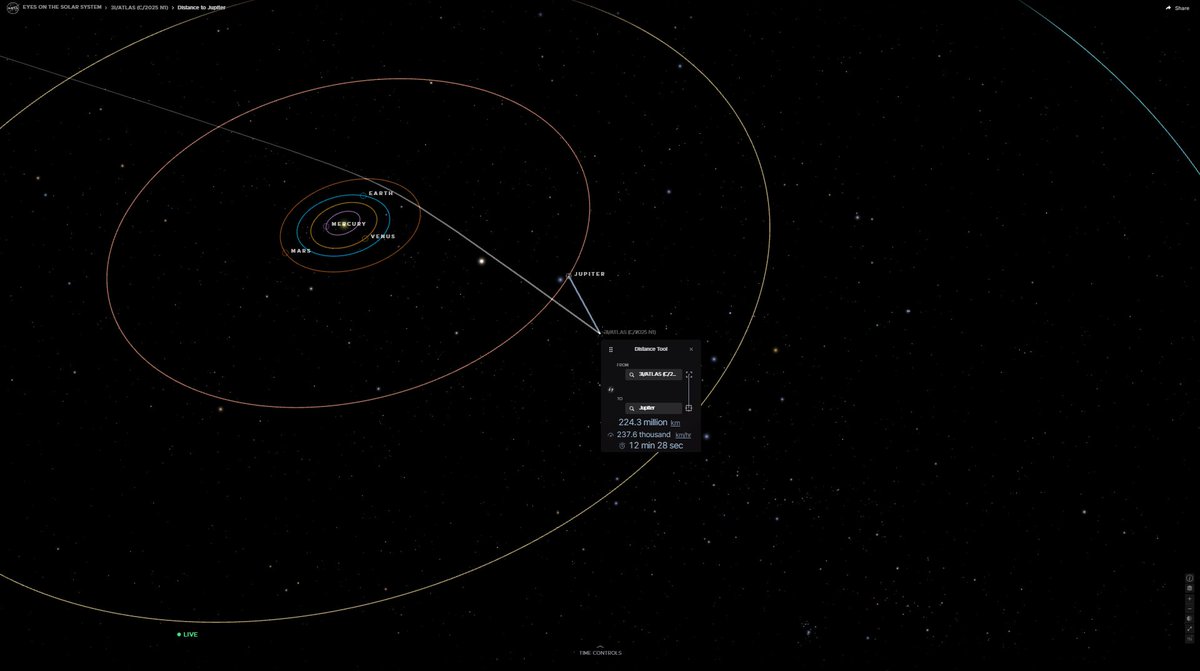
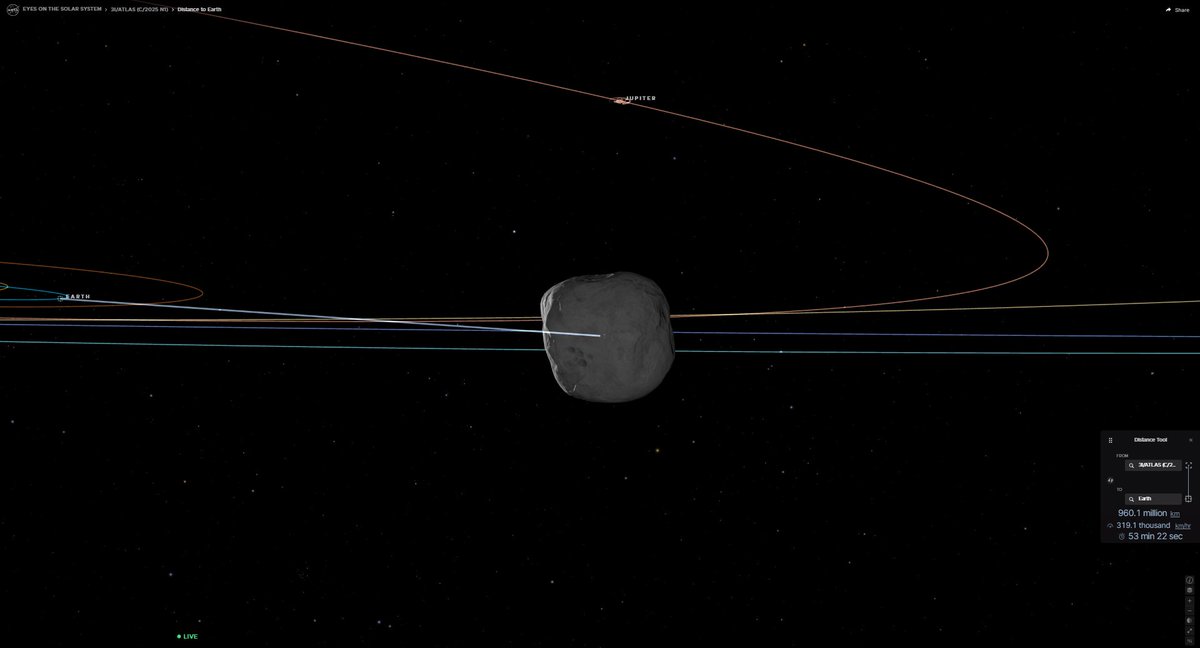
🚨 BREAKING: 3I/ATLAS keeps leaving everything behind By SPACETRACKER.SPACE By mid-April 2026, your tracking angle shows 3I/ATLAS already beyond the Moon’s viewing line and moving away from Jupiter. By April 23, 2026, the distance reading in the screen capture shows the interstellar object about 224.3 million km from Jupiter, still pulling away fast. That is the haunting part of this object. It does not stay. It does not circle back. It turns the Solar System into a trail of markers behind it. First the inner system. Then the Moon’s perspective. Then Jupiter’s realm. And if the long-range simulator path holds, another remarkable checkpoint may come on March 21, 2028 β€” around the equinox season β€” when 3I/ATLAS appears set to cross Neptune’s orbital line. That is a beautiful cosmic coincidence. Not because Neptune and 3I/ATLAS will meet. But because an object from interstellar space would be reaching one of the outer Solar System’s great boundary lines right as Earth passes through one of its own seasonal balance points. It is a reminder that two clocks are always running at once: Earth’s human clock of seasons, equinoxes, and calendars 3I/ATLAS’s galactic clock of escape, distance, and deep time So the story of 3I/ATLAS is no longer just discovery. It is now a sequence of departures. A visitor that passed our planetary zone... left the Moon behind... left Jupiter behind... and may next mark its outward crossing near Neptune’s orbital boundary in March 2028. An interstellar traveler does not need to collide with a planet to become unforgettable. Sometimes the most powerful image is simply this: it came in, crossed our system, and kept going. #3IATLAS #InterstellarObject #Comet #Jupiter #Neptune #Moon #SolarSystem #Astronomy #Space #DeepSpace #Astrophotography #SpaceNews #BreakingNews #CosmicJourney #OrbitalMechanics #PlanetaryScience #SkyWatch #NASA #ESA #Science #SpaceTracker #SpaceTrackerSpace #Equinox #NeptuneOrbit #JupiterDistance #InterstellarVisitor
3
23
1,815
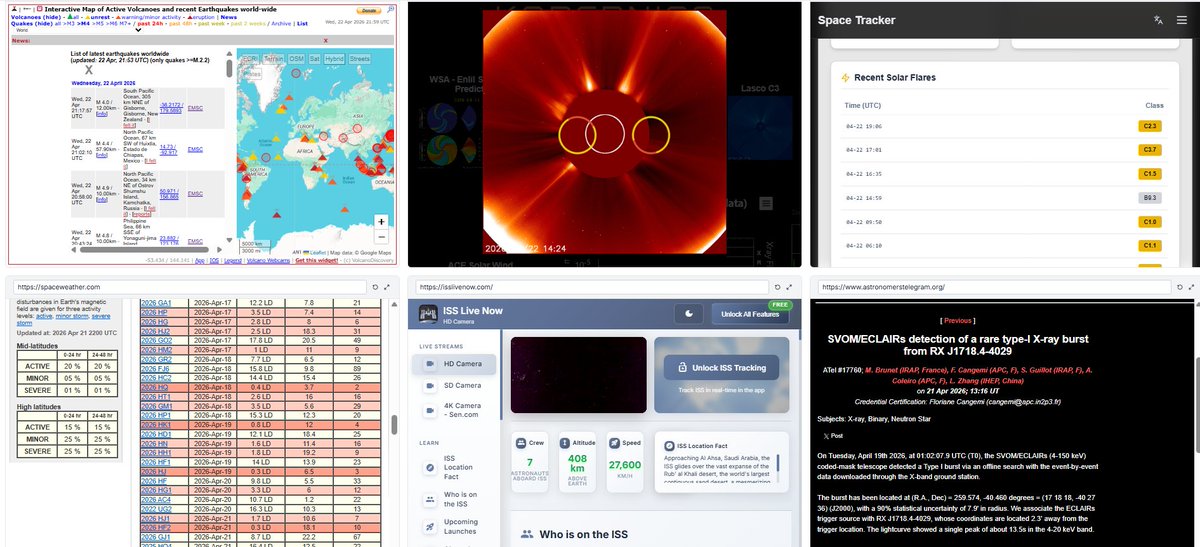
🚨 LIVE COSMOS REPORT: Earth Shakes, the Sun Flares, Asteroids Rush By, and Deep Space Just Erupted by SPACETRACKER.SPACE πŸŒβ˜€οΈβ˜„οΈπŸ›°οΈβœ¨ Six live layers on SpaceTracker reveal a universe in motion, from earthquakes on Earth to a rare neutron-star X-ray burst far beyond our Solar System. FULL X POST 🚨🌌 BREAKING: The cosmos is active on every level right now. A live 6-layer SpaceTracker view shows a powerful chain of real-time activity across Earth, near-Earth space, the Sun, human orbit, and deep space. 🌍 Layer 1: Earth is restless Global earthquake and volcano monitoring shows widespread seismic activity across major tectonic regions, a reminder that our planet is constantly shifting beneath us. β˜€οΈ Layer 2: The solar corona is under watch Coronagraph imagery shows bright structures around the Sun, with multiple flagged regions suggesting active solar outflow monitoring and possible plasma motion. ⚑ Layer 3: The Sun is firing repeatedly Recent flare logs show a run of C-class solar flares, including C3.7, C2.3, C1.5, C1.1, and C1.0, plus a B9.3 event. Not extreme yet, but the Sun is clearly awake. β˜„οΈ Layer 4: Near-Earth space is crowded The asteroid tracking panel shows multiple recent close passes, including objects at only fractions of a lunar distance. Our cosmic neighborhood is not empty. It is busy. πŸ›°οΈ Layer 5: Humanity is still in orbit The ISS remains overhead with 7 astronauts aboard, orbiting at about 408 km altitude and roughly 27,600 km/h. While Earth rumbles and the Sun flares, humans are still circling above it all. ✨ Layer 6: Deep space just flashed Astronomers have also reported a rare Type-I X-ray burst from RX J1718.4-4029, a violent high-energy event linked to a neutron star system. That means this dashboard is not just watching our world. It is watching the universe itself. πŸ“‘ What makes this moment special? This is not one isolated event. This is a stacked live snapshot of reality: Earth activity Solar activity Asteroid traffic Human spaceflight Deep-space alerts In one screen, SpaceTracker shows how connected the cosmic environment really is. πŸ”₯ The universe is not quiet. It is shaking, flaring, passing, orbiting, and exploding in real time. Processed by SpaceTracker.space #SpaceTracker #BreakingNews #LiveCosmos #Earthquake #Volcano #SolarFlare #SpaceWeather #CME #Asteroid #NearEarthObject #ISS #Astronomy #NeutronStar #XRayBurst #DeepSpace #Cosmos #Universe #Science #SpaceNews #RealTimeSpace #Earth #Sun #SolarActivity #AstroAlert #SkyWatch #spacetrackerspace
2
6
945
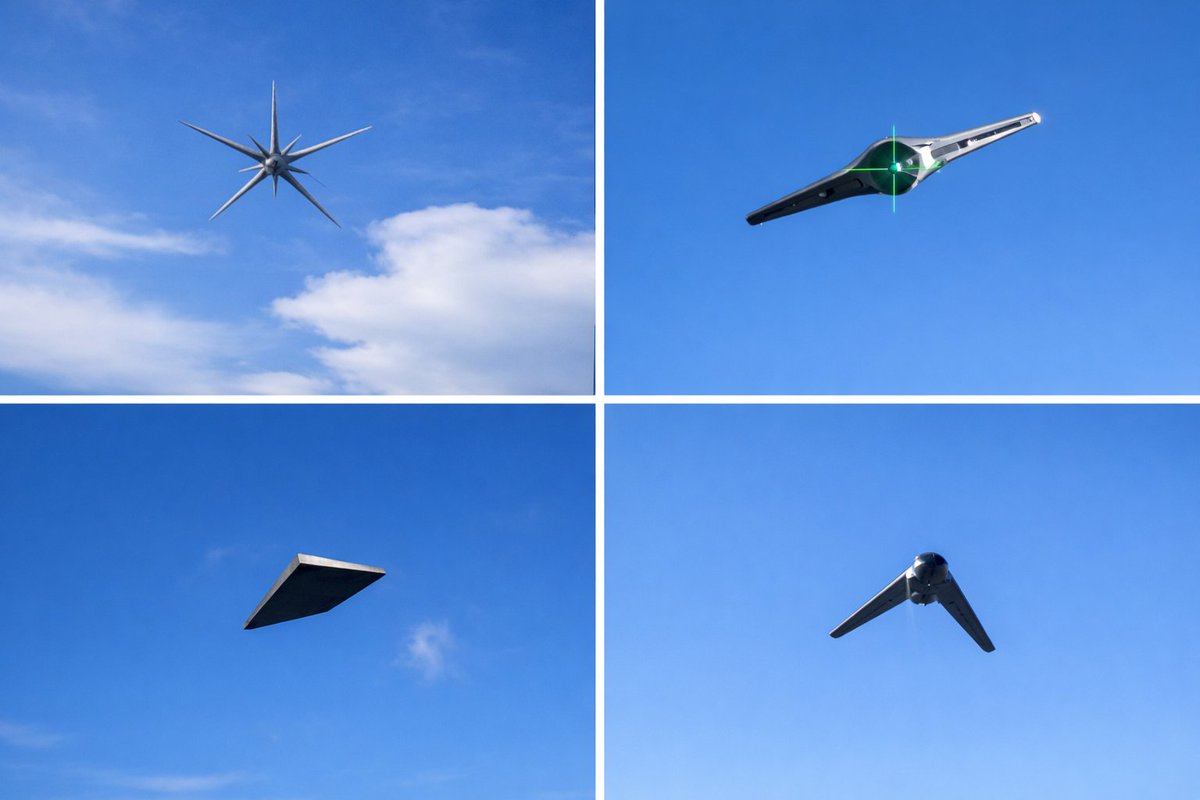
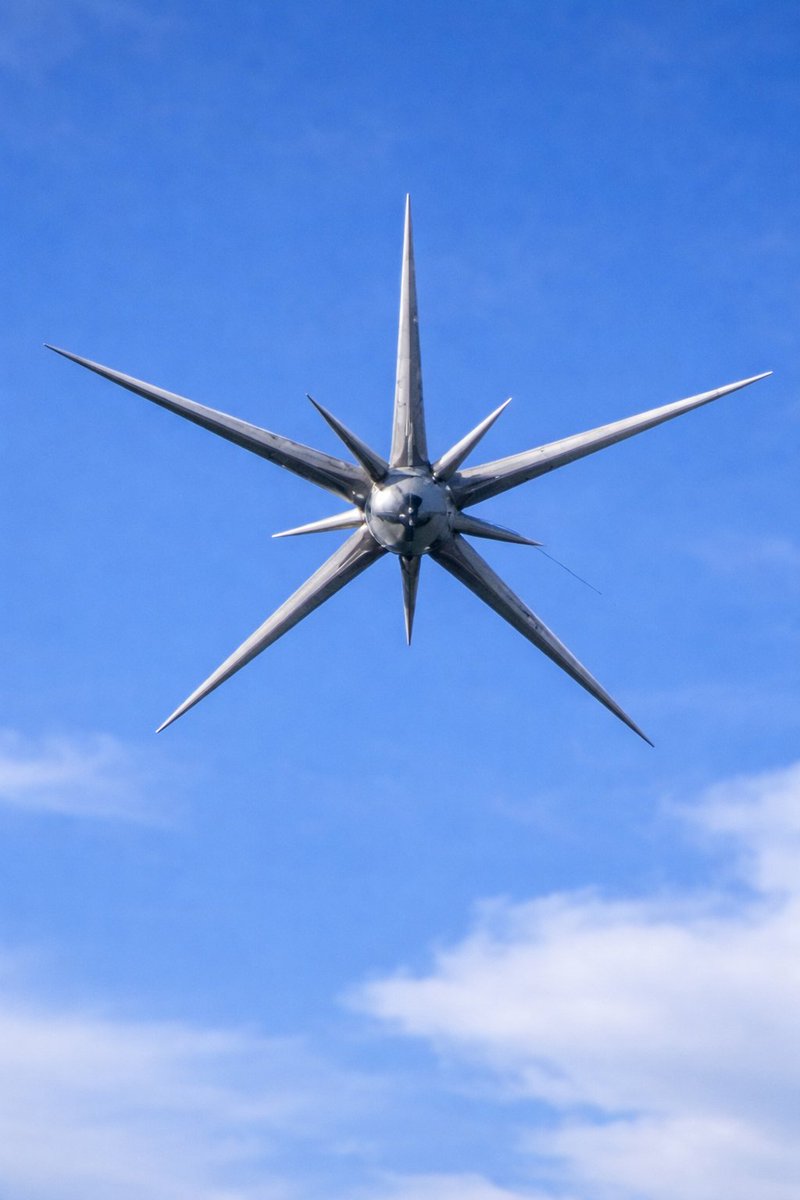
🚨 BREAKING: Full-Color UFO, Ultra-Zoomed Frames Reveal a Chilling Shape Hidden in the Original Leaks Spacetracker.space reveals enhanced, corrected, ultra-zoomed versions of alleged leaked UAP images now circulating online. One appears as a dark boomerang-shaped flying wing. Another looks like a metallic spiked star suspended in the sky. After deep enhancement, the objects look sharper than ever β€” but that does not make them proven. These new colorized frames are visually powerful, yet their exact origin remains unverified. Some online claims say similar images were captured by a pilot around 2000, but no authoritative source currently confirms the full chain of custody for these exact frames. That is what makes this story so explosive. Because in the modern UAP era, the biggest mystery is no longer just what is in the sky. It is what is real data, what is leaked media, and what is a reconstructed interpretation of an already uncertain original. Official U.S. reviews of UAP cases have shown that many dramatic reports eventually turn out to be balloons, birds, or drones, while a smaller set remain unresolved because the data is incomplete. So these Spacetracker.space enhancements should be seen for what they are: a powerful visual investigation, not a final verdict. Image descriptions The first object appears as a sleek dark flying-wing form with a rounded central cockpit-like dome and broad angled wings, giving it the profile of a stealth drone or futuristic aircraft. The second object appears as a metallic orb-like core with long spike-like arms radiating outward, producing one of the strangest silhouettes seen in circulating UAP imagery. Bottom line These images are stunning. They are mysterious. They are not yet verified enough to close the case. Hashtags #UFO #UAP #BreakingNews #SpacetrackerSpace #Alien #Mystery #Aviation #Pilot #LeakedImages #UFOFootage #UAPDisclosure #SkyWatch #Anomaly #HighStrangeness #Unexplained #AARO #Pentagon #ViralNews #EnhancedImage #Colorized
4
11
37
13,754
β˜„οΈπŸ’¨ 3I/ATLAS Is Racing Away From Earth 🌍➑️🌌 SpaceTracker.space analysis shows the growing distance is driven by Earth’s motion and the comet’s interstellar escape path A reminder that the Solar System’s third confirmed interstellar visitor is already leaving us behind Published journal-style feature Interstellar comet 3I/ATLAS has not vanished from the story. It is still out there, still moving away, and still carrying material from another planetary system back into deep space. NASA states that 3I/ATLAS is on a hyperbolic path, meaning it is not gravitationally bound to the Sun and will not return. Its closest approach to Earth already happened on December 19, 2025, at about 1.8 AU, or roughly 270 million km. As of April 17, 2026, live tracking data place it at about 951.9 million km from Earth. That means the comet is now in the phase that many people forget: the long goodbye. The excitement of discovery, perihelion, Mars flyby, and Jupiter encounter may be behind us, but scientifically this outbound leg is just as important. Caltech reported on April 16, 2026 that 3I/ATLAS is already past Jupiter’s orbit and continuing outward, while new JWST work is still extracting chemistry from the comet’s emissions. Is it really nearing 1 billion km from Earth by late April? Yes, that is a reasonable and well-supported statement. On April 17, 2026, TheSkyLive lists the Earth-comet distance at about 951,948,260 km. So saying that by late April 2026 it is at or approaching 1 billion km from Earth is accurate as a rounded public-facing summary. Why does it seem to be pulling away so fast from Earth? Part of your idea is right, but it needs one correction. The increasing Earth distance is not simply because Earth is moving from spring toward summer. The deeper reason is that Earth and 3I/ATLAS are on very different solar orbits, and 3I/ATLAS is an interstellar outbound object, not a normal bound comet. NASA notes it is on a hyperbolic escape path, and recent research shows its incoming galactic radiant was in Sagittarius. As Earth continues along its own orbit while 3I/ATLAS departs on a very different trajectory, the geometry between them opens up quickly, so the Earth-comet distance grows fast. So the clean scientific wording is this: 3I/ATLAS appears to be speeding away from Earth because both Earth and the comet are moving, and they are no longer traveling in anything like the same direction around the Sun. Earth’s seasonal position changes the observing geometry, but the main driver is the comet’s outbound interstellar trajectory relative to Earth’s motion. Sagittarius: origin, direction, or projection? This part matters. A 2025 study found the comet’s galactic velocity radiant in Sagittarius, which means that when its motion is traced through the Galaxy, its incoming direction projects from that region of the sky. But that does not prove it literally formed in the Sagittarius Arm. The same study says the parent system was more likely associated with the Galactic thin disk and may have been a solar-like star with slightly sub-solar metallicity. So a careful SpaceTracker-style interpretation would be: 3I/ATLAS arrived on a trajectory whose galactic radiant points toward Sagittarius, but its exact birthplace remains uncertain. That phrasing is scientifically stronger than saying its origin has been confirmed as Sagittarius. Why 3I/ATLAS still matters now Even outbound, 3I/ATLAS remains one of the most valuable extrasolar objects ever observed. NASA identifies it as the third known interstellar object discovered passing through our Solar System. Caltech’s April 2026 report says JWST observations found methane behavior that helps reveal material from beneath the comet’s irradiated outer surface, giving astronomers a better look at the chemistry of matter formed around another star. This is why 3I/ATLAS is more than a passing headline. It is a messenger. It crossed interstellar space for at least about a billion years, according to Caltech’s summary of the new research, then slipped through our planetary system for only a brief observational window before heading back out. SpaceTracker-style takeaway 3I/ATLAS is no longer the comet coming in. It is now the comet getting away. Earth already had its nearest moment with it in December 2025. Jupiter had its turn in March 2026. Now, by late April 2026, the object is nearing 1 billion km from Earth, still outbound, still scientifically rich, and still reminding us that the Solar System is not sealed off from the rest of the Galaxy. by SPACETRACKE.SPACE #3IATLAS #InterstellarComet #CometNews #SpaceNews #Astronomy #Astrophysics #SolarSystem #DeepSpace #Jupiter #Sagittarius #CometTracking #SkyWatch #SpaceDiscovery #NASA #JWST #SpaceTracker #SpaceTrackerSpace #BreakingSpace #CosmicVisitor #GalacticTraveler
2
8
1,165
A futuristic hard rock / metal anthem built on scars, survival, and rising louder than the noise. Song Link : suno.com/s/YheOxdgedUBImdzy Special drop by spacetracker.space πŸ”₯ STILL NOT GONE πŸ‘‘βš™οΈβš‘ #NowPlaying #NewMusic #HardRock #AltMetal #Metal #TechnoRock #Cyberpunk #OriginalSong #Suno #spacetrackerspace
1
3
528
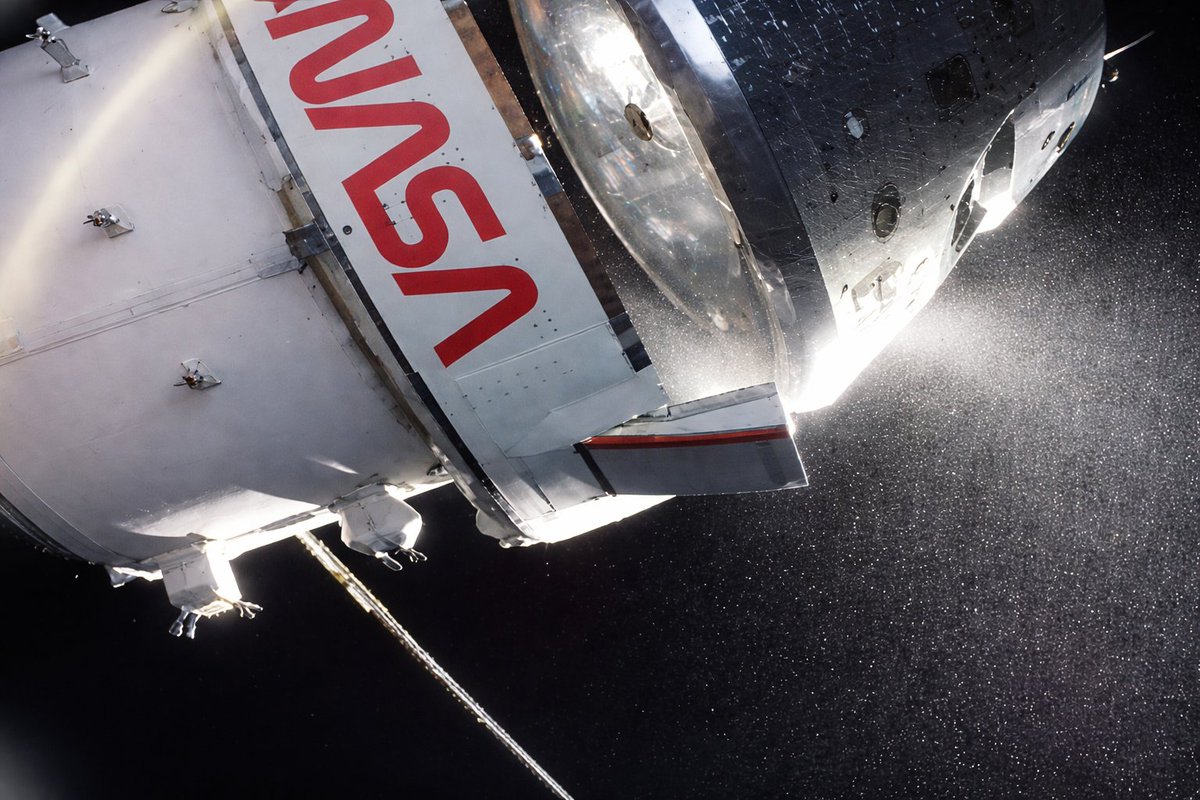
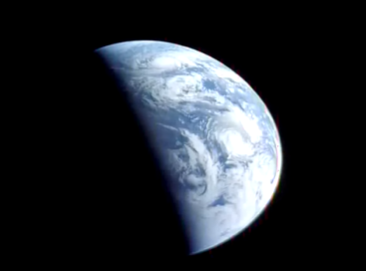
BREAKING: Orion Begins Its Final Split Before Earth Re-entry Spacetracker.space is tracking live as NASA’s Orion spacecraft enters the most intense phase of the Artemis II mission: the moment the crew module separates from the service module and turns from a deep-space ship into a reentry capsule. NASA’s timeline shows the final return burn was completed at 2:53 p.m. EDT, with splashdown targeted for 8:07 p.m. EDT off the coast of San Diego. (NASA) This is not a malfunction. This is the planned transition that exposes Orion’s heat shield for atmospheric entry. NASA says the separation is scheduled for 7:33 p.m. EDT, followed by a crew module raise burn, then first contact with Earth’s upper atmosphere at about 400,000 feet. During entry, Orion is expected to face temperatures near 3,000Β°F, a short plasma blackout, and loads up to 3.9 Gs before parachutes slow the capsule for ocean recovery. (NASA) The full sequence is pure spacecraft choreography. NASA’s timeline shows drogue parachutes deploying near 22,000 feet, main parachutes at about 6,000 feet, and splashdown at roughly 20 mph, closing out a 694,481-mile journey around the Moon and back. (NASA) For space watchers, this is one of the most dramatic moments of the mission. The service module did the long-haul work in deep space. Now it peels away, burns up in Earth’s atmosphere, and leaves the crew module alone to survive the fire of reentry and the final descent home. (NASA) Refined image by Spacetracker.space Live tracking follows NASA’s AROW real-time mission system, which shows Orion’s path, distance, and major milestones all the way through atmospheric reentry. (NASA) #ArtemisII #Orion #NASA #MoonMission #Reentry #Splashdown #SpaceX #Astronomy #SpaceNews #BreakingNews #SpacetrackerSpace
2
2
6
617
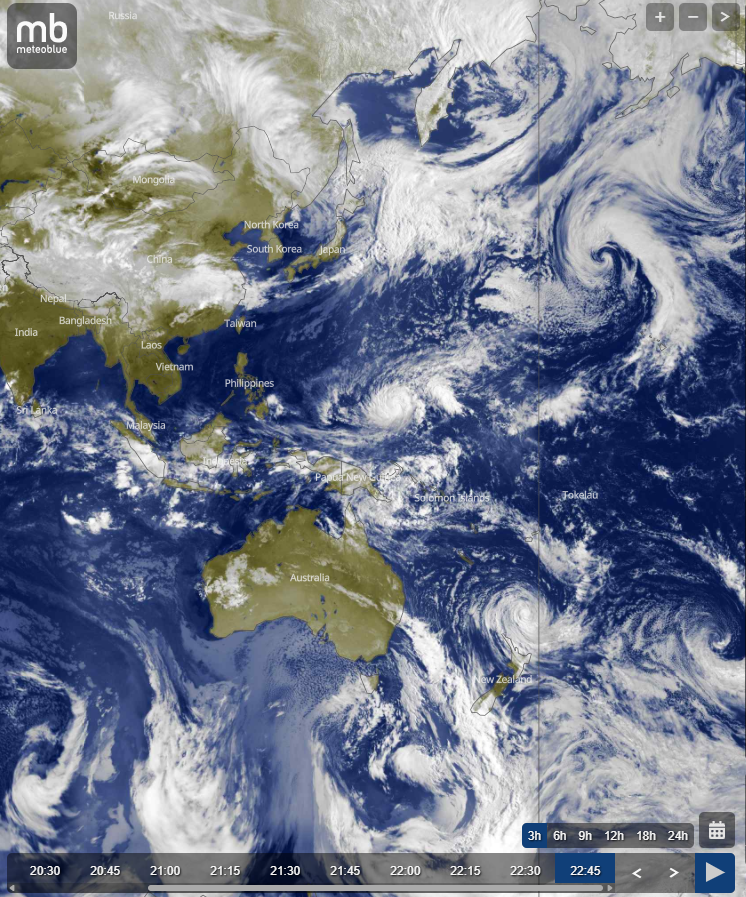
BREAKING: Orion’s view of Earth appears to match real-time Pacific cloud patterns from space weather satellite before splashdown By Spacetracker.space One of the most striking details in the latest Orion imagery is not just the blue crescent of Earth. It is the weather. From deep space, the spacecraft appears to have captured major cloud structures over the Pacific that closely resemble live satellite cloud fields seen in weather products around the same time. That kind of match is exactly what you would expect when a spacecraft is looking back at the sunlit side of Earth during its final return corridor. In the Orion frame, the visible hemisphere shows broad cloud organization across the Pacific basin, the same region where operational weather imagery was tracking large spirals and long cloud bands. From thousands of miles away, those systems are still large enough to remain visible as planetary-scale features. NASA said Orion’s return sequence included a 2:53 p.m. ET deorbit burn, with splashdown targeted for 8:07 p.m. ET in the Pacific off the coast of San Diego, completing a 694,481-mile journey around the Moon and back. That timing makes this Earth view especially meaningful because it was captured during the spacecraft’s final approach home. To an astronomer, this image is more than a beautiful crescent Earth shot. It is a real planetary observation. That is what makes Orion imagery so powerful. It turns weather into planetary science. As Orion closes out humanity’s first crewed lunar return mission in more than half a century, this frame captures something quietly historic: Earth not as a map, but as a moving world, alive with storms, oceans, light, and motion. By SpaceTracker.space #ArtemisII #Orion #NASA #EarthFromSpace #PacificOcean #SpaceWeather #Astronomy #MoonMission #WeatherFromSpace #SpaceTrackerSpace
1
5
243
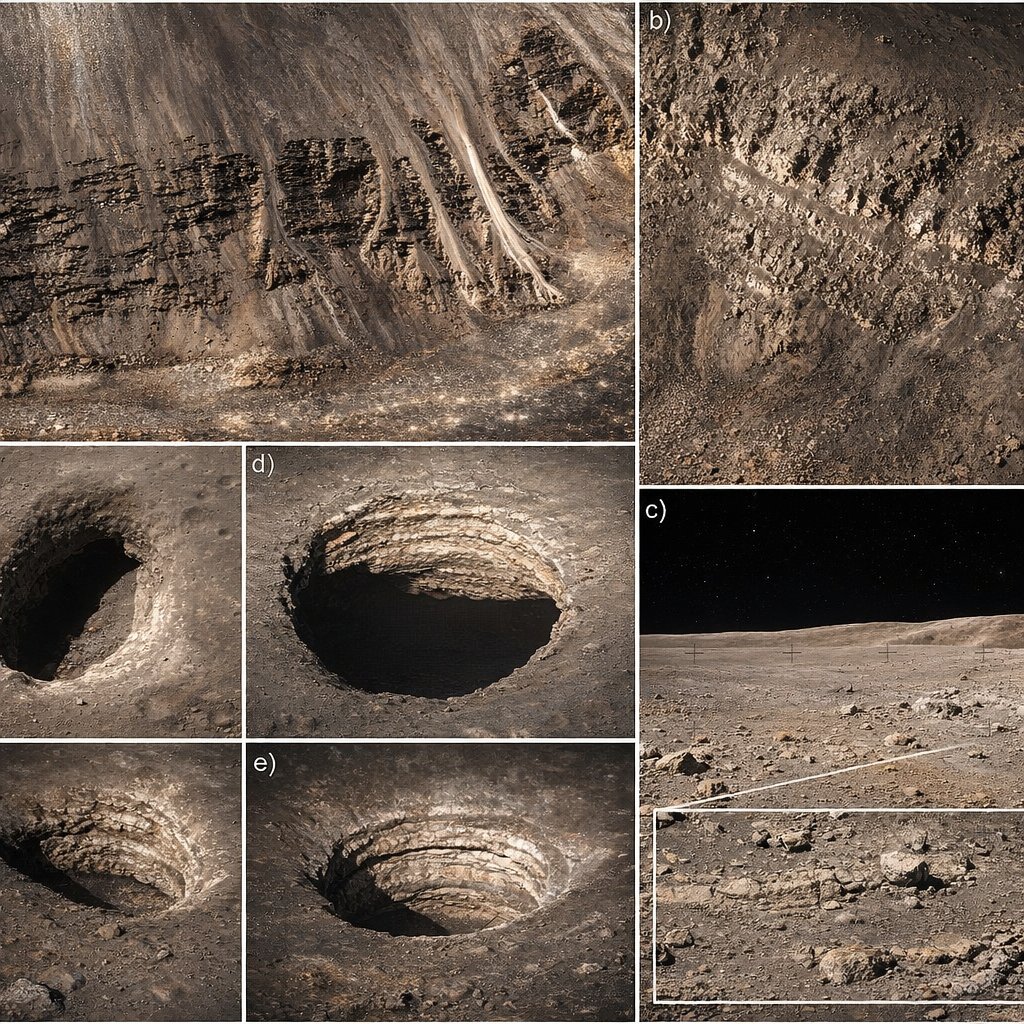
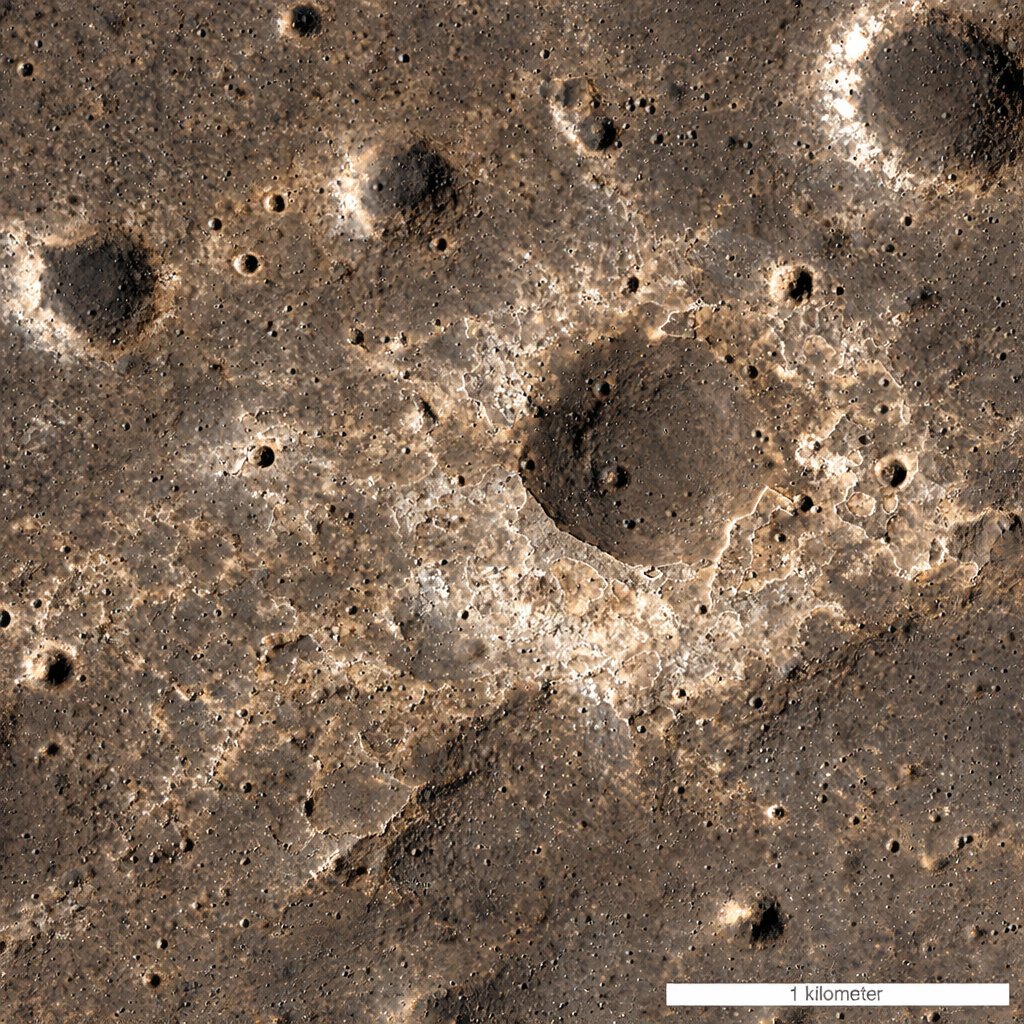
🚨 BREAKING: COLORIZED LUNAR MARE REVEALS ANCIENT VOLCANIC HISTORY πŸŒ•πŸ”₯ Spacetracker.space re-analyzes decade-old Moon data with modern processing A newly refined 8K color reconstruction from archival lunar imagery is bringing fresh attention to one of the Moon’s most important geological regions. What once appeared as simple gray terrain now reveals a complex volcanic landscape shaped billions of years ago. These regions, known as lunar maria, are not seas but vast plains of basalt formed by ancient lava flows that filled massive impact basins. πŸŒ• What we are seeing in this refined image From an amateur astronomy and imaging perspective, this terrain is highly telling: β€’ The darker brown zones indicate iron-rich basalt, giving maria their low reflectivity β€’ The smoother plains show lava flooding events after major impacts β€’ The bright fractured edges are older highland material disrupted by impacts β€’ Crater density variations reveal different geological ages across the surface These maria formed roughly 3.1 to 3.9 billion years ago, making them among the Moon’s younger large-scale features. πŸ”¬ Scientific insight behind the image This is not just a visual upgrade. It’s geological storytelling: β€’ Ancient asteroid impacts fractured the crust β€’ Molten material rose from the Moon’s interior β€’ Low-viscosity lava spread across basins and cooled into basalt layers β€’ Over time, micrometeorites turned the surface into regolith The result is what we now observe as dark plains covering about 16% of the Moon’s surface, mostly on the near side. πŸ“‘ Spacetracker Insight What stands out in this processed frame is the textural contrast between mare basalt and surrounding ejecta fields. With enhanced color mapping, subtle mineral differences become visible, something early missions could not fully resolve. This is exactly why revisiting archival lunar data matters. With modern processing, we are not just improving images β€” we are uncovering hidden layers of planetary history. #BreakingNews #Moon #LunarSurface #LunarMare #MoonGeology #Space #Astronomy #Astrophotography #SpaceNews #NASA #ESA #LRO #PlanetaryScience #Cosmos #Universe #SpaceExploration #Science #STEM #AstroImaging #DeepSpace #SolarSystem #MoonCrater #Volcanic #Geology #SpaceTech #SkyWatch #NightSky #AstronomyLovers #SpaceLovers #Spacetracker #SpacetrackerSpace #ViralScience #ExploreSpace #MoonMission #FutureOfSpace #AIImaging #DataRevealed
3
201
πŸš¨πŸš€ BREAKING: ORION 34 HOURS IN β€” HUMANS NOW PUSHING FARTHER FROM EARTH THAN EVER BEFORE by SPACETRACKER.SPACE πŸ“‘ Distance: ~65,000–70,000 miles from Earth πŸŒ• Distance to Moon: ~185,000 miles remaining ⚑ Speed: over 5,000 mph and holding strong 34 hours into the mission, Orion is entering a historic zone. For the first time in this mission, humans are traveling far beyond the comfort boundary of Earth, moving deeper into space with every passing minute. 🌍 Earth is no longer dominant in the sky At this distance, our planet is shrinking Still bright Still alive But no longer overwhelming the view This is the psychological threshold of deep space 🌌 What is happening now Orion is steadily increasing its distance from Earth, following its outbound trajectory after the translunar injection setup phase. The spacecraft is now fully committed to the Moon path No orbital loops No returns Only forward motion πŸŒ• The numbers tell the story ~65,000 to 70,000 miles from Earth ~185,000 miles still ahead to the Moon We are now well into the journey But still only at the beginning of deep space travel ⚑ Speed and stability Traveling at over 5,000 mph, Orion maintains a stable trajectory while gradually climbing outward. Every second adds distance Every hour reshapes perspective πŸ‘¨β€πŸš€ Why this moment matters This is not just distance This is history It marks the expansion of human presence beyond near-Earth space once again A reminder that exploration is not a concept It is happening right now 🌍 β†’ πŸŒ• A mission to follow closely This is one of the most compelling journeys in modern spaceflight A real-time lesson in physics, engineering, and human ambition Watch it moment by moment Because this is how humanity moves outward #Breaking #ArtemisII #Orion #NASA #MoonMission #DeepSpace #SpaceExploration #Astronomy #SpaceNews #SpaceTracker #SpacetrackerSpace

ALT πŸš¨πŸš€ ORION 34 HOURS: HUMANS MOVING FARTHER FROM EARTH πŸ“‘ ~65,000–70,000 miles from Earth πŸŒ• ~185,000 miles to the Moon ⚑ Speed: 5,000 mph Earth is shrinking The Moon is ahead This is deep space in real time 🌍 β†’ πŸŒ• #ArtemisII #Orion #NASA #MoonMission #DeepSpace #SpaceTracker #SpacetrackerSpace

1
6
182
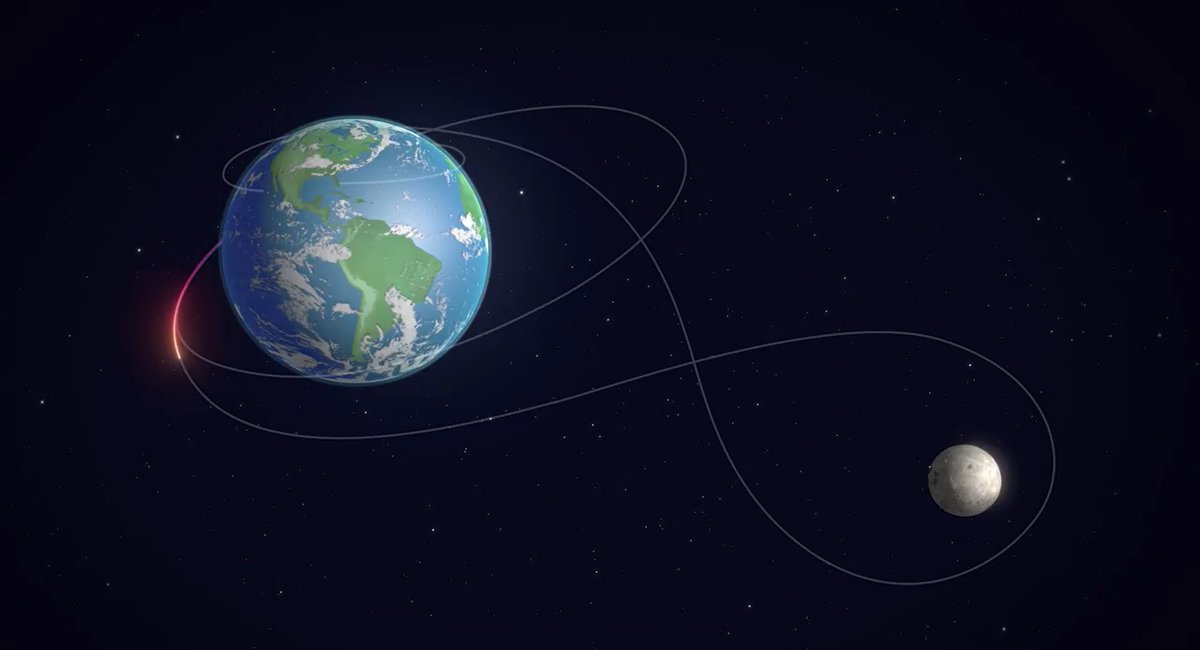
πŸš¨πŸš€ BREAKING: ORION SURGES PAST 1,000 MILES - THE MOON JOURNEY HAS BEGUN vy SPACETRACKER.SPACE ⏱ 1 day, 1 hour, 24 minutes into flight ⚑ Great news: Speed now surging beyond 10,000 mph and rising πŸ“‘ From ~150 miles to over 1,000 miles altitude in minutes Orion has made its move. Just about 10 minutes ago, the spacecraft was cruising at roughly 150 miles above Earth. Now, it has climbed beyond 1,000 miles altitude and accelerating outward. This is not routine orbit anymore. This is departure. 🌍 What just happened Orion has executed its outbound trajectory phase, rapidly increasing altitude as it leaves low Earth orbit behind. The spacecraft is now on a path that is no longer bound to Earth’s immediate environment. In simple terms We are going to the Moon. ⚑ Velocity and energy Speed is now surging past 10,000 mph, building the energy required for deep space travel. The rapid climb from 150 to 1,000 miles shows the power and precision of this maneuver. 🌌 Mission transition This marks the transition from Earth operations to Translunar flight The translunar injection phase is now unfolding. πŸŒ• What this means From this point forward, every mile increases the separation between humanity and Earth. Orion is no longer testing systems in orbit It is executing a deep space mission πŸ‘¨β€πŸš€ Historic moment This is one of the defining checkpoints of Artemis II The moment where the spacecraft truly commits to the Moon 🌍 β†’ πŸŒ• No turning back Follow this mission closely This is one of the most exciting journeys in modern spaceflight #Breaking #ArtemisII #Orion #NASA #MoonMission #SpaceFlight #DeepSpace #Astronomy #SpaceNews #SpaceTracker #SpacetrackerSpace
5
134
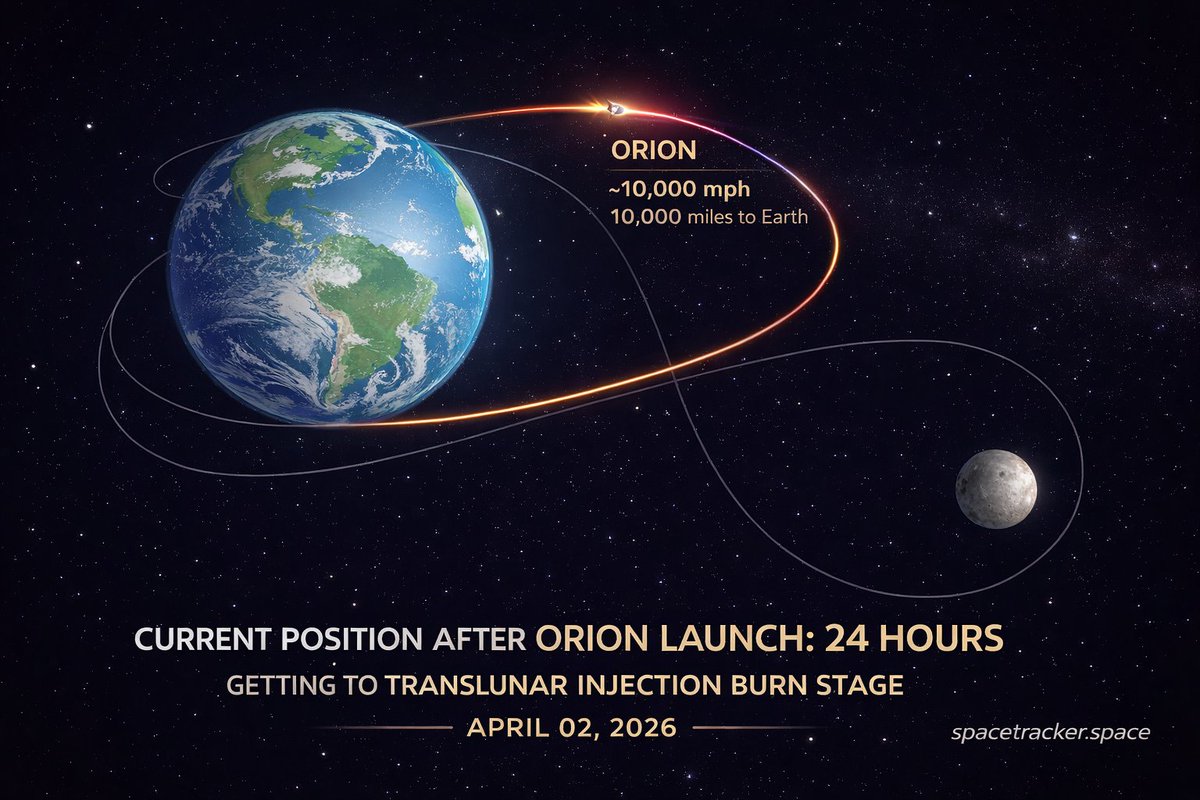
πŸš€ ORION STATUS AFTER 24 HOURS: SPEED RISING, EARTH PULLING - THE BUILDUP TO THE MOON BEGINS by SPACETRACKER.SPACE ⚑ Speed now exceeding 10,000 mph | Distance tightening toward ~10,000 miles from Earth 24 hours into flight, Orion is entering one of the most fascinating phases of the mission. At first glance, it looks like the spacecraft is coming back toward Earth. Its altitude is decreasing. But in reality, Orion is doing exactly what it must to leave. 🌍 What is happening now Orion is dipping closer to Earth along its elongated orbit. As it does, gravity is accelerating the spacecraft. Speed is now surging past 10,000 mph Distance tightening toward ~10,000 miles from Earth ⚑ The physics behind the moment In orbital mechanics, getting closer to a planet means moving faster. NASA uses this principle to prepare Orion for its next move. By allowing the spacecraft to fall inward slightly, it gains the velocity needed for deep space travel. This is controlled acceleration. 🌌 Why this stage matters Everything happening now is leading to one critical event The translunar injection burn That burn will take Orion from Earth orbit And place it on a direct path to the Moon To do that, the spacecraft must have the right speed The right angle The right timing This phase is building all three πŸŒ• The bigger picture We are watching a transition From orbit To escape To exploration Orion is no longer just circling Earth It is preparing to leave it πŸ‘¨β€πŸš€ A moment to follow closely This is one of the most dynamic parts of the mission Where motion, gravity, and precision come together A perfect example of how spaceflight is not about force alone But about timing and understanding the physics of motion Today is a powerful reminder We are not just watching a mission We are learning how humanity moves beyond Earth 🌍 β†’ πŸŒ• the journey continues #Orion #ArtemisII #NASA #MoonMission #SpaceFlight #Astronomy #DeepSpace #SpaceNews #SpaceTracker #SpacetrackerSpace
4
5
171