Teri retweeted

Is anyone at all concerned about the affects of this #technology on the human organism which now contains high levels of heavy metals and self assembling #nanotech??? #MAHA


2
6
228

Teri retweeted
Bought a bag of apples from Walmart. After scrubbing the heck out of 1 I sliced it in half. Ate 1 half, left the other on a plate in my warm humid Florida kitchen until I had time to nibble on the rest. I'm busy. 5 days later I come back to the apple. Zero bugs, zero browning...

They aren’t passing laws against local farms and cattle to “save the climate.” They are intentionally destroying the natural food supply.
They want to make farming so expensive that your only option is to buy their patented, lab-grown, synthetic food.
If a corporation owns the only food source, they own you.
1
1
64
Teri retweeted
Happy Sunday everyone! Next time you hear your town's church bells ring........ youtube.com/shorts/1qPONnnvj…
1
68


En realidad, son más de 400.000 los asesinados en #GazaGenocide #GazaNeedsHelp @SorprendenteF @ComPalestinaCL @RiksinakuyTV @canutocompa85 @ComunOlla @TargetedRn @SusanSarandon @morgan_freeman @Il_Consigliori_ @BadChoices123
May 25

Más de 900 días desde que estos monstruos desataron un genocidio en Palestina. Más de 75 mil inocentes asesinados.
Niños en su mayoría.
Todas las universidades demolidas.
Casi todos los hospitales demolidos.
10 mil palestinos secuestrados en prisiones.
SIGUEN LIBRES.

2
3
7

May 10
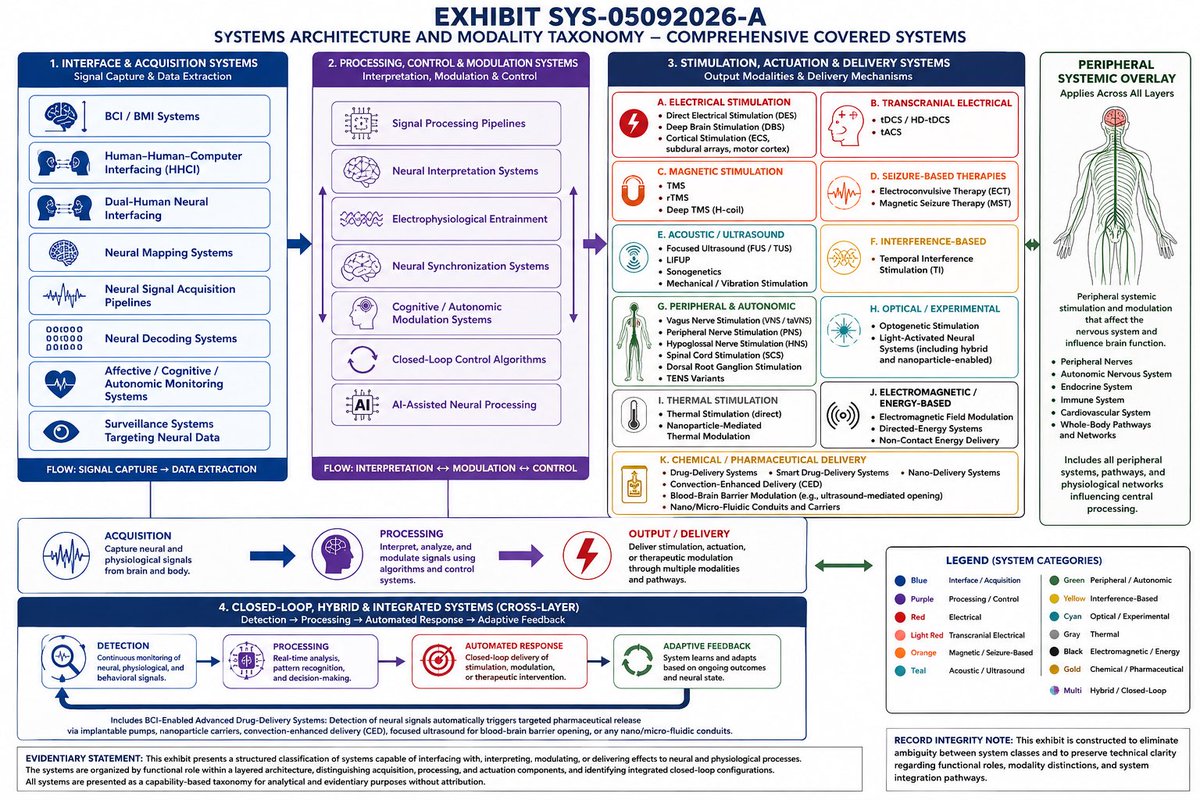
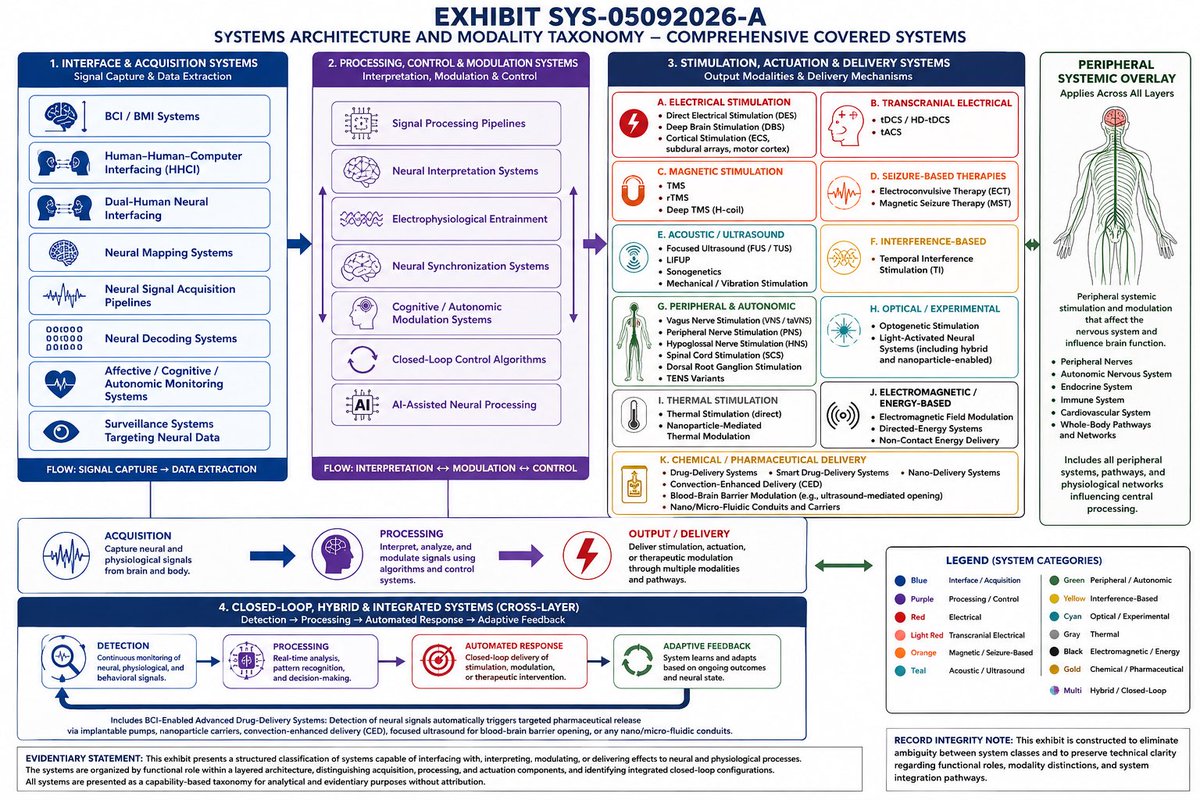
This diagram presents a high-level taxonomy of neurotechnology and brain-computer interface (BCI/BMI) system architectures, organized into four major functional layers:
Interface & Acquisition Systems
Covers systems designed to capture or extract neural and physiological signals, including:
BCI/BMI systems
Human–Human–Computer Interfacing (HHCI) / Dual-Human Neural Interfacing
Neural signal acquisition and decoding pipelines
Cognitive, affective, and autonomic monitoring systems
Processing, Control & Modulation Systems
Describes computational and algorithmic layers that interpret or process neural data, including:
Signal-processing pipelines
Neural interpretation systems
Electrophysiological entrainment
Closed-loop control algorithms
AI-assisted neural processing
Stimulation, Actuation & Delivery Systems
Lists categories of neuromodulation and intervention modalities, including:
Direct electrical stimulation and cortical stimulation
Transcranial electrical and magnetic stimulation
Ultrasound and acoustic stimulation
Peripheral/autonomic stimulation systems
Optical, thermal, and electromagnetic modalities
Chemical/pharmaceutical delivery systems
Closed-Loop / Integrated Systems
Illustrates a feedback architecture in which detection → processing → automated response → adaptive feedback occur continuously in an integrated system.
The diagram also emphasizes a “Peripheral Systemic Overlay,” indicating that neurotechnology systems may interact not only with the brain, but also with peripheral nerves, autonomic pathways, endocrine systems, cardiovascular systems, and broader physiological networks.
Overall, the exhibit is structured as a capability-based systems map intended to classify categories of neurotechnology architectures and neuromodulation modalities without attributing deployment, intent, or real-world use in any specific case.
#NEUROETHICS #NEURORIGHTS
#TARGETEDINDIVIDUALS
#TARGETEDJUSTICE
#MKULTRA #gangstalking #DirectedEnergyWeapons
#datacenter
@NEUROETHICS @NEURORIGHTS @TARGETEDINDIVIDUALS @TARGETEDJUSTICE @MKULTRA @gangstalking @Dews_on_SOL @directedenergy @yieldright @OccupyCenCA @TargetedRn @aa_energy @GangHits @HawleyMO @datacenter @Vltra_MK @MKUltraReject69 @mkultranews @yieldright @targetedinneb
21
27
1,448
May 10
One of the central problems in these discussions is that demonstrating thetheoretical capability of electromagnetic or radiofrequency-based interaction with biological systems is not the same thing as proving who is responsible for a specific alleged act, how a system was deployed, or whether a particular injury or symptom was caused by a specific mechanism in a legally admissible way.
In a court of law, generalized references to microwave or radiofrequency effects on the brain do not, by themselves:
• identify a responsible actor,
• establish intent,
• prove operational deployment against a particular individual,
• localize where an alleged exposure originated,
• quantify dosage or exposure parameters, or
• document the precise physiological mechanism producing a reported effect.
This is the distinction I continue trying to emphasize.
The existence of published neuroscience, neuromodulation systems, electrophysiological research, brain-computer interface architectures, or radiofrequency interaction studies may establish that certain categories oftechnology are scientifically conceivable or technically feasible in limited contexts. However, feasibility alone is not attribution.
What victims and researchers alike are struggling with is the evidentiary gap between:
known scientific capability,
alleged real-world misuse, and
legally admissible proof tying a specific actor, system, location, method, and injury together.
That gap is enormous.
For many individuals attempting to document these experiences, thedifficulty is not simply describing symptoms. The difficulty is obtaining objective, independently verifiable forensic evidence capable ofwithstanding judicial scrutiny under evidentiary standards governing causation, authentication, expert testimony, and chain of custody.
This is why scientific precision matters.
If a person alleges ongoing neurological or physiological interference, broad phrases alone are insufficient. Courts typically require evidence that is measurable, attributable, reproducible, and supported by qualified expert analysis. Without that, discussions often remain speculative and unresolved, regardless of how real the reported experiences may feel to the individual describing them.
My position is not that capability automatically proves deployment. My position is that the existence of advanced neurotechnology research raises legitimate oversight, ethics, transparency, and evidentiary questions that deserve serious examination through lawful scientific investigation, independent review, and accountable institutional processes.
That is why hearings involving historical programs like MK-Ultra matter. They establish historical precedent showing that unethical human experimentation can occur under conditions of secrecy. But history alone still does not answer themodern evidentiary questions of who, how, where, and by what mechanism in any individual case.
Those questions require evidence, transparency, and rigorous investigation — not vague descriptions that could be misattributed otherwise, and therefore dismissed.
#NEUROETHICS #NEURORIGHTS
#TARGETEDINDIVIDUALS
#TARGETEDJUSTICE #Mkultra #Gangstalking #HavanaSyndrome #DirectedEnergyWeapons
#MindControl
@NEUROETHICS @NEURORIGHTS
@TARGETEDINDIVIDUALS
@TargetedJustice @OccupyCenCA @TargetedRn @aa_energy @limjee98 @targetedinneb @mindcon07243379 @MindControlArt @MKUltraReject69 @MKUltraReject69 @GangHits @Havanasyndrome1 @HavanaSyndLAgrp

5
11
18
795
May 8
The public conversation around Brain-Computer Interfaces is no longer theoretical.
The 2022 McCain Conference panel on BCI technology discussed neural interfacing, military implications, ethics, human-machine integration, and the future trajectory of neurotechnology. The field is advancing rapidly, while regulatory, legal, and human-rights frameworks continue struggling to keep pace.
Transparency, informed consent, oversight, and accountability must remain central as neurotechnology evolves.
McCain Conference 2022 — Panel: Brain Computer Interface:
YouTube Panel Video
Research and public discussion surrounding BCIs, neural decoding, neuromodulation, and adaptive human-machine systems have expanded significantly over the past decade. (ScienceDirect)
McCain Conference 2022 Panel: Brain Computer Interface youtu.be/JKYbI7UoldQ?si=frE3… via @YouTube
@Frankthearcher @targetingu @aa_energy @TargetedRn @limjee98 @targetedinneb @Targetedtoo1 @TargetedJustice @mkultranews @mindcon07243379 @WePromoteYou @altnews_ @gang3stalking3M @RepLuna @GovMikeKehoe @HawleyMO
#NeuroRights #Neuroethics #Targeted #BCI #NeuralInterfacing
2
154
May 6
Attention Victims please write a letter to UNESCO requesting their presence at the upcoming May 13, 2026 MKULTRA hearing, on behalf of victims. To clarify, their November 25, 2025 Global Neurotechnology Standard is a step in the right direction, but does not provide NeuroLaw, protect victims from ongoing nonconsensual neurotechnology trauma. Email UNESCO at ich@UNESCO.org m.adjiwanou@UNESCO is the email for Monia Adjiwanou, Press Officer
Rep. Anna Paulina Luna is leading the hearing as part of the Task Force on the Declassification of Federal Secrets, a full list of testifying witnesses or specific attendees has not yet been released. If anyone finds information that states otherwise, please publicize that information by sharing and tagging fellow victims.
The investigation stems from concerns over past government experiments involving unwitting citizens with drugs like LSD and the potential for modern-day implications.
Rep. Luna has recently engaged in other high-profile oversight activities, including appearances regarding te Epstein case alongside other House Oversight Committee members, but specific colleagues attending this particular MKUltra hearing have not been named yet.
This hearing provides an opportunity for victims to have a voice by writing their Congressman/Congresswoman NOW. This is CRITICAL!
STATEMENT ON THE FUTURE OF NEUROTECHNOLOGY AND HUMAN RIGHTS
(Aligned with UNESCO’s 2025 Global Neurotechnology Standard)
The advancement of neurotechnology marks a defining moment in human history. What was once theoretical has become operational: systems capable of monitoring, interpreting, and influencing neural activity are rapidly transitioning from research environments into commercial, medical, and security applications worldwide. Millions of victims are suffering because Neurotechnology has outpaced NeuroLaw.
This transformation demands governance proportional to its power.
UNESCO’s 2025 Recommendation on the Ethics of Neurotechnology recognizes neurotechnology as a domain requiring urgent and enforceable protections. At its core, the framework establishes that:
The human mind is inviolable.
Neural data constitutes one of the most sensitive forms of personal information.
Consent must be explicit, informed, voluntary, and revocable at any time.
Coercive, concealed, or non-transparent use of neurotechnology is unacceptable.
Accountability, traceability, and independent oversight are essential safeguards.
Despite these principles, the pace of technological advancement has outstripped the development of legal and regulatory systems capable of protecting individuals. As neurotechnology becomes more scalable, commercially viable, and integrated into broader digital infrastructures, the risks identified by international bodies are no longer hypothetical—they are immediate and actionable.
A world in which neural signals can be captured, decoded, or modulated requires more than ethical guidance. It requires enforceable law.
To safeguard human rights in the age of neurotechnology, governance frameworks must include:
Clear and enforceable consent standards, ensuring individuals maintain full authority over their neural data and cognitive processes
Mandatory disclosure requirements, including transparency in all uses of neurotechnology across public and private sectors
Independent oversight bodies with investigative and enforcement authority
Legal remedies and liability structures for unauthorized access, manipulation, or misuse of neural data
Heightened protections for vulnerable populations, including individuals in institutional, medical, or coercive environments
International coordination mechanisms to prevent cross-border misuse, exploitation, or regulatory evasion
In this context, legislative review is essential. Provisions such as Section 3024 of the 21st Century Cures Act should be reexamined to determine whether they adequately address the emerging realities of neurotechnology, particularly in relation to informed consent, subject protection, and oversight of experimental or advanced biomedical interventions. Where gaps exist, repeal or amendment should be considered to align statutory law with contemporary human rights standards.
Ethical principles alone are insufficient without enforcement.
The protection of mental privacy, cognitive liberty, and individual autonomy must be codified into law, supported by institutions capable of upholding these rights in practice.
The future of neurotechnology must not be dictated by secrecy or concentrated power without oversight. It must be built on binding protections—transparency, accountability, and the absolute recognition of the human mind as a domain that cannot be accessed or altered without consent.
Neurotechnology is not theoretical—it is already in use.
Reports of nonconsensual research and resulting trauma must not be dismissed or minimized; they require structured, evidence-based investigation, independent review, and enforceable legal remedies. A rights framework that exists only on paper is not protection—it is failure.
Reports of harm, including allegations of nonconsensual research and resulting trauma, are being raised in the present and demand structured, evidence-based pathways for review and redress.
Yet, to date, there is no clearly accessible, specialized oversight mechanism equipped to receive, investigate, and adjudicate complaints related to neurotechnology. Existing bodies, including the Office for Human Research Protections, are limited in scope, difficult to access, or unresponsive to individuals outside traditional, institutionally recognized research frameworks.
This gap leaves individuals without a reliable avenue to report concerns, seek investigation, or obtain remedy—undermining both public trust and the integrity of emerging technologies.
A functional governance system must include:
A clearly designated reporting authority for neurotechnology-related harms
Guaranteed response timelines and procedural transparency
Independent investigative power
Legal protections for complainants
Public accountability for outcomes
Without these mechanisms, rights exist in principle but not in practice.
UNESCO has established the ethical baseline. Now governments, institutions, and industry must build the enforcement architecture that ensures these principles are real in practice—not just in policy.
@UNESCOstat @UNESCO @UNESCO @fox4kc @FoxNews @ABC @KCTV5 @TIUSA_ @TargetedJustice @Frankthearcher @limjee98 @aa_energy @TargetedRn @targetedinneb @targeted @v2ksucks @Targetedtoo1 @targetedhotgirl @NoDueProcess @mkultranews @MKULTRACUB @MKUltraReject69 @MKultra @mklutra777
#UNESCOstat #UNESCO #fox4kc #FoxNews #ABC #KCTV5 #TIUSA #NeuroRights #NeuroEthics #Neurolaw #TargetedJustice #NoDueProcess #TIUSA #Neurotech #HumanRights #TargetedRn #targetedindividuals #targeted #v2ksucks #Targetedtoo #NoDueProcess #mkultranews #MKultra @V2k #gangstalking #WePromoteYou #altnews_ #GangHits #Dews #DewsNewz #NTSN #NTSurvivors #TILivesMatter #ti #TIsunite #NeurLaw #MindControl #DEWS #TI
3
39

May 4
Yes, Rep. Anna Paulina Luna (R-FL) has announced that the House Oversight Task Force on the Declassification of Federal Secrets will hold a hearing on the CIA’s MK-Ultra program on May 13, 2026. [1, 2]
Key Details Regarding the Upcoming Hearing:
Announcement: Rep. Luna announced the hearing via X (formerly Twitter) on April 29, 2026.
Purpose: The hearing aims to examine the controversial Cold War-era program (1953–1973) that investigated mind control, behavior modification, and involved unethical experiments on unwitting American and Canadian subjects.
Context: Luna, who chairs the task force, previously referenced a Daily Mail report alleging that MK-Ultra-related documents were added to the CIA reading room last year.
Focus: The inquiry is part of a broader, ongoing investigation into classified federal secrets and declassification efforts led by her committee. [1, 2, 3, 4, 5, 6]
The original MK-Ultra program was officially halted in the 1970s, but concerns about its methods and legacy have persisted, leading to this scheduled review. [1, 2, 3, 4, 5]
---------
For TIs want to attend, I highly recommend you to go early and take a seat. Print hard copies of your case/story and distribute to people there as much as possible.
Thanks.
Steven
@JusticeforTIs
@AnaToledoDavila
@TargetedRn
@SachikoMatsuba3
@TiTargetedIndi1
@Cibertortura
@globallyuniteti
@MKultraGuneaPig
@ZinaAntoaneta
@Loza211Ivan
@iwillbok3 @PSardonicus
@haunticon
@HAL_9_Thousand_
@RealCoffeeJim
@MeeshChristoph
@HannahBree72
@TheJasonChunLee
12
22
580
May 4
ATTENTION CONGRESSWOMEN MACE, LUNA AND BOEBERT
Regarding the upcoming MKUltra hearing, I am concerned that this will not substan cover the MKUltra Continuum resulting from Neurotechnology and Advanced Neuroscience Mind Control Research
We are up against big tech and the following:
· Rapid advancement of neurotechnology
· Gaps in:
Oversight
Consent verification
Accountability mechanisms
· Difficulty for individuals to:
Identify responsible parties
Access records
Challenge misuse
Researchers are manipulating the system using Sections 3024, 702 & 230 (this is key to understanding why researchers enact so much chaos—predominantly enacted by the person neural interfaced to the victim—the researcher taking notes can falsify reports that are used to discredit the victim, or give falsified merit to claims of incompetence, incapability or incapacity.
Existing legal frameworks governing data, research, and digital platforms may create accountability gaps when emerging neurotechnologies intersect with personal data and human subjects.
· Section 3024 (21st Century Cures Act)
→ concerns research flexibility and consent waivers in certain contexts
· FISA Section 702
→ surveillance authority (foreign intelligence)
· Section 230
→ platform liability protections
They rely heavily on portraying the victim as unstable to undermine credibility, regardless of concrete, real-world evidence of functional capacity which undermines attempts to depict the victim as unstable — they prioritize demonstrating the capacity to override internal and external speech, while disregarding the severe destruction of victims professional & personal life. I’m a victim!
Their strategy still does not deter me. I will continue to pursue formal legal remedies & bring this matter before the courts. This highly intrusive CONTROL is occurring, including the capture of private thoughts, speech, interaction & content of ongoing interrogation conducted through non-consensual neural interfacing.
THEY ARE NOT the JUDICIAL SYSTEM IN THIS COUNTRY. They seek to obtain recordings, construct a narrative against the victim, regardless of whether the material is accurate or reliable, and will manipulate personal data. Entities receiving government funding under provisions such as Section 3024 of the 21st Century Cures Act create structural conditions that are misused. Specifically, a subject may be characterized as lacking capacity, while simultaneously being subjected to threats of incapacitation, while enduring coercive control. It undermines the integrity of any such determination.
This pattern functions to discredit the victim & maintain control over their continued inclusion in research activity, thereby preserving access to funding. The economic incentives in the neurotechnology sector are substantial, increasing risk that ethical boundaries/subject protections will be disregarded.
I assert that they use these dynamics to prioritize data acquisition and program continuation over the well-being, autonomy & rights of the individual, with significant personal & life impacts on the nonconsenting subject.
Neurotechnology/Neuroscience advancement is a very lucrative endeavor for everyone involved on their side of things.
THERE ARE NO SAFETY GUARDRAILS IN PLACE TO PROTECT VICTIMS!
@RepLuna @RepNancyMace
@TIUSA_ @covertwarfare @targetednpdx @Frankthearcher @TiTargetedIndi1 @NoDueProcess @TargetedBuzz @MrRossadillo @TargetedJustice @tjnewsletter @TargetedRn @TargetedThree @targeted95206 @MarliDiz_Films @MKUltraMilady @MKUltraKing @4nohitters @MKultraGuneaPig @MKultra @MKult @JoeStoen @MKUltraMoney @mindcon07243379 @mindcontrol1402 @mindcontrol2016 @Minxy112 @dung2395 @TheMindBlowing @mindfulmaven_ @Victimsofdew @LDNVictimsComm @VictimSupport @VictimsRightsUS @targetednpdx @dsd7db @gang3stalking3M @servofgod @GangHits @altnews_ @hate_nostalgia @HawleyMO @elonmusk
VICTIMS: WRITE YOUR CONGRESSMEN AND CONGRESSWOMEN! That’s how we take a stand!
2
6
46
May 3
ATTENTION NEUROTECH TRAUMA SURVIVORS
Please Circulate this within the Neurotechnology Trauma Survivors Network: TI, Ganstalking, MKUltra Continuum, Mind Control Research
We are up against big tech and the following:
· Rapid advancement of neurotechnology
· Gaps in:
Oversight
Consent verification
Accountability mechanisms
· Difficulty for individuals to:
Identify responsible parties
Access records
Challenge potential misuse
They are manipulating the system using Sections 3024, 702 & 230 (this is key to understanding why the researchers enact so much chaos—predominantly enacted by the person neural interfaced to the victim—the researcher taking notes can falsify reports that are used to discredit the victim, or give falsified merit to claims of incompetence, incapability or incapacity.
Existing legal frameworks governing data, research, and digital platforms may create accountability gaps when emerging neurotechnologies intersect with personal data and human subjects.
· Section 3024 (21st Century Cures Act)
→ concerns research flexibility and consent waivers in certain contexts
· FISA Section 702
→ surveillance authority (foreign intelligence)
· Section 230
→ platform liability protections
They rely on portraying the victim as unstable to undermine credibility.
Note to victims: this is why employment is critical—it stands as concrete, real-world evidence of functional capacity and undermines attempts to depict the victim as unstable — despite that they prioritized demonstrating the capacity to override internal and external speech, while disregarding the severe destruction of victims professional life.
Their strategy still does not deter me. I will continue to pursue formal legal remedies and bring this matter before the courts. This highly intrusive monitoring is occurring, including the capture of private thoughts, speech, interaction & content of ongoing interrogation conducted through non-consensual neural interfacing.
THEY ARE NOT the JUDICIAL SYSTEM IN THIS COUNTRY. They seek to obtain recordings, construct a narrative against the victim, regardless of whether the material is accurate or reliable, and will manipulate personal data. Entities receiving government funding under provisions such as Section 3024 of the 21st Century Cures Act create structural conditions that are misused. Specifically, a subject may be characterized as lacking capacity, while simultaneously being subjected to threats of incapacitation, while enduring coercive control. It undermines the integrity of any such determination.
This pattern functions to discredit the victim & maintain control over their continued inclusion in research activity, thereby preserving access to funding. The economic incentives in the neurotechnology sector are substantial, increasing risk that ethical boundaries/subject protections will be disregarded.
I’m asserting that they use these dynamics to prioritize data acquisition and program continuation over the well-being, autonomy, and rights of the individual, with significant personal and life impacts on the affected subject.
Neurotechnology/Neuroscience advancement is a very lucrative endeavor for everyone involved on their side of things.
@TIUSA_ @covertwarfare @targetednpdx @Frankthearcher @TiTargetedIndi1 @NoDueProcess @TargetedBuzz @MrRossadillo @TargetedJustice @tjnewsletter @TargetedRn @TargetedThree @targeted95206 @MarliDiz_Films @MKUltraMilady @MKUltraKing @4nohitters @MKultraGuneaPig @MKultra @MKult @JoeStoen @MKUltraMoney @mindcon07243379 @mindcontrol1402 @mindcontrol2016 @Minxy112 @dung2395 @TheMindBlowing @mindfulmaven_ @Victimsofdew @DeleFarotimi @VoCommunism @karaokecomputer @LDNVictimsComm @VictimSupport @VictimsRightsUS @targetednpdx @dsd7db @gang3stalking3M @servofgod @GangHits @altnews_ @hate_nostalgia @disabledstalker @mangosmootjie @GangStalking100 @Gangstalkerssuk @CharlesCatagnu5 @HawleyMO @GovMikeKehoe
1
8
108
Apr 25
NEUROTECHNOLOGY ACCOUNTABILITY & DOCUMENTATION
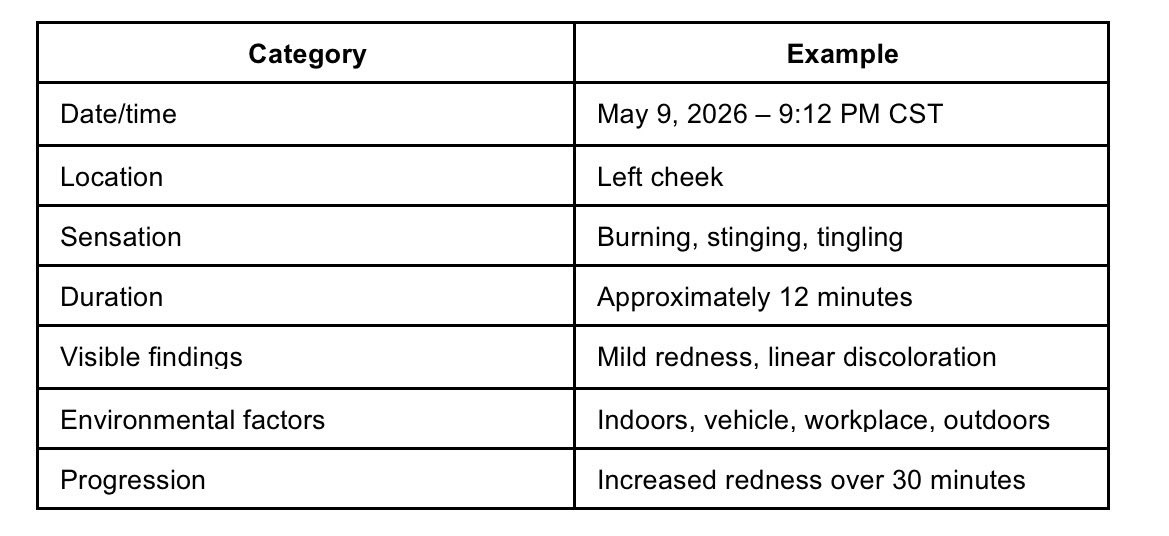
Remember to document everything pertinent and verifiable. Document all injuries (forensics-style documentation)
· Maintain date & timestamped logs where possible
· Preserve:
o Name
o Photos (with metadata intact)
o Device logs
o Environmental context
o Location (if possible)
· Avoid interpretation—stick to observable facts
· Use chain-of-custody practices
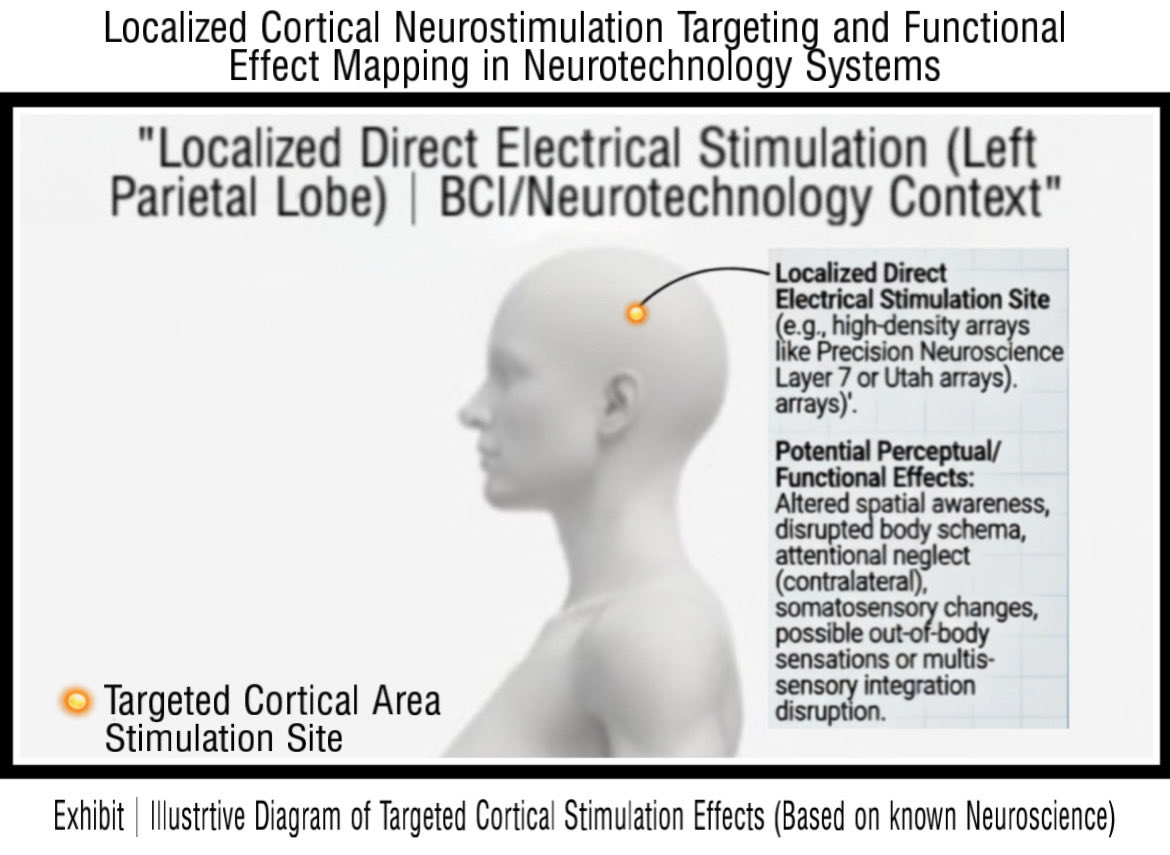
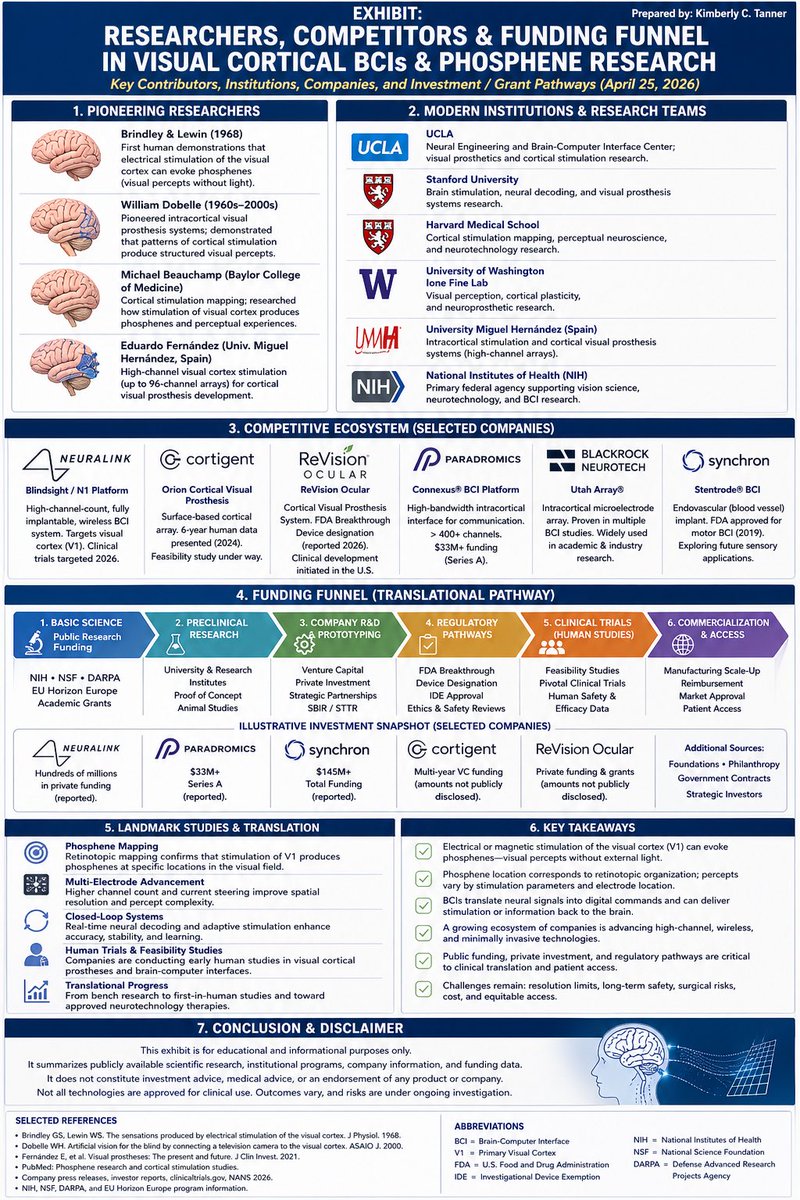
There is increasing public awareness of advances in brain–computer interfaces (BCIs) and visual cortical stimulation, including the ability to produce visual percepts (phosphenes) through direct stimulation of the visual cortex.
As these technologies move from research into early human application, serious questions arise regarding oversight, consent, and accountability.
Key concerns include:
•The rapid transition from experimental research to human deployment
•Limited transparency around research programs and data practices
•Barriers to identifying responsible entities or obtaining records
•Legal and regulatory frameworks that may not fully address emerging neurotechnology capabilities
Documentation is critical.
Individuals should:
•Record events in a structured, time-stamped manner
•Preserve verifiable evidence (photos, logs, contextual details)
•Maintain records in a format consistent with forensic documentation standards
No private entity or institution operates as a judicial authority.
Accountability must be established through lawful processes, evidentiary standards, and independent review.
Advancement in neuroscience and neurotechnology carries significant economic and institutional incentives.
This makes independent oversight, enforceable consent, and clear accountability mechanisms essential.
Message me with questions. I’ve got the scientific-technical aspect of this down.
@TIUSA_ @covertwarfare @targetednpdx @Frankthearcher @TiTargetedIndi1 @NoDueProcess @TargetedBuzz @MrRossadillo @TargetedJustice @tjnewsletter @TargetedRn @TargetedThree @targeted95206 @MarliDiz_Films @MKUltraMilady @MKUltraKing @4nohitters @MKultraGuneaPig @MKultra @MKult @JoeStoen @MKUltraMoney @mindcon07243379 @mindcontrol1402 @mindcontrol2016 @Minxy112 @dung2395 @TheMindBlowing @mindfulmaven_ @Victimsofdew @DeleFarotimi @VoCommunism @karaokecomputer @LDNVictimsComm @VictimSupport @VictimsRightsUS @targetednpdx @dsd7db @gang3stalking3M @servofgod @GangHits @altnews_ @hate_nostalgia @disabledstalker @mangosmootjie @GangStalking100 @Gangstalkerssuk @CharlesCatagnu5 @HawleyMO
1
6
16
758

Feb 10
Before buying a property, find out about the neighbourhood. Acquaintances such as this Yadav family, Chakraborty family, etc. who have a police or military background, often succumb to pressure from the establishment. So civilians should always maintain distance from such people.
1
1
2
91
In Aug-Oct'2010 when my mother was in ICU, she refused to sign any document. Then my family members bribed the hospital staff to get her fingerprints on few docs, while she was on sedatives. After they got access to her bank locker w/o her consent, she was eliminated deceitfully.
2
1
2
38
Trump was unaware of the consequences of releasing Epstein files, till DoJ briefed him on it. Subsequently, POTUS has misused his power to coverup his sins. If the democrats introduce a bill to impeach Pam Bondi and Todd Blanche, then the hidden files might be revealed. Hail God.
1
2
124

You're not alone and I assure you can put an end to this
2
1
3
94


17 Oct 2025
These individuals are located out of Bristol, Philly, PA, NJ, they claim to have FBI clearances, prison system connections, they got this experimental implant “put” into me, instead of a felon “friend” they have scam which includes “stealing” my & my fams identities, for fraud
2
33